
A medication adherence call service sounds simple until the phones start ringing, the nurse is already behind on callbacks, and a patient who just left your office still hasn't started the new prescription. In an independent practice, that follow-up either gets done by hand or it doesn't get done at all. When it falls through, the problem isn't only clinical. It's workflow drag, missed documentation, and more pressure on a front desk that's already stretched thin.
That's why practices keep looking at medication adherence call service options through an operational lens, not just a clinical one. The key consideration is whether the service can reach patients reliably, record the outcome, and hand the next step back to staff without adding another layer of work. For a practical view of the broader adherence workflow, see how adherence outreach fits into practice operations.
Introduction
A staff member calls a patient to check whether the new medication was picked up, whether they understood the dose, and whether anything is getting in the way. Meanwhile, the hold queue keeps building, refill requests are waiting, and a roomed patient is asking when the doctor will be back. That's a normal afternoon in many dermatology, GI, and internal medicine offices, and it shows why medication follow-up is rarely just a clinical task.
A medication adherence call service is meant to take that repeat work off the team without losing the human touch. Used well, it can support refill checks, post-prescription follow-up, chronic disease outreach, and patient education without forcing every call through a person's manual to-do list. Used badly, it becomes another noisy tool that dials, leaves messages, and creates more cleanup than it saves.
The practical value is in the handoff. The patient gets contacted, the response gets captured, and unresolved issues can move to staff instead of disappearing into voicemail. That matters in small and mid-sized practices where every missed call has a downstream cost, especially when the same people answering phones are also scheduling visits, handling refill requests, and triaging questions from the waiting room.
What Is a Medication Adherence Call Service
A medication adherence call service is a system that reaches out to patients about medications and records the result. At the simplest level, it can place reminder calls. At a more advanced level, it can hold a structured conversation, interpret the patient's response, and document what happened so the practice has a usable trail rather than a note someone has to retype later.
The three common models
A basic automated reminder is like a kitchen timer. It goes off, it sends the alert, and that's the end of it. It's useful for simple prompts, but it can't tell the difference between a patient who forgot, a patient who is confused, and a patient who never received the medication.
A live or AI voice agent is closer to a smart oven. It can ask a set of questions, branch based on the response, and route the patient to the right next step. In a real practice, that matters when the issue is not just “did you take it,” but “did you fill it, can you afford it, and do you know how to use it.”
A blended workflow sits between the two. Automated outreach handles the first pass, then staff or a clinician gets involved only when the patient needs help or doesn't respond. That's the model most practices should look at first, because it respects limited staff time while still giving patients a live path when the situation isn't routine.
Practical rule: if the system can't tell you what happened after the call, it's not really an adherence workflow. It's just outbound dialing.
Public health guidance backs layered outreach instead of relying on one channel alone. The CDC's medication adherence guidance emphasizes individualized services such as refill synchronization, enhanced follow-up, motivational interviewing, pillboxes, calendars, and text messaging, while WHO adherence programs also rely on layered monitoring and patient feedback rather than passive reminders alone. That's the right mental model for practices, too.

What makes it different from a simple reminder system
The difference is not the phone number or the call itself. It's the logic behind the call. A usable service asks follow-up questions, recognizes when someone is confused, and stores the outcome in a way staff can act on.
That's why the better platforms behave less like a dialer and more like part of the front office. They can support refill troubleshooting, prescription renewals, medication education, and post-start check-ins without making staff recapture the same information later. In a practice that already uses tools like eClinicalWorks, gGastro, EMA ModMed, Athenahealth, Epic, or DrChrono, that kind of workflow fit matters more than fancy voice quality.
The Clinical and Operational Benefits for Your Practice
The clinical case for a medication adherence call service is straightforward. In a randomized controlled trial of a pharmacist-led telephone intervention, the odds of being adherent were 60% higher after 6 months in the intervention group, and 92% of patients reported overall satisfaction with the service in the BMJ Quality & Safety study. That doesn't prove every call program works the same way, but it does show that structured follow-up can move real adherence behavior, not just patient sentiment.
A separate randomized trial of a pharmacist-led telephone intervention for long-term conditions also found improved adherence when the calls were personalized for the patient rather than delivered as a generic script, and the clinical trend improved as well, though that outcome still needed confirmation. The point for a practice owner is simple. A thoughtful call process can support medication-taking behavior, but the design matters.
Where the operational value shows up
On the office side, the payback is less abstract. A good call service can absorb routine follow-up, prescription check-ins, and refill status calls so staff aren't spending the day on repetitive outbound work. That frees the same people to handle higher-value tasks, like complex scheduling, patient questions, and exception management.
It also reduces avoidable churn in the phone queue. If fewer staff members are manually chasing down routine adherence issues, there's less competition for the same phone lines and less interruption in the middle of check-in, prior auth work, or chart prep. For smaller practices, that matters as much as the clinical benefit because it directly affects how the day feels to run.
A practice can also use the outreach to support chronic care workflows. When a medication follow-up uncovers a refill problem, confusion about the dose, or a post-start issue, that call becomes part of ongoing care coordination instead of a dead-end message. That's especially relevant in internal medicine and GI, where treatment plans often change and follow-up questions are common.
For practices evaluating an AI voice workflow, the question is whether the tool behaves like a staffed extension of the front office. A voice agent that can collect patient responses, document them, and escalate unresolved issues belongs closer to AI medical staff automation than to a simple answering service.
The best outcome isn't more calls. It's fewer wasted callbacks and cleaner handoffs.
Key Features and Critical EMR Integration Points
A medication follow-up tool lives or dies on what happens after the patient answers. If the system can only speak and listen, it's just a recorder with better manners. The useful version captures responses, decides what to do next, and writes the result back into the workflow where staff already work.
The features that actually matter
The first feature is configurable call cadence. Not every patient needs the same timing or the same follow-up path, and a one-size-fits-all call script gets old fast. A GI office may care about prep compliance and post-procedure medication questions, while a dermatology practice may need refill confirmation and post-treatment education.
The second feature is response logic. If a patient says the medication is delayed, confused, or unaffordable, the system should handle that differently than a plain yes. That's where the value lives, because the call becomes a triage step instead of a dead-end reminder.
The third feature is documentation. Staff should not have to listen to messages, interpret them, and then re-enter them into the chart. If the system stores the answer and opens a clean trail for follow-up, the office stays organized and audit-friendly.
Operational rule: the call is only useful if the response lands in the chart or queue where someone can act on it.
Why EMR integration changes the result
Deep integration separates a real workflow tool from a disconnected add-on. In practices using integrated medication reminder workflows, the call outcome can be tied directly to the patient record, which cuts down on duplicate entry and makes follow-up easier to own.
That matters in systems like eClinicalWorks, gGastro, EMA ModMed, Athenahealth, Epic, and DrChrono because the team already depends on those records for scheduling, meds, and documentation. If the outreach tool lives outside the EMR, somebody has to reconcile it later. If it writes back cleanly, the work stays in one place.
The strongest technical pattern is closed-loop monitoring. In one automated design, if the patient doesn't confirm a dose after five minutes, the system places a voice call. Another platform uses a web scheduler, call logs, and adherence logs to track the result. The lesson from the technical literature is clear. Value comes from escalation and tracking, not just outbound dialing.
Ensuring Compliance and Measuring Real-World Success
Security is usually the first objection, and it should be. A call service that handles patient medication details needs HIPAA-aware architecture, clear access controls, and a documented way to protect patient information. For practices that ask vendors to prove their controls, HIPAA BAA-compliant phone system documentation is part of the basic vetting process, not a nice extra.
SOC 2 Type 2 matters for a different reason. It signals that the vendor's controls have been tested over time, not just described in a slide deck. For a practice manager, that reduces the chance that a system looks polished but falls apart under real use.
What to measure after launch
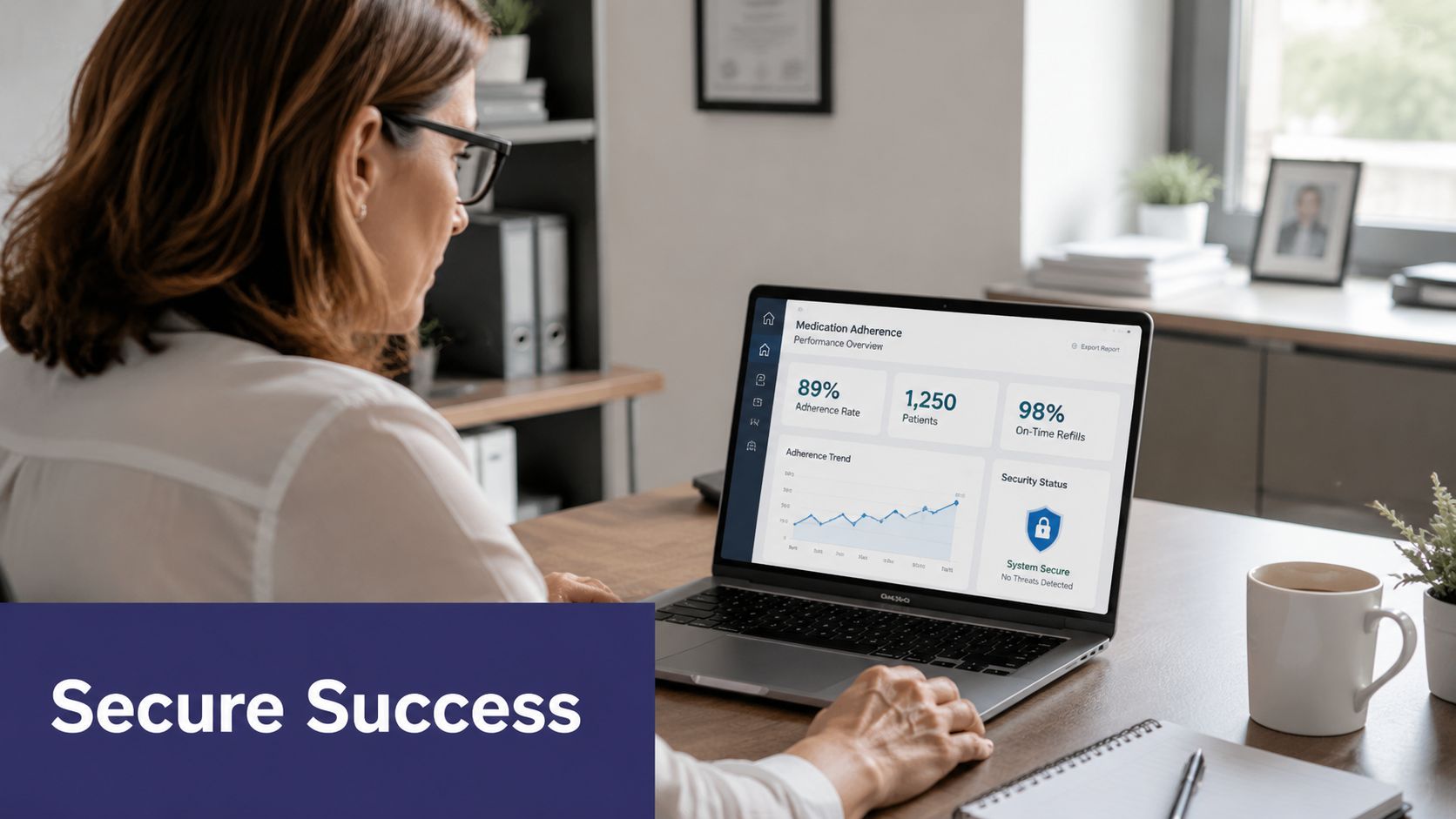
The cleanest way to judge a medication adherence call service is to track a short list of practical metrics.
- Reach rate. How many patients answered or completed the call.
- Resolution rate. How many calls ended with a clear outcome, such as confirmed adherence, a refill issue, or a staff callback.
- Staff time saved. How much manual outbound follow-up the team no longer has to do.
- Downstream care actions. Whether the call uncovered refill issues, confusion, or other barriers that needed intervention.
You don't need a giant dashboard to start. A small practice can review these numbers weekly, then look for patterns by specialty, payer mix, or patient cohort. The point is to prove that the service is helping the office run better while supporting patient follow-up.
Why measurement has to include exceptions
A call service should not be judged only by successful confirmations. The unresolved cases matter just as much because those are the patients who need human review. If the system is good, it should make the exceptions obvious instead of burying them.
That's also where the administrative value shows up. A team that can see unresolved issues in one queue is easier to manage than a team that has to hunt through voicemail, notes, and callback lists. In day-to-day practice operations, that difference is real.
How to Evaluate and Implement a Call Service
The safest way to buy this kind of tool is to start small and judge it against your own workflow, not a vendor demo. A call service that works for a large system may still fail in a 4-provider GI office if it can't handle prep questions, med rec, or the staff handoff cleanly.
The vendor checklist that matters in a small practice
Look for specialty awareness first. A dermatology office and a gastroenterology office do not need identical outreach scripts, and a generic patient reminder usually misses the point. If the vendor understands how follow-up happens in your specialty, you'll spend less time correcting it later.
Next, ask how thoroughly it connects to your EMR. A system that can document back into the chart, route exceptions, and keep staff from double-entering data will age much better than one that only sends call summaries by email. That's true whether you run Athenahealth, Epic, ModMed, eClinicalWorks, gGastro, or DrChrono.
Also ask who designed the workflow. Products built by clinicians usually reflect real call patterns better than tools that were adapted from generic customer service software. In practice, that shows up in the questions asked, the escalation logic, and the documentation style.
A useful reminder from the evidence base is that calls aren't universally effective. A meta-analysis of telephone interventions for diabetic patients found no statistically significant improvement in medication adherence, with a pooled mean difference of 0.05 and a 95% confidence interval from -0.08 to 0.17 in the preprint review. That doesn't mean call services don't work. It means the patient group and the workflow design matter.
How to roll it out without creating staff resistance
Keep the first cohort narrow. Pick one use case, one team, and one clear escalation path. Staff adopt the tool faster when they see it removing repetitive work instead of adding a new review burden.
Training should focus on what happens when the system flags a problem. If the team knows exactly who gets the unresolved call, how it's documented, and when it escalates, the process feels manageable. If that part is vague, staff will treat the tool like another inbox.
A medication adherence call service works best when it behaves like AI Medical Staff, not a separate toy that sits off to the side. That means it supports front-office work, clinical follow-up, and documentation in one workflow. For practices that want a closer look at how that model operates, the next step is usually to see it in action at simbie.ai/book-a-demo/.
A CTA for Simbie AI.