
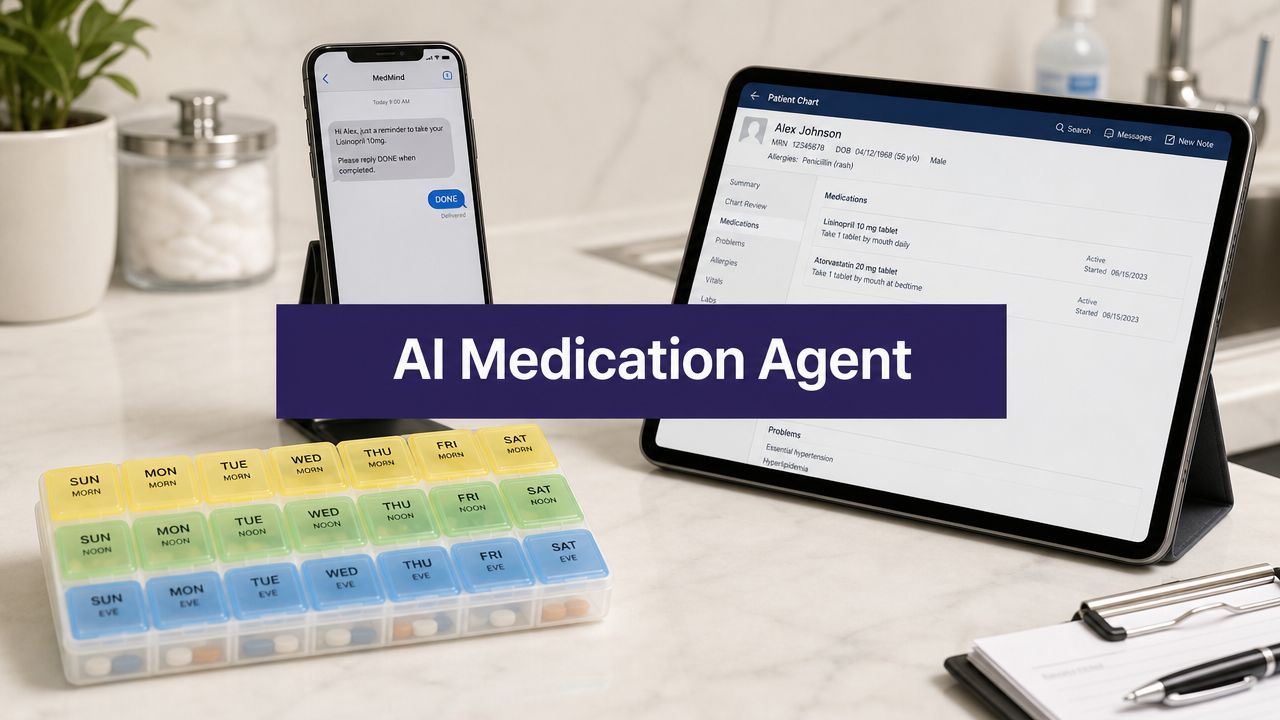
Missed doses rarely stay contained to the medication list. In a small practice, they turn into callback tasks, chart updates, caregiver outreach, refill confusion, and another interruption for the person already covering the phones. That is why an AI medication reminder agent matters to independent dermatology, gastroenterology, and internal medicine groups. Used well, it helps close the loop on adherence inside real workflows, not just send reminders and hope for the best.
Most office managers don't need another dashboard. They need fewer manual follow-ups, cleaner documentation, and a safer way to catch patients who are slipping. Consequently, the operational design matters, especially when the tool can connect directly with systems like eClinicalWorks and gGastro.
Meta description: AI medication reminder agent software helps practices improve adherence, reduce staff workload, and document follow-up inside EMR workflows.
The Daily Scramble of Medication Non-Adherence
A patient misses a dose on Tuesday morning. By lunch, your front desk has already left one voicemail, a medical assistant has sent a portal message, and someone still needs to document the outreach. If the patient is older, recently discharged, or managing several medications, the risk is not abstract. It becomes a live task list.
That pattern shows up every day in smaller practices. Internal medicine offices see it in chronic care plans. GI groups see it after procedures and during prep-related medication changes. Dermatology practices run into it with longer treatment courses where adherence fades once the patient leaves the office.
The clinical stakes are real. Adverse medication events harm over 1.5 million people in the United States annually, which is one reason clinically aware reminder systems are being built around real-time tracking and intervention, as described in this overview of AI medication management and adverse event prevention.
Practical rule: If a missed dose creates manual work every time, the problem is not just adherence. It is workflow design.
An effective response has to reduce both clinical risk and staff drag. That means moving away from one-way outreach and toward a process that can confirm what happened, log it, and escalate only when needed. Practices already dealing with outreach gaps often see the same pattern in other follow-up workflows, which is why patient adherence and follow-up prevention belong in the same operational conversation. A useful reference point is this look at AI for patient loss to follow-up prevention.
What Is a Clinical AI Medication Reminder Agent
An AI medication reminder agent is not a timer, a robocall, or a bulk text blast. The useful version acts more like a focused staff member assigned to one job, making sure a patient receives the reminder, responds, and gets routed correctly based on that response.
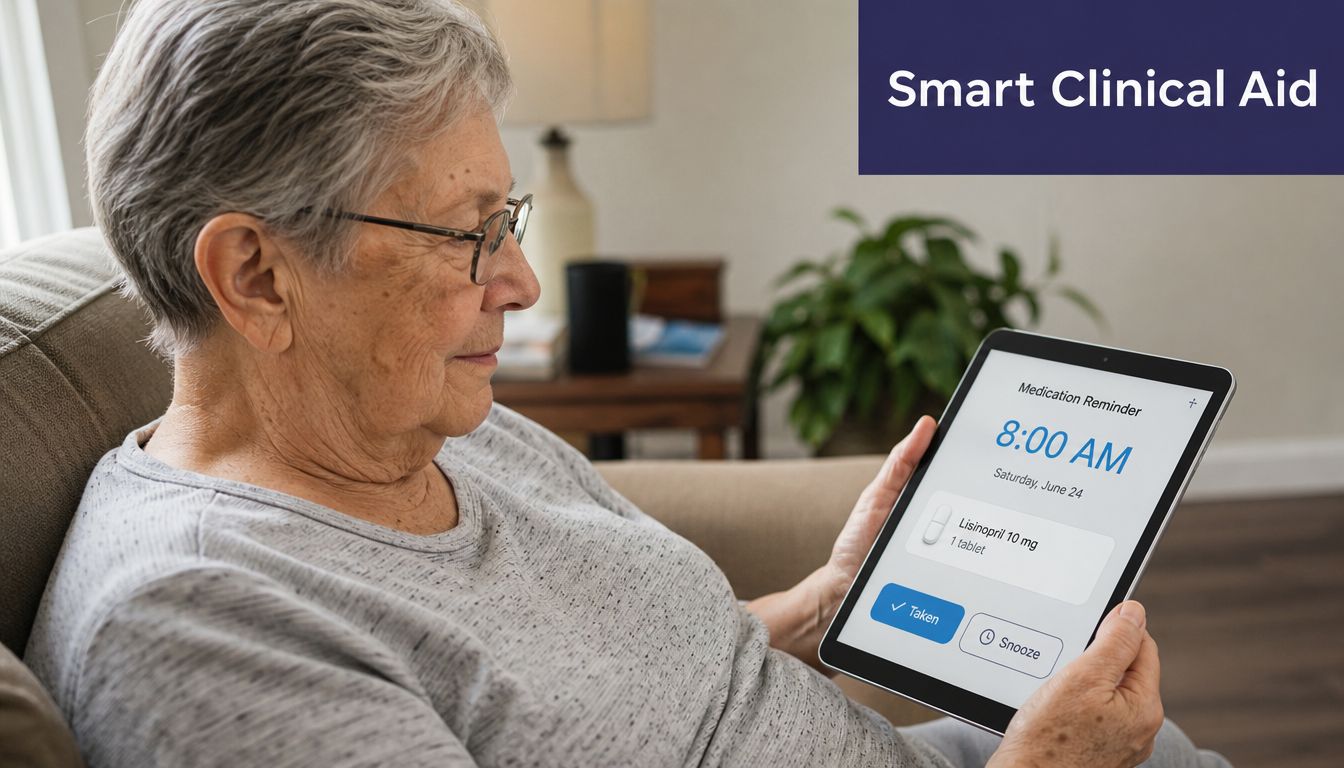
What separates an agent from a reminder
A basic reminder sends a message at a scheduled time. After that, the burden falls back on the patient or your staff.
A clinical agent handles the next step too:
- It asks for confirmation, not just acknowledgment.
- It interprets common responses, including yes, later, no, or confusion.
- It creates follow-up logic based on what the patient says.
- It records the result so the practice has a usable adherence trail.
That distinction matters because passive reminders leave too many loose ends. A patient can ignore a text. A generic app notification doesn't tell your team whether the dose was taken, delayed, refused, or misunderstood.
What this looks like in practice
A stronger model is voice-based and conversational. In one deployment, an AI voice calling system increased medication adherence by 32% compared to generic reminder methods, using natural conversation to confirm intake, capture delays such as “two hours later,” and schedule precise follow-up calls without manual staff intervention, as shown in this AI-powered medication calling system example.
That is why the technology works better when it is treated as part of workflow operations, not a marketing add-on. Outside healthcare, the same core shift appears when businesses move from passive automation to task-driven agents. This explainer on how AI agents boost business sales is useful because it shows the same operational principle. The system does more than notify. It progresses the task.
A reminder says, “It's time.”
An agent says, “Did it happen, and what should happen next?”
That second model is the one practices can build around.
How AI Agents Manage Patient Communication Workflows
The value of the agent is not the voice itself. It is the workflow behind the voice. If the logic is weak, you still create rework for staff. If the logic is tight, the system absorbs routine outreach and leaves the team with only the exceptions that need judgment.
The communication flow that actually works
At dose time, the system reaches out based on the patient's communication preference and the clinic's protocol. Voice is often better for older patients or those who do not reliably use portal messages. SMS can work for straightforward cases, but only if the workflow still closes the loop.
A practical workflow usually looks like this:
- Initial outreach goes out on schedule. The patient receives a call or message tied to the prescribed timing.
- The response gets classified. Confirmed taken, delayed, not taken, no answer, or confusion.
- The next step happens automatically. A confirmed dose is logged. A delayed dose triggers a follow-up. A concerning response gets escalated.
- Only exceptions reach staff. Your team handles the cases that need judgment, not every routine check-in.
This is the same operational principle behind broader patient outreach systems like AI-powered patient appointment reminders. Consistency matters more than volume. The system has to complete the loop.
Why escalation logic matters
Medication adherence should not be handled as a flat sequence of repeated reminders. It needs tiers. One useful model is the four-level escalation system described by U.S. Pharmacist's review of AI-enabled medication adherence, where Level 1 is automated patient reminders, Level 2 is caregiver notification, Level 3 is pharmacist review for persistent issues, and Level 4 is provider escalation for clinical concerns.
A small practice can adapt that structure without making it bureaucratic.
| Workflow level | What happens | Who gets involved |
|---|---|---|
| Level 1 | Automated reminder and response capture | Patient only |
| Level 2 | Additional outreach after continued non-response or delay | Caregiver or designated contact |
| Level 3 | Pattern review for persistent adherence problems | Pharmacist or medication management staff |
| Level 4 | Clinical concern flagged for intervention | Provider or nurse |
Keep clinical staff out of the first two levels unless there is a reason to pull them in. That is how you protect bandwidth.
Where voice agents outperform staff-heavy models
Scale is one reason. AI voice assistants can handle up to 1000 simultaneous calls per hour versus approximately 20 for a human in the same timeframe, a 4900% efficiency increase, according to this breakdown of AI assistants for patient medication reminders. For an SMB practice, that matters less as a headline and more as a scheduling reality. The phones do not pile up just because two staff members called out.
It also matters because every inbound and outbound communication sits next to the rest of the front office burden. If the same platform can capture 100% of inbound calls, run continuously with 24/7 availability and zero hold times, and support medication follow-up alongside scheduling, intake, refills, and prescription renewals, then the practice stops buying disconnected tools for each narrow task. That is the practical advantage of using AI Medical Staff, not just an answering service.
Clinical and Operational Benefits for Your Practice
Skepticism is healthy. A medication workflow tool should earn its place with better adherence and less manual work. If it does only one of those, the rollout usually stalls.

What changes clinically
The evidence base is broad enough now to move past theory. In clinical trials, AI-based tools improved medication adherence by 6.7% to 32.7% compared to standard intervention controls and current practices, with one study showing an absolute improvement of 67% in patients monitored by an AI app, according to this peer-reviewed review in the medical literature.
For a practice, that translates into fewer silent failures between visits. Internal medicine groups can support chronic disease management with documented outreach. GI practices can reinforce post-procedure and treatment-plan adherence. Dermatology practices can keep longer regimens from fading out after the first few weeks.
What changes operationally
The more immediate win is usually workload. A real-world deployment at a U.S. home healthcare provider achieved a 32% lift in medication adherence, 2.5x higher patient engagement, and a 40% reduction in manual nursing workload, as reported in this published case study on AI voice calling for adherence.
That is the kind of result office managers care about because it maps directly to staffing pressure. Calls, reminders, chart notes, and follow-ups stop landing on the same few people all day.
A strong deployment also fits the larger economics of the front desk:
- Lower front-office pressure: Practices often look for automation first in scheduling, intake, and phones, but medication follow-up belongs in the same stack.
- Better staff retention: Repetitive callback work is one of the fastest ways to wear down good staff.
- More complete coverage: If the same platform supports calls, refills, patient education, test result review, and adherence check-ins, work stops falling through shift changes and lunch breaks.
For many independent groups, the broader AI Medical Staff model is what creates ROI. The medication reminder workflow helps on the clinical side, while front-office automation can contribute to up to 60% reduction in front-office staff costs when the system also handles scheduling, intake, calls, and related administrative work. That is why this category belongs next to resources on the best virtual medical receptionist options, not off in a separate population-health corner.
Operational takeaway: The best adherence tool is the one that reduces phone work, chart work, and exception handling at the same time.
EMR Integration and HIPAA Compliance
A reminder tool that lives outside your workflow will create more work than it removes. Staff will end up checking another inbox, copying notes into the chart, and trying to remember whether “patient said later” meant one hour or one day. That is why EMR integration is not a nice extra. It is the whole point.
What good integration looks like
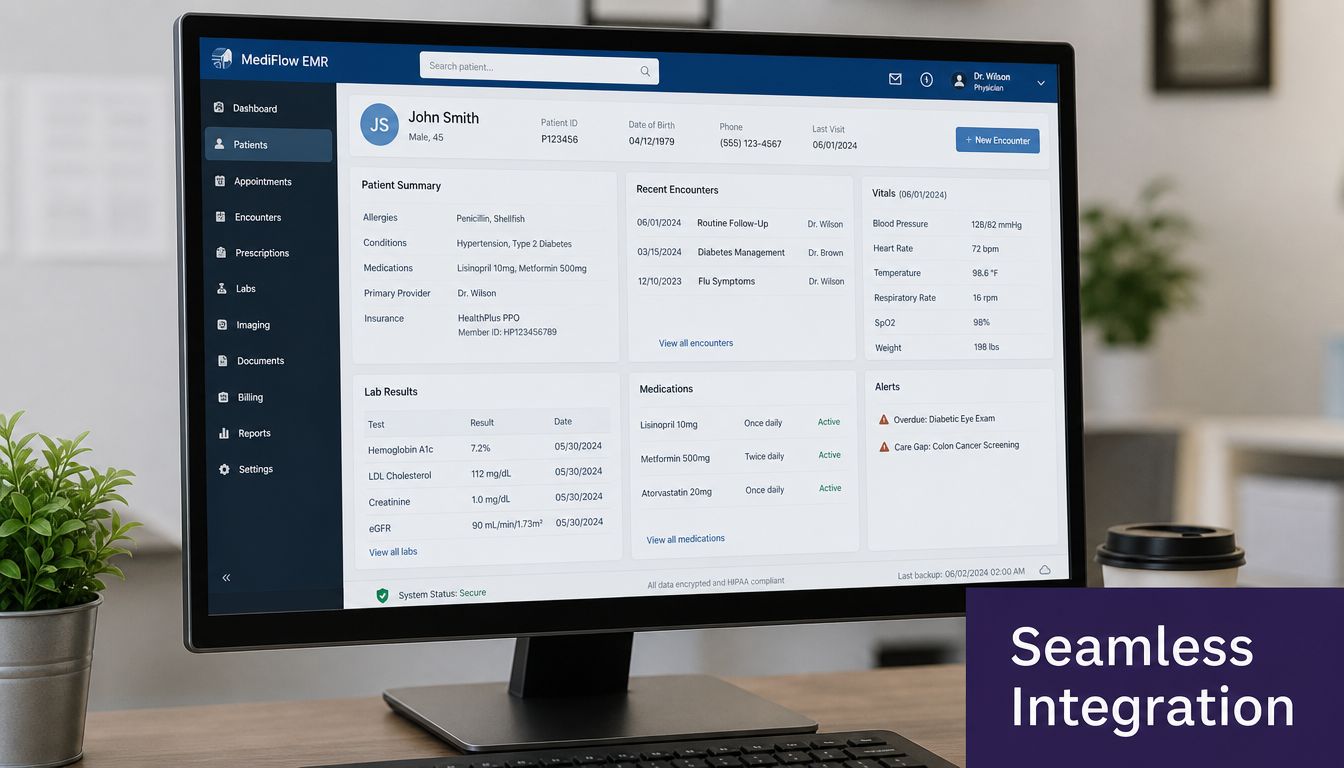
For an SMB practice, the standard should be simple. The agent should read the needed medication details, execute the outreach, and write the outcome back into the chart in a structured way.
That matters especially in systems such as eClinicalWorks, gGastro, EMA ModMed, Athenahealth, Epic, and DrChrono. If a patient confirms a dose, delays it, or reports confusion, the documentation should land where staff already work. No duplicate entry. No sticky-note workflow. No separate spreadsheet managed by the most organized person in the office.
A practical integration should support:
- Medication details pulled from the record, including names, dose timing, and schedule logic.
- Structured documentation written back automatically after each interaction.
- Escalation tasks routed correctly so nurses and providers only see what needs review.
- Shared workflow support across front-office and clinical tasks, not medication reminders in isolation.
This is also why practices should look closely at EMR integration options for healthcare AI workflows. The quality of the integration will determine whether the project sticks.
Compliance is part of workflow design
Security language gets tossed around casually, but healthcare practices cannot afford that. If a platform is handling protected health information through calls, messaging, chart documentation, refill coordination, and patient education, the compliance bar has to be high.
At minimum, teams should expect HIPAA-compliant handling and serious third-party controls. SOC 2 Type 2 certification is a meaningful operational signal because it reflects how security controls are managed over time, not just described in a policy. If your administrator is comparing vendors and needs a neutral starting point, this directory to find healthcare SOC 2 auditors is a useful way to understand what that review process looks like.
Security should remove friction for the practice, not add another layer of manual checking.
When the integration is right, adherence outreach becomes part of routine charted care. When it is wrong, the technology becomes another task queue.
Implementation and Clinical Best Practices
Most rollout problems start with a workflow that is too broad. Practices do better when they begin with one patient group, one medication pattern, and one escalation policy. Internal medicine groups often start with chronic disease patients who already need regular outreach. GI practices may begin with post-procedure or treatment-dependent follow-up. The narrower the initial scope, the easier it is to tune the language and escalation rules.
The more important clinical question is not whether the system can reschedule a reminder. It is whether it knows when not to keep rescheduling. A critical best practice is configuring the agent to recognize recurring delay patterns that may signal confusion or dementia, then escalating those cases for clinical review rather than treating every “later” as harmless, as discussed in this analysis of AI medication scheduling and cognitive decline signals.
Where practices usually get it right
The strongest setups share a few traits:
- They define exception rules early. A patient who misses once is different from a patient who repeatedly sounds uncertain.
- They keep humans in the loop. Staff can review, monitor, and take over when needed.
- They connect admin and clinical work. Medication reminders, refill coordination, pre-op calls, patient education, and chronic disease check-ins work better when they are part of one system.
That last point matters. An office manager does not need five separate AI tools, one for calls, one for refills, one for intake, one for reminders, and one for documentation. The better model is AI Medical Staff that supports both layers of the practice, the administrative front office and the clinical follow-up work that usually spills back onto staff.
A clinically grounded platform also matters here. Systems designed with physician input tend to reflect real judgment points better, especially in specialties where symptom language, procedure timing, and adherence nuance are not interchangeable. That is where a clinician-built approach shows up in the workflow itself, not in a slogan. Protecting Doctors' Time for Doctoring.
If you're evaluating AI for your practice, Simbie AI offers clinician-built AI Medical Staff with front-office and clinical workflow coverage, including EMR integrations, HIPAA-compliant operations, SOC 2 Type 2 controls, 24/7 availability, and support for scheduling, intake, refills, prescription renewals, test result review, patient education, and adherence check-ins. You can see it in action at book a demo.