
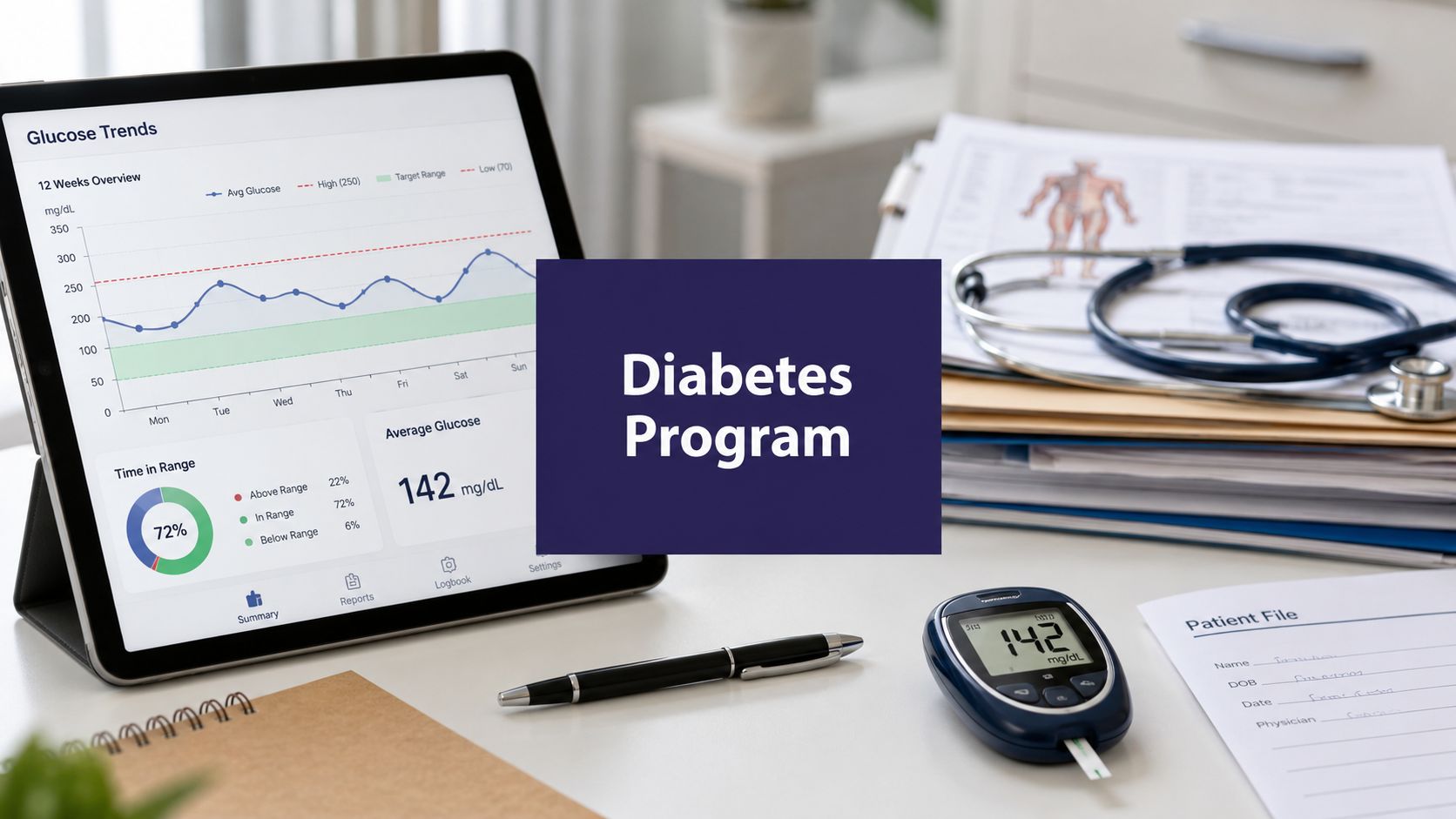
Building a diabetes management program inside an independent practice usually starts with a familiar mess, a short follow-up visit, a rushed A1C discussion, a medication tweak, and then silence until the next appointment. Patients leave without much between-visit support, staff are left chasing messages, and the same problems show up again at the next check-in. For busy internal medicine, GI, and dermatology practices that also manage diabetes panels, the challenge isn't knowing diabetes needs attention. It's building a system that makes follow-up consistent, efficient, and financially sustainable.
A good program does more than repeat education. It creates a workflow for outreach, monitoring, medication adjustment, and documentation, so care doesn't depend on whoever happened to answer the phone that day. That's where the business case starts to make sense, because disease management programs have shown clinical and economic impact in long-running cohorts, including lower mortality and lower mean annual costs in one large retrospective study (PMC study). In practice, that means the right structure can improve patient outcomes without turning the office into a call center.
What a Modern Diabetes Program Really Is
A patient with rising glucose comes in, gets a quick medication change, hears advice to improve diet, and then returns months later with the same problem. That pattern wastes time for the practice and leaves the patient without a clear plan between visits.
A diabetes management program replaces that drift with a defined operating system. It sets who reaches out, what gets documented, when the team escalates abnormal readings, and how missed follow-up is handled. For independent practices, the value is not abstract. Long-running disease management programs have shown meaningful clinical and economic impact, including 22.1% mortality over 8 years in the program cohort versus 29.7% in controls, plus lower mean annual costs of about €1,070 per patient in the program group (PMC study).
From episodic visits to continuous management
A small practice does not need a population health division to run this well. It needs a repeatable workflow for education, monitoring, medication escalation, and documentation that fits lean staffing and does not depend on who happens to answer the phone. That is what makes the model practical for independent physicians who are already balancing diabetes care with other specialty and primary care demands.
The operational point matters. If a task repeats every week, it needs a defined owner, a trigger, and a standard response.
That structure also makes the work easier to budget and bill against. Chronic disease management becomes more predictable when the follow-up cadence is organized, staff know their roles, and the practice can use a platform like chronic care management to keep outreach and documentation from piling up on clinicians.
The Core Components of an Effective Program

A diabetes management program works only when the parts reinforce one another. If the practice has education but no follow-up, or monitoring but no response pathway, care slips back into scattered messages and inconsistent action. For an independent office, the strongest setup is practical and narrow, with clear pathways, repeatable education, actionable monitoring, and a treatment response process that staff can carry out without waiting for the right person to be free.
Structured pathways keep staff from improvising
Clinical pathways are the playbook. They define what happens when a glucose reading is high, when a patient misses a refill, or when follow-up labs are overdue. In a small practice, this can be as simple as a protocol that tells an MA when to route a patient to a nurse, and when the physician needs to weigh in.
That clarity matters because independence leaves little room for improvisation. If the workflow changes every time the phone rings, the program becomes dependent on memory instead of process, and the team spends more time sorting messages than managing disease.
Education has to be repeatable
One-off counseling rarely sticks. Education works better when it is reinforced through phone calls, portal messages, or scripted outreach after the visit. The CDC notes that diabetes self-management education is underused, even though only 52% of adults with diabetes reported receiving DSMES or another type of diabetes education, and nearly 25% of those who received education followed at least 9 of 10 recommended self-care and clinical-care practices, compared with only 10% among those who never received education (CDC). That gap is exactly why the program has to continue after the visit ends.
For an independent practice, the point is not to build a classroom. The point is to make education part of routine care, so patients hear the same core instructions at the visit, in follow-up outreach, and in the charted plan. Repetition is what makes the message usable.
Monitoring needs to be actionable
For patients using CGM, routine review should focus on the metrics that change care, time in range, time below range, time above range, and glycemic variability. ADA-aligned guidance recommends standardized CGM reporting with 14 days of data and at least 70% sensor wear, which gives the team a clearer picture than A1C alone (NCBI Bookshelf).
That only helps if someone is assigned to look at the data and decide what happens next. A glucose stream without a response protocol adds work but does not improve care. In a lean practice, the value comes from filtering the data down to the readings that require medication changes, outreach, or same-week follow-up.
Treatment response must be fast
Programs work better when the care team can act without waiting for a future appointment. In a meta-analysis, diabetes disease-management programs produced a pooled absolute A1C reduction of 0.51%, and programs where care managers could start or modify treatment without prior physician approval achieved larger reductions (PMC meta-analysis). For a practice, that means the workflow needs authority, not just reminders.
Independent physicians also need a structure that keeps decisions within scope. A protocol can tell staff which readings trigger a medication review, which ones trigger patient education, and which ones require the physician to step in. That is where a service like chronic care management can help keep outreach, documentation, and follow-up from piling up on clinicians.
Staffing Models and Clinical Workflows

Staffing is where most independent practices get stuck. The program may look sound on paper, but if the workflow assumes a big care team, it won't survive contact with a 3-provider office and a packed phone queue. Two models are realistic for small practices, a nurse-led model and a distributed MA-led model.
Nurse-led care works well when complexity is high
A dedicated nurse care manager can own escalation, education, and medication follow-up. That model is usually stronger when the practice has a higher-risk panel or more patients on insulin, because the nurse can review trends, call back sooner, and escalate confidently. The downside is obvious, it adds a specialized role, which is hard for smaller groups to staff consistently.
MA-led workflows can be leaner
A distributed model pushes more of the routine outreach and documentation to MAs, with nurses or physicians handling exceptions. This can work in a smaller practice if the tasks are tightly scripted. An MA can confirm adherence, gather home readings, update the chart, and route only the outliers.
A practical workflow for a high-glucose alert looks like this, device data or patient-reported values come in, the MA triages against protocol, the nurse reviews concerning patterns, and the physician signs off on medication changes when needed. The point is not to avoid clinical review. It's to keep low-risk, repetitive work from landing on the physician's desk.
The smoother the handoff, the less time the doctor spends rescuing the workflow.
That's where automation helps. A voice layer can handle outreach, intake, refill requests, and routine check-ins before the clinical team ever touches the case. If you're mapping this into a specialty clinic or internal medicine practice, it's worth looking at EHR-integrated care coordination AI alongside your current workflow, then comparing it with more general voice AI agent options.
Technology Integration and Automation Opportunities
Technology should reduce friction, not add another system for staff to babysit. In a practical diabetes management program, the EMR is the source of truth, whether that's Athenahealth, eClinicalWorks, or gGastro. Everything else should feed into it cleanly, so the team is not copying the same note into two places or chasing down the latest version of the care plan.
Use the EMR as the coordination hub
The EMR should hold the care plan, the current medication list, and the follow-up tasks. When patient calls, refill requests, or remote readings arrive, the team needs a clear place to document the response and decide what happens next. If the workflow lives outside the chart, follow-up gets lost, and small gaps turn into missed care.
A good setup also makes handoffs clearer. Physicians, nurses, and MAs should be able to see what has already been addressed, what still needs review, and which patients need another touchpoint. That matters in an independent practice, where no one has time for duplicate work.
Let automation take the repetitive work
AI Medical Staff offers practical utility. It can handle adherence check-in calls, document answers in the chart, route refill requests, and flag patients who do not respond. That does not replace the clinician. It keeps staff time available for judgment, education, and escalation.
Practices evaluating implementing AI automation often find that the main gain is not a flashy feature. It is removing the constant interruption of routine phone work, especially when the office is already managing prior authorizations, scheduling, and refill pressure. In a diabetes program, that matters because the work is repetitive, but missed follow-up has a real clinical cost.
The right automation also has to fit the way the practice already works. If a tool creates another inbox, another login, or another place to reconcile tasks, the burden just moves somewhere else. That is why many groups do better with EHR-integrated care coordination AI than with a disconnected add-on.
Build around data that changes care
The monitoring layer should focus on data the team can act on quickly. That means trends in blood glucose, medication adherence, missed contacts, and response to outreach. It also means deciding which alerts deserve attention from a nurse or physician, and which ones should stay in automation until a threshold is crossed.
For teams that want a broader operational layer, automated business performance monitoring can help practice managers see whether the workflow is holding together. In a small practice, that kind of visibility matters as much as the clinical dashboard, because a program that runs poorly operationally will feel expensive even when the clinical intent is right. Simbie AI uses the same basic logic, with inbound calls, refills, patient education, and documentation handled in one connected system.
Measuring Success with KPIs and ROI
A diabetes program without metrics is just more activity. Practice managers need a scorecard that shows whether the work is improving care, saving time, and supporting revenue. If the numbers aren't visible, the program will feel expensive even when it's helping patients.
Track clinical, operational, and financial signals together
Clinical measures should include A1C trends and CGM metrics when available. Operational metrics should show how much staff time the program consumes, plus how many patients enroll and stay engaged. Financial metrics should connect the workflow to chronic care billing, follow-up volume, and reductions in avoidable gaps in care.
The reason to track all three is practical. A program can look clinically strong but still fail if staff spend too much time chasing responses. It can also generate revenue but miss the point if no one is showing improvement.
Build a scorecard managers can review weekly
The best KPI is the one your team will actually look at every week.
That usually means a short dashboard, not a giant spreadsheet. For a small practice, the point is to spot breakdowns early, then fix the step that's causing them. If enrollment is weak, the outreach script needs work. If follow-up is inconsistent, the handoff needs tightening. If documentation is late, automation or task ownership is the problem.
A clean operational view also helps separate program performance from staff performance. That matters in independent practices, where people wear multiple hats and nobody has time to decipher a messy report.
Strategies for Sustainable Patient Engagement

Education matters, but education alone doesn't hold a program together. The harder problem is retention. Patients miss calls, forget steps, and drop off when the process feels inconvenient or impersonal. CDC data show only 52% of adults with diabetes report receiving education, and successful programs in underserved populations often need high-touch support like one-on-one education and follow-up phone calls to improve enrollment and retention (CDC).
Make outreach consistent and specific
General reminders don't move people much. Messages tied to the patient's actual chart status work better, especially when they reflect medication changes, recent labs, or missed refills. That's why a good program uses automation for frequency, but keeps the content personal.
Keep the patient's barrier in view
Some patients need simpler materials. Others need phone calls instead of portal messages. Some need transportation-aware scheduling or help in a preferred language. A program that ignores those realities will look organized and still underperform.
For practices building this layer, a virtual medical receptionist can help manage inbound questions and reduce the friction of contacting the office. It's even more effective when paired with structured patient education, like the diabetes patient education workflow that supports glucose monitoring basics, medication adherence, nutrition, physical activity, and sick-day planning.
If the patient can't understand the next step, the system isn't patient-centered yet.
This is the true measure. A sustainable diabetes program doesn't just send reminders, it creates a steady pattern of contact that patients can follow.
A Practical Implementation Roadmap
A small practice can get this done in phases without trying to build everything at once. In the first 30 days, define the clinical protocol, choose the technology partner, and select the first patient cohort. In days 31 to 60, train staff, test the workflow, and start onboarding patients. In days 61 to 90, go live, measure the core KPIs, and refine the process in weekly check-ins.
One internal medicine group usually does better when it starts with a narrow panel, not the entire diabetic population. That keeps the workflow manageable while the team learns what breaks. After that, expansion is much easier.
Simbie AI helps practices run diabetes outreach, intake, refill coordination, and chart documentation as part of a single AI Medical Staff workflow, while also supporting clinical follow-up and patient education. If you're evaluating a diabetes management program for your practice, you can see how it works in a live setting at Simbie AI.