

More than 830 million people were living with diabetes in 2022, and the burden keeps landing on small practices that don't have the staffing model to provide repeated, high-touch education to every patient who needs it (WHO diabetes fact sheet). For independent internal medicine groups, and for specialty practices that also manage diabetes alongside GI or longitudinal care, the usual approach falls apart fast: a handout at checkout, a rushed nurse callback, and a portal message many patients never open.
That's why diabetes patient education has to be built as a system, not a one-time conversation. The workable model for SMB practices is structured education delivered through your existing workflows, documented in the chart, and reinforced through automation that reaches patients by phone as well as portal. If you're assessing operational options, it also helps to see how this fits with voice AI agents for medical practices, EMR and software integrations, and broader comparisons like best virtual medical receptionist platforms.
Meta description: Diabetes patient education works better when built into EMR workflows, patient outreach, and follow-up automation that improves adherence and saves staff time.
The Clinical and Financial Case for Structured Education
The practices that get traction with diabetes education stop treating it like an add-on. They treat it like a clinical intervention.

A strong DSMES program is tied to real outcome change, not just better patient satisfaction. Diabetes self-management education and support has been shown to reduce hemoglobin A1c by an average of 0.45% to 0.57%, and patients who completed more than 10 hours over a 6-to-12-month period experienced a significant reduction in all-cause mortality (Diabetes Care on DSMES outcomes).
Why pamphlets fail and structured education works
A brochure can remind. It usually can't change behavior on its own. Structured education works because it turns abstract advice into repeatable self-management tasks, then reinforces those tasks over time.
That matters in real practice operations because diabetes doesn't break down into one decision. Patients have to understand medication timing, food choices, glucose monitoring, refill timing, what to do when they're sick, and when to call the office. If those touchpoints are inconsistent, adherence gets inconsistent too.
Practical rule: Education only counts if the patient can do something differently after the visit.
The financial case is stronger than many practices assume
Owners and administrators often see education as labor-intensive, and they're not wrong. The old model is expensive in staff time because it depends on repeated one-to-one teaching by clinicians who are already overloaded.
The problem is that avoiding the investment doesn't eliminate the work. It shifts the burden into call volume, preventable confusion, medication issues, urgent add-on visits, and acute care use that shows up later. The same DSMES evidence base notes that while outpatient costs can appear higher, those costs are offset by lower acute care expenses from fewer emergency department visits, admissions, and readmissions.
For an independent practice, that translates into a simple operating truth:
- Unstructured education creates hidden labor, because staff keep re-explaining the same basics by phone.
- Structured education creates reusable workflows, because the practice standardizes what gets taught, when it gets reinforced, and how it gets documented.
- Ongoing education supports value-based performance, because better self-management affects downstream utilization and continuity.
The right benchmark is continuity, not a single class
Many teams still think of education as one referral or one counseling block. That's too narrow. The better benchmark is whether the patient receives a sequence of education that matches disease stage and keeps going long enough to matter.
Busy practices don't need to become academic diabetes centers to do this well. They need a repeatable operating model that combines clinical oversight, documented content, and scalable follow-up. That's the difference between education that sounds good and education that changes outcomes.
Designing Your Core Curriculum and Patient Segments
The fastest way to lose patients in diabetes education is to dump everything on them at once. The second-fastest way is to give every patient the same script.
A better program starts with a small core curriculum and then adjusts the emphasis by patient segment. That's also where many practices see the biggest operational win, because once the curriculum is modular, it can be assigned, reinforced, and tracked without rebuilding the process for every visit.
Start with the non-negotiable curriculum
Every practice needs a baseline set of topics that appear again and again across visits, calls, and follow-ups. Keep the first round focused and practical.
- Glucose monitoring basics: What to check, when to check if instructed, and what to do with the result.
- Medication adherence: How to take the medication, what a missed dose means, and when to call the office about side effects or access problems.
- Nutrition fundamentals: Portioning, meal regularity, and a plain-language method such as the Plate Method.
- Physical activity: What counts as movement and how to fit it into the patient's actual schedule.
- Sick day planning: When to monitor more closely and when symptoms require office outreach or urgent care.
Structure proves to be significant. According to a CDC-cited trial, nearly 25% of adults who received structured DSMES followed at least 9 of 10 recommended self-care practices, compared with 10% of those who did not (CDC research on diabetes education adherence). Better education changes day-to-day compliance, which is exactly what your office is trying to influence.
Segment patients before you assign content
A newly diagnosed patient and a patient with years of poor control do not need the same sequence. One needs orientation. The other often needs troubleshooting, simplification, and reinforcement.
Use practical segmentation criteria that your front office and clinical team can apply:
Newly diagnosed
Focus on basics, not edge cases. These patients usually need plain language, fewer instructions per touchpoint, and quick confirmation that they understood what the plan is.Long-term management
These patients often know the vocabulary already. The gap is usually follow-through, treatment fatigue, changing medications, or habits that drifted over time.High-risk or poor control
This group needs closer follow-up, tighter staff review, and escalation rules when confusion, access issues, or symptom concerns show up.
Core Diabetes Education Topics by Patient Segment
| Topic Area | Focus for Newly Diagnosed | Focus for Long-Term Management | Focus for High-Risk/Poor Control |
|---|---|---|---|
| Glucose Monitoring | What the number means, how to check correctly, when to log readings | Pattern review and consistency | Escalation triggers, symptom-linked checks, staff follow-up |
| Medication Adherence | What each medication is for and how to take it | Refill timing, side effects, regimen drift | Missed doses, barriers, pharmacy issues, urgent clinician review when needed |
| Nutrition | Plate Method and portion awareness | Meal planning in real routines | Simplified action steps, repeat reinforcement, caregiver involvement when appropriate |
| Physical Activity | Start safely and build consistency | Maintain routine and adapt to schedule changes | Low-barrier movement goals tied to current capacity |
| Sick Day Management | When to call and what changes during illness | Refresher on common mistakes | Early outreach and clear escalation instructions |
Use modules, not lectures. Patients retain more when each interaction has one main job.
Keep the cadence realistic
The practical mistake is trying to “finish education” at one visit. That usually produces information overload and weak retention. Better programs assign one or two core behaviors per contact, then reinforce them over time through staff outreach, portal messages, or automated calls.
That approach is also easier to operationalize in smaller practices. It lets the physician focus on treatment decisions while the broader team handles repetition, reminders, and comprehension checks in a consistent way.
Defining Staff Roles and HIPAA Guardrails
Diabetes education breaks when nobody owns the follow-up. It also breaks when everyone owns all of it.

The cleanest model is role-based. The physician decides the care plan. The nurse, MA, or educator handles teaching that requires clinical context or demonstration. Administrative staff coordinate access, scheduling, and reminders. Reinforcement between visits should be standardized, documented, and governed by clear escalation rules.
Assign work by decision level
Not every education task belongs to licensed staff. Practices waste clinical time when nurses spend large blocks repeating logistics, while front-desk teams get pulled into clinical conversations they shouldn't own.
A practical split looks like this:
- Physician or APP: Treatment decisions, risk framing, medication changes, escalation decisions
- Nurse or MA: In-visit teaching, med review support, device teaching, symptom triage under protocol
- Front office: Scheduling education touchpoints, routing refill requests, confirming follow-up completion
- Automation layer: Reminder calls, post-visit reinforcement, history collection, adherence check-ins, documentation support
That model protects clinical time and reduces variance. It also creates a more defensible workflow when patients later say, “Nobody told me what to do.”
HIPAA discipline matters more when outreach scales
As soon as a practice expands education beyond in-person visits, privacy workflow becomes part of the care model. The risk usually isn't malicious misuse. It's inconsistency: unsecured texts, callbacks without documentation, staff improvising scripts, and messages that live outside the chart.
A short operational review against a HIPAA training LMS checklist is useful here, especially if your team is training across multiple roles and communication channels. The checklist itself is about training infrastructure, but the bigger lesson is relevant to every diabetes outreach workflow: permissions, auditability, and standardized handling can't be optional.
Practices don't lose control all at once. They lose it one undocumented patient touchpoint at a time.
Build auditable communication into the workflow
If a patient gets medication reinforcement by phone, that interaction should tie back to the chart. If staff hand off a concern, the escalation path should be visible. If education materials are sent, the practice should know what was sent and when.
That's also why communication policies should align with broader patient privacy standards such as confidentiality in patient care. The operational goal is simple: the same level of discipline should apply whether the patient interaction happens at the front desk, through the portal, or during an outbound education call.
When roles are clear, the program scales more safely. When they aren't, staff burnout and compliance risk usually show up together.
Implementing EMR-Integrated Automation Workflows
Most diabetes education programs fail in the handoff between the visit and everything that happens after it. The care plan is sound. The execution is patchy.
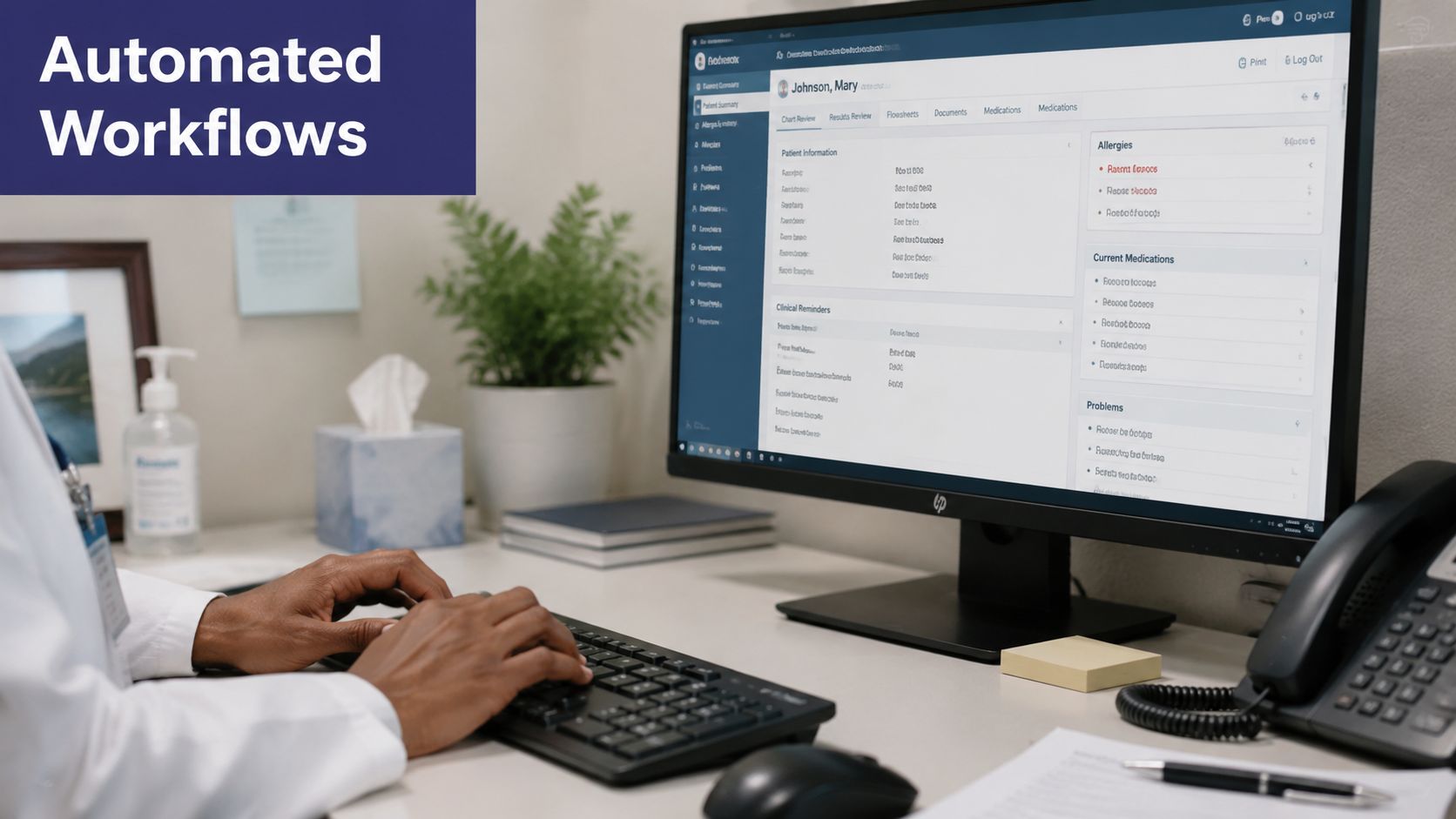
The fix is to build education into the same systems your team already uses. In eClinicalWorks, Athenahealth, Epic, DrChrono, gGastro, or EMA ModMed, the workflow should begin with a chart event and end with documented follow-up, not a sticky note or callback list.
Start the workflow at diagnosis or care-plan change
Automation works best when it has a clean trigger. In diabetes care, the common triggers are a new diagnosis, a medication start or change, a follow-up interval, or a missed education milestone.
A practical sequence looks like this:
Trigger in the EMR
A diagnosis code, visit type, or order starts the education sequence.Pre-visit outreach
The patient gets a phone call or message to collect basics such as current medications, questions, barriers, and whether they prefer phone or portal communication.Visit support
The clinician sees the intake details in the chart and can focus the visit on decision-making instead of collecting the same history again.Post-visit reinforcement
The patient receives simple follow-up that repeats the key plan, checks for confusion, and routes concerns back to staff.Ongoing adherence touchpoints
The system schedules follow-up contacts around refill timing, upcoming appointments, or unanswered education items.
Use phone-based reinforcement, not portal-only outreach
Many practices overestimate how many patients will consistently use digital tools. That's a mistake, especially in older, rural, or lower-access populations.
A recent review notes a 65% increase in digital diabetes education adoption, but also found that 58% of patients in underserved communities abandoned digital tools within three months because of complexity, and it points to voice-agent technology as a bridge through phone-based reinforcement (PMC review on digital diabetes tool abandonment and voice support).
That maps directly to what smaller practices see every day. Patients may ignore a portal task and still answer a phone call. A scalable workflow needs both.
Build around the systems you already have
The best automation projects don't ask staff to live in a separate operational universe. They connect outreach to the tools already driving care and documentation.
For diabetes education, that usually means:
- EMR triggers: eClinicalWorks, Athenahealth, Epic, DrChrono, gGastro, and EMA ModMed can serve as the source of truth for diagnosis, appointment timing, and follow-up tasks.
- Outbound logic: New diagnosis gets onboarding content. Medication change gets side-effect and adherence reinforcement. Missed follow-up gets scheduling outreach.
- Chart write-back: Call outcomes, patient questions, and unresolved concerns should return to the record.
- Staff oversight: Exceptions need manual takeover. Automation should catch routine work, not replace clinical judgment.
A useful reference point is EMR system integration for patient communication workflows, because the implementation challenge is usually less about the message itself and more about whether the workflow stays connected to scheduling, charting, and follow-up accountability.
Sample Scripts for Patient-Centered Communication
The script matters. Not because patients need polished language, but because teams drift into shorthand that's efficient for staff and confusing for everyone else.
The ADA Standards of Medical Care call for a patient-centered communication style that uses active listening and assesses literacy and barriers to care to optimize health outcomes (ADA guidance on language in diabetes care and education). In practice, that means your scripts should avoid blame, confirm understanding, and make space for the patient to say what isn't working.
Script for a post-visit follow-up call
This works well for a nurse callback or an automated phone workflow with staff escalation:
“Hello, this is your care team calling to follow up after your recent visit. We're checking that your plan feels clear. In your own words, can you tell us how you're taking your diabetes medication now?”
That prompt does two things. It tests understanding, and it avoids yes-or-no answers that hide confusion.
If the patient sounds uncertain, the next line should stay neutral:
“Thanks for walking through that. A lot of people need to hear the plan more than once. Let's go step by step.”
Script for a portal or text-style reinforcement message
Keep written follow-up short and specific. Don't send an essay.
- Medication reinforcement: “Your visit plan included a diabetes medication update. Please take it exactly as discussed at your appointment. If the instructions are unclear, reply here or call the office so we can review it with you.”
- Nutrition reinforcement: “This week, focus on one meal change you feel you can repeat. At your next check-in, we'll ask what worked and what got in the way.”
- Appointment follow-up: “Your next diabetes follow-up is important because it helps us review how the plan is working and adjust it if needed.”
Script for outreach when control appears to be slipping
Practices often become judgmental without meaning to. Patients hear blame quickly.
Use language that keeps the door open:
- “We're reaching out because it may be time to review your diabetes plan.”
- “We know routines, medications, and access issues can all affect how things go.”
- “Before your next visit, what has felt hardest to keep up with?”
Good diabetes communication sounds collaborative, not corrective.
Teams that want to refine this further should review examples of effective communication in healthcare, then adapt scripts to the reading level, specialty mix, and staffing reality of the practice. The best script is one your team can use consistently without sounding scripted.
Measuring Program Success and Clinical ROI
If your team can't measure the program, the program will eventually get treated like extra work. That's what happens in many practices. Staff feel the effort, but leadership can't see the return.
The right scorecard mixes clinical, operational, and access measures. Not vanity metrics. Usable ones.
Track outcomes that connect to care decisions
Your first layer of measurement should tie directly to whether the education process is supporting safer self-management and better continuity.
Start with:
- A1c trend review: Look for cohort-level movement over time in the patients enrolled in your structured education workflow.
- Follow-up completion: Measure whether patients complete the visits, calls, and reinforcement steps you designed.
- Medication-related outreach: Track refill confusion, instruction questions, and repeat clarification calls.
- Acute utilization signals: Watch for patterns in urgent calls, ED follow-up, and readmission-related outreach.
A structured DSMES approach matters here because adherence to a 10-hour protocol is linked to a 20% reduction in mortality risk, and while it can increase initial outpatient costs, those costs are offset by lower acute care expenses from reduced emergency visits and hospital admissions. That's discussed in the evidence cited earlier in the clinical and financial case section.
Measure the operational lift your staff no longer carries manually
Many SMB practices discover the true ROI story. Not because the clinical outcomes are secondary, but because the operational savings become visible faster.
Review these workflow metrics monthly:
- Inbound call capture: Are diabetes-related questions being handled consistently, including after hours?
- Staff time on repeat education calls: Which tasks are still manual that could be standardized?
- Documentation completion: Are outreach interactions making it back to the chart?
- No-show and reschedule patterns: Are patients more likely to stay engaged when follow-up is proactive?
For practices comparing patient experience metrics alongside clinical ones, this guide to patient satisfaction in healthcare is a helpful framing tool. It's useful because it treats satisfaction as an operational outcome tied to communication, access, and follow-through, not just friendliness at the front desk.
Use the ROI story your practice can defend
Don't try to prove everything at once. Build a simple narrative from the data you already control.
One practice might lead with reduced manual callbacks and better charted follow-up. Another might focus on more reliable medication reinforcement and stronger follow-up completion. The point is to connect the education program to fewer dropped tasks, clearer accountability, and better patient continuity.
That's where modern AI Medical Staff models can matter operationally. They can support both layers of the work: front-office demand such as scheduling, intake, refill coordination, and inbound calls, plus clinical support workflows such as test result follow-up, patient education reinforcement, adherence check-ins, and chronic disease outreach. For practices under staffing pressure, that combination can mean up to 60% reduction in front-office staff costs, 100% of inbound calls captured, and 24/7 availability with zero hold times, while maintaining HIPAA-compliant operations and SOC 2 Type 2 certification. Built by physicians from Stanford, Yale, Columbia, and Princeton, the model is designed to support the care team, not replace it. Protecting Doctors' Time for Doctoring.
If you're evaluating a practical way to run diabetes education without adding more manual follow-up work to an already stretched team, you can see Simbie AI in action at book a demo.