

Meta description: Chronic care management helps independent practices build recurring revenue, tighter follow-up, and better patient support with compliant workflows.
Chronic care management sits at the center of outpatient medicine because chronic disease drives the largest share of healthcare utilization and spend. The CDC reports that 90% of the nation's $5.3 trillion in annual health care expenditures go to people with chronic and mental health conditions, which is why a loose follow-up process is no longer enough for independent practices managing medically complex panels (CDC chronic disease facts and stats). For practice owners and administrators, the primary issue isn't whether CCM matters. It's whether your program is built to last, documented correctly, and workable for a small team.
Most CCM programs fail for operational reasons, not because the idea is wrong. They rely on scattered phone calls, inconsistent charting, and staff who are already overloaded. A durable program looks different. It has a defined enrollment process, a care plan that people utilize, reliable monthly outreach, and technology that supports both front-office and clinical work.
What Chronic Care Management Really Means for Your Practice
Many practices still treat chronic care management like a timer attached to a claim. That view is too narrow, and it usually produces weak programs.
A 2025 qualitative study on chronic care management found that effective CCM depends on whole-person assessment, individualized planning, direct assistance, and longitudinal monitoring, not just managing a diagnosis list. That's the gap most practices run into. They set up billing rules before they design care delivery.

CCM is ongoing care, not a monthly task
A patient with diabetes, heart failure, CKD, arthritis, or multiple overlapping conditions doesn't need one generic check-in every few weeks. They need a system that notices medication confusion, transportation barriers, missed specialist follow-up, and early signs that things are slipping.
That changes how a practice should think about staffing and workflow. The work isn't just "make a call and log minutes." The work is to maintain continuity between visits.
Practical rule: If your CCM workflow starts with billing and ends with billing, patients will feel it, and staff will burn out.
The strongest programs usually share a few traits:
- They build around patient context: The care plan reflects what the patient can realistically do, not just what the chart says should happen.
- They coordinate across clinicians: Primary care, specialty care, medication issues, and follow-up tasks don't live in separate silos.
- They document with intent: Notes support both care continuity and compliance, instead of becoming a pile of disconnected outreach logs.
Whole-person support is where the real work sits
Independent practices already know this from experience. The difficult cases are rarely difficult because the diagnosis is unknown. They are difficult because life gets in the way of the plan.
One patient can't afford a refill. Another doesn't understand discharge instructions. Another keeps missing appointments because a family caregiver's schedule changed. None of that fits neatly into a diagnosis list, but all of it shapes whether the patient stays stable.
Good chronic care management is relationship-based support with structure around it.
This is also why specialty practices should not write off CCM as a primary care-only service. Internal medicine, gastroenterology, and dermatology all manage patients whose outcomes depend on sustained follow-up, medication adherence, symptom monitoring, and clear communication between visits. If you support patients longitudinally already, you likely have the clinical foundation. What you may be missing is a repeatable operating model.
The Clinical and Financial Case for a CCM Program
The business case for CCM starts with scale. Chronic disease is not a side issue in outpatient care. It is the main workload.
The CDC reports that 90% of the nation's $5.3 trillion in annual health care costs are for people with chronic and mental health conditions, and Avalere reports that a federally funded CCM study found estimated savings of $74 per member per month, or $888 annually per beneficiary, alongside improvements in clinician efficiency, patient satisfaction, therapy adherence, and reduced hospitalizations and emergency department visits (Avalere on optimizing CCM utilization).

Why this matters to an independent practice
For an SMB practice, CCM does two things at once. It creates a recurring care process for a patient population that needs it, and it gives the practice a reimbursable framework for work that often goes unpaid when handled informally.
That's an important distinction. Many practices already spend time on refill issues, patient education, follow-up calls, care coordination, and medication questions. The problem is that the work is reactive and fragmented. CCM gives that work structure.
A solid program can improve:
- Continuity between visits: Patients don't disappear until the next appointment.
- Medication adherence: Problems surface sooner, before they become urgent.
- Patient confidence: People know who to call and what to do when plans get confusing.
- Practice economics: Clinical support work becomes organized, documented, and billable when it meets CMS requirements.
The financial upside depends on execution
Not every CCM program becomes profitable. Some create more burden than value because they are underdesigned. Common failures are predictable: poor patient selection, weak documentation, no monthly cadence, and staff doing outreach whenever they can squeeze it in.
The clinics that do well with CCM usually avoid two mistakes.
First, they don't enroll everyone who qualifies on paper. They prioritize patients who are likely to benefit from recurring support and who have enough care complexity to justify the operational effort.
Second, they don't hand the program to already overextended MAs or nurses without infrastructure. If enrollment rises but workflow doesn't change, the hidden cost shows up fast in turnover, sloppy notes, and missed follow-up.
CCM works financially when the clinical workflow is real, the documentation is clean, and someone owns the program every month.
For practices participating in value-based arrangements, that matters even more. Better adherence, earlier escalation, and tighter coordination don't just support CCM billing. They also support utilization reduction and more stable longitudinal care.
CMS Billing Codes and Documentation Essentials
Compliance is where many CCM programs either become stable or become risky. The rules are manageable, but they require discipline.
CMS defines CCM for patients with two or more chronic conditions expected to last at least 12 months or until death. The core service under CPT 99490 requires at least 20 minutes of non-face-to-face clinical staff time per calendar month, and CMS expects structured recording of health information, an electronic detailed care plan, medication review, care-transition coordination, and timely information-sharing across clinicians (CMS chronic care management guidance).
The core codes your team needs to know
The practical starting point is knowing which code fits the work being done.
| CPT Code | Time Requirement per calendar month | Description |
|---|---|---|
| 99490 | 20 minutes | Clinical staff time for standard chronic care management |
| 99491 | 30 minutes | Provider time for CCM |
| 99487 | 60 minutes | Complex CCM |
| 99439 | Additional time | Add-on code for additional CCM clinical staff time |
| 99437 | Additional time | Add-on code for additional provider CCM time |
| 99489 | Additional time | Add-on code for additional complex CCM time |
Those codes are not interchangeable. The code has to match who performed the work, how much time was spent, and whether the case meets the standard for complex CCM.
Documentation has to show care, not just contact
A compliant note should make it easy to answer a simple audit question: what clinically meaningful work happened this month?
That means documenting more than “called patient” or “left voicemail.” CMS expects an actual care management process. In practice, your chart should support these elements:
- Eligibility basis: The patient has at least two chronic conditions expected to last at least 12 months or until death.
- Care plan status: The complete electronic care plan exists, is current, and is available to the care team.
- Medication work: Reconciliation, review, refill coordination, adherence barriers, or patient education when relevant.
- Coordination activity: Communication with other treating clinicians, transitions of care, or follow-up around referrals and testing.
- Time tracking: Monthly time is logged accurately and tied to billable work.
If your clinicians struggle with note quality, clinical documentation improvement matters here because weak charting usually starts upstream, long before a claim goes out.
The safest CCM program is the one where an outside reviewer can read the note and understand the patient story, the intervention, and the reason the time counted.
What tends to go wrong
Practices usually run into trouble in one of three places:
- Time is estimated instead of tracked. That creates avoidable compliance risk.
- The care plan is generic. If every patient has the same template with minimal updates, the chart doesn’t reflect real management.
- Coordination is implied rather than documented. Staff may do the work, but if the record doesn’t show it, the claim is exposed.
A good rule is simple. If your team cannot explain the workflow in plain language, it probably isn’t ready for scale.
A Step-by-Step CCM Implementation Checklist
Launching chronic care management goes better when the practice treats it like an operations build, not a side project. The order matters. Start with patient selection and workflow ownership, then add scripting, documentation, and reporting.
Start with patient identification and consent
Pull an initial list from your EMR, then refine it by real-world fit. The question isn’t only who qualifies. It’s who is likely to benefit from recurring support and who your team can realistically serve well.
In systems such as eClinicalWorks, Athenahealth, DrChrono, or Epic, that usually means reviewing chronic diagnoses, visit history, refill activity, hospitalization history, and existing care coordination burden. Specialty groups using EMA ModMed or gGastro can take the same approach, especially when a chronic GI condition or treatment plan already requires repeated outreach.
A practical launch checklist looks like this:
- Define eligibility logic: Align your clinical and billing teams on which patients meet CCM criteria.
- Create the consent workflow: Decide who explains the service, where consent is documented, and how questions are handled.
- Assign program ownership: One person should be accountable for enrollment status, monthly workflow, and issue escalation.
Build the monthly workflow before enrolling at scale
Often, many practices move too fast. They enroll patients, then scramble to deliver the service.
Use a monthly operating sequence instead:
- Outreach cadence: Decide when check-ins happen, how many attempts are made, and what happens if the patient is unreachable.
- Documentation rules: Standardize where time is logged, where care plan updates live, and how medication issues are captured.
- Escalation path: Define when the CCM team routes a problem to an RN, APP, or physician.
- Care plan maintenance: Update goals, barriers, and interventions in a way that reflects actual patient progress.
For many teams, this is also the point where broader workflow cleanup pays off. A guide to medical practice automation for modern clinics can help frame which tasks belong in automation and which still need human review.
Choose a staffing model that you can sustain
There is no universal staffing model. The right choice depends on visit volume, patient complexity, and how mature your documentation processes already are.
Here are the trade-offs:
- Existing staff model: Familiar and clinically grounded, but it can overload nurses, MAs, and front-office staff if the program grows.
- Dedicated care manager model: Better continuity and accountability, but requires steady oversight and enough enrolled volume to justify the role.
- Technology-supported model: Useful for repetitive outreach, intake, reminders, education, and chart preparation, but it still needs clinical governance and clear exception handling.
A workable CCM program protects the staff doing the work. If your model depends on people staying late to finish notes, it won’t hold.
Pilot with a limited group, tighten the script, stress-test documentation, and only then expand enrollment. Slow is faster when you’re building something monthly and recurring.
Using Technology and AI for a Scalable CCM Program
In a small practice, even a modest CCM panel can create dozens of monthly touches that have to be completed, documented, and tied back to the right patient record. If that work lives in phone notes, sticky reminders, and staff memory, the program usually stalls before it becomes reliable revenue.
Integration matters more than another dashboard
Independent practices do not need another place for staff to log in and retype work. They need CCM activity to flow into the chart, the task queue, and the documentation process they already use.
That is why EHR-integrated care coordination AI has practical value for practices using eClinicalWorks, gGastro, EMA ModMed, Athenahealth, Epic, or DrChrono. Calls, outreach attempts, refill requests, care plan updates, and escalation notes should end up in the record in a format a clinician can review quickly. If the technology creates extra reconciliation work ultimately, it is adding labor, not removing it.
I usually tell practices to judge a CCM tool by one standard. Does it reduce clicks and cleanup for the clinical team?
Where AI fits in a real CCM workflow
AI works best on repetitive, rules-based work that has to happen on time every month. That includes routine outreach, adherence check-ins, reminder calls, refill intake, standardized education, and documentation support after a patient interaction.
It has limits. Patients who sound confused, unstable, distressed, or clinically off-pattern need human review. A scalable program depends on clear handoff rules, not on pretending every conversation can be automated safely.
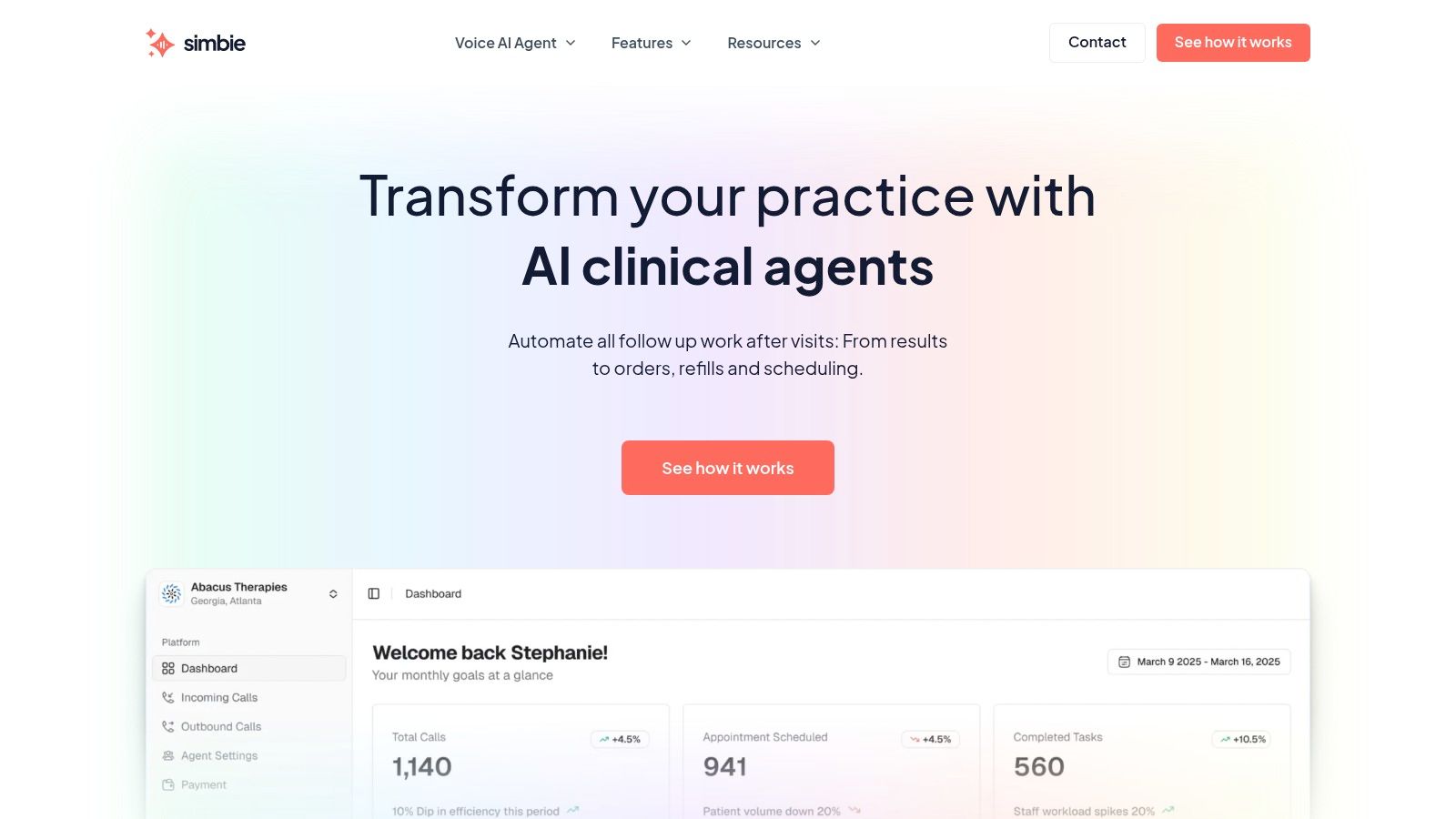
Simbie AI is one example of a tool designed to support both front-office and care coordination work. In practical terms, practices use tools in this category to handle scheduling, intake, refill requests, follow-up calls, patient education, and chronic disease outreach while routing exceptions back to staff. The value is operational. Staff spend less time on repeatable touchpoints and more time on patients who need clinical judgment.
Technology can also help practices optimize patient experiences between visits. That matters in CCM because patients stay enrolled when communication is consistent, instructions are clear, and follow-up does not depend on who happened to answer the phone that day.
The trade-off is straightforward. Automation can increase capacity and improve consistency, but only if the practice sets tight protocols for consent, escalation, documentation, and chart review. Without that discipline, AI just helps you make the same mistakes faster.
Measuring Success and Avoiding Common Pitfalls
A CCM program should be judged like any other service line. Is it clinically useful, operationally sustainable, and financially clean?
The easiest mistake is tracking only claims submitted. That tells you almost nothing about whether the program is working.
Measure the workflow first
Start with process reliability. If this part is unstable, outcome review won’t mean much.
Track items such as:
- Enrollment quality: Are enrolled patients appropriate for the service, or is the list inflated with low-engagement patients?
- Monthly completion: Are outreach, documentation, and care plan updates happening consistently?
- Escalation handling: Are clinical concerns routed quickly to the right person?
- Staff burden: Are nurses and front-desk staff absorbing too much hidden work?
A useful operational check is whether chart data can be reviewed without hunting through free-text notes. If your team is still piecing together outreach details manually, it may help to understand what intelligent document processing means in practical workflow terms, especially for turning repetitive communication into usable structured data.
Watch for the common failure modes
Most CCM breakdowns are not dramatic. They are quiet and cumulative.
Practices don’t usually lose CCM because the idea is weak. They lose it because the workflow gets messy, the notes get thin, and the team stops trusting the process.
The common traps look like this:
- Check-the-box outreach: Staff complete a call requirement, but no one updates the care plan in a meaningful way.
- Overreliance on memory: Time, interventions, and coordination details are remembered later instead of captured during the workflow.
- No ownership: Everyone touches the program, but no one is accountable for monthly completion and cleanup.
- Technology without governance: Automation is added, but escalation rules, documentation standards, and clinical review are vague.
What durable programs do differently
They keep the model simple. They standardize scripts where appropriate, but they don’t let scripting replace judgment. They audit documentation early. They review a sample of charts monthly. They also make it easy for staff to surface edge cases rather than forcing every interaction into the same template.
For independent practices, that last point is critical. CCM should reduce chaos, not hide it. When the workflow is built well, physicians get cleaner information, staff spend less time chasing routine tasks, and patients feel the difference between visits.
If you’re evaluating AI medical staff for chronic care management and the broader workflow around scheduling, calls, refills, documentation, and care coordination, you can see Simbie AI in action at book a demo.