
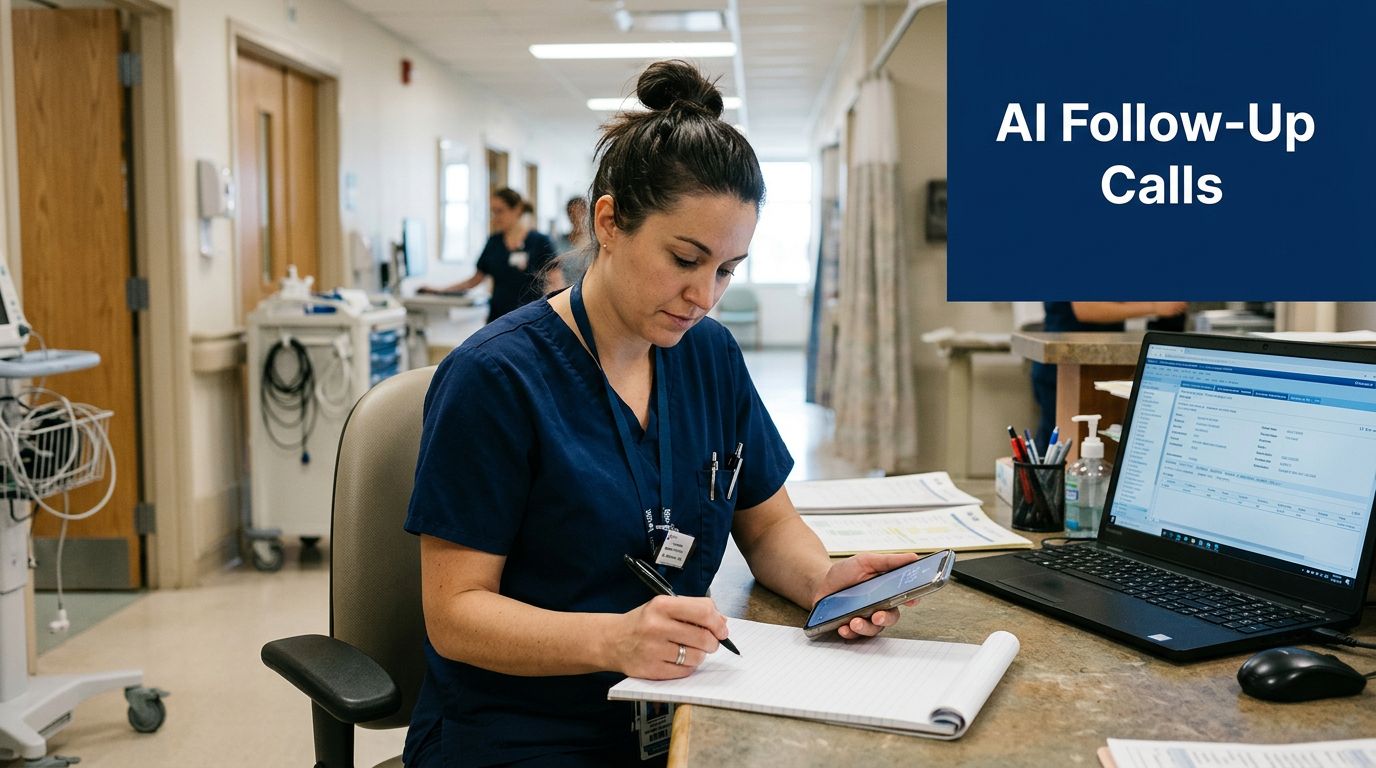
Discharge day rarely ends when the schedule says it should. In a small or midsize practice, someone still has to call patients, confirm they understood instructions, ask about symptoms, check whether medications were filled, and decide what needs a nurse now versus tomorrow. AI post-discharge follow up calls matter because this work is clinically important, operationally messy, and too often squeezed into the margins. For independent dermatology, gastroenterology, and internal medicine practices, the difference between a good process and a loose one is staff strain, inconsistent documentation, and missed issues that should've been caught early.
The Challenge with Manual Post-Discharge Follow-Up
A manual follow-up process usually starts with good intent and ends with uneven execution. The nurse or MA has a list. The phones are already active. Refill requests are backing up. A physician wants a message pulled forward. By late afternoon, post-discharge calls become one more important task competing with several other important tasks.
That creates variability fast. One patient gets a thorough call and clear documentation. Another gets voicemail. A third answers, mentions a red-flag symptom, and the note sits in a task queue longer than anyone wants. The work isn't hard because staff don't care. It's hard because the process depends on uninterrupted human attention in an environment that rarely allows it.
Where manual follow-up breaks down
Three weak points show up again and again in community practices:
- Timing slips: Follow-up happens later than intended because urgent in-office work takes priority.
- Documentation gets thin: Staff remember the clinical issue but don't always capture the conversation in a structured way.
- Escalations vary by person: One nurse forwards a symptom immediately, another waits for a provider review, and a third sends a portal message instead of calling.
Practical rule: If your follow-up process depends on who happens to be free at 4:45 PM, it isn't really a process.
For practice owners and administrators, the pain isn't just labor. It's reliability. A follow-up program has to work on ordinary Tuesdays, not only when staffing is ideal. That's why AI has become relevant here, not as a novelty, but as a way to make a repetitive clinical workflow more consistent.
The important point is this. AI post-discharge follow up calls are not about replacing nurses or physicians. They handle the repeatable parts, surface exceptions quickly, and free the clinical team to focus where judgment matters most. That's the operational version of Protecting Doctors' Time for Doctoring.
How AI Follow-Up Calls Actually Work
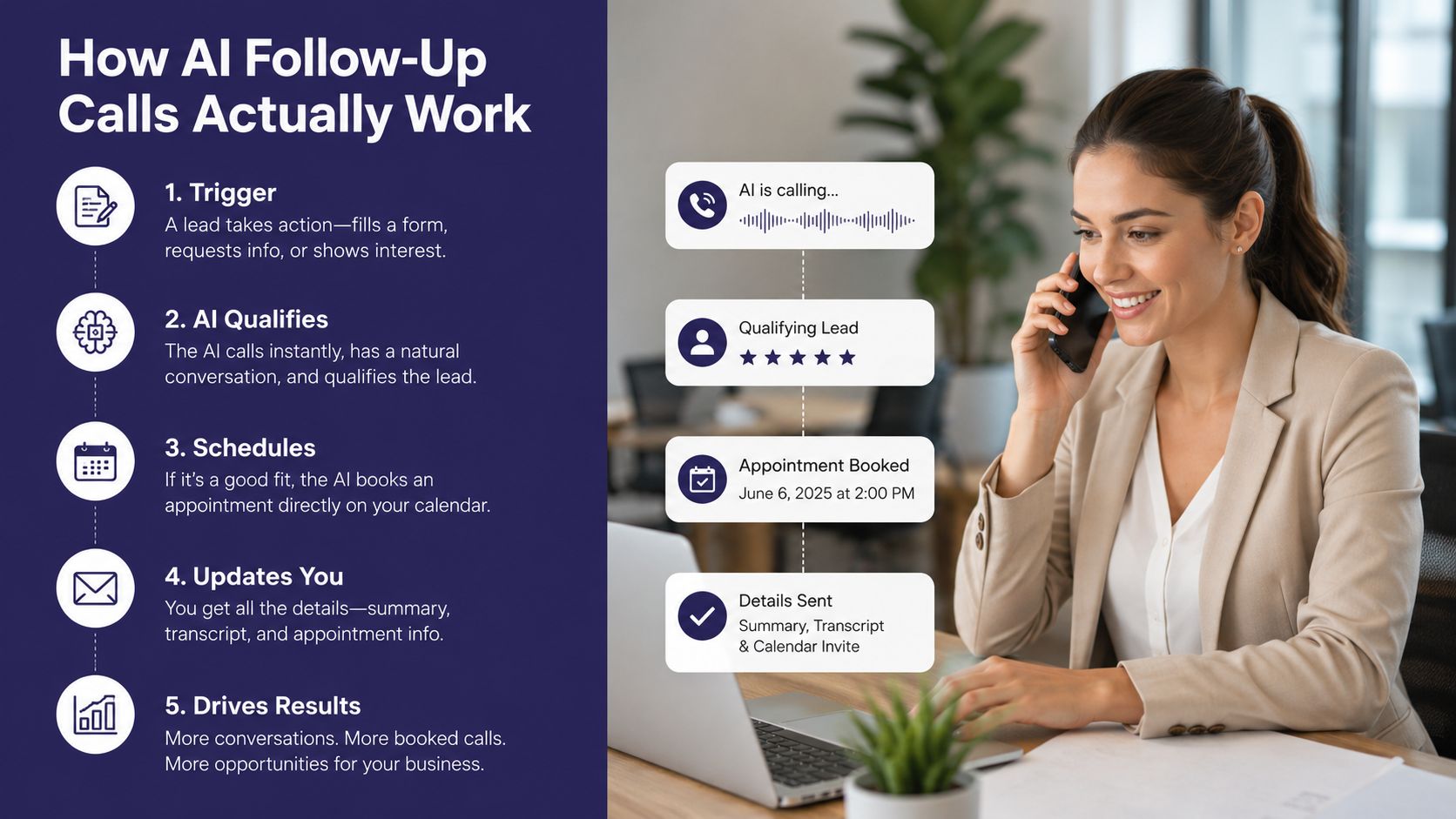
Most skepticism disappears once people see the workflow. A real AI follow-up call isn't a generic robocall with a stiff script. It acts more like an automated clinical assistant tied to your practice rules, your escalation paths, and your charting workflow.
The trigger starts in the chart
The cleanest setup starts in the EMR. A discharge event, procedure completion, or visit disposition triggers the outreach. In GI, that might be a post-endoscopy or post-colonoscopy follow-up. In internal medicine, it may be a hospital discharge tied to medication changes. In dermatology, it might be a post-procedure wound check.
The system doesn't call instantly. It waits for the interval your clinicians define, then places the call and introduces itself as calling from your practice. If you're evaluating how outbound automation is structured in healthcare operations, this overview of outbound call workflows for medical practices is a useful reference point.
The conversation is structured, but not rigid
Good call design matters more than the AI label. The script should verify identity, state the reason for the call, and ask concise clinical questions in plain language. It should also branch logically.
A patient who reports no concerning symptoms moves into education and reminders. A patient who mentions bleeding, fever, worsening pain, inability to obtain medication, or confusion about instructions should trigger an escalation path immediately. That can mean a live transfer during business hours, an urgent task to a nurse, or routing to the on-call protocol after hours.
The handoff rules matter more than the voice quality. If the AI identifies a concern but your team doesn't know who owns it, you've automated the easy part and broken the critical part.
Documentation closes the loop
Many systems underperform here. If the call result lives in a separate dashboard, staff still have to re-enter it, and your efficiency gains disappear. The useful version is chart-native. The encounter note, symptom responses, call outcome, and escalation status should write back into systems like eClinicalWorks, gGastro, Athenahealth, EMA ModMod, Epic, or DrChrono in the right place and in a format your clinicians will read.
That documentation piece also connects to a broader workflow issue many practices already know from dictation. If your team is thinking about how spoken clinical interactions become usable documentation, AIDictation's medical dictation guide offers a practical frame for what accurate, structured transcription and workflow fit should look like.
One practical example from the market is Simbie AI, which positions itself as AI medical staff rather than just phone coverage. That distinction matters because post-discharge follow-up works best when the same platform also supports intake, scheduling, refills, patient education, and chart documentation instead of operating as a disconnected call tool.
The Clinical and Financial Benefits for Your Practice
The obvious benefit is time back for staff. The more meaningful benefit is consistency. When every eligible patient gets a structured follow-up and every concerning answer follows a defined path, your practice stops relying on memory and spare minutes.
Clinical value shows up in early issue detection
The point of these calls is not to create a friendlier voicemail campaign. It's to catch problems while they're still outpatient problems. Medication confusion, worsening symptoms, side effects, poor adherence, and missed follow-up instructions often surface during the first outreach if the questions are specific enough.
That matters beyond the office. Under the Hospital Readmissions Reduction Program, CMS reduces payments to hospitals with excess readmissions, and in fiscal year 2024, nearly 2,400 hospitals received penalties, according to the CMS HRRP program page. Independent practices aren't running that hospital penalty program, but they are often part of the care chain that can identify trouble early and help keep patients from bouncing back into higher-acuity settings.
Patient experience improves when access feels real
Patients notice whether follow-up is prompt, clear, and personal. They also notice when no one calls back, when they hit voicemail, or when they have to repeat the same story to three different people. AI doesn't replace clinician reassurance, but it can make sure routine outreach happens.
That has practical effects in smaller groups:
- Fewer dropped balls: Every eligible patient can receive the same baseline check-in.
- Better staff focus: Nurses spend more time on exceptions and less time on voicemail attempts.
- Stronger continuity: Education, reminders, and next steps are delivered consistently.
Financial impact is broader than labor savings
For small and midsize practices, the financial case usually starts with front-office pressure, not discharge workflow. That's fair. If your phones are overloaded, every new outbound process feels unrealistic. A true AI medical staff model operates differently than a narrow call bot. Practices often look for support across both administrative and clinical tasks, including scheduling, intake, refills, test result review, adherence outreach, and follow-up campaigns.
The operational upside can be meaningful. Some practices pursue these systems because they can support up to 60% reduction in front-office staff costs, while also aiming for 100% of inbound calls captured, 24/7 availability, and zero hold times. Those benefits matter because a post-discharge program works better when your phone operations and your clinical outreach aren't fighting each other for the same limited staff bandwidth.
A follow-up program usually fails for operational reasons before it fails for clinical reasons. If your phones are chaos, your discharge calls won't stay reliable.
There's also a revenue angle in chronic disease follow-up and care management programs. The exact billing pathway depends on your workflow and documentation discipline, but the broader point is simple. When outreach is structured, documented, and tied to actual care management work, it becomes easier to build repeatable programs without adding another layer of manual effort.
EMR Integration and HIPAA Security
Practice administrators usually ask two questions first, and they're the right two. Will this fit our EMR workflow, and will it handle protected health information safely? If the answer to either is weak, the project shouldn't move forward.
Integration has to be practical, not theoretical
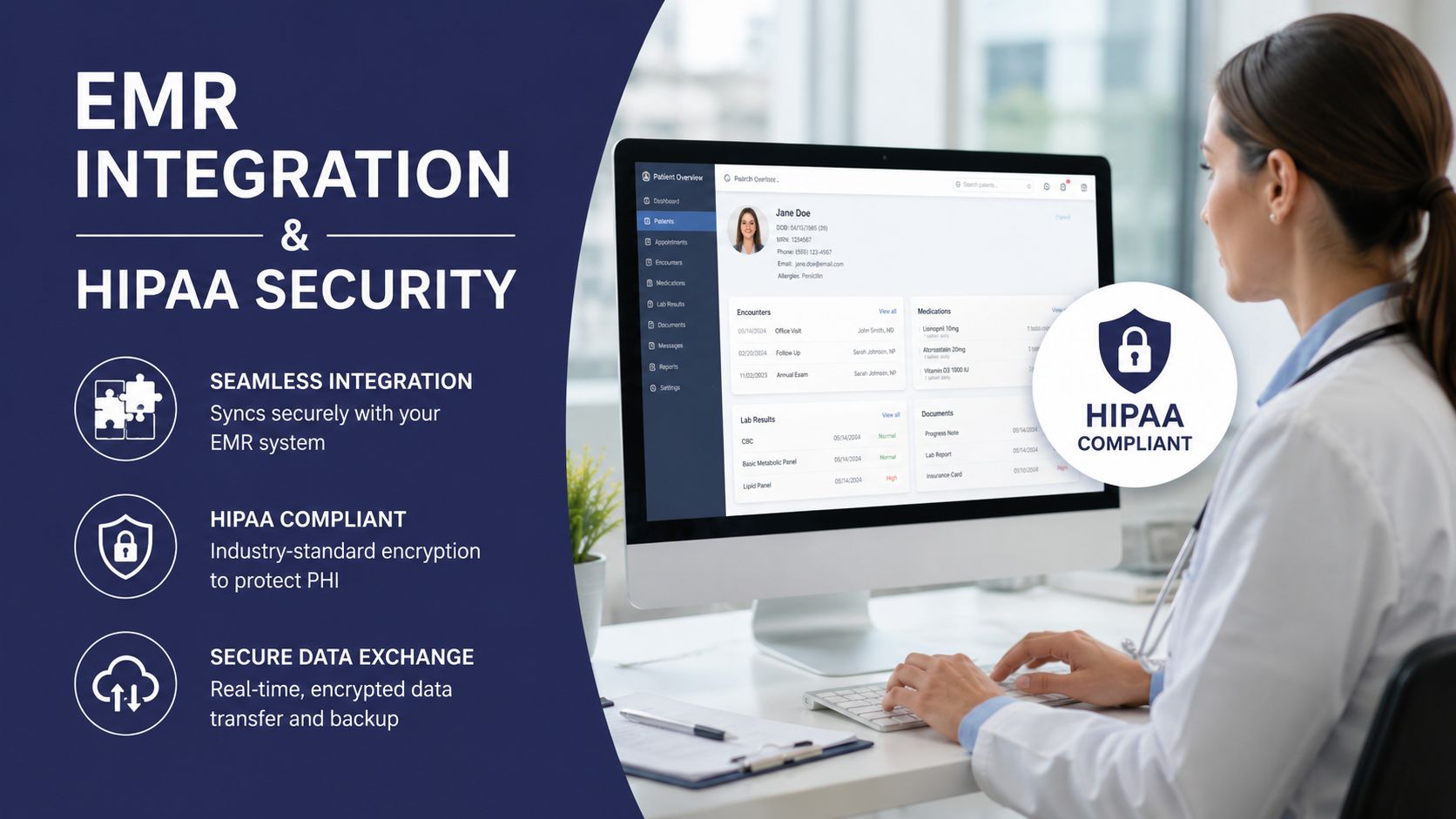
"Integrates with EMR" can mean almost anything, so press for specifics. For post-discharge follow-up, the system should be able to identify who needs outreach, pull enough chart context to drive the correct script, and write the result back into the patient record in a structured way.
That means more than exporting a CSV and uploading call outcomes later. In real practice operations, you want bidirectional movement of information with systems such as eClinicalWorks, gGastro, EMA ModMed, Athenahealth, Epic, and DrChrono. If you're reviewing how that connection should work in day-to-day operations, this look at AI and EMR integration for medical practices is the right level of detail to ask vendors about.
What clean data flow looks like
A workable setup usually includes these elements:
- Trigger logic: A discharge, procedure completion, or status change starts the outreach workflow.
- Context pull: The AI references relevant diagnosis, procedure, medication, or instruction context so the call matches the visit.
- Chart write-back: Responses become structured documentation, not free-floating notes in a separate portal.
- Escalation routing: Concerning answers generate a task, alert, or handoff tied to your staffing model.
If one of those pieces is missing, staff will end up creating manual workarounds. That's how a promising tool turns into another inbox.
HIPAA and SOC 2 Type 2 should show up in operations
Compliance language is easy to put on a website. The operational question is whether the controls reduce risk in actual workflows. A healthcare AI platform handling PHI should be HIPAA-compliant and SOC 2 Type 2 certified. Data should be protected in transit and at rest, and access should be limited by role.
Just as important, the design should reduce risky side channels. Staff shouldn't need to paste clinical details into unsecured text threads, email symptom summaries around the office, or keep side spreadsheets for callback status. Those workarounds create exposure because the process is fragmented. The safer pattern is direct chart documentation and controlled alerting inside the systems staff already use.
A useful reminder comes from real breach reporting. This report on sensitive healthcare data exposure is a good example of why healthcare groups should take data handling seriously even when a workflow seems routine.
Security isn't a separate workstream. It's a product of workflow design. If staff have to leave the core system to make the process work, risk goes up fast.
Clinically built systems tend to fit better
This is one place where background matters. Simbie AI was built by physicians from Stanford, Yale, Columbia, and Princeton, and that kind of clinical input usually shows up in the right places, script logic, escalation thinking, note structure, and the understanding that automation in medicine has to support care teams rather than force them into generic call center behavior.
For community practices, that fit matters more than flashy demos. The platform should feel like part of your workflow, not something your team has to work around.
Sample Scripts and Performance Metrics to Track
Script quality decides whether follow-up calls feel useful or annoying. The right script is calm, concise, and clinically specific. It doesn't try to sound clever. It tries to identify whether the patient is stable, confused, or at risk.
A sample post-procedure follow-up flow
Here's a simplified example for a gastroenterology practice after colonoscopy:
Hello, this is the care team calling from your gastroenterology office to check on you after your recent procedure. Before we continue, please confirm your full name and date of birth.
Once identity is confirmed, the script should move through a short sequence that branches based on the answer:
Symptom screen
Ask about abdominal pain beyond expected mild cramping, bleeding, fever, chills, dizziness, vomiting, or trouble tolerating fluids.Medication and instruction check
Confirm whether the patient understood medication guidance, resumed or held medications correctly, and knows any diet or activity restrictions.Next-step reinforcement
Remind the patient about pathology follow-up, office callbacks, or the next appointment if applicable.Open non-urgent question capture
Offer to route non-urgent questions to staff rather than leaving the patient to initiate another call later.
A dermatology version would focus more on wound care, drainage, redness, swelling, pain progression, dressing changes, and signs of infection. Internal medicine discharge calls often need stronger medication reconciliation and adherence prompts, especially when the regimen changed during hospitalization.
What works and what doesn't
The difference between a useful script and a bad one usually comes down to three things:
- Specific symptoms beat vague wellness questions: "Are you having new bleeding?" works better than "How are you feeling?"
- Branching reduces patient frustration: Stable patients shouldn't be dragged through unnecessary escalation language.
- Plain language wins: If a patient has to decode the question, the call loses clinical value.
Poor scripts often sound like they were written by compliance and nobody else. They're too long, too formal, and packed with terms patients don't use. The best scripts are reviewed by the physicians and nurses who already handle these callbacks manually.
Key metrics for AI follow-up call programs
You don't need a massive dashboard to know whether the program is working. Track a short set of operational and clinical measures every week.
| Metric | What It Measures | Good Target |
|---|---|---|
| Call completion rate | Whether patients are actually being reached and finishing the call flow | High and stable over time |
| Escalation rate | How often the script identifies issues that need nurse or provider review | Appropriate for the patient population, not artificially low |
| Documentation completion | Whether call outcomes are written back into the chart correctly | Near-complete charting with minimal manual cleanup |
| Time to staff follow-up | How quickly escalated issues receive human review | Same day during office hours, clear after-hours coverage |
| Voicemail and retry pattern | Whether outreach timing and retry logic are sensible | Consistent contact attempts without overcalling patients |
| Patient question capture | How often non-urgent concerns are surfaced for office response | Increasingly organized, not lost in ad hoc messages |
A "good target" should be defined by your baseline and specialty. A GI practice doing high procedure volume will evaluate these differently than an internal medicine group managing complex discharges.
The first sign of success isn't usually a flashy metric. It's that nurses stop saying, "I think that patient was supposed to get a callback."
Implementation and Avoiding Common Pitfalls
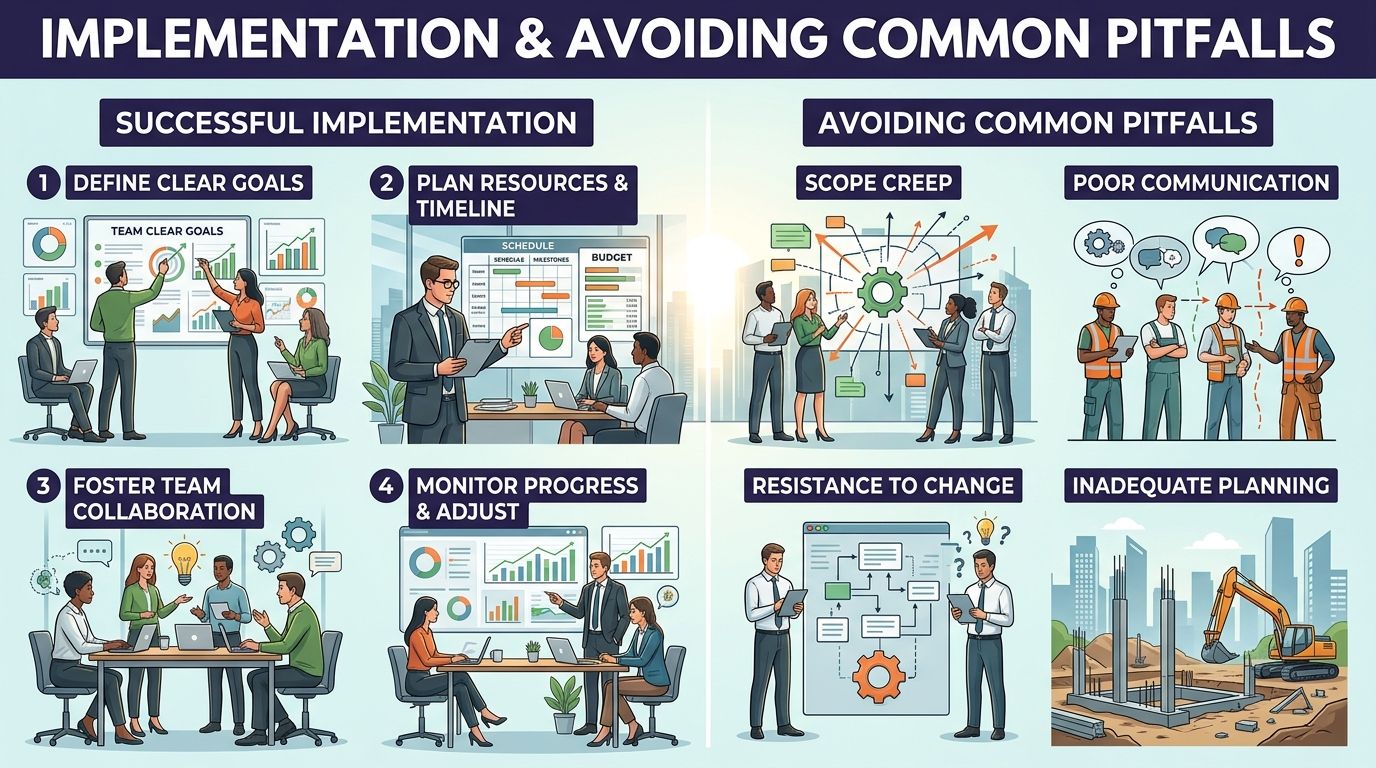
The safest rollout is narrow and disciplined. Start with one use case, one script family, and one clearly defined escalation workflow. Don't begin with every discharge type in the practice.
A practical rollout sequence
A straightforward implementation usually looks like this:
- Start with a narrow cohort: Pick one common discharge or post-procedure scenario where the questions are predictable and the escalation rules are already understood.
- Review scripts with clinicians: Nurses and physicians should edit the language, red-flag triggers, and patient education steps.
- Assign owners for escalation: Decide who gets alerted during clinic hours and what happens after hours, weekends, and holidays.
- Train the front office too: If patients call back after an automated outreach, front-desk staff need context so the handoff is smooth.
- Audit the first wave closely: Listen to call transcripts or summaries, review chart notes, and adjust the script quickly.
If you're planning broader proactive outreach beyond discharge workflows, this article on AI for post-diagnosis patient outreach helps frame where follow-up automation fits in the larger care process.
Common pitfalls and the fix for each
Some failures are predictable.
Bad script design
If the wording is stiff or clinically vague, patients get confused and staff lose trust. Fix it by using real language from your nurses' existing callbacks.Unclear patient expectations
Patients should know your practice may use an automated system for routine follow-up. That reduces surprise and improves response quality.No owner for alerts
An escalation without a named team or protocol is just a delayed problem. Build the routing map before launch.Weak monitoring after go-live
Teams sometimes assume the workflow is fine because calls are being placed. Review outcomes weekly, especially early on.
The practices that get value from AI post-discharge follow up calls don't treat the tool as a plug-in. They treat it like a clinical workflow that happens to be automated. That's the right mindset for independent groups that need reliability, not hype.
If you're evaluating AI for your practice and want to see how an AI medical staff model works across follow-up calls, scheduling, refills, and charting, you can explore Simbie AI or see it in action at book a demo.