
A morning in a community GI practice can unravel fast. Refill requests are already waiting, a patient with ulcerative colitis is calling about new bleeding, a biologic prior authorization is stalled, and two lab results still need review before lunch. For independent practices, ulcerative colitis management works only when the treatment plan and the workflow match, because the best guideline in the world still fails if patients can't get through, stay on therapy, or get rechecked on time.
Meta description: Practical ulcerative colitis management for GI practices, with evidence-based treatment steps and workflow fixes that keep patients on therapy and monitored.
The Daily Reality of Ulcerative Colitis Management in Independent GI Practices
A typical morning in a small GI office rarely matches the algorithm in a guideline. Calls pile up, refills sit pending, labs need review, and a patient with ulcerative colitis wants to know whether new bleeding is a minor change or a real flare. Ulcerative colitis management gets difficult because the clinical decision is often the easy part. The harder part is getting the patient to the right step before the disease changes course.
The gap between the plan and the follow-through
UC stays chronic, but the operational burden is what makes it feel unpredictable. A patient may leave with the right medication, yet the refill is still waiting, teaching is never reinforced, or follow-up slips far enough that a mild flare becomes harder to control. That gap matters because modern UC care depends on steroid-free remission, ongoing monitoring, and shared decisions that reflect symptoms, endoscopy, and biomarkers, not just the prescription pad (ACG guideline summary).
Practical rule: If a UC patient has to chase the office for refills, education, or lab follow-up, the treatment plan is already leaking.
Independent practices feel that pressure first. They do not have a large IBD support team watching every message and every result. They still carry the same clinical responsibility as larger centers, which means the workflow has to absorb part of the burden or the best plan falls apart.
For more on optimizing patient flow, see our guide on improving patient flow in GI clinics.
Why access problems change the disease course
UC patients do not always say they are struggling. Some hesitate to ask questions, some worry they are bothering the staff, and some are carrying medication fears they never mention in a rushed visit. That communication gap is a clinical issue, not just a service issue, because patients who stay quiet often drift off the plan before anyone notices, as shown in survey and observational findings.
Practical UC care in community GI means more than choosing a drug. It means building a system that catches refill gaps, tracks symptoms, and brings the patient back before the flare turns into a hospital problem. When that system is weak, the office spends its day reacting. When it is strong, the office feels more predictable, and the treatment plan has a real chance to work.
Evidence-Based Treatment Ladder From First-Line to Advanced Therapy
UC treatment looks simple on a whiteboard, but independent GI practices see where it breaks. A patient with mild distal disease should not be treated the same way as someone with extensive colitis, and a steroid prescription should never become the default holding pattern because follow-up, authorization, or education stalled in the background.
Start with disease extent, then match the route
For mild-to-moderate ulcerative colitis, expert guidance consistently favors combined oral and rectal 5-ASA, usually mesalamine, as the best first-line approach. Oral therapy is typically at least 2.0 g/day and often 2.4 g/day or higher, while rectal treatment is recommended at 1 g/day for proctitis and at least 1 g/day enema for left-sided colitis or pancolitis (guideline review). For disease distal to the descending colon, topical 5-ASA, including suppositories and enemas, is preferred, and it works better than oral 5-ASA or topical corticosteroid foams or enemas for that location-specific pattern (AAFP review).
Once-daily oral dosing helps adherence without giving up efficacy (guideline review). That is the kind of practical difference that shows up in daily practice. A regimen the patient takes is better than a more elaborate plan that never gets filled, started, or remembered.
Escalate when response stalls, don't keep recycling the same step
For mild to moderate disease, 5-ASA remains the induction foundation, and StatPearls reports a remission rate of about 50% with sulfasalazine and 5-ASA given orally or rectally (StatPearls). If remission is still not there after two weeks, glucocorticoids can be added (StatPearls). If appropriately dosed 5-ASA fails, the next step is usually a different therapeutic class rather than another version of the same one.
For moderate-to-severe or steroid-refractory UC, the guideline-backed path is advanced therapy, not prolonged steroid exposure. AGA-backed outpatient induction options include infliximab, adalimumab, golimumab, vedolizumab, tofacitinib, or ustekinumab (AGA review). Other advanced options used in current practice include ozanimod, etrasimod, guselkumab, mirikizumab, risankizumab, and upadacitinib, depending on the disease context and treatment goal (ACG guideline summary).
Operational takeaway: The biggest mistake is not picking the “wrong” advanced drug first. It is letting a patient sit on steroids too long because prior authorization, infusion scheduling, or follow-up ownership is unclear.
UC treatment ladder by disease severity
| Disease Severity | First-Line Therapy | Escalation Options | Key Decision Point |
|---|---|---|---|
| Mild proctitis | Rectal 5-ASA, 1 g/day (guideline review) | Topical corticosteroids, tacrolimus suppository, or beclomethasone if nonresponsive (ACG guideline summary) | Stay local if disease is distal and symptoms are controlled |
| Mild-to-moderate left-sided or extensive UC | Oral 5-ASA, at least 2.0 g/day, often with rectal 5-ASA (guideline review) | Budesonide MMX, then a different class if 5-ASA fails (ACG guideline summary) | Do not underdose mesalamine or keep cycling formulations |
| Moderate-to-severe UC | Advanced therapy after steroid induction or instead of prolonged steroids (AGA review) | Biologics or small molecules, based on prior response and risk profile (ACG guideline summary) | Escalate before steroid dependence becomes the default |
| Acute severe UC | IV corticosteroids first (UEG guideline) | Rescue with infliximab or ciclosporin if no response in 3 to 5 days (UEG guideline) | Rescue timing matters more than debate |
Monitoring Strategies That Catch Flares Before They Escalate
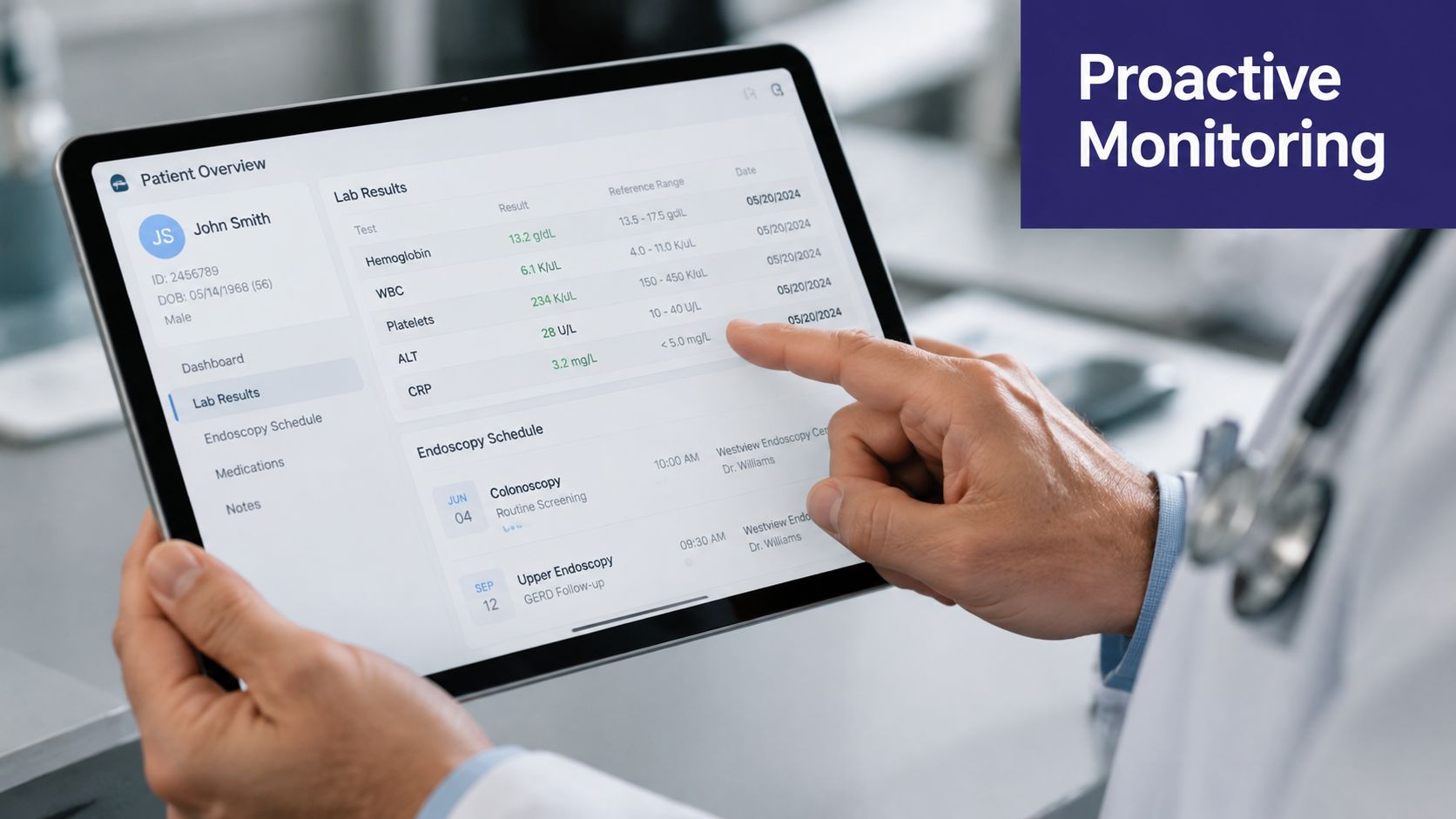
A UC follow-up visit is only as good as the system behind it. The prescription matters, but so do the reminders, lab checks, symptom review, and the note that gets acted on. In independent GI practices, the patients who stay stable are usually the ones whose monitoring never relies on memory alone.
What to track and when to look again
The ACG guidance emphasizes using clinical, endoscopic, histologic, and biochemical information together, with fecal calprotectin and CRP among the noninvasive tools used to judge response, relapse, and maintenance (ACG guideline summary). It also calls for reassessment of response to induction therapy within 8 weeks.
That timing matters because inflammation often gets ahead of symptoms. A patient can report that things feel acceptable while biomarkers are drifting in the wrong direction, or while mucosal healing never really happened. The point of monitoring is to catch that mismatch early, before a “minor” flare becomes the next urgent phone call.
Why manual tracking fails in a busy panel
A small panel can be followed in someone's head for a while. A full practice cannot. Missed labs, overdue scopes, and unread portal messages are what let a controllable flare turn into a same-week add-on visit or a hospitalization.
That problem gets worse in offices without dedicated IBD coordination, where the same staff are handling scheduling, refills, prior authorizations, infusion questions, and call volume. The plan may be sound on paper, but paper does not call the patient back, flag a missing calprotectin, or notice that the follow-up slot never got booked.
Practical rule: If the follow-up plan depends on someone remembering to remember, it will fail when the day gets busy.
Cancer surveillance and maintenance discipline
Longstanding UC also needs structured surveillance, because keeping inflammation quiet is part of lowering downstream risk. The ACG guidance ties disease monitoring to prevention of hospitalization, surgery, and cancer, which is why routine visits still matter when the patient seems stable (ACG guideline summary). In practice, the office that treats UC as an episodic problem usually misses that maintenance is the core workload.
A better system uses reminders, outreach, and chart-based tasking so labs and scopes do not slip through the cracks. That does not replace judgment. It preserves it.
Recognizing Acute Severe Colitis and When Surgery Becomes Necessary
A hospitalized UC patient is a different kind of work. The pace is faster, the margins are narrower, and delays show up quickly as a longer stay, a rescue failure, or an avoidable operation. Acute severe disease requires tight coordination between GI, hospital medicine, and surgery, because the window for turning the course is short.
The inpatient sequence that actually matters
In acute severe UC, intravenous corticosteroids remain first-line therapy (UEG guideline). Patients should receive prompt infection testing, including C. difficile assessment, and the team should track stool frequency, rectal bleeding, vital signs, physical exam findings, serial CRP, and signs of toxic megacolon. In real hospital workflows, the hard part is not knowing the sequence. It is making sure every step happens early enough and gets documented clearly enough that the next clinician can act without guesswork.
If the patient does not respond within the first few days, rescue therapy with infliximab or cyclosporine is appropriate (AGA review). The ACG guidance also supports high-dose inpatient steroids such as methylprednisolone 60 mg/day or hydrocortisone 100 mg 3 or 4 times per day to induce remission. In practice, that means someone has to own the timer, watch for incomplete response, and keep the escalation plan from stalling in the chart.
When surgery stops being the backup plan
Surgery becomes necessary when medical therapy fails or when life-threatening complications appear. Toxic megacolon, colonic perforation, severe refractory hemorrhage, and refractoriness to medical therapy are indications for surgery in acute severe UC. The point is not to wait for the patient to look catastrophic before the surgical team gets involved.
Early colorectal surgery consultation usually helps. It does not mean the patient is headed straight to the operating room. It means the team is prepared if the bowel is no longer salvageable, and that preparation often makes the decision less chaotic for everyone involved.
| Decision Point | Medical Path | Surgical Path |
|---|---|---|
| First hours of admission | IV corticosteroids, infection testing, toxic megacolon assessment (UEG guideline) | Early awareness, not immediate operation |
| No meaningful response by day 3 to 5 | Rescue infliximab or cyclosporine (AGA review) | Surgical consultation should already be in motion |
| Complications or refractory disease | Further medical delay is not helpful | Colectomy becomes the definitive option |
Operationally, independent GI practices feel the gap between guideline logic and real-world execution. The hospital course may be managed by multiple teams, but the outpatient practice still has to close the loop after discharge. That means medication reconciliation, follow-up scheduling, and clear documentation of what happened in the hospital cannot be left to memory. Practices that use structured handoffs and better medication adherence workflows tend to recover faster after a severe flare because the next step is already organized when the patient leaves the hospital.
Lifestyle, Mental Health, and the Adherence Problem That Undermines Every Treatment Plan
UC management falls apart less from the treatment choice than from what happens after the prescription is written. Patients may understand the plan and still miss doses, stop a medicine after one rough day, or avoid bringing up side effects because they do not want to seem difficult. Fatigue, fear of pregnancy, embarrassment about symptoms, and plain overload all show up in the exam room, and they show up again in the refill queue.
What patients don't say in the room
Patients often keep their true concerns to themselves. They may worry about asking too many questions, or wish they had said more about medication fears, yet leave the visit sounding agreeable and then never start the drug, stop it early, or wait until the next flare to mention what went wrong.
Survey and observational findings from Japan showed that many patients were hesitant to speak up about questions and medication concerns, which matches what GI practices see in daily follow-up. A patient who nods through the visit may still need a different plan once the phone call, portal message, or refill lapse reveals what did not get said in the room (survey and observational findings).
Patients with UC also need screening for anxiety and depressive disorders, along with practical support when those issues are identified. That belongs in routine disease management because psychosocial well-being affects whether patients stay with therapy and keep up with monitoring (ACG guideline summary).
Practical rule: The patient who says “I'm fine” may still need a structured check-in, not another generic handout.
Self-management has to be built into the workflow
Diet changes, smoking cessation, and vaccination planning matter, but they do little if they only live in the after-visit summary. They work better when the practice reinforces them before the visit, during medication check-ins, and through simple prompts that give the patient a low-friction way to raise concerns. Communication barriers are often the main obstacle, not the medication itself.
Routine visits also matter here. They create a reliable place to catch medication fears, side effects, and symptom drift before the patient disappears between flares. In independent practices, one missed follow-up can turn into weeks of instability, so the system has to catch the gap before the patient does.
The part that tends to hold up in real practice is structured medication adherence support. A GI office can use pre-visit outreach, refill review, and short check-ins to spot nonadherence early, then correct it before the next flare disrupts work, family life, or the treatment plan. Medication adherence strategies for GI practices
How AI Medical Staff Transforms UC Workflow From Reactive to Proactive
Most UC programs don't fail because clinicians don't know the guidelines. They fail because the practice can't execute the routine work at scale. That's where AI Medical Staff becomes operationally useful, not as a replacement for the care team, but as the layer that keeps the plan moving between visits. Simbie's model is built to cover both the front office and clinical support, which is the part a lot of “AI receptionist” tools miss.

Where automation actually helps in UC care
In a GI practice, the bottlenecks are familiar. Refill requests pile up, prior auths stall, patients call after hours, and intake details arrive too late to help the visit. A system that can manage scheduling, intake, calls, refills, prescription renewals, test result review, patient education, adherence check-ins, and chronic disease management campaigns removes a lot of that friction before it hits the staff desk.
Simbie also integrates with the EMRs many GI practices already use, including gGastro, eClinicalWorks, Athenahealth, and EMA ModMed. That matters because automation only works when it lives inside the workflow instead of forcing staff into another portal or another set of tabs. The point is not more software. It's fewer handoffs.
What the operational trade-offs look like
The practical upside is straightforward. Practices using this kind of coverage can capture 100% of inbound calls, avoid hold times, and keep the office reachable 24/7. The platform is also designed for zero hold times, simultaneous call handling, HIPAA-compliant operation, and SOC 2 Type 2 certification, which are the baseline concerns a cautious practice owner should ask about before trusting any patient workflow tool.
The clinical side matters just as much. Built by physicians from Stanford, Yale, Columbia, and Princeton, the system is meant to support staff with structured intake, result review workflows, and reinforcement of what was discussed in the visit. That's a better fit for UC than a generic answering service, because the disease depends on follow-up, not just access.
Practical rule: If a patient's refill, result, or teaching task can wait until someone has a spare minute, the schedule will decide the care plan instead of the clinician.
Internal link
AI Medical Staff for healthcare practices
Implementing Automated UC Management in Your Practice This Quarter
The best way to start is not with a full redesign. Start with the panel you already have. Review how many UC patients are active, where follow-up is slipping, and which tasks are consuming the most staff time. Most practices already know the pain points. They just haven't mapped them cleanly enough to fix them.
A simple rollout sequence
- Audit the UC panel. Count active patients, recent flares, open refill requests, and overdue follow-ups.
- Map the EMR flow. Identify where the work sits in systems like Epic, Athenahealth, eClinicalWorks, gGastro, EMA ModMed, or DrChrono.
- Automate the repetitive steps. Refill routing, monitoring outreach, and education reinforcement should not depend on someone remembering to send the message.
- Keep human oversight in place. Staff should still review exceptions and take over whenever needed.
- Track the result. Look for fewer missed calls, faster follow-up, and fewer gaps between the plan and the actual next step.
The compliance question usually comes up next. It should. Any workflow touching patient communication needs HIPAA-compliant controls, and the ability for staff to intervene manually matters just as much as automation speed. The goal is support, not surrendering clinical control.
What good adoption feels like
When automation is working, the office feels less fragmented. Calls are captured, refill work doesn't sit overnight, and patients hear back before small issues become loud ones. That's a key operational win for UC, because the disease punishes delay.
If you're evaluating AI for your practice, start with the workflows that break most often and build from there. If you want to see how that looks in a real GI setting, visit Simbie AI and book a demo to see how AI Medical Staff can support ulcerative colitis management without adding more burden to your team.