
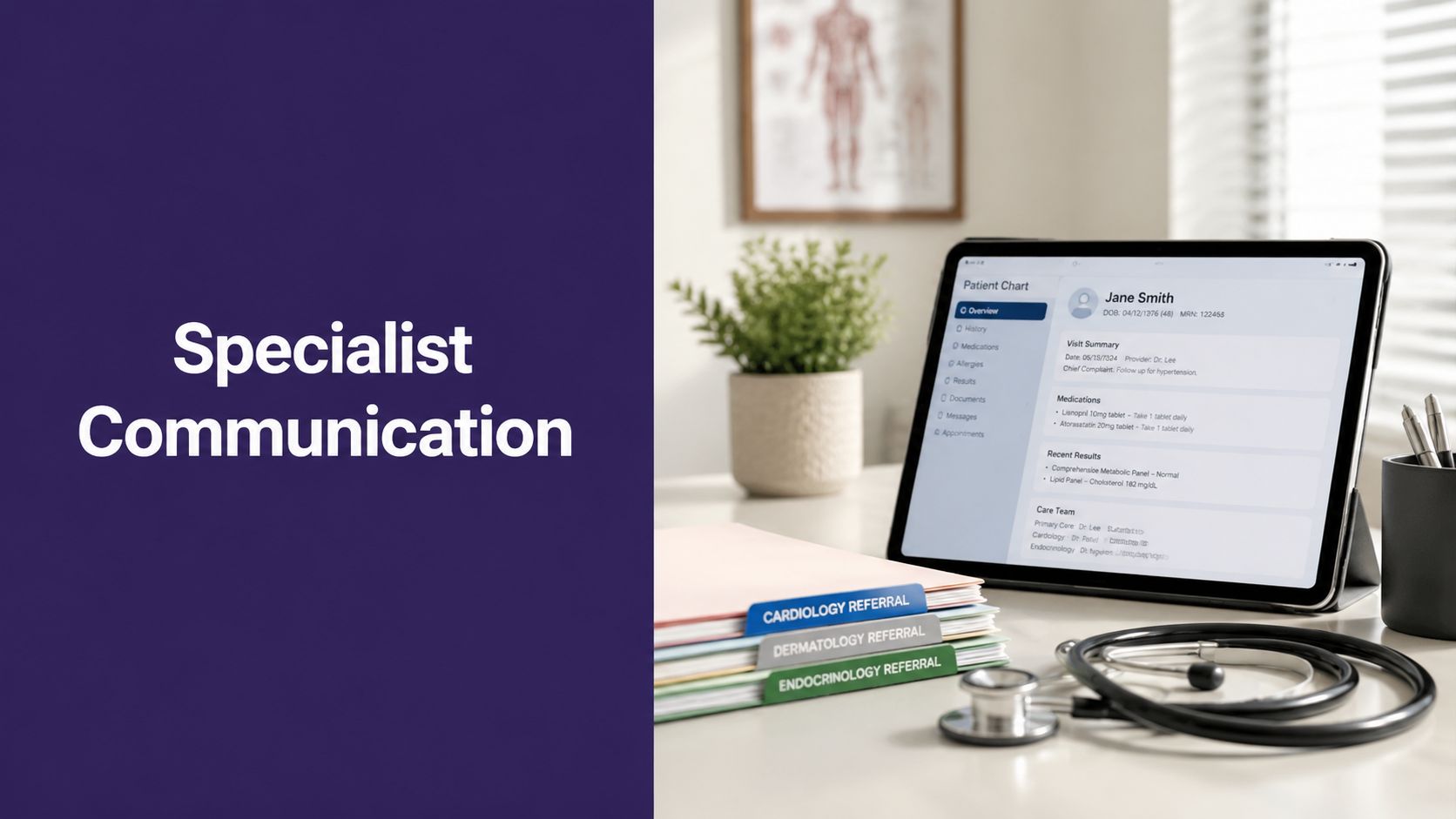
A referral lands from primary care on Monday. By Thursday, the patient still hasn't been scheduled because the fax was incomplete, the portal message sat unread, and nobody confirmed who owned follow-up. Meanwhile, the patient calls twice for an update, gets voicemail once, waits on hold once, and starts looking elsewhere. That's specialist communication in practice for independent GI, dermatology, and internal medicine practices.
For small and midsize specialty groups, specialist communication isn't an abstract care-coordination idea. It's the daily chain of referrals, chart messages, test results, scheduling calls, refill requests, and provider handoffs that either keeps the practice moving or gradually drains it. The fix usually isn't one more staff reminder. It's a tighter workflow, clearer ownership, and better systems where they matter most.
Meta description: Improve specialist communication with practical workflows that reduce missed handoffs, protect staff time, and strengthen referral, scheduling, and follow-up operations.
The High Cost of a Single Dropped Handoff
It usually starts with something small. A primary care office sends a referral for a GI consult. The diagnosis is there, but the medication list is outdated and the insurance note is missing. Your scheduler flags it for review, then gets pulled into inbound calls. The referral sits. The patient assumes your office is slow. The referring office assumes your team dropped the ball. Nobody is fully wrong, but the result is the same.
That same pattern shows up everywhere in specialty care. A dermatology patient calls for biopsy results, and the front desk can't tell whether the message belongs with a medical assistant, a nurse, or the ordering clinician. An internal medicine practice gets a discharge summary after the patient has already called twice with medication questions. A specialist gets interrupted for a routine status check that should've been resolved in a structured message.
The damage from poor communication rarely looks dramatic at first. It looks like delay, duplication, confusion, and staff frustration.
Independent practices feel this more sharply because there's less slack in the system. One missed referral, one unreturned result call, one unclear refill request can ripple across the whole day. It affects patient retention, referral confidence, staff morale, and provider focus.
If your current referral process still depends on incomplete forms, verbal handoffs, or inbox guessing, it helps to standardize the intake itself. A simple specialist referral form template can tighten the front end before the patient ever calls your office.
Why Specialist Communication Constantly Breaks Down
Specialist communication breaks down because most practices are still running critical handoffs across too many channels at once. Referrals come by fax, portal, phone, and PDF. Test result questions hit the phones while refill requests sit in the EMR queue. PCP offices expect fast confirmation, but your staff may still be piecing together records from eClinicalWorks, Athenahealth, Epic, DrChrono, or specialty systems that don't share context cleanly.
A patient only sees the surface. They just know they called and didn't get an answer.

The safety stakes are not theoretical. A landmark study by The Joint Commission determined that 80% of serious medical errors were the direct result of miscommunication between caregivers during critical periods of patient care (review of the Joint Commission finding). When specialty practices treat communication as an administrative nuisance instead of a clinical process, they create avoidable risk.
Where breakdowns happen most often
In community specialty practices, the failure points tend to cluster in a few places:
- Referral intake: Missing records, unclear reason for consult, and no confirmation back to the referring office.
- Results communication: Staff can see that something is final, but not who owns patient notification or what script should be used.
- Front-desk triage: Calls that sound simple at first, then turn clinical midway through the conversation.
- Post-visit follow-up: Instructions were given, but nobody verifies the patient understood prep steps, medication changes, or follow-up timing.
Some of these are workflow failures. Some are tool failures. Most are both.
Why specialty clinics feel it more
Dermatology, GI, and internal medicine each have their own friction points. GI deals with prep instructions, pathology follow-up, and procedure scheduling. Dermatology manages high visit volume with image-heavy documentation and frequent result communication. Internal medicine handles broad chronic disease coordination, where messages often span clinical and administrative categories.
Practical rule: If a staff member has to stop and ask, “Whose job is this message?” the workflow is already too loose.
That's why specialist communication has to be treated like a care pathway. Ownership must be explicit. Channels must be limited. Confirmation must be built in.
The Hidden Operational Costs of Bad Communication
Poor communication doesn't just create risk. It burns time all day long, and that cost is easy to underestimate because it's spread across small interruptions. A callback here, a duplicate chart review there, a referral chase at lunch, a pharmacy clarification at 4:45 p.m. None of it looks catastrophic in isolation. Together, it slows the entire practice.
A time-motion study found that communication accounts for exactly 24% of the work time of specialists (hospital time-motion study). For an independent specialty practice, that means nearly a quarter of specialist capacity is tied up in communication tasks rather than direct patient care.
What that looks like in practice
The operational drag usually shows up in familiar ways:
- Lost referrals: The patient was interested, the referring office did its part, but the scheduling chain broke before the visit was booked.
- Staff fatigue: Front-desk teams spend the day switching contexts between phones, portals, faxes, refill requests, and messages from clinicians.
- Provider interruption: Physicians get pulled into non-urgent communication because the practice hasn't defined escalation rules well enough.
- Revenue leakage: Missed calls and scheduling delays often become unfilled slots, not just temporary inconvenience.
For many administrators, the turning point comes when they stop calling this a “communication issue” and start treating it like access infrastructure. That also includes digital usability. If forms, portals, reminders, and online scheduling tools are hard to use, communication breaks before a human even steps in. This broader view of healthcare accessibility is worth paying attention to because access failures often begin upstream.
What doesn't work
Adding more inboxes doesn't work. Telling staff to “communicate more” doesn't work. Piling manual checks on already busy teams doesn't work either.
A loose process creates heroic behavior. Someone stays late, remembers a callback, catches a missing note, and saves the day. That feels good in the moment, but it's not a system. It's a staffing risk.
Implementing a Closed-Loop Communication Workflow
A better system starts with one principle. Every important handoff needs a sender, a receiver, and confirmation that the message was completed. Without that loop, referrals stall, results sit, and patients fall into the gap between offices.
For specialty practices, closed-loop communication works best when it's boring. Standardized. Repeatable. Easy to audit.

Build the loop around referral ownership
A referral should move through a set sequence, not a shared assumption.
Intake with required fields
The receiving team confirms reason for consult, urgency, payer details, key records, and contact information before the referral enters scheduling.Clinical review when needed
If a GI referral needs prep, prior scope history, or medication context, that review should happen before the scheduler starts calling the patient.Scheduling attempt with documented outcome
Not “called patient.” Documented outcome. Reached, left voicemail, needs records, declined, scheduled, or returned to referring office.Confirmation back to sender
The PCP office should know whether the patient is scheduled, still pending, or missing required information.
Closed-loop communication is less about speed than certainty. People can work with a delay. They can't work with silence.
This is especially important when practices are splitting workflows across eClinicalWorks, gGastro, EMA ModMed, Athenahealth, Epic, and DrChrono. If the data doesn't transfer cleanly, your process has to compensate with clear checkpoints.
Don't automate a broken note template
Automation helps only when it matches the specialty workflow. That's where many practices get burned. A significant challenge in automation is specialty-specific compliance; 42% of dermatology/GI practices report AI-generated chart notes failing specialty documentation templates, requiring manual correction that negates the intended benefits (specialty documentation findings).
That's why note structure matters. A dermatology template that expects lesion history and treatment response is different from a GI template built around procedure history, HPI detail, and prep instructions. Generic automation often fails because it ignores that distinction.
A practical outside resource on process design is this guide to workflow automation benefits, especially if your team is still deciding which workflows should stay manual and which should be standardized.
For practices trying to tighten these handoffs inside the charting workflow, EHR-integrated care coordination tools are useful only if they mirror the existing handoff steps your staff already has to manage.
Using AI Medical Staff to Support Your Team
At 4:47 p.m., a referring PCP sends over a patient with rectal bleeding, the patient calls twice before close, nobody answers, and the chart sits untouched until morning. In an independent GI, Derm, or IM practice, that is not just a service miss. It can turn into a lost consult, a delayed workup, and revenue that never makes it onto the schedule.
That is why AI medical staff is worth evaluating as an operations tool, not just a phone tool. The right system takes repetitive communication work off the front desk and keeps routine handoffs from dying in voicemail, sticky notes, and half-finished tasks.
Where voice AI actually helps
In specialty practice, the best use cases are specific. Scheduling new referrals. Collecting registration details before the visit. Routing refill requests to the right queue. Reinforcing prep instructions. Following up after visits. Reaching patients who do not answer during business hours. Those are the jobs that consume staff time, create bottlenecks, and still need consistency every single day.
Used well, voice AI supports both administrative work and structured patient communication. It should answer common questions, document the interaction, and hand the call to a person when the situation is clinically sensitive, unclear, or off script. That trade-off matters. If the tool tries to handle edge cases it should escalate, staff stop trusting it fast.
Healthcare providers have reported up to a 40% reduction in missed calls after deploying voice AI specifically for scheduling workflows (voice AI in scheduling operations). For independent practices, fewer missed calls usually means more booked visits, fewer referral leaks, and less staff time spent returning calls that should have been answered the first time.
What to look for before rollout
A polished demo does not tell you much. Day-two performance does.
Use a short checklist during evaluation:
| Capability | Why it matters in specialty practices |
|---|---|
| 24/7 call handling | Patients call after hours, during lunch, and while staff is tied up with rooming or procedures. Coverage outside peak desk hours prevents silent loss. |
| Zero hold times | Monday mornings, post-procedure windows, and referral surges create call spikes that a small front desk cannot absorb alone. |
| 100% inbound call capture | Every missed new-patient call is a potential consult lost to another group. |
| EMR integration | Staff should not have to retype call details into eClinicalWorks, gGastro, EMA ModMed, Athenahealth, Epic, or DrChrono. |
| HIPAA-compliant security | Patient communication belongs inside healthcare-grade privacy controls. |
| SOC 2 Type 2 certification | Practice leadership needs proof of operational controls, not marketing copy. |
The critical test is whether the system fits the workflows that make or break specialty revenue. Can it follow your scheduling rules by visit type? Can it capture enough context to route a symptom call correctly? Can it reinforce prep, biopsy follow-up, medication instructions, or no-show recovery without creating more cleanup for staff? Those are the questions that matter more than whether the voice sounds polished.
Teams evaluating this space often start by reviewing how a voice AI agent for healthcare practices handles real call flows, then comparing that with available EMR and system integrations. The closer the fit with your actual intake, scheduling, and documentation rules, the lower the rework burden after go-live.
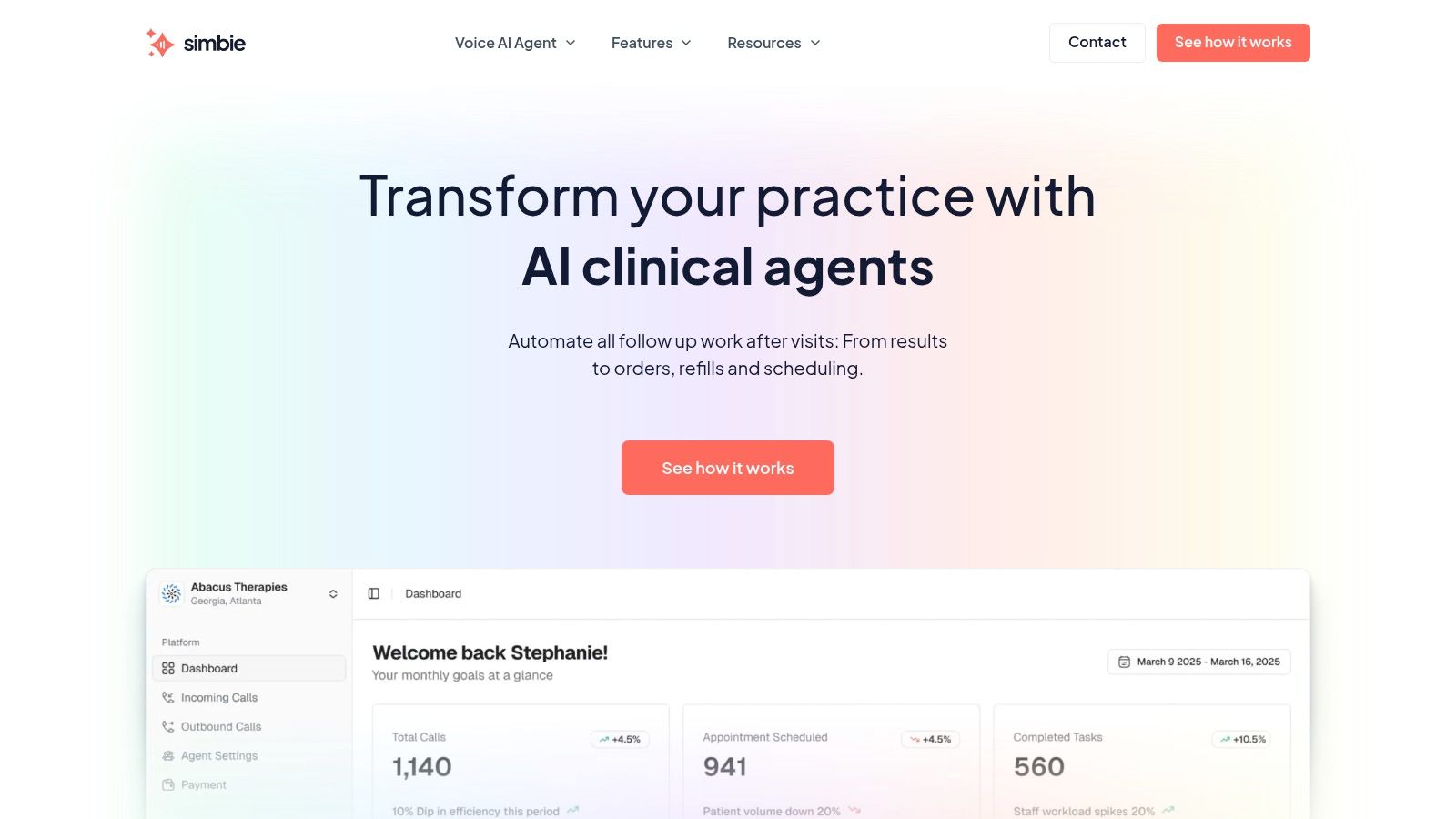
Cost still matters. So does scope. A tool that only answers calls may help at the margins, but independent specialty groups usually need broader support across front-office communication and repeatable patient outreach. Simbie AI is built as AI Medical Staff rather than a basic answering service, with support for both layers of work while offering up to 60% reduction in front-office staff costs, 100% of inbound calls captured, and 24/7 availability with zero hold times. It is also HIPAA-compliant and SOC 2 Type 2 certified, with clinical design shaped by physicians from Stanford, Yale, Columbia, and Princeton.
Measuring Success and Protecting Doctor's Time
If the workflow is improving, you should see it in a small set of operational measures. Not dozens. Just the ones that reveal whether communication is becoming more reliable.
Track the signals that matter
Use a short scorecard each month:
- Referral completion rate: Of the referrals received, how many become scheduled visits?
- Time to patient notification: How long does it take to communicate routine results or next steps?
- Phone abandonment or missed-call trend: Are patients reaching the practice when they call?
- Manual message escalation volume: How often does routine communication still need clinician intervention?
These measures tie directly to one operational principle: Protecting Doctors' Time for Doctoring. If staff can resolve more communication inside a defined workflow, physicians get fewer avoidable interruptions and more usable clinical time.
A calmer practice is usually a more measurable one. When ownership is clear, the numbers get easier to trust.
There's also growing evidence that well-designed voice systems can support clinical communication safely. A large-scale safety evaluation found that generative voice agents achieved medical advice accuracy rates exceeding 99% with no instances of potentially severe harm in simulated patient interactions reviewed by licensed clinicians (safety evaluation of generative voice agents). That doesn't replace clinician judgment. It does support the case for using clinically trained systems in structured, supervised workflows.
The best outcome isn't flashy. It's a practice where referrals move, patients get answers, staff can breathe, and doctors spend more of the day on medicine.
If you're evaluating AI for your practice, Simbie AI is built as AI Medical Staff for independent specialty clinics, covering both front-office operations and clinical support workflows. You can see it in action at book a demo.