
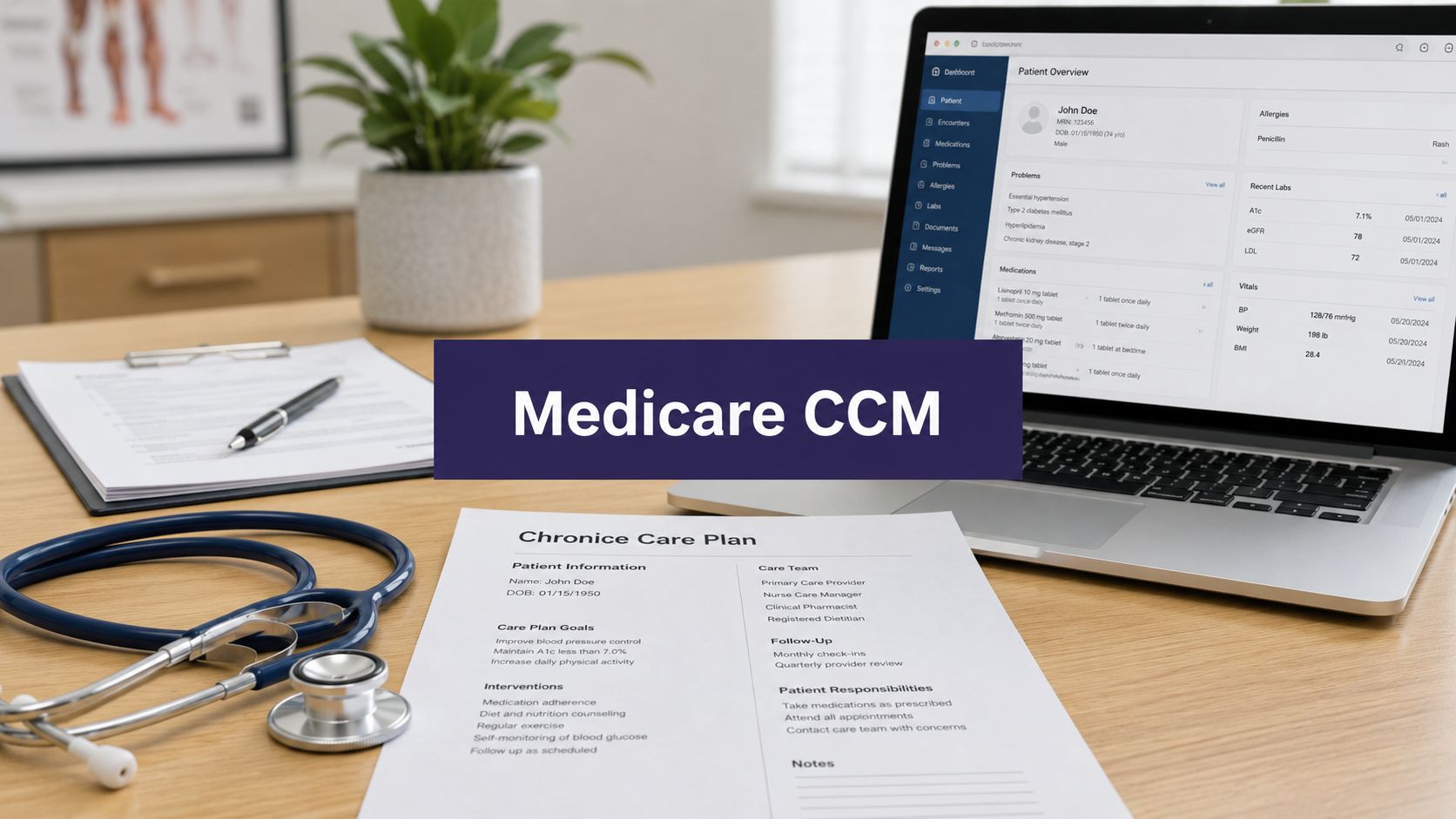
Medicare chronic care management sounds simple on paper. In a real clinic, it usually breaks down in the same places: no one owns enrollment, time isn't tracked correctly, consent is buried in a note nobody can find, and the monthly work gets done without clean documentation to support a claim.
If you're running an independent or community-based practice, that's the core issue. Not whether CCM is a good CMS idea. The issue is whether your team can turn Medicare chronic care management into a repeatable, compliant workflow that secures payment. That's what this guide covers.
Meta description: Medicare chronic care management made practical for small practices. Learn billing rules, workflow fixes, and how to run CCM without staff overload.
What Is Medicare Chronic Care Management Really
Medicare chronic care management is Medicare's way of paying practices for the between-visit work they already do for complex patients. That includes care planning, medication review, support during care transitions, and giving patients a way to reach the care team when problems come up outside the exam room.
This is not a niche program. CMS says it applies to patients with 2 or more chronic conditions expected to last at least 12 months or until death, and CMS created it because nearly two-thirds of the 40 million Medicare fee-for-service patients have multiple chronic conditions and account for over 90% of all spending in that program, according to CMS chronic care management guidance.
What CCM means in daily operations
For a practice owner, CCM is not just a billing code. It's a service line. You are agreeing to run an ongoing support process for patients who predictably need more than episodic visits.
That means your practice needs all of the following to happen consistently:
- A documented care plan: The plan has to be more than a vague problem list. It should guide monthly outreach and escalation.
- 24/7 access: Patients need a way to reach the team for urgent needs, not just during front-desk hours.
- Care coordination: Someone has to handle medication issues, transitions, and communication with other clinicians.
- Monthly follow-through: Enrollment alone does nothing. The operational value comes from repeated contact and documentation.
Practical rule: If your staff can't describe who calls the patient, where time is logged, and where consent lives in the chart, you don't have a CCM program. You have a compliance risk.
Why small practices should care
Independent internal medicine, GI, and specialty clinics often already carry this workload. The problem is that they carry it informally. Nurses answer calls. MAs chase refills. Front-desk staff pass along messages. Providers ultimately clean up the mess.
CCM gives structure to that work, but only if you build it deliberately. If you need a patient-level breakdown of qualifying diagnoses, this guide on conditions that qualify for chronic care management is useful for enrollment planning.
Why Bother with CCM A Guide to the ROI for Your Practice
Most practices don't skip CCM because they doubt the clinical need. They skip it because they expect operational pain. That's fair. A sloppy CCM program burns staff time and invites denials. A disciplined one can become a dependable monthly service with real staying power.
The market signal is clear. Avalere reported 6.5 million CCM claims in 2023, nearly 1.3 million Medicare beneficiaries receiving any CCM service, and average annual utilization growth of 7.4% from 2019 to 2023, according to Avalere's CCM utilization analysis. That tells you providers are not treating CCM like an experiment anymore.
The financial case is straightforward
CCM works best when you stop thinking of it as extra paperwork and start treating it as recurring care delivery. Monthly reimbursement follows monthly execution. If the workflow is sound, that recurring structure is valuable in a practice environment dominated by irregular call volume, staffing gaps, and visit-based revenue swings.
Avalere also cited CMS-linked evidence estimating CCM saves about $74 per member per month, or $888 annually per beneficiary, which helps explain why payer and provider interest keeps expanding in this model.
The best reason to add CCM is simple. Your team is already doing a lot of this work for free.
The soft ROI matters too
Practices usually underestimate the downstream benefits. A good CCM program gives high-need patients a reason to stay connected to your office instead of drifting into fragmented care. It also creates a cleaner structure for medication review, symptom follow-up, and triage before a simple issue turns into a chaotic callback chain.
That matters in independent practices where the phone is still the front door.
A few practical gains show up quickly:
- Better retention: Patients who hear from your team between visits are less likely to treat your practice as interchangeable.
- Cleaner follow-up: Monthly outreach creates a natural path for check-ins, refill review, and escalation.
- Less reactive work: Structured outreach reduces random, last-minute crisis calls.
- Stronger staff focus: When the workflow is defined, your clinical team spends less time reinventing the process each month.
When CCM is worth it
CCM is worth doing when you can answer yes to three questions.
- Can you identify eligible patients reliably?
- Can you document monthly work without heroic effort?
- Can you maintain access between visits without crushing your staff?
If the answer is no, don't abandon CCM. Fix the workflow first. That's where most clinics get the return.
Decoding CCM Billing Eligibility and CPT Codes
Most claim problems in CCM are not mysterious. They come from a short list of preventable misses: the wrong patient, no qualifying visit, incomplete consent, weak care plan documentation, or bad time logging.
CMS does not grade this on effort. It grades it on whether the required elements are present.
The non-negotiable eligibility rules
For standard CCM billing, the patient must have 2 or more chronic conditions expected to last at least 12 months or until death, and those conditions must place the patient at significant risk of death, acute exacerbation, or functional decline. For new or inactive patients, an initial face-to-face or Annual Wellness Visit must have occurred within the past year before billing. The care plan must be electronic within a certified EHR, address physical, mental, psychosocial, and environmental needs, and require patient or caregiver consent to implement.
If your team misses the initiating visit requirement, the rest of the month doesn't matter. The work may be clinically useful, but it's not billable.
The time thresholds that decide payment
The strict requirements for billing often lead to financial losses for many practices. CPT 99490 requires a strict minimum of 20 minutes of non-face-to-face clinical staff time per calendar month. CPT 99487 requires 60 minutes plus moderate-to-high complexity medical decision-making. CMS states these thresholds clearly in the MLN chronic care management billing document.
If you log 19 minutes for 99490, you do not get partial credit. If you log 59 minutes for 99487 and do not meet the complexity standard, you have a problem. This is one reason practices that “know they did the work” still get denied.
Billing reality: Time in CCM is a gatekeeper, not a rough estimate.
CCM CPT Code Comparison
| Requirement | Standard CCM (CPT 99490) | Complex CCM (CPT 99487) |
|---|---|---|
| Minimum monthly clinical staff time | 20 minutes | 60 minutes |
| Decision-making complexity | Standard CCM requirements | Moderate to high complexity medical decision-making required |
| Type of service | Non-face-to-face chronic care management | More intensive chronic care management for complex patients |
| Billing risk if time threshold is missed | Claim denial if the minimum is not met | May revert to standard CCM or be denied if time or complexity is not met |
What your billing team should verify every month
A strong monthly review is usually more effective than trying to fix errors after claim submission.
- Patient status: Confirm the patient still fits the enrolled CCM population and isn't double-booked into conflicting care management workflows internally.
- Consent documentation: Make sure the chart shows clear consent, not a vague mention that staff discussed the program.
- Initiating visit: Check that the required visit occurred within the allowed window for new or inactive patients.
- Care plan presence: Verify the care plan is current, electronic, and visible in the record.
- Exact time logs: Use actual cumulative monthly activity, not rough staff memory.
If your team wants a code-specific reference, this breakdown of chronic care management CPT codes is a useful companion for training billers and care coordinators.
Building a Compliant CCM Workflow in Your Practice
Most clinics don't fail at CCM because the rules are too hard. They fail because nobody builds a workflow that fits a real workday. The fix is to stop treating CCM as side work and assign it a defined operating model.

Start with the patient list, not the phone calls
Pull a candidate list from systems your staff already uses, such as eClinicalWorks, Athenahealth, DrChrono, Epic, EMA ModMed, or gGastro. Don't ask nurses to remember who “might qualify.” Build a report around chronic diagnoses, recent visit history, and active Medicare coverage, then hand that list to one owner for review.
The biggest early mistake is loose eligibility. If you enroll the wrong patients, every step after that creates cleanup work.
A practical setup looks like this:
- Generate a draft roster from the EMR.
- Have a clinician validate fit for risk and appropriateness.
- Segment by readiness, such as recently seen, needs initiating visit, or not yet contactable.
If your team is reviewing whether your system setup meets documentation expectations, this plain-language guide about EMR certification is worth reading before you finalize your CCM workflow.
Standardize consent and care plan creation
Do not leave consent to improvisation. Staff need a short script that explains what CCM includes, that it is billed monthly, and that Medicare cost-sharing may apply. Then they need one place in the chart where consent is always recorded.
The same goes for the care plan. Create a template that covers medication review, current conditions, specialist involvement, goals, barriers, and escalation instructions. If every coordinator writes it differently, your audit risk goes up and your monthly outreach gets inconsistent.
A stable CCM program usually depends more on templates than on talent.
Track time like it matters, because it does
The cleanest workflow uses one running log per patient per month. Every qualifying activity gets entered when it happens. Not later. Not from memory at month end.
Your time log should connect the activity to the patient and the chart. Common entries include outreach calls, medication review, care coordination, care plan updates, and communication with other providers. The note should make sense to a biller and to an auditor.
Three habits separate workable programs from messy ones:
- Log in real time: Retroactive reconstruction is where missed minutes and unsupported claims begin.
- Use a single source of truth: Don't split time across spreadsheets, sticky notes, and inbox flags.
- Close the month deliberately: Someone should review the roster before claims go out and verify threshold, documentation, and code choice.
Assign ownership before launch
CCM dies in committee. One person should own enrollment operations. One person should own documentation review. One person should own claim readiness. In smaller clinics, one person may wear multiple hats, but the ownership still needs to be explicit.
If you skip this step, the program turns into shared responsibility, which usually means no responsibility.
Supercharging Your CCM Program with AI Medical Staff
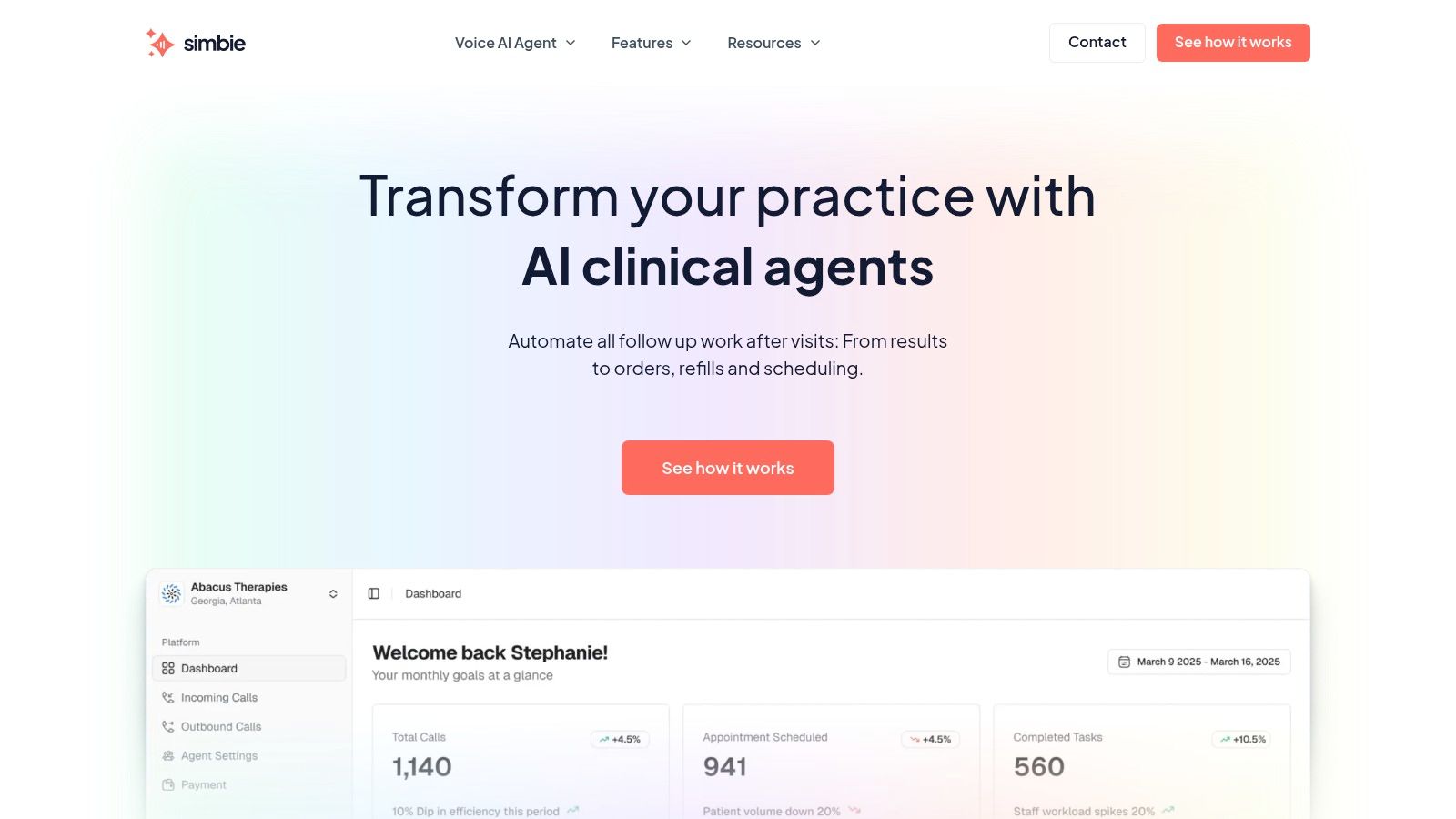
Manual CCM is possible. It's also fragile. One sick staff member, one heavy Monday, or one backlog in refill calls can throw off the whole month. That's why more practices are moving routine outreach and documentation support into automation.
Where AI actually helps in CCM
This is not about replacing physicians. It is about handling repetitive work with better consistency than an overextended front office can maintain.
An AI medical staff layer can support CCM in practical ways:
- Outbound monthly check-ins: Patients get contacted on schedule instead of when the team finally has time.
- Inbound access coverage: Calls don't vanish into voicemail after hours or during lunch.
- Documentation support: Patient interactions can be structured and written back into workflows tied to the chart.
- Medication and education follow-up: Refill coordination, adherence reminders, and basic education can happen without constant staff chasing.
- Escalation routing: Issues that need clinical judgment can be sent to staff quickly instead of buried in callback queues.
For clinics handling medication-heavy populations, tools like a PDF AI medication analyzer can also help teams review medication documents more efficiently during reconciliation workflows.
The operational fit matters more than the AI label
If a platform can't work inside your real systems, it won't fix CCM. It needs to support front-office and clinical workflows together. That means scheduling logic, refill handling, patient education, chart documentation, and integration with systems like eClinicalWorks, Athenahealth, EMA ModMed, Epic, DrChrono, and gGastro.
Many “AI receptionist” products often prove inadequate. CCM doesn't only need call answering. It needs workflow execution tied to compliance.
One option in this category is AI medical staff, which is positioned to cover both administrative tasks such as calls, intake, scheduling, and prescription renewals, and clinical support such as test-result review, adherence check-ins, patient education, and chronic disease outreach. For smaller practices, that matters because the same patient interaction often crosses both operational layers.
What to look for before you trust AI with CCM
Do not buy vague promises. Ask specific questions.
- Can it capture every inbound call? If the answer is no, your access problem remains.
- Can it run after hours? CCM includes ongoing access expectations, not just business-hour convenience.
- Can staff take over mid-workflow? Human-in-the-loop control matters when a patient situation changes.
- Can it document into the EMR? If not, your staff still has to re-enter everything manually.
- Is it secure for healthcare use? HIPAA controls and SOC 2 Type 2 certification are not optional details.
Simbie AI, for example, is built as AI medical staff rather than only a phone bot, supports both front-office and clinical workflows, is available 24/7, captures inbound demand continuously, and is HIPAA-compliant with SOC 2 Type 2 certification. It was built by clinicians from Stanford, Yale, Columbia, and Princeton. In the right practice, that kind of setup can reduce front-office staffing costs by up to 60% while maintaining full call coverage.
Protecting Doctors' Time for Doctoring only works if the technology reduces actual workflow burden, not if it adds another dashboard your staff has to babysit.
Common CCM Pitfalls and How to Avoid Them
The hard part of CCM isn't getting started. It's staying clean after month three, when the novelty is gone and the staff is back under normal pressure.
Pitfall one, bad time tracking
This is the fastest way to lose revenue and create audit trouble. Staff often perform qualifying work but fail to log it in a way that supports billing. Then someone tries to reconstruct the month from memory. That's not a system.
Fix it by making time capture part of the task itself. The interaction is not complete until the time and activity are documented. If your workflow requires a second step later, people will skip it.
Pitfall two, staff overload
Manual outreach sounds manageable until your care coordinator is also covering phones, rooming patients, chasing prior auths, and helping with refills. Then CCM becomes the first thing that slips.
The solution is to remove repetitive tasks from the same small group of employees who already carry the clinic. Use templates, routing rules, and automation for first-pass outreach and documentation. Reserve human time for escalations, exceptions, and clinical judgment.
Pitfall three, weak patient explanations about cost
This one gets avoided in a lot of articles because it's uncomfortable. It shouldn't be. Medicare says CCM falls under Part B, and beneficiaries generally pay a 20% coinsurance after the deductible, according to this consumer-facing CCM coverage explanation. If your staff dances around that, patients will feel surprised and trust will drop.
Give staff a script. Keep it plain.
- Explain the service clearly: Monthly support, medication review, care coordination, and access between visits.
- State the billing reality early: Tell patients there may be monthly cost-sharing under Part B.
- Tie the service to actual access: Patients should understand they are enrolling in ongoing support, not just a code on a claim.
Patients don't usually object to value. They object to unclear value.
Pitfall four, no one owns the program
When everyone “helps with CCM,” nobody protects the process. Enrollment slows. Notes get inconsistent. Claims go out late. Problems linger until they become write-offs.
Pick an owner. Then back that person with defined reports, scripts, templates, and monthly reviews. That's how CCM becomes durable instead of aspirational.
If you're evaluating a practical way to run Medicare chronic care management without adding more strain to your staff, Simbie AI is worth a look, and you can see it in action at book a demo.