
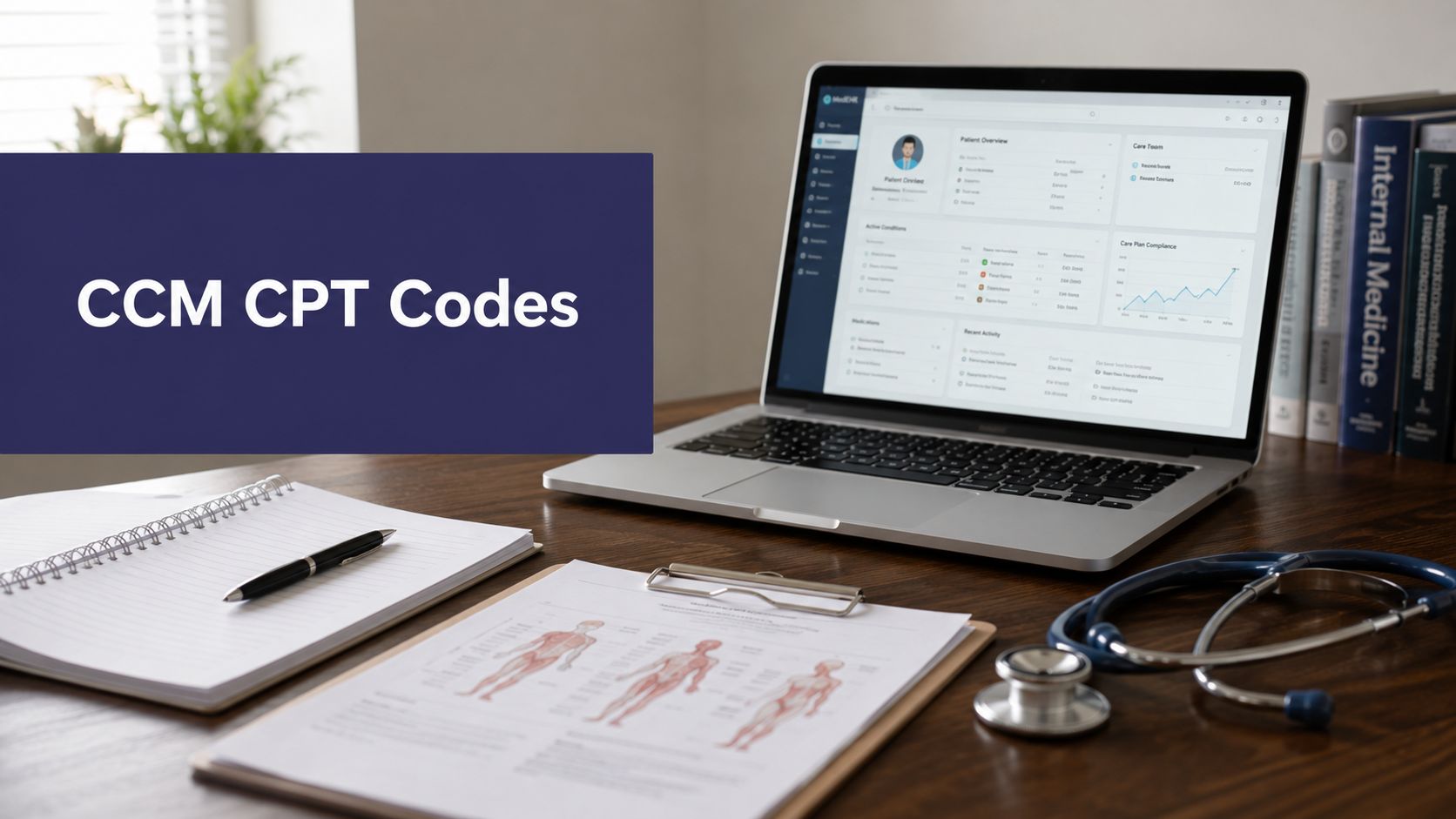
If you run an internal medicine, GI, or dermatology practice, you already know the hard part of chronic care management isn't finding patients who need it. It's turning the work your team is already doing into compliant, billable care. Staff call patients about medications, coordinate with outside specialists, update care plans, and chase follow-ups all month long. Then billing day comes, and half of that work is nowhere in the record.
That gap is why chronic care management CPT codes feel more complicated than they should. The coding rules are manageable. The workflow is what breaks most programs. CMS created the original CCM code 99490 in 2015 for 20 minutes of non-face-to-face services for Medicare patients with two or more chronic conditions expected to last at least 12 months or until death, and by 2019 it had added three more CCM codes for longer or more complex monthly care, according to the HHS ASPE descriptive analysis of CCM and TCM.
For a small or mid-sized practice, that matters for one reason. You need a system that matches real clinic operations, not just a coding cheat sheet.
Introduction
Most practices start CCM with the wrong assumption. They think the challenge is learning the codes. It usually isn't. The main issue is building a repeatable process for identifying eligible patients, getting consent, delivering the service, and documenting the work in a way that stands up to billing review.
The starting point is patient eligibility. At the core, CCM applies to Medicare beneficiaries who have two or more chronic conditions expected to last at least 12 months or until death. If your panel includes patients with diabetes, chronic kidney disease, heart failure, inflammatory bowel disease, or other long-duration conditions, you likely already have a CCM population. What many practices lack is a clean enrollment path.
Consent is the next gate, and it's not optional. Before billing starts, the patient needs to agree to participate, and your team needs a clear record that the discussion happened. In practical terms, that means documenting who obtained consent, when it was obtained, and that the patient understood they were enrolling in CCM. If that step is vague in the chart, everything downstream gets weaker.
Practical rule: If your practice cannot prove eligibility and consent quickly in the chart, it is not ready to bill CCM consistently.
For owners and administrators, the point is simple. CCM works when operations are simple enough for the team to follow every month, even on a busy week.
Understanding CCM Eligibility and Patient Consent
Eligibility sounds straightforward until real-world chart review begins. A patient can be medically complicated and still not be documented well enough for CCM enrollment. Your team needs a checklist, not a hunch.

What qualifies a patient
Start with the two core screens:
- Condition count: The patient must have two or more chronic conditions.
- Expected duration: Those conditions must be expected to last at least 12 months or until death.
That screen should be applied before anyone talks about time tracking or monthly outreach. In Athenahealth, eClinicalWorks, Epic, DrChrono, and similar systems, the cleanest approach is to use a standard enrollment note template that pulls in active diagnoses, identifies the treating clinician, and leaves a dedicated field for CCM consent.
How consent should be handled
Practices get into trouble when consent is treated like a verbal side note. It needs a durable record. That usually means documenting:
- Who explained the program
- When the conversation happened
- That the patient agreed to receive CCM services
- That the agreement was entered into the chart
If your staff has to guess where that documentation lives, you will lose time during audits and rebills.
A simple script helps. Not because patients need a formal speech, but because staff need consistency. The conversation should explain that the practice will provide ongoing non-face-to-face care management, maintain a care plan, and perform monthly coordination work. Then the staff member records the consent in one place, every time.
Where practices lose momentum
Many clinics never get past enrollment because they try to identify patients manually at the end of the month. That's backwards. Build a rolling enrollment workflow tied to recent visits, annual wellness visits, refill requests, and post-discharge follow-up.
The best enrollment lists come from patients your staff is already calling, not from spreadsheets built after hours.
Once a patient is eligible and consent is documented, you can move into the actual code selection. That's where many wish to begin. It shouldn't be.
Foundational CCM Codes for Non-Complex Care
For most independent practices, non-complex CCM is the operational backbone. This is the code set that fits the broadest patient population and the one staff should master before trying to scale more advanced workflows.
CPT 99490 is the workhorse code
CPT 99490 is the foundational non-complex CCM code. It applies to at least 20 minutes of non-face-to-face clinical staff time directed by a physician or other qualified health professional per calendar month, and CMS treats these activities under general supervision, as described in the CMS CCM services guidance.
That definition carries a few practical implications.
First, this is cumulative time across the month, not a single call requirement. A medication reconciliation on one date, a symptom check-in on another, and coordination with a cardiology office later in the month can all contribute if they are legitimate CCM activities and documented correctly.
Second, general supervision gives practices flexibility, but not a free pass. The physician or qualified professional does not have to perform every touch, yet the service still needs clear oversight and defensible records.
What counts as billable staff work
In day-to-day clinic operations, common CCM activities often include:
- Medication reconciliation: Reviewing active medications, adherence issues, refill barriers, and side effects.
- Care coordination: Communicating with outside specialists, home health, dialysis centers, or other treating clinicians.
- Care plan work: Updating the detailed care plan and making sure it reflects current conditions and treatment goals.
- Patient communication: Symptom check-ins, education, follow-up planning, and support related to chronic disease management.
What does not work is vague charting like “left voicemail” with no clinical context and no cumulative time discipline. That kind of documentation may reflect effort, but it usually doesn't support billing.
Where 99439 fits
When your team goes beyond the first monthly block, 99439 covers each additional 20 minutes of non-complex CCM time. Operationally, many practices often start leaking value. They do the extra work but fail to aggregate the minutes consistently enough to support the add-on code.
The fix is mundane, but it works. Use one running monthly log per enrolled patient. Every CCM touch should feed that log. If three staff members interact with the same patient across the month, the record still has to tell one coherent story.
| CPT Code | Time Threshold | Key Use Case |
|---|---|---|
| 99490 | At least 20 minutes per calendar month | Foundational non-complex CCM |
| 99439 | Each additional 20 minutes | Add-on when non-complex CCM work exceeds the first time block |
Operational advice: Do not ask staff to remember billable time from memory at month-end. Capture it when the work happens or you will miss it.
Most practices don't fail 99490 because the rule is hard. They fail because the workflow is loose.
Advanced CCM Codes for Complex Cases
Some patients need more than routine monthly coordination. They have multiple chronic conditions, high instability, and care needs that consume more staff time and clinical judgment. That is where the complex CCM tier belongs.
When care rises to the complex level
99487 and 99489 define the complex CCM tier. 99487 requires at least 60 minutes of clinical staff time per month, and 99489 is an add-on for each additional 30 minutes. CMS also ties this tier to patients with two or more chronic conditions expected to last at least 12 months or until death, with meaningful risk of death, functional decline, exacerbation, or decompensation, according to CGS Medicare guidance on CCM.
That “meaningful risk” language matters. Complex CCM is not just non-complex CCM with more minutes. The patient's condition burden and instability have to justify the level of management.
What complex CCM looks like in practice
Think about the patient with heart failure and chronic kidney disease who is bouncing between medication adjustments, worsening symptoms, and specialist coordination. Or the patient with diabetes and progressive renal disease whose care plan changes repeatedly because adherence, symptoms, and treatment response are moving targets.
Those are not just longer phone calls. They create more intensive coordination, more clinically significant follow-up, and greater documentation expectations.
A useful way to think about the distinction is this:
- Non-complex CCM fits stable chronic disease management with recurring coordination needs.
- Complex CCM fits patients whose chronic conditions create higher risk and heavier monthly management demands.
Documentation has to show why
With 99487 and 99489, the chart needs to do more than list diagnoses and minutes. It should make the complexity visible. If your note reads like routine outreach, the code choice won't look credible.
That means documenting things like:
- Condition burden: Why these chronic conditions create meaningful ongoing risk.
- Clinical changes: Exacerbations, decompensation, or functional decline that increase coordination needs.
- Care plan intensity: Why the patient required more substantial monthly management than a standard CCM enrollee.
| CPT Code | Time Threshold | Key Use Case |
|---|---|---|
| 99487 | At least 60 minutes per month | Initial complex CCM for high-risk patients |
| 99489 | Each additional 30 minutes | Add-on for extra complex CCM time |
The practical mistake is trying to push borderline patients into complex CCM because the team spent a lot of time on them. Time matters, but time alone is not the story. The patient's acuity has to be clear in the record.
A Quick-Reference Guide to CCM Billing Codes
When your billing team is checking charts at month-end, speed matters. This is the short version worth keeping close.
2026 Chronic Care Management CPT Codes
| CPT Code | Description | Time Threshold | Intended Use |
|---|---|---|---|
| 99490 | Foundational non-complex CCM | At least 20 minutes per calendar month | Ongoing non-face-to-face chronic care management by clinical staff under physician or qualified professional direction |
| 99439 | Additional non-complex CCM | Each additional 20 minutes | Add-on to 99490 when cumulative monthly time exceeds the first block |
| 99487 | Initial complex CCM | At least 60 minutes per calendar month | Higher-acuity patients with significant risk and more intensive monthly management |
| 99489 | Additional complex CCM | Each additional 30 minutes | Add-on to 99487 when complex CCM time extends beyond the initial block |
How to use this table correctly
Code selection should follow the record, not the other way around. Start with the patient's clinical profile and the documented monthly work. Then confirm that your time log, care plan activity, and supervision record all align.
If your staff is choosing codes before the month's documentation is complete, you are inviting avoidable denials. The clean process is always the same. Confirm eligibility, confirm consent, track cumulative work, then assign the code that matches the documented service.
Key Documentation and Billing Requirements
Most CCM denials and audit problems come from weak process, not obscure coding trivia. The service has to be visible in the chart. If an outside reviewer opens the record, they should be able to see what was done, why it qualifies, and how the time was accumulated.
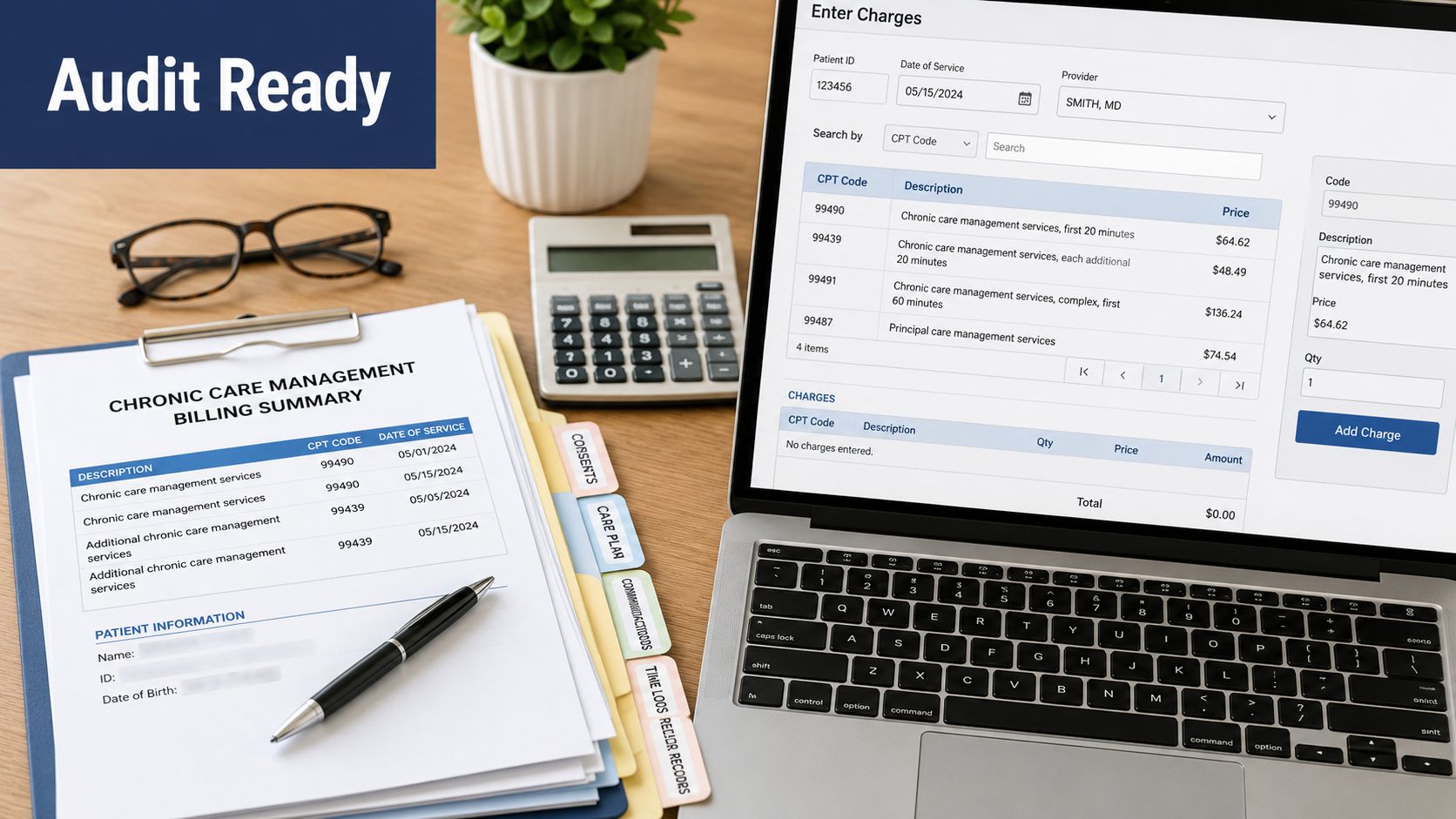
CMS utilization data show that 99490 remains the center of CCM billing, and CMS states that CCM services require structured recording of patient information, a detailed electronic care plan, medication management, and coordinated communication, as summarized in this review of CMS RPM and CCM data.
The care plan has to be real
A detailed care plan cannot be a generic note copied forward for months. It should reflect the patient's chronic conditions, current management approach, and coordination needs. It also has to be accessible in a usable electronic format.
If your team updates medications, changes follow-up instructions, or adjusts coordination tasks, those changes should appear in the care plan or in clearly linked documentation. Otherwise the chart reads like disconnected call notes.
Time tracking must be cumulative and disciplined
CCM is a time-based service. That means every minute you intend to bill needs support. A scattered trail of short notes across the month is not enough unless those notes clearly show time spent and tie back to CCM activities.
Practically, the strongest workflows use:
- One monthly tracking location: A centralized running log inside the chart or billing workflow.
- Staff-specific entries: Each person records what they did and how long it took.
- Linked clinical purpose: The activity should connect to medication management, coordination, education, or care plan work.
A standardized tracking sheet can help teams tighten this process. Practices that want a starting point often use medical billing templates for structured documentation and then adapt them to their EHR workflow.
Build a defensible record
A defensible CCM record usually rests on three pillars:
- Detailed care plan
- Clear cumulative time record
- Documentation showing the coordination work occurred
A short note can support billing if it is specific. A long note often fails if it is vague.
The trap for small practices is assuming that because the staff did the work, payment should follow automatically. It won't. Billing only works when the record makes the work legible.
Building a Sustainable CCM Workflow in Your Practice
A CCM program becomes profitable or painful based on workflow. The code set is stable. The economics are not. If staff spend time chasing unreachable patients, documenting late, or splitting tasks across too many people, the margin disappears.
That is why operational feasibility matters so much. As ThoroughCare's overview of CCM billing rules notes, CCM's margin depends heavily on workflow efficiency, patient reachability, and consistently capturing billable time. If outreach, consent, and documentation are not timed correctly, billable minutes disappear even though staff work still happened.
What breaks in a manual CCM model
In a manual setup, the usual pattern looks familiar. A medical assistant calls the patient and leaves a message. A nurse follows up days later. Someone updates medications in one part of the chart. Another person tries to finish time capture at month-end. The billing team then sees fragments, not a service.
That creates several hidden costs:
- Missed contact attempts: Staff time is spent, but the interaction may not move the CCM episode forward.
- Scattered documentation: Notes live in different parts of Athenahealth, eClinicalWorks, gGastro, or ModMed.
- Incomplete monthly totals: Time gets lost when staff document after the fact.
- Physician frustration: Doctors still get dragged into coordination clean-up because the support workflow is inconsistent.
What a sustainable model looks like
A workable CCM program is more structured than most clinics first expect. It needs assigned ownership and a monthly rhythm.
A practical setup usually includes:
Enrollment owner
One person or team handles eligibility review, consent capture, and the first care-plan setup.Monthly outreach cadence
Outreach is scheduled proactively, not left to spare moments between rooming patients and refill messages.Single time ledger
Every clinical support touch contributes to one running monthly record.Defined escalation path
If a patient reports worsening symptoms, the next step is clear. Staff should not improvise.
If nobody owns CCM operations end to end, everybody touches it and nobody controls it.
Automation then starts to matter. Practices looking at dedicated support tools often evaluate options that manage both communication and clinical documentation layers. That includes platforms designed for chronic care management workflows rather than just reminder calls.
Before and after the workflow shift
Before automation, a practice might rely on staff memory, task inboxes, callback notes, and a billing report at the end of the month. After a workflow redesign, outreach becomes scheduled, the interaction is structured, and the documentation lands where the billing team can use it.
That shift is not about replacing clinical judgment. It is about removing the clerical drag around it. For independent practices, that is usually the only way CCM stops feeling like extra work piled onto an already stretched team.
Protecting Doctors' Time for Doctoring starts with that operational discipline.
How AI Medical Staff Automates CCM Documentation
The hardest part of CCM is not the first month. It is month four, month seven, and month twelve, when consistency matters more than enthusiasm. That's where AI medical staff can be useful, especially for practices that need both patient communication and chart-ready documentation.
Where automation actually helps
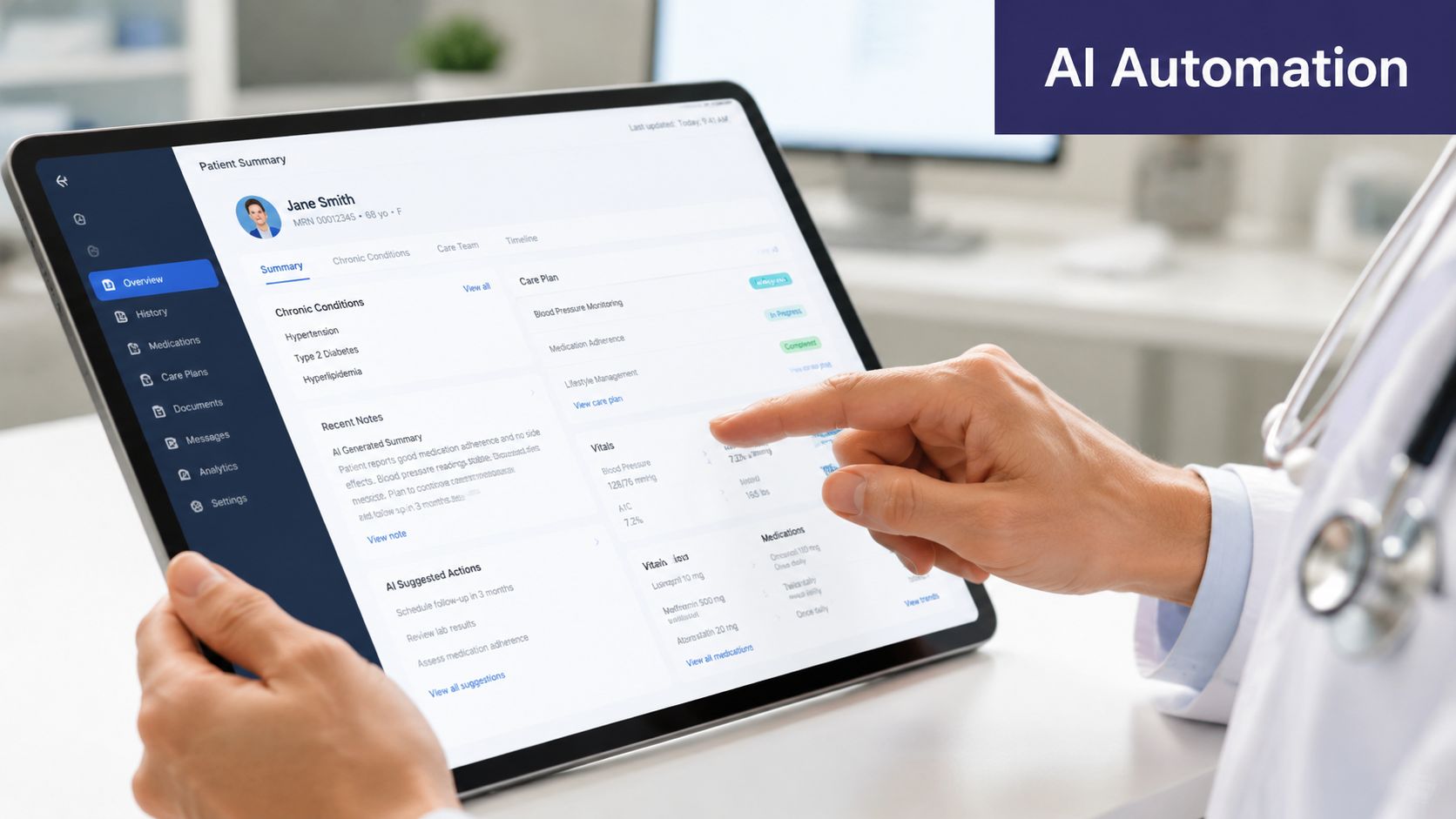
A well-designed AI workflow can handle repetitive, structured outreach that staff often struggle to complete reliably every month. That includes chronic disease check-ins, medication adherence prompts, patient education, refill-related follow-up, and routing responses for escalation when a patient reports a concern.
Used correctly, that changes the documentation burden in three ways:
- The interaction is structured from the start
- Time is captured as the work occurs
- The summary can be posted into the chart in a consistent format
For practices using eClinicalWorks, gGastro, EMA ModMed, Athenahealth, Epic, or DrChrono, consistency is usually more valuable than sophistication. Billing teams need records they can read quickly.
What to ask before you adopt a tool
If you are evaluating an AI workflow for CCM, the important questions are operational:
- Can it support both front-office and clinical support work? A tool limited to answering phones leaves the care coordination problem unsolved.
- Can it document directly into the chart? If your staff still has to retype notes, you have not fixed the bottleneck.
- Can it maintain compliance expectations? HIPAA handling and a serious security posture matter.
- Can it support real clinic volume? Reliable outreach matters more than novelty.
One option practices evaluate is AI medical documentation for healthcare workflows, including chronic disease outreach, structured note capture, and EMR posting. In the broader category, some groups also look at contact-center style infrastructure when they need high-volume communication orchestration, and this overview of a unified contact center platform AI is useful for understanding that operational model.
The right tool should reduce manual chasing, not create another queue to manage.
Frequently Asked Questions About CCM Billing
Can CCM and RPM be billed for the same patient
They can overlap in real operations, but concurrent billing decisions need careful review of current payer rules, documentation boundaries, and whether the time and service components are distinct. This is one area where practices should tighten internal policy before scaling.
What if the patient is hospitalized during the month
A facility stay can affect whether your practice can bill CCM for that period. The key issue is whether your record supports the service performed and whether another setting's billing rules interrupt your claim. Staff should flag these patients early so billing is not reconstructing the month after the fact.
Can outside staff or vendors support CCM
They can participate under the applicable supervision framework if your practice has the right structure in place, but you still own the quality of the documentation, the care plan integrity, and the audit trail. Outsourcing the task does not outsource the compliance risk.
What is the most common reason practices fail with CCM
Operational inconsistency. Not coding knowledge. A clinic can understand the codes perfectly and still lose money if consent is hard to find, patient outreach is irregular, and monthly time capture is incomplete.
What should a practice fix first
Fix enrollment and documentation before chasing volume. A small, disciplined CCM program is usually stronger than a large, chaotic one.
If you're evaluating AI medical staff for CCM, scheduling, intake, refills, documentation, and continuous patient access, you can see how Simbie AI works in a live workflow at book a demo.