
Your schedule is full, the phones won't stop, and the first clinician is already behind before lunch. That's what healthcare workforce management feels like in a small practice when staffing, intake, calls, refills, and follow-up work all hit at once. For dermatology, gastroenterology, and internal medicine groups, the problem usually isn't one vacant role. It's the way every gap cascades into slower access, more friction, and a tired team that spends too much time catching up.
Healthcare workforce management is the operating system behind the front desk, back office, and clinical support flow. The goal isn't just to hire more people. It's to keep the practice moving when someone calls out, the schedule changes, or patient demand spikes, without burning out the people you already have. That's where workflow design, better data, and AI Medical Staff can make a real difference.
The Monday Morning Staffing Reality
Monday morning in an independent practice usually starts with a problem before the coffee is finished. Two front-desk staff call out sick, the refill queue is already building, and a physician is opening charts while waiting for intake paperwork that should have been done the day before. None of that is unusual. It is the kind of morning that shows whether the practice has a staffing plan or only a hope that everyone will push through.
The harder truth is that most practices cannot fix that by adding headcount every time the workflow breaks. The labor market is tight, training takes time, and the work keeps expanding. The World Health Organization describes the health workforce as a major systems issue, and practices feel that pressure locally as missed calls, late starts, and back-office work that never quite clears. Independent groups also have to make practical choices about coverage, intake, and follow-up, which is why resources such as medical office staffing are useful when you are trying to sort out where the gaps really are.
Workforce management is not an HR side task. It is the difference between a practice that can absorb a bad morning and one that spends the whole day in recovery mode.
Practical rule: if a staffing issue regularly turns into a patient-access issue, it is a workforce management problem, not just a personnel problem.
Administrators often also compare their internal hiring process with an AI resume screening tool guide to see where screening work is slowing things down. The point is not to copy a recruiting process from another industry. It is to notice how much time disappears when basic screening, sorting, and triage stay manual.
Independent practices looking at staffing usually start with the basics. Who answers the phone, who handles schedule changes, who clears refills, and who owns follow-up all matter before anyone even gets to the exam room. That is where the hidden productivity cost sits, not in a single empty seat, but in the repeated administrative load that pulls skilled people away from higher-value work.
Core Components of Practice Workforce Management
Good workforce management in a practice isn't a single policy. It's a set of connected operating decisions. If one part is weak, the rest usually absorbs the stress. That's why a 10-provider dermatology clinic and a 25-physician gastroenterology group can't borrow a hospital staffing model and expect it to fit.
Scheduling has to match real visit types
A full calendar doesn't mean a well-run schedule. In dermatology, a biopsy follow-up, a skin check, and a procedure slot don't behave the same way. In GI, new consults, procedure prep, and post-procedure calls all create different labor demands. Internal medicine adds another layer, because chronic care visits often generate more message traffic after the appointment ends.
The workforce question is not “who is available?” It's “who is available with the right credential, the right skill set, and the right timing?” That includes front-desk coverage, back-office triage, and clinical coordination.
The invisible work is usually the pressure point
A lot of practices think the staffing gap is in the exam rooms. In reality, it often shows up at the phone bank, in patient registration, and in refill processing. A healthcare workforce white paper found that time and attendance remains the top manual process, with pain points in employee scheduling requests (57%), managing overtime budgets (52%), and communicating schedule changes (34%) (Infor workforce challenges). Those are operational clues, not just admin complaints.
When the schedule, time tracking, and request process are fragmented, managers end up making decisions with stale information. That's how overtime creeps up and the day turns reactive.
The staffing model also has to account for onboarding. A new hire who needs months to become productive creates a temporary drag before they ever reduce it. Practices that do well here usually standardize training, simplify task ownership, and make sure new staff aren't learning a dozen unofficial workarounds.
For administrators comparing outsourcing and shared-service options, the tips from PEO Metrics can be a useful reference point. Even when a practice doesn't use a PEO, the operational lesson still applies. Simpler processes are easier to manage, train, and scale.

Why Hiring More Staff Is Not the Complete Answer
The reflex makes sense. When phones ring too long and the front desk is buried, the first move is often to hire another person. Sometimes that is the right call. In many practices, though, a new hire lands in the middle of the same broken process and starts absorbing the same friction.
The core issue is that a large share of the work clogging the day is administrative, not clinical. Calls, refill coordination, intake follow-up, schedule edits, and documentation cleanup all take time away from patients. Handle those tasks manually, and the practice keeps paying for them in staff attention, overtime, and turnover risk. The hidden cost is not just payroll. It is the constant interruption of work that should have been routinized long ago.
Capacity grows when repetitive work gets standardized
WHO guidance makes the larger point clearly. Workforce policy should align with primary care, strengthen stewardship, and manage the distribution and productivity of health workers through education, regulation, incentives, and support (WHO health workforce factsheet). For a private practice, the local version of that is process redesign. If every refill request follows a different path, every schedule change depends on memory, and every intake form gets chased by hand, staffing needs climb faster than patient volume.
That is why workflow redesign matters more than raw hiring. It lets existing staff spend less time on low-value repetition and more time on work that requires judgment and empathy. In practical terms, the front desk stops acting like a bottleneck and starts functioning as a support layer again.
The benchmark is not the number of names on payroll. It is whether patient access improves, whether the team feels less reactive, and whether clinicians begin visits with better information. Some practices that adopt AI-supported front-office workflows report relief in coverage pressure and front-office cost burden, but the operational gain is simpler than the buzz around it. Fewer interruptions. Faster response. Less clerical drag.
The AI medical staff overview reflects that shift well. AI medical staff can take on repetitive routing, reminders, and triage-like admin work so human staff can stay focused on the parts of care that need judgment, reassurance, and problem solving.
A useful parallel comes from how AI is reshaping HR management. The same pattern shows up in healthcare operations. Automation is valuable when it reduces the friction that forced the schedule, inbox, and task list to grow in the first place.
Metrics That Actually Measure Workforce Effectiveness
Most practices track headcount, turnover, and maybe overtime. Those matter, but they're lagging indicators. By the time they move, the problem has already been working against you for months. A better measurement approach connects staffing to access, continuity, and day-to-day load.
The WHO-linked measurement framework for workforce impact points administrators toward indicators such as staff ratios, absence rates, waiting times, readmissions, and patient satisfaction, with longitudinal review to catch unintended effects rather than relying on a snapshot (WHO-linked workforce impact framework). That's the right mindset for practices too. Track the process, not just the payroll.
A practical dashboard for an independent practice
| Metric Category | Specific Indicators | Review Frequency | Action Threshold |
|---|---|---|---|
| Access | call abandonment, hold time, missed-call rate | daily or weekly | when patients are waiting or leaving before contact is made |
| Scheduling | unfilled slots, late cancellations, schedule change backlog | weekly | when openings stay empty or rescheduling piles up |
| Intake | incomplete forms, pre-visit delays, paperwork lag | weekly | when appointments start late because data is missing |
| Refill workflow | refill queue age, callback volume, pending approvals | weekly | when requests are sitting long enough to create complaints |
| Staff strain | absence rate, burnout signals, intention to leave | monthly | when coverage issues start repeating across the same roles |
| Patient experience | satisfaction tied to access and communication | monthly | when access problems show up in feedback or complaints |
The best way to use this dashboard is to establish a baseline before making changes. Otherwise, the practice can't tell whether a new workflow improved anything or just shifted the pain somewhere else. That's especially important when you're changing phone coverage, intake, or refill processes at the same time.
Retention can be measured with more discipline than many teams realize. NCBI guidance says retention policies should be tracked with at least intention to leave in the next 12 months, job satisfaction rates by occupational group, and the share of health workers experiencing burnout by occupation (NCBI retention guidance). Those are useful because they turn a vague morale concern into a management signal.
The medical practice metrics resource fits well here because workforce data only matters when it ties back to patient flow. If the metric doesn't help you make a scheduling, staffing, or workflow decision, it's probably not the right metric for the dashboard.
A practice doesn't need more dashboards. It needs a few measures that tell the truth quickly.
AI Medical Staff as Workforce Multipliers
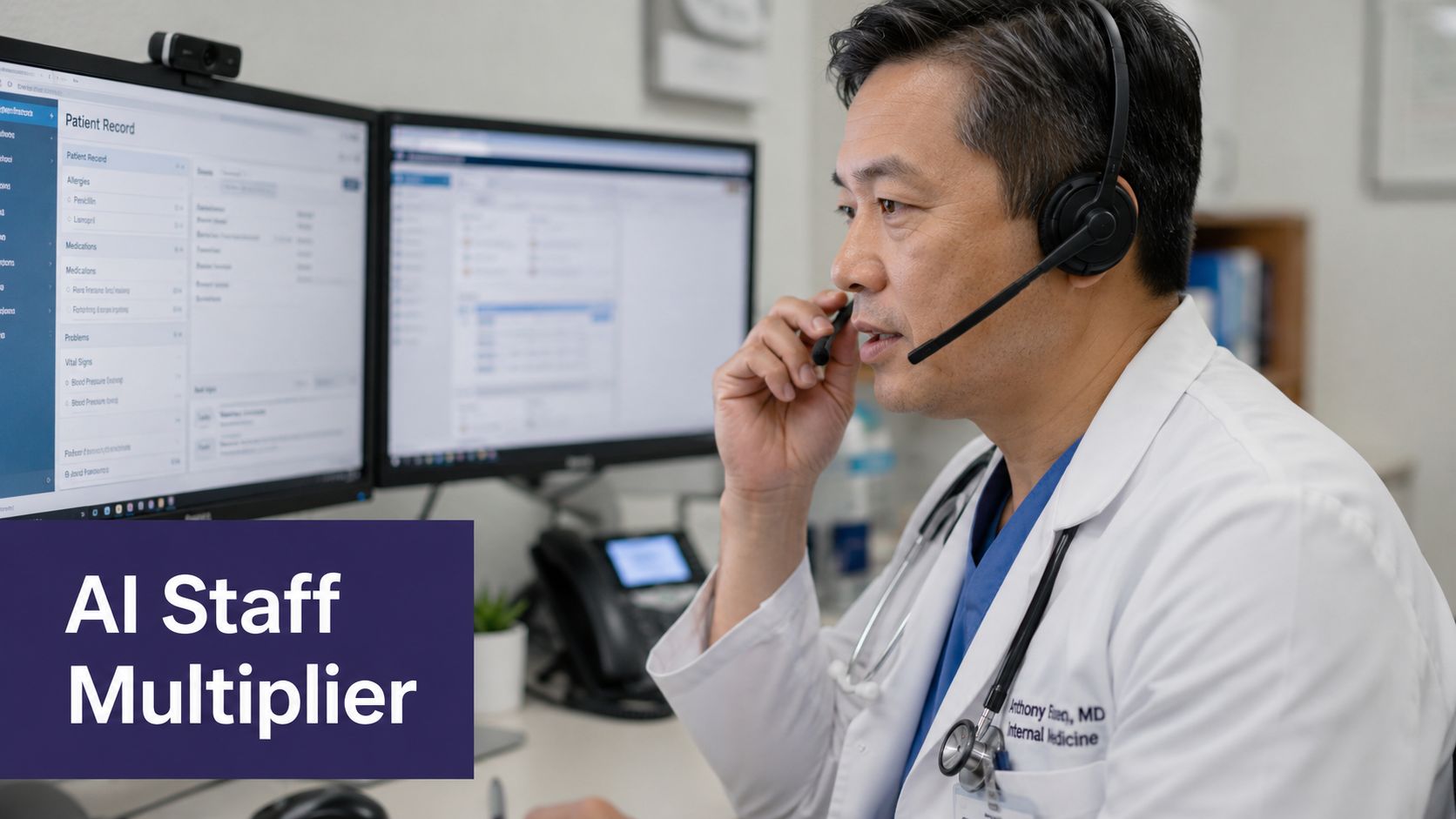
The most useful automation in healthcare workforce management does not try to replace staff. It takes over repeatable work that trained people should not have to babysit all day. That is where AI Medical Staff earns its place in a practice.
Where automation really helps
The front office is where capacity leaks start. Smart call management can answer inbound calls continuously, handle simultaneous calls, and keep the practice from losing contact when staff are busy or the office is closed. Patient scheduling, intake, and refill coordination are the other obvious pressure points. When those workflows are automated with human oversight, staff are not stuck triaging every request manually.
That helps clinicians too. Pre-visit intake and HPI collection mean the visit begins with more complete information. Test result review, patient education, adherence check-ins, and chronic disease management campaigns are all parts of the support load that can be structured so staff are not reinventing the same outreach every day.
For practices using systems like eClinicalWorks, gGastro, EMA ModMed, Athenahealth, Epic, or DrChrono, integration matters more than feature lists. If the tool does not fit the EMR, it creates another workflow island. That is why EMR-connected automation is usually more useful than a separate phone solution that never reaches the chart.
Security cannot be treated casually. Any automation that touches patient data needs HIPAA-compliant controls and clear oversight. Simbie AI is one option in this category, built by clinicians and designed to manage both front-office and clinical support workflows inside existing practice operations. The broader case for AI medical staff is simple, it works best as part of the workflow, not as a side system that staff have to chase down.
What to expect from a sane implementation
The best setup keeps staff in control. AI should handle the routine work, then hand off exceptions. That includes unusual refill questions, unclear patient messages, or anything that needs clinical judgment. The point is to stop using a trained employee as a live switchboard.
If you want a broader management lens on how automation changes people operations, the how AI is reshaping HR management conversation is useful because the same tension shows up in healthcare practices. Good automation removes noise. Bad automation adds another layer for staff to manage.
Implementation Roadmap for Small Practices
The easiest mistake is trying to fix too much at once. Small and mid-sized practices rarely have the slack for a big-bang rollout, and they shouldn't need one. A staged plan works better because it lets the team see results before the next change lands.
Start with a baseline. Measure missed calls, refill backlog, intake delays, and schedule friction for a short period and make the pain visible. Then choose the one workflow that causes the most downstream damage. In many practices, that's the phone queue. In others, it's intake or refill handling.
Phase one focuses on the highest-friction tasks
Pick a narrow starting point. A single location, one provider group, or one workflow is enough. Define who owns exceptions, who reviews the handoff, and what success looks like. That keeps the team from feeling like every process is changing at once.
Phase two adds automation with human oversight
Once the first workflow is stable, expand to the next repetitive task. That might mean scheduling, reminders, pre-visit intake, or follow-up outreach. Staff should know exactly when they can intervene and how to take over. The best systems don't remove judgment, they reduce the number of times judgment is needed for routine work.
Phase three connects the work back to the chart
When the practice trusts the first layers, bring in deeper integration and documentation support. That's where the workflow starts to feel less like a patch and more like part of the operating model. Patient data stays organized, handoffs improve, and managers get a cleaner view of what's happening.
Frontline staff need to be part of this from the start. If they only hear about automation after the fact, they'll assume it's a staffing cut. If they help shape the workflow, they usually spot the exceptions leadership would miss.
The most successful rollout is usually the one that makes a hard day a little less hard, then proves it again the next week.
Building Sustainable Workforce Advantage
The practices that get this right won't look magical. They'll just be steadier. Calls get answered, schedules hold up, clinicians start on time more often, and the staff isn't constantly making up for broken handoffs.
That steadiness matters because workforce pressure isn't going away. The WHO says women make up 67% of the global health workforce, which means staffing policy has to think carefully about retention design, leadership development, and pipeline planning (WHO health workforce). In the U.S., the scale is just as telling. Healthcare employed nearly 18 million people in 2024, nursing remained the largest health profession with more than four million RNs, LPNs, and APRNs, and HRSA projects the physician workforce will meet only 90% of estimated demand in 2026 and 87% in 2036 (HRSA workforce report). That means practices that can manage workload well will have a real advantage in recruiting, retention, and patient loyalty.
The phrase Protecting Doctors' Time for Doctoring moves beyond a slogan to become a practical reality. When the practice reduces administrative drag, doctors and staff can spend more time on the work patients came for. The result is a more resilient practice, not a perfect one. That's the right goal.
If your team is still losing time to missed calls, manual intake, refill bottlenecks, or disconnected follow-up work, it's worth seeing how AI Medical Staff fits into the workflow you already run. Visit Simbie AI to see how it supports scheduling, intake, calls, refills, and clinical follow-up without asking your practice to rebuild everything from scratch.