

Most medical office staffing problems don't start with a hiring shortage. They start with a front desk that's absorbing chaos all day, a clinical team doing clerical work between patients, and a manager who knows everyone is busy but can't say exactly where the system is breaking.
I've seen this pattern in small private practices, multisite groups, and specialty clinics. The office feels understaffed, so leadership posts another job. Then nothing really gets better, because the underlying issue wasn't headcount alone. It was role drift, bad scheduling logic, and too much low-value admin work sitting on the wrong people.
This is the current conversation about medical office staffing now. You do need enough people. But if your workflows are weak, adding staff just makes an expensive mess more comfortable.
First, diagnose your practice's real staffing needs
A chaotic morning at the front desk usually looks the same. Phones are ringing. Check-ins are backed up. Someone is asking a medical assistant to track down an insurance issue. The physician is already running behind, and by 10 a.m. the whole office is reacting instead of operating.
That scene matters because office-based care is where most care happens. About 71% of patient care practicing physicians in the United States work in office-based settings, and a projected shortage of 141,160 full-time equivalent physicians by 2038 puts even more pressure on practices to staff well according to Dialog Health's healthcare staffing statistics roundup. If you run an office, you are not on the edge of the staffing problem. You're in the center of it.

Stop staffing by gut feel
Most practices I've worked with say some version of, “We're slammed, so we need another person.” Sometimes that's true. Often it isn't.
You need a short diagnostic review before you approve another hire. I'd start with four questions:
- Where does work pile up: Look at call volume, check-in waits, refill requests, prior auth follow-up, inbox tasks, and end-of-day charting spillover.
- Who is doing work below their role: If MAs are spending chunks of the day on phones or physicians are fixing scheduling errors, your staffing model is off.
- What's your real capacity by daypart: Don't use the schedule template on paper. Use what happened over the past few weeks.
- Which delays are caused by demand versus confusion: Those are different problems and need different fixes.
Practical rule: If you can't point to the exact handoff where work stalls, you're not ready to hire. You're still guessing.
Audit the workflow, not just the org chart
A proper staffing review is a workflow review. Count the touches in a normal patient journey, from first call through follow-up. Then mark where staff double-handle the same task, where information gets re-entered, and where tasks sit in limbo waiting for someone “when they get a chance.”
I also push practices to calculate their actual support load by provider, not the number they think they have. If two “front desk” staff also spend time on billing, referrals, and refill messages, they are not fully available for reception work. Your headcount can look fine while your usable capacity is not.
A simple planning worksheet helps here. If you need a starting point, this template for scaling businesses is a decent way to organize roles, responsibilities, and staffing assumptions before you change payroll.
Separate the three problems people lump together
In practice, staffing trouble usually falls into one of these buckets:
A capacity problem
You don't have enough coverage for your patient demand.A workflow problem
Work is bouncing between people, getting repeated, or waiting too long in queues.A role definition problem
Team members have fuzzy ownership, so everyone touches everything and nobody owns the outcome.
Those sound similar from the outside because they all create stress. But the fix is very different. If you confuse them, you'll spend money and keep the pain.
Define roles and workflows for peak efficiency
Once you've found the pressure points, make roles painfully clear. I mean clear enough that a new hire, a float staff member, or a covering manager could tell who owns what without asking around.
Vague job descriptions are one of the biggest causes of wasted labor in medical offices. “Helps with phones” and “assists clinical team as needed” sound harmless until five people assume someone else handled a refill request or a prior auth packet.

Write role charters, not vague job descriptions
A role charter should answer four things:
- What outcomes this role owns: Not just tasks. Think “same-day referral submission” or “clean room turnover.”
- What this role does every day: The repeatable work that defines the position.
- What this role does not own: This enables you to stop task creep.
- How success is judged: Use simple measures tied to speed, accuracy, and completion.
That last piece matters. Staff burn out faster when they're blamed for bad results inside a broken process. Clear ownership protects good employees from that.
Map the patient journey on paper
Take one patient visit and map it step by step. Start with the first contact and go through scheduling, pre-visit prep, check-in, rooming, physician handoff, orders, checkout, and follow-up. Don't make it fancy. A whiteboard works.
Then ask where the friction sits. In a lot of offices, the friction isn't in the exam room. It's before and after the visit.
A common example is pre-authorization work. I still see practices hand that task to MAs because “they understand the clinical side.” Sometimes that makes sense. Often it doesn't. A trained admin specialist with a clear process can own much of that work, while MAs stay focused on rooming, patient prep, and direct care support.
If your clinical staff spends the day cleaning up administrative loose ends, you haven't built a staffing model. You've built a workaround.
Fix one workflow before you redesign the whole office
Start with check-in because it touches everything else. In the broken version, patients arrive, forms are incomplete, insurance has to be verified on the spot, phones interrupt staff every few minutes, and the line grows.
In the better version, pre-visit tasks are finished before arrival, the front desk handles exceptions instead of everything, and clinical staff isn't dragged forward to rescue the waiting room.
That is what good medical office staffing looks like in real life. Not more bodies at the desk. Better ownership, cleaner handoffs, and fewer surprises.
Master scheduling, capacity planning, and staffing ratios
Scheduling is where weak staffing decisions become visible. You can hide role confusion for a while. You can't hide a bad schedule. It shows up immediately as long waits, late providers, missed calls, and staff staying after hours to finish work that should've been done during the day.
I don't treat staffing ratios as rigid law, but I do treat them as a serious diagnostic tool. A practical benchmark is a support staff to full-time physician ratio of 4 to 5 to 1, staffing spend in the 25 to 35% range, and a clinical to non-clinical split around 60/40, based on Wolters Kluwer's guidance on medical practice staffing. If your numbers sit far outside those ranges, you should know why.
Use the schedule model that matches your visit pattern
Not every office should schedule the same way.
Block scheduling works better when visit types are predictable and require similar resources. Specialty clinics often do better with this because the day can be built around procedure blocks, consult blocks, and follow-up blocks.
Wave scheduling fits practices that need some elasticity. Primary care often benefits because arrivals and visit complexity vary, and the office needs room to absorb same-day demand without wrecking the whole day.
What matters isn't choosing the trendy model. What matters is matching the schedule to the work of the office.
Watch the handoffs around same-day demand
Practices get into trouble when they promise access without protecting capacity. Same-day slots can be useful, but only if the office has a defined process for triage, rooming, and follow-up tasks that come with those visits.
I tell managers to look at the hidden labor tied to each “simple” appointment. Every visit creates documentation, messages, refill questions, and sometimes prior auth or referral work. If you only plan for face time on the schedule, you undercount the staffing load.
For practices trying to centralize these moving parts, healthcare staff scheduling software can help surface gaps earlier, especially when managers are juggling multiple roles or locations.
Recommended medical office staffing ratios by specialty
Use this table as a starting point, not as gospel. The exact answer depends on payer mix, visit complexity, physician style, technology stack, and how much administrative work still sits inside the clinic.
| Specialty | Support Staff per FTE Provider (Low End) | Support Staff per FTE Provider (High End) | Notes |
|---|---|---|---|
| Primary care | 4 | 5 | Usually needs more flexibility for phone volume, same-day demand, and broad visit mix |
| Pediatrics | 4 | 5 | Parent communication and scheduling complexity can add pressure to the front office |
| Orthopedics | 4 | 5 | Procedure flow, imaging coordination, and follow-up logistics often shape staffing needs |
| Cardiology | 4 | 5 | Clinical prep and authorizations can push workload toward specialized support roles |
| Behavioral health | 4 | 5 | Scheduling consistency matters, but non-clinical support design often determines office flow |
I'm staying inside the cited benchmark range because that's the reliable number set we have. In real consulting work, I'd then adjust by site and specialty workflow.
Ratios don't tell the whole story
A practice can sit inside a normal ratio and still run badly. That happens when:
- Admin work is scattered everywhere: Headcount looks fine, but no one owns the intake queue, refill queue, or referral follow-up.
- Clinical staff is doing clerical rescue work: Your ratio might look healthy while your patient throughput does not.
- Managers build schedules around habit: “This is how we've always done Tuesdays” is not a staffing strategy.
- No one reviews staffing spend against output: Payroll alone doesn't tell you if the team is structured well.
Good staffing math should answer one hard question. Are we paying for patient care support, or are we paying for process failure?
The real solution is retention, not just recruiting
Hiring matters, but retention is where practices either get healthy or stay stuck. I'm blunt about this with clients because too many offices treat turnover like weather. It isn't. Some turnover is unavoidable. A lot of it is a management and workflow problem.
The expensive part isn't just the vacancy. It's the distraction that comes with it. Supervisors train while covering shifts. Strong employees carry extra work. New hires inherit unclear processes, get frustrated, and then start looking elsewhere.

Burnout usually starts with repetitive admin work
This is the piece most staffing advice misses. Front-office tasks such as phone management and scheduling can take up 30 to 40% of staff time, and that repetitive administrative burden is a primary driver of burnout according to The Doctors Company's discussion of healthcare staffing shortages and practice risk.
That lines up with what I see in the field. People rarely quit because one clinic day was hard. They quit because every day feels like interruption, rework, and cleanup.
What actually keeps good staff
Retention work doesn't have to be flashy. It has to be real.
- Protect focused work time: Give staff blocks for authorizations, referrals, or inbox work so they aren't trying to finish everything between interruptions.
- Build role progression: Medical assistants and front-office staff stay longer when they can see a next step, not just another busy year.
- Use staff feedback as operational data: If the same complaint keeps coming up, that's a process signal, not whining.
- Train managers to fix workload design: A nice culture won't save a role that's structurally exhausting.
A broader people strategy also helps. If you want an outside perspective on policy, communication, and retention systems, Benely's guide to employee retention is worth reading.
I'd also look hard at your turnover patterns inside the office before assuming pay is the only issue. In many practices, employees leave because the day feels unmanageable. That's an operations problem. For teams trying to diagnose that pattern, this guide on how to reduce staff turnover is a useful operational lens.
Recruiting won't save a bad workday
If people walk into noise, ambiguity, constant phone pressure, and unfinished queues, your new hire pipeline becomes a revolving door. You can keep posting jobs. You still won't fix the office.
Retention starts when staff can finish their work, know what they own, and spend more time on useful tasks than on avoidable mess.
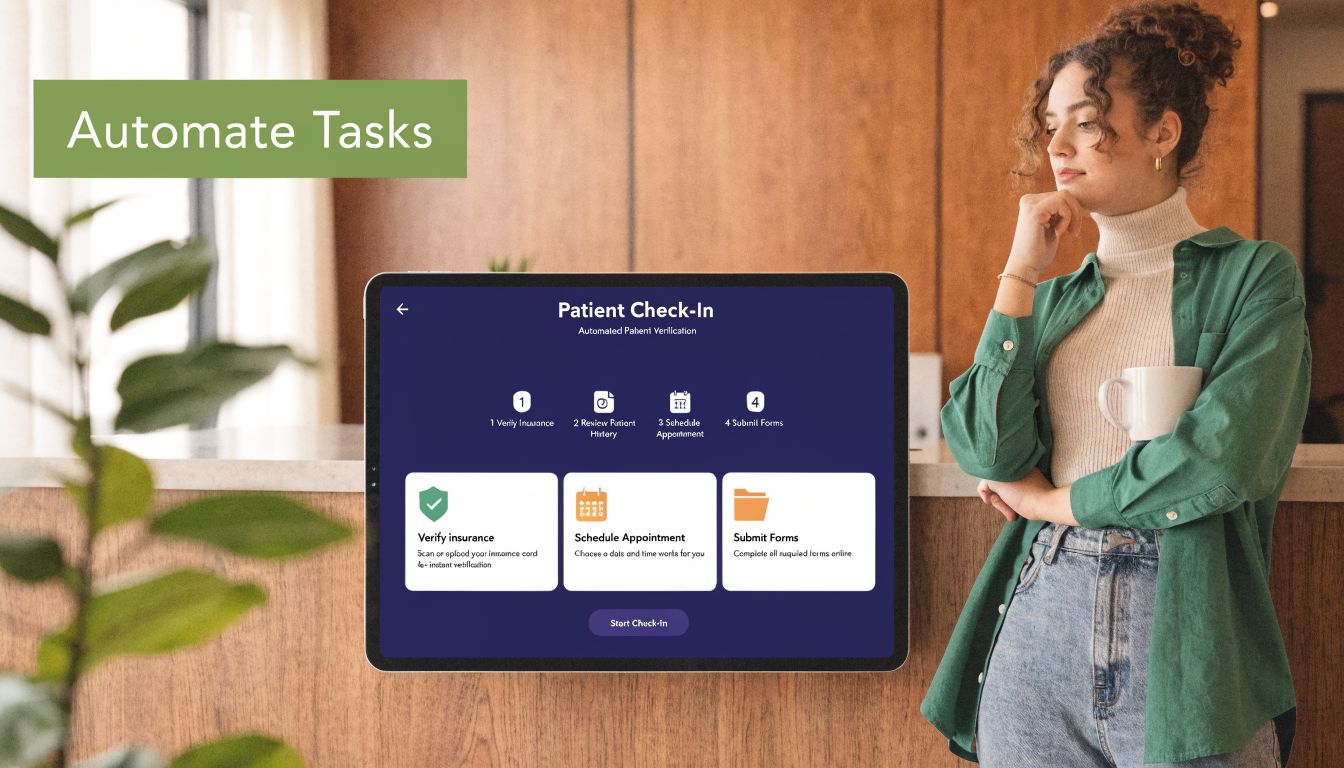
Use technology to automate the work no one wants
I'll say this plainly. A lot of practices are trying to hire humans for work that shouldn't require more humans in the first place.
That doesn't mean people don't matter. It means your people should not spend their best hours answering repetitive calls, re-entering the same intake details, or chasing routine follow-up that a system can capture more cleanly.
Hiring more isn't always the smart answer
The staffing market itself tells you how much pressure offices are under. The U.S. healthcare staffing industry is projected to reach $64.5 billion in 2025, 54% of facilities use agency staff weekly, and AI-driven tools can cut administrative overhead by up to 60% according to PRN Funding's 2025 healthcare staffing statistics.
If weekly agency dependence is becoming normal, then “just hire more” is not a complete strategy. It's a reaction.
Start with the tasks that drain morale
The best automation targets are usually obvious because staff complain about them constantly:
- Appointment scheduling and rescheduling: High volume, repetitive, and interruption-heavy
- Prescription refill intake: Rules-based at the front end, but still time-consuming
- Patient intake collection: Necessary work that often gets repeated across channels
- Prior authorization intake and routing: Tedious and easy to bottleneck
Those tasks matter, but they don't all need a human at the first touch.
Use tools that change role design, not just speed
Voice AI and medical practice automation have become practical. A tool like medical practice automation can handle routine administrative interactions, capture structured information, and pass cleaner work to the team. That changes staffing in a useful way. Front-office staff stop acting like human switchboards and start handling exceptions, patient nuance, and in-office service.
The same is true for Simbie AI. It's one option in this category, and its voice agents are built for healthcare tasks like intake, scheduling, refills, and prior authorizations. That kind of setup makes sense if it plugs into the rest of your workflow instead of sitting off to the side.
Automating repetitive admin work is not about replacing good staff. It's about giving good staff a job they'll still want six months from now.
The mistake I see is offices buying software without changing ownership. If automation takes first-pass calls, someone still needs to own exceptions, escalations, and quality review. Technology fixes a lot. It does not fix vague management.
Your playbook for better medical office staffing
If I were walking into your practice this month, I would not start by posting jobs. I'd start by forcing clarity. Good medical office staffing is built through diagnosis, role discipline, and targeted automation. If you skip those, you'll keep paying for confusion.
Your first 30 days
Start with this checklist and keep it tight.
Run a one-week workflow audit
Track where work backs up, who touches it, and how often tasks bounce between roles. Keep it simple. Paper logs are fine if that's what you can manage fast.Calculate your current staffing structure
Compare your support staff per provider, staffing spend, and clinical versus non-clinical balance against the benchmark ranges discussed earlier. Don't chase perfect precision. Get a clear baseline.Rewrite role ownership for the busiest positions
Start with front desk, MA, scheduler, and office manager responsibilities. Remove vague shared ownership where possible.Map one patient journey end to end
Pick a common visit type. Follow it from first contact to follow-up and mark every friction point.Choose one admin process to redesign
Good candidates are phones, refill intake, prior auth routing, or check-in prep. One clean win beats a messy office-wide rollout.
The conversations to have this month
You also need better questions in your staff meetings:
- “What work do you do every day that shouldn't sit in your role?”
- “Where do patients wait because our handoff is weak?”
- “Which task creates the most interruptions?”
- “What gets dropped when the office gets busy?”
Those questions get better answers than “Do we need more staff?”
Bring in outside help if your managers are stretched
Some practices need a neutral third party to sort out people issues, role design, and compliance questions. If that's your situation, this list of Best HR Advisors for Healthcare Businesses is a good place to start.
The next step is simple. Pick one workflow this week, measure it, and redesign it before you approve your next hire.
If your practice is drowning in calls, scheduling work, refill requests, and intake tasks, Simbie AI is worth a look. It gives healthcare offices a way to automate routine administrative work so your team can spend more time on patients and less time acting as a backup system for broken workflows.