
Your notes are more than just a task to check off at the end of a long shift. A strong head to toe assessment documentation sample isn't just about filling in a template; it's a vital communication tool that keeps your patients safe. It’s the story of their care, bridging the gap between shifts, disciplines, and every single patient encounter. In an increasingly complex healthcare environment, the clarity and precision of your documentation can directly influence patient outcomes, making it one of the most critical skills a healthcare professional can master.
Why Your Documentation Is Everything
It’s easy to see charting as a chore that pulls you away from the bedside. But your notes are the official, legal record of your patient’s health journey, and they’re the main way the entire care team stays on the same page. Effective documentation serves as the backbone of patient care, providing a detailed, chronological account that informs clinical decisions, supports billing and reimbursement, and serves as a legal record of the care provided. It's not just about what you did; it's about proving why you did it based on your clinical assessment.
Think about it: the next nurse on shift, the doctor rounding in the morning, the physical therapist, and even the case manager all rely on your assessment to make informed clinical decisions. Clear, objective information ensures true continuity of care, which is critical when a patient's condition can change in an instant. Without it, the care team is essentially flying blind, reacting to problems rather than anticipating them.
The Real-World Impact of Your Notes
The quality of your charting has immediate, real-world consequences. Vague notes are dangerous. They can lead to missed signs of a patient deteriorating, medication errors, critical delays in treatment, or misinterpretation of a patient's condition. A poorly documented assessment can create a domino effect of poor decision-making down the line.
For instance, charting "patient seems comfortable" is worlds away from "Respirations even and unlabored at 16 breaths/min, denies pain, resting quietly with eyes closed." That second note gives the next person a concrete baseline to assess against. It quantifies the observation and provides specific details that can be trended over time. If the next nurse finds the patient's respirations are 28 and labored, they have a clear, documented change to act upon.
On the other hand, a well-documented assessment is your best defense. It protects you legally, showcases your clinical judgment, and, most importantly, creates a safety net for your patient. When notes are clear, timely, and specific, there's no room for guessing games. It is the tangible evidence of your professional diligence and critical thinking.
Your documentation is more than just a task; it's a professional responsibility that directly influences patient outcomes. It’s the evidence that high-quality, attentive care was delivered.
Choosing the Right Documentation Format
Not all documentation styles are created equal. The best format often depends on the specific clinical situation, the patient's acuity, and what your facility requires. Understanding the key differences will help you chart more efficiently and effectively, tailoring your approach to best communicate the necessary information. Each format has its strengths, and a skilled practitioner knows when to use each one.
For a deeper look into this, our guide on improving clinical documentation is a great resource.
Here’s a quick look at the most common documentation styles to help you decide which is best for your specific clinical scenario.
| Format Type | Core Structure | Ideal for |
|---|---|---|
| Narrative Notes | Free-text, story-like format that describes events chronologically. | Complex situations, patient admissions, significant changes in condition, or summarizing a series of events. |
| Checklists/Flowsheets | Grid-based format using checkboxes or short entries like "WNL" (Within Normal Limits) to track routine data. | Routine assessments, vital signs, intake/output, and tracking frequent data points on stable patients. |
| SOAP/PIE Notes | Problem-oriented structure that focuses on specific issues (Subjective, Objective, Assessment, Plan / Problem, Intervention, Evaluation). | Documenting new problems, a specific complaint, a change in status, or evaluating progress on an existing issue. |
Each style has its place. Narrative notes let you tell the whole story, providing context that checklists can't capture. Checklists are built for speed and consistency, ensuring that routine assessments are completed uniformly. Formats like SOAP or PIE help you zero in on a specific problem with a clear, logical structure that demonstrates your clinical reasoning process. Getting comfortable with all of them will make you a much stronger (and faster) charter.
The Narrative Note: A Real-World Example

The narrative note is where your clinical observations come to life. Think of it as telling the patient's story for that shift. Unlike a simple checklist, a good narrative note connects the dots, providing crucial context that paints a clear picture for the next nurse, the doctor, or anyone else on the care team. It allows you to detail the nuances of a patient's condition, their response to treatment, and any psychosocial factors that might be influencing their health.
The real skill here is being descriptive without getting lost in the weeds. It’s a balance you’ll find with practice. A good narrative note is concise yet comprehensive, focusing on pertinent positives and negatives while avoiding unnecessary jargon or subjective fluff.
Let's walk through a complete head to toe assessment documentation sample written in a narrative format. We'll use a common scenario: a 68-year-old man admitted for community-acquired pneumonia. Pay attention to how each finding is objective and specific, leaving nothing up to interpretation. This example demonstrates how to structure the note logically, moving system by system.
Complete Narrative Documentation Sample
Patient Scenario: Mr. David Chen, a 68-year-old male, was admitted from the ED last night with a diagnosis of community-acquired pneumonia.
General: 68 y/o male, pleasant and cooperative, appears his stated age. Currently sitting upright in bed and is in no apparent distress. Appears fatigued, with noticeable dark circles under his eyes. Maintained eye contact throughout the assessment.
Neurological: Alert and oriented to person, place, time, and situation (A&O x4). Speech is clear and appropriate. Follows all commands consistently. Pupils are equal, round, and reactive to light and accommodation (PERRLA), measuring 3mm bilaterally. All facial movements are symmetrical. Grip strength is strong and equal in both hands, rated 5/5. Reports no numbness, tingling, or other sensory deficits in extremities. No dizziness or headache reported.
Cardiovascular: S1 and S2 auscultated with a regular rate and rhythm at 88 bpm. No murmurs, gallops, or rubs noted. Capillary refill is brisk at <2 seconds on all extremities. All peripheral pulses (radial, brachial, dorsalis pedis, posterior tibial) are palpable, +2, and equal bilaterally. No jugular vein distention (JVD) is visible with the head of the bed at 30 degrees. Skin is warm, dry, and pink. No edema noted in upper or lower extremities.
Respiratory: Respirations are even but slightly labored at 22 breaths/min. The patient states he feels short of breath with exertion, specifically when walking to the bathroom. Accessory muscle use is noted with slight intercostal retractions. He has a productive cough that produces thick, yellow-green sputum. On auscultation, breath sounds are diminished in the right lower lobe (RLL), with coarse crackles that do not clear with a cough. All other lung fields are clear. O2 saturation is 94% while on a 2L nasal cannula.
Gastrointestinal: Abdomen is soft, non-distended, and non-tender to light palpation across all four quadrants. Bowel sounds are normoactive throughout. The patient reports his last bowel movement was this morning; it was soft and formed. He is tolerating a regular diet but notes a fair appetite, stating food "tastes bland." Denies any nausea, vomiting, or diarrhea. Oral mucosa is pink and moist.
Genitourinary: Voids without difficulty. Urine is clear and amber. Denies frequency, urgency, or dysuria. Intake for shift so far is 400 mL oral fluids; output is 350 mL urine. Intake and output will continue to be monitored.
Integumentary: Skin is warm, dry, and intact with good turgor (recoil <2 seconds). Skin tone is appropriate for ethnicity. No rashes, lesions, or bruising are present. A 20g saline-locked IV is in the left forearm; the site is clean, dry, and intact with no signs of infiltration or phlebitis. Heals of both feet are clean, dry, and without redness. Braden score is 18, indicating low risk for skin breakdown.
Musculoskeletal: Moves all extremities with full range of motion against resistance. Strength is 5/5 in all extremities. Gait is steady but slow; patient reports feeling weak. No joint swelling, redness, or deformity observed. Uses call light for assistance to ambulate to the bathroom.
Breaking Down the Language
This example shows how you can be both detailed and straight to the point. Notice the absence of vague terms like "good" or "normal." Everything is backed by specific, measurable data (e.g., "3mm bilaterally," "22 breaths/min," "5/5 strength"), which is essential for tracking any changes—good or bad—in the patient's condition. For a deeper dive into crafting these kinds of entries, you can learn more about how to write effective narrative notes in nursing.
A great narrative note creates a clear, chronological account that any healthcare professional can understand in seconds. You're telling the patient's clinical story with precision so nothing gets lost between shifts.
Phrases for Efficient Charting
To chart faster without sacrificing quality, seasoned nurses often have a go-to list of clear, descriptive, and standardized phrases. Adding these to your own charting vocabulary can make a huge difference, particularly when documenting normal findings, allowing you to focus your energy on the abnormalities.
- For Neurological Status: "Follows commands appropriately," "Speech clear and coherent," "No focal neurological deficits noted," "Moves all extremities purposefully."
- For Respiratory Findings: "Respirations even and unlabored," "Air entry clear and equal bilaterally," "Non-productive cough," "Chest expansion symmetrical."
- For Skin Assessment: "Skin warm, pink, and dry," "No signs of skin breakdown," "Turgor is elastic," "Mucous membranes pink and moist."
Using standardized, approved language not only saves valuable time but also ensures everyone on the care team is on the same page, making your head-to-toe assessment documentation truly effective and reducing the risk of misinterpretation.
Making Your Charting Faster with Checklists and Flowsheets
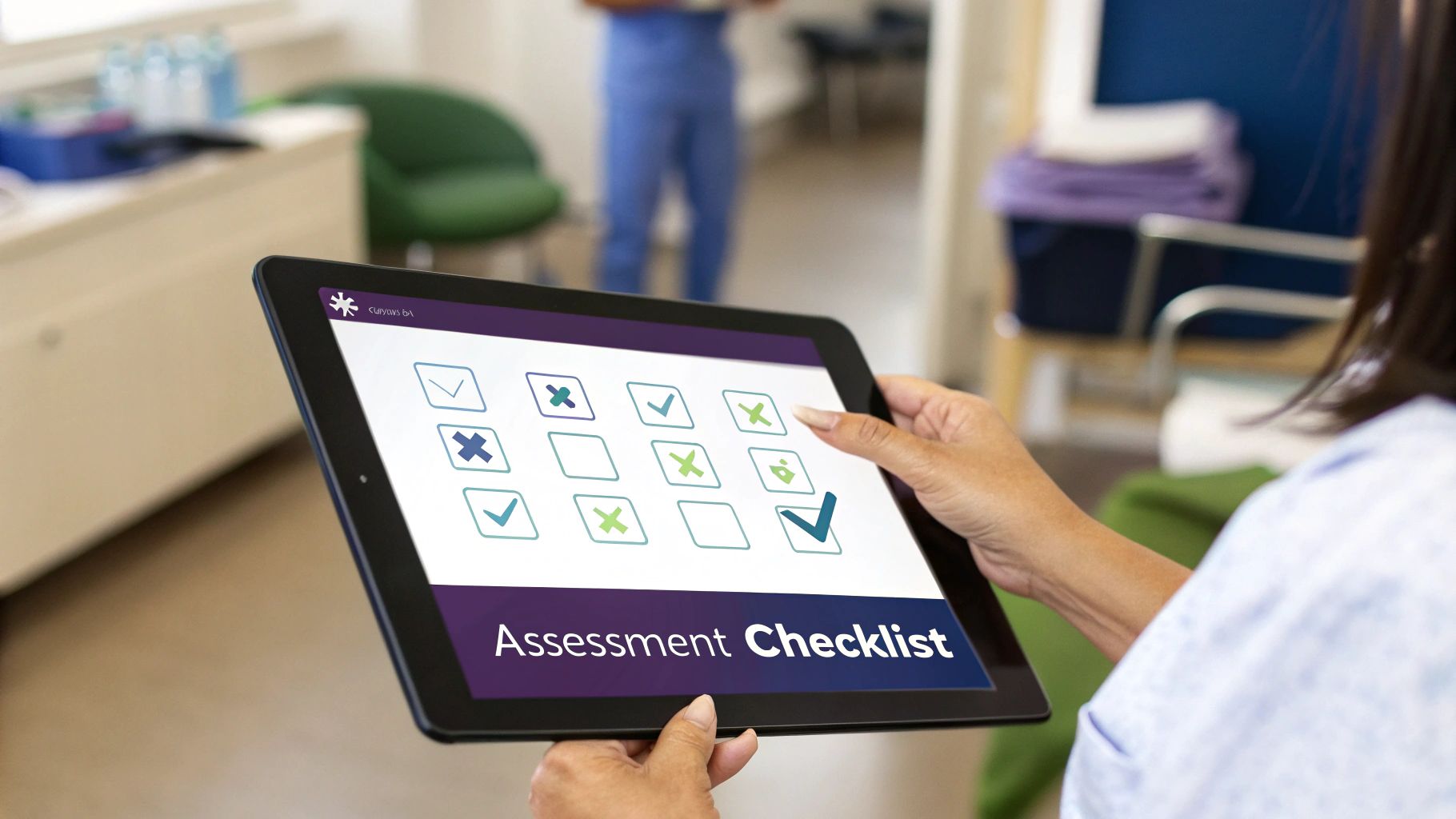
Let’s be real—when you're juggling multiple patients on a chaotic shift, writing a full narrative note for every assessment just isn't going to happen. This is where checklists and flowsheets become your best friends. They give you a structured, fast way to get all the essential data down without missing a beat, ensuring comprehensive data collection even under pressure. These tools are designed for efficiency and consistency.
Think of a good checklist as a safety net for your brain. During a code or a rapid response, it’s shockingly easy to forget a small but crucial detail. A checklist guides you through each body system, ensuring nothing gets overlooked and freeing up your mental energy to focus on what the patient actually needs. This structured approach helps standardize care and minimizes the risk of omission, which is critical in high-stakes environments.
It's all about finding that sweet spot between being thorough and being fast, which is the constant challenge of our job. Flowsheets allow for quick visualization of trends over time—a patient's blood pressure, heart rate, or oxygen saturation can be seen at a glance, making it easier to spot subtle changes.
The Power of Charting by Exception
One of the smartest ways to use a checklist is with a method called charting by exception. The whole idea is simple: you assume everything is normal according to a predefined, facility-approved standard, unless you say it isn't. This method is highly efficient but relies heavily on clear, institutional guidelines.
This lets you fly through your documentation. You can quickly check off "WNL" (Within Normal Limits) for healthy systems and then spend your time writing detailed notes only on the abnormal findings. This flips charting from a tedious chore into a quick, targeted process. You’re no longer writing paragraphs about normal breath sounds; you’re zeroing in on the things that actually need attention and require intervention.
When you focus only on the exceptions, you create a chart that's easy to scan. The next nurse or doctor can immediately see the problem areas without wading through pages of fluff. It’s a system built for the real world of a busy floor.
For this to work safely and effectively, your facility has to have a crystal-clear, standardized definition of what "WNL" actually means for every part of the assessment. That way, everyone is on the same page. Without this foundation, charting by exception becomes risky and subjective.
Post-Op Scenario Checklist Sample
Let's walk through a real-world example. You're on a busy surgical floor, and you're assessing a patient who is two days out from an appendectomy. Here’s a head to toe assessment documentation sample using a checklist that leans on charting by exception.
Patient: 45 y/o female, 2 days post-op laparoscopic appendectomy.
- Neurological:
[✔] WNL - Cardiovascular:
[✔] WNL - Respiratory:
[✔] WNL - Gastrointestinal:
[ ] WNL— See notes below - Genitourinary:
[✔] WNL - Integumentary:
[ ] WNL— See notes below - Musculoskeletal:
[✔] WNL - Pain:
[ ] WNL— See notes below
See how fast that was? Now you just need to add a few lines for the systems that weren't totally normal. This targeted approach saves immense time while highlighting the most important information.
Exception-Based Notes:
- GI: Bowel sounds hypoactive in RLQ. Abdomen soft, but tender to light touch around incision sites. Pt reports passing gas but no BM since surgery. Encouraged to ambulate.
- Integumentary: Three small surgical incisions on abd, covered with C/D/I dressings. No redness, swelling, or drainage noted.
- Pain: Pt reports pain 3/10 at rest, 5/10 with movement. States current pain med (Oxycodone 5mg PO) is providing adequate relief. Last dose given 3 hours ago.
In just a few minutes, you’ve documented a complete assessment. More importantly, you've clearly flagged the key areas for the care team to watch: her GI function, wound healing, and pain control.
Using structured tools like this has a huge impact on our workflow. It’s no surprise that modern AI-powered platforms report a staggering 70% reduction in time spent on charting. The time nurses spend documenting has dropped from an average of 2 hours per shift in 2020 to just 36 minutes today. You can read more about how AI is reshaping clinical workflows with these kinds of templates.
Ultimately, checklists and flowsheets are more than just a way to chart faster. They are essential for keeping our standards of care high when time is short, making sure our assessments are complete and our notes are always clear.
Using SOAP and PIE for Problem-Focused Notes
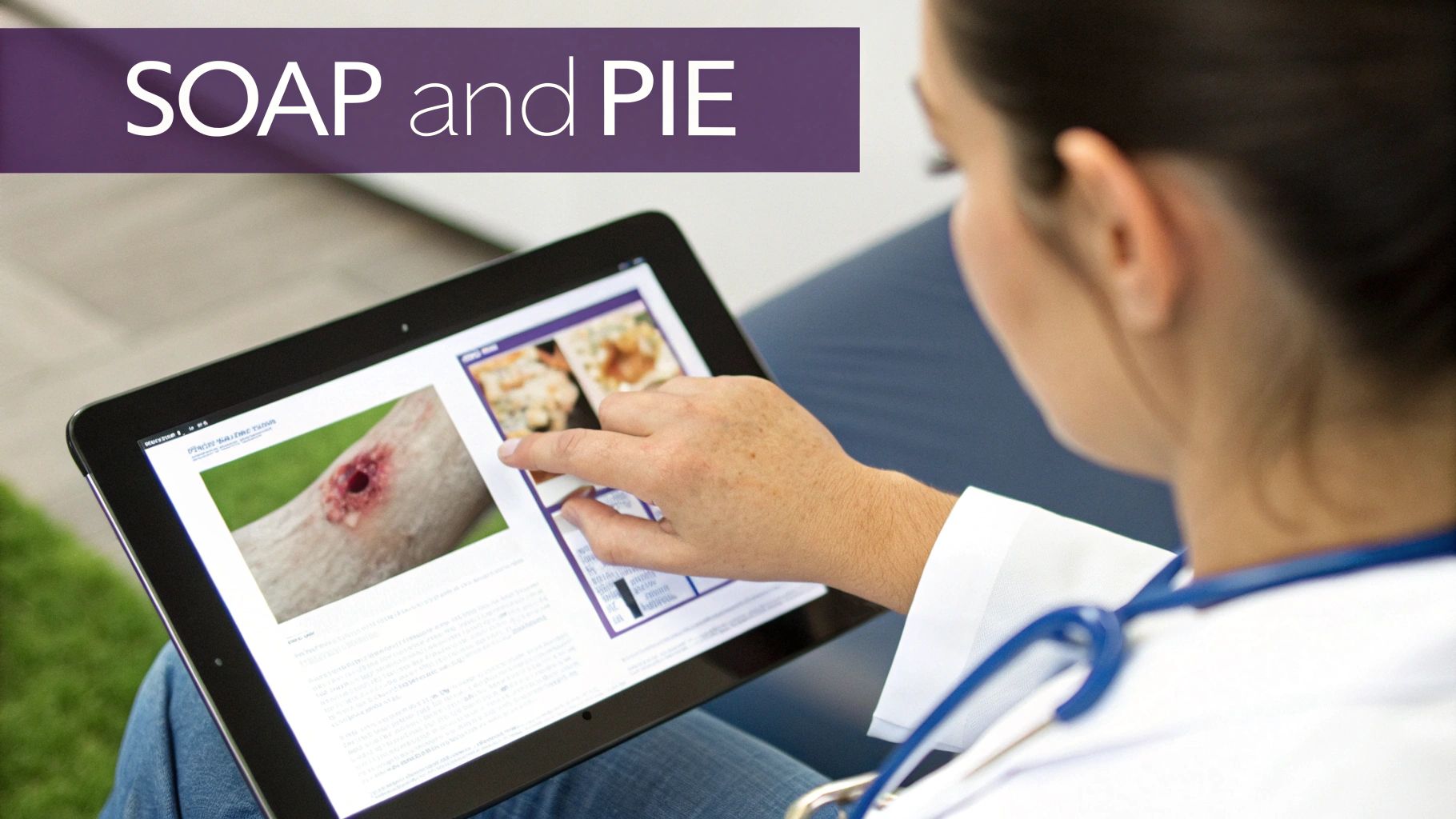
While narrative notes and checklists are your bread and butter for routine shift assessments, they don't always cut it when a new problem pops up. Let's be real—when you find a new rash, a patient spikes a fever, or their mental status suddenly changes, you need a more focused way to document what's going on. This requires a shift from routine data collection to in-depth problem analysis.
This is where problem-oriented charting comes into play. These structured formats, which are built into just about every electronic health record (EHR) system, are designed to guide your clinical thinking. They make you connect the dots between what the patient is telling you, what you're seeing, your clinical judgment, and what you're going to do about it. Two of the most common and effective methods you'll use are SOAP and PIE notes.
Diving Into the SOAP Note Format
The SOAP note is a classic for a good reason. It neatly organizes your findings into four distinct sections, creating a logical trail that anyone on the care team can easily follow. It’s the perfect tool for documenting a new complaint or tracking how an existing issue is progressing. This format is widely used across many healthcare disciplines, making it a universal language for problem documentation.
- S (Subjective): This is the patient's story. It’s what they tell you, in their own words—their symptoms, pain level, and direct quotes. This section captures the patient's perspective and experience of their condition.
- O (Objective): This is what you see, measure, and observe. It’s all the hard data: your assessment findings, vital signs, physical exam results, and any relevant lab or diagnostic results. This is the evidence.
- A (Assessment): Here’s where your clinical brain comes in. This is your professional interpretation of the subjective and objective information—basically, your nursing diagnosis or clinical impression of what you think is happening.
- P (Plan): This is your game plan. What are you going to do about it? List your interventions, any further monitoring needed, consultations to be made, and patient education.
If you want a more detailed look, you can find a comprehensive free SOAP note template that really helps you get the hang of this structure.
Now, let's see how it works in a real-world situation.
Head to Toe Assessment Documentation Sample: A SOAP Note
Patient Scenario: You're assessing Mr. Davis, an 82-year-old man with limited mobility. During your skin check, you notice a new red area on his sacrum.
S – Patient reports "a nagging, sore feeling on my tailbone" for the past day. He rates the discomfort as a 2/10 and describes it as a dull ache. Denies any sharp pain, numbness, or tingling. States, "It just feels tender when I shift my weight."
O – A 2cm x 3cm area of non-blanchable erythema is noted over the sacrum. The skin is intact, with no breaks, blisters, or drainage. Surrounding skin is warm and dry. Patient has been repositioned every 2 hours per protocol. He is incontinent of urine and was last changed 1 hour ago.
A – Impaired skin integrity related to prolonged pressure and immobility, evidenced by a Stage 1 pressure injury on the sacrum. Patient is at high risk for further skin breakdown due to immobility and incontinence.
P – Continue turning and repositioning patient q2h, utilizing a pressure-reducing mattress. Apply barrier cream to the sacral area with each incontinent episode or at least q12h. Educate patient on the importance of shifting weight frequently. Monitor area for any changes in size, color, or skin integrity and document findings each shift. Will consult wound care nurse for further recommendations.
The PIE Note: An Alternative Approach
Another fantastic problem-focused method is the PIE note. It’s similar to SOAP but has a slightly different flow that often feels more direct and action-oriented. You’ll find it’s especially helpful in settings where the care plan is already established and you’re focused on documenting the daily interventions and their effects.
The structure is clean and simple:
- P (Problem): State the specific issue using a standard nursing diagnosis.
- I (Intervention): Detail exactly what you did to address that problem during your shift.
- E (Evaluation): Describe how the patient responded to what you did. Was the intervention effective?
Head to Toe Assessment Documentation Sample: A PIE Note
Let's use the same scenario with Mr. Davis to see how a PIE note would look.
P – Impaired skin integrity related to immobility, as evidenced by a 2cm x 3cm area of non-blanchable erythema over the sacrum.
I – Sacral area cleansed with a pH-balanced cleanser and water, then patted dry. A protective barrier cream was applied. Patient was repositioned onto his left side with pillows supporting his back and between his knees to offload pressure from the sacrum. Educated on the need to call for assistance with position changes.
E – Patient verbalizes understanding of the education provided. Stated the new position is comfortable and reports no increase in discomfort at this time. Skin remains intact with non-blanchable redness. Will continue to monitor and implement turning schedule.
SOAP vs PIE: What's the Difference?
To get a clearer picture, it helps to see these two methods side-by-side. Both are excellent for problem-oriented charting, but they come at it from slightly different angles, and understanding this can help you choose the best format for a given situation.
| Aspect | SOAP (Subjective, Objective, Assessment, Plan) | PIE (Problem, Intervention, Evaluation) |
|---|---|---|
| Primary Focus | The diagnostic process: collecting data, forming a conclusion, and creating a plan. It tells the whole story of the problem from identification to planning. | The ongoing care process: identifying a problem, acting on it, and evaluating the result within a single shift. It focuses on action and response. |
| Structure | Divides data into what the patient says (S) and what the clinician observes (O) before the assessment, clearly separating patient perspective from clinical findings. | Merges all assessment data directly into the "Problem" statement (the nursing diagnosis). It assumes the assessment data is known from the initial assessment. |
| Care Plan | The "Plan" section creates a new plan of care or updates an existing one for that specific problem. It is integral to the note. | The note itself doesn't create the care plan; it documents interventions for a problem already on the overall plan of care. It reflects the implementation of the plan. |
| Best For… | Initial assessments, new problems, complex situations, or when a detailed diagnostic thought process needs to be shown to justify the plan of care. | Documenting ongoing care, daily progress notes, and situations where problems are already well-defined and the focus is on intervention and evaluation. |
Ultimately, both SOAP and PIE notes provide a clear, logical, and defensible way to chart.
Choosing between SOAP and PIE often comes down to your facility's policy or even just your personal preference. The most important thing is that both formats give you a structured way to document a specific problem, ensuring every member of the care team understands the issue and the plan.
Getting Faster and Better at Charting
Becoming a great charter doesn't happen overnight—it’s a skill you build with practice, repetition, and a commitment to clarity. The real leap from novice to expert comes when you learn to write notes that aren’t just complete, but also sharp, professional, and legally solid. At its core, this means sticking to the facts: what you can see, hear, feel, and measure. Objective data is always more powerful than subjective interpretation.
For example, instead of a vague note like "sore spot on back," a pro-level entry gets specific: "2cm reddened area on sacrum, skin intact, non-blanchable." That single change, from subjective to objective, turns a simple observation into clinical data that your whole team can track and act on. It removes ambiguity and provides a measurable baseline.
Why Ambiguous Language Is a Major Risk
One of the quickest ways to get into trouble is by using unapproved or "dangerous" abbreviations. I get it, shorthand feels like a necessary time-saver on a busy shift. But it can lead to devastating medical errors. An abbreviation that’s common on your floor might mean something completely different to a pharmacist or a consulting physician, leading to miscommunication and patient harm.
To prevent these kinds of mix-ups, The Joint Commission maintains an official "Do Not Use" list. This isn't just a friendly suggestion; it's a critical safety standard because these specific abbreviations have been directly linked to patient harm. Committing this list to memory is a professional responsibility.
Common Culprits to Avoid in Your Charting
- U (for unit): This is so easily mistaken for a zero (0), the number four (4), or "cc." The result? A potential tenfold overdose. Always take the extra second to write out "unit".
- IU (for International Unit): This one often gets misread as "IV" (intravenous) or the number 10. The room for error is massive. Just write "International Unit".
- Q.D., QD, q.d., qd (daily): If that tiny period after the Q is missed, your note suddenly looks like QID (four times a day). It's the same problem with Q.O.D. (every other day), which gets confused with Q.D. or QID. Spell it out: "daily" and "every other day".
- Trailing Zero (X.0 mg) & Lack of a Leading Zero (.X mg): This is a classic trap. Never write "5.0 mg" because if the decimal is missed, the patient gets 50 mg. Always write "5 mg". On the flip side, never write ".5 mg" because that decimal can be overlooked, turning it into a 5 mg dose. The correct way is "0.5 mg".
- MS, MSO4, MgSO4: These can easily be mixed up, causing someone to confuse morphine sulfate with magnesium sulfate—two very different drugs with very different jobs. Write out the full name: "morphine sulfate" or "magnesium sulfate".
Think of your documentation as a legal record. Every entry must be timely, accurate, and objective. It’s the official story of the care you provided and your strongest defense if that care is ever questioned.
Using Tech to Chart Smarter, Not Harder
Let's be real: staying compliant and detailed while you're stretched thin feels impossible. This is where tools like AI voice scribes are really starting to make a difference. These aren't meant to replace your clinical judgment. They’re designed to kill the tedious administrative work that eats up your shift, freeing you to focus on patient care.
An AI scribe, like Simbie AI, lets you dictate your assessment findings naturally, often right at the bedside. You can just talk, and the AI translates your words into a perfectly formatted note in whatever style your EHR requires—narrative, SOAP, you name it. This allows for contemporaneous documentation, which is the gold standard.
This changes your entire workflow. You spend way less time stuck at a computer typing and more time with your patients. It also makes your notes more accurate because you're documenting in the moment, when the details are fresh, instead of trying to remember everything hours later. The push for this kind of precision in head-to-toe assessments has been building for 50 years. In fact, data shows that consistently using structured charting templates correlates to 35% fewer medication errors globally, as nurses document reconciled lists during their assessments. You can read the full study to dig into these findings and their impact on patient safety.
By building these smart charting habits and bringing in modern tools, you can raise the quality of your documentation while getting precious time back. Your notes will be clearer, your workflow will be faster, and your patients will be safer.
Answering Your Top Questions About Assessment Charting
It's one thing to learn about documentation in a classroom, but it's another thing entirely to put it into practice on a busy floor. Let's tackle some of the most common questions that come up when you're trying to chart accurately and efficiently during a hectic shift.
How Often Does a Full Head-to-Toe Assessment Need to Be Documented?
This is a great question, and the honest answer is: it depends. The key factors are your patient's stability, the level of care (ICU vs. Med-Surg), and your facility's policies.
Every single patient gets a complete, comprehensive head-to-toe assessment documented on admission. This is non-negotiable. It creates the critical baseline we compare everything against for the rest of their stay.
For a stable patient on a med-surg floor, you'll typically do a full assessment at the start of each shift. In an intensive care unit, assessments are often required every 2-4 hours. In a long-term care setting, where residents are generally stable, this might be weekly or even monthly. The game changes, however, the moment your patient's condition shifts. If they have a fall, a sudden change in mental status, or a significant swing in vital signs, a new, focused assessment must be performed and charted immediately. This captures what’s happening in real-time and gives the team the information needed to intervene.
What's the Best Way to Chart "Within Normal Limits"?
Using "WNL" or a similar phrase can be a massive time-saver, but you have to be careful. It’s only safe and legally defensible if your facility has a very specific, written policy defining exactly what "normal" looks like for each body system. Without that shared, official definition, "WNL" is just too vague and can be a big liability.
The safest and most efficient way to use "WNL" is through a method called charting by exception. This gives you the speed of a checklist without sacrificing the detail needed for excellent care.
This usually works best with a flowsheet. You can check the "WNL" box for the systems that meet the defined criteria, but you are required to write a note detailing anything that falls outside of that standard. For instance, you could chart: "Respiratory: WNL except for diminished breath sounds in the right lower lobe." This is fast, clear, and immediately points everyone to the abnormal finding. The takeaway? Never just write "WNL" and leave it at that. Ensure you understand your facility's definition and use it consistently.
Is It Okay to Document My Assessment Before It's Done?
Let me be crystal clear: absolutely not. Never, ever document an assessment, a medication, or an intervention before you've actually completed it.
This practice, often called "charting ahead," is incredibly dangerous, unethical, and puts your license at risk. Your chart is a legal document—a record of what you saw and did at a specific moment. If you chart something that hasn't happened yet and the patient's condition suddenly changes, your documentation is now inaccurate and fraudulent. This can lead to serious medical errors, patient harm, and significant legal trouble. Always chart in real-time or as soon as possible after providing care to ensure your notes are a true and honest reflection of what happened.
How Can AI Tools Actually Help with My Charting Workflow?
This is where things get interesting. AI voice assistants and ambient scribes are making a huge difference in how we handle the burden of documentation. Think about it: instead of trying to remember every detail from your last four patient encounters at the end of a 12-hour shift, you can simply dictate your findings at the bedside while they're still fresh.
You can speak naturally, and an AI assistant translates your words into a perfectly formatted note—whether your hospital uses a narrative style, SOAP notes, or another format. It can even populate the right fields in the EHR for you, ensuring that data is entered correctly and consistently. This integration with existing systems is key to their effectiveness.
This workflow all but eliminates the tedious typing and the risk of forgetting something important hours later. The result is more accurate, more detailed, and much faster documentation. For nurses, it means less time glued to a computer screen and more time for what actually matters: being with your patients. It helps combat burnout by reducing administrative tasks and allows clinicians to practice at the top of their license.
Ready to cut your documentation time and bring your focus back to your patients? The future of clinical charting is here. See how Simbie AI can automate your notes, reduce burnout, and give you back valuable time. Discover Simbie AI today.