
Colorectal cancer screening saves lives, but only about 70% of eligible U.S. adults are screened, and the gap gets much wider when a positive stool test still has to be closed with colonoscopy. For independent practices, that means the problem isn't just ordering the test. It's getting patients from eligibility to completion without burying the front desk.
Why Colorectal Cancer Screening Matters More Than Ever
Colorectal cancer screening in 2026 is a workflow issue as much as a clinical one. The tests are established, the benefit is real, and the guideline structure is clearer than it's been in years, yet many practices still lose patients between the first outreach and the final diagnostic step. That's the gap this topic really comes down to, especially for community gastroenterology, internal medicine, and any practice that wants preventive care to run without constant manual chasing.
The 2021 USPSTF shift lowered the average-risk starting age to 45 and kept selective screening for ages 76 to 85. That change expanded the estimated U.S. average-risk population by about 19 million people, with roughly 117.1 million adults ages 45 to 85 estimated to be average-risk, or 86.9% of that age band, according to the guideline impact analysis in JAMA Network Open. That is not an abstract policy update. It changes recall lists, preventive outreach, and the load on already busy teams.
Practical rule: if your recall logic still starts at 50, you're missing patients before the conversation even begins.
For practices trying to reduce avoidable admin work, simple outreach channels matter. A well-timed reminder, especially by text, can help patients move from “I meant to do that” to scheduling. For a practical overview of that tactic, SMS for medical practices is a useful reference point.
Who Needs Screening and When
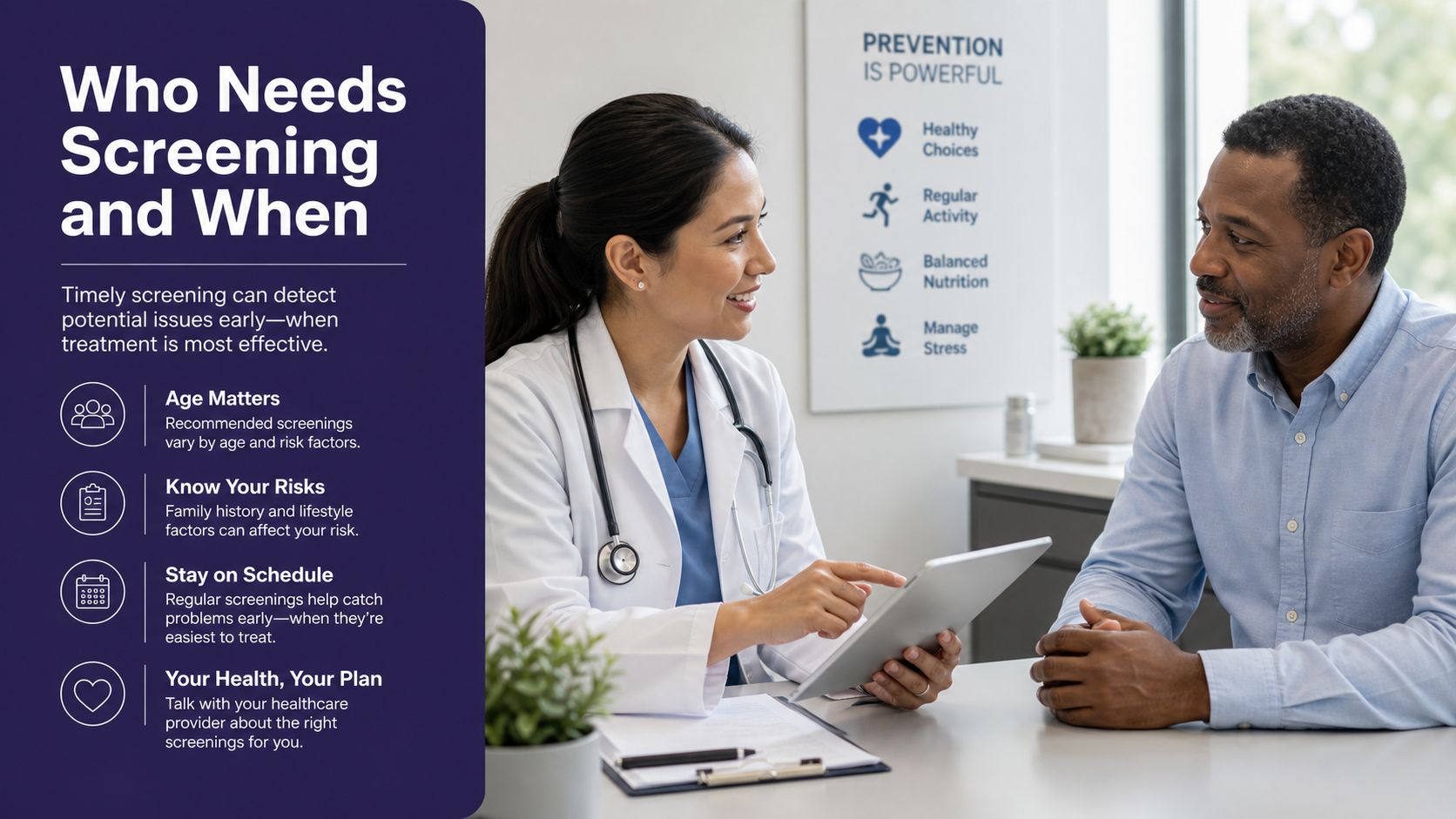
Average-risk adults should start colorectal cancer screening at age 45 and continue through age 75. For adults 76 to 85, screening becomes an individualized decision based on overall health and prior screening history, which is why practices need a different recall logic for that age band instead of the same generic reminder sequence used for younger patients, as summarized by the USPSTF recommendation page on colorectal cancer screening.
Build recall around risk, not just birthdays
The practice mistake I see most often is treating every overdue patient the same way. That creates noise for staff and confusion for patients. A cleaner system starts by sorting patients into age and risk buckets, then using the right outreach path for each.
A practical setup looks like this:
- Age 45 to 75, average risk: routine preventive recall, screening offer, and test selection based on preference and access.
- Age 76 to 85: shared decision-making workflow, not automatic bulk outreach.
- Higher-risk patients: separate logic for family history, hereditary syndromes, or prior findings, with clinician review before any standard reminder goes out.
The scheduling team should never have to guess whether a patient belongs in a routine screening batch or a shared decision-making queue.
That age split matters operationally because it keeps outreach accurate and avoids sending routine messages to patients who need a clinician conversation first. It also helps with preventive-care capacity, since the 2021 recommendation expanded the eligible pool so sharply. The same basic logic should be reflected in your PM system, your reminder list, and your staff scripting.
Match the pathway to the patient
Not every eligible patient should be pushed toward the same test. Some need a colonoscopy because of prior findings or clinician judgment. Others are better served by stool-based screening because access, time, or preference makes that more realistic. The point is to create a predictable, age-aware process so the office isn't redesigning the conversation for every single patient.
Understanding the Main Screening Options
The right screening test depends on what you need to optimize, prevention, convenience, access, or completion. Colonoscopy remains the most complete single-step option because it can detect and remove polyps in the same visit, but it isn't the easiest test for every patient to finish. In daily operations, the best-performing workflow is usually the one your patients will complete.
Compare the options without flattening the differences
Screening Test Comparison
| Test | Interval | Sensitivity | Key Advantage | Key Limitation |
|---|---|---|---|---|
| Colonoscopy | Every 10 years | Not provided in the verified data | Detection and polyp removal happen in one visit | Prep, sedation logistics, and higher patient resistance |
| FIT | Annual | 73% to 88% | High specificity and scalable outreach | Positive result still needs colonoscopy |
| Stool DNA-FIT | Every 1 to 3 years | Not provided in the verified data | Home-based and convenient for many patients | More positives can mean more follow-up colonoscopies |
| CT colonography | Every 5 years | Not provided in the verified data | Noninvasive imaging option | Positive findings still require colonoscopy |
| Flexible sigmoidoscopy | Every 5 years | Not provided in the verified data | RCT evidence for reduced incidence and mortality | Exam is limited to part of the colon |
The National Cancer Institute's colorectal screening review notes that screening works through polyp interception, not just early detection, because removing precancerous lesions can prevent cancer from forming in the first place. It also summarizes that screening reduces CRC mortality, and some modalities reduce CRC incidence as well. For FIT, commonly studied tests show specificity of 90% to 96%, which makes it a strong fit for population outreach where false positives have to be kept manageable. The same review emphasizes that any positive non-colonoscopy screen requires prompt diagnostic colonoscopy, which is the operational step too many practices underbuild. See the NCI's clinical summary on colorectal cancer screening.
Flexible sigmoidoscopy is easy to overlook because it's less central in many offices, but it has real outcome data. Across four randomized controlled trials with 458,002 participants, one or two screening rounds were associated with lower incidence, IRR 0.78, and lower CRC-specific mortality, IRR 0.74, over 11 to 17 years of follow-up, according to the meta-analysis indexed on PubMed. That's a strong reminder that convenience and effectiveness don't always line up neatly.
Use the modality to fit the patient profile
Colonoscopy works well when a patient is already ready for definitive evaluation. FIT works well when a practice needs a broad, low-friction outreach tool. Stool DNA testing can increase uptake among patients who prefer home testing, but it also increases the importance of close tracking because positives still need colonoscopy. CT colonography sits in the middle, while sigmoidoscopy has a narrower role but still belongs in the conversation where it's available.
What to Expect Before and After Screening
Preparation is where a lot of screening programs lose people. Colonoscopy and CT colonography both depend on good prep, and poor prep doesn't just make the day unpleasant. It can miss lesions, force earlier repeat testing, and waste staff time on a result that should have been cleaner the first time.
Before the test, patients need clear instructions, not a pile of generic paperwork. The office should spell out what to stop, what to drink, when to arrive, and who to call if prep breaks down. That sounds basic, but the patient who is confused the night before a colonoscopy usually becomes the patient whose appointment gets delayed.
The same logic applies to documentation. A practice using browse HIPAA document automation can reduce the manual load of prep letters, result notices, and standardized instructions, which helps staff stay consistent when the queue gets busy.
After the test, the interpretation should be simple and tightly protocolized. Normal colonoscopy usually means the next interval is long. Polyps change the interval based on pathology. Cancer triggers treatment referral. Stool-based tests are different, because a positive result is not a diagnosis, it's a flag that diagnostic colonoscopy is needed.
Operational insight: the office doesn't win when it mails a kit. It wins when it confirms the patient actually finished the next step.
That's where a reminder workflow helps. A preventive tracking system, such as the preventive screening reminder agent, can keep the follow-up path from getting lost in the chart. The value isn't in the reminder alone. It's in closing the loop when the test is abnormal and someone on staff would otherwise have to manually chase the patient.
Why Screening Rates Still Fall Short
The national screening picture has improved, but the pace tells a more complicated story. Among U.S. adults ages 50 to 75, colorectal cancer screening coverage rose from 47.7% in 2005 to 69.9% in 2021, with the largest jump between 2005 and 2010, when coverage moved from 47.7% to 60.7%. After that, progress slowed and plateaued for years before rising again, partly helped by stool DNA testing, which increased from 2.5% in 2018 to 6.6% in 2021, according to the PubMed-indexed coverage analysis.
The barrier is usually not one thing
The most expensive assumption in preventive care is that nonadherence always means refusal. In reality, patients get stuck for practical reasons. Some don't have transportation. Some can't miss work. Some don't understand why a positive stool test still needs colonoscopy. Some never got a clear callback after the order was placed.
Transportation deserves special attention because it's a common and modifiable barrier. One review cited an estimated 41% of patients referred for initial CRC screening reporting transportation as a barrier to completion, and it also noted that navigation and reminders improve uptake. That single fact lines up with what practice owners already know from experience, patients often want to follow through, but life gets in the way before the second appointment happens. See the equity-focused review on screening access and completion barriers.
The completion gap is why stool-based and home-based testing can't be treated as an endpoint. They can improve the first step, but they also create a second step that demands real workflow ownership. If your office has no explicit process for positive-result follow-up, you haven't solved the problem, you've just moved it.
How Practices Can Improve Screening Completion
The practices that do this well don't rely on a single reminder. They build a chain. The chain starts with accurate eligibility lists, then moves into outreach, then scheduling, then follow-up, then documentation. Break any link and patients slip away.
Make the recall logic do the heavy lifting
Age-based recall should be automatic, not manually assembled by a receptionist at the end of a busy clinic day. When the system identifies eligible patients at 45, then shifts into a different pathway at 76, staff spend less time sorting lists and more time helping people complete care. That's especially important in small and mid-sized groups, where every extra task gets absorbed by the same people answering phones.
A practical rollout includes:
- Eligibility flags in the PM system: identify average-risk patients who have crossed into the screening window.
- Separate workflows for 76 to 85: route to clinician review instead of default reminder blasts.
- Closed-loop tracking: mark whether the order was sent, the kit was returned, and the colonoscopy was completed.
Use the phone for what the phone still does best
For many practices, the phone is still the fastest way to move a reluctant patient. That doesn't mean staff should spend all day on outbound reminders. An AI medical staff layer can handle routine calls, answer basic screening questions, and escalate only the cases that need a human voice. Simbie AI is one option in that category, with workflows that cover both administrative tasks like scheduling and intake and clinical support like patient education, pre-visit calls, and follow-up check-ins.
The integration matters more than the promise. If the tool connects cleanly with eClinicalWorks, gGastro, ModMed, Athenahealth, Epic, or DrChrono, the office can keep documentation inside the chart instead of scattered across messages and sticky notes. That's how reminders become measurable work instead of just another inbox.
Coordinate around the patient's actual barrier
Some patients need prep instructions repeated. Others need help finding the right appointment type. Others need the office to confirm that a positive stool result has a real next step, not an open-ended “we'll call you back.” A reminder program works best when it includes the operational details patients fail on.
The guide to cohesive care teams is a useful reminder that communication is not just a soft skill. In practice, it's a process design issue. If the front desk, nursing team, and gastroenterologist aren't aligned on the exact follow-up path, the patient experiences that as delay.
For practices already building outreach infrastructure, the colorectal cancer screening outreach workflow is the kind of structure that keeps the program from turning into a one-off campaign. It matters because outreach without completion tracking just creates more activity, not better care.
Keep the work sustainable
The goal isn't more noise. It's fewer dropped balls. Automated reminders, structured callback workflows, and documented escalation paths reduce the burden on staff who are already balancing calls, refill requests, and same-day scheduling. That's where Protecting Doctors' Time for Doctoring means something in day-to-day operations.
Moving Forward with Screening Quality
Colorectal cancer screening improves when the office treats it as an active workflow, not a checkbox. A practice can have the right clinical guidance and still miss patients if identification, test selection, and follow-up are handled inconsistently. The operational difference usually comes down to whether the team can move patients from eligibility to completion without gaps.
The programs that hold up in daily work do not rely on staff memory alone. They use recall logic, call handling, and follow-up automation so patients keep moving through the pipeline without piling hidden tasks onto the team. That same approach is what practices are looking for when they compare ways to improve screening completion, including practical workflow guidance such as how to increase cancer screening rates.
For practices evaluating automation, the goal is not extra technology for its own sake. It is fewer missed callbacks, cleaner handoffs, and a clearer path from outreach to completed screening. Simbie AI is one option built around that kind of administrative follow-through, and it fits best when a practice wants to reduce friction in routine outreach, reminders, documentation, and follow-up. If you're evaluating AI for your practice, you can see it in action at simbie.ai/book-a-demo.
If the office wants fewer patients falling out of the pipeline, the work has to stay tied to the practical tasks that break down in daily practice. That means repeatable outreach, clear assignment of next steps, and enough structure that staff are not forced to reconstruct every case from scratch. Simbie AI supports those touchpoints so the team can spend less time chasing loose ends and more time on the patients who need direct attention.