
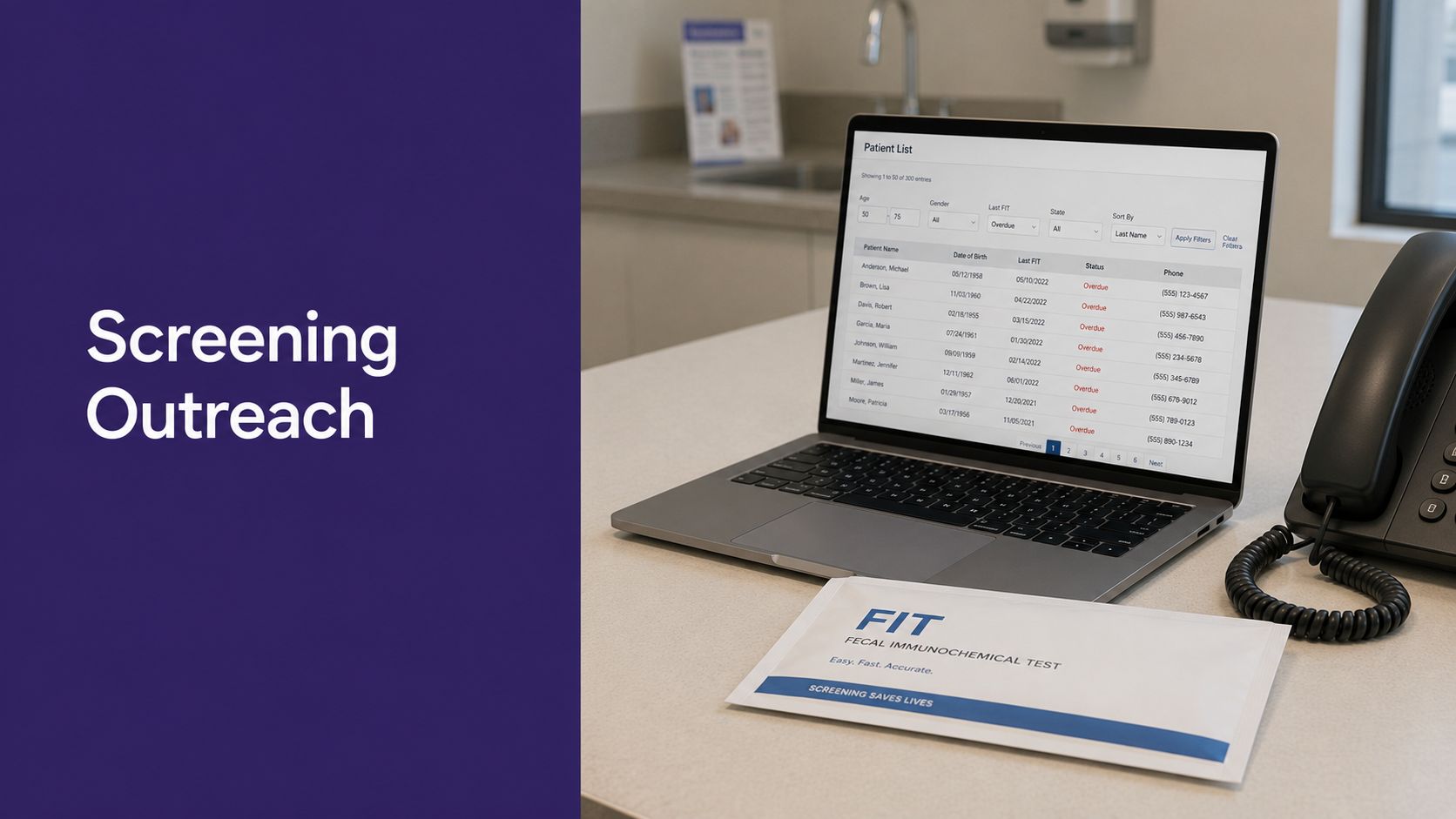
A colorectal cancer screening outreach program lives or dies on execution. Most practices already know screening matters, but the main challenge is operational, patients are overdue, lists are messy, staff are busy, and the follow-up step after a positive stool test is where too many people disappear. For busy GI and internal medicine teams, the right workflow has to start in the EMR, reach patients without burning out staff, and keep moving all the way to diagnostic colonoscopy.
Meta description: Colorectal cancer screening outreach works best when it's built around clean EMR lists, mailed FIT kits, and tight follow-up that patients can complete.
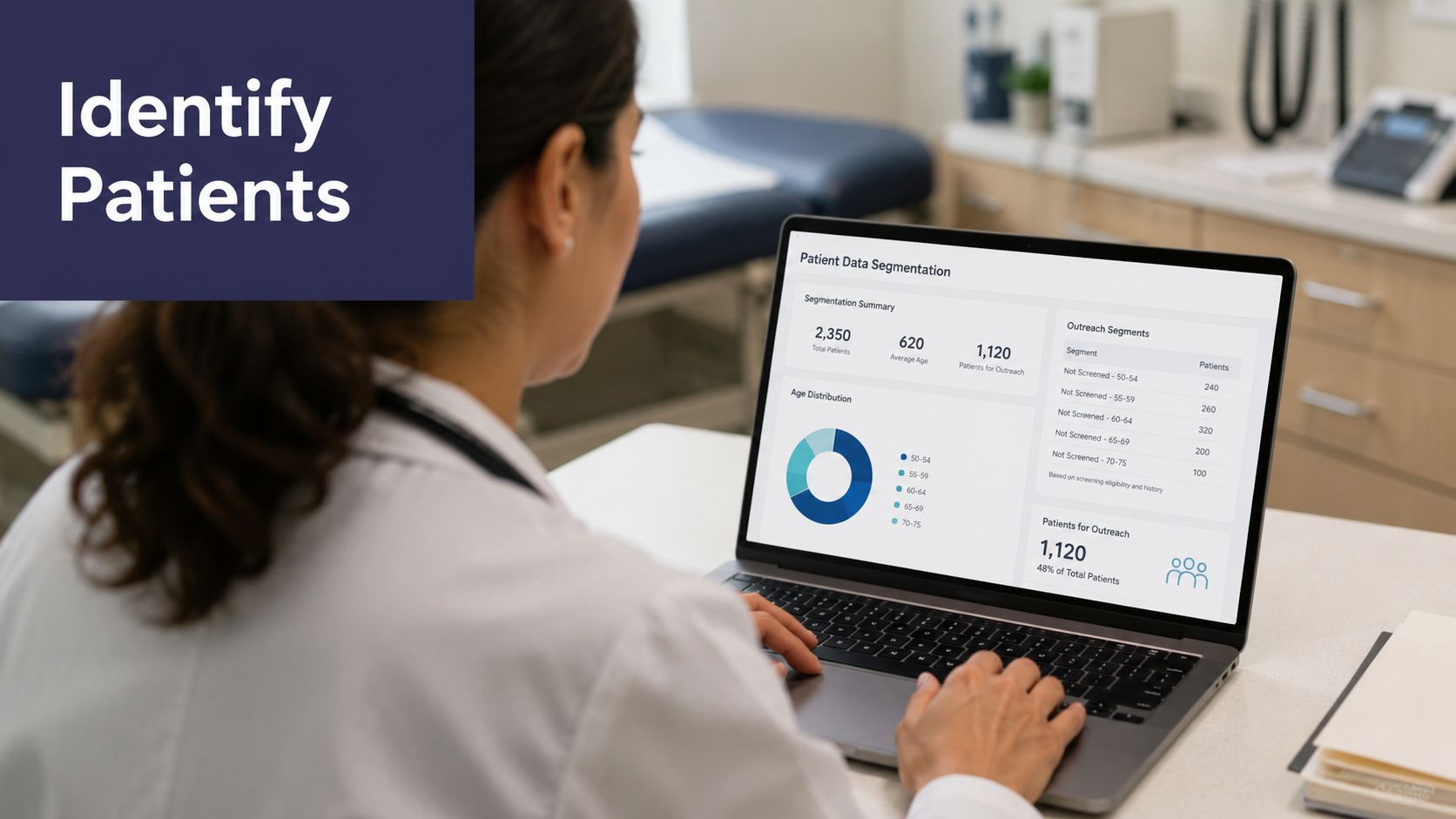
Identifying and Segmenting Your Eligible Patient Panel
The EMR has to be the source of truth. If the patient list is sloppy, every downstream step gets expensive, noisy, and harder to trust. Start by pulling average-risk adults who fall inside the current screening window, then exclude the patients who are already compliant, already referred, or not appropriate for routine outreach.
For average-risk adults, the key screening age is 45, and the USPSTF recommends screening all adults 45 to 75 years old, with selective screening from 76 to 85. Screening options include annual FIT, stool DNA-FIT every 1 to 3 years, and colonoscopy every 10 years. That guidance is the cleanest place to anchor your outreach logic. USPSTF colorectal cancer screening recommendation
Build the panel from the chart, not from memory
In practice, that means querying your EMR for age, last completed screening date, and documented screening modality. In systems like eClinicalWorks or Athenahealth, the query should flag patients who are due now, not patients who were screened recently and haven't had the result imported correctly. That distinction saves staff time and keeps patients from getting duplicate mailers.
A clean list also needs exclusions. Patients with a recent colonoscopy, active GI workup, or a documented plan that already addresses screening should come off the list before outreach begins. Otherwise, your team will spend time generating confusion instead of access.
Practical rule: if the chart can't show why a patient is due, don't send the first wave yet. Clean the registry first.
A useful mindset is to treat this like segmentation in any other operational workflow. Even outside healthcare, segmentation improves targeting and reduces waste. If your team wants a simple reference point for how organized lists are built, segmentation with Mail Merge for Gmail is a helpful parallel, even though your clinical list has much stricter rules.
The list should also support population health reporting. The more clearly your clinic can separate due, deferred, completed, and not-indicated patients, the easier it becomes to manage the campaign without reworking the same file every week. That structure fits naturally into a population health approach, and this overview of population health management in practice is a good internal reference point for organizing the work.
Choosing Outreach Channels and Crafting the Message
The channel matters, but the message matters just as much. If the outreach feels vague, patients ignore it. If it sounds accusatory, they delay. If it asks for too much work up front, staff ends up doing the chasing anyway.
The strongest evidence supports mailed FIT as the first-pass strategy for many practices. In a pragmatic trial in a federally qualified health center system, usual care screening completion was 28%, while mailed FIT outreach alone increased it to 77%. That means outreach using mailed FIT nearly tripled completion compared with usual care, and it outperformed one-on-one inreach alone. Mailed FIT outreach in an FQHC system
Mail, phone, and SMS do different jobs
Mailed kits work well because they reduce friction. The kit arrives with the test, so the patient isn't asked to make a separate trip, book a separate appointment, or remember another task. Phone outreach is useful when a patient needs encouragement, translation, or help understanding why the test matters, but it's labor intensive. SMS reminders are lighter weight, yet they're best used as reinforcement, not as the only channel.
A thoughtful mailed program usually pairs the kit with a clear letter and a simple call-to-action. Patients should know what the test is, why they got it, what to do next, and how to ask for help if they're confused. That language should be calm and concrete. No jargon. No guilt.
Keep the first message short. Patients rarely need more detail up front, they need a clear next step.
The operational trade-off is plain. Mail creates upfront production work, but it scales better than repeated staff calls. Phone calls add human touch, but they can swallow front-desk time fast. SMS can reduce reminder fatigue, but it can't replace the tactile simplicity of a kit landing at home.
If your team is planning the logistics, planning bulk mail campaigns is a useful nonclinical analogy for thinking through batching, timing, and consistency. The point isn't to turn clinical outreach into marketing. It's to make sure the workflow is repeatable.
For practices that rely on outbound phone workflows, this overview of outbound call automation in healthcare is a practical internal read. The big lesson is that outreach works best when the patient gets one clear message, then a sensible follow-up cadence, not a chaotic burst of disconnected reminders.
Building an Automated and Compliant Workflow
A good outreach campaign should run like a controlled background process, not a series of heroic staff interventions. The moment your team has to manually track every call, every postcard, and every result, the program gets fragile. Automation matters because the work is repetitive, and repetition is where errors creep in.
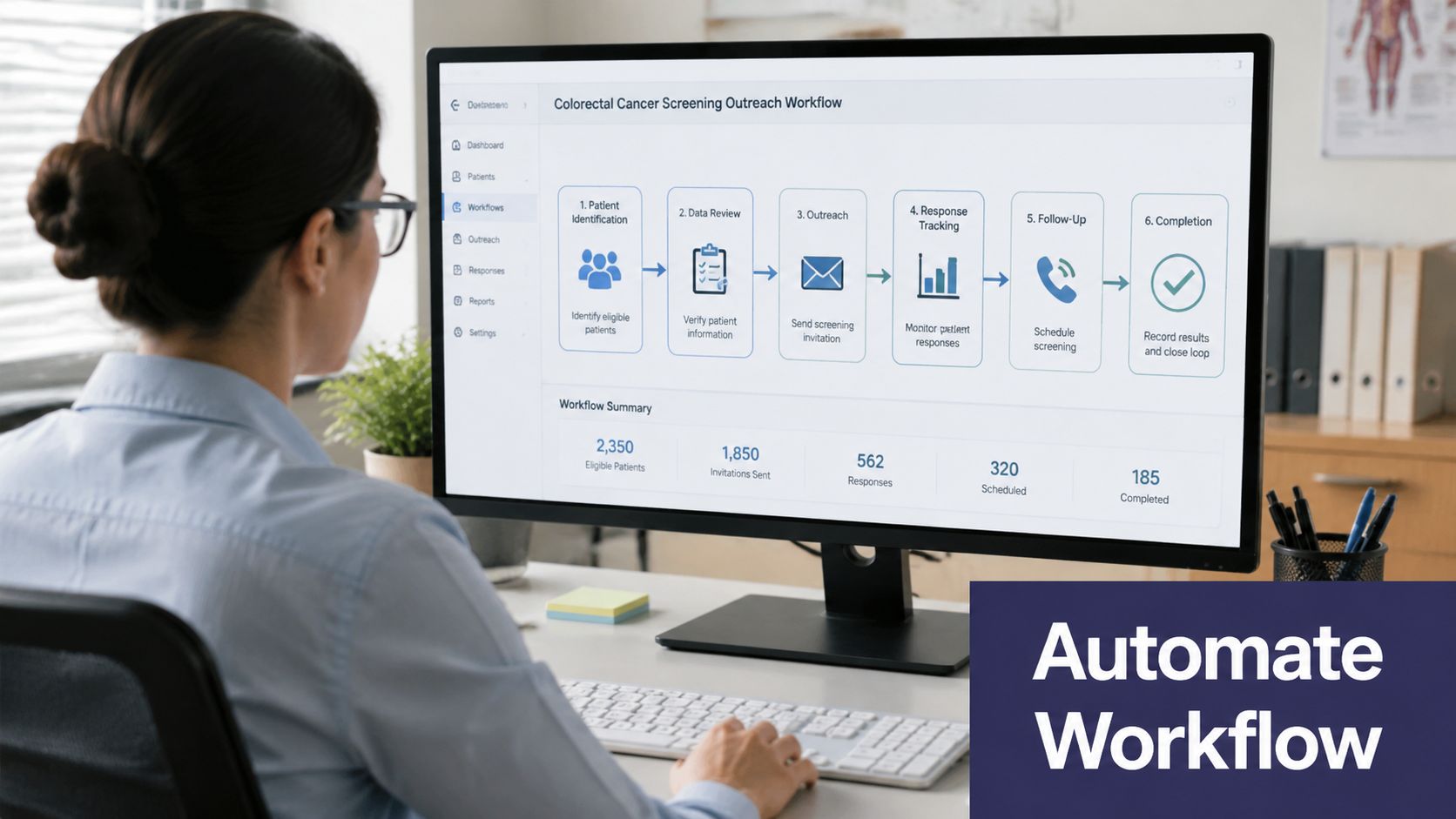
The highest-yield workflow is straightforward. Identify eligible patients from the EHR, send a mailed invitation plus a FIT kit, add reminder calls or letters, and route abnormal FITs to diagnostic colonoscopy navigation. That sequence is the backbone of effective population management outreach. High-yield colorectal cancer screening outreach workflow
Connect the workflow to the EMR
Practices using gGastro, EMA ModMed, Athenahealth, Epic, DrChrono, or eClinicalWorks should aim for an outreach loop that writes back to the chart. If a patient was mailed a kit, that should be visible. If a reminder went out, that should be visible too. When staff have to toggle between spreadsheets and the chart, someone eventually misses a patient.
That's where integration matters. Good integration reduces duplicate entry, improves traceability, and makes escalation easier when the patient is overdue for follow-up. For teams evaluating workflow connections, the internal integrations overview is a useful reference for what a connected system should look like in day-to-day practice.
HIPAA compliance can't be an afterthought. The workflow has to protect patient data at each step, especially if external vendors touch mail, calls, or documentation. Secure handling, access controls, and chart-level traceability are not optional if you want the program to survive real-world scrutiny.
You can also borrow operational discipline from telecom planning. A practice that is comparing phone system reliability should think about whether the setup can support outreach volume without collapsing under repeated call attempts. This overview of NBN vs Opticomm for medical practices is a reminder that infrastructure choices shape whether a workflow stays stable under load.
Make the process auditable
Every outreach wave should leave a trail. Who was eligible, who was contacted, what method was used, and what happened next should all be visible without manual detective work. That matters when a patient calls back, when a clinician asks about a gap, or when leadership wants to know whether the program is being executed.
Automation also keeps the workflow realistic for smaller practices. A system that depends on a team member remembering to print labels, stuff envelopes, and update the registry every afternoon will eventually stall. A system that pushes tasks into the EMR and routes exceptions to staff is far more durable.
Navigating Patients from Positive Screen to Diagnostic Care
The hardest part of colorectal cancer screening outreach isn't getting the first test accepted. It's making sure the positive result turns into diagnostic colonoscopy. That's where patients get stuck, and it's also where screening programs can lose their impact.
Evidence reviews emphasize that effective CRC outreach must be multicomponent and should include navigation to diagnostic colonoscopy, because screening gains can be lost if follow-up is not completed. Many guides overfocus on the initial outreach and ignore this higher-friction downstream pathway. Evidence review on CRC outreach and diagnostic colonoscopy navigation
Treat the positive FIT as a separate workflow
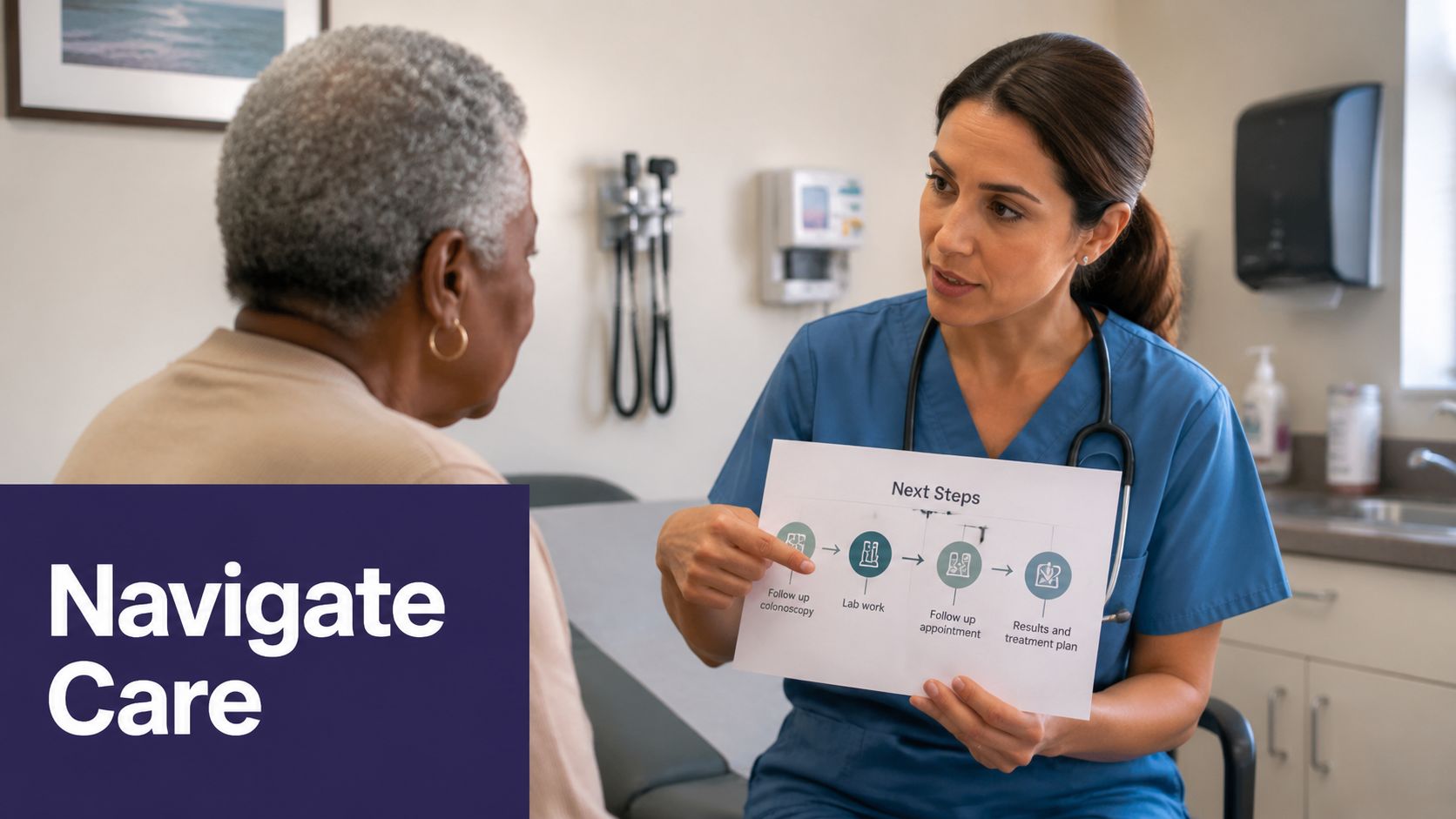
A positive stool test should trigger a different process, not just a note in the chart. The patient needs timely explanation, scheduling help, and repeated contact if the colonoscopy isn't booked. If the clinic handles that step passively, completion slips.
A clinically trained voice workflow can do real work. The right agent can call back, explain next steps in plain language, check for barriers like transportation or confusion, and escalate to staff when the case is complex. That kind of repeated follow-up is tedious for humans and exactly the sort of task that benefits from structured persistence.
The downstream handoff also needs a clean document trail. A referral form, prep instructions, and a documented callback sequence reduce the odds that the patient is left wondering what happens next. This referral form template is a useful internal anchor for standardizing the transition from positive screen to diagnostic care.
A screening program is only as good as its last step. If the colonoscopy never happens, the work upstream doesn't fully count.
Barriers are predictable. Fear of the procedure, scheduling friction, cost concerns, and prior bad experiences all slow down completion. The answer isn't a single reminder. It's a navigation protocol that keeps checking in until the patient either completes the procedure or a real clinical reason changes the plan.
Build persistence into the workflow
Repeated outreach isn't nagging when it's tied to a clinical task that matters. It's the difference between a patient hearing one message and a patient attending the next appointment. Practices that automate this step tend to protect staff time while improving the odds that the referral doesn't stall.
The best approach is simple. Confirm the result, explain the reason for colonoscopy, assist with scheduling, and keep the chart updated until the handoff is closed. Anything less leaves a gap that patients often can't bridge on their own.
Staffing Your Program and Managing the Workload
A successful program needs ownership, but it doesn't need to consume your front desk. In smaller practices, that balance matters. If one MA or coordinator is supposed to chase every patient, answer live calls, manage refills, and keep a screening registry current, the outreach work eventually crowds out everything else.
The better model is a hybrid one. Routine, high-volume tasks should be handled by automation, while human staff stay focused on complex questions, exceptions, and coordination problems. That division of labor keeps the program moving without turning it into another burnout source.
Match the task to the right person or system
Initial outreach, reminders, and documentation updates are repetitive enough to automate. Patient education, unusual barriers, and diagnostic scheduling issues need a person. That split respects both the workflow and the staff's time.
There's also a practical reason to keep humans for the higher-touch moments. Patients are more likely to need reassurance after an abnormal result than after a routine reminder. The conversation changes. So should the staffing model.
The internal framing of AI medical staff is useful here because it reflects the actual workload. The system isn't replacing clinical judgment, it's absorbing the repetitive administrative layer so the clinic can stay responsive.
If a task happens the same way hundreds of times, staff shouldn't be the default engine for it.
That principle applies cleanly to colorectal cancer screening outreach. Staff should supervise, review exceptions, and handle the calls that require judgment. They shouldn't be hand-entering the same outreach status over and over.
For independent practices, that's not just a convenience. It's a sustainability issue. The more predictable the workflow, the easier it is to keep the program alive long enough to matter.
Measuring Success and Refining Your Approach
You can't improve what you don't track. If the outreach work lives only in anecdote, it'll be impossible to know whether the clinic is reaching overdue patients or just creating more noise. The right metrics keep the program honest.
Start with the basics. Track the number of eligible patients identified, the number contacted, the number who completed FIT, and the number with abnormal results who reached diagnostic colonoscopy. That last metric matters most because it shows whether the program is closing the loop.
Focus on the handoff, not just the mailing
A lot of teams stop measuring once the kit goes out. That's not enough. You need to know which patients returned the test, which didn't, which were positive, and which ultimately completed colonoscopy. Without that full chain, the clinic can't see where the workflow is breaking.
Real-world economics depend on execution quality too. One EHR-embedded mailed FIT program reported an outreach cost of about $23 per patient and about $112 per additional patient screened, which shows why mailing, tracking, and callback systems have to be reliable if the program is going to make operational sense. EHR-embedded mailed FIT program cost data
A simple measurement cadence works well in practice:
- Weekly: review outreach volume, returned mail, and patients who haven't responded.
- Monthly: assess FIT completion, positive results, and colonoscopy scheduling follow-through.
- Quarterly: look for workflow bottlenecks, such as delayed result review or referral drop-off.
Those checkpoints help you spot where the program leaks. Sometimes the issue is the message. Sometimes it's the mail list. Sometimes it's that nobody owns the follow-up queue.
Use data to refine the workflow
If one outreach channel underperforms, don't assume the whole program failed. Check whether the issue is wording, timing, or staffing. A mailed FIT workflow may need a different reminder cadence than a phone-first campaign. Small operational adjustments often matter more than dramatic redesigns.
The broader point is that colorectal cancer screening outreach is a practice capability, not a one-time project. When it's measured well, it supports quality performance, patient retention, and smoother access for patients who would otherwise fall through the cracks. That's the kind of operational discipline that keeps a busy clinic functioning without adding unnecessary load.
If you're evaluating a more reliable way to run outreach, reminders, and follow-up without burying your team in manual work, you can see how Simbie AI fits into the workflow at simbie.ai/book-a-demo.