

A new diagnosis of chronic kidney disease can leave a family standing in the kitchen with two bad choices, guess and hope, or cut food down so hard that meals stop feeling normal. The better path is more specific than that. A chronic kidney disease diet changes with stage, lab values, diabetes status, dialysis, and even what the person can afford and cook.
That's why the same blanket advice doesn't work for everyone. Sodium usually needs attention early, protein targets shift as kidney function falls, and potassium or phosphorus limits depend on what the kidneys can still clear. The goal isn't to build a perfect menu. It's to match the food plan to the person sitting at the table, without making the family guess at every meal.
Why the Right Diet Matters at Every CKD Stage
A new kidney diagnosis often sends a family into the kitchen with the same question. What needs to change, and what is just extra worry? With CKD, food choices are not background health advice. They shape nitrogenous waste, uremic symptoms, fluid balance, blood pressure, and the workload on kidneys that are already doing more than they should.
That is why stage-specific nutrition matters. A chronic kidney disease diet is not one fixed meal plan for everyone. For people with non-dialysis CKD G3b to G5, contemporary guidance commonly recommends about 0.6 to 0.8 g/kg/day protein, while dialysis patients are typically advised to eat 1.0 to 1.2 g/kg/day because protein losses and catabolic demand are higher (PMC review on CKD diet guidance). The numbers change because the kidney's job changes. A plan that is reasonable in earlier stages can become too lax later, and a dialysis plan can be too restrictive if it ignores replacement losses.
Earlier stages often allow more flexibility, especially with plant-forward eating patterns and closer attention to blood pressure and sodium first. By the time kidney function falls further, the same food choices can create more waste than the body can clear. Once dialysis starts, the trade-off shifts again, because the treatment removes some of what failing kidneys can no longer handle, and protein needs rise to match ongoing losses. A family that understands that logic is less likely to treat every food rule as permanent.
A history of the evidence helps make that logic feel less arbitrary. A meta-analysis of 16 randomized controlled trials found that lower protein intake of <0.8 g/kg/day was associated with lower risk of end-stage kidney disease and all-cause mortality in non-dialysis CKD (PMC review on CKD diet guidance). Real-world intake still often misses the target. One population report found mean protein intake in people with an early-CKD indicator was 1.3 g/kg/day, above the proposed 0.75 to 1.0 g/kg/day range (PMC review on CKD diet guidance).
Practical rule: if the advice sounds the same for stage 2 and dialysis, it is too vague to be useful. The right plan should also fit the person's care team, including chronic care management when follow-up, labs, and medication changes need to stay coordinated.
The rest of this guide follows the same logic a renal dietitian would use at the table. First comes the reason behind each food limit. Then the targets by stage. Then the practical part, what a day of meals looks like, how plant-forward patterns fit, how to shop on a budget, and when lab results should change the plan.
The Five Nutrient Levers in a Kidney Diet
Sodium sets the pressure load
A newly diagnosed patient often wants one simple rule for the grocery cart. Sodium is usually the first place to start, because it pulls water with it. When the kidneys cannot clear salt well, the body holds on to more fluid, and that can show up as swelling, higher blood pressure, or the heavy, puffy feeling that builds by evening. Low-sodium cooking helps even before a person needs major changes in protein, potassium, or phosphorus.
The National Institute of Diabetes and Digestive and Kidney Diseases gives a practical label rule, 5% Daily Value or less for sodium is low, and 20% Daily Value or more is high (NIDDK). It also advises limiting prepared, packaged, and fast foods, and rinsing canned vegetables, beans, meats, and fish to remove extra salt.
Potassium depends on what the kidneys can clear
Potassium matters because the heart and muscles need it in a narrow range. As urine output falls, potassium can rise, and that is where families often assume every CKD diet must ban bananas, tomatoes, and potatoes right away. The tighter rule depends on labs, medications, and stage. Earlier CKD may not need a strict potassium cap unless hyperkalemia is present or a medication makes the level climb, while later stages often need closer monitoring (National Kidney Foundation nutrition guidance).
A clinical review gives a common range for CKD G3 and G4 of 2 to 4 g/day potassium. That range is a guide, not a universal command. The lab result still decides whether a person can keep more plant foods on the plate or needs a narrower list for a while.
Phosphorus and protein become more important as kidney function declines
Phosphorus builds up when kidneys cannot excrete it well. Over time, that can pull calcium out of bone and contribute to vessel damage, which is why phosphorus control becomes more visible as CKD advances. Protein works differently. The body needs it to maintain muscle and repair tissue, but it also breaks down into nitrogenous waste, so the kidney has to clear more after each meal. That is why protein restriction shows up in non-dialysis CKD, and why dialysis changes the target in the opposite direction.
The 2020 KDOQI nutrition guideline recommends 0.55 to 0.60 g/kg/day protein for metabolically stable adults with CKD stage 3 to 5, or 0.28 to 0.43 g/kg/day with ketoacid analogs for a very-low-protein diet. For adults with diabetes and CKD 3 to 5, 0.6 to 0.8 g/kg/day is considered reasonable (KDOQI summary). The guideline also stresses adequate calories, commonly 30 to 35 kcal/kg/day, so people do not slide into protein-energy wasting (KDOQI summary).
Fluids become a balancing act later on
Fluid targets are easier to keep loose early and harder to set later, especially when urine output drops or dialysis starts. Too much fluid can worsen swelling and blood pressure. Too little can leave a person thirsty and uncomfortable. In practice, fluid advice belongs with stage, urine output, and dialysis schedule, not in a generic handout.
A kidney diet works when each limit has a reason. Sodium protects against fluid overload, potassium protects heart rhythm, phosphorus helps guard bone and blood vessels, protein has to match the stage, and fluids depend on how much the kidneys still move out of the body.
How Targets Shift From CKD Stage 1 Through Dialysis
A newly diagnosed person often hears one phrase and applies it to every meal, every stage, and every lab result. CKD food planning does not work that way. Stage 1 and stage 2 are handled differently from stage 4, and dialysis sits in its own category. The mistake is to put every nutrient on the strictest setting from the start, which can make eating harder than it needs to be.
Typical daily targets across CKD stages
| Stage | Sodium | Potassium | Phosphorus | Protein | Fluids |
|---|---|---|---|---|---|
| CKD G1 to G2 | Focus on sodium control and overall diet quality | Often no blanket restriction unless individualized | Usually individualized | Usually standard healthy intake unless proteinuria or other factors change the plan | Usually no universal restriction |
| CKD G3a to G3b | Sodium control stays important | Often monitored more closely, especially if labs rise | May need closer attention | 0.6 to 0.8 g/kg/day is commonly used for non-dialysis CKD | Usually individualized |
| CKD G4 | Sodium control continues | Often more active restriction if potassium trends up | More active phosphorus control | 0.55 to 0.60 g/kg/day per KDOQI, or individualized within low-protein planning | May become more relevant |
| CKD G5 non-dialysis | Sodium control remains | Often tighter if needed by labs | Often tighter if needed by labs | Protein restriction remains important, with calories protected | May need individual limits |
| Dialysis | Sodium still matters | Often more careful because fluid and potassium control get harder | Usually monitored with binders and diet | 1.0 to 1.2 g/kg/day is typical because losses rise | Often more structured, especially around treatment days |
The table is a map, not a prescription. It shows why the target shifts as the kidney loses more filtering capacity. Early CKD is often about protecting the kidneys and keeping the rest of the diet balanced. Mid-stage CKD asks for tighter control where the kidneys are starting to fall behind. Dialysis changes the protein target in the opposite direction, because treatment removes waste but does not fully replace normal kidney function. The trade-off stays the same: enough protein to prevent wasting, without pushing waste products higher than the body can handle.
A useful way to read the table is to ask what problem each limit is trying to solve. Sodium helps with blood pressure and fluid retention. Potassium matters more when the kidneys can no longer clear it reliably. Phosphorus becomes harder to manage as CKD advances, so the limit often grows stricter with stage. Protein is the most stage-dependent lever of all, since too little can lead to undernutrition, while too much raises the burden of waste in non-dialysis CKD.
The public-health picture points in the same direction. Analysts at Frontiers in Nutrition analysis reported that CKD deaths tied to dietary risks rose sharply over time, and that low vegetable intake, low fruit intake, and high sodium intake were the biggest contributors to diet-related CKD deaths and disability. That does not mean every person with CKD needs the same restrictions at the same time. It does mean the food pattern matters early, before the labs force the issue.
Stage 1 and stage 2 usually leave more room for a plant-forward pattern, especially when blood pressure and urine protein are the main concerns. In those stages, a person may only need sodium control and better overall diet quality, rather than a full list of potassium or phosphorus limits. By stage 3, the diet often starts to feel more like a set of guardrails than a free choice, because the kidney has less reserve. By stage 4 and stage 5 without dialysis, those guardrails narrow further. Once dialysis starts, protein often goes up again, while fluid, potassium, sodium, and phosphorus still need close attention.
The practical rule is simple. Stage first, then labs, then the plate.
A Day of Meals That Respects Stage 3 Limits
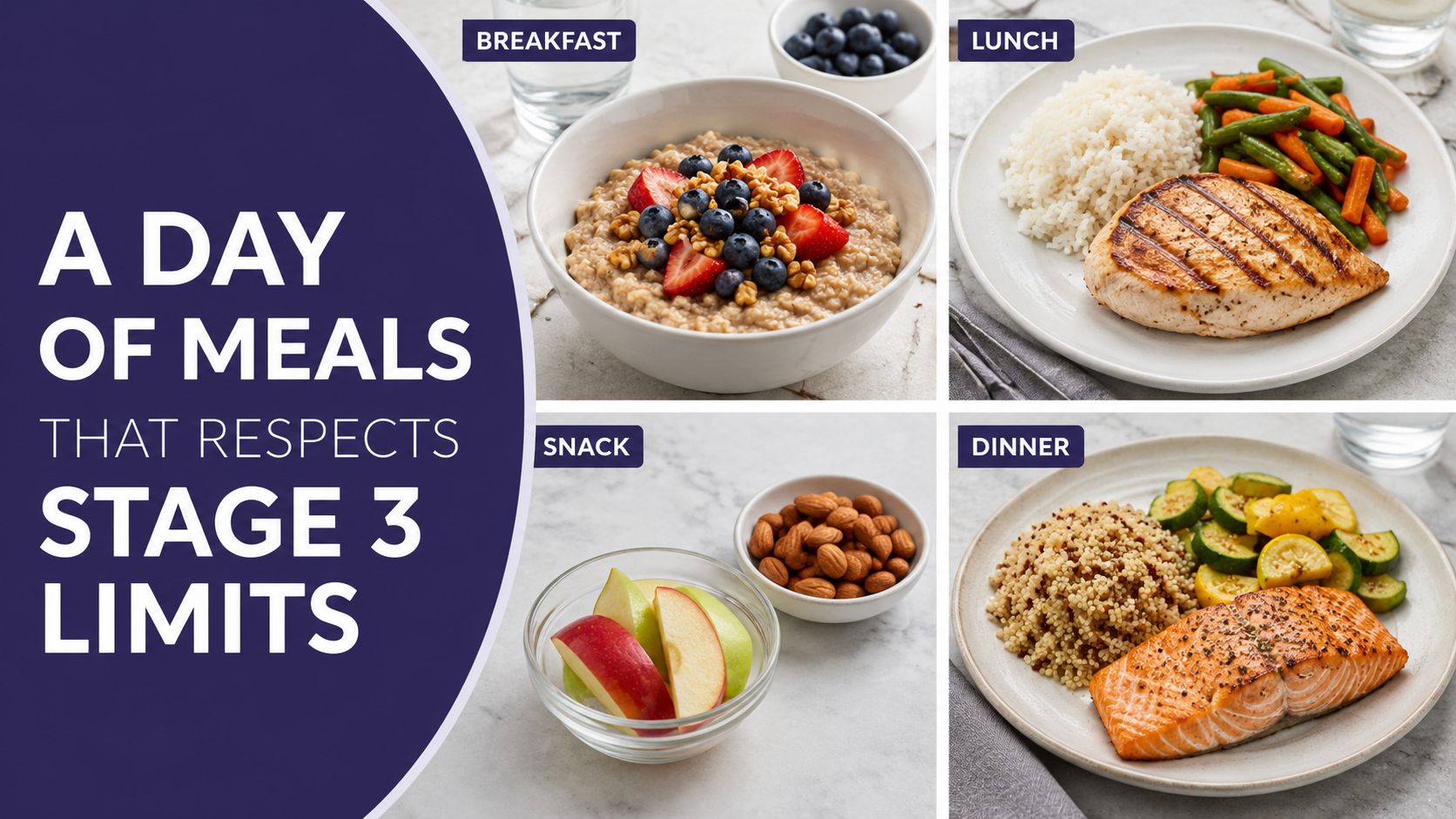
A stage 3 day doesn't need specialty food to start. It needs familiar foods in the right mix, with sodium under control and protein portions measured instead of guessed. That alone usually looks very different from a normal American convenience-food day.
Breakfast can stay simple
Start with oatmeal cooked in water, topped with sliced apple and cinnamon. Add one egg or egg whites if protein is being watched closely. The apple matters here because fruit choices often need to change before a person realizes it, and oatmeal is more forgiving than a packaged breakfast pastry. If milk is part of the routine, portion it rather than pouring freely.
Lunch should be lower in sodium than most deli meals
A sandwich made with fresh chicken, lettuce, and a small amount of mayonnaise on white bread is easier to control than deli meat, which is usually much saltier. Add cabbage slaw or a side of cucumber instead of salted chips. If the person has diabetes, the carbohydrate portion needs attention too, but the kidney rules stay the same.
A plain lunch like this also leaves room for the biggest pitfall, hidden sodium. Soup, cured meat, pickles, and restaurant portions can undo a careful morning fast. A stage 3 plan works because it controls the parts that move the labs, not because it bans flavor.
Dinner and snacks can be adjusted by stage
Dinner might be baked fish, white rice, and sautéed green beans. A snack could be unsalted crackers with a small serving of fruit. If the person's stage 4 or labs require tighter protein, reduce the fish portion and build the plate around rice and vegetables. If dialysis starts, the same meal can be shifted upward in protein with a larger serving of fish or chicken.
For a diabetes-friendly version, the carbohydrates need to be spread more evenly across the day. For a dialysis pattern, protein comes back up, but sodium still needs attention so thirst doesn't spiral after the meal. That's the part families often miss. Dialysis does not mean “anything goes.”
Plant-Forward and Mediterranean Patterns in CKD
A dinner table can look healthy and still miss the mark for CKD. A bowl of beans, a big salad, and fruit may sound safe in theory, yet the right choice depends on the person's potassium, phosphorus, protein needs, and stage of disease. That is why blanket “good food, bad food” lists fail so many families.
The better approach is to match the pattern to the labs and the stage. CKD nutrition reviews support sodium restriction, and they also show that some patients can do well with a Mediterranean-style or more plant-forward pattern when blood pressure, lipids, body weight, and acid load are being watched carefully (PMC review on individualized CKD nutrition). That does not mean every patient should be told to eat that way. It means the plan should be adjusted for the person sitting at the table, not copied from a general handout.
Potassium is where the trade-off becomes clear. A person with normal serum potassium, no recent hyperkalemia, and a medication list that is being reviewed may tolerate more plant foods than someone who keeps running high potassium readings. RAAS-antagonist use changes the picture too, because the diet has to fit the medicine list as well as the lab values.
A better question is simple and practical. Which fruits and vegetables fit my current labs, and which ones need smaller portions or different preparation? That question gets a more useful answer than “Are bananas bad?” because the answer depends on the numbers, the medications, and the stage, not on a single food label.
A Mediterranean pattern can also be a practical teaching tool for families who are trying to manage two conditions at once. If CKD overlaps with diabetes, the meal plan has to fit kidney limits and blood sugar control at the same time, which is why broad food rules often collapse in real life. Diabetes patient education for complex dietary counseling helps connect those pieces so the family sees how carbohydrate planning, sodium control, and portion size fit together instead of treating each problem in isolation.
For some people, that same pattern can stay mostly intact with a few guarded changes. For others, especially when potassium or phosphorus starts to rise, the plan has to become more selective, with smaller servings of certain plant foods and more attention to preparation methods. Plant-forward eating can still work, but only when it is fitted to the stage, the lab results, and the medicines, not when it is treated as a one-size-fits-all rule.
Families often ask whether this means they should avoid every familiar meal. The answer is usually no, but the trade-offs need to be plain. A plate that relies more on plants may help with blood pressure and acid load, while dialysis or later-stage disease may require more protein again, along with tighter attention to sodium so thirst does not climb after the meal. For people who want practical meal ideas in that style, the Just Cook It Mediterranean meal prep resource can help them see how a Mediterranean pattern is assembled, then adapted to kidney limits without pretending every ingredient fits every stage.
Reading Labels and Building a Budget-Friendly Shopping List
Most kidney diet advice falls apart in the grocery aisle. A family might understand low sodium in theory, then get hit by the price of fresh produce, lean meat, or low-phosphorus specialty products. That gap is real, and it's why budget and food access belong in CKD counseling.
The label rule from NIDDK is the fastest place to start. 5% Daily Value or less for sodium is low, and 20% Daily Value or more is high (NIDDK). The same guidance says to rinse canned vegetables, beans, meats, and fish to wash off extra salt (NIDDK). That gives families something concrete to do before they ever buy a new product.
A low-cost shopping list can still work around CKD limits:
- Dried beans in controlled portions, soaked and rinsed before cooking.
- Rice as a low-cost base when portions fit the plan.
- Apples and cabbage for fruit and vegetable choices that are usually easy to work into meals.
- Eggs in moderation when protein targets allow.
- Fresh chicken or fish in measured portions, rather than processed lunch meat.
- Canned vegetables or beans only when the label and rinsing step keep sodium down.
The affordability problem is not a side note. Research on disadvantaged populations notes that healthful dietary patterns are often hard to access because of cost and food barriers, and a 2025 review found economic constraints, taste, and concern about food-related disease were major barriers to following CKD diets (PubMed review). That is why a food plan that ignores budget usually fails at home.
If a family wants a ready-made cooking reference, Just Cook It Mediterranean meal prep can help translate a more plant-forward pattern into actual meals, as long as the kidney team checks the potassium and protein fit first.

Labs, Monitoring, and When to Loop in a Renal Dietitian
A kidney meal plan only works if it keeps pace with the labs. A person may be doing everything “right” at the table, yet the blood work can show a different story. The markers most often used are eGFR, potassium, phosphorus, PTH, albumin, and urine albumin-to-creatinine ratio. Those results show whether the current plan is helping, whether limits need to tighten, and whether protein or calorie intake is drifting too low.
The best way to use lab work is to match the trend with the food change. If potassium rises, it is time to review plant portions and salt substitutes. If phosphorus climbs, dairy, processed foods, and binders deserve a closer look. If albumin falls or appetite stays poor, the diet may have become too restrictive. The menu should change with the numbers, because the numbers are describing how the body is handling the plan.
Medication can shift the picture too. ACE inhibitors and ARBs can raise potassium. Potassium binders and phosphate binders can give a person more room with food, but they do not replace follow-up labs. A list copied from the internet often causes trouble here, especially when kidney disease sits alongside diabetes, heart disease, or other conditions.
For families who want to follow kidney function over time, track kidney health with OneTwenty offers a focused view of estimated GFR alongside diet and lab follow-up. It is most useful when the care team is watching the trend, not reacting to a single result.
Clear lab communication matters just as much as the result itself. How to communicate lab results to patients is useful because CKD food advice only makes sense when patients understand why the recommendation changed. A renal dietitian referral is especially helpful when diabetes, dialysis planning, poor appetite, food insecurity, or repeated lab swings make the plan hard to carry at home.