
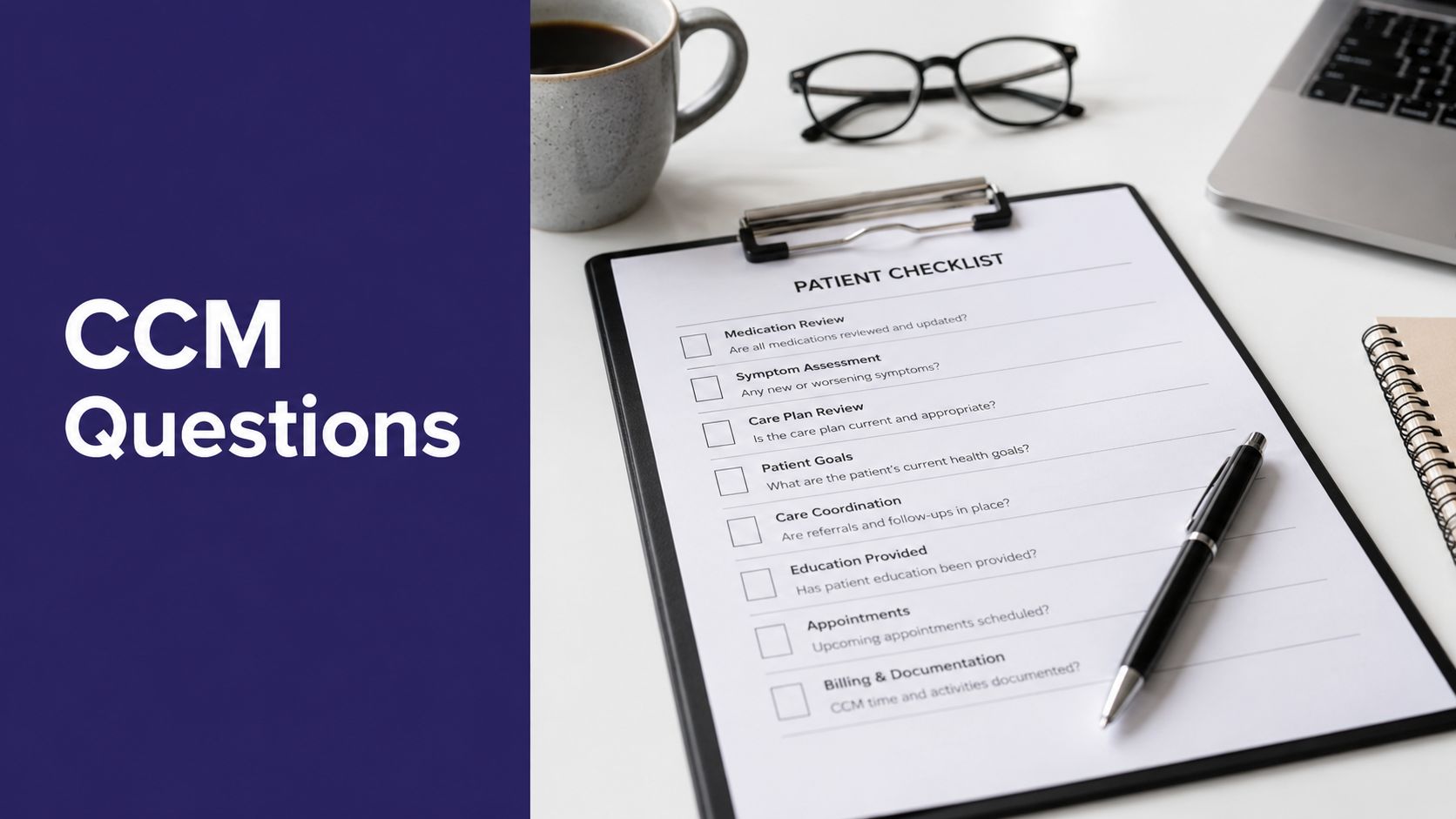
Your front desk already knows the pattern. A patient calls about a refill. Another asks whether yesterday's lab result is normal. Someone else missed an appointment and wants to know if they need a new referral. By noon, your staff is buried in repeat questions that matter clinically but don't always require a clinician to stop what they're doing. That's where most chronic care management questions for patients break down in practice. They stay trapped as phone messages instead of becoming structured, billable, documented care workflows.
Beyond the checklist, effective CCM is about operationalizing those conversations. Medicare Chronic Care Management requires patients to have two or more chronic conditions expected to last at least 12 months or until death, with significant risk of death, acute exacerbation, decompensation, or functional decline, according to the AAFP CCM eligibility summary. This guide shows practice owners and administrators how to turn common patient questions into repeatable workflows that support safety, access, and documentation. For more on how this works, see our voice AI agent. If your team still relies on fax for records exchange, tighten that process too with guidance on sending medical records securely.
Chronic care management questions for patients about medications between visits
Medication questions are where CCM either becomes proactive or stays chaotic. Patients with hypertension, diabetes, inflammatory bowel disease, or chronic dermatologic conditions don't just need refills. They need help understanding what changed, what's due, and what requires a callback.

In a manual workflow, the patient leaves a voicemail, your MA checks the chart, someone reviews the last visit, then staff calls the pharmacy, then calls the patient back. That sequence repeats all day. In a better workflow, an AI medical staff layer handles the first pass, verifies medication history in eClinicalWorks, Athenahealth, or EMA ModMed, routes exceptions, and documents the interaction in the chart.
Build refill logic before call volume builds itself
For a common scenario, think of an established internal medicine patient on lisinopril who calls Monday morning saying they're out. The right workflow checks whether the medication is active, whether the refill is routine, whether the patient is overdue for follow-up, and whether the request falls into an exception bucket such as a controlled substance or a newly prescribed medication. If it's routine, the request moves forward without staff phone tag.
That's where automation earns its keep. Simbie's AI medical staff can cover the front-office layer and the clinical support layer together, so the same system that captures inbound calls can also support refill coordination, patient education, and chart-ready documentation. If medication adherence outreach is part of your CCM design, the AI medication reminder agent is directly relevant.
Practical rule: Auto-process stable maintenance medications. Force human review for controlled substances, first-time fills, and anything tied to recent abnormal labs.
A few operating rules make this safer and cleaner:
- Define refill categories clearly: Split medications into auto-eligible, provider-review, and nurse-review groups before go-live.
- Use refill timing as a signal: Late refill behavior can indicate nonadherence. Early refill behavior can signal misuse or confusion.
- Train patients once: Tell them at check-in and in after-visit instructions that routine refill calls can be handled anytime, including after hours.
- Keep pharmacy coordination in workflow: The call isn't finished until the action is documented and routed correctly.
For patient-facing education, a plain-language resource like Family Caregiving Kit's expert guide can reinforce what your staff already teaches.
What should I do if I miss a dose of my medication
Patients rarely think this is worth calling about until it's after hours. Then your answering service gets a vague message, the on-call clinician gets interrupted, and the patient still may not get a clear answer in time.
A missed-dose question should not float around as an unstructured callback. It should sit inside a protocol. For chronic care, that protocol needs to be medication-specific, tied to timing, and tied to escalation criteria.
Turn missed-dose calls into documented protocol encounters
An internal medicine patient on metoprolol who remembers a missed dose at 9 PM needs immediate guidance, not a voicemail loop. A dermatology patient on isotretinoin needs a different path because the risk profile is different. A gastroenterology patient on a maintenance medication for inflammatory disease may need adherence reinforcement and symptom screening in the same interaction.
That's why practices should build decision trees with clinicians and pharmacists for the medications they prescribe most often. The AI agent should never improvise. It should follow approved logic, document the exact guidance provided, and escalate when the situation falls outside the protocol.
If the patient reports chest pain, shortness of breath, severe dizziness, or any other emergency symptom, the workflow should stop and direct emergency care immediately.
Use the workflow to standardize four things:
- Time-sensitive guidance: The script should account for how long ago the missed dose occurred.
- Drug-class exceptions: High-risk medications need their own escalation path.
- Behavioral reinforcement: Add a reminder setup, pharmacy sync suggestion, or adherence follow-up when missed doses recur.
- Chart documentation: Record what the patient reported, what guidance was given, and whether staff follow-up is needed.
This is also where CCM becomes more than billing. Medicare generally covers 80% of CCM costs, leaving a typical 20% coinsurance of about $12 per month for patients without secondary coverage, and the care coordinator must spend at least 20 minutes each month on care plan activities such as medication reconciliation and lab tracking, as summarized in this CCM patient cost and service overview. Missed-dose interactions can contribute meaningful clinical context to that monthly work when they're documented correctly.
When should I call my doctor about chronic condition symptoms
This is one of the highest-risk chronic care management questions for patients because the wrong answer cuts two ways. Some patients call for every baseline fluctuation. Others wait too long on something that should have been escalated the same day.
Your practice needs a symptom workflow that distinguishes routine self-management from real change. That means the script has to reference the patient's condition, their baseline, and clear red flags. Generic symptom trees aren't enough for CCM.

Baseline matters more than generic symptom lists
A patient with type 2 diabetes reporting thirst and frequent urination may need education, medication adherence review, or urgent escalation depending on their history and associated symptoms. A heart failure patient with new leg swelling is a different story. In internal medicine and gastroenterology, where multimorbidity is common, symptom calls need context from the chart.
That's why practices should connect symptom triage workflows to Epic, Athenahealth, or eClinicalWorks and route only the right cases to nurses or providers. For a practice building those protocols, these telephone triage protocols for nurses are a useful reference point.
Use a simple framework:
- Ask whether the symptom is new: “Is this different from your usual baseline?”
- Screen for red flags first: Chest pain, difficulty breathing, severe bleeding, or rapid functional decline should never sit in a queue.
- Capture trend information: Worse today than yesterday matters. So does “this has happened every week for a month.”
- Document the disposition: Self-care guidance, same-day callback, urgent visit, or emergency referral should all be charted clearly.
Patients trust systems that respond quickly and escalate appropriately. They lose trust when every answer is either “go to the ER” or “wait for a callback.”
This trust point matters. Research summarized in a peer-reviewed discussion of AI and telemedicine in chronic care highlights a real patient concern: digital tools can scale support, but practices still need to preserve the longitudinal human relationship at the center of effective chronic care. Build the workflow so the AI handles consistency and speed, while clinicians stay visible for judgment, reassurance, and complex change.
Do I need a follow-up appointment or can this be handled by phone
This question is really a schedule design problem. If every post-visit question becomes an in-person appointment, you clog the calendar. If too many issues stay on the phone without rules, you create risk and inconsistent care.
The fix is operational. Define which issues can be managed by phone, which require video, and which need in-person evaluation. Then teach the workflow to follow those rules every time.
Protect in-person capacity without creating clinical drift
A common scenario is the patient who calls a few days after a hypertension follow-up and asks whether they need to come back. If the last note shows stable blood pressure and no medication changes, a phone check-in may be appropriate. A dermatology patient with a minor treatment question may need secure messaging or a brief phone consult, not an office slot.
That judgment shouldn't live in your front desk's memory. It should be embedded in your scheduling logic and tied to chart context in eClinicalWorks, DrChrono, Athenahealth, or EMA ModMed. This keeps your visit types clean and reduces interruptions to providers during clinic hours.
A few guidelines help:
- Write the telehealth policy down: Don't leave it as tribal knowledge.
- Map question type to visit type: Medication review, post-lab clarification, rash flare, or chronic symptom update may each follow different rules.
- Offer patients a real choice: When both options are clinically acceptable, let them choose between phone and in-person.
- Document in one record: Phone guidance should live in the same chart timeline as office visits.
This also supports access. More than 80% of healthcare providers now use telemedicine or telehealth technology specifically for chronic care management, according to the chronic care management statistics summary. The operational lesson is simple. Patients already expect remote access. Your workflow should make it orderly.
Is my test result normal and what does it mean for my condition
Lab and imaging questions create some of the most avoidable call volume in ambulatory care. They also create some of the most preventable patient anxiety. A result sitting in the chart without timely communication turns into repeat calls, portal messages, and frustration.
Result communication needs structure. Normal results should move quickly with plain-language explanation. Slightly abnormal but nonurgent results should include next steps. Actionable findings should escalate immediately with clinical context.
Plain language lowers anxiety and reduces callbacks
An established patient asking about a thyroid panel doesn't need a copied reference range read back to them. They need a clear interpretation tied to their condition. “Your thyroid level is back in the normal range and your current dose appears to be working” is different from “TSH was 2.1.”
That interpretation layer can be operationalized when the workflow has access to prior values and provider-approved language in Epic, Athenahealth, or gGastro. For gastroenterology practices especially, where result volume can be heavy, this is a high-yield place to reduce repeat contacts without reducing quality.
Clinical communication rule: Never send a result without the next step. Recheck date, medication plan, provider callback, or urgent escalation should always be explicit.
Build the process around these standards:
- Separate informational from actionable results: Normal or stable results can move through automation with approved scripts.
- Compare against prior values: Trend often matters more than one isolated number.
- Route emotion as well as abnormality: A normal result can still require staff follow-up if the patient is distressed or confused.
- Close the loop in the chart: Result communication should never live only in voicemail history.
For practices still moving records manually between offices, delayed result communication often gets worse when records transfer is sloppy. Tightening operational handoffs, including sending medical records securely, supports cleaner result workflows too.
I missed my appointment. Can I reschedule or do I need a new referral
No-shows are rarely just a scheduling issue. They often reveal friction around transportation, work schedules, childcare, confusion about referrals, or poor access to your office by phone. If staff treats every missed appointment as a one-off reschedule, you miss the pattern.
Chronic care operations and patient access intersect. The best workflow re-engages the patient fast, checks whether the referral is still usable, confirms payer requirements, and offers the next appropriate slot before the patient drifts away.
Rebooking should happen in one interaction
A dermatology patient who missed an appointment because they were sick doesn't want a callback tomorrow to find out whether their referral still works. They want an answer now. The workflow should verify referral status, insurance status, provider availability, and visit type in one pass.
That can be handled inside an AI medical staff workflow connected to your scheduling rules and PM system. If no-show reduction is a current priority, this guide on how to reduce no-show appointments fits naturally into the same playbook.
Use missed appointments as a data source, not just a scheduling nuisance:
- Track the reason for the miss: Transportation and cost barriers need a different response than forgetfulness.
- Offer alternatives: A phone visit may save the patient and preserve continuity.
- Follow up the same day: Delay kills rebooking rates.
- Review repeat no-show patterns monthly: That's where access problems become visible.
This matters more than most practices realize. Despite nearly 75% of Medicare fee-for-service beneficiaries being eligible for CCM between 2015 and 2019, utilization only rose from 1.1% to 3.4%, according to a published analysis in the National Library of Medicine. One operational takeaway is clear. Eligibility alone does not create engagement. Friction in intake, outreach, and follow-up blocks enrollment and retention.
Can you refill my prescription or do I need to see the doctor first
This question sounds simple, but it's a care-gap detector. When a patient requests a refill, your practice has a chance to see whether the medication is current, whether monitoring is overdue, and whether the patient has drifted off the follow-up schedule.
If your team handles these one by one from memory, you'll get inconsistency. One staff member sends the refill. Another insists on a visit. Another leaves a message for the provider. Patients notice the inconsistency immediately.
Tie refill approval to follow-up status
The better model is to connect refill rules to the last completed visit, the diagnosis, and the monitoring interval your clinicians have already approved. A stable internal medicine patient on long-term antihypertensive therapy may be eligible for refill plus scheduled follow-up. A diabetes patient who is overdue for review may need an appointment before the next refill is processed.
That workflow works best when the AI can read the chart, queue the refill, offer the appropriate visit, and write the interaction back into the EMR. This makes Simbie's positioning as AI medical staff relevant. It isn't just answering calls. It supports refill coordination, scheduling, adherence check-ins, and documentation across tools such as eClinicalWorks, Athenahealth, Epic, DrChrono, gGastro, and EMA ModMed.
Keep the policy simple and enforceable:
- Set medication-specific visit intervals: Your clinicians should approve these, not your front desk.
- Use refill requests to schedule care: Don't make staff chase the patient separately later.
- Make exceptions visible: New symptoms, recent hospitalization, or overdue labs should trigger review.
- Audit edge cases: If providers override the policy often, the policy needs refinement.
For practices building CCM at scale, this refill logic becomes part of monthly care plan management rather than a disconnected admin task.
My insurance says it won't cover this medication. What are my options
Coverage confusion causes avoidable treatment gaps. Patients hear “not covered” at the pharmacy and then call your office frustrated, anxious, and often ready to abandon the medication altogether. Staff then has to sort out whether this is a deductible issue, a formulary issue, a prior authorization issue, or a simple misunderstanding.
This is one of the best examples of a question that should become a guided workflow. The practice needs a consistent response path that explains the issue, offers alternatives when appropriate, and escalates only the clinical decisions.

Separate coverage problems from clinical problems
If the issue is purely formulary, the patient should get a fast answer on covered alternatives or prior auth status. If the issue affects treatment selection, then the chart should route it to the clinician with the relevant context already assembled. That distinction saves staff time and reduces patient drop-off.
A strong process includes:
- Current coverage verification: Pull plan details before staff starts guessing.
- Approved alternative lists: Common substitutions should already be mapped by condition and payer.
- Prior authorization templates: Build them for the drugs your practice uses most often.
- Patient-friendly explanation: “Your plan requires prior approval” is clearer than payer jargon.
This is also where health literacy and socioeconomic barriers show up in real life. Research discussed in a peer-reviewed article on barriers to CCM access emphasizes that standard CCM content often fails to address the practical barriers that keep patients from enrolling or using these services, including financial constraints and limited health literacy. If your staff or AI workflow can't explain coverage issues in plain language, adherence will break long before the next office visit.
8-Question Comparison: Chronic Care Management for Patients
| Item | 🔄 Implementation complexity | 📊 Resource requirements | ⭐ Expected outcomes | ⚡ Speed / Efficiency | 💡 Ideal use cases |
|---|---|---|---|---|---|
| How do I manage my medications between doctor visits? | Medium, EMR + pharmacy integration, rules for escalation | EMR access, pharmacy APIs, rule config, staff training | ⭐⭐⭐⭐, fewer refill delays, improved adherence | ⚡⚡⚡⚡, 24/7 automated refill handling | Primary care/internal med with high refill volume; practices on eCW/Athena/ModMed |
| What should I do if I miss a dose of my medication? | Medium, protocol authoring per drug class, clinical oversight | Clinical protocols, EMR med list access, legal/clinical review | ⭐⭐⭐⭐, reduces after-hours calls and unsafe actions | ⚡⚡⚡, immediate guidance; escalates when needed | Chronic disease panels needing after-hours guidance (HTN, diabetes, HF) |
| When should I call my doctor about my chronic condition symptoms? | High, CDSS, baseline comparison, nuanced triage rules | Clinical decision support, EMR baseline data, provider input | ⭐⭐⭐⭐, fewer unnecessary visits; earlier detection of decompensation | ⚡⚡⚡, real-time triage; routes urgent cases promptly | Internal medicine, cardiology, pulmonary, complex comorbidity clinics |
| Do I need to schedule a follow-up appointment, or can I handle this by phone? | Medium, scheduling + telehealth policy integration | EMR visit notes, scheduling system, telehealth workflow | ⭐⭐⭐, improves access and preserves in-person slots | ⚡⚡⚡, often same/next-day phone/virtual visits | Dermatology, primary care, high follow‑up-volume practices |
| Is my test result normal, and what does it mean for my condition? | High, deep EMR/lab integration, context-aware messaging | Lab/imaging feeds, provider-approved templates, escalation paths | ⭐⭐⭐⭐, reduces patient anxiety; flags actionable abnormalities | ⚡⚡⚡⚡, instant normal-result feedback; fast escalation for abnormal | Practices with high result volume (internal med, gastroenterology) |
| I missed my appointment. Can I reschedule, or do I need a new referral? | Medium, schedule + referral/insurance checks | Scheduling access, referral verification, insurance eligibility integration | ⭐⭐⭐, recovers slots; reduces revenue losses | ⚡⚡⚡, quick rebooking and automated reminders | Specialty clinics with high no-show rates (derm, GI) |
| Can you refill my prescription, or do I need to see the doctor first? | Medium, last-visit logic and visit-interval policy enforcement | EMR visit history, provider-defined intervals, scheduling integration | ⭐⭐⭐⭐, balances access with clinical oversight; improves follow-up rates | ⚡⚡⚡, can approve refill and schedule visit in one flow | Chronic medication management (diabetes, HTN, long-term meds) |
| My insurance says it won't cover this medication. What are my options? | High, external formulary/insurance integrations and PA workflows | Insurance/formulary APIs, PA templates, staff for appeals | ⭐⭐⭐⭐, reduces abandonment; speeds PA resolution | ⚡⚡, instant coverage info; prior auths take longer | Practices prescribing high-cost or specialty meds; diverse payer mixes |
From Questions to a Coordinated Care System
Most practices don't have a chronic care management problem. They have a workflow problem. The questions patients ask every day about medications, symptoms, test results, appointments, and insurance are already showing you where your system is overloaded. If those interactions stay trapped in voicemail, staff memory, or handwritten call notes, CCM will remain fragmented and hard to scale.
The operational shift is to treat each of those questions as a repeatable care pathway. Medication refill requests become adherence signals. Missed-dose calls become protocol-driven patient education. Symptom questions become triage encounters tied to baseline status and red flags. Result calls become structured communication with documented next steps. No-show follow-up becomes a retention workflow. Insurance denials become a guided access process instead of a staff fire drill.
That approach also fits the scale of the problem. Chronic diseases are responsible for about 70% of deaths globally, about 6 in 10 adults in the United States have a chronic disease, 4 in 10 have two or more chronic conditions, and roughly 90% of the nation's healthcare spending goes to people with chronic conditions, according to the chronic care management statistics summary. Practices can't manage that burden with ad hoc callbacks and overworked front desks.
The business case is there, but so is the clinical case. CCM programs can reduce hospitalizations, reduce emergency department visits, and improve mortality outcomes when they are implemented and sustained, as noted in the same chronic care management data summary. The problem for independent and community practices isn't whether longitudinal care matters. It's whether they have the operational capacity to deliver it consistently.
That's where an AI medical staff model is more useful than a narrow answering service. Simbie AI was built by physicians from Stanford, Yale, Columbia, and Princeton, and the product is designed to cover both front-office and clinical support workflows. That means scheduling, intake, calls, refills, and prescription renewals on one side, with test result review, patient education, adherence check-ins, pre-op and post-op calls, and chronic disease management campaigns on the other. For small and mid-sized practices, that matters. The work doesn't split neatly between “administrative” and “clinical” once the phone rings.
Practically, the right system should capture every inbound call, stay available around the clock, avoid hold times, document into EMRs like eClinicalWorks, gGastro, EMA ModMed, Athenahealth, Epic, and DrChrono, and let your staff take over when judgment or nuance requires it. It should also meet security expectations with HIPAA-compliant controls and SOC 2 Type 2 certification. Just as important, it should reduce the cost pressure on the front office. Simbie reports up to 60% reduction in front-office staff costs and 100% capture of inbound calls while maintaining 24/7 availability and zero hold times.
Protecting Doctors' Time for Doctoring starts with stopping the wrong work from reaching the wrong person at the wrong time. Seeing how Simbie's AI medical staff handles these workflows with deep EMR integrations is often the fastest way to evaluate whether your CCM process can finally become consistent, scalable, and easier on your team.
If you're evaluating Simbie AI for your practice, you can see it in action at book a demo.