
It starts the same way in a lot of small practices. The phones back up before noon, refill requests sit in a queue, and an MA is trying to piece together monthly CCM documentation on Friday afternoon from half-finished notes and call logs. That is not a technology problem first. It is an operations problem.
Chronic care management only works when the outreach, documentation, and billing process fit the way your practice already runs. If you treat CCM as a side revenue project, staff will resent it, patients will get inconsistent follow-up, and compliance work will spill into overtime. If you build it into daily workflows, it can support better between-visit care and produce reimbursable work without burying the team.
That is the lens for this list. We are not lumping every vendor together. Some companies provide staff and service delivery. Some sell software and expect your team to run the program. Some, including AI-powered healthcare solutions for patient communication and workflow support, sit in a different category and reduce the actual labor behind outreach and follow-up.
For an independent practice, that distinction matters more than feature counts. Key questions are simple. Who is doing the monthly touches? How well does the platform fit your EHR? Where does documentation land? How much training, supervision, and cleanup will your staff still own after go-live?
The companies below are ranked with those trade-offs in mind, not vendor marketing claims.
1. Simbie AI
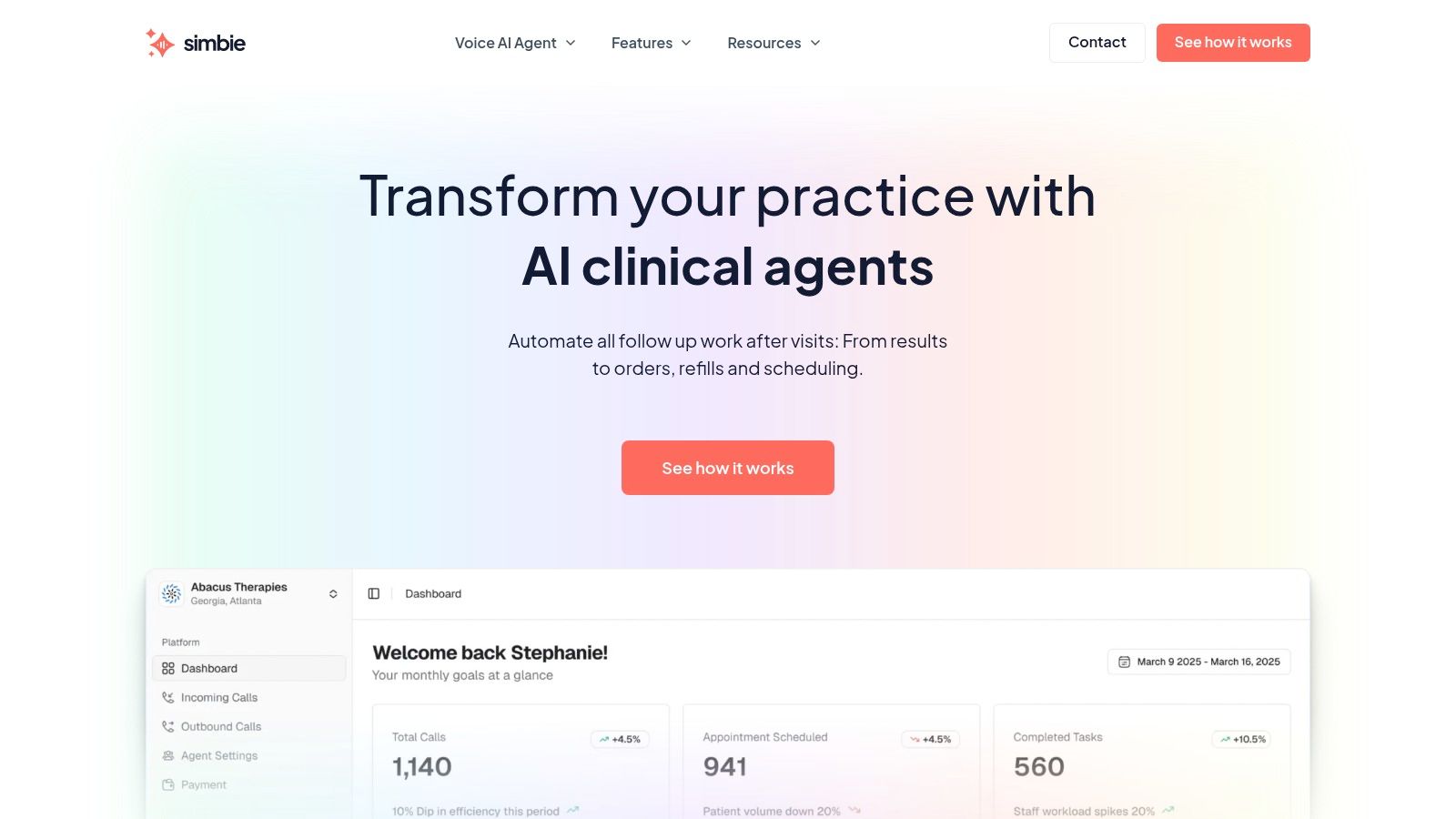
Simbie AI is the most practical fit here for independent practices that need more than a CCM point solution. It works as AI Medical Staff, not just a phone bot and not just a billing tool. That distinction matters because small practices usually don't need another dashboard. They need calls answered, intake captured, follow-up handled, and clinical communication documented without burning out the team they already have.
Simbie covers both sides of the house. On the administrative side, it handles inbound and outbound calls, scheduling, intake, refills, prescription renewals, and other front-office tasks. On the clinical support side, it can help with test result review, patient education, adherence check-ins, pre-op and post-op calls, and chronic disease management campaigns.
Why Simbie stands out for CCM
Most chronic care management companies either outsource nurse outreach or give you software and expect your staff to run it. Simbie sits in a different category. It automates the patient communication layer while posting structured information into systems like eClinicalWorks, gGastro, EMA ModMed, Athenahealth, Epic, and DrChrono. That means less copy-paste work, fewer callback bottlenecks, and less dependence on a single overextended MA or front-desk lead.
You can see the broader clinical and admin workflow model in Simbie's AI-powered healthcare solutions.
Operational reality: If a CCM vendor can't also help with access, intake, and documentation flow, your staff still carries the hidden work.
A few details matter here for a skeptical practice owner. Simbie captures 100% of inbound calls, runs 24/7 with zero hold times, and can reduce front-office staffing costs by up to 60%. It's also HIPAA-compliant and SOC 2 Type 2 certified. The product was built by clinicians and researchers from Stanford, Yale, Columbia, and Princeton, which shows up in the workflow design. It doesn't try to replace physicians. It protects doctors' time for doctoring.
Best fit
Simbie is the strongest option for internal medicine, GI, and dermatology groups that want one system handling both access and ongoing patient coordination. The trade-off is that setup isn't instant. Deep integration and workflow tailoring take planning. But for practices that want fewer missed calls, fewer manual touches, and real support for longitudinal outreach, it's the most complete option on this list.
- Best for: Independent practices that want 24/7 patient access plus clinical support automation
- Main strength: Front-office and CCM-adjacent clinical workflows in one platform
- Watch for: Workflow mapping upfront, especially if you use specialty-specific templates in ModMed or gGastro
Website: Simbie AI
2. ChartSpan
ChartSpan is the classic full-service CCM partner. If your practice wants somebody else to run enrollment, monthly outreach, care plans, documentation, and billing support, this is the model you look at first. It reduces internal lift, which is why it gets attention from practices that are interested in CCM revenue but don't have bandwidth to build a care coordination team.
This is also the vendor category that works best when your internal operations are already stretched thin. Instead of asking your MA team to become a mini call center, you hand off most of the recurring monthly process.
Where ChartSpan fits
ChartSpan is a sensible choice for practices that want a vendor-run program with established workflows. It also tends to appeal to groups looking beyond CCM alone, especially if annual wellness visits, quality programs, and reimbursement support are part of the same conversation.
For a smaller practice, the trade-off is continuity. Patients may experience the program as adjacent to your practice rather than fully embedded in it. That isn't always a deal-breaker, but you should test that during demos.
Some practices want less staffing burden. Others want tighter control over the patient relationship. ChartSpan usually favors the first priority.
Before you sign with any outsourced partner, compare it against a more integrated workflow model like Simbie's chronic care management approach.
- Best for: Practices that want turnkey CCM operations
- Main strength: Reduced staffing burden through outsourced delivery
- Watch for: How outreach, notes, and patient handoffs connect back to your in-house team
Website: ChartSpan
3. CareHarmony
CareHarmony is another turnkey CCM company, but it leans more clearly toward larger provider groups and health systems. The core value is simple. They provide dedicated care coordinators and established workflows around Medicare fee-for-service CCM requirements, so your team doesn't have to build that infrastructure from scratch.
That model works well when you have enough patient volume to justify external coordination at scale. It works less well when your practice needs highly personalized workflows tied to a tight-knit local staff.
Practical trade-offs for a smaller clinic
For an independent practice, CareHarmony can still make sense if your immediate problem is execution. Patients need monthly touches, your team can't keep up, and you need a partner to stand up the process quickly. But don't confuse a mature outreach engine with a fully integrated operational one. You'll want to verify exactly how documentation gets back into the chart and who owns follow-up when something clinically important surfaces.
If you're comparing this against a software-first or AI-assisted route, it helps to understand what a dedicated chronic care management software layer can and can't do on its own.
- Best for: Larger multisite groups, or smaller practices that want vendor-managed coordination
- Main strength: End-to-end operations aligned to CCM workflows
- Watch for: Public detail on integration depth, reporting, and patient experience continuity
Website: CareHarmony
4. Wellbox
Wellbox positions itself as a nurse-led extension of the practice, and that framing will appeal to physicians who want a more clinical feel than a pure call-center model. For practices with older Medicare populations, that can matter. Patients often respond better when outreach sounds like care coordination, not generic vendor follow-up.
The attraction here is low disruption. If your front office is already buried in prior auths, scheduling, and refill traffic, a vendor that can shoulder preventive and chronic outreach without creating extra work gets attention fast.
What to validate in the demo
Ask Wellbox to walk you through how its nursing team documents interactions, escalates concerns, and closes loops with your providers. That's the difference between true support and one more inbox for your staff to check. Also ask how well the service fits your specialty. Internal medicine is the obvious use case, but GI and dermatology groups need to know whether outreach logic reflects specialty realities.
A nurse-led model sounds reassuring. It still has to prove chart visibility, escalation discipline, and consistency.
- Best for: Practices that want clinically led outreach with minimal front-office disruption
- Main strength: Preventive engagement and nurse-driven patient contact
- Watch for: How much of the reported outcomes story is independent evidence versus vendor marketing
Website: Wellbox
5. TimeDoc Health
TimeDoc Health is useful when you don't want to make an all-or-nothing decision. It offers a software-first model with the option to add staffing support later. For practices that want to start by owning the workflow and then outsource selectively, that's a sensible middle path.
The key advantage is flexibility. You can begin with your own team handling enrollment and outreach, then shift parts of the program if internal capacity changes. That matters for a practice in growth mode or one dealing with hiring instability.
Where it works best
TimeDoc fits clinics that have at least some operational discipline already. Somebody on your team still has to own process design, outreach cadence, and billing handoff if you start software-first. If your practice struggles with basic callback management now, software alone won't fix that.
The broader market direction supports this kind of tooling. One industry estimate values the chronic care management software segment at $15.26 billion in 2025 and projects $27.48 billion by 2030, with a 12% CAGR, driven by EHR integration, remote patient monitoring, medication management, patient engagement, and care coordination tools, according to The Business Research Company's CCM software market report.
- Best for: Practices that want flexibility between in-house and outsourced CCM operations
- Main strength: Hybrid deployment options
- Watch for: Total workflow burden if you start with software and limited staff
Website: TimeDoc Health
6. ChronicCareIQ
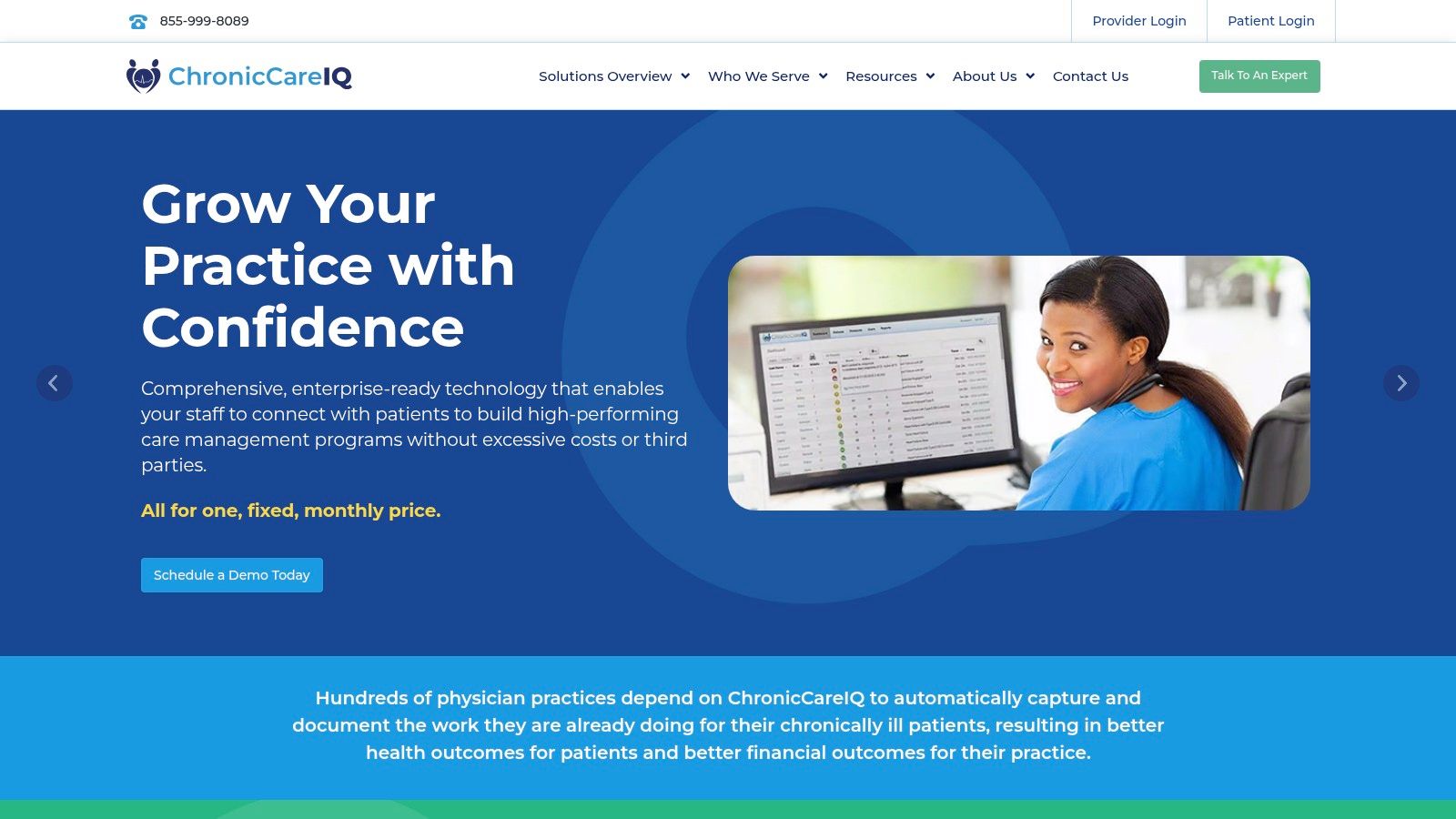
ChronicCareIQ is a better fit for practices that want to keep CCM in-house but need tighter documentation and patient engagement infrastructure. This is software for teams that already believe the relationship should stay inside the practice. It helps capture time, log interactions, and support longitudinal care work without outsourcing the patient contact itself.
That makes it attractive to physician-owned groups that don't want an external party speaking for the practice. It also means you still need people to do the monthly work.
The real staffing question
The mobile app and data capture features are useful, especially if you're layering in device data or self-reported information. But don't buy software-only CCM expecting it to erase staffing needs. It reduces administrative friction. It doesn't create follow-up capacity out of thin air.
A qualitative study on whole-person CCM is helpful here. It found effective programs should include whole-person assessment, patient-centered care planning, direct assistance with patient needs, care coordination, and longitudinal monitoring, as described in this peer-reviewed study on whole-person chronic care management. That's the lens to use when evaluating platforms like ChronicCareIQ. Time tracking is necessary, but it isn't the care model.
- Best for: Practices committed to keeping CCM operations internal
- Main strength: Documentation support and patient app ecosystem
- Watch for: Whether your current staff can deliver true longitudinal care, not just monthly task completion
Website: ChronicCareIQ
7. Prevounce
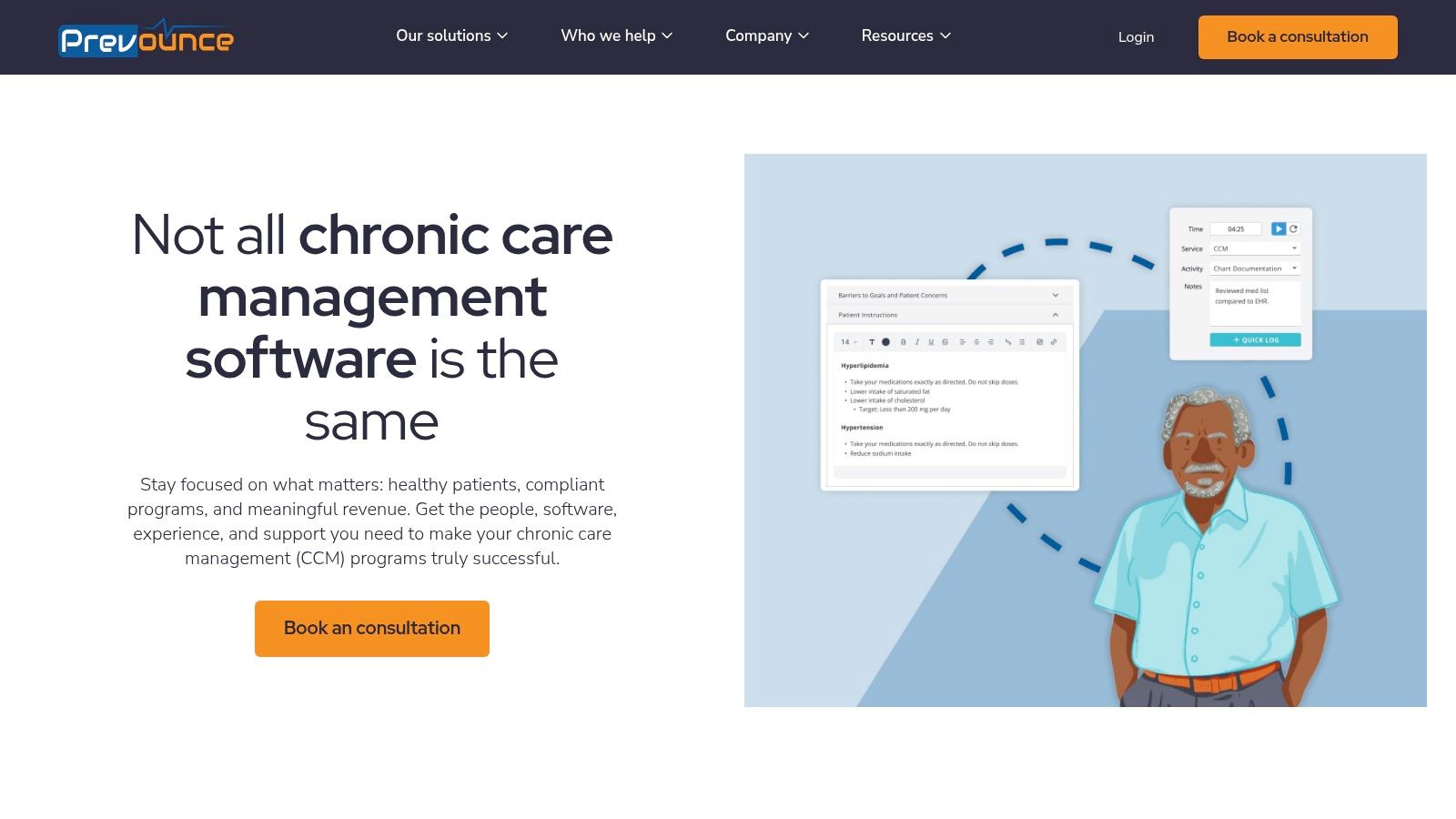
Prevounce is a good builder's tool. If your practice wants a compliance-oriented CCM platform with structured workflows, time logging, care-plan generation, and billing reports, it gives you the essentials without pretending to be a full outsourced service.
That makes it attractive to small and midsize clinics that want to stand up CCM deliberately. You keep control. You also keep responsibility.
What small practices should like about it
Prevounce tends to fit practices that want process clarity. If you're starting from zero, provider education and revenue modeling resources can help your team understand what has to happen each month. That's valuable for office managers who need a cleaner operational framework before they commit staff time.
Still, this is not staff in a box. If your MAs are already covering phones, rooming, and forms, you'll need a realistic plan for who handles outreach, documentation review, and claim coordination.
- Best for: Small to midsize clinics building CCM from scratch
- Main strength: Compliance workflow structure
- Watch for: The internal staffing commitment after implementation goes live
Website: Prevounce
8. ThoroughCare
ThoroughCare makes the most sense for practices that are already thinking across multiple care management programs, not CCM in isolation. It supports CCM, RPM, TCM, and PCM, which is useful if your practice participates in value-based arrangements or plans to broaden remote care workflows over time.
For a more advanced independent practice, that multi-program support is a strength. For a small clinic with limited admin depth, it can also become one more system that only a few people understand.
The hidden cost is management attention
ThoroughCare has strong operational tooling, configurable care plans, and reporting that can support broader population health workflows. But because it's software-only, your practice still owns the care coordinator function. That's the recurring issue with this category. The platform may be sound, but somebody still has to drive it every month.
The chronic care management market itself has become a large category, with one estimate valuing it at US$5.04 billion in 2023, US$5.71 billion in 2024, and projecting US$12.14 billion by 2030 at a 13.2% CAGR, according to MarketsandMarkets research on the CCM market. That growth explains why multi-program software is proliferating. It doesn't change the staffing math inside a small practice.
- Best for: Practices aligning CCM with broader value-based or remote care programs
- Main strength: Multi-program documentation and reporting
- Watch for: Who internally owns day-to-day workflow after go-live
Website: ThoroughCare
9. Optimize Health
Optimize Health is appealing if you want one vendor to manage both CCM and RPM under the same roof. That can simplify operations. Instead of juggling separate contracts, dashboards, and care-team handoffs, you get one partner for monthly outreach and remote monitoring workflows.
For practices with patients who would benefit from both ongoing coordination and device-based follow-up, that combined model is practical. It can also reduce implementation drag if your team doesn't have the appetite to stitch together multiple vendors.
Where diligence matters
The main thing to verify is workflow integration. Ask exactly how notes, alerts, and billing support land in your charting environment. A combined CCM and RPM program sounds efficient until your staff has to reconcile updates in a separate portal every day.
If a vendor says "integrated," ask whether that means structured chart posting, flat-file export, or staff copy-paste.
- Best for: Practices that want one managed partner for CCM and RPM
- Main strength: Single-vendor operational model
- Watch for: Documentation flow into your EHR and billing process
Website: Optimize Health
10. HealthSnap
HealthSnap tends to lean more enterprise, but some independent groups will still want to look at it because it combines virtual care workflows with analytics and outcomes reporting. If your leadership team wants stronger visibility into program performance across CCM, RPM, and PCM, that reporting layer may be attractive.
The caution is fit. Enterprise-style platforms can be powerful but heavy. Smaller practices should be careful not to buy a strategy deck when what they really need is cleaner execution on phone outreach and chart documentation.
Best use case
HealthSnap is better suited to larger medical groups, or to independent practices that already have a mature care management operation and want more formal analytics. If your practice is early in CCM, it may be more platform than you need.
Access equity should still be part of the evaluation. Industry guidance notes that telephonic software, live texting, 24/7 phone lines, AI call auditing, and analytics are used to close communication gaps for underserved and rural populations, as discussed in this analysis of CCM communication infrastructure and access challenges. That's the right frame for reviewing any analytics-heavy vendor. Better reports don't matter if outreach still fails in practice.
- Best for: Larger groups, or advanced independent practices that want stronger program analytics
- Main strength: Multi-program virtual care reporting
- Watch for: Enterprise onboarding scope and whether the workflow is too heavy for your team
Website: HealthSnap
Top 10 Chronic Care Management Companies, Feature Comparison
| Solution | Core Capabilities | Experience & Quality (★) | Value & Pricing (💰) | Target Audience (👥) | Unique Selling Points (✨) |
|---|---|---|---|---|---|
| 🏆 Simbie AI | Voice AI agent (24/7 inbound/outbound), pre-visit intake, test review, EHR posting | ★★★★★, captures 100% calls, HIPAA & SOC2 | 💰 Utilization-based, up to 60% front-office cost reduction | 👥 Independent & community SMB practices, primary & specialty clinics | ✨ Clinical-grade automation, deep EHR integrations, clinician-built |
| ChartSpan | Turnkey CCM ops: enrollment, monthly outreach, documentation, billing support | ★★★★, proven at scale | 💰 PMPM negotiated, vendor-run reimbursement focus | 👥 Independent practices, FQHCs, health systems | ✨ End-to-end outsourced CCM, reimbursement optimization |
| CareHarmony | End-to-end CCM operations, dedicated coordinators, CMS-aligned templates | ★★★★, enterprise-grade | 💰 Custom pricing for enterprise deployments | 👥 Health systems, multi-site groups | ✨ Enterprise implementation experience, compliance templates |
| Wellbox | Nurse-led CCM, preventive engagement, practice-friendly integration | ★★★★, prevention-focused claims | 💰 Negotiated pricing, vendor-led nursing model | 👥 Practices wanting nurse-led outreach with low disruption | ✨ Nurse-led clinical model, minimized front-office impact |
| TimeDoc Health | CCM software platform with optional staffing, care plans & tasking | ★★★, flexible deployment | 💰 Software-first pricing (custom); optional staffing add-ons | 👥 Clinics wanting to own ops initially, scale later | ✨ Flexible delivery (in-house, vendor, hybrid) |
| ChronicCareIQ | Automated CCM documentation, patient app, device/self-report integration | ★★★, documentation automation | 💰 Software-only (pricing custom); in-house staffing required | 👥 Practices keeping CCM in-house, RPM adopters | ✨ App ecosystem, automated time-capture for billing |
| Prevounce | CCM & RPM workflows, time logging, care-plan generation, billing exports | ★★★, compliance-oriented | 💰 No public per-site pricing; revenue modeling tools | 👥 Small–midsize clinics building CCM programs | ✨ CMS-focused workflows, billing/reporting resources |
| ThoroughCare | CCM software with multi-program support (CCM/RPM/PCM) and AI enhancements | ★★★★, strong operational tooling | 💰 Software model; staffing stays with practice | 👥 Value-based care practices, clinics stacking programs | ✨ Multi-program stacking, AI productivity features |
| Optimize Health | Managed CCM + RPM with U.S.-based care teams and device support | ★★★★, managed-service outcomes | 💰 PMPM & device fees negotiated (custom) | 👥 Clinics wanting single vendor for CCM+RPM | ✨ Combined CCM+RPM managed service, U.S. care teams |
| HealthSnap | Virtual care management for CCM/RPM/PCM, analytics & outcomes reporting | ★★★★, enterprise evidence & reports | 💰 Enterprise pricing; implementation varies | 👥 Health systems and large provider groups | ✨ Integrated analytics, case studies & outcomes reporting |
Software vs. Service vs. AI: Making the Final Call
It is 4:45 p.m. on a Thursday. Your front desk is buried, refill requests are stacking up, and nobody has called this month's CCM patients. That is the essential decision point for a small practice. CCM rarely breaks because a vendor missed one feature. It breaks because the day-to-day work has nowhere to live.
CCM only works when someone consistently handles outreach, documentation, care-plan follow-up, and billing support. If your phones are already overloaded and your clinical team is squeezing admin work between visits, adding a CCM platform alone will not fix the problem. It usually creates one more log-in and one more queue.
For an independent practice, the final choice is usually one of three operating models.
Full-service CCM companies
ChartSpan, CareHarmony, Wellbox, and TimeDoc Health reduce staffing pressure fast. That is their main value. If you need a program live without hiring, training, and supervising an in-house care team, a service model is the practical answer.
You give up some control in exchange.
Patients may build a relationship with an outside team instead of your staff. Physicians may need to chase context across a vendor portal, faxed notes, or routed summaries. For some practices, that trade-off is fine. For others, especially physician-owned groups that compete on continuity and personal access, it weakens the patient experience.
Software-first platforms
Prevounce, ChronicCareIQ, ThoroughCare, and parts of Optimize Health make more sense if you already have operational discipline. These tools can support compliant workflows, time tracking, care plans, and multi-program billing. They do not supply the labor required to keep the program running month after month.
That distinction matters more than the feature list.
If you have a reliable care coordinator, strong MA support, or an RN-led chronic care workflow, software keeps control inside the practice. If you do not, software-only CCM tends to stall after the first wave of setup. The platform is configured. The outreach falls behind. Claims get delayed. Staff stop trusting the process.
AI-supported operational models
AI changes the equation when it reduces actual workload instead of adding another layer of review. That is the standard to use.
Simbie AI is notable because it addresses the operational bottlenecks around CCM, not just CCM documentation itself. It handles inbound calls, after-hours access, scheduling, intake, refill and renewal workflows, and outreach tasks that small practices routinely miss when the front office is stretched. It also writes back into systems such as eClinicalWorks, Athenahealth, Epic, DrChrono, EMA ModMed, and gGastro. For a small group that wants to keep the patient relationship in-house without hiring a larger support staff, that model is materially different from a software dashboard or a traditional outsourced call team.
The practical question is simple. Where is your failure point today?
If the failure point is labor, choose a service-heavy model. If the failure point is workflow discipline and you already have staff capacity, choose software. If the failure point is constant front-office overload that spills into CCM, refills, scheduling, and after-hours access, an AI-supported operations model deserves serious consideration.
Do not pick the vendor with the longest feature table. Pick the model your team can run in six months without dropped calls, overdue follow-ups, and burned-out staff.
You can also explore related workflow options in our guides to medical voice AI agents, medical software integrations, and the best virtual medical receptionist tools. If you're evaluating AI for your practice, this outside guide to AI integration services adds useful implementation context.
If you want a CCM approach that also fixes missed calls, front-office overload, and after-hours patient access, take a closer look at Simbie AI. If you're evaluating AI for your practice, you can see it in action at simbie.ai/book-a-demo.