

Annual Wellness Visit outreach usually looks simple from the outside. A practice pulls a list, sends a few reminders, and waits for the schedule to fill. In practice, that stale list is full of patients who already had the visit somewhere else, the messages go to the wrong cohort, and the office still ends up making calls that never convert. For independent practices, the problem is not lack of effort. It's eligibility accuracy, channel sequencing, and scheduling friction.
Meta description: Annual wellness visit outreach that cleans eligibility, reduces call waste, and turns more Medicare patients into booked AWVs.
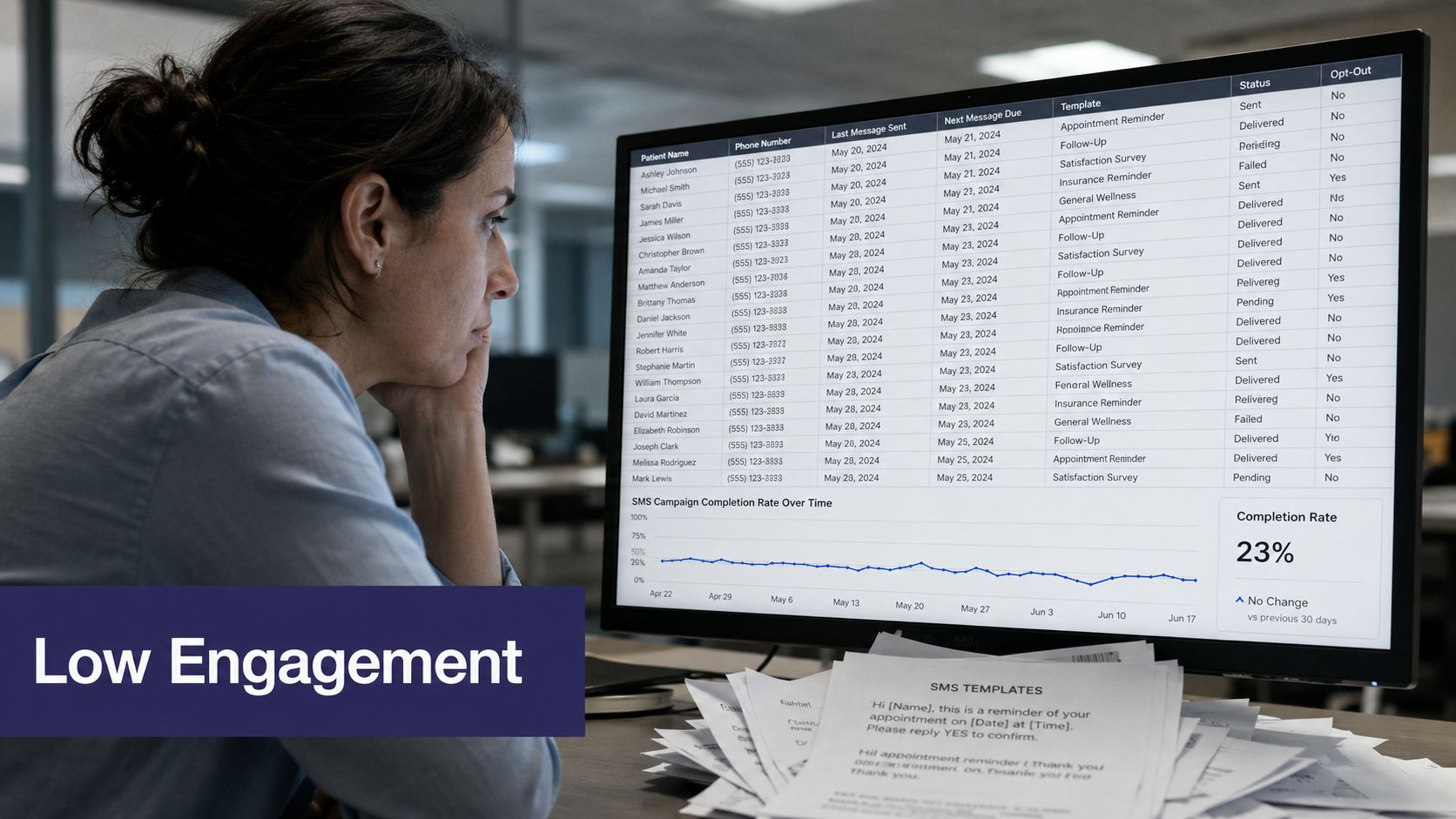
Why Most AWV Outreach Falls Flat
The first failure point is easy to recognize. Someone exports an AWV spreadsheet, the list ages for weeks, and the team sends broad reminders to anyone who looks eligible. That approach can create activity without creating visits, because an AWV is preventive, not symptom-driven. Patients don't wake up and ask for it the way they ask for help with a cough or a rash.
The scale of the gap has been clear for years. CMS introduced Medicare's Annual Wellness Visit in 2011, and by 2015 only 18.8% of eligible beneficiaries had received one. Among beneficiaries who could be assigned to a practice, the rate was 24.8%, which shows how much outreach was left on the table even in established Medicare populations. The same study found that 90.6% of AWVs among attributed beneficiaries were performed at the patient's assigned practice and 79.7% were done by the attributed primary care provider, which tells me the highest-return effort is usually the care team that already knows the patient, not a generic broadcast list. See the underlying analysis in Health Affairs.
The real bottleneck is not the reminder text
A lot of practices start by polishing scripts. That's backward. If the list is dirty, the message is late, or the patient still has to call back during business hours, the campaign burns staff time and barely moves completion. A better operating model starts with a continuously updated gap file, then assigns the right channel and the right follow-up path.
That shift matters because digital outreach changes behavior when it reaches the patient at the right moment. In a PubMed-indexed study, patients who read the outreach message were 40% more likely to schedule an AWV than those who did not read it, and scheduling rose by 50% for White patients and 325% for Black patients after the intervention compared with prepandemic 2019 rates. Longer-term evidence also shows that sustained outreach can become routine, with nearly 6 in 10 older adults becoming regular AWV users and 86% having at least two AWVs over five years. The message is simple. Outreach works best when it's treated like a workflow, not a one-off blast. The research is in PubMed.
Practical rule: If the patient can't book without extra steps, your outreach is doing half the job.
The good news is that the fix is operational, not mystical. Clean the eligibility logic first. Then segment by behavior. Then use channels in the order that reduces friction.
Get the Eligibility List Right Before You Touch a Channel
Most AWV programs waste their first week on copy and design. We start with data cleanup instead. Build a weekly prioritized list from Medicare Part B and Medicare Advantage panel data, then reconcile it against payer gap files so you stop calling patients who already completed an AWV elsewhere. CMS covers one initial AWV and one subsequent AWV every 12 months, so a patient who already closed the gap is not a live outreach target anymore. When teams skip this step, they spend money and staff attention on dead leads.
A useful way to think about this is like list hygiene in any outreach workflow. If you want a deeper look at the mechanics of cleaning and maintaining a list before messaging, the principles behind cut bounces with CleanMyList are a helpful analog. In AWV work, the stakes are different, but the logic is the same, stale records create wasted touches.
What to reconcile every week
| Source | What it tells you | Refresh cadence | Common blind spot |
|---|---|---|---|
| EMR AWV history | Whether the visit was already completed in your chart | Weekly | Visits completed outside your practice |
| Payer gap files | Whether the payer still considers the AWV open | Weekly | Delay between completion and payer update |
| Attribution rosters | Which patients belong on your active list | Weekly | Patients who moved care or changed primary site |
| Scheduling system | Who is already booked or no longer needs outreach | Daily to weekly | Double-contacting recently scheduled patients |
Practices that treat this as a continuous reconciliation process, not a quarterly campaign list, are the ones that can sustain 60% or higher completion rates. That is not because the message is magical. It's because the list is current, the reach is targeted, and the patient isn't being asked to solve your data problem.
The operational cadence that keeps the list honest
The workflow we use is straightforward. Pull the panel. Reconcile against payer files. Remove patients with completed visits. Flag new eligibles within 48 hours so the list doesn't rot. That rhythm matters more than adding another reminder channel. A quarterly export sounds organized. It usually isn't.
| Source | What it catches |
|---|---|
| EMR AWV history | Visits completed inside the practice |
| Payer gap files | Visits completed elsewhere, if the payer has updated |
| Attribution rosters | The correct target population |
| Scheduling system | Patients already in motion |
The point of the table is simple. Outreach begins with eligibility logic, not messaging volume. Once that foundation is right, the rest of the campaign starts to behave.
Segment Patients So Outreach Matches Real Behavior
A single AWV campaign usually treats every eligible patient the same way. That's the mistake. Someone who has never had an AWV will need a different nudge than someone who's only slightly overdue, and a high-risk patient with multiple open gaps needs more handholding than either of them. Behavioral segmentation makes the campaign feel quieter to staff and more relevant to patients.
Not every eligible patient needs the same campaign. Treating them as one audience is the fastest way to create busy outreach that books very little.
A practical segmentation model starts with four cohorts. Never-seen patients need the most touches because there's no prior habit to build on. Lapsed patients, meaning those who are 12 to 24 months out, usually need a simple reactivation message and easy scheduling. Active but overdue patients often respond to a lighter nudge because they already understand the visit. High-risk, rising-risk patients, especially those with multiple open gaps or a recent hospitalization, deserve a coordinated sequence and staff follow-up.
Match intensity to behavior
- Never-seen: Use a full cadence with multiple touches and a self-scheduling link. This group is where most conversion work lives.
- Lapsed: Send a shorter sequence that reminds them the visit is due and keeps the scheduling path short.
- Active but overdue: Start with one direct SMS and stop if they book.
- High-risk, rising-risk: Use outreach plus live escalation when there's no response.
The reason to segment is not just personalization. It helps you see whether the campaign is working. If the never-seen group converts but the lapsed group doesn't, the issue is probably message clarity or scheduling friction. If the high-risk group keeps stalling, the problem may be follow-up ownership, not messaging volume.
For practices that want to see how behavioral grouping works outside healthcare, automating customer segmentation is a useful framework to compare against. The mechanics aren't identical, but the logic of matching intensity to behavior is very similar.
The cleanest weekly habit is to review each cohort separately. Don't average them together. Once you do, the weak spot becomes obvious fast, and the team stops guessing where the drop-off is happening.
Choose the Channel Mix That Books Visits
Channel choice matters, but sequence matters more. AWV outreach usually starts with SMS because it is fast, low-friction, and easy to act on during the day. Text is the first touch because it reaches patients where they already check updates, and it does so without forcing staff into repeated phone tag.
The next move is follow-up, not repetition. If the patient does not respond in a few days, add voice AI for nonresponders, then use email, mail, or the portal for the long tail. The practical shift that changes booking behavior is the self-scheduling link. Messages that send people back to “call the office” convert worse than messages that let them book directly.
A simple four-touch cadence over 21 days
- Day 1, SMS
- Day 5, email
- Day 14, SMS
- Day 21, portal message
Stop the sequence the moment the patient schedules. That sounds obvious, but many practices forget to suppress future touches and end up sending reminders to someone who is already on the calendar.
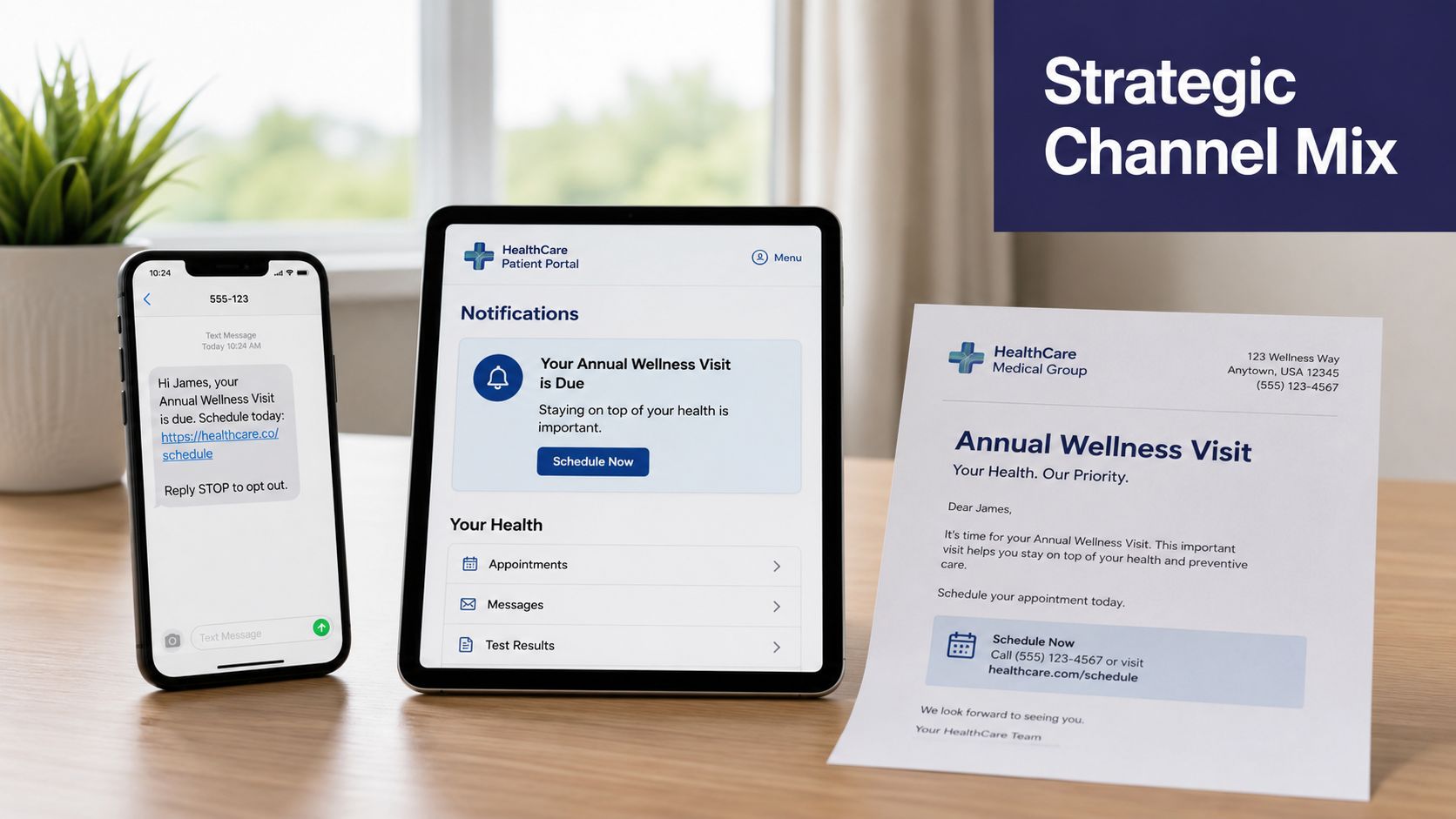
Phone-only outreach can work, but it usually costs more staff time per booked visit because someone has to keep redialing or waiting on callbacks. SMS is fast and scalable. Voice AI is useful for the people who ignore texts. Mail and portals still have a place, especially for older patients or those who prefer written instructions, but they are usually not where you start.
For teams that want a more technical breakdown of outbound workflow design, outbound call automation in healthcare is a useful example of how scheduled outreach can be handled without turning the front desk into a call center.
Scripts and Templates That Handle the Three Real Objections
Most patients stall for three reasons. They think an AWV is a physical. They're unsure whether adding services could trigger cost-sharing. Or they don't want to call back during office hours to finish the booking. Good scripts answer all three without sounding defensive.
SMS template that frames the visit correctly
“Hi [Name], it's [Practice]. Your Medicare Annual Wellness Visit is due. This is a prevention planning visit, not a routine physical, and you can book it here: [link].”
That wording does two jobs. It clarifies scope, and it removes the callback burden. Short is fine. Clear is better.
Voice AI opening that handles the cost concern
“This visit is covered as your Medicare Annual Wellness Visit when no additional services are billed. If your clinician addresses other issues during the same appointment, separate cost-sharing may apply.”
That line is plain enough for patients and accurate enough for staff. It also reduces back-and-forth because the common confusion gets addressed before anyone books.
Portal message that sets expectations
“Your AWV focuses on health risk review and prevention planning. Please bring a list of medications, recent specialist visits, and any questions you want covered. You'll be able to schedule directly from this message.”
That expectation-setting matters because an AWV is not a routine physical exam. It centers on a health risk assessment and a personalized prevention plan, with the HRA completed before or during the encounter and a written preventive screening and services plan built for the next 5 to 10 years. The required HRA content includes demographic data, self-assessed health status, psychosocial and behavioral risks, activities of daily living, and activities such as shopping, housekeeping, managing medications, and handling finances. CMS-aligned guidance is summarized in ChartSpan's AWV guide and documentation details are outlined by Prevounce.
After the visit is booked, the reminder cadence matters. Timed reminders at 72 hours, 24 hours, and day-of are the kind of practical detail that helps reduce no-shows by 30% to 40% when they're set up correctly. The exact wording matters less than the rhythm. Patients don't need a clever headline. They need to know what the visit is, what it isn't, and what happens next.
Expectation-setting converts more patients than clever copy ever will.
For patient-facing workflows that need to carry those reminders cleanly, patient appointment reminders are most effective when they're tied to the actual booking and not left as generic blasts.
Wire Outreach Into Your EMR and Scheduling Workflow
If outreach sits in a spreadsheet, it will drift. Booked patients keep getting contacted, completed AWVs stay active, and no-shows disappear until the next campaign run. The fix is to connect outreach to the systems that already hold the current status, your EMR and scheduling stack.
That matters in tools like eClinicalWorks, Athenahealth, EMA ModMed, gGastro, Epic, and DrChrono. When a patient books, the outreach workflow should stop future touches automatically. When the AWV is completed, the patient should drop off the active list without anyone cleaning a spreadsheet by hand. When there is a no-show, the patient should return to the cohort within a defined window so the opportunity stays visible.
The practical question is not whether the outreach can send messages. It is whether the EMR can keep the gap file current as patients move through booking, completion, and rescheduling. For a closer look at the system side, understanding EHR integration helps explain how data has to move between platforms without creating duplicate work. Teams that are also evaluating front-desk automation can compare that setup with EMR integration with an AI receptionist to see how intake, booking, and chart updates fit into one workflow.
Where automation fits and where staff still matter
- Inbound overflow: A voice agent can answer calls during AWV season when the front desk is tied up.
- Pre-visit intake: Outreach can collect basic information before the appointment, which saves staff time later.
- Outcome logging: The result of the outreach should write back to the chart or queue so the next touch is based on current status.
Human-in-the-loop rule: Automation runs the campaign, staff handle exceptions, and the clinician always owns clinical decisions.
That is the model that holds up in a community practice. It does not replace the front office, and it does not ask nurses to babysit campaigns all day. It removes the repetitive steps that clog the schedule and leave the same patients sitting in limbo.
For teams comparing workflow options, the key implementation detail is how the system ties the call outcome, the booking status, and the chart note together. Simbie AI is built to cover both layers, administrative front-office work and clinical support, so it can sit inside the outreach and scheduling flow instead of sitting outside it.
Continuity is the main benefit. Once outreach, scheduling, intake, and chart updates are connected, AWV campaigns stop behaving like seasonal projects. They become a running program that keeps patients moving.
Measure, Optimize, and Lift Completion Past 60%
The numbers that matter are straightforward. Track outreach-to-schedule rate, schedule-to-completion rate, no-show rate, gap-closure rate by cohort, and cost per completed AWV. Anything else is secondary. If outreach-to-schedule is weak, the problem is usually the message or the self-scheduling step. If schedule-to-completion is weak, the reminder sequence or expectation-setting is off. If one cohort closes better than the others, segmentation needs work.
The rhythm matters just as much as the metrics. Use a weekly gap check to keep eligibility fresh, a monthly cohort review to see which segment is lagging, and a quarterly channel audit to decide whether SMS, voice, email, or portal is pulling its weight. That cadence keeps the program from becoming a one-time burst of effort.
A mature AWV outreach program feels less like marketing and more like operations. The list is current, the segments are clear, the channel mix is deliberate, and the schedule updates itself as patients move through the workflow. If you want to see how that can look in a specific practice, book a demo and review how AI-driven outreach and scheduling can fit your current setup.