
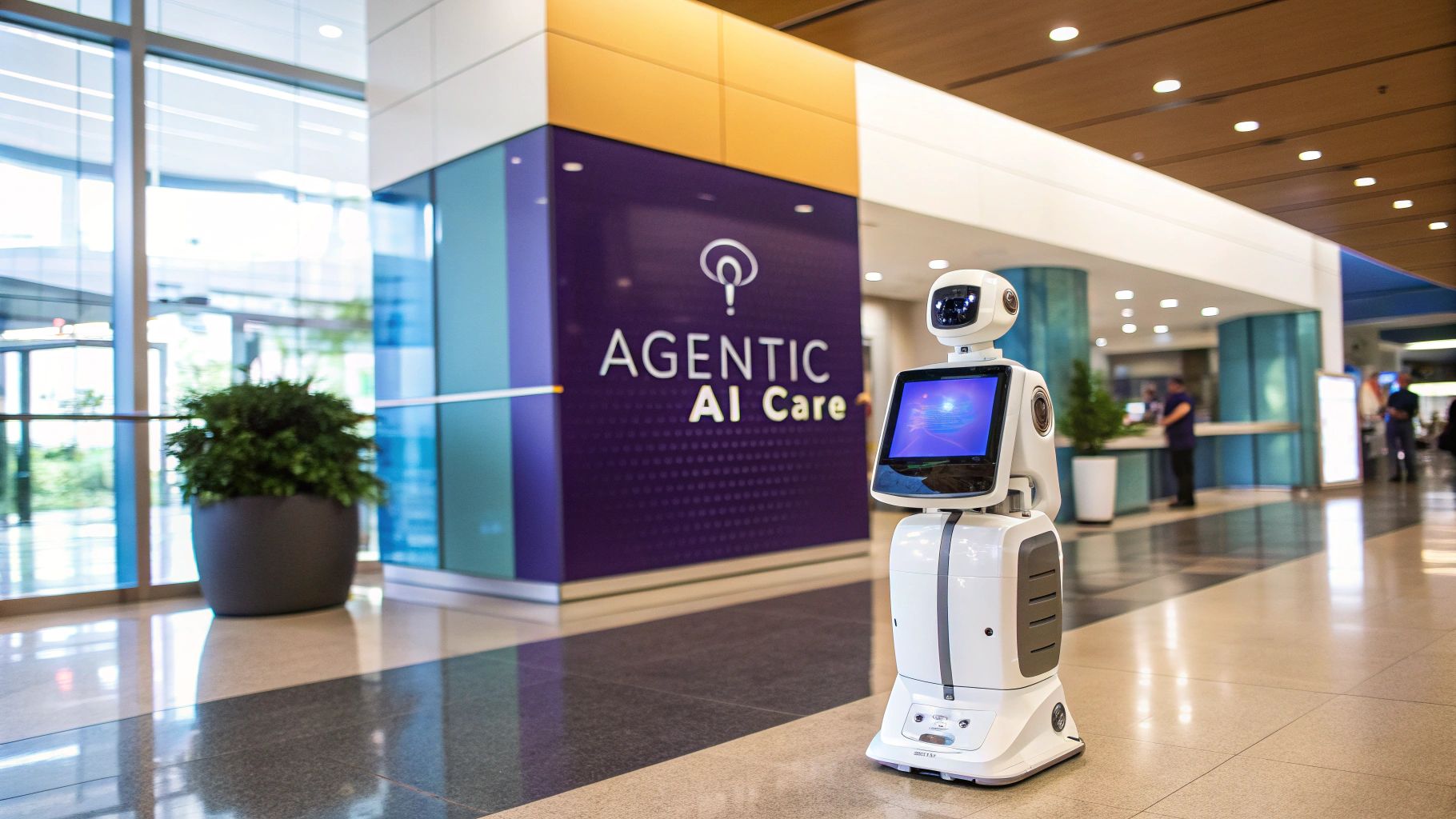
Agentic AI in healthcare is a system that digs into data, makes decisions on its own, and completes tasks without waiting for step-by-step human directions.
Think of it as a seasoned medical assistant: predicting what’s needed next, running routine checks, and alerting staff when something looks off.
That independence speeds up workflows and boosts patient outcomes.
How Agentic AI Transforms Healthcare Workflows

By tapping into electronic health records, lab results, and scheduling systems, Agentic AI can spring into action without a human standing by.
For instance, if blood work crosses a critical threshold, it can automatically book a follow-up visit and notify the care team.
- Improved Triage: Alerts clinicians to urgent cases in real time.
- Administrative Efficiency: Processes routine claims and paperwork without manual review.
- Continuous Monitoring: Flags patient risk factors 24/7, cutting down on errors.
Each example highlights how Agentic AI drives value for providers, payers, and patients.
Of course, rolling out these systems means setting up clear governance, ironing out compliance details, and tackling data silos head-on.
Analogy To A Medical Assistant
Picture a nurse who seems to know exactly what comes next—checking vital signs, refilling meds, and prepping reports—so doctors can zero in on complex cases.
Agentic AI does much the same job, only it never sleeps and never misses an alert.
“Agentic AI bridges data and action, transforming speed and accuracy in patient care.”
That shift brings major upsides but also raises questions around trust and oversight.
- Trust Management: Establish clear decision boundaries and points for human review.
- Data Integration: Merge scattered records into a single, reliable source.
- Compliance: Align every step with HIPAA and keep an audit trail.
Recognizing both the promise and the pitfalls lets organizations move forward responsibly.
Providers gain speed in daily operations, patients get faster warnings, and payers see lower back-office costs.
This sets the stage for a deeper look at key concepts and real-world use cases ahead.
Core Promise And Challenges
At its heart, Agentic AI delivers rapid alerts in triage and automates claims to sharpen clinical and administrative processes.
The main hurdles lie in matching AI actions to medical best practices and keeping every decision transparent.
- Governance Frameworks: Define roles for oversight, review, and intervention.
- Training Data Quality: Ensure datasets are diverse, representative, and clean.
- Performance Metrics: Set clear indicators for safety, accuracy, and efficiency.
When stakeholders balance innovation speed with solid guardrails, Agentic AI can truly reshape how care gets delivered.
Understanding Key Concepts
Think of cruise control. It holds speed steady with minimal input. A self-driving car goes further, steering around obstacles, handling traffic jams, and mapping new routes.

In a hospital, basic scripts fire off single commands—maybe an alert or a reminder. Agentic AI, on the other hand, weaves together multi-step workflows: ordering tests, updating records, and setting up follow-ups on its own.
Comparing Automation To Agentic AI
- Traditional Automation: Follows fixed rules and triggers one action when the right condition matches.
- Agentic AI: Crafts goals, weighs options, and shifts tactics based on what happens next.
What this means for healthcare? Processes flow more smoothly across labs, clinics, and admin offices.
Agentic AI sets goals, acts, and learns from outcomes to complete workflows end to end.
Planning And Learning In Agentic AI
Agentic systems build in feedback loops to sharpen each decision. They break broad aims into bite-sized tasks and tackle them step by step.
They watch patient data, flag critical readings, and spring into action. After each cycle, they tweak their strategy using real-world results.
- Monitor vital signs like blood pressure or glucose.
- Compare readings against clinical benchmarks.
- Place Orders—for labs or record updates—when thresholds are crossed.
- Schedule follow-up visits if issues persist.
This goal-focused method cuts down handoffs and speeds up care. A busy ward might have an AI agent flag a spike in lab values and schedule a follow-up in under an hour, updating staff automatically. It’s a sharp contrast to static rule sets or basic machine learning models that stop after a single decision.
Learn more about agentic AI workflows in healthcare in our detailed guide on AI agents in healthcare.
To get consistent results across diverse patient groups:
- Define clear goals for each AI workflow, such as test scheduling or reminder alerts.
- Measure performance—track response times and success rates.
- Build in human review at key checkpoints to keep safety front and center.
Everyday Example In Scheduling
Imagine an outpatient clinic where an AI agent scans lab reports every hour. When results land, it books appointments and sends reminder texts.
Staff focus on complex cases, while routine follow-ups run automatically. The AI quietly handles the rest.
Real Benefits And Efficiency Gains

Agentic AI steps in to run safety checks and speed up workflows, taking on tasks that once ate into clinicians’ time. By automating routine scans and alerts, it lets care teams focus on decisions that truly need a human touch.
Take prescription reviews, for instance. When AI agents comb through complex medication lists, they spot dangerous interactions in seconds—tasks that used to take pharmacists much longer. This shift frees up pharmacy staff to dive into clinical issues instead of paperwork.
- 8x faster prescription analysis: evaluating 800 patients daily versus 100 before
- USD 500,000 saved each year by a 200-bed hospital through automated medication checks
- 50% shorter triage wait times thanks to instant alerts and priority flags
On the administrative side, everything from schedules to billing moves quicker and smoother. With fewer manual handoffs, back-office bottlenecks practically disappear.
Key Efficiency Metrics
In pilot programs, agentic AI agents cut prescription review time from minutes down to mere seconds. That’s how a team went from handling 100 patient charts a day to 800.
Those gains add up. A mid-sized hospital saw an estimated USD 500,000 in yearly savings once medication-safety workflows ran themselves, reducing pharmacist workloads and errors. For deeper details, check out this AWS report.
Efficiency Gains Before and After Agentic AI Deployment
Below is a snapshot of how key clinical workflows transform with agentic AI in place:
| Workflow | Time Before | Time After | Annual Cost Savings |
|---|---|---|---|
| Prescription Checking | 10 mins | 1.2 mins | $500,000 |
| Intake Question Handling | 20 mins | 5 mins | $200,000 |
| Appointment Scheduling | 15 mins | 3 mins | $150,000 |
These numbers highlight how agentic AI slashes both time and costs, allowing staff to redirect energy toward patient care and complex decision-making.
Case Example With Virtual Assistants
Virtual agents now handle routine intake questions, gather medical histories, and confirm coverage details. Clinicians can then zero in on diagnosis and treatment plans.
- Up to 70% of standard intake tasks managed without human intervention
- 60% drop in administrative hold times as multiple calls get answered at once
“Virtual agents give our front-desk team breathing room, so they can address urgent calls without a backlog.”
This capability not only improves patient experience but also reduces the risk of missed information.
Back Office Automation Impact
Agentic AI streamlines billing inquiries, claim submissions, and prior authorization follow-ups. Real-time EMR updates keep records accurate and current.
- 60% fewer missed calls through simultaneous handling
- 30% faster billing query resolutions compared with manual processes
- Zero missed patient intake forms thanks to instant documentation
Every minute saved here ripples through the system, cutting delays and boosting staff morale.
Scheduling Efficiency Gains
AI-powered schedulers watch calendars in real time, fill last-minute openings, and send reminders automatically. The result? Fewer gaps and happier patients.
- 40% reduction in no-shows with automated confirmations
- 25% increase in daily appointment fulfillment rates
- 3-day average decrease in rescheduling lead times
Combined, these improvements create smoother workflows, lower operational costs, and more face-to-face time between providers and patients.
Market Growth And Adoption Trends
Like a river swelling with fresh runoff, agentic AI is reshaping how healthcare providers and payers operate. In 2024, the market stood at USD 538.51 million. By 2030, it could crest near USD 4.96 billion, riding a 45.56% CAGR from 2025 to 2030.
Learn more about agentic AI growth projections on Grand View Research.
Key Drivers Of Growth
Several factors are pushing agentic AI into the mainstream:
- Automation of routine clinical and administrative tasks cuts down on manual handoffs and mistakes.
- Smarter scheduling and resource use bring costs down and speed up patient throughput.
- Clearer guidance from regulators makes it easier to run pilot programs and scale solutions.
- More vendors competing in the space means smaller practices can afford to join in.
By 2027, this market is set to quadruple as health systems grow more confident in autonomous helpers.
In a recent survey:
- 34% of hospitals are already piloting or scaling agentic AI.
- 29% of payers are doing the same, focusing on triage, claims processing, and patient engagement.
Investment And Competitive Landscape
Venture capital is flowing into startups that tailor agentic AI to specific healthcare tasks. Meanwhile, larger tech firms are partnering with hospitals to embed agents into electronic health record (EHR) and billing systems. Pharmaceutical teams rely on these agents for trial recruitment, adverse‐event monitoring, and data analysis.
- Venture funding jumped by 55% annually through 2027, showing investor confidence.
- Startups and incumbents alike face pressure: adopt AI agents or risk falling behind in efficiency and patient satisfaction.
Agentic AI Market Size Projections
Here’s a year‐by‐year look at global estimates for agentic AI in healthcare:
| Year | Market Size (USD Millions) |
|---|---|
| 2024 | 538.51 |
| 2025 | 782.00 |
| 2026 | 1,135.00 |
| 2027 | 1,649.00 |
| 2028 | 2,396.00 |
| 2029 | 3,481.00 |
| 2030 | 4,960.00 |
This forecast highlights how regulatory clarity and shorter approval times are speeding AI adoption across clinical, payer, and pharmaceutical settings.
Outlook For 2030 And Beyond
By 2030, agentic AI will feel less like an add-on and more like a member of the care team.
- Improved interoperability will let agents tap into data from labs, hospitals, and insurers.
- Stronger governance frameworks will keep patient safety and data privacy front and center.
- As solutions become more affordable, smaller practices will jump on board.
Sustained investment and aligned regulations will cement agentic AI as a daily tool in healthcare.
Start now by mapping your priority workflows and selecting pilot partners. Insurers and pharma teams should align agents with cost models, risk frameworks, and trial protocols to capture early wins. Collaboration is key. Act strategically and you’ll ride the next wave of healthcare innovation without sacrificing care quality.
Implementation Best Practices
Rolling out agentic AI in healthcare demands a clear roadmap and close collaboration. Start small, think big, but always stay grounded in practical steps.
Pick a pilot workflow that promises impact and stays within your team’s bandwidth.
Data Integration Essentials
Agentic AI thrives on clean, connected data. Pull together records from EHRs, labs, imaging, and billing so your platform has a single source of truth.
- Standardize formats to ensure every system speaks the same language.
- Automate data exchange with secure APIs or ETL pipelines.
- Put validation rules in place to catch errors the moment data enters your platform.
That early work prevents islands of information that slow down growth.
“Clean data pipelines unlock agentic AI performance and trust.”
Lay down governance guardrails before you get too far. Decide which decisions need human approval and embed audit logs for every action. Set up role-based access controls so every click is traceable. Then, adjust your policies in line with HIPAA, GDPR, and other rules. Finally, rehearse your compliance workflows with regular drills.
Governance And Compliance Checks
Encryption is non-negotiable. Keep PHI locked down both at rest and in transit.
Loop in legal, privacy, and clinical experts from day one.
- Keep detailed audit trails for every AI-driven decision.
- Host quarterly policy reviews with all stakeholders.
- Refresh your risk matrix and incident response plan after each pilot.
A 2025 survey found 23% of organizations scaling agentic AI and 22% with domain-specific tools—a sevenfold jump from 2024—while 63% are actively using AI and 31% are still piloting new agents. Learn more about these adoption trends on McKinsey
You might be interested in our guide on HIPAA compliant AI tools which covers security checks in depth.
Strong partnerships between IT, clinicians, and vendors smooth out many roadblocks.
- Align on goals through joint workshops.
- Build shared dashboards to monitor progress.
- Schedule regular check-ins for feedback and tweaks.
In one clinic pilot, a billing agent slashed claim turnaround time and targeted a 5% error rate. Weekly metrics reviews led to a 40% jump in accuracy within days.
Scaling From Proof Of Concept
Taking a pilot live enterprise-wide means defining clear targets and refining your playbook.
- Capture lessons learned to tighten processes.
- Budget for extra training, support, and policy updates.
- Track ROI in real time and pivot as needed.
| Common Pitfall | Mitigation Tip |
|---|---|
| Data silos block unified insights | Form a dedicated integration task force |
| Uncertain ROI makes leadership wary | Nail down measurable metrics early |
| Over-customization drags out timelines | Focus on core features first |
“Scaling quickly means balancing momentum with guardrails.”
With these best practices in hand, you’re ready for a successful enterprise rollout. Next up: real-world use cases featuring Simbie AI to see how it all comes together.
Use Cases With Simbie AI
Hospitals and clinics discover real savings when agentic AI focuses on everyday tasks.
Simbie AI delivers three specialized agents that cut down on manual work and trim errors.
- Virtual Scribe Agents capture and draft clinical notes in real time.
- Claims Auditing Bots catch billing mistakes before they go out.
- Predictive Maintenance Tools watch over medical equipment to stop breakdowns.
Clinical Documentation In Real Time
A virtual scribe listens during patient visits, picks out critical details, and turns them into structured notes on the spot. It “talks” naturally to populate EHR fields and wrap up visit highlights before the doctor moves on.

This dashboard view shows intake summaries, real-time note drafts, conversational logs, data fields, and status indicators for every patient encounter.
Driving ROI And Integration
Some organizations report up to 60% savings on administrative overhead after deploying Simbie AI. Agents run 24/7, slash hold times by 50%, and make sure no call goes unanswered.
Key Steps For Success:
- Choose high-impact workflows with clear, measurable outcomes.
- Set concrete metrics like error reduction rates and time saved per task.
- Partner closely with vendors to align integration goals and meet compliance standards.
“Clear metrics and collaboration are essential for scaling agentic AI in healthcare.”
Mapping specific use cases and defining success metrics helps providers maximize ROI. Explore additional scenarios by checking out our guide on agentic AI use cases in healthcare.
Choosing The Right Use Cases
Start by pinpointing pain points where agentic AI can take over routine decisions. Look for processes with well-defined inputs, outputs, and data access to ensure a smooth rollout. Involve frontline staff early to validate relevance and gather feedback.
Best Practices For Selecting Use Cases:
- Identify workflows with high volume and repetitive tasks.
- Evaluate data readiness and system interoperability.
- Set pilot timelines with milestones for quick wins.
- Assign a cross-functional team to guide rollout and adoption.
In one clinic, Simbie AI patient-intake agents reduced registration time by 40%, freeing staff to focus on care. Claims auditing bots led to a 30% drop in billing denials by catching errors early. Predictive maintenance agents scheduled over 200 equipment checks monthly, preventing unexpected downtime.
These examples show how Simbie AI integrates seamlessly and delivers measurable impact. Partner with vendors to customize agents and track performance against defined KPIs. Setting clear goals and reviewing outcomes each month keeps progress on track.
Frequently Asked Questions
Healthcare leaders often wonder if agentic AI can really streamline their daily routines and free up precious time. This quick FAQ tackles the most pressing questions, so you can dive into autonomous agents with confidence and clarity.
How Agentic AI Differs From Traditional AI Tools
Traditional AI usually handles one-off tasks—like translating text or spotting anomalies—only after you feed it a prompt. Agentic AI, on the other hand, acts on its own to complete a series of steps. Picture a virtual assistant that orders a lab test, schedules a follow-up, and even alerts staff when results arrive—all without constant human oversight.
Starting A Pilot Program
Launching a pilot doesn’t have to be overwhelming. Begin by picking one high-impact process—say, patient intake or medication reconciliation—and rally executive support.
- Define Goals and Metrics: Aim for targets like 30% time reduction per task.
- Build the Right Team: Bring together IT, clinical champions, privacy, and legal experts.
- Run a Small-Scale Trial: Gather real-world data, tweak the approach, and iterate fast.
“Clear metrics and governance protect both patients and ROI.”
Measuring ROI
Measuring return on investment is about more than cost savings. Compare your baseline data—time per task, error rates, patient throughput—with numbers you see after rolling out agentic AI. Don’t forget to:
- Collect clinician feedback
- Run patient satisfaction surveys
- Crunch the numbers on efficiency gains
This mix of quantitative and qualitative insights paints the full picture.
Ensuring Data Privacy
Data security must never be an afterthought. Start by encrypting information both in transit and at rest, then lock down access with role-based controls. Keep a tight audit trail, and work closely with your privacy officer and legal team to stay on the right side of HIPAA and any regional regulations.
Additional Resources
- Dive deeper into real-world examples at AI Agents in Healthcare
- Learn about compliance best practices on HIPAA Compliant AI Tools
When you’re ready to take the next step, these resources will give you the roadmap you need.
Experience the efficiency of automated voice-based agents by visiting Simbie AI.