
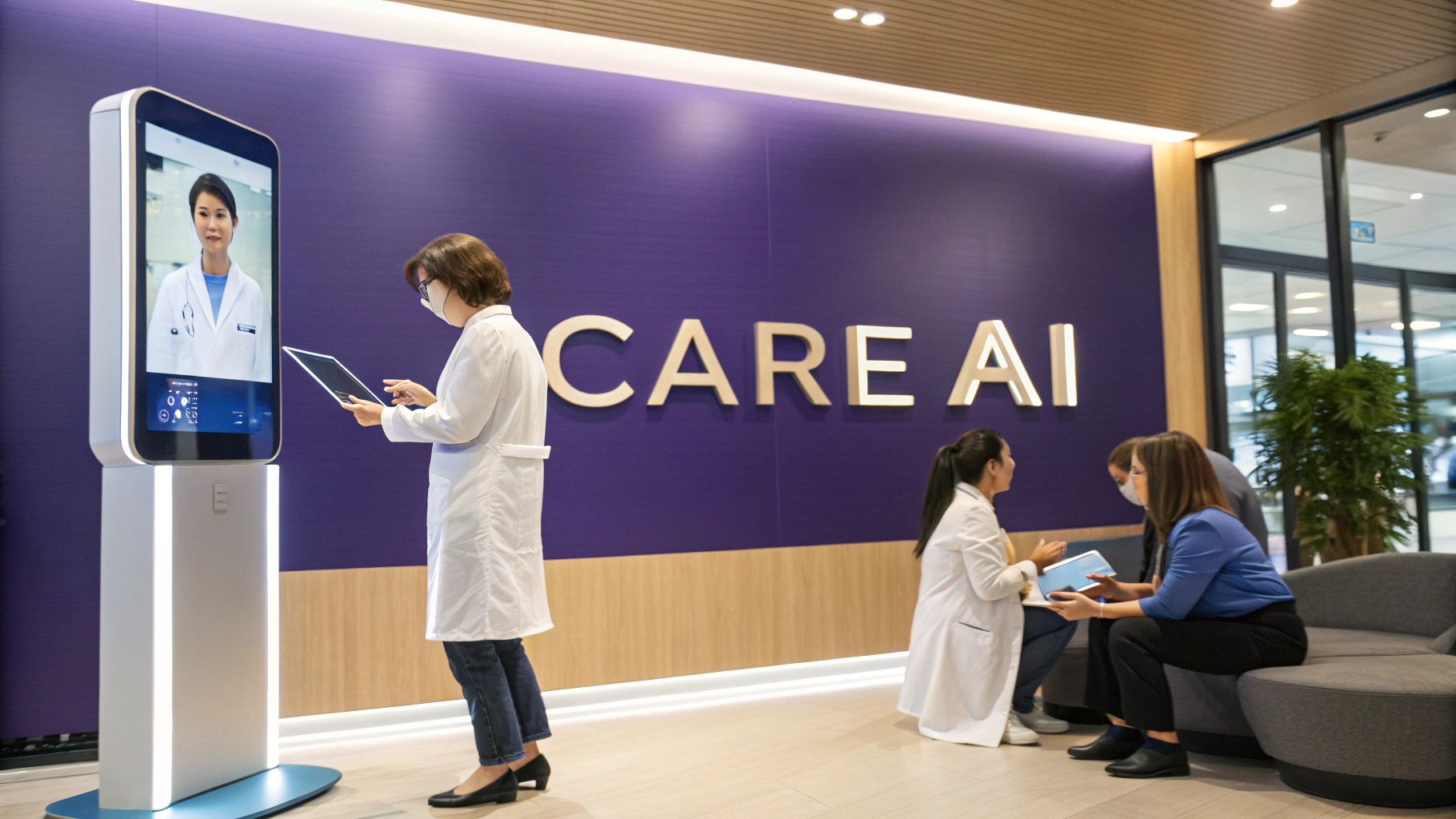
Conversational AI in healthcare is technology that understands and responds to patients in natural language, by voice or chat, to handle tasks like scheduling appointments, taking refill requests, collecting intake details and answering routine questions. In medical practices it works best on administrative conversations, with clinical questions passed to staff.
Key takeaways
- Conversational AI understands what a patient means, not just keywords, and responds in natural language by phone or chat.
- The strongest use cases today are administrative: scheduling, reminders, refills, intake and routine patient inquiries.
- Patients are cautious about AI in clinical decisions, so clear escalation to staff matters as much as automation.
- EMR integration decides whether conversational AI saves time or creates duplicate data entry.
- HIPAA safeguards, a Business Associate Agreement (BAA) and AI governance belong in every evaluation.
What is conversational AI in healthcare?
Healthcare conversational AI is artificial intelligence that holds real conversations with patients to get tasks done. It answers patient calls or chat messages, works out what the person needs, and completes the request or hands it to the right person on the healthcare team.
It is a step beyond the old phone tree or scripted chatbot. Instead of forcing patients through menus, conversational AI technology understands requests phrased in everyday language. A patient can say “I need to move my Thursday appointment” and the system knows what to do.
Healthcare organizations are adopting AI quickly. In the AMA’s 2026 Physician Survey on Augmented Intelligence, 81% of 1,692 physicians said they use AI professionally, up from 38% in 2023. Much of the pressure comes from administrative work: a 2016 study in the Annals of Internal Medicine found physicians spent nearly two hours on EHR and desk work for every hour of direct patient time.
The core components of conversational AI
Three pieces of AI technology work together in a conversational AI system:
- Natural language processing (NLP): Understands what the patient said and the intent behind it. It helps the system tell an appointment request apart from a question about office hours.
- Machine learning: Helps the system improve over time from past interactions, so it recognizes more of the ways people phrase the same request.
- Natural language generation (NLG): Forms a clear, natural reply instead of a robotic script.
Together, these let the system handle real conversations. For example, it can tell the difference between “I need to cancel my appointment” and “I need to reschedule my appointment” and start the right process for each.
Conversational AI vs chatbots vs AI agents
The terms overlap, but they describe different levels of capability.
| Scripted chatbot | Conversational AI | AI agent | |
|---|---|---|---|
| How it understands patients | Fixed menus and keywords | Natural language and intent | Natural language and intent |
| What it does | Shares set information | Holds a conversation and completes routine requests | Plans and completes multi-step tasks across systems |
| Channels | Usually web chat | Voice and chat | Voice, chat and back-office systems |
| When it hands off | When the script runs out | When a request needs a person | Under rules the practice sets |
Conversational AI is the conversation layer. When it also takes actions in your scheduling system or EMR, it starts to work like an AI agent. For a deeper look at agents, see our guide to AI agents in healthcare.
Conversational AI vs generative AI
Generative AI creates new content, such as text or summaries, from a prompt. Conversational AI is focused on dialogue: understanding a request and responding in a way that moves a task forward. Many modern conversational AI tools use generative AI underneath, but in healthcare they are usually limited to approved workflows and information, so responses stay accurate and on topic.
Examples of conversational AI in healthcare

These are the most common real-world uses in medical practices today.
Automating appointment scheduling
Managing the appointment book is one of the most time-consuming jobs at the front desk. Conversational AI can handle many scheduling requests at the same time, around the clock. It understands appointment types, such as a new patient visit versus a follow-up, offers open times and books the slot in the practice’s system.
- Before: A patient calls, waits on hold, then explains what they need while a receptionist clicks through the schedule.
- After: The patient states what they need in their own words, the system finds matching slots and books the one they choose, without a hold queue.
Appointment reminders and rescheduling
Conversational AI can call or message patients before visits to confirm, cancel or reschedule. Because the patient can respond in their own words, a reminder becomes a two-way conversation instead of a one-way alert.
Prescription refill requests
Refill calls arrive in high volume. Conversational AI can verify the patient’s identity, confirm which medication they need and send a structured request to the care team for review. The clinician makes the decision, and staff spend less time on the phone.
Patient intake before the visit
Before an appointment, conversational AI can collect demographic details, reason for visit and medical history in a short conversation. The answers flow into the EMR, so staff do not have to retype paper forms at check-in.
Answering routine patient inquiries
Questions about office hours, location, directions and visit preparation make up a large share of patient calls. Conversational AI can answer them quickly and consistently, which keeps phone lines open for more complex patient conversations.
After-hours calls, follow-ups and call routing
Conversational AI can answer calls in the evening and on weekends, place follow-up calls set by the practice, and route each caller to the right person when a human is needed. Practices set escalation rules so clinical questions and urgent symptoms go to staff.
Benefits of conversational AI in healthcare

For healthcare providers and healthcare teams, the benefits come from taking routine administrative tasks off staff.
- Lower administrative burden: Conversational AI tools handle repetitive calls and data collection, so staff can focus on patient care.
- Better patient access: Patients can get routine requests handled after hours without waiting on hold.
- Stronger patient engagement: Two-way reminders and follow-ups keep patients connected between visits.
- Consistent patient communication: Every caller gets the same accurate information.
- Operational efficiency: Lower call center volume at peak times and fewer manual handoffs.
Keep it administrative: what patients say
Patients are open to convenience but cautious about AI in clinical decisions. In a Pew Research Center survey of 11,004 US adults, 60% said they would be uncomfortable if their own provider relied on AI to diagnose disease and recommend treatments, and 57% expected AI to worsen the patient-provider relationship. 79% said they would not want to use an AI chatbot for mental health support.
The lesson for practices is to use conversational AI for administrative conversations, be clear with patients that they are talking to AI, and make it easy to reach a person.
EMR integration: the make-or-break feature
Conversational AI is only useful if it connects to your electronic health records. A tool that cannot read from and write to the EMR creates separate pools of patient data and forces staff to enter the same information twice.
With proper two-way integration, an appointment booked by the AI is blocked in the schedule right away, and intake answers land in the patient’s chart ready for the clinician. Ask any vendor to show a live, two-way connection with your own EMR, not a generic demo.
HIPAA, data security and AI governance

Conversational AI handles protected health information (PHI), so it has to meet HIPAA requirements for privacy and security. Physicians see this as a precondition for AI adoption: in the AMA’s 2026 survey, 86% said data privacy and 88% said robust safety validation are critical to broader adoption of AI.
Security features to require
- A signed Business Associate Agreement (BAA) that holds the vendor to the same standards for protecting PHI as your practice.
- Encryption of patient data at rest and in transit.
- Role-based access controls so people only see the data they need.
- Audit logs that record who accessed what and when.
- Independent audits, such as SOC 2 Type II, showing a third party has reviewed the controls.
For more detail, see our guide to HIPAA-compliant AI.
AI governance and accuracy
The World Health Organization has called for caution with AI language models in health, pointing to risks such as biased training data, responses that sound authoritative but are wrong, and the use of data without consent. It calls for rigorous oversight before these tools are used widely.
For a medical practice, good AI governance means:
- Limiting the AI to approved workflows and information
- Reviewing conversations regularly for accuracy
- Testing performance across your patient population
- Naming an owner who is accountable for the system
- Keeping human intervention available for anything outside the AI’s scope
How to measure the ROI of conversational AI
The return on conversational AI shows up in three areas. Measure each before launch and again after a pilot, so you are comparing your own numbers.
- Financial: No-show rate, appointments booked outside business hours, and staff time spent on routine calls.
- Operational: Daily call volume, hold times, calls completed without a handoff, and time from arrival to visit.
- Patient experience: Short post-call surveys, how many patients choose self-service, and how quickly routine questions get answered.
Tie each measure to a specific workflow. For example, if reminders are automated, track the no-show rate for the appointment types that receive them.
How to get started
Phase 1: Define your goals
Pick the top two or three bottlenecks where staff lose the most time, such as scheduling calls or refill requests. Set specific, measurable goals based on your own baseline, and map the patient journey to see where automation helps most.
Phase 2: Choose the right vendor
Ask each vendor to show:
- A live, two-way integration with your EMR
- HIPAA documentation, a signed BAA and independent audit reports
- How the AI is limited to your workflows and how accuracy is reviewed
- How escalation to staff works, and what support looks like after go-live
Phase 3: Pilot, then expand
Start with one workflow, such as appointment reminders or after-hours scheduling with an AI medical receptionist. Train staff on why the tool is being introduced, tell patients what it does for them, review results, then expand to the next workflow.
How Simbie AI’s voice agents work
Simbie AI provides clinically trained voice agents for medical practices. They answer and place patient calls, schedule appointments, take refill requests, handle patient registration and collect pre-visit intake, then write the results into your EMR.
- Voice first: Simbie works on your practice’s phone lines 24/7 and can handle many calls at once.
- Human review: A virtual medical assistant (VMA) review step keeps a person involved in the agent’s work.
- EMR integration: Epic, eClinicalWorks, ModMed EMA, gGastro, EZDerm and Nextech.
- Security: HIPAA-compliant and SOC 2 Type II certified.
Frequently asked questions
What is conversational AI in healthcare?
Conversational AI in healthcare is technology that talks with patients in natural language, by voice or chat, to complete tasks like scheduling, reminders, refill requests and intake. It uses natural language processing and machine learning to understand what patients mean.
What are examples of conversational AI in healthcare?
Common examples include voice agents that book and reschedule appointments, two-way appointment reminders, refill request intake, pre-visit intake conversations, answers to routine questions about hours and location, and after-hours call handling.
Is there a HIPAA-compliant AI chatbot or voice assistant?
Yes, some conversational AI tools are built for HIPAA compliance. Look for a vendor that signs a BAA, encrypts patient data, uses access controls and audit logs, and has independent certification such as SOC 2 Type II.
Will patients actually use conversational AI?
Many patients welcome the convenience of booking or asking a simple question at any hour. Adoption is best when the AI is easy to talk to, clearly identified as AI, focused on administrative tasks, and makes it simple to reach a person.
Does conversational AI replace front desk staff?
No. It takes on repetitive conversations so staff can focus on patients in the office and on requests that need human judgment.
Which EMRs does Simbie AI integrate with?
Simbie AI integrates with Epic, eClinicalWorks, ModMed EMA, gGastro, EZDerm and Nextech.
Ready to see how Simbie AI cuts costs by 60% for your practice? See how it works.