
So, what is conversational AI, really? Forget the jargon for a moment. Think of it as a smart assistant that can actually talk with people, whether through text or over the phone, to get things done—much like a real person would.
Your Introduction to Conversational AI in Healthcare

Imagine adding a new member to your practice's front-office team. This person works 24/7, never calls in sick, and can handle hundreds of patient calls at once. They schedule appointments, manage intake forms, and answer frequently asked questions instantly, freeing up your staff to focus on the patients right in front of them.
That’s what a good conversational AI platform brings to a clinical setting. It’s not just about a basic chatbot that offers a few canned responses. To understand its potential in healthcare, it helps to know what is conversational AI in the broader sense—it’s technology built for meaningful, two-way dialogue to achieve a specific goal.
The Growing Demand for Smart Automation
This isn't just a niche technology; it's rapidly becoming a mainstream solution. The market for conversational AI is booming, projected to have reached $17.12 billion in 2026. The reason is simple: it delivers real savings, with some estimates showing it will cut agent labor costs by a staggering $80 billion in the same year.
For medical practices, the impact is even more direct. Voice agents designed for healthcare can slash administrative overhead from tasks like patient intake and scheduling by up to 60%.
And this isn't just about abstract numbers. It's about solving the daily headaches that lead to staff burnout and frustrated patients—like an overflowing voicemail box, endless games of phone tag, and administrative backlogs that never seem to shrink.
By taking over repetitive administrative duties, conversational AI doesn't just improve efficiency; it restores the human connection in healthcare by giving clinicians more time for direct patient interaction.
Platforms like Simbie AI are built from the ground up for the unique demands of a medical office. These systems show just how much administrative weight can be lifted off your team's shoulders. You can see more on how these specialized AI agents in healthcare are designed to work within your existing practice.
So, how does this new approach really stack up against a traditional hire? Let's break it down.
Human Agent vs Conversational AI Agent at a Glance
This table offers a quick comparison, showing the distinct advantages of integrating a platform like Simbie AI into your administrative workflow versus relying solely on human staff for these tasks.
| Feature | Human Agent | Conversational AI Agent (Simbie AI) |
|---|---|---|
| Availability | Limited to office hours; needs breaks | 24/7/365 without interruption |
| Call Handling | Manages one call at a time | Handles hundreds of calls simultaneously |
| Cost | Salary, benefits, training, and overhead | Predictable subscription fee; no overhead |
| Consistency | Performance can vary based on workload/mood | Provides 100% consistent, error-free responses |
| Integration | Manual data entry into EMR systems | Fully integrated for automatic EMR updates |
As you can see, while a great human team is irreplaceable for patient-facing care, an AI agent excels at handling the high volume and repetitive nature of administrative work with perfect consistency and around-the-clock availability.
How Conversational AI Actually Understands a Patient
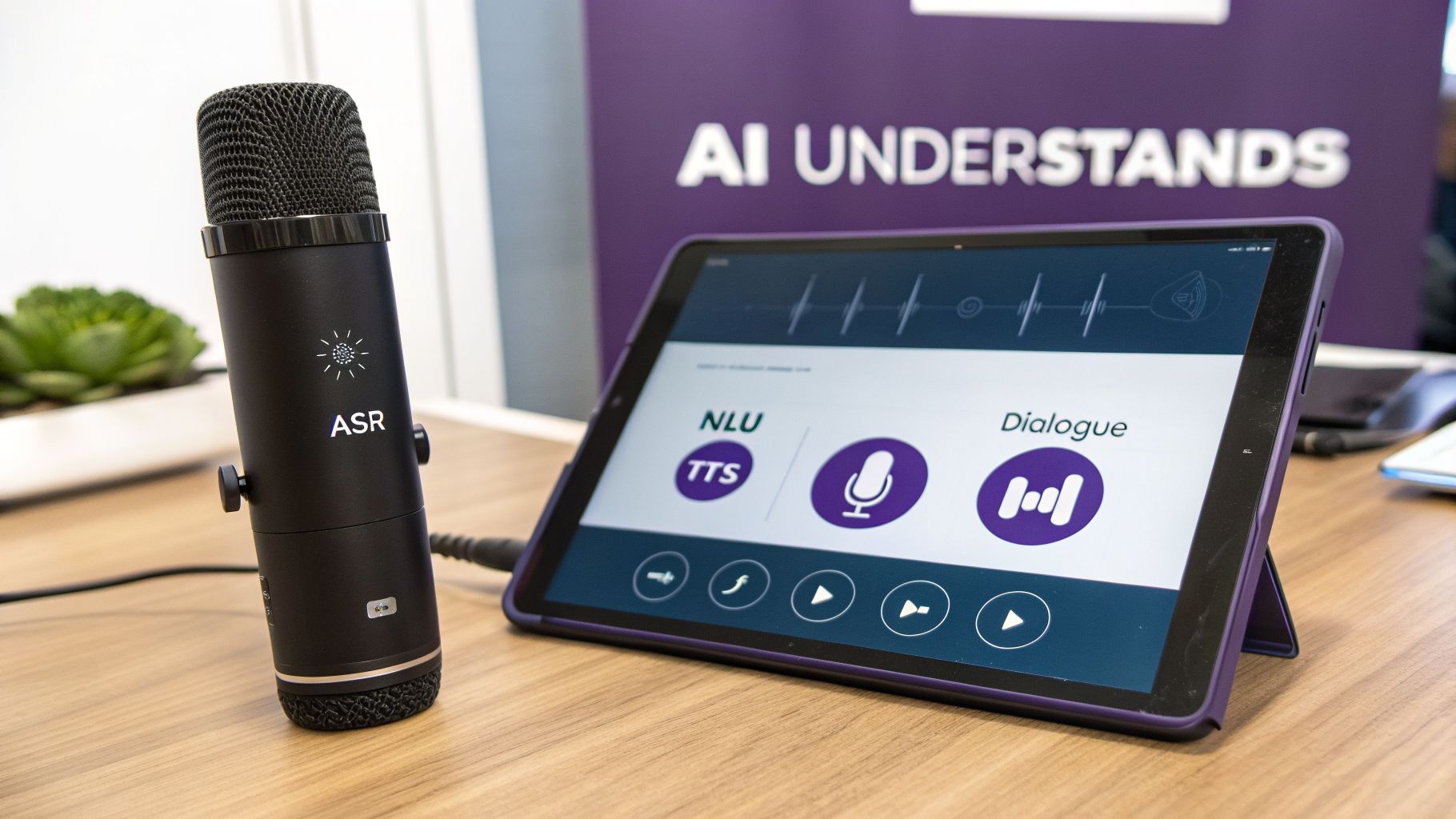
When a patient calls your practice with a complicated request, it’s fair to ask: how can an AI possibly keep up? It’s not magic, but it’s also not a rigid phone tree. It’s a series of technologies working in sync, all within the span of a single breath.
Think about a skilled barista taking a coffee order. A customer doesn’t just say "coffee." They might ramble, "Uh, let's see… I'll get a large decaf latte, and can you use oat milk for that?" The barista has to hear the words, figure out the core request, check for ingredients, and then confirm the order.
Conversational AI works much the same way, using a four-step process to handle a patient’s call from start to finish.
Step 1: Hearing the Words (ASR)
First, the system has to "hear" what the patient is saying. This is the job of Automatic Speech Recognition (ASR), which functions as the AI’s ears. It captures the sound of the patient's voice and instantly converts it into text.
- Patient says: “Hi, I need to book a follow-up appointment for my son, Michael, for next Tuesday afternoon.”
- ASR translates to text: "Hi, I need to book a follow-up appointment for my son, Michael, for next Tuesday afternoon."
Everything else depends on getting this step right. The better the ASR, the cleaner the starting information. If you're curious about the specifics, you can dive deeper into how modern voice technology in healthcare is making these conversations more reliable.
Step 2: Figuring Out What They Mean (NLU)
With the words converted to text, the AI now has to grasp the intent. This is where Natural Language Understanding (NLU) comes in. Think of NLU as the brain of the operation. It analyzes the text from the ASR to pinpoint what the patient wants and pulls out the important details, called "entities."
Natural Language Understanding is what helps an AI know the difference between a patient saying “I need to change my appointment” and “I need to schedule my appointment”—even when most of the words are the same.
Using our example, the NLU engine would deconstruct the sentence like this:
- Intent: Schedule Appointment
- Entities:
- Appointment Type: Follow-up
- Patient Name: Michael
- Requested Day: Next Tuesday
- Requested Time: Afternoon
This is what allows a patient to speak naturally without having to use specific, clunky keywords. The NLU just gets it.
Step 3: Deciding on the Next Move (Dialogue Management)
Okay, so the AI knows the patient wants to book a follow-up for Michael next Tuesday. Now what? The system needs a game plan. Dialogue Management acts as the logical center, taking what the NLU figured out and deciding on the next action.
For our appointment request, the Dialogue Manager would immediately get to work:
- Access the EMR: It connects to your practice’s scheduling software.
- Verify the Patient: It checks if "Michael" is an active patient.
- Search for Openings: It scans the calendar for available slots on "next Tuesday afternoon."
- Craft a Response: Based on what it finds, it prepares something to say back.
This component is the glue that holds the conversation together, making sure the interaction flows logically toward getting something done.
Step 4: Speaking the Reply (TTS)
The final piece is communicating back to the patient. Text-to-Speech (TTS) technology serves as the AI's voice. It takes the text response prepared by the Dialogue Manager and converts it into clear, natural-sounding audio.
So, after its quick work, the AI would use TTS to say something like: "Of course. I see an opening for Michael next Tuesday at 2:30 PM. Does that time work for you?"
All of these pieces—ASR, NLU, Dialogue Management, and TTS—work together in a fraction of a second. The result is a fluid, helpful conversation that turns a phone call into a completed task without anyone on your team having to pick up the phone.
From Basic Bots to Clinically-Trained AI
When you hear "conversational AI," you probably picture the simple chatbots you see on retail websites. They’re programmed to answer a short list of questions and not much else. But in a field like healthcare, where every interaction carries weight, that kind of basic, scripted tool just doesn't cut it.
Think of it like the difference between a phrasebook and a certified medical interpreter. The phrasebook can give you the words for "Where is the bathroom?", but the interpreter understands the urgency, context, and potential consequences when a patient says, "I'm having sharp pains in my chest."
A standard chatbot works off a script. It spots a keyword and spits out a pre-written response. Ask "What are your hours?" and it works perfectly. But if a patient calls and says, "I'm feeling dizzy after my last prescription change, and I need to know if I should come in," that bot is completely lost. That’s a huge problem.
The Power of Clinical Intelligence
This is where clinical intelligence makes all the difference. An AI agent like Simbie isn’t just a customer service bot with a healthcare skin. It’s a specialized tool built from the ground up with physician input, designed to understand the nuances of medical language and the intricate pathways of patient care.
This specialized training means the AI can handle conversations that would stump a generic bot. Things like:
- Prior Authorizations: Navigating the back-and-forth with insurance companies, submitting the right documents, and keeping track of the status.
- Prescription Refills: Checking patient details against the EMR, confirming the medication, and sending the request to the pharmacy and the right clinician for approval.
- Complex Scheduling: Knowing the difference between a new patient exam, a routine follow-up, and a post-op check, then booking the appointment correctly.
A general chatbot can tell a patient your office is open. A clinically-trained AI can hear the concern in a patient’s voice, pick up on words related to adverse symptoms, and immediately escalate the call to a nurse—all while documenting the interaction in the EMR.
A Clear Shift Toward Specialized AI
While basic customer support made up a big chunk of the chatbot market (42.4% in 2024), the real growth is happening in specialized fields. Healthcare is leading this charge as practices adopt AI to take routine clinical tasks off their staff's plates.
This move is also being driven by a preference for more natural, voice-based communication, which is why Automatic Speech Recognition (ASR) is one of the fastest-growing technologies in this space. Simbie AI is a perfect example of this evolution in action—it captures patient histories and queues up refill requests by voice, all while maintaining strict HIPAA compliance. The result? Practices are saving up to 60% on administrative overhead. For a deeper dive into the numbers, you can check out this full report on conversational AI statistics.
Here’s the bottom line: a generic bot is built for quick, transactional chats. Its only job is to close a support ticket. A clinically-trained agent, however, is built for the complex reality of healthcare. Its purpose is to improve accuracy, ensure patient safety, and make your practice run more efficiently. That distinction is what turns AI from just another piece of software into a genuine asset for a modern medical practice.
Putting Conversational AI to Work in Your Practice

It’s one thing to talk about the technology, but it’s another thing entirely to see how it fixes the real-world problems that weigh down a medical practice every day. This is where the theory becomes practical, helping your clinic get ahead instead of just keeping up.
Let’s look at some real-life scenarios. Think about the headache of prior authorizations. Right now, a member of your staff might spend hours on hold with an insurance company, navigating endless phone menus, only to find out they need different paperwork.
Now, imagine this instead: your AI agent makes the call, sits through the hold time, clearly communicates the necessary clinical details, and documents the whole conversation automatically. This isn't science fiction; it’s what a properly trained AI agent can do for you right now.
Automated Patient Intake, 24/7
Your office might close at 5 PM, but your patients are often looking for care in the evenings. When a potential new patient decides to find a doctor at 9 PM, they can call your practice, complete the entire intake process over the phone, and have their information waiting securely in your EMR the next morning.
The AI agent can:
- Collect all the necessary demographic information and insurance details.
- Ask about their medical history and the reason for their visit.
- Verify their information in real-time to prevent common errors.
This means you have zero missed opportunities to bring in new patients. It also means your front desk staff can start their day helping patients, not buried in a mountain of manual data entry.
Intelligent Appointment Scheduling
Managing the schedule is one of the most challenging jobs in any front office. A conversational AI agent acts like a master scheduler, working around the clock to fill, adjust, and optimize your calendar without any human oversight.
Picture this: A patient calls at midnight to cancel their 9 AM appointment. The AI immediately processes the cancellation, opens the slot, and then contacts the first person on your waitlist to offer them the spot. By the time your staff arrives at 7 AM, the slot is already filled. The system handles cancellations, reschedules, and your waitlist on its own, cutting down on costly no-shows and keeping your providers’ schedules full.
A conversational AI agent doesn't just book appointments; it actively manages your schedule to maximize revenue and ensure patients get seen sooner.
Hassle-Free Prescription Refill Management
The constant flow of prescription refill requests demands careful attention. Instead of pulling a nurse or medical assistant away from patient care, an AI agent can handle the entire front-end of this process.
When a patient calls for a refill, the agent securely verifies their identity, confirms the medication and dosage against their EMR record, and puts the request in the queue for a clinician's final sign-off. This simple workflow ensures accuracy, creates a perfect audit trail, and frees up your clinical staff to focus on more complex patient needs.
This kind of efficiency is exactly why the conversational AI market is projected to grow to $89.80 billion by 2030. In healthcare, that growth comes from optimizing every patient interaction. You can learn more about these projections and their impact on healthcare to see where the industry is heading.
Automated Charting and Documentation
After any conversation—whether it's with a patient, a pharmacy, or an insurance company—the details need to be documented accurately. A conversational AI agent captures all the important information from every call and translates it into clear, structured notes.
Those notes are then sent directly into the correct patient chart in your EMR. This simple step eliminates the risk of manual data entry errors and saves your team countless hours. Your staff can walk in each morning ready to prepare for the day’s patients, not playing catch-up on yesterday’s paperwork. The result is a lighter administrative load, a happier team, and more time for what truly matters: caring for your patients.
Looking at AI Risks and Limitations in Healthcare
As promising as conversational AI is, we have to be honest about its risks. When you’re bringing any new technology into a clinical environment—especially one that talks to your patients—you need to look at its limitations head-on. In healthcare, the stakes are just too high to do otherwise.
A trustworthy AI partner gets this. They don't just sell you a product; they build safeguards right into the system. From my experience, the biggest concerns always boil down to three things: patient safety, data privacy, and the potential for errors. Tackling each one is the only way to build a solution that your staff and patients can actually rely on.
Keeping Patients Safe, Always
The absolute number one priority is making sure an AI agent never gives medical advice or misses an emergency. It's a deal-breaker. A conversational AI built for healthcare has to be programmed with very clear boundaries and know exactly what it can't do. For instance, it should never try to diagnose symptoms.
We built Simbie AI with this rule at its core. Our agents are trained to listen for specific keywords, phrases, and even tones of voice that signal a patient might be in distress. If someone mentions “chest pain” or “trouble breathing,” the system is designed to immediately escalate that call to a human.
A critical safeguard here is the ‘human in the loop’ protocol. This isn't just a nice-to-have feature; it’s an essential safety net. It guarantees that a trained member of your team can take over a call instantly, whether the AI flags it automatically or a staff member decides to step in.
This ensures a patient always gets to the right person without any delay. The AI is there to help, never to replace your team’s clinical judgment.
Protecting Patient Data and Staying Compliant
In healthcare, data security isn’t just a good idea—it’s the law. Every bit of information a patient shares is protected health information (PHI), and we all have a legal and ethical duty to keep it private under HIPAA.
Any AI tool you consider has to be built for this reality from the ground up. This means having multiple layers of security in place:
- Data Encryption: All patient data has to be unreadable, both when it's stored and when it's being sent.
- Secure Infrastructure: The entire system, from the servers to the databases, must meet strict security standards.
- Access Controls: You need to control exactly who can see patient information and when.
A platform’s commitment to security shows how well it understands the healthcare world. For anyone running a practice, it’s vital to know what makes a platform a truly HIPAA compliant AI solution.
Reducing Bias and Preventing Mistakes
Finally, let's be realistic: no AI is perfect. The data used to train AI models can sometimes carry hidden biases, which could mean the system doesn't work as well for certain groups of patients. And even the smartest systems can sometimes misunderstand a request or make a simple mistake. Understanding solid AI Governance and Risk Management frameworks is key to using this technology responsibly.
The only way to manage this is through constant monitoring and total transparency. At Simbie AI, we are always auditing our system’s performance. We give practices complete, detailed logs of every AI interaction, so if an issue pops up, we can find it and fix it fast. This ensures the system remains a fair and dependable tool for every patient you serve.
How to Implement Conversational AI in Your Practice
Here’s a step-by-step guide to bringing conversational AI into your practice. It’s not about a massive, disruptive overhaul. Think of it more as a strategic, phased approach that makes the entire process manageable and, most importantly, successful.
The idea is to introduce this new technology in a way that immediately starts reducing your team's administrative burden, freeing them up to focus on what matters most: your patients.
Phase 1: Pinpoint Your Biggest Headaches
Before you even think about new software, you need to take a hard look at your current operations. Where are the administrative logjams? Is your front desk staff drowning in calls about scheduling and insurance? Are they spending hours manually keying in patient intake data?
Finding these specific pain points is the most critical first step. Your goal is to identify the most repetitive, time-consuming tasks that are pulling your team away from valuable, patient-facing work.
- Follow the Hours: Get a real sense of where the time goes. How many hours a week are lost to appointment scheduling, prescription refills, or chasing down prior authorizations?
- Check the Phone Logs: Dig into your call data. High call volumes, long hold times, and a large number of abandoned calls are all red flags pointing to patient frustration and staff overload.
- Talk to Your Team: This is a simple but powerful step. Ask your staff directly: "What administrative task drives you the most crazy?" They're on the front lines and know the workflow inefficiencies better than anyone.
This initial audit gives you a concrete target. You’ll go from a vague goal like "be more efficient" to a specific, measurable objective, like "cut our front-desk phone time by automating 80% of inbound scheduling requests."
I always tell practices to start with the one task that, if you could make it disappear tomorrow, would give your team the biggest sigh of relief. For most, that’s either appointment management or prior authorizations.
Phase 2: Get Your Practice Ready for Integration
Once you’ve picked your starting point, it's time to prepare your practice for its new AI team member. This is where the rubber meets the road, and it starts with making sure the AI can communicate with the tools you already rely on, especially your Electronic Medical Record (EMR) system.
Seamless integration isn't just a "nice-to-have"—it's essential. If your AI agent can't read and write information directly to the EMR, you're just trading one manual task for another. This is where a specialized solution like Simbie AI is so valuable, as it’s designed from the ground up to plug into the software healthcare practices use every day.
Next, you have to bring your human team into the loop. This technology is a tool to support them, not a threat to their jobs. Good training focuses on:
- Explaining the "Why": Clearly show your staff how this AI will absorb the tedious parts of their day, freeing them up for more complex and rewarding work.
- Redefining Roles: Be clear about how jobs will evolve. For example, a front-desk coordinator might shift from booking appointments all day to managing only the complex patient situations the AI escalates.
- Setting Up Handoffs: Create crystal-clear rules for when the AI should pass a conversation to a human. This ensures patients always have a smooth and supportive experience, no matter who they’re talking to.
Phase 3: Keep an Eye on Performance and Refine
So, your conversational AI is up and running. Great! But the job isn't quite done. The final—and ongoing—phase is all about monitoring and fine-tuning. This is how you ensure the system is not only working correctly but also delivering the real-world results you set out to achieve.
You’ll want a dashboard that gives you a clear view of the AI's performance. Keep a close watch on key metrics like how many calls it successfully handles on its own, its task completion rate, and how quickly it resolves inquiries. Reviewing these numbers regularly helps you catch any small issues before they become big problems.
This isn't a "set it and forget it" tool. It’s a dynamic process. For instance, if you see the AI is having trouble with a certain type of insurance question, you can adjust its programming to handle that query more effectively. This constant feedback loop is what makes the AI smarter and more indispensable to your practice over time.
Thinking through these steps can feel like a lot, but having a clear checklist makes the process much more straightforward. The table below breaks down the key actions and goals for each phase of implementation.
Simbie AI Implementation Checklist for Your Practice
| Phase | Key Action | Objective |
|---|---|---|
| 1. Assessment | Audit administrative workflows and survey staff. | Identify 2-3 high-volume, repetitive tasks ideal for automation. |
| Analyze call logs for volume, wait times, and abandonment rates. | Quantify the current strain on front-desk resources and patient experience. | |
| 2. Preparation | Confirm EMR compatibility and integration pathways. | Ensure seamless data flow between the AI and your patient records. |
| Develop a staff training plan and clear handoff protocols. | Prepare your team to work alongside the AI and manage escalations. | |
| Define key performance indicators (KPIs) for success. | Establish clear metrics to measure the AI's impact (e.g., calls deflected, time saved). | |
| 3. Launch & Optimization | Go live with a pilot program for a single, focused task. | Test the system in a controlled environment to minimize disruption. |
| Monitor performance analytics on the AI dashboard weekly. | Track KPIs to ensure the AI is meeting its goals and delivering ROI. | |
| Gather feedback from both staff and patients. | Use qualitative insights to fine-tune AI scripts and workflow handoffs. | |
| Gradually expand the AI's responsibilities to other tasks. | Scale the solution's impact across the practice based on proven success. |
Following a structured plan like this demystifies the process. It turns a potentially overwhelming project into a series of logical, achievable steps that lead to a stronger, more efficient practice.
A Few Common Questions About Conversational AI
When practice leaders start looking into new technology, the same questions tend to pop up. We get it. Adopting AI can feel like a big step, so let’s clear the air and answer some of the most common things we hear from practices just like yours.
What Happens if a Patient Reports a Medical Emergency?
This is, without a doubt, the most critical question, and patient safety is always the number one priority. The AI is not a doctor and is specifically trained not to act like one. Its programming includes a long list of keywords and phrases—like "chest pain" or "can't breathe"—that instantly signal a potential emergency.
The moment one of these triggers is detected, the AI immediately stops what it's doing. It will then follow your practice's specific protocol, either by instructing the patient to hang up and call 911 or by directly transferring the call to a live staff member. This safety protocol is non-negotiable and ensures that any urgent medical need is handled by a human, every single time.
Is This Technology Actually Affordable for a Smaller Practice?
Yes, absolutely. The term "AI" might bring to mind a massive, expensive system, but that’s not the reality anymore. Modern platforms are built to be affordable and deliver a clear return on investment, even for solo practitioners or small clinics. The real value isn't just in the technology itself, but in the operational costs it cuts.
Think about the direct financial wins:
- Lower Administrative Overhead: The AI takes over the repetitive tasks that eat up hours of your staff's day, significantly reducing labor costs.
- Recaptured Revenue from No-Shows: It works tirelessly to fill last-minute cancellations, turning what would have been lost income back into a filled appointment slot.
- Reduced Staff Turnover: By automating the draining, thankless tasks that contribute to burnout, you create a more positive work environment. This leads to a happier team and lowers the steep costs of hiring and training new employees.
For most practices, a platform like Simbie AI isn't really a cost center—it’s a revenue driver. By plugging financial leaks and improving efficiency, the system often pays for itself in a matter of months.
Will My Patients Actually Be Okay with Talking to a Robot?
We hear this concern a lot, but what we see in practice is that patients adapt much faster than you’d think. People are already comfortable asking Siri for directions or telling Alexa to play a song, so having a conversation with an AI on the phone feels surprisingly normal.
In fact, for simple administrative tasks like scheduling a check-up or requesting a prescription refill, many patients come to prefer the AI. Why? Because it’s available 24/7, there are no hold times, and it handles their request instantly. It delivers a level of convenience that a busy front desk simply can't match.
Best of all, this frees up your human staff to do what they do best: care for patients. When your team isn't bogged down by routine calls, they have more time and energy for the patients in your office who need a compassionate ear or a helping hand. The AI handles the logistics so your team can focus on the people.
Ready to see how a clinically-trained voice agent can transform your practice's administrative workflow? Discover Simbie AI and learn how you can reduce staff burnout, cut overhead costs, and deliver a better patient experience. https://www.simbie.ai