

It’s a scene every doctor knows well: the day is over, patients have gone home, but a mountain of charting and administrative work still looms. This crushing documentation burden is a primary driver of physician burnout, stealing time and focus from patient care. This is where virtual scribing services have become a game-changer, acting as a remote partner for clinicians. They take on the documentation in real-time, letting doctors get back to focusing completely on their patients. This comprehensive guide will explore how these services work, compare the different models, and show you how to choose the right solution to reclaim your practice's efficiency and your clinicians' time.
What Are Virtual Scribing Services
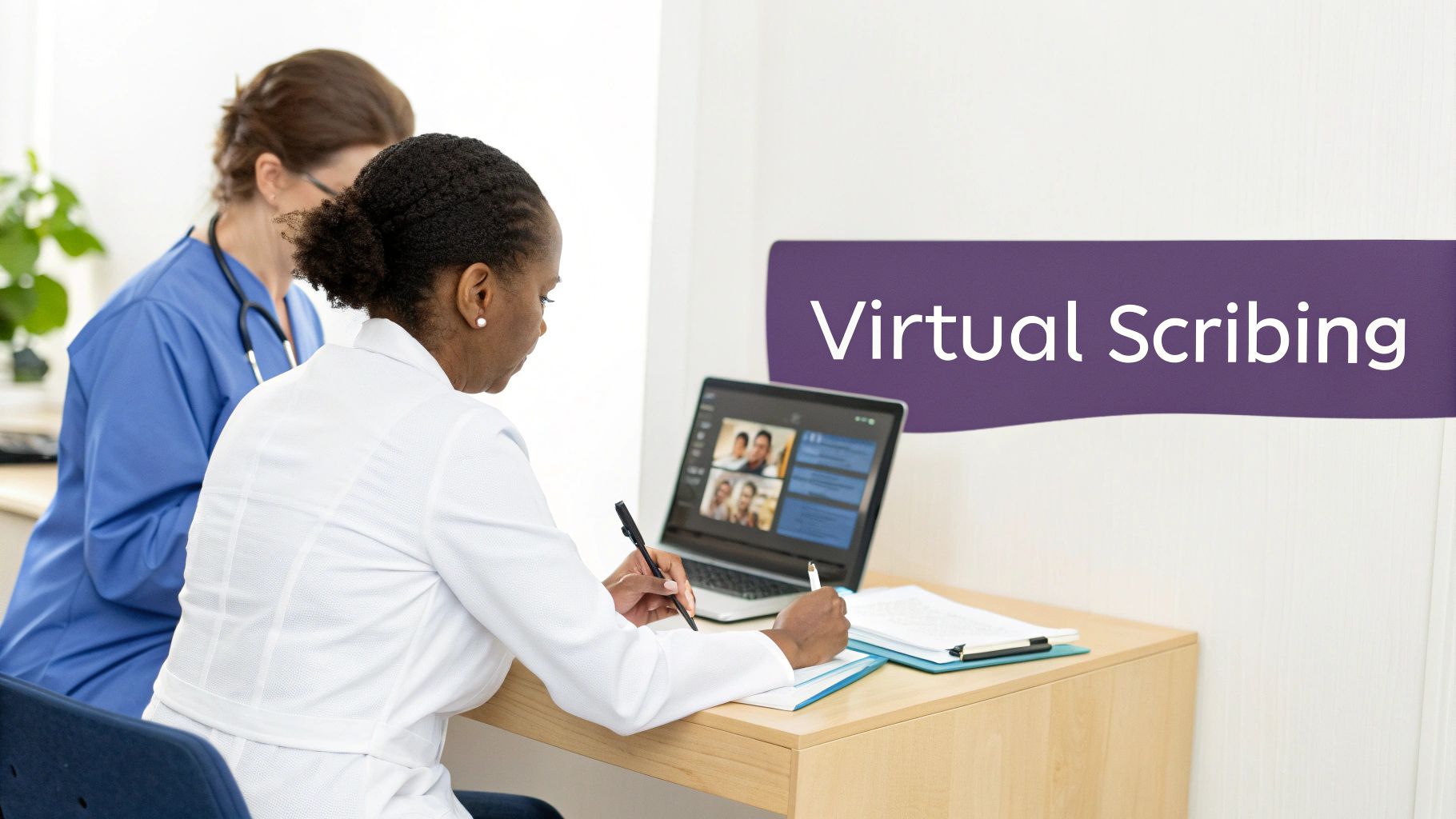
Think of a virtual scribe as a dedicated assistant who captures every key detail of an appointment without physically being in the exam room. This model reimagines the traditional, in-person medical scribe by placing them in a secure, remote setting. They connect to the physician through a HIPAA-compliant audio or video stream, listening in and meticulously documenting the visit as it happens.
This isn’t just about convenience. It’s a direct and powerful answer to the overwhelming administrative load that has fallen on healthcare providers. As Electronic Medical Record (EMR) systems have grown more complex and telehealth has become standard, the time doctors spend on paperwork has skyrocketed, becoming a major driver of physician burnout and a bottleneck to efficient care delivery. Virtual scribing directly addresses this pain point by offloading the clerical tasks that distract from clinical duties.
A Modern Fix for Documentation Overload
A virtual scribe is essentially an extension of your care team, a specialist focused solely on documentation. They listen to the natural conversation between a doctor and patient and translate it into a structured, accurate clinical note right inside the EMR. This simple change means doctors no longer have to spend hours of their personal time—what many call "pajama time"—just to catch up on charting. This is a critical step in restoring work-life balance and improving career satisfaction for medical professionals.
The demand for these services is growing fast as healthcare organizations look for ways to work smarter, not harder. The remote medical scribe market is expected to grow from $2.3 billion in 2025 to $3.1 billion by 2026, which is an impressive 12% annual growth rate. This growth is fueled by real results; some hospitals have seen a 20% drop in documentation errors and have given back as much as 30 minutes to each physician per shift. These metrics highlight a tangible return on investment, both in terms of clinical quality and operational efficiency.
The Two Main Approaches
Virtual scribing services typically come in two flavors: human-assisted and AI-powered. Each has its own strengths, and understanding them is the first step to figuring out what your practice really needs.
- Human-Assisted Scribing: In this classic model, a professionally trained scribe listens to the appointment, either live or from a recording. They bring their clinical knowledge to the table, catching nuances, context, and complex medical terms to craft a comprehensive note. They act as a true remote assistant.
- AI-Powered Scribing: This is the newer, technology-driven approach, using sophisticated voice recognition and natural language processing to generate clinical notes automatically. An AI scribe can transcribe, structure, and summarize an entire patient visit in seconds, often connecting with other automated workflows to create a seamless experience.
By handing off documentation to a virtual scribe, physicians can get back valuable time, slash their administrative stress, and give their undivided attention to what actually matters: providing excellent care.
Both models share the same mission: to free clinicians from the keyboard. As we’ll see, choosing between them comes down to your practice's specialty, workflow complexity, budget, and how much automation you're comfortable with. You can learn more about the core role of a scribe in our guide on what a medical scribe is.
Comparing Human Scribes and AI-Powered Solutions

When it comes to choosing the right documentation partner, you'll find two main flavors of virtual scribing services. The best fit really comes down to your practice's specific workflow, patient load, budget, and where you want to be in a few years.
Both human-assisted and AI-powered scribes aim to solve the same frustrating problem: getting clinicians out of the EMR and back to focusing on patients. But they take very different paths to get there, each with distinct advantages and potential drawbacks.
Let's unpack each model to see how they work and what they're best at, so you can make an informed decision for your practice.
The Human-Assisted Virtual Scribe
Think of this as the classic in-person scribe, just working remotely. A professionally trained medical scribe joins the patient visit through a secure, HIPAA-compliant audio or video stream. They listen in and type the clinical note directly into your EMR in real time, following your specific templates and preferences.
The biggest advantage here is the human touch. A person can understand nuance, interpret complex back-and-forths, filter out the small talk that an automated system might capture, and ask for clarification if something is unclear. This makes them a great option for specialties with unpredictable conversations, highly detailed procedural notes, or providers who prefer a collaborative, personal touch. They can also handle ancillary tasks like queuing up orders or referrals.
But there are some trade-offs. You’re tied to another person's schedule, which can make things tricky for last-minute appointments or after-hours work. Plus, the service is usually billed by the hour, which can be a significant operational expense. For a busy practice, that can add up quickly, and scaling means finding, training, and managing more people, which introduces logistical challenges.
The Rise of AI-Powered Scribing
The second route uses artificial intelligence to do the heavy lifting. An AI scribe, like Simbie AI, uses sophisticated natural language processing (NLP) and machine learning to listen to, transcribe, and structure the entire clinical conversation on its own.
It doesn't just type out every word. The AI is trained to pick out what's clinically important—symptoms, medications, the treatment plan, patient history—and organize it into a clean, structured note that fits your EMR's format. The whole process is incredibly fast, with a draft note often ready for your review just moments after the appointment ends.
AI-powered virtual scribing services work around the clock, offering unmatched consistency and the ability to scale up instantly at a much lower cost. There are no scheduling conflicts or sick days to worry about.
AI solutions often do more than just write notes. They can plug into other administrative tasks like scheduling, patient intake, and even coding, creating a more connected and efficient practice ecosystem.
Modern AI tools are also built to learn. They get smarter over time, adapting to your specific vocabulary, templates, and documentation style. This personalization means the AI becomes more accurate and helpful with every single use, effectively becoming a custom-trained assistant for each provider.
A Head-to-Head Comparison
To help you decide, let's put these two models side-by-side and look at the factors that really matter to a busy medical practice. This gives you a clear snapshot of the strengths and weaknesses of each approach, enabling a more strategic choice.
Comparison of Human-Assisted vs AI-Powered Virtual Scribes
Choosing between a human scribe and an AI-powered platform involves weighing nuanced understanding against speed, cost, and scalability. This table breaks down the key differences to help you see which model aligns best with your practice's operational, clinical, and financial priorities.
| Feature | Human-Assisted Scribe | AI-Powered Scribe (e.g., Simbie AI) |
|---|---|---|
| Accuracy & Nuance | Excellent at interpreting complex conversations, non-verbal cues, and provider intent. Can ask clarifying questions. | High accuracy for standard encounters; constantly learning to improve. Excels at structured data capture. |
| Scalability | Limited by the availability of trained human scribes. Scaling can be slow and costly. | Instantly scalable to any number of providers or visits without additional overhead. |
| Cost Structure | Typically a higher hourly or per-visit rate. Can be a significant operational expense. | Lower cost, often a flat subscription fee. Highly cost-effective at scale. |
| Availability | Dependent on the scribe's schedule, working hours, and time zone. | Available 24/7, on-demand. Ideal for varied clinic schedules and telehealth. |
| Speed & Efficiency | Documentation is done in real time but is limited by human typing speed and attention. | Notes are generated almost instantly after the visit, accelerating the entire clinical workflow. |
| Integration | Can be trained on any EMR but may require manual navigation and data entry. | Deep, automated integration with EMRs and other practice tools for a seamless data flow. |
| Consistency | Can vary between scribes; subject to human error or fatigue. | Extremely high consistency in note structure and quality, regardless of volume. |
In the end, the right choice really depends on what your practice needs most. A small specialty clinic with highly variable consults might prefer the deep, nuanced understanding a human scribe provides. On the other hand, a large, fast-paced practice could see huge efficiency gains and significant cost savings by handing the work over to a scalable AI platform.
How Virtual Scribes Can Benefit Your Practice
Bringing virtual scribing services into your practice isn't just about tweaking your workflow. It’s a strategic decision that delivers real, measurable value from the exam room to the balance sheet. When you lift the heavy burden of documentation off your clinicians' shoulders, you create a positive ripple effect that improves patient care, smooths out operations, and boosts your bottom line.
The benefits really stack up across three key areas: clinical, operational, and financial. Each one feeds into the next, building a powerful case for leaving old-school, time-draining documentation behind and embracing a more modern, efficient approach.
Let’s dig into the tangible improvements you can expect.
Better Clinical Outcomes
The first thing you’ll notice is the freedom it gives back to your doctors and nurses. When clinicians aren't trying to talk to a patient and type into an EMR at the same time, they can be completely present. This alone makes for stronger relationships, more meaningful conversations, and a more thorough understanding of the patient's needs.
That focused attention translates into better care in a few important ways:
- Fights Physician Burnout: We all know the "pajama time"—those endless hours doctors spend catching up on charts at home. This is a leading cause of burnout, which affects over 50% of physicians. Virtual scribes give clinicians their evenings and weekends back, which is a massive win for job satisfaction and a key to keeping great people on your team.
- Improves Documentation Accuracy: Having a dedicated scribe, whether it's a person or a sophisticated AI, means someone is focused on one thing: getting the story right. This dramatically cuts down on the errors, missed details, and typos that happen when a doctor is multitasking under pressure. We’ve got more tips on this in our guide to improving clinical documentation.
- Encourages Deeper Patient Engagement: When a provider can look a patient in the eye instead of staring at a screen, everything changes. They can listen more actively and pick up on subtle non-verbal cues. Patients feel heard, and that trust is the foundation of the doctor-patient relationship, leading to better adherence to treatment plans.
Smoother Day-to-Day Operations
Outside of the exam room, virtual scribing helps the entire clinic run more efficiently. It cuts through the administrative sludge that slows everyone down, creating a much more productive and less stressful environment for the entire staff.
Think of it as clearing out the bottlenecks in your daily schedule. Charts get closed out faster, handoffs between team members are clearer, and the whole patient journey feels less clunky. For example, when a note is finished right after the visit, billing can get started immediately, referrals can be sent out without delay, and prescriptions can be filled promptly. This acceleration of tasks prevents work from piling up and reduces administrative lag time.
By getting charts closed faster, virtual scribes stop clinical and administrative tasks from piling up. This allows the practice to run more smoothly and even see more patients without adding more stress.
The market is certainly taking notice. The U.S. AI medical scribing market, a huge piece of the virtual scribing services puzzle, was valued at $397.05 million. It's expected to hit an incredible $2,955.72 million by 2033. That explosive growth, representing a 25.09% CAGR, shows just how badly healthcare needs this kind of efficiency. You can see more on this market growth on Grand View Research.
A Clear Financial Payoff
Ultimately, all these clinical and operational improvements lead straight to a stronger financial picture for your practice. Yes, there's an upfront investment, but the return shows up quickly through both cost savings and new revenue opportunities.
The business case is pretty straightforward. By delegating or automating documentation, practices can cut their administrative overhead by as much as 60%. That's not a fuzzy estimate; it's real savings in staff hours and resources that can be reallocated to patient-facing activities.
Here’s how the numbers add up:
- Higher Patient Throughput: When clinicians can move from one appointment to the next without a mountain of charting waiting for them, they can comfortably see more patients each day. Seeing just one or two extra patients per day per provider can lead to a significant increase in annual revenue.
- Lower Administrative Costs: Less time spent on paperwork means your staff can focus on higher-value, patient-facing work. You can grow your practice without having to hire more administrative staff just to keep up, improving your operational leverage.
- Faster Billing Cycles: With complete and accurate notes ready to go, claims get submitted sooner and with fewer rejections. This is a game-changer for your cash flow, significantly reducing the time it takes to get paid and improving your revenue cycle management.
At the end of the day, investing in virtual scribing services is an investment in the long-term health, profitability, and growth of your practice.
How Virtual Scribes Connect With Your EMR
For any new tool to be genuinely useful in a clinic, it can't just be another piece of standalone software. It has to plug right into the heart of your practice—the Electronic Medical Record (EMR) system. The best virtual scribing services get this, and they're built to feel like a natural extension of the tech you already use every day, not an inconvenient add-on.
The whole point is to make information flow effortlessly. The scribe captures the patient encounter, and the finished note should pop up in the right patient chart without anyone needing to copy and paste. This isn't just a time-saver; it dramatically cuts down on the risk of simple human error during data entry, which can have serious clinical consequences.
This tight integration is what unlocks the full power of a virtual scribe. But, understandably, it also brings up some big questions about security and data privacy.
Connecting Securely to Your EMR
You don’t need clunky software or a complicated IT project to get a virtual scribe up and running. Modern platforms are designed to connect with major EMR systems—think Epic, Cerner, and Athenahealth—through secure, well-established methods that are both reliable and compliant.
Most often, this connection happens through an Application Programming Interface (API). The easiest way to think of an API is as a secure messenger that lets two different software systems talk to each other in a pre-approved language. The virtual scribe platform sends the finished clinical note, and the EMR’s API receives it and puts it exactly where it belongs in the patient's chart. This method is standardized and minimizes the need for custom development.
This process ensures data moves fast and accurately, turning the scribe from an external helper into a seamless part of your documentation workflow. To get deeper into the technical side, check out our guide on https://www.simbie.ai/integration-with-emr/.
Upholding HIPAA and Protecting Patient Data
Let's be clear: whenever patient information is in play, security is priority number one. The Health Insurance Portability and Accountability Act (HIPAA) sets the gold standard for protecting sensitive patient health information (PHI). Any virtual scribing service worth considering must meet—and really, exceed—these rules. There is no room for compromise.
Adopting a virtual scribe should make your practice more efficient without ever weakening its security. The best platforms are built with a security-first mindset, treating patient data with the same care and respect you do.
To make this happen, top-tier scribe providers use multiple layers of protection. These safeguards all work together to create a secure bubble for your data, whether it’s being sent across the internet or stored on a server.
Here are the non-negotiable security measures you should look for:
- End-to-End Encryption: Every bit of data that travels between your clinic and the scribe platform, from audio streams to text files, must be scrambled using strong encryption protocols like AES-256. Encryption makes the information unreadable to anyone who isn't authorized to see it.
- Secure Cloud Infrastructure: The service should be hosted on a secure, HIPAA-compliant cloud platform like AWS or Google Cloud. These environments are monitored 24/7 for any threats and are purpose-built to handle sensitive healthcare data with robust physical and digital security.
- Strict Access Controls: This is all about the "principle of least privilege." A scribe (human or AI process) should only be able to access the specific parts of the EMR required for their job, and nothing more. Every click and action should be logged in a detailed audit trail for full accountability.
- Business Associate Agreements (BAA): A BAA is a signed, legal contract that holds the virtual scribing company to the same strict HIPAA standards your own practice must follow. It makes them legally liable for any breaches. If a vendor won't sign one, walk away immediately.
By making sure these safeguards are in place, virtual scribing services can deliver on their promise of efficiency while ensuring patient privacy is always protected.
A Practical Checklist for Getting Started
Bringing a virtual scribe into your practice doesn't have to be a massive, disruptive undertaking. The key is to have a clear, strategic plan. If you break the process down into a few manageable steps, you can make the transition smooth, get your team on board without a hitch, and start seeing benefits quickly.
Think of it like building a house—you need a solid foundation before you can start putting up the walls. A little prep work now will save you from major headaches down the road and ensure you get the results you're looking for.
Phase 1: Figure Out What You Actually Need
Before you even think about looking at different vendors, you have to get clear on what problem you're trying to solve. What are the biggest documentation headaches in your practice right now? Answering that question honestly is the first step toward picking the right kind of virtual scribe.
Start by asking yourself and your team a few straightforward questions:
- What’s our main goal? Are we trying to cut down on physician burnout? See more patients each day? Improve note quality? Or maybe just get our billing cycle moving faster? Define your primary objective.
- How busy are we? Is our schedule pretty consistent, or does our patient volume swing wildly from day to day? This will influence whether a flexible AI or a scheduled human scribe is a better fit.
- What's our budget? Knowing what you can realistically spend will help you decide between a human-assisted service (higher operational cost) and a pure AI solution (lower subscription cost).
- What is our specialty? Do our notes require a deep understanding of complex, nuanced conversations, or are they more straightforward and structured?
Getting these answers down on paper gives you a clear picture of what a "win" looks like for your practice. That clarity is crucial for what comes next.
Phase 2: Choose the Right Partner
Once you know what you’re looking for, you can start checking out potential vendors. Be warned: not all virtual scribing services are the same. It’s really important to look past the slick marketing and get into the nitty-gritty details of technology, security, and support.
A great vendor should feel more like a part of your team, not just some company you buy software from. As you evaluate your options, zero in on these key areas:
- EMR Integration: Does the service play nice with your specific EMR? Don't just take their word for it—ask for a live demo to see exactly how it works and how seamless the integration is.
- Security and HIPAA: This is a big one. Ask to see their security protocols, third-party audit reports (like SOC 2), and make sure they’ll sign a Business Associate Agreement (BAA). This is non-negotiable.
- Training and Support: What happens after you sign up? A good partner will have a solid plan for getting your team up to speed and will offer accessible, responsive support when you run into snags.
- Trial Period: Does the vendor offer a free trial or a pilot program? This is the best way to test the service in your real-world environment before making a long-term commitment.
A vendor’s willingness to really understand your practice's unique workflow is a huge green flag. Steer clear of any one-size-fits-all sales pitches and find a service that can adapt to how you work.
Phase 3: Get Your Team Ready and Run a Test
Change can be tough, so open communication is your best friend here. Let your team know why you’re making this move and, more importantly, how it will make their lives easier. Focus on the good stuff, like less time charting at home and more time focusing on patients. Address their concerns head-on.
Instead of flipping the switch for everyone at once, start small with a pilot program.
- Pick a few champions: Choose one or two clinicians who are generally open to new tech. Their enthusiasm and success will be contagious.
- Set clear goals: Decide how you’ll measure success. This could be anything from time-to-chart-completion and note accuracy to physician satisfaction scores.
- Ask for feedback: Check in regularly with your pilot group. Find out what’s working, what isn’t, and what could be improved. Their insights are gold for fine-tuning the process before you go big.
Phase 4: Measure Your Results and Scale Up
After the pilot has been running for a few weeks, it's time to look at the results. Did you hit the goals you set back in phase one? The numbers will tell part of the story, but make sure you also listen to what your team has to say.
This kind of data-driven decision is becoming standard practice. The market for medical scribes, including virtual ones, was valued at $1.61 billion and is projected to hit $3.32 billion by 2031. That steady 10.7% annual growth is fueled by practices like yours looking for smarter ways to manage documentation. You can get more details on how the market is expanding at 6wresearch.
Once you've proven that virtual scribing services work on a small scale and deliver a positive ROI, you can confidently roll the program out to the rest of your practice. Use everything you learned from the pilot—from workflow tweaks to training tips—to make onboarding smooth and effective for everyone.
Where Clinical Documentation is Headed
The idea of virtual scribing services isn't new, but its journey from a niche add-on to a core part of a modern medical practice has been incredibly fast. What was once a simple fix for note-taking has become a strategic move for clinics that want to work smarter and build a sustainable future. It's a fundamental shift in thinking about administrative work—not as a necessary evil, but as an opportunity for intelligent automation.
And we're just getting started. As the technology matures, these services are becoming much more than digital transcriptionists. They're evolving into smart clinical assistants, and the next wave of innovation, driven by more advanced AI, is already here. This is about creating a truly ambient clinical experience.
A Glimpse into Tomorrow's Clinic
Imagine a virtual scribe that does more than just capture what was said. The next generation of these tools will actually anticipate what's needed next, creating a more proactive and predictive approach to care. This isn't just wishful thinking; it's where the data and technology are leading us.
We're moving toward a system where technology actively helps providers make better clinical decisions, right in the exam room.
- Predictive Clinical Analytics: Soon, scribing platforms will be able to analyze a patient's story and EMR history in real time during the visit. They might flag potential health risks, highlight missing preventative screenings, or suggest care pathways based on established evidence. For example, the system could pick up on a combination of symptoms that points to a specific diagnostic test and quietly prompt the provider.
- Fully Automated Coding: The headache of medical coding is on its way out. The AI will listen to the entire visit, pull the right ICD-10 and CPT codes based on the documented encounter, and get them ready for billing with supporting justification. This will dramatically cut down on errors, reduce claim denials, and speed up the revenue cycle.
- Patient-Facing Automation: The same AI that documents the visit can also generate patient-friendly summaries, instructions, and educational materials automatically. This improves health literacy and ensures patients leave with a clear understanding of their care plan, improving adherence and outcomes.
The real goal here is to create a closed loop where documentation doesn't just record what happened—it actively improves the care being delivered. The scribe stops being a passive tool and becomes an active partner in the patient's health.
The New Strategic Imperative
For anyone running a medical practice, the writing is on the wall. It’s time to stop thinking of virtual scribing as just another operational cost. It's a core investment in the future of your organization—an investment in efficiency, quality, and clinician well-being.
More than anything, it's an investment in your clinicians—your most valuable asset. Giving them tools that fight burnout and let them focus on what they were trained to do is essential for retention and recruitment. By bringing these services into your practice, you're building faster, smarter workflows and setting yourself up for long-term success by delivering top-notch care as efficiently as possible.
Frequently Asked Questions
Bringing a new tool into your practice, especially one that touches patient documentation, is a big decision. You're going to have questions, and you need good answers. Let's tackle some of the most common ones we hear from practice managers and physicians when they're considering a virtual scribing service.
We've pulled together the things people really want to know—from how long it takes to get started to how secure their data will be.
How Quickly Can We Get a Virtual Scribe Up and Running?
You’ll be pleasantly surprised by how fast this can be. With a purely AI-driven scribe, you can be live in just a few days. The setup usually involves a quick session to link the service with your EMR and walk your team through the basics. The technology is designed for rapid, low-friction deployment.
If you opt for a human-assisted service, it might take a little longer—think one to two weeks. That extra time is for your dedicated scribe to get familiar with your specific templates, your workflow, and the way you personally like to document patient encounters. This onboarding ensures they can function as a true extension of your team from day one.
Is It Accurate Enough for Complex Specialties?
This is a big one, and the right answer really hinges on the type of service you choose.
- Human-assisted scribes are fantastic for highly complex fields like neurology, oncology, or psychiatry. Having a trained professional who understands the nuance, context, and complex decision-making process is invaluable.
- Today's AI scribes are also remarkably accurate, having been trained on enormous sets of medical data across dozens of specialties. They do a great job across most fields, but if your practice involves a lot of unique procedures or highly variable patient visits, you might feel more comfortable starting with a human scribe or an AI solution that offers a human-in-the-loop review option.
A key thing to remember is that either model is almost always a huge step up in accuracy from a busy doctor trying to document while also focusing on patient care. It’s all about matching the service to your specific clinical needs.
What Kind of Training Will My Staff Need?
Hardly any, and that’s by design. The whole point is to make your team's life easier, not give them another piece of complex software to learn. For doctors and nurses, the "training" is typically just learning how to start and stop the recording (often a single click) and how to quickly review and e-sign the final note in the EMR.
Most platforms are built to be incredibly intuitive and fit naturally into the existing workflow. Usually, one short session of 30-60 minutes is all it takes to get everyone comfortable. The best virtual scribe companies also provide ongoing support, comprehensive help docs, and video tutorials, so you're never left hanging if a question pops up down the road.
How Do Virtual Scribes Handle Different Accents?
This is where modern AI platforms really shine. They've been trained on millions of hours of audio from people all over the world, so they're excellent at understanding a huge variety of accents, dialects, and speaking speeds. They're also great at tuning out background noise to focus on the conversation that matters, a feature known as speaker diarization.
While human scribes are also trained listeners, advanced AI often has the advantage here because of the sheer volume of data it's learned from. Any reputable provider will encourage you to do a trial run with your providers to make sure the technology works perfectly with your team’s unique speech patterns before you make any commitment.
Ready to see how intelligent automation can free your clinicians from documentation and transform your practice? Simbie AI offers a clinically-trained voice AI that handles patient intake, scheduling, and charting, reducing administrative overhead by up to 60%.