

Think of a virtual medical receptionist service as a highly skilled, remote front desk for your healthcare practice. They're on deck 24/7 to handle patient calls, manage scheduling, and tackle administrative tasks. This provides the compassionate, live support your patients expect while letting your in-house team focus completely on delivering excellent care to the people in your office.
A well-implemented virtual receptionist service doesn't just answer phones; it streamlines operations, improves patient satisfaction, and ultimately contributes to the financial health of your practice. By offloading the constant barrage of calls and routine administrative duties, you empower your on-site staff to perform at their best, focusing on higher-value tasks and direct patient interaction. This shift can transform the entire dynamic of your front office from a reactive, chaotic environment to a proactive, organized one.
What Is a Medical Virtual Receptionist Anyway?

A great analogy is an air traffic controller for your practice. They aren't physically in the cockpit with the pilot, but they're expertly managing every arrival and departure to make sure everything runs smoothly, safely, and on time. A medical virtual receptionist does the same for your patient communications. They orchestrate the flow of information and appointments, ensuring a seamless experience for patients and staff alike.
They become a strategic partner, working remotely but fully dedicated to managing the constant flow of patient interactions. This is so much more than a basic answering service that just takes messages. It's a specialized extension of your own team, trained specifically for the unique demands of a healthcare environment. They understand the cadence of a medical office, from the urgency of certain calls to the importance of accurate scheduling.
More Than Just Answering Calls
At its core, a virtual receptionist for a medical office makes sure no patient call ever gets missed. Think about it: research shows a staggering 74% of patients hang up after being put on hold. That’s a huge potential loss of appointments and revenue. A virtual service completely solves that problem by providing immediate, live responses around the clock.
But it goes way beyond just picking up the phone. These specialists are equipped to handle a wide range of front-desk duties that keep your practice running like a well-oiled machine. This comprehensive support is what differentiates a true virtual receptionist service from a simple call center.
Key tasks they handle include:
- 24/7 Live Call Answering: A professional and empathetic voice representing your practice, even after hours, on weekends, or during holidays. This constant availability enhances patient access to care and information.
- Appointment Scheduling: Booking, rescheduling, and confirming appointments directly in your practice's scheduling software. This includes managing complex schedules for multiple providers.
- New Patient Intake: Walking new patients through the registration process, collecting all the necessary demographic, insurance, and medical history information accurately and efficiently.
- Intelligent Call Routing: Screening calls to identify urgent issues and routing them to the right on-call provider or department without a moment's delay, following your exact protocols.
A virtual receptionist service acts as an extension of your team, offering critical support that allows practitioners to prioritize patient care without being burdened by administrative tasks.
The Specialist vs. Generalist Distinction
It’s incredibly important to understand the difference between a medical virtual receptionist and a general virtual assistant (VA). While a general VA might be great at answering calls or managing a calendar for a tech startup or a law firm, they simply don't have the specialized training required for a healthcare setting. The stakes are much higher in medicine.
A true medical receptionist understands:
- Medical Terminology: They can grasp what a patient needs without getting confused, understanding terms related to symptoms, procedures, and specialties.
- Patient Empathy: They are trained to handle sensitive, sometimes stressful, calls with genuine compassion, offering reassurance and clear guidance.
- HIPAA and Privacy: They know the absolute importance of protecting sensitive patient health information (PHI) and operate within strict compliance frameworks.
This isn't just a small detail—it's the very foundation of the trust between your practice and your patients. Choosing a specialist ensures that the first person a patient talks to reinforces your commitment to professional, secure, and compassionate care. It sets the tone for their entire experience.
By handing off these administrative duties to a trained remote professional, you free up your on-site team to give their full, undivided attention to the patients right in front of them. This improves not only staff morale and reduces burnout but also elevates the quality of care you provide in person.
What a Medical Virtual Receptionist Really Does
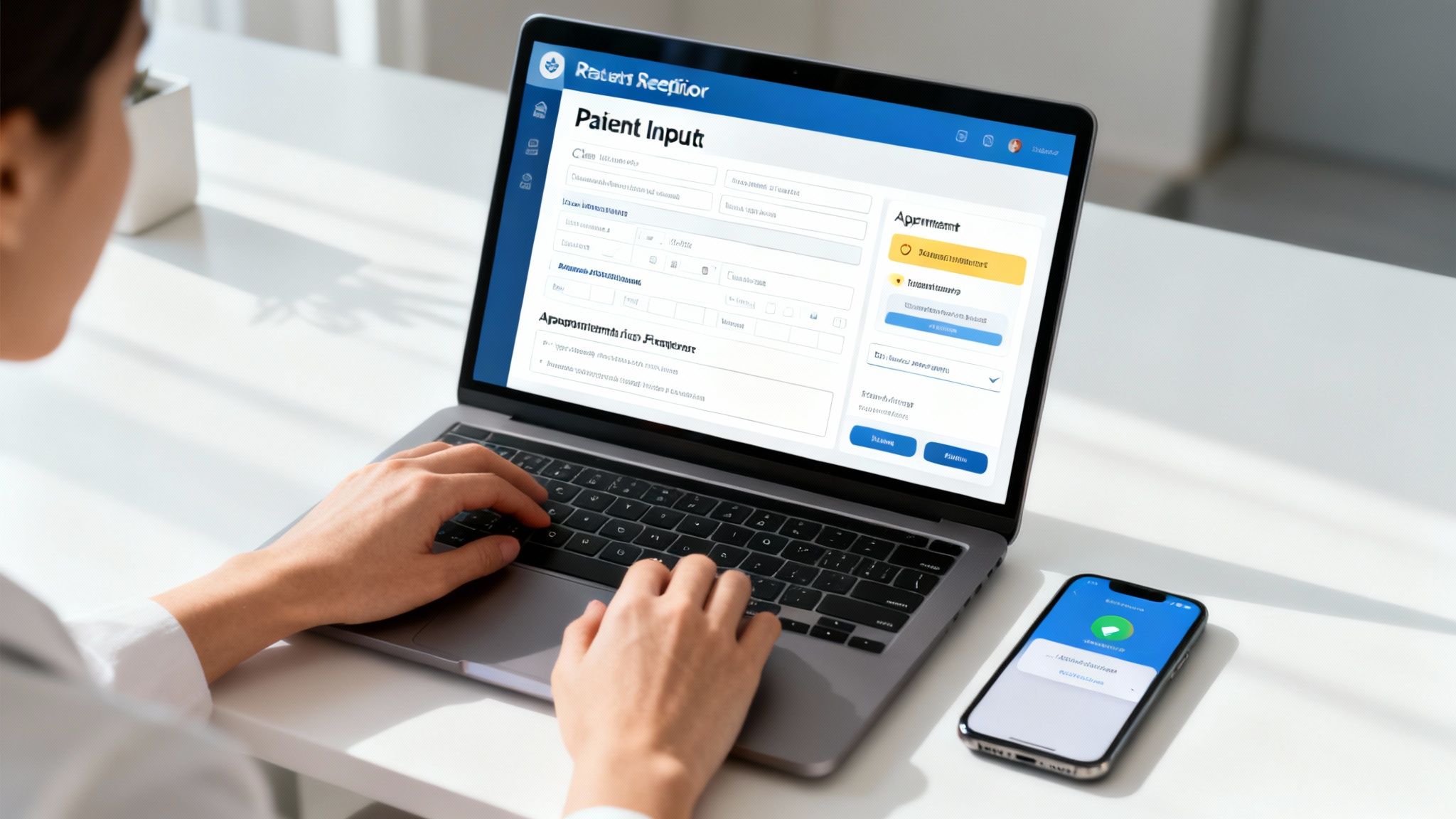
When you hear "virtual receptionist," you might just think of a remote person answering phones. But in a medical setting, the role is far more integrated and impactful. A truly specialized medical virtual receptionist is a seamless extension of your practice, handling a smart mix of administrative and clinical support tasks that make a real difference to your patients and your bottom line.
Think of them less as a simple answering service and more as a remote command center for all the critical, non-clinical interactions that shape a patient's experience with your office. Their role is proactive, not just reactive.
Their skills really fall into two main buckets: administrative workflow management and clinical support coordination. Grasping this distinction is the key to understanding just how valuable they can be in optimizing your practice's operations and improving patient outcomes.
This move toward specialized remote help isn't just a healthcare trend. The global virtual assistant market is expected to hit USD 44.25 billion by 2027. On top of that, experts predict that by 2025, a whopping 40% of virtual assistants will be highly specialized in fields like medicine. This industry-wide shift underscores the demand for focused expertise that a generalist just can't offer. You can dig into more of these virtual assistant statistics and trends to see the bigger picture.
Administrative Mastery: The Backbone of Your Practice
On the administrative side, a virtual receptionist service acts as the operational engine for your front office. They take on all those repetitive, time-sucking tasks that are absolutely vital but can easily swamp your in-house team, especially during busy periods. Their job is to make the entire administrative process feel effortless for both patients and your staff.
This support kicks in from the very first call. Instead of getting lost in a frustrating phone menu or leaving a voicemail that may or may not get a quick reply, a new patient connects with a real, live person who can walk them through everything, answering questions and building confidence from the outset.
Some key administrative duties include:
- New Patient Registration: Skillfully gathering demographic information, medical history, and insurance details, ensuring everything is accurate right from the start to prevent downstream issues.
- Insurance Verification: Proactively checking a patient's insurance eligibility before their appointment. This one step dramatically cuts down on billing mistakes, claim denials, and surprise bills for patients.
- Billing Inquiries: Fielding common questions about statements, co-pays, and balances, which frees up your dedicated billing team to focus on more complex cases and revenue cycle management.
Clinical Support: Where Empathy Meets Efficiency
Beyond the paperwork, a medical virtual receptionist offers vital clinical support that strengthens patient care coordination. They never give medical advice, of course, but they manage the communication streams that are essential for treatment continuity and making sure patients are prepared for their visits. This is where their specialized training in medical lingo and patient empathy really shines.
Think about a patient who needs to book a follow-up after a procedure. A trained virtual receptionist can access the schedule, find the right time slot, and provide clear, concise pre-appointment instructions with clarity and compassion. It’s a small touch that makes patients feel looked after and well-informed, even when they aren't speaking directly to a clinician.
A virtual receptionist bridges the gap between appointments, handling the logistical and communication tasks that ensure patients follow their care plans and feel consistently supported by your practice.
They become a reliable point of contact for routine requests, such as prescription refills or questions about lab results, stopping these calls from interrupting your clinical staff. This crucial function frees up your nurses and medical assistants to focus 100% of their attention on the patients right there in the office, improving both efficiency and the quality of in-person care.
Administrative vs. Clinical Support Tasks Handled by a Medical Virtual Receptionist
To make it even clearer, let's break down the two distinct but connected roles a medical virtual receptionist plays. The table below shows how their tasks in each category directly benefit your practice by streamlining workflows and enhancing patient care.
| Task Category | Example Tasks | Impact on Practice |
|---|---|---|
| Administrative Support | Handling new patient intake, verifying insurance details, managing billing questions, and processing payments. | Reduces staff workload, minimizes data entry errors, improves revenue cycle management, and speeds up collections. |
| Clinical Support | Sending appointment reminders, guiding pre-screening, processing prescription refill requests, and relaying messages to clinical staff. | Decreases patient no-show rates, streamlines pre-visit prep, ensures care continuity, and improves communication flow. |
By weaving these administrative and clinical support functions together, a virtual receptionist service does more than just check tasks off a list. They become an active partner in creating a more efficient, patient-focused practice, ultimately contributing to better health outcomes and a stronger bottom line.
How to Ensure HIPAA Compliance and Data Security
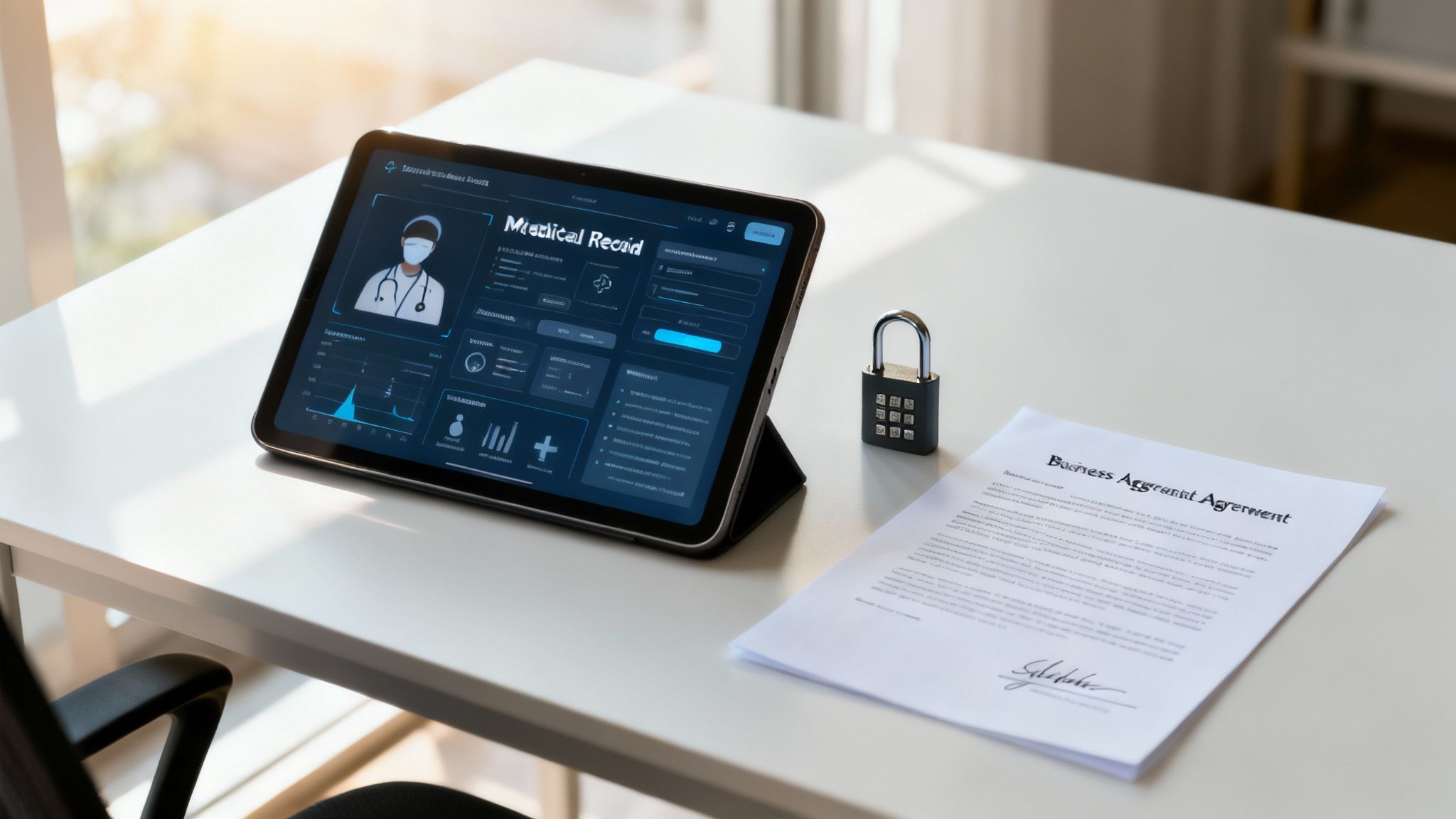
When you're looking into a virtual receptionist medical service, there's one topic that overshadows all others: security. Patient trust is the foundation of your entire practice. Protecting their information isn't just a good idea—it's your legal and ethical duty under the Health Insurance Portability and Accountability Act (HIPAA).
Any new technology deserves a close look, but when that tech will handle Protected Health Information (PHI), the scrutiny has to be intense. You need absolute confidence that every call, message, and piece of patient data is locked down tight. A single breach can lead to devastating financial penalties, legal action, and irreparable damage to your practice's reputation.
Understanding the Business Associate Agreement (BAA)
Let’s start with the absolute deal-breaker: the Business Associate Agreement (BAA). This is a legal contract that holds your virtual receptionist service to the exact same HIPAA standards you follow. It outlines their responsibilities for safeguarding PHI and makes them legally liable for any breaches that occur on their end.
Simply put, if a provider won't sign a BAA, walk away. End of conversation. This document is your proof that they are legally on the hook for protecting patient data, reporting any breaches in a timely manner, and following every single HIPAA rule. It is a non-negotiable component of any third-party relationship in healthcare.
A signed Business Associate Agreement isn't just a formality; it's the foundational requirement for a HIPAA-compliant partnership. It legally extends your practice's privacy obligations to your virtual receptionist provider, making them accountable for protecting patient data.
A refusal to sign a BAA is a massive red flag. It tells you they either don't understand the healthcare industry's legal landscape or, worse, they know they can't meet the necessary security requirements. This is the first and most important checkpoint in your vetting process.
Core Security Measures to Demand
Okay, so they’ll sign a BAA. Great. Now, let’s get technical. A truly secure virtual receptionist service should have layers of security, like a digital fortress protecting your data. Their security posture should be robust and transparent.
Here are the non-negotiable security protocols you need to see:
- End-to-End Encryption: All data—from call transcripts to a patient’s phone number—must be scrambled and unreadable both while it's moving across the internet ("in transit") and when it's stored on their servers ("at rest").
- Secure Communication Channels: They must use secure platforms for every interaction, including calls, messaging, and data transfer. This prevents anyone from snooping on sensitive conversations between their team, your patients, and your practice.
- Access Controls and Audits: Not everyone on their team needs to see patient data. Access should be restricted based on the principle of least privilege, meaning staff can only access the information absolutely necessary for their job. The provider must keep detailed logs of who accessed what and when, creating a clear paper trail for audits.
A Practical Vetting Checklist for Providers
Don't just take their word for it. Go into conversations with potential providers armed with specific questions. How they answer will tell you everything you need to know about their commitment to security and compliance. For a real-world example of how these policies look, you can review ChatWithDr's privacy policy to see how they handle patient data with transparency.
Here are the key questions you must ask:
- Do you sign a Business Associate Agreement? Start here. If they hesitate or say no, thank them for their time and move on immediately.
- How do you train your receptionists on HIPAA? You want to hear about regular, ongoing training and periodic assessments, not just a quick video they watched during hiring.
- What encryption methods do you use? Look for specifics. A good answer sounds like "AES-256 bit encryption," which is a gold standard in the industry, for both data in transit and at rest.
- How do you manage secure access to our systems? They should describe a system with unique logins, strong password rules, multi-factor authentication (MFA), and role-based permissions that limit what each user can see and do.
By demanding clear answers and solid proof, you can find a virtual receptionist medical partner that boosts your practice’s efficiency without ever putting patient privacy at risk. For an even more thorough breakdown, our detailed HIPAA compliance checklist gives you a step-by-step guide to keeping your practice and your patients secure.
Making Your Virtual Receptionist Part of the Team: EMR Integration
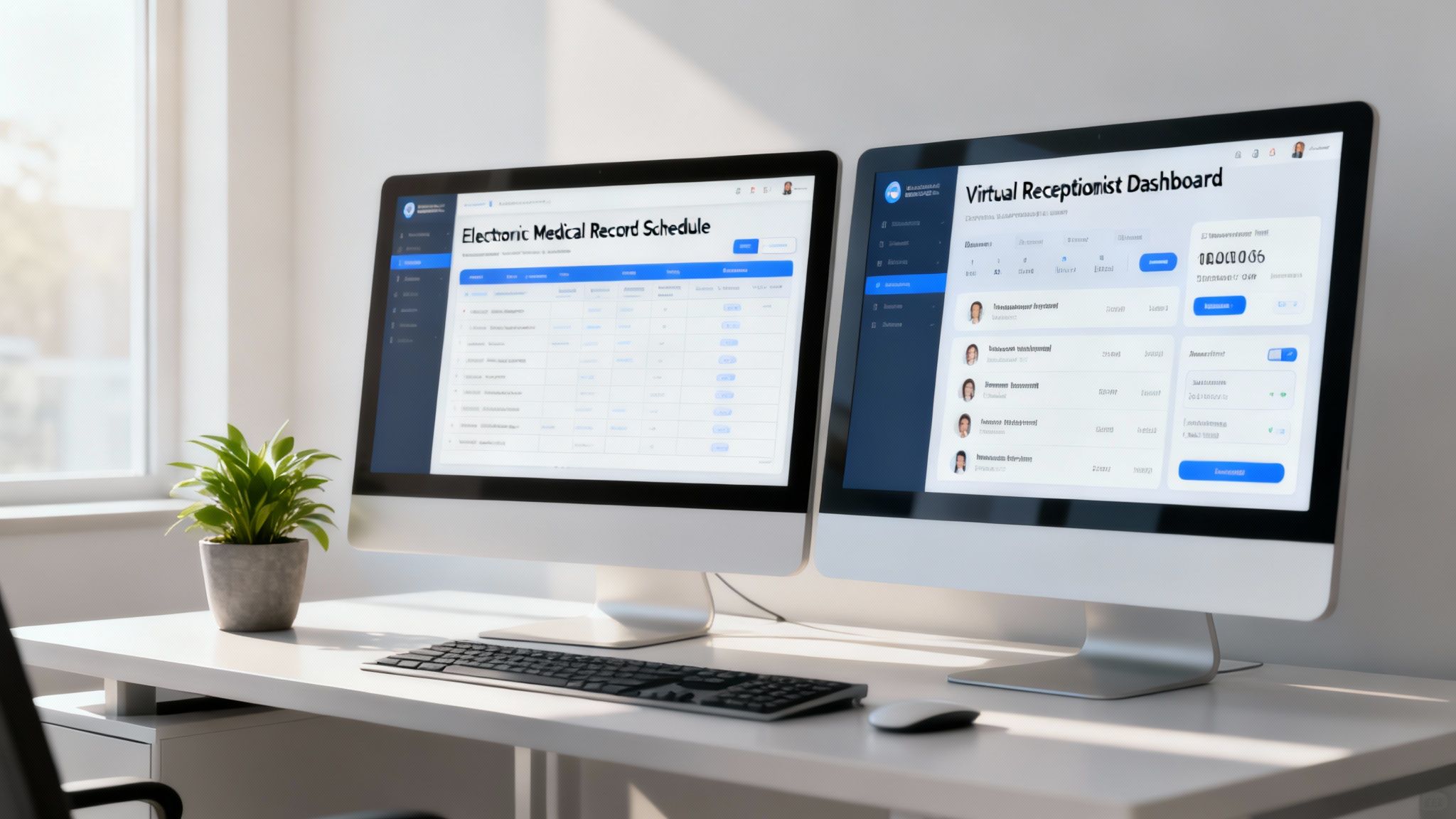
A truly effective virtual receptionist medical service isn't just an outside answering service; it functions as a natural extension of your practice. But for that to happen, the remote team needs a way to plug into your clinic’s most critical software: your Electronic Medical Records (EMR) and Practice Management System (PMS). This is the linchpin that transforms the service from a simple call-forwarding solution into a fully integrated operational asset.
The key is seamless integration. Think of it like a secure digital bridge connecting your practice's core data hub with your virtual reception team. This "bridge" allows for a controlled, safe flow of information so your remote staff can see schedules, book appointments, and update patient info right inside your system—just like they were sitting at your front desk.
Without this connection, you're just creating more work for your in-house team, who would have to manually transfer information. But with it, the service becomes a powerful, integral part of your daily operations, driving efficiency and reducing errors.
Why This Digital Bridge Matters
A deep dive into system integration shows why this is so important. When your virtual receptionist can plug into your EMR, you completely avoid the risky and clunky workaround of using separate, offline calendars or patient lists that can quickly become outdated.
Instead, your virtual team gets real-time access to the exact same information your in-house staff sees. This creates one "single source of truth" for everything patient-related, which is the bedrock of consistent operations and quality care. It eliminates confusion and ensures everyone is on the same page.
This connection isn't just a nice-to-have; it's about accuracy and patient safety. For a closer look at the technical side, our guide on EMR system integration breaks down how these connections are built to support a medical practice securely and efficiently.
You Control the Level of Access
Integration isn't an all-or-nothing deal. You have total control over how much access your virtual team gets, letting you customize the setup to fit your practice’s specific needs and comfort level. A reputable provider will work with you to establish granular permissions.
There are usually three common tiers of access:
- Read-Only Access: The most basic level. Virtual receptionists can view your calendar to see availability and provider schedules but can't make any changes themselves. They simply pass on appointment requests for your team to book manually. This is a good starting point for practices new to the concept.
- Partial Write Access: A step up. Here, receptionists can book appointments directly into open slots on your schedule, but they might not have permission to access or change detailed patient files or clinical notes. This is a popular choice for balancing efficiency with security.
- Full Integration Access: This is where you get maximum efficiency. Trained and authorized virtual receptionists can schedule appointments, update patient demographics, and handle other approved administrative tasks right inside the EMR, just as an on-site employee would. This level requires the highest degree of trust and training.
The real goal of EMR integration is to kill double data entry. When your virtual receptionist can enter appointment details and patient information directly into your system, you slash the risk of human error and give your staff back precious time.
The Big Wins of a Connected System
When your virtual receptionist service is fully integrated, the positive effects are felt across your entire practice. The service goes from being a simple call-answering tool to a genuine efficiency booster that improves the experience for both staff and patients.
Here are the biggest advantages you'll see:
- No More Busywork: Your in-house staff is freed from the tedious task of manually copying messages, appointment details, or patient information from one system to another.
- Fewer Errors: With a single point of data entry, the chances of typos, double-bookings, or incorrect patient information drop dramatically, leading to smoother appointments and cleaner billing cycles.
- A Perfectly Synced Schedule: Everyone—from your front desk to your providers to your remote receptionists—is looking at the same live, up-to-the-minute schedule, preventing conflicts and confusion.
Calculating the ROI of a Virtual Receptionist
It's easy to look at a virtual receptionist service as just another line item in your budget, but that's a mistake. Think of it as a strategic investment—one that's meant to sharpen your operations, improve patient retention, and actually grow your revenue. To really understand its value, you need to calculate the return on investment (ROI) by looking past the monthly fee to see the direct cost savings and, just as importantly, the new revenue it brings in.
A numbers-first approach gives you the hard data you need to build a solid business case. When you break down the real, tangible benefits alongside the less obvious but equally powerful ones, you'll see exactly how this service not only pays for itself but actively fuels your practice's growth and long-term sustainability.
The Tangible ROI Your Budget Will Love
Let's start with the hard numbers—the direct financial benefits you can track on a spreadsheet. This is the most straightforward part of the ROI calculation, and it all begins with the massive reduction in overhead compared to hiring a full-time, in-house receptionist.
Think about the true cost of an employee. It’s never just their salary. You’re also on the hook for benefits (health insurance, retirement), payroll taxes, paid time off, workers' compensation, and the costs of recruitment and training. A virtual receptionist medical service rolls all of that into one predictable, flat monthly fee, often at a fraction of the cost.
Here's a quick comparison:
- In-House Employee Costs: Salary, health insurance, retirement contributions, vacation pay, sick leave, training expenses, and office space/equipment.
- Virtual Receptionist Costs: A single monthly fee that covers all staffing, training, technology, and operational needs.
Moving to a service model instantly takes a huge financial and administrative weight off your shoulders, delivering clear and immediate cost savings right from the start.
Unlocking Revenue from Previously Missed Opportunities
Beyond just saving money, a virtual receptionist directly pumps up your top-line revenue by capturing calls you were probably losing. Every missed call is a missed appointment, and every missed appointment is lost income. Simple as that. With 24/7 coverage, you can be sure that every single person who calls—whether it's during a chaotic lunch hour, before the office opens, or late at night—gets a real, helpful person.
The biggest financial win from a virtual receptionist comes from turning missed calls into booked appointments. By making sure every patient inquiry is answered promptly and professionally, you're essentially plugging a major revenue leak and opening a direct path to growth.
This is especially true as telehealth and patient expectations for accessibility continue to grow. The market for healthcare virtual assistants, valued at USD 1.7 billion in 2025, is expected to skyrocket to USD 19.5 billion by 2035. You can read the full research on the healthcare virtual assistants market to see just how fast this sector is expanding. This explosive growth proves how essential scalable, affordable solutions are for handling more patients without having to hire more people, allowing your practice to grow efficiently.
The ‘Soft’ ROI: Powerful, Yet Harder to Measure
Finally, we get to the "soft" ROI. These are the benefits that are incredibly valuable but don't neatly fit into a budget line item. These intangible gains can have a massive impact on your practice's long-term health, reputation, and competitive advantage.
A big one is improved staff morale. When your in-house team isn't constantly pulled away from their work to answer a ringing phone, they can give their full attention to the patients right in front of them and focus on more complex tasks. This means less stress, less burnout, lower staff turnover, and a much more positive and productive clinic environment.
Better yet, higher patient satisfaction creates loyalty. Happy patients stick around, are more likely to comply with treatment plans, and are far more likely to recommend your practice to friends and family. A smooth, professional, and caring first impression sets the tone for their entire experience, building a stellar reputation in your community that becomes your most powerful marketing tool. Our guide on the AI medical receptionist dives deeper into how this kind of technology can take the patient experience to the next level.
Choosing the Right Virtual Receptionist Provider
With so many companies offering virtual receptionist services these days, picking the right one for your medical practice can feel a little overwhelming. The best way to approach this is to think of it less like buying software and more like hiring a new front-desk employee. You're looking for a partner who will become a seamless extension of your team, so you need to be just as thorough in your vetting process.
This decision goes far beyond just finding someone to answer the phone. The provider you choose will have a direct hand in shaping your patients' experience, your practice's day-to-day efficiency, and the security of your data. A careful, methodical approach with the right questions will ensure you find a service that truly fits your practice's specific needs and culture.
Evaluate Their Healthcare Specialization
First things first: you need a healthcare specialist, not a generalist. A company that also answers calls for plumbers and accounting firms simply won't have the nuanced understanding required for a medical environment. The language, empathy, and sense of urgency are completely different. Your partner's receptionists must be thoroughly trained in medical terminology, patient communication, and the unique challenges of a clinical setting.
When you're talking to potential providers, ask them some direct questions:
- What percentage of your clients are actually medical practices?
- How do you train your receptionists to handle healthcare-specific conversations and terminology?
- Can you walk me through how your team would handle a sensitive or urgent call from one of our patients?
- Do your receptionists receive ongoing training on privacy and patient communication?
A provider's deep specialization in healthcare is your first line of defense against misunderstandings and errors. It ensures the person representing your practice can speak with empathy and accurately grasp the context of a patient's needs.
Scrutinize HIPAA Compliance and Security
As we've covered, HIPAA compliance isn't just a nice-to-have; it's a deal-breaker. But don't just take their word for it or settle for a HIPAA logo on their website. You need to see real proof of their commitment to protecting patient health information (PHI). This starts with one simple test: ask if they will sign a Business Associate Agreement (BAA). If they hesitate, stumble over the answer, or say no, walk away.
Beyond the BAA, it's fair to ask about their security infrastructure. A trustworthy provider will be completely transparent about their protocols and should welcome your questions. They should be able to detail their encryption standards, access controls, and data storage policies. How they handle security is a direct reflection of their professionalism and tells you everything you need to know about whether they're a suitable partner for your practice.
Confirm EMR Integration and Onboarding Support
A great virtual receptionist service should make your life easier, not add another layer of complexity to your workflow. This is where seamless EMR integration is absolutely critical. The ability for their system to plug directly into your practice management software eliminates the headache of double-data entry, reduces the risk of scheduling mistakes, and ensures real-time accuracy.
Be sure to ask potential providers:
- Which EMR and practice management systems do you already integrate with? Is our system on your list?
- What does your onboarding and integration process look like, step by step? Who manages it?
- How do you train your team on our specific office protocols, scheduling rules, and workflows?
- What is the process for updating our protocols as our practice evolves?
Their answers will tell you a lot about how well they can adapt to the way you already do things. This is a huge point, especially as this technology grows. The global healthcare chatbot market, which overlaps with these services, was already valued at over USD 1 billion in 2025 and is expected to hit USD 10 billion within a decade. You can learn more by sizing up the market for AI chatbots in medical practices. A provider with proven integration experience and a robust onboarding process is simply better prepared to meet the technical demands of a modern medical office.
Common Questions About Medical Virtual Receptionists
Even after seeing all the benefits on paper, it's completely normal to have some practical "what if" questions before bringing a new service into your practice. Thinking through the day-to-day details is just smart planning. Let's tackle some of the most common questions we hear from practice managers to clear up any lingering uncertainties.
Our goal here is to give you a clear picture of how this all works in the real world, from the first day of setup to handling those critical patient calls, so you can make a fully informed decision.
How Quickly Can We Get Started?
This is usually the first thing everyone asks. Practice managers often brace themselves for a long, complicated setup process, but a good provider makes it surprisingly painless and efficient. Most of the time, you can be up and running in a matter of days, not weeks. A well-oiled provider has a streamlined process.
The process is pretty straightforward and usually breaks down like this:
- Initial Chat: You'll have a discovery call to talk about your practice's needs, typical call volume, scheduling rules, and how you like things done.
- Customizing the Playbook: You provide the scripts and instructions for how your receptionists should handle different types of calls, book appointments, and escalate anything urgent. This is where you define your practice's "voice."
- Connecting the Tech: The service will link up with your EMR or scheduling software. With most modern platforms, this is a quick and easy step often managed by their technical team.
- Training Your Team: The receptionists assigned to your account get trained on your specific protocols so they truly sound like they're part of your in-house staff from the very first call.
A well-designed onboarding process is everything. It’s what ensures the virtual team gets your practice's personality and rules from day one, making the transition seamless for your staff and, most importantly, for your patients.
How Are Urgent Patient Calls Handled?
This is, without a doubt, one of the most critical questions, and one that requires absolute clarity. You can't afford any mistakes or ambiguity here. A specialized medical virtual receptionist service will have rock-solid, pre-defined protocols for any urgent or emergency calls. You work directly with them to build a clear escalation plan that you're 100% comfortable with.
This plan is not a one-size-fits-all template; it's customized for your practice. For instance, you can set up specific on-call numbers for different issues (e.g., post-operative concerns vs. new urgent symptoms) or times of the day. When a patient calls describing symptoms that meet your urgent criteria, the receptionist immediately follows the script to connect them to the right on-call doctor or nurse via warm transfer or secure messaging. There's no guesswork involved. The entire process is designed to be completely reliable, documented, and tailored to your clinical standards.
Ready to see how a clinically-trained AI voice agent can reduce administrative overhead by up to 60% and ensure you never miss another patient call? Discover Simbie AI and learn how our intelligent, HIPAA-compliant platform can automate your front desk tasks 24/7. Visit us at https://www.simbie.ai to schedule a demo.