
Monday at 8:07 a.m. is when many refill problems become visible. The phones are already stacked, a medical assistant is toggling between voicemail and the EMR, a pharmacy is calling about a duplicate request, and a physician is opening refill tasks between patients just to keep the day from slipping. In a 10-provider GI, dermatology, or internal medicine practice, that pattern isn't a side issue. It's a real operational drag.
Prescription refill automation matters because refill work sits right at the intersection of front-desk access, clinical safety, staff burnout, and physician time. Manual workflows create phone tag, handoffs, chart review delays, and frustrated patients who often just want a routine renewal handled without friction. For independent practices, the question isn't whether refill volume is annoying. It's whether that volume is being handled in a way that protects staff capacity and keeps providers focused on decisions that require a license.
A lot of the broader discussion around automation is still too abstract or too pharmacy-centric. If you're running a community practice, what's more useful is a practical view of how this gets implemented inside your existing operation, with your staff, your protocols, and systems like Athenahealth, eClinicalWorks, gGastro, EMA ModMed, Epic, or DrChrono. Some teams looking at broader Healthcare Automation Services start there, then realize refill workflows are one of the clearest places to create immediate relief without disrupting care.
Introduction
The refill queue rarely looks dangerous from the outside. It looks routine. That's why it lingers.
Inside the practice, it's not routine at all. It's repeated identity checks, medication history review, last-visit confirmation, protocol matching, pharmacy coordination, call-backs, and EMR documentation. The average physician receives 10 to 25 refill requests daily, which adds directly to administrative overload, according to US Tech Automations. In smaller groups, that pressure doesn't disappear into a centralized operations team. It lands on the same front-office and clinical staff who are already covering phones, prior auths, intake, rooming, and patient follow-up.
What makes this especially frustrating is that a large share of refill work is predictable. The medication is known. The protocol is known. The exceptions are known too. Yet many practices still run the entire process as if every request is a surprise.
Practical rule: If a workflow is routine most of the time but still consumes licensed attention every day, it's a strong candidate for automation with oversight.
That doesn't mean handing clinical judgment to a bot and hoping for the best. It means building a controlled workflow where routine requests move faster, the chart is reviewed consistently, and anything outside protocol is escalated cleanly. Done right, refill automation isn't just a call-management project. It's a full-stack workflow redesign that starts with patient access and ends with the right person reviewing the right request at the right time.
Understanding the Automated Refill Workflow
A good refill workflow starts where the bottleneck starts, at the phone.

When a patient calls after hours, during lunch, or while staff are already tied up, the system should answer immediately, collect the reason for the call, verify identity, and capture the refill details in a structured way. Voice communication is essential. A lot of patients still prefer or require a phone call, especially older adults and patients who prefer to bypass portal steps. For practices evaluating phone-first access, these tips for using a refill service are a useful reminder that convenience only helps if the process matches how patients typically request medications.
What the automated path should look like
In a solid setup, the workflow follows a predictable sequence:
Call capture and intent recognition
The patient says they need a refill. A voice agent identifies that request without forcing the caller through a rigid menu tree.Identity verification
The system confirms the patient using the identifiers your practice allows within a HIPAA-compliant workflow.Medication capture
Drug name, dose, pharmacy, and any relevant request details are documented in structured fields.Chart lookup in the EMR
The workflow checks the medication list, refill history, visit history, and other rule-based criteria.Protocol application
If the request fits your practice's refill rules, it moves forward. If it doesn't, it routes to the right staff member.Staff review only for exceptions
Nurses, MAs, or physicians see the outliers, not every single request.Status communication
The patient gets an update instead of calling back two more times.
That last step matters more than people think. A surprising amount of refill phone volume is really status-check volume.
What actually changes operationally
The difference between manual and automated processing is not just speed. It's consistency.
According to Clarity Ventures, AI voice agents deployed for prescription refills achieve a 92% capture accuracy on the first attempt while processing requests in 2–3 minutes, directly correlating to a 65% reduction in inbound refill calls and a 70% acceleration in patient processing speed. That same source notes that traditional phone-based refill requests can carry roughly 35 minutes of latency once manual transcription and routing are involved.
The best refill automation doesn't eliminate staff involvement. It removes staff from the repeatable parts so they can focus on the patients and requests that need real judgment.
For an SMB specialty practice, tools like a voice AI agent for medical practices become more than an answering layer. The front end captures the request accurately, but its primary value comes from what happens next, when the request is checked against your workflow, your charting logic, and your routing rules.
Why voice-first matters for community practices
Portal-first refill systems can work for some patients. They don't work for all of them.
A meaningful gap remains for elderly and non-English-speaking patients who rely on phone access rather than portals or text-heavy workflows, as discussed in this peer-reviewed analysis. In independent practices, that's not a niche issue. It's often a visible part of your patient panel.
If your refill process only works for digitally confident patients, your phones will still be flooded. You'll just have created two systems instead of one.
Key Benefits Beyond Fewer Phone Calls
A refill process that stays phone-heavy usually creates trouble in two places at once. The front desk keeps fielding repeat calls, and the back office keeps sorting messages that should have been resolved before they ever reached a nurse or provider.

For a 10-provider GI or dermatology practice, the benefit is not just lower call volume. It is tighter control over how refill work enters the practice, how it is validated, and which requests deserve clinical attention. Health Catalyst reports that refill automation can reduce the share of requests routed to providers by 60%, and that staff using automation support can process up to 31 refills per hour.
That shift matters because refill volume is rarely distributed evenly. Monday mornings, post-holiday backlogs, prior authorization spillover, and maintenance medications all hit the same staff pool. A good automation workflow evens out that load by handling the routine cases consistently and surfacing the exceptions early.
It reduces avoidable handoffs
The operational risk in refill work usually comes from rework. A voicemail is transcribed. A message is re-entered. A nurse checks the chart, then sends it to a provider because one detail is missing. Hours later, someone calls the patient back for clarification.
Each touch adds delay and another chance to document the wrong drug, the wrong dose, or the wrong pharmacy.
The Agency for Healthcare Research and Quality has long treated medication reconciliation and medication management as patient safety priorities because medication discrepancies often arise during transitions and handoffs across the care process, not only at the point of prescribing. That same logic applies inside the practice. A refill workflow with fewer manual transfers gives staff fewer opportunities to create discrepancies that someone else has to clean up later.
It protects clinical time without cutting clinical oversight
Practices often underestimate how much licensed staff time gets consumed by low-complexity refill work. In specialty care, this is especially visible with stable maintenance medications, topicals, bowel prep repeats, acid suppression therapy, biologics follow-up steps, and routine renewals tied to standing protocols.
Automation does not replace review where review is needed. It narrows the review queue.
In practical terms, that means:
- Providers spend less time on predictable approvals: Routine requests that meet protocol can be prepared correctly before a clinician sees them.
- Nurses and MAs work exception queues instead of voicemail piles: Their judgment is used on recent no-shows, lab gaps, dose changes, duplicate therapies, and early refill patterns.
- Front-desk staff stop acting as message brokers: They are no longer chasing pharmacies, clarifying patient details, or relaying refill status one call at a time.
- Managers can spot workflow failures faster: Delays become visible by rule category, staff queue, or provider, instead of showing up as patient complaints.
That is the part skeptical physicians usually care about. They do not want a new tool that creates another inbox. They want fewer interruptions and a cleaner queue, while keeping control over medications that require judgment.
A healthy refill workflow sends routine requests down a standard path and sends exceptions to the right clinician with the context already attached.
It improves adherence by making follow-through more reliable
Many refill problems are not clinical. They are operational. The patient is unsure whether the request went through, the pharmacy received an incomplete order, or the practice approved the medication but never closed the loop with the patient.
Automation helps by creating consistent status updates, reminders, and closed-loop follow-up. The Centers for Disease Control and Prevention identifies medication nonadherence as a major driver of worse outcomes and avoidable cost, especially in chronic disease care. For specialty practices, that shows up in familiar ways: flares after treatment gaps, extra portal messages, urgent appointments that could have been avoided, and staff time spent tracing what happened to a prescription.
For GI and dermatology groups, refill performance becomes part of continuity of care. A patient on a long-term therapy does not experience the refill process as an administrative side issue. They experience it as whether the practice is organized, responsive, and safe.
Technical Architecture and EMR Integration
The technical side should feel boring. That's a good sign.
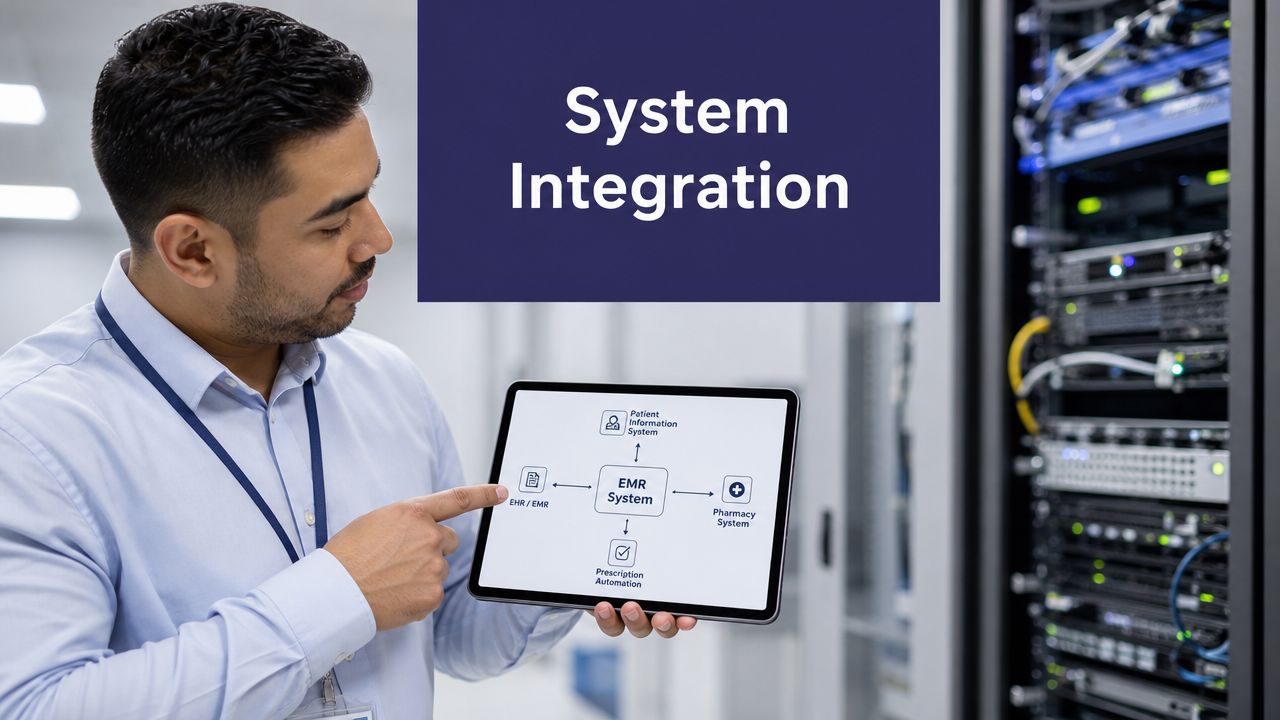
If your automation platform sits outside the chart and depends on staff re-entering data, you've built a second inbox, not a better process. Refill automation works when the system can read from and write back into the same operational environment your team already uses, whether that's eClinicalWorks, gGastro, EMA ModMed, Athenahealth, Epic, or DrChrono.
What a useful integration actually does
At minimum, the integration should support a two-way workflow:
| Function | What the practice needs |
|---|---|
| Read access | Pull medication lists, refill history, allergy context, and recent visits |
| Write-back | Document the interaction and next step directly in the chart |
| Task routing | Send exceptions to the correct queue, role, or provider |
| Status visibility | Let staff see what was handled automatically and what still needs review |
That is why EMR integration matters in practice operations. If the automation can only answer the call but can't participate in chart-based workflow, staff will still carry the administrative burden on the back end.
Security has to be designed in, not bolted on
Independent practices are right to be skeptical here. Refill calls involve protected health information, medication data, and chart activity. Any platform touching that workflow should be HIPAA-compliant and SOC 2 Type 2 certified, with clear controls around access, encryption, auditability, and staff oversight.
For clinicians and administrators, the practical question is simple: can this system operate inside the rules we already live under, without creating new risk? That's the standard. Not flashy demos.
Simbie AI is one example of an AI Medical Staff platform built for that broader workflow. It covers front-office tasks like calls, scheduling, intake, refills, and prescription renewals, and it also supports clinical workflows such as test result review, patient education, adherence check-ins, pre and post-op calls, and chronic disease management campaigns. For smaller practices, that full-stack model matters because refill work rarely lives in isolation from the rest of the patient communication burden.
The architecture should support takeover, not deny it
No matter how good the workflow is, staff need visibility and manual takeover when exceptions appear.
A GI patient with changing liver labs, a dermatology patient on a medication that requires ongoing monitoring, or an internal medicine patient with multiple comorbidities shouldn't be forced through a rigid automated lane. The right architecture routes simple work automatically and complex work visibly.
Managing Risks and Ensuring a Smooth Rollout
The biggest mistake practices make is treating refill automation like a software install. It isn't. It's a protocol project with a technology layer on top.
That distinction matters because the skepticism around AI in medication workflows is not irrational. The debate is active for a reason. As reported by ABC News on Utah's Doctronic pilot, the debate over AI's role is growing, with pilots like Utah's 'Doctronic' chatbot raising unaddressed questions about liability and whether algorithmic checks are sufficient for complex patient histories that require nuanced clinical assessment, highlighting the need for human-in-the-loop systems.
What should never be fully automated
Complexity is where practices need discipline. Some refill categories should remain tightly supervised based on your specialty, patient mix, and clinical rules.
A few examples:
- Monitoring-dependent medications: If the refill depends on labs, interval follow-up, or symptom review, the workflow should pause for clinical validation.
- Medication changes since the last visit: New contraindications, side effects, or outside prescribing activity should trigger escalation.
- High-risk histories: Multi-morbidity patients, polypharmacy cases, and unstable chronic disease patients need a human reviewer.
If your automation can't explain why a request was routed forward or held back, your team won't trust it, and they shouldn't.
A useful way to think about rollout discipline comes from outside healthcare software. Teams dealing with operational systems often talk about reducing hidden fragility before scaling. This short piece from Faberwork LLC on risk control is relevant because the same logic applies here. Don't automate around messy rules. Clean the rules up first.
A rollout path that works in smaller practices
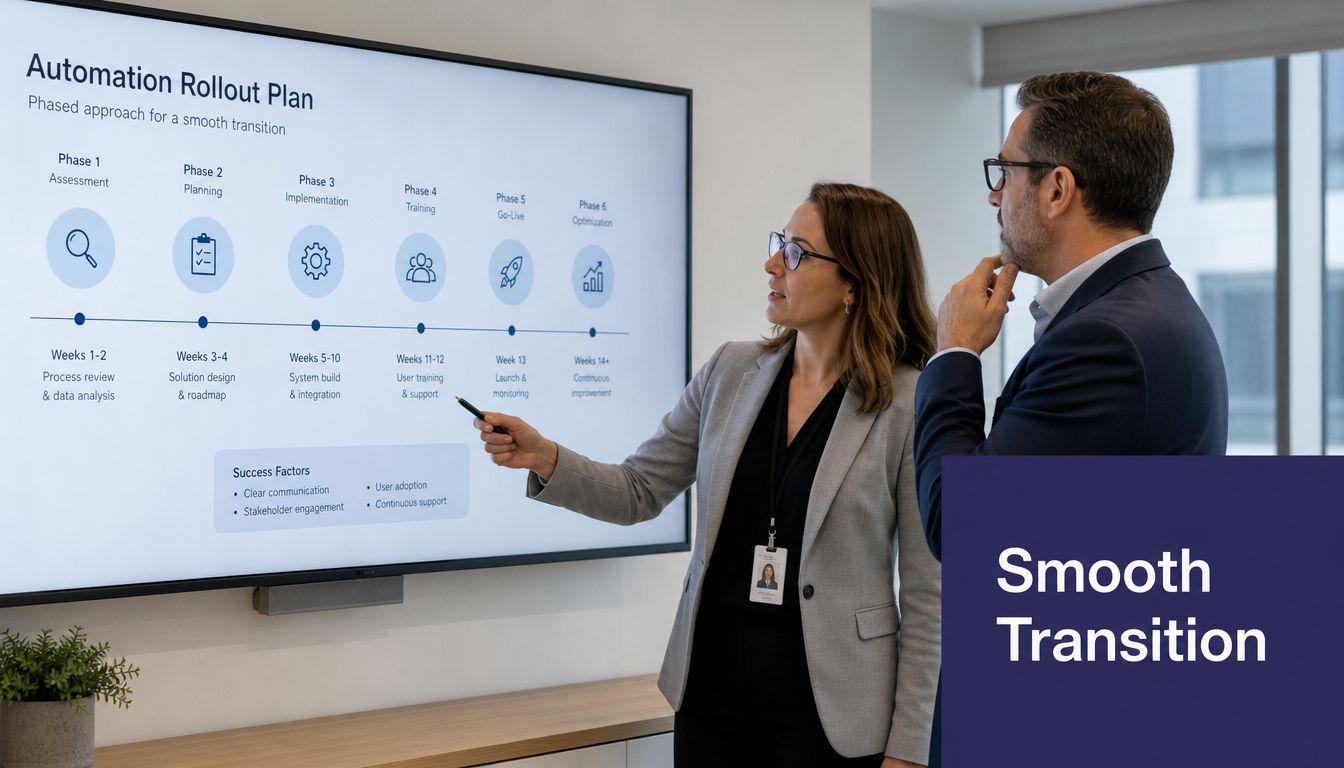
For a 2 to 75 provider group, the best approach is controlled and boring. That usually looks like this:
Document the refill policy as it really exists
Not the policy in a binder. The one your nurses and MAs follow. Include time windows, lab requirements, visit requirements, excluded medications, and escalation triggers.Pilot one lane first
Start with one provider, one medication class, or one office location. You want a narrow test where the team can inspect every step.Train supervisors, not just users
Staff need to know how to intervene, correct, route, and audit. This is especially important if you're using workflow tools connected to PHI, such as clinical workflow AI for medical practices.Tell patients what changed
Keep the script simple. Refill requests are now handled faster, by phone and after hours, with clinical review when needed. Good communication prevents confusion and repeat calls.Review exceptions weekly at first
Don't just look at what succeeded. Look at what escalated, stalled, or created staff uncertainty.
Change management is the real implementation
Most rollout problems are not technical failures. They are trust failures.
If staff think the system is a black box, they'll duplicate the work manually. If providers think every refill is still landing on them anyway, they won't support the change. If patients don't understand the new path, they'll bypass it and press zero for the front desk.
A smooth launch depends on making the rules visible, the handoffs clear, and the exceptions manageable. Human-in-the-loop isn't a marketing phrase here. It's the operational design principle that makes automation usable in real clinical practice.
Defining ROI and Choosing the Right Partner
A 10-provider GI or dermatology practice usually feels the refill problem in two places at once. The phones stay busy at the front desk, while refill work piles up in the EMR for nurses and providers to sort out later. ROI gets clearer once those two costs are measured together instead of treated as separate headaches.
Start with baseline numbers your practice already controls. Count monthly refill request volume, refill-related call volume, average staff touch time per request, provider review volume, and the number of requests that stall because key information is missing. Then price the current process using actual labor cost by role. Front-desk staff, MA or RN review, provider sign-off, and rework all belong in the model.
Keep the math simple. If the new system only reduces call handling and manual routing, that still has value. If it also shortens turnaround time, cuts repeat calls, improves protocol adherence, and keeps routine renewals out of the provider inbox, the financial case gets stronger. For smaller independent groups, refill automation usually works best as part of a broader AI strategy for independent medical practice growth, because the same communication bottlenecks often affect scheduling, intake, follow-up, and results calls.
The KPIs that actually matter
Many practices track activity because it is easy to pull. Flow metrics are more useful.
- Average refill turnaround time: Measure request to resolution, not just time to first staff touch.
- Percent completed within protocol: This shows whether your rules are clear enough to support consistent execution.
- Provider review volume: Break out true clinical exceptions from routine approvals.
- Refill-related call volume per day: This shows whether the phone burden is dropping.
- Exception categories: Missing labs, overdue visits, controlled substances, duplicate requests, prior auth confusion, and pharmacy mismatch should all be visible.
- Rework rate: Count requests that bounce between staff, pharmacy, and provider before closure.
For GI and dermatology groups, this breakdown matters. Biologics, maintenance meds, topical therapies, and short-course prescriptions do not behave the same way, and one average can hide a bad workflow.
A practical vendor checklist
The right partner for an SMB practice fits the way the practice already operates, then improves it without adding new clerical work.
| Question | Why it matters |
|---|---|
| Does the platform integrate with your EMR and write back cleanly to the chart or task queue? | If staff have to re-enter requests, the labor savings disappear |
| Can you configure refill rules by medication type, provider, and visit or lab status? | SMB practices need protocol control, not a generic call bot |
| Can nurses, MAs, and supervisors see exceptions and intervene quickly? | Refill automation fails when staff cannot inspect or correct the workflow |
| Does the system document what happened at each step? | Auditability matters for compliance, training, and dispute resolution |
| Can it handle after-hours patient requests without creating a morning backlog? | Access problems often start before the clinical review step |
| Does the vendor understand specialty workflow, not just call containment? | Refill logic in GI or derm often depends on follow-up intervals, diagnostics, and medication-specific rules |
| Are HIPAA controls, user permissions, and security reviews clearly documented? | Refill workflows involve PHI every day |
Often, buying processes go off track at this critical point. A polished demo can make intake sound easy, but the hard part is the handoff from patient request to chart review to approval or escalation. Ask the vendor to show the exact path for a common refill, an overdue follow-up case, and a request that should be denied and routed back with patient instructions. If they cannot show those paths clearly, implementation will be harder than promised.
Clinician-built products tend to perform better here because they account for real review logic. A refill request is rarely just a message. It may depend on last visit date, medication class, recent labs, prior instructions, or whether the patient is due for follow-up. A vendor that understands those dependencies is more likely to reduce inbox noise instead of relocating it.
The best partner helps the front office capture the request correctly, routes it into the EMR without added clerical work, applies the right protocol, and sends only the right cases to licensed staff. That is what produces ROI in a smaller practice. Fewer phone calls help, but cleaner clinical workflow is what makes the savings hold.
If you're evaluating an AI Medical Staff platform for refill workflows, scheduling, intake, and clinical follow-up, Simbie AI is one option to review. You can see it in action at simbie.ai/book-a-demo.