

Hypertension education fails in a lot of practices. Not because clinicians don't care, but because patient education for hypertension is often treated like a handout instead of a workflow. The scale of the gap makes that mistake expensive, since the World Health Organization estimated that 1.4 billion adults aged 30 to 79 had hypertension in 2024, and 600 million of them were unaware they had it, while only 320 million had it controlled. In the United States, the CDC reported that 48.1% of adults, about 119.9 million people, had high blood pressure in 2024, and only 22.5% had it under control. For independent practices, that means education isn't a soft skill on the side. It's part of access, adherence, and outcomes.
Practices that handle this well stop asking whether patients “understand hypertension” in the abstract. They build a repeatable teaching process around what patients need to do at home, what staff should reinforce between visits, and what gets documented so nothing falls through the cracks. That's the operational lens here. Not theory. Not a pamphlet.
Why Patient Education Is the Bottleneck in Hypertension Control
The global numbers show a problem that clinics feel every day. If 44% of adults with hypertension were unaware they had it, and another 44% were diagnosed and treated but not controlled, then diagnosis alone clearly isn't enough, and medication alone isn't enough either. Education sits in the middle of that gap because patients can't follow a plan they don't understand, and they won't keep doing a plan that hasn't been made concrete.
For independent practice owners and administrators, that turns hypertension into an operations issue. You can't solve pharmacology at the front desk, but you can solve whether patients know their category, know how to measure correctly, know when to call, and know why the plan matters enough to keep going. That's where the drop-off usually happens.
The numbers also show why this isn't just a low-resource problem. The WHO notes that two-thirds of adults with hypertension live in low- and middle-income countries WHO hypertension fact sheet, while the U.S. still has low control rates despite broad access to care. So the education model has to work in very different settings, with different literacy levels, different language needs, and different follow-up realities.
Practical rule: if the patient leaves with a diagnosis but no way to self-check, self-report, and self-correct, the visit was incomplete.
The right way to think about patient education for hypertension is simple. Teach the patient what the numbers mean, teach the skill of home monitoring, teach medication follow-through, and keep reinforcing all of it after the visit ends. A practice that does those four things reliably is doing real hypertension care, not just giving advice.
The Five Topics Every Hypertension Education Program Must Cover
A busy practice does not need fifty talking points. It needs five. Anything more scatters the message, and anything less usually leaves out the parts patients will use after they leave.
Start with what hypertension means
Patients need a plain explanation that high blood pressure can damage the body over time even when they feel fine. That framing matters because it makes the condition real without turning the visit into fear-based counseling. A patient who sees hypertension as “numbers only” is much harder to engage than one who understands why control matters.
Teach the blood pressure categories in plain language
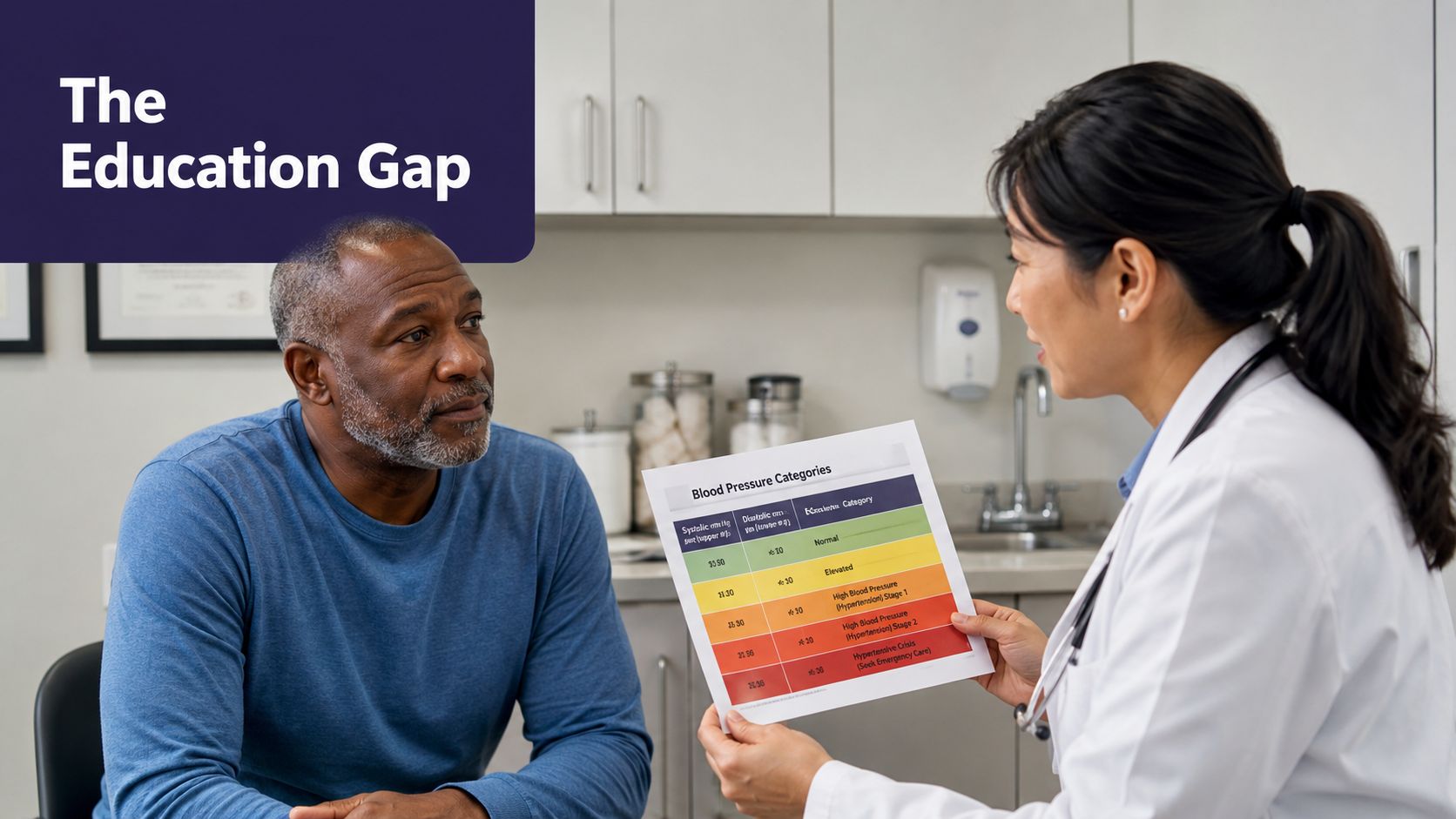
Patients do better when staff translate the categories into “what bucket am I in today, and what does that mean for me?” rather than reciting them like lab values. Keep the language simple, keep the explanation consistent, and tie it back to the care plan the patient is expected to follow.
Explain medication purpose and adherence
Patients should leave knowing that the medicine is being used to lower risk and control pressure, not to punish them or label them as “sick forever.” The clearest line is often the simplest one. Take the medication exactly as prescribed, and don't stop it just because you feel better.
That message also has to account for real life. Some patients miss doses because of cost, side effects, confusion about refills, or a belief that one missed day does not matter. If staff never ask about those barriers, adherence problems stay hidden until the blood pressure is back up.
Make home monitoring a skill, not a tip
A structured model recommends 5 to 6 education sessions lasting 30 to 45 minutes over 1 to 4 months with follow-up between visits structured education model. That tells you this is a multi-visit process. One lecture and a handout will not carry the load.
The teaching script should also make room for practical reinforcement after the visit ends. That can mean a nurse call, a portal message, or a short AI-assisted reminder tied to the same instructions the clinic gave in person. If the follow-up message says something different, patients notice.
Give the emergency threshold a place in the script
Patients should know that if blood pressure is higher than 180 and/or 120 mm Hg with symptoms such as chest pain, shortness of breath, back pain, numbness, weakness, vision changes, or difficulty speaking, they should call 911. This belongs in the main script as a safety rule, not as an afterthought.
If your team wants a starting point, keep the teaching checklist short and reuse it at every visit. The internal resource at patient education resources can sit beside your workflow notes, but consistency is the key win. The patient should always hear the same five ideas, in the same order, from the same clinical logic.
Teaching Home Blood Pressure Monitoring With Teach-Back
Home monitoring is where a lot of education falls apart. Staff say “check it at home,” the patient nods, and then the readings come back noisy, incomplete, or impossible to interpret. Technique matters because inaccurate readings can lead to unnecessary escalation or, worse, a missed worsening trend.
Teach the technique step by step
A home blood pressure cuff works only if the patient knows how to use it the same way each time. The patient should sit with back supported, feet flat, and arm at heart level, avoid caffeine, exercise, and smoking before measuring, and take a reading at the same time each day AHA home monitoring guidance. The Nevada toolkit adds the details clinics often skip. The patient should rest for 5 minutes, avoid smoking, alcohol, or caffeine immediately before measurement, keep the cuff on a bare arm, and use the proper cuff size Nevada blood pressure toolkit.
Practical rule: if the cuff doesn't fit right, the number doesn't mean much.
That sentence saves time in real clinics because it keeps staff from treating every home reading as equally trustworthy.
Use teach-back the way staff can actually say it
Medical assistants do not need a lecture. They need a script they can repeat without sounding stiff. A good version sounds like this.
“Show me how you would take this at home tomorrow morning.”
Then listen for the details. A correct answer includes resting first, no caffeine or smoking right before, sitting with the back supported and feet flat, keeping the cuff on a bare upper arm at heart level, and using the right cuff size. If the reading is high, staff should ask the patient to wait at least 1 minute and take it again before deciding what to do next.
The emergency trigger should be part of the same script, not a separate handout no one reads. If the patient reports higher than 180 and/or 120 mm Hg with chest pain, shortness of breath, back pain, numbness, weakness, vision changes, or difficulty speaking, staff should tell them to call 911. That turns a vague warning into a decision rule.
The proactive patient outreach after diagnosis model fits here because the first few weeks after diagnosis are when technique errors, anxiety, and confusion show up. A short reinforcement call or message keeps the instructions alive after the visit, which is where most home-monitoring teaching usually fails.
Medication Adherence When Real Life Gets in the Way
“Just take your pills” is weak education. It ignores the things that interrupt adherence, like cost, side effects, work schedules, and patients deciding to stop medication once they feel okay. That's especially true in underserved communities, where barriers aren't theoretical. Research in underserved African American older adults found issues such as lack of money, lack of motivation to exercise, and fear of injury from exercise, while family support and an unexpected diagnosis could help people stick with care underserved adherence research.
Use the affordability conversation first
The affordability conversation should be direct, not embarrassed. Staff can say, “If the medicine is hard to afford, tell us before you stop it.” That's the right tone because many patients stop without mentioning it and only disclose it later when the refill gap is already hurting control. The point is to surface the barrier early enough for the clinician or staff team to route the issue.
Treat side effects as a follow-up question, not a failure
Patients also need permission to report side effects without being told they're noncompliant. A good teach-back prompt is, “What would you do if this medicine made you dizzy, tired, or gave you swelling?” The correct answer is not to quit on their own. It's to call the practice before changing the plan.
The adherence message lands better when patients understand what the numbers mean for them. If their readings are still in stage 2, they can connect the inconvenience of a pill to a real risk of staying uncontrolled. That's a much stronger motivator than “because the doctor said so.”
A meta-analysis found that health education improved medication adherence by 33% overall, with a risk ratio of 1.33 and 95% CI 1.08 to 1.64 meta-analysis on education and adherence. That's not a reason to overpromise. It's a reason to stop treating adherence education as optional.
The medication adherence resource is useful if your team wants a workflow lens, but the clinical message stays the same. Ask about cost. Ask about side effects. Ask what gets in the way. Then document the answer and follow up.
Weaving Education Into the Practice Workflow
Good hypertension education doesn't depend on one champion. It depends on a rhythm the whole practice can keep. In a typical 90-day arc, the visit starts the teaching, a follow-up call reinforces it, refill touchpoints keep the plan from drifting, and the next visit checks whether the patient can repeat the key steps.
The first teach happens at diagnosis or medication start. That's when the clinician or MA covers the category, the home monitoring setup, and the medication plan. The next touch can be a two-week reinforcement call focused on what the patient is doing at home, not what they intended to do. Around 30 days, refill status becomes a practical check on adherence and access. At the 3-month follow-up, teach-back should happen again, because repetition is part of the intervention.
Put the work where the workflow already lives
Documentation belongs in the EMR, not in a separate notebook that no one opens. That matters for practices using eClinicalWorks, Athenahealth, EMA ModMed, Epic, DrChrono, or gGastro, because the note should be visible to the next person who touches the chart. If the workflow includes chronic care management documentation, the education touchpoints should land there too.
The key strategies for patient satisfaction piece from Recepta.ai is worth a look for teams thinking about access and follow-up, because patients notice when the practice calls back, explains clearly, and closes the loop. That's not a marketing detail. It's part of whether education sticks.
AI medical staff can do useful work without replacing clinical judgment. A system like Simbie AI can handle repetitive reinforcement calls, intake, refills, and post-visit education recaps, while staff keep oversight on exceptions and clinician questions. It also fits practices trying to capture every inbound call, keep zero hold time, and avoid the usual handoff gaps between front office and clinical follow-up.
The point isn't automation for its own sake. It's keeping the education thread intact after the patient leaves the room.
Adapting Education for Literacy and Culture
Adaptation works best when it's built into the teaching method, not added afterward as a translation task. Many patients don't need more information. They need simpler language, better confirmation of understanding, and a way to absorb the message in their own context.
Use plain language and teach-back together
A 5th to 6th grade reading level is a practical target for patient materials, but the primary safeguard is teach-back. If the patient can explain the plan in their own words, you've learned more than a yes-or-no answer could tell you. That's especially important in hypertension, where patients may nod through a visit and still leave unsure how to measure, when to take meds, or when to call.
Use demonstrations when words are not enough
A handout can be replaced with a 60-second video script or a short in-clinic demonstration. For example, a MA can show the cuff placement, then ask the patient to repeat the setup with the same cuff before they leave. That's faster than re-explaining the basics at the next visit, and it's more durable than a pamphlet.
The underserved clinic evidence points in the same direction. Brief teach-back was described as feasible and low-cost in a student-led clinic serving a medically underserved Hispanic population, and interactive education that included video, in-person engagement, feedback, and coaching outperformed handing out materials alone, with one study reporting a 13.2 mm Hg BP reduction in the intensive-intervention arm versus 2 mm Hg with materials only interactive education review.
That doesn't mean every practice needs a complex program. It means the patient needs interaction, not just information. If family members help with meds or transport, involve them when appropriate. If the patient is more comfortable in another language, use that language for the teach-back and the written reminder. Same program. Better delivery.
Measuring Whether Education Is Working
If you don't measure hypertension education, it turns into a well-meaning habit that gets dropped the next time staff gets busy. The better approach is to track three layers: knowledge, behavior, and outcome. Each one tells you something different, and together they show whether the program is changing care.
Track what the patient knows
A simple 5-question teach-back score at each visit is enough to show whether the key messages are landing. The questions don't need to be complicated. They should cover the category, the home measurement steps, the medication plan, what to do if a reading is high, and when to call for urgent symptoms. If patients miss the same question repeatedly, that topic needs reteaching.
Track what the patient does
Behavior is the second layer. Look at home log completeness and refill adherence on a monthly cadence, because those are the first signs that education is drifting. If logs are blank or refills are late, the teaching may have been clear in the room but ineffective in real life.
Track what the panel is doing
Outcome belongs at the panel level. Quarterly, review the proportion of diagnosed patients with controlled BP and compare that with your own earlier performance. The point isn't to chase a perfect number. It's to see whether the program is moving control in the right direction.
Operational rule: if knowledge is low, reteach the content. If behavior is low, fix the barrier. If outcome is low across a cohort, change the workflow.
Common EMRs can usually support this with a mix of structured fields, reminders, and registry views. If the practice is already documenting chronic care management, the education data should ride along there so staff aren't entering the same story twice. That makes the work easier to sustain and easier to audit.
AI medical staff can also take the routine measurement touchpoints off the team's plate. Refill checks, log reminders, and post-visit reinforcement calls are exactly the kind of repetitive work that can be standardized while clinicians focus on the outliers. That's how the program stays alive after the first month.
If your practice is trying to make hypertension education more consistent without adding more front-desk strain, Simbie AI can handle reinforcement calls, intake, refills, and follow-up documentation while your team keeps clinical control. It's a practical way to keep education from collapsing between visits. You can see how it works at Simbie AI.