
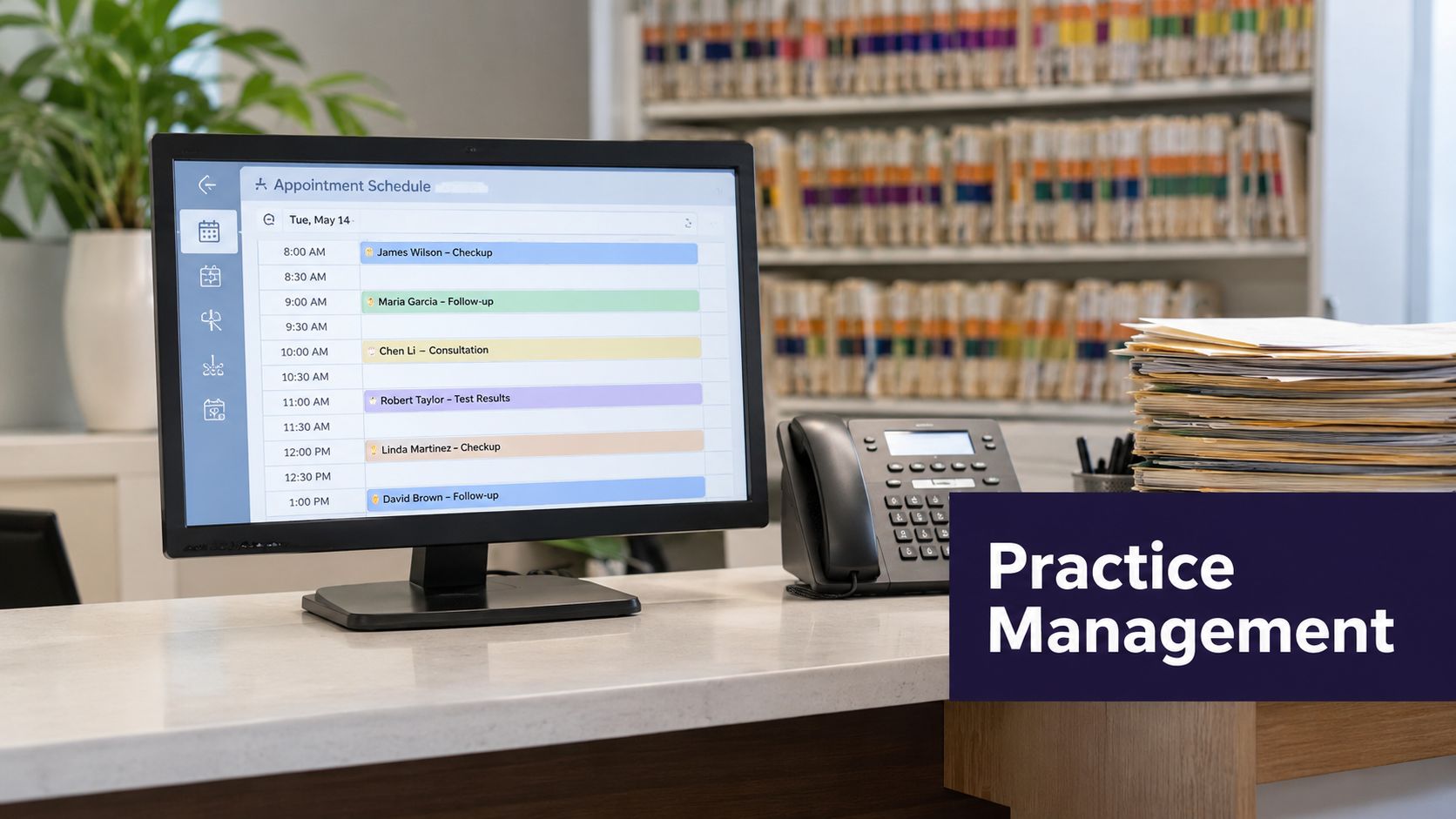
Phones ring before the first patient is roomed. A refill request is waiting, a cancellation just opened a slot, and the physician expects a clean schedule in five minutes. That's medical practice management in real life, not a policy binder. For independent clinics, especially dermatology, gastroenterology, and internal medicine, the job is no longer just keeping the front desk busy. It's managing the whole access system, from first call to final claim, so patients get seen and the day doesn't fall apart.
Meta description: Medical practice management helps clinics protect access, reduce admin burden, and keep schedules full with smarter front-door workflows.
What Medical Practice Management Actually Covers
A small clinic can look orderly from the waiting room and still be one phone call away from chaos. A patient calls back about a refill, another wants to move a visit, the lab line is lighting up, and the person at the front desk is trying to answer while checking insurance and room status. That's why medical practice management can't be reduced to billing or check-in. It's the operating system of the practice.
The work goes far beyond the front desk
The field formally includes scheduling, clinic flow, chart organization, office staff management, operating costs, patient billing, revenue flow, advertising, and public communication. STFM goes even further and notes that the term has been redefined in medical education as Health Systems Management STFM practice management handbook. That broader definition matches what practice owners feel every day. If scheduling is broken, billing gets hit. If staffing is thin, patient communication slips. If documentation is delayed, the charting burden lands on the clinician.
Practical rule: If a workflow affects access, revenue, or documentation, it belongs in practice management, even if someone calls it “just admin.”
That's also why operational reliability matters so much. A clinic can't treat phone calls, intake, and follow-up as separate chores when they all shape whether the day runs on time. For practices that want a cleaner workflow foundation, the feature set on Simbie AI's practice management software page is a useful way to think about how these tasks fit together.
HIPAA compliance sits inside operations, not beside them
Practice management also overlaps with technology choices. If the systems that handle patient data aren't secure, the whole operation carries risk. A practical starting point for many offices is to review HIPAA-compliant IT for medical offices alongside scheduling and communication workflows, because security and workflow design are tied together. The point isn't to add more tools. It's to make sure the tools support the way the clinic works.
In independent practice, that distinction matters. A polished front desk with weak internal flow still loses time, loses calls, and frustrates patients. Good practice management makes the invisible parts of the day visible, then keeps them moving.
The KPIs and Benchmarks That Define Modern Operations
A practice manager used to be judged by whether the phones got answered and the bills went out. That view is too narrow now. Modern operations are measured by throughput, access, staffing stability, and revenue-cycle discipline, and the benchmarks are broad enough to show where the bottleneck sits.
MGMA's 2023 operations guidance recommends that practice leaders monitor physician and APP productivity, panel size, staffing ratios, patient portal use, wait times, same-day appointments, third-next-available appointments, no-show rates, cancellation rates, turnover, and phone metrics such as volume, length, and abandonment rate MGMA foundational benchmarks and KPIs. That list says a lot. Practice management is no longer a clerical layer. It is a measured system.
The benchmark set maps to the whole patient journey
These KPIs do not sit in one department. They track the patient from the first call to the final balance, which is how the day unfolds in a small clinic. If calls are abandoned, access breaks. If cancellations are not backfilled, schedule utilization slips. If turnover is high, the front desk cannot keep up. If portal use is weak, routine communication moves back onto the phone.
For practices that want a simple way to view provider productivity in context, a physician RVU tool can connect daily work to output without turning the clinic into a spreadsheet factory. It does not tell the whole story, but it does keep productivity, access, and staffing tied together.
Market growth reflects how central operations have become
The software market around these workflows is large and still expanding. Fortune Business Insights reported that the global practice management system market was valued at USD 12.7 billion in 2025, is projected to reach USD 13.76 billion in 2026, and is forecast to grow to USD 29.11 billion by 2034, implying a 9.82% CAGR over the forecast period. It also said North America held 54.83% of global market share in 2025 Fortune Business Insights. That scale aligns with what most administrators already know: operations software is now core infrastructure.
For teams that want a more granular view of practice performance, medical practice metrics give a cleaner way to connect access, staffing, and revenue-cycle pressure to the day-to-day work happening at the front desk and behind the scenes.
| KPI Category | Specific Metrics | What It Reveals |
|---|---|---|
| Provider output | Physician and APP productivity, panel size | Whether clinician time is being used efficiently |
| Access | Wait times, same-day appointments, third-next-available appointments | How quickly patients can get in |
| Scheduling quality | No-show rates, cancellation rates, portal use | How well the schedule holds up in real life |
| Staffing | Staffing ratios, turnover | Whether the team can sustain demand |
| Phone performance | Volume, length, abandonment rate | Whether the front door is actually open |
Front-Door Access as Your Biggest Operational Bottleneck
A clinic can have a full schedule on paper and still lose patients at the front door. A call goes unanswered, a referral sits in limbo, a waitlist never gets touched, and the open slot that should have gone to care turns into dead time. That is why the digital front door in healthcare matters. It is not a buzzword. It is the intake-to-booking funnel that decides whether patient demand turns into usable capacity.
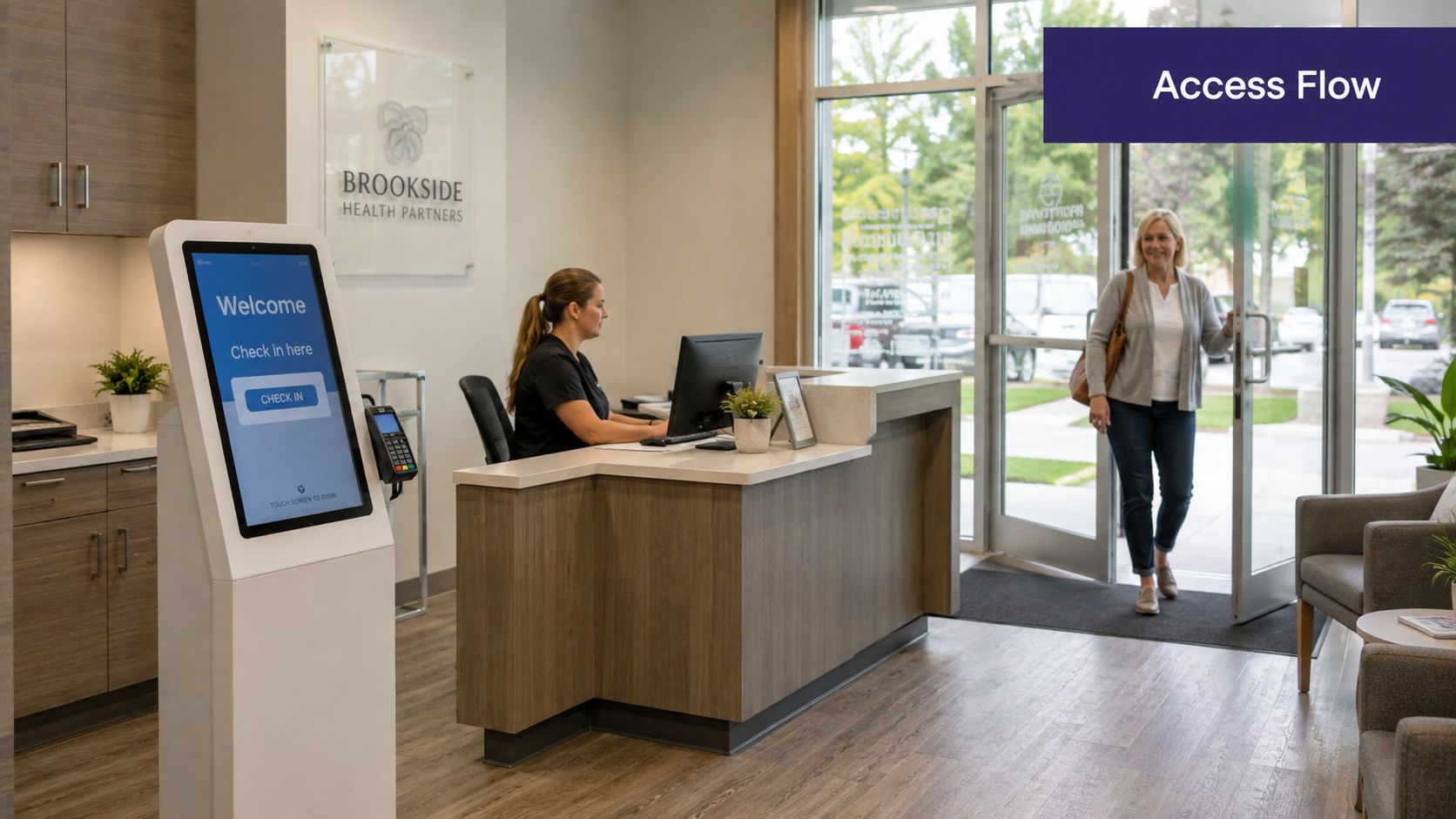
Access problems usually travel together
Front-door problems rarely show up one at a time. Missed calls, after-hours requests, outdated contact details, faxed referrals, and waitlist backfilling often come from the same weak access process. SVMIC's practice management guidance points to earlier confirmations, automated waitlists, telemedicine conversion for cancellations, and predictive analytics to improve slot use SVMIC practice management guidance. That matters because a practice that fixes only one weak spot usually finds the others still draining the day.
The patients most affected are usually the ones who have the least room for error. Limited English proficiency, transportation barriers, homelessness, and low insurance coverage make every extra callback, fax delay, or scheduling mistake harder to absorb. The bottleneck is not just the schedule template. It is the whole intake-to-booking funnel.
Better scheduling helps, but only if the practice can receive the request in the first place.
Operational access needs a system, not a workaround
Better utilization comes from disciplined follow-up across the entire path. Earlier confirmations reduce uncertainty. Waitlists help fill late cancellations. Outbound outreach can bring back demand that would otherwise disappear. Predictive scheduling logic can help the front desk match appointment types to slot length instead of guessing under pressure.
The practical point is simple. Front-door access is a continuous system, not a task that gets done when the phones are slow. It determines who gets seen, when they get seen, and whether the clinic can keep the schedule full without burning out the staff.
Staffing Shortages and the Hidden Cost of Turnover
Staffing problems don't stay in HR. They show up in the waiting room, on the phone, and in the schedule template. MGMA's 2023 Practice Operations report found front-office staff turnover reached 40 percent in 2022, while clinical support and business-operations support staff turnover was 33 percent. It also reported that primary care practices cut weekend availability by eight hours versus 2019 levels MGMA Practice Operations report.
Turnover changes what the clinic can promise
When front-office staff churn, the effect is bigger than training time. Calls get answered differently. Intake becomes inconsistent. Patients get asked to repeat information. The schedule loses discipline because the people who manage it are still learning the system, or leaving before they finish. In a small practice, that fragility can become structural fast.
The decline in independent ownership makes this more than a staffing complaint. The AMA's 2024 Physician Practice Characteristics report found that 42.2 percent of physicians were in private practice, defined as wholly physician-owned, which is an 18 percentage point drop from 2012 AMA Physician Practice Characteristics report. That means operational discipline matters even more. Smaller practices can't afford to absorb waste the way a larger system sometimes can.
Stability matters more than heroics
A clinic doesn't need a heroic staff member who carries five jobs for six months and burns out. It needs a workflow that holds when people are absent, new, or overloaded. That's where automation earns its place, not by replacing people, but by taking the repetitive phone and scheduling load off the team that remains.
Practical rule: If a task has to be done the same way a hundred times a week, it should not depend on one exhausted employee remembering every step.
That's the hidden cost of turnover. You lose speed, consistency, and access at the same time. The practices that survive it are the ones that design for continuity instead of hoping the team stays fully staffed.
How AI Automation Handles Administrative and Clinical Workflows
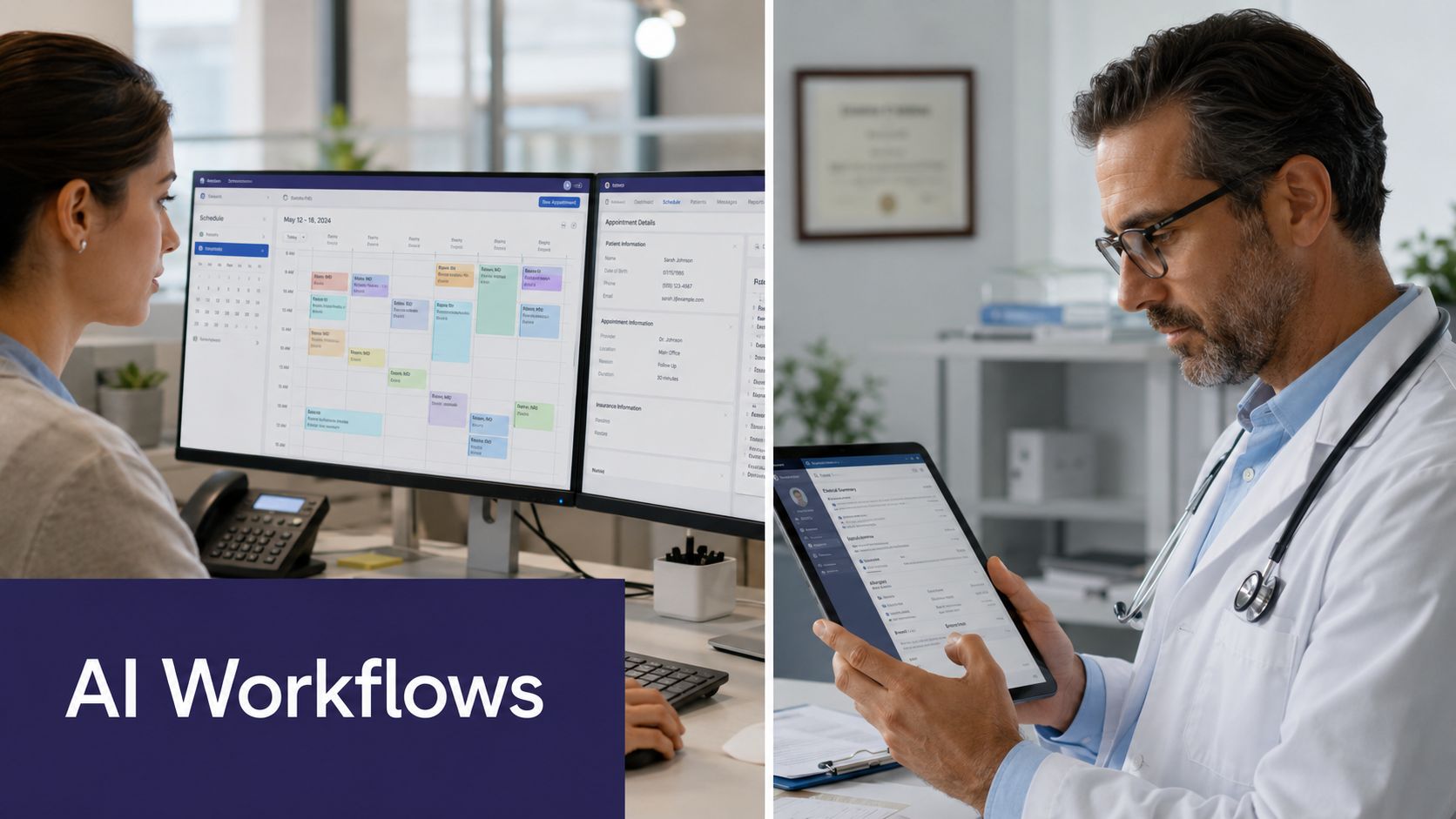
AI in a medical practice makes sense only if it fits the work the practice already does. That means two layers. The first is administrative, phone handling, scheduling, intake, refills, and prescription renewals. The second is clinical support, things like test result review, patient education, adherence check-ins, pre-op and post-op calls, and chronic disease management campaigns. If a tool only covers one layer, it leaves the other one sitting on the staff.
The practical workflow looks like this
A clinically trained voice agent can answer inbound calls at any hour, handle multiple callers at once, and route requests without creating hold-time pressure. It can collect pre-visit information, manage new and established patient scheduling, and queue medication refill requests for review. In specialty clinics, that matters because visit type and duration have to match the actual clinical need, not just a generic slot.
Simbie AI is one example of this approach. It functions as AI Medical Staff, not just an answering layer, with workflows for phone handling, intake, scheduling, refills, chart documentation, and patient follow-up across EMRs such as eClinicalWorks, gGastro, EMA ModMed, Athenahealth, Epic, and DrChrono.
Documentation and charting need to stay inside the record
The strongest systems don't leave the interaction in a separate inbox. They translate the phone call or questionnaire directly into the chart, which reduces transcription drift and makes the record more usable later. That's especially helpful for practices where clinical staff are already doing medication reconciliation, pre-visit tasks, and patient education by hand.
The value here is not mystery automation. It's consistency. Human-in-the-loop controls let staff monitor the workflow and take over when the case is complex, the patient is upset, or the request needs a judgment call. That keeps the practice in charge.
Comparing Traditional Staffing Against AI-Augmented Operations
Traditional staffing works well when call volume is predictable, the team is fully present, and every request comes in during business hours. That's not most independent practices. AI-augmented operations are strongest where the schedule is noisy, the phone doesn't stop, and the clinic needs coverage without adding more headcount.
The trade-offs are real
A front desk team brings judgment, warmth, and familiarity with the patient population. It also has limits. People can only answer one call at a time, they need breaks, and they can't reliably cover the practice after hours without stretching thin. AI-augmented coverage can answer continuously, capture calls around the clock, and reduce hold time pressure. The human team still matters, but it's no longer carrying every repetitive request.
Practical rule: Use staff for exceptions and relationship work. Use automation for repeatable intake, call capture, and scheduling logic.
| Criteria | Traditional Staffing | AI-Augmented Operations |
|---|---|---|
| Coverage hours | Limited by shifts and availability | 24/7 availability |
| Call handling | One call at a time | Simultaneous handling with zero hold times |
| Consistency | Depends on staff training and fatigue | Standardized workflows and scripted capture |
| Compliance posture | Depends on internal process discipline | HIPAA-compliant architecture and SOC 2 Type 2 certification |
| Scalability | Requires hiring, onboarding, and coverage planning | Expands without the same staffing burden |
The human touch doesn’t disappear
A common concern is that automation feels impersonal. That concern is valid, and it’s why the best systems keep staff oversight and manual takeover available. The goal isn’t to make the practice feel automated. It’s to keep the team from spending its energy on tasks that don’t need a human brain every time.
When automation handles the repetitive work, staff can focus on the calls that need empathy, explanation, or escalation. That’s a better use of everyone’s time.
Protecting Clinical Time While Scaling Practice Capacity
Independent practices don’t need more noise. They need more capacity. The strongest operational payoff from automation is simple, it protects physician time for doctoring while keeping the front door open and the schedule from collapsing under routine work. Practices that use these systems can reduce front-office staff costs, capture 100 percent of inbound calls, and keep the office available 24/7 without adding more people to the phone tree.
That matters because every missed call and every empty late-cancellation slot is wasted access. Filling those gaps proactively helps a practice serve more patients with the staff it already has. In a market where independent ownership has been shrinking, that kind of discipline is not optional. It’s how smaller practices stay functional without giving up autonomy.
If your clinic is trying to keep access strong without burning out the team, Simbie AI offers clinically trained voice and workflow automation that handles front-office and clinical support work in one system. If you’re evaluating AI for your practice, you can see it in action at Simbie AI.