

Most advice on medical practice growth starts in the wrong place. It starts with ads, social posts, or a new website, when the actual limit is usually inside the practice.
I've seen clinics add demand before they were ready for it. The phones got backed up. Scheduling slowed down. Claims sat unresolved. Front-desk staff absorbed the stress, providers felt it in their schedules, and leadership wondered why “more patients” didn't feel like growth. Bigger and better are not the same thing.
That's the hard truth for 2026. Sustainable growth comes from operational readiness first, then smart demand generation, then disciplined follow-through. If the back office is weak, new volume just exposes the weakness faster.
Diagnose your practice's health before you grow
If a practice can't convert visits into clean claims, timely cash, and a manageable staff workload, marketing is premature. You don't fix that by pouring more patients into the system. You fix it by getting honest about the numbers that tell you whether the business side of the practice is healthy.

The fastest way to do that is to treat revenue cycle performance like your first operational gate. A healthy net collection rate is typically 95–97% for most specialties, and days in accounts receivable should generally stay around 30–40 days. If net collection drops below 90%, or A/R runs well above that benchmark, you're usually looking at revenue leakage that can hold back growth even when patient volume goes up, according to Aspect Billing Solutions' revenue cycle dashboard guidance.
Watch the metrics that actually predict stability
Leadership teams often get distracted by activity metrics. Website sessions, social engagement, and total appointment requests can be useful, but they don't tell you whether growth is profitable. What matters first is whether the practice captures the revenue it already earns and how long it takes to collect it.
That means starting with a short scorecard, not a huge dashboard. In smaller practices especially, too many reports create noise. I'd rather see a clean operating view than a busy spreadsheet nobody trusts.
A simple way to frame it:
| Metric | What it tells you | Why it matters before growth |
|---|---|---|
| Net collection rate | How much collectible revenue you actually collect | Low performance points to write-offs, billing gaps, or follow-up problems |
| Days in A/R | How fast claims turn into cash | Slow cash conversion creates strain even if schedules look full |
| Claim denial rate | How often claims fail on first review | Rising denials usually mean rework, staff burden, and delayed payment |
| First-pass resolution rate | How often claims go through cleanly | Low first-pass performance often means preventable billing waste |
| Point-of-service collections | How well you collect patient responsibility up front | Weak front-end collection pushes avoidable balance chasing downstream |
If you want a practical benchmark framework, this guide to medical practice metrics is a good place to organize what you track and why.
Use the right review loop
The best practices I've worked with don't just measure. They use a repeatable operating rhythm. The useful loop is measure, analyze, act, review. That sounds simple, but many practices skip straight from “we have a problem” to broad changes that don't match the root cause.
Practical rule: Don't fix revenue cycle issues with general admin meetings. Trace the failure to registration, coding, claim submission, or denial follow-up first.
Segment the data by payer, provider, and service line. A healthy practice overall can still have one payer contract causing drag, one location with intake errors, or one provider workflow that produces coding delays. If you only look at top-line totals, you miss the source of the problem.
Common mistakes I see before growth pushes
A few patterns come up again and again:
- More visits, same leakage. Volume rises, but cash doesn't keep pace because billing operations were already weak.
- One metric obsession. Teams watch collections but ignore billing speed, or watch A/R but ignore denial trends.
- No process map. Staff know the practice is “busy,” but nobody can describe where work gets stuck.
- Marketing before capacity. Leadership funds outreach while the front desk is already underwater.
The point isn't to become obsessed with dashboards. It's to establish whether the practice can absorb new demand without creating more waste, delay, and burnout. If these basics aren't stable, growth efforts won't fix the business. They'll stress it.
Building your strategic growth mix
Once the internal picture is clear, growth becomes a strategy choice instead of a guessing game. Most practices need some mix of new patient acquisition, stronger retention, and careful service expansion. The balance depends on what the numbers and workflows already told you.
I don't like growth plans built around one channel or one idea. If the whole plan is “rank on Google” or “add a new service,” that's usually too thin. Resilient growth comes from combining demand, retention, and market fit.
Start with high-intent acquisition
The best new-patient demand usually comes from people already looking for care. That's why local search tends to matter more than broad awareness campaigns for many practices. Good growth guidance consistently points to local SEO, a well-maintained Google Business profile, mobile-friendly site performance, and location-specific keywords because those improve visibility in intent-driven searches like provider-near-me queries, as explained in MD Management's practice growth guidance.
That doesn't mean every practice should turn into a content machine. It means your digital front door has to be accurate, fast, local, and easy to convert from.
A practical acquisition mix usually includes:
- Google Business discipline. Hours, services, insurance details, and location data need to be current.
- Location-specific service pages. “Primary care in [city]” is more useful than generic service copy.
- Review generation. Not vanity reviews. Current, credible patient feedback tied to real experiences.
- Mobile booking flow. If the site works poorly on phones, demand leaks before the first call.
If you want a niche-specific perspective on how search strategy changes for healthcare, this piece on how to learn specialized SEO techniques is worth reading.
Retention is usually cheaper than replacing lost patients
Growth plans fail when leaders treat retention like a side effect. It isn't. Retention comes from making it easy for patients to stay with you.
That means paying attention to the practical reasons people drift away. Slow callbacks. Confusing follow-up. Referral loops that break. Billing questions that bounce around. None of those show up in a marketing dashboard, but all of them shape whether a patient returns.
A full schedule can hide a retention problem for a long time. Then a competitor opens nearby, and the weakness becomes obvious fast.
One of the best habits is reviewing the patient journey as if you were a new patient and as if you were an existing patient with a chronic issue. Those are different journeys, and both matter.
Expand services only where demand is real
Service diversification can work well, but only if it matches the market. I've watched practices add trendy offerings because another clinic did it, then wonder why the schedule never filled. A new service line only helps if your patient base needs it, your staff can support it, and the workflow fits your operating model.
Neutral guidance on underserved markets makes this point well. Growth gets more interesting when you ask whether local demand is unmet, whether patients travel long distances for care, and whether there are access gaps tied to provider availability, payer mix, or referral leakage. That is often a better expansion signal than copying what another practice launched.
A sensible decision frame looks like this:
| Growth lever | Good fit when | Bad fit when |
|---|---|---|
| New patient acquisition | Capacity exists and access is reasonably smooth | Calls, intake, and billing already strain staff |
| Retention work | Patients drop off due to friction and follow-up gaps | The practice has a clear demand shortage |
| Service expansion | Local need is visible and operations can support it | The idea is trend-driven and demand is untested |
The strongest growth mix is rarely dramatic. It is usually a calm combination of better local discovery, cleaner patient retention, and selective expansion where demand is already waiting.
Scaling operations without breaking them
The practicalities of medical practice growth usually become apparent. Getting more attention is not the hard part. Handling that attention without overloading the team is the hard part.
The workforce pressure is not easing on its own. HRSA's 2025 primary care workforce report says there were 340,319 primary care physicians in 2023, with 374,970 nurse practitioners and 29,433 physician assistants estimated in primary care for 2024, yet HRSA still projects a national shortage of 70,610 full-time equivalent primary care physicians by 2038, with shortages especially acute in nonmetropolitan areas, according to the HRSA primary care workforce report. That matters because many practices can't hire their way out of growth friction, even if they want to.
Capacity is more than headcount
A lot of leaders hear “scale operations” and think “hire more people.” Sometimes that's part of the answer, but it's rarely the first one. Capacity also depends on whether the staff spends time on work that only humans can do.
If your front desk keeps answering the same scheduling questions, collecting the same demographic details, chasing routine refill requests, and managing repetitive calls, then the problem isn't just staffing. The problem is task design.
Here's the distinction that matters:
- Clinical judgment work should stay with trained staff and providers.
- Routine, repeatable admin work should be standardized, digitized, or automated where appropriate.
- Exception handling needs clear escalation rules so staff don't have to improvise every time.
- System handoffs should be visible. Invisible handoffs are where delays and errors multiply.
Fix the flow before you add volume
I usually start with intake, phones, and chart-adjacent admin work because that's where friction compounds. One missed call becomes one lost appointment. One incomplete intake form becomes a registration issue, then a coding issue, then a denial issue. Practices often treat those as separate problems, but they're usually the same process failing at different points.
That's why I prefer workflow mapping over broad “efficiency initiatives.” Follow one patient request from first contact through scheduling, registration, visit completion, billing, and follow-up. If the path depends on sticky notes, inbox memory, or one heroic staff member, it won't hold under growth.
The practices that scale well are usually boring on purpose. Their workflows are repeatable, documented, and easy to hand off.
Use technology where it removes repeat work
This is the part of the conversation where software either helps or creates more mess. A new tool only earns its place if it removes manual work, reduces dropped tasks, or improves response time without making staff double-document.
That's why integration matters. Scheduling, intake, refill requests, prior auth workflows, and communication tools should connect cleanly to the rest of the operating system, or you end up with one more screen and one more failure point.
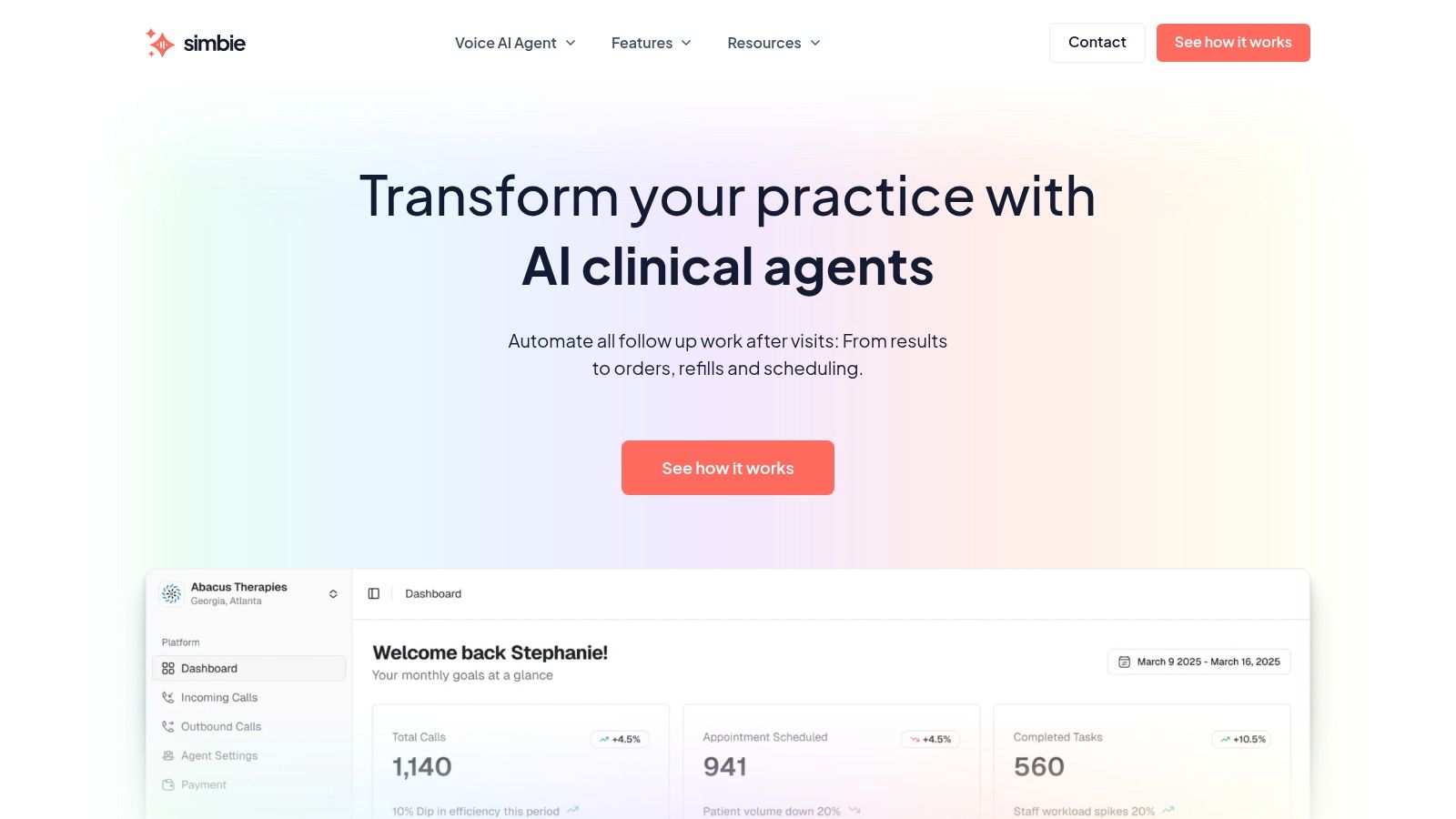
For practices reviewing workflow tools, this overview of medical practice automation lays out where automation tends to matter most. One example is Simbie AI, which uses voice agents for tasks such as patient intake, appointment scheduling, and prescription refill handling with EHR-connected workflows. That kind of tool makes sense only if it reduces front-desk load and improves handoffs, not if it just adds another layer to supervise.
Protect staff well-being while you grow
A practice can survive a busy month. It can't build long-term growth on constant catch-up.
Operational scaling should reduce chaos for staff, not formalize it. If growth requires more after-hours callbacks, more claim cleanup, and more emotional labor at the front desk, then the model is wrong. Staff burnout is not an HR side issue. It is a capacity issue, a retention issue, and eventually a patient experience issue.
Before adding more demand, ask a blunt question: if appointment requests rose tomorrow, would the team absorb it with clear workflows, or with overtime and stress? The answer tells you whether the practice is ready.
Enhancing the patient experience for retention
Patients don't experience your practice as separate departments. They experience one journey. If that journey feels confusing, slow, or repetitive, many won't complain. They'll just go elsewhere next time.
Industry guidance has started to say this more plainly. Growth depends on reducing friction for both patients and staff, especially around response times, scheduling, billing denials, and follow-up consistency, rather than only increasing visit volume, as noted in Practolytics' practice growth guidance.

The bad version of the journey
A new patient finds the practice online and calls during lunch. They hit a hold queue. When they finally reach someone, they're asked for insurance details they don't have handy. They're told to call back or arrive early.
At check-in, they fill out forms that ask for information they already gave over the phone. After the visit, they get a portal message that doesn't explain the next step clearly. Weeks later, they receive a bill they don't understand and call with a question. The phone tree starts the whole cycle again.
Nothing in that story sounds dramatic. That's why it's dangerous. No single moment is disastrous, but the patient leaves with a clear feeling: this practice is hard to deal with.
The better version
Now take the same patient journey with less friction. The call is answered quickly, or the patient gets a clean self-scheduling path. Intake details are collected once, then carried forward. Appointment reminders are clear. Follow-up instructions are specific. Billing communication uses plain language, and there's an easy path for questions.
That experience tells the patient something important before they ever judge the clinical care. It tells them the practice respects their time.
A smoother journey usually includes:
- Fast first response. Patients should not feel like access starts with a chase.
- One-time data capture. Repeating the same demographic and insurance information erodes trust.
- Clear follow-up. Patients need to know what happens next, who contacts them, and when.
- Simple billing communication. Confusion after the visit cancels out goodwill built during it.
Administrative friction is a clinical issue in disguise, because patients judge reliability long before outcomes are visible.
Small changes carry more weight than fancy ones
This is the part people often miss. Patient retention usually improves through ordinary operational fixes, not expensive gestures.
Digital intake. Better reminder timing. Tighter refill communication. Fewer voicemail dead ends. Cleaner handoffs after visits. Those changes don't sound glamorous, but they shape whether patients return and whether they refer family members or friends.
I've found that the most useful retention conversations happen at the front desk and in billing, not in brand meetings. Ask staff where patients get confused, where forms break, where messages pile up, and where they apologize most often. That's where loyalty is being won or lost.
Financial planning and measuring true ROI
Growth spending gets sloppy when leaders only ask one question: “Did revenue go up?” That's too crude to guide decisions. Revenue can rise while margins tighten, staff strain grows, and cash flow gets worse.
The broader context matters. The U.S. medical group practice management sector reached an estimated market size of $210.4 billion in 2026 and had a compound annual growth rate of 9.5% from 2020 to 2025, according to IBISWorld's medical group practice management industry data. That tells me two things. First, operators across the market are investing in practice infrastructure. Second, competition for efficient operations is not going away.
Build a budget before you buy the fix
Whether you're considering a scheduling tool, workflow automation, or a local search push, put the project through a simple operating budget first. Not a complicated finance model. Just enough structure to avoid buying hope.
I use a plain framework:
| Budget item | What to include |
|---|---|
| Direct cost | Software fees, agency fees, setup work, training time |
| Internal time cost | Staff hours spent on rollout, cleanup, and change management |
| Expected operational effect | Faster scheduling, fewer dropped calls, cleaner claims, better follow-up |
| Measurement window | When you'll review whether the project is working |
| Kill criteria | What would tell you to stop, change course, or narrow scope |
If a project has no clear operational effect and no review date, it's not an investment. It's a hopeful purchase.
Track outcomes that tie to practice strength
A CFO mindset changes what counts as success. You're not just asking whether something brought in more appointment requests. You're asking whether the practice became stronger because of it.
That usually means watching a mix of financial and operational signals. Not every practice needs the same dashboard, but the logic should stay tight.
Useful categories include:
- Cash conversion. Are you collecting more cleanly and more predictably?
- Labor pressure. Did staff workload get easier, or did the project create more admin work?
- Patient access. Are calls answered more reliably and follow-up handled faster?
- Retention quality. Are fewer patients falling out of the process after first contact or first visit?
- Profitability by service line. Is the new growth worth supporting?
For revenue-cycle-specific work, this guide to healthcare revenue cycle optimization is useful because it keeps the focus on cash capture and operational discipline, not just billing activity.
If you can't say what the project should change in daily operations, you won't know whether it worked.
Separate real ROI from vanity wins
A website redesign may look successful because the partners like the new homepage. A phone tool may look successful because call logs look busy. A marketing vendor may celebrate impressions while the front desk still drowns in manual rescheduling.
That's why I prefer a pre-and-post operating review. Before launch, write down the exact problems you're trying to fix. After launch, compare against those problems. Did response times improve? Did intake get cleaner? Did claim follow-up get easier? Did staff stop doing workarounds?
Sometimes the answer is mixed, and that's fine. Real ROI review is not about proving every purchase was smart. It's about learning quickly enough to stop weak bets and double down on the changes that make the practice easier to run.
Your next steps for sustainable growth
The biggest mistake after reading a piece like this is trying to fix everything at once. That usually causes a burst of activity, then the practice falls back into old habits.
A better move is to put growth work on a clock. Start with a few actions that change visibility, then a few that change workflow, then a few that change how leadership reviews performance.
Do this this week
Keep the first step narrow and concrete.
- Pull your core numbers. Review net collection rate, days in A/R, denials, and front-end collection performance.
- Trace one patient journey. Start with an inbound call or online booking and follow it through billing.
- List your top friction points. Don't guess. Ask front-desk, billing, and clinical support staff where work gets stuck.
- Check your local digital presence. Make sure your Google Business profile, hours, and service details are current.
If you only complete those four actions, you'll already know more than most practices that talk about growth in broad terms.
Do this this month
Use the next few weeks to fix one part of the system, not all of it.
I'd pick the area causing the most repeat work. For some practices that's intake. For others it's unanswered calls, refill requests, or claim cleanup after visits. Choose one lane and make it measurably better.
A good monthly agenda looks like this:
- Map the current workflow in plain language.
- Remove duplicate steps and unclear handoffs.
- Assign ownership for each stage.
- Set one review meeting to see if the change held.
That kind of small operational win builds trust inside the team. Staff are more willing to support growth work when they can see that leadership is fixing real pain, not adding slogans.
Do this this quarter
Once the basics are stable, make one larger growth decision. That might be a local search push, a service expansion review, or an automation project tied to phones, scheduling, or intake. Keep the scope tight enough that you can judge it objectively.
Here's the standard I'd use before approving the next move:
| Quarter decision test | Yes means proceed | No means wait |
|---|---|---|
| Operations can absorb demand | Scheduling, intake, and billing are not already overloaded | New demand will create more chaos |
| The need is real | Local demand or workflow pain is visible | The project is based on trend-chasing |
| Success is measurable | You know what outcomes should improve | You're relying on vague optimism |
| Ownership is clear | Someone is accountable for rollout and review | The project will drift between teams |
Growth gets easier once the practice stops treating it like a marketing campaign and starts treating it like an operating discipline. Pick one problem, fix it well, then earn the right to add more demand.
If your practice is ready to reduce phone bottlenecks, intake delays, and repetitive front-desk work, Simbie AI is one option to evaluate. It's a voice-based platform for healthcare practices that handles routine administrative tasks such as scheduling, patient intake, prescription refills, and related workflows, with EHR-connected documentation. For teams trying to grow without adding more manual chaos, that's the kind of operational support worth reviewing carefully.