

Good progress notes are more than just a requirement—they're a fundamental part of the clinical process. At its core, note-writing is about telling a story: the patient's story. It’s about skillfully weaving together what the patient tells you (the subjective) with what you observe and measure (the objective) to form a clear assessment and a solid plan.
Getting this right is crucial for several reasons. It’s how you ensure continuity of care, communicate effectively with colleagues, protect yourself legally, and secure reimbursement for your valuable work. Without well-crafted notes, the entire system of care can falter.
The Foundation Of Effective Progress Notes
It’s easy to see progress notes as just another administrative task on an endless to-do list, a hurdle to clear at the end of a long day. But in reality, they are the very backbone of quality patient care. Each entry is a new chapter in the patient's health journey, creating a detailed, chronological record that guides future decisions and keeps the entire care team on the same page. Without that clear narrative, you risk gaps in care, redundant treatments, or even medical errors.
But these documents do more than just guide clinical care. They are your primary evidence for establishing medical necessity, which is what justifies billing and reimbursement from insurance payers. In an era of increasing scrutiny, a vague or incomplete note can lead to claim denials and lost revenue. And from a legal standpoint, a detailed, well-written note is your best defense, creating a defensible record of your thought process, clinical rationale, and actions. It's your professional memory, captured in a permanent, legal format.
Core Principles of Great Note Writing
So, what separates a mediocre note from a great one? It really comes down to a few key principles that every clinician should internalize. A strong note is always:
- Clear and Objective: Use precise, unbiased language. Stick to the facts and avoid personal judgments or vague terms. Describe behaviors, don't label them. For example, instead of "patient was agitated," write "patient paced the room and spoke in a raised voice."
- Concise: Include everything that's relevant, but cut out the fluff. Time is valuable for you and for anyone who reads your notes. Every word should count—just not at the expense of being thorough and providing the necessary context.
- Comprehensive: Capture the complete clinical picture for that specific encounter. This means everything from the patient's own words and reported symptoms to the objective data, your assessment of the situation, and a clear, actionable plan. A complete note leaves no room for ambiguity.
Striking this balance is a real challenge, especially with the constant pressure to see more patients and manage administrative burdens. Mastering note-writing is about learning the art of being detailed yet brief. Honing general strategies for taking better notes is a great place to start building that foundational skill.
The Real-World Impact on Care and Operations
High-quality documentation isn't just a "nice-to-have"; it has a direct, measurable impact on both patient care and your practice's bottom line. In behavioral health, for example, a well-crafted note between 100 to 300 words can capture all the necessary clinical detail efficiently, proving medical necessity without unnecessary length.
This kind of efficiency is vital. With spending on physician and clinical services in the U.S. hitting $978 billion in 2023, payers are scrutinizing documentation more than ever before to control costs. Good notes lead to smoother workflows, fewer claim denials, less time spent on appeals, and, most importantly, better patient outcomes. When documentation is clear, care transitions are safer and the entire team can operate from a single source of truth. For a deeper dive into these numbers, the latest national health expenditure data offers valuable context on the financial landscape of healthcare.
Getting to Grips with Common Progress Note Formats

Picking the right progress note format is a lot like choosing the right tool for a specific job. While they all aim to capture similar, essential information, each one has a slightly different structure and focus that can be better suited to certain clinical settings or patient populations. Understanding these nuances is the key to writing notes that are not just compliant, but genuinely useful for patient care.
We're going to walk through the three most common frameworks you'll encounter in clinical practice: SOAP, PIE, and DARE. Don't think of these as rigid, unbreakable rules that stifle your clinical voice. Instead, see them as proven guides for organizing your thoughts and bringing much-needed clarity and consistency to your documentation, making it easier for you and others to follow the patient's story.
The SOAP Note: The Clinical Gold Standard
If there’s one format almost every clinician knows, it’s the SOAP note. It's the bedrock of documentation in countless disciplines, from primary care and physical therapy to behavioral health and beyond. Its four-part structure—Subjective, Objective, Assessment, and Plan—creates a beautiful, logical flow that perfectly mirrors how we think as clinicians: gathering information, analyzing it, and deciding what to do next. Its real strength is how it cleanly separates what the patient tells you from what you actually observe.
-
S – Subjective: This is the patient’s story, in their own words. You're capturing their chief complaint, how they feel, their perspective on their progress, and what they're experiencing. Quoting them directly can be incredibly powerful for adding context and authenticity. For example: Patient reports, "My anxiety has been through the roof this week, I just can't seem to calm down." States they have had difficulty sleeping more than 4 hours per night.
-
O – Objective: Now it’s your turn. This section is for the hard facts—the measurable, observable, and quantifiable data you've gathered. Think vital signs, lab results, physical exam findings, mental status exam observations, or your direct observations of the patient’s behavior, affect, and appearance. An entry might look like this: Observed client pacing in the waiting room. Affect appeared constricted and tearful, with minimal eye contact during our session. Patient fidgeted with their hands throughout the appointment.
-
A – Assessment: Here’s where you connect the dots. You take the subjective and objective pieces and synthesize them into your professional judgment or diagnosis. This is where you really show your clinical reasoning and justify the medical necessity of the visit. For instance: Patient's reported increase in anxiety and observed agitation are consistent with a flare-up of Generalized Anxiety Disorder (F41.1), likely triggered by recent work stressors. The patient continues to meet criteria for this diagnosis and is demonstrating a limited ability to utilize previously learned coping skills.
-
P – Plan: What are we going to do about it? The final section clearly lays out the next steps for treatment. This includes any new medications prescribed, therapies provided during the session, patient education, referrals made, and when you'll see them next for a follow-up. A solid plan might read: Will introduce CBT techniques for managing catastrophic thoughts, focusing on cognitive restructuring. Patient agreed to practice a 5-minute grounding exercise daily and track its effectiveness in a journal. Schedule follow-up in 1 week to review progress and introduce new skills.
The real power of a SOAP note is how it structures your problem-solving. It guides you to build a clinical case, connecting the patient's narrative to objective data before you formulate an assessment and a clear plan forward.
The PIE Note: A Problem-Focused Approach
PIE notes are a favorite in nursing and many mental health settings, and for good reason. They organize everything around the patient's specific problems as identified in their overall care plan. The structure—Problem, Intervention, Evaluation—creates an incredibly clear, running record of how each individual issue is being managed over time.
This format is a game-changer for multidisciplinary teams. Anyone can glance at the chart, instantly identify the patient's main problems by number, and see exactly what's been done to address them and how the patient responded. It excels at demonstrating progress toward specific goals.
Breaking Down the PIE Format
Unlike a SOAP note, which often starts fresh with each encounter, a PIE note directly ties back to a numbered problem list established in the patient's overall care plan. Each entry then hones in on one or more of those specific, pre-identified issues.
Let’s imagine a patient with two items on their problem list: "1. Social Isolation" and "2. Medication Non-adherence."
- P (Problem): You start by identifying the exact problem you're addressing by its number and name. It’s that simple. P #1: Social Isolation.
- I (Intervention): Next, you document what you did about it. What specific actions did you take during the session to address this problem? I: Explored patient's ambivalence about attending a local support group. Used motivational interviewing to identify personal benefits and address perceived barriers, such as fear of judgment. Provided pamphlet with details for two groups meeting this week.
- E (Evaluation): Finally, how did it go? This is where you capture the patient's response to your intervention and the immediate outcome. What was the impact of your actions? E: Patient expressed increased willingness to consider a group, stating, "Maybe it wouldn't be as bad as I think." They agreed to look up one of the groups online before our next session. Plan to follow up on this goal next week.
This problem-first method makes tracking progress toward specific treatment goals incredibly straightforward and easy for anyone on the care team to follow.
The DARE Note: For Action-Oriented Encounters
DARE is a dynamic, no-nonsense format that shines in settings where you need to document immediate actions and responses. Think crisis intervention, residential care, or fast-paced behavioral health units where rapid communication is key. The acronym says it all: Data, Action, Response, and Evaluation.
It delivers a concise, easy-to-follow narrative that’s perfect when multiple providers need to get up to speed quickly on a critical situation.
- D (Data): This part blends the subjective and objective information into one cohesive snapshot of the current situation. It's the "what's happening right now." Data: Patient called the crisis line reporting intense suicidal ideation with a specific plan. They state that a recent job loss has left them feeling "hopeless and like a burden." Speech is slow and volume is low.
- A (Action): This is what you did, right now. Document your immediate interventions clearly and sequentially. Action: Clinician engaged patient in collaborative safety planning, identifying coping strategies and sources of support. Worked with the patient to restrict access to means and facilitated a phone call to their designated emergency contact (sister), who confirmed she is on her way to the patient's home.
- R (Response): How did the patient react to your actions? This section captures their immediate feedback and change in status. Response: Patient verbally contracted for safety for the next 24 hours and reported a slight reduction in acute distress from a 10/10 to a 7/10. They were able to identify one reason for living when prompted.
- E (Evaluation): This is the wrap-up. You evaluate the intervention's effectiveness and outline the immediate plan moving forward. Evaluation: Immediate risk was de-escalated through safety planning and activation of social supports. The plan is for the mobile crisis team to conduct an in-person wellness check within the next hour. A follow-up call with this clinician is scheduled in 2 hours.
Ultimately, the best format is the one that fits your workplace, meets all the regulatory requirements, and, most importantly, helps you tell the patient's story with clarity and precision. If you want to get a head start, exploring a comprehensive https://www.simbie.ai/progress-note-template/ can give you a solid foundation for any of these formats.
Writing Notes That Are Clear, Concise, and Compliant
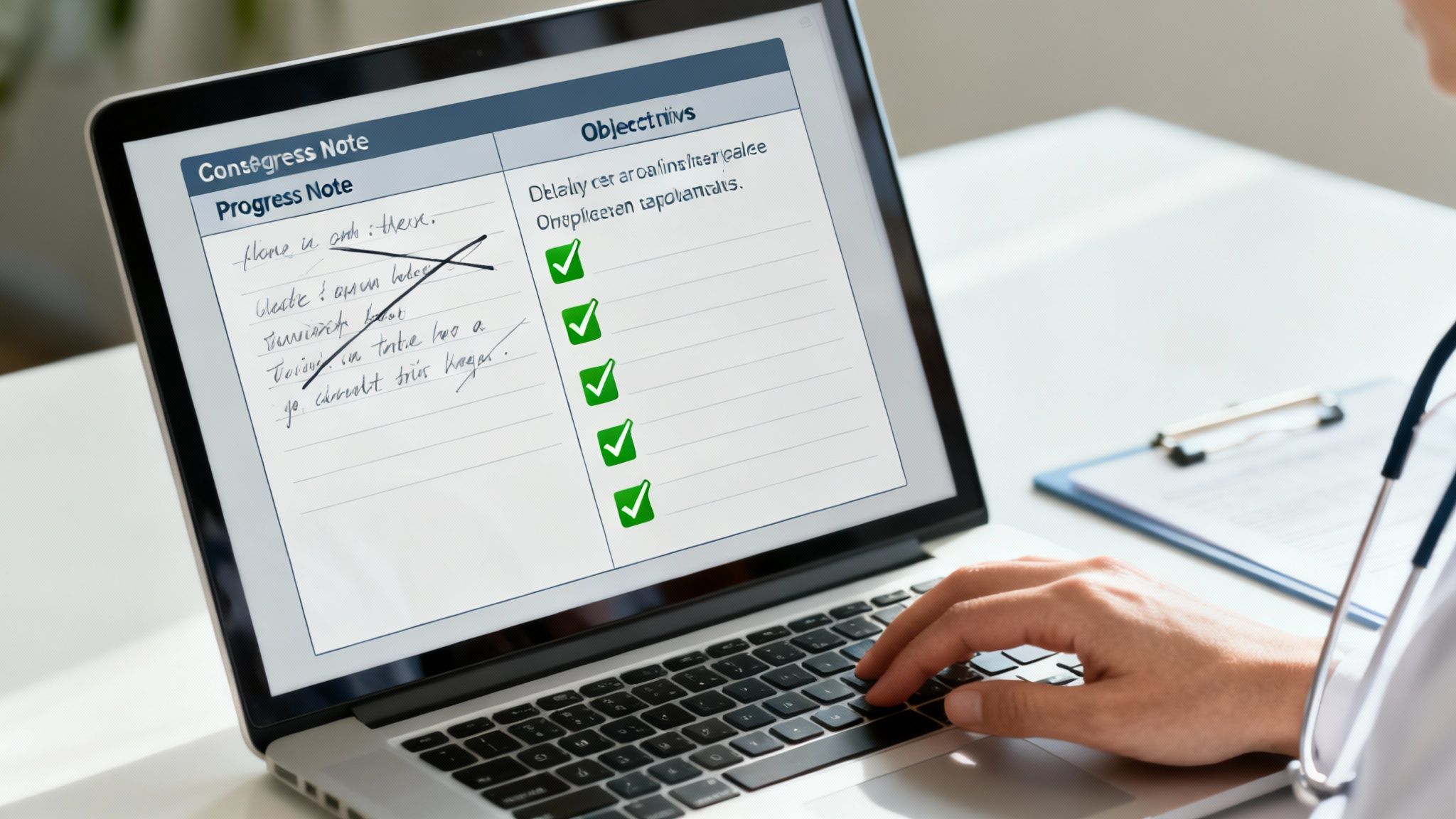
Knowing the format of a progress note is just the first step. The real skill lies in the writing itself. You can have a perfectly structured SOAP or PIE note that’s still clinically useless because the language is vague, biased, or just plain confusing.
The goal is to create a document that tells a clear story of the patient's care—one that’s both clinically sharp and legally sound. Every word counts, because your notes become a permanent part of the patient's record. They need to be clear enough for any colleague to pick up and understand the case, yet objective enough to withstand scrutiny from auditors, insurance payers, or even a courtroom.
Choosing Precise and Objective Language
The bedrock of a solid progress note is objective language. This is all about sticking to the facts and ditching any words that hint at judgment, bias, or your own personal opinion. Your job is to be an observer and a reporter, not a critic.
Instead of calling a patient "dramatic," "non-compliant," or "manipulative," describe the actual behaviors you witnessed. For instance, writing "Patient spoke in a loud, rapid voice and cried intermittently while recounting the conflict" paints a clear, factual picture without any judgment. This allows the reader to draw their own clinical conclusions based on the evidence you provide.
It’s also crucial to steer clear of vague terms like "good," "bad," or "normal." These words are completely subjective and mean different things to different people. Be specific.
-
Instead of: "The patient had a good session."
-
Try: "The patient actively participated in treatment planning, identified two new coping strategies, and reported feeling more hopeful about their ability to manage symptoms."
-
Instead of: "The patient seems better."
-
Try: "Patient reported a reduction in anxiety, scoring a 4/10 on the subjective distress scale, down from 8/10 last week. They were able to maintain eye contact for the majority of the session, an improvement from the previous visit."
A great rule of thumb to follow is this: write what you see and hear, not what you think or feel. If you can't back it up with observable evidence or direct patient quotes, it probably doesn't belong in the subjective or objective sections of the note.
Structuring a Powerful Assessment and Plan
Every part of your note is important, but the Assessment and Plan sections carry the most weight. This is where you connect all the dots, showcasing your clinical reasoning and justifying why the session was medically necessary. This is the part that payers and auditors scrutinize most closely.
Just how important is this section? An analysis of electronic hospital progress notes revealed the average note was 886 words long, with the Assessment and Plan making up roughly two-thirds of that—often around 500 words. This data shows that these sections are the heart of clinical communication, viewed an average of 16.1 times by other healthcare professionals for each note.
Your Assessment should be a tight synthesis of the subjective and objective data—your professional take on the patient's current status, progress, and any remaining challenges. The Plan must then flow logically from that assessment, spelling out clear, actionable next steps for the patient, for you, and for any other providers involved.
The Medico-Legal Lens: What to Include and Exclude
Remember, every progress note is a legal document. To make sure your notes are defensible, there are a few key practices to adopt. Always document communication with others involved in the patient's care (like family or other providers), any missed appointments ("no-shows"), and all discussions about informed consent, risks, and benefits of treatment.
If a patient expresses any risk of harm to themselves or others, you have to document it meticulously. Use direct quotes whenever possible, detail your full risk assessment process, describe the safety plan you created together, and list every action you took, like contacting emergency services, a designated contact, or consulting with a supervisor.
Just as important is knowing what to leave out. Don’t include overly personal or sensitive details that aren't clinically relevant to the patient's diagnosis or treatment. Avoid speculation or personal opinions about the patient's life choices. Staying current with training in compliance is one of the best ways to ensure your notes meet all legal and ethical standards.
Sidestepping Common Documentation Pitfalls
Even the most experienced clinicians can fall into bad documentation habits, especially under time pressure. Staying aware of common mistakes is the first step toward avoiding them and keeping your notes in top shape.
Here’s a quick look at some of the most frequent slip-ups and how to handle them.
Common Documentation Mistakes and How to Fix Them
| Common Mistake | Why It's a Problem | How to Correct It |
|---|---|---|
| Using Unapproved Abbreviations | Can lead to dangerous medical errors and miscommunication between providers. What "PT" means to you (physical therapy) might mean something else to a pharmacist. | Stick strictly to your organization's approved abbreviation list. If one doesn't exist, use widely accepted medical abbreviations. When in doubt, just write it out completely. |
| Copying and Pasting (Note Bloat) | Creates redundant, lengthy notes that obscure new information and can perpetuate outdated or incorrect data. This practice is a major red flag for auditors. | Always write a fresh note for each encounter that reflects what happened that day. Use templates for structure, but populate them with current, relevant, and specific information from the session. |
| Documenting Opinions as Facts | Introduces bias and undermines the note's objectivity, creating significant legal and clinical risks. Personal judgments have no place in a professional record. | Clearly label your clinical impressions and interpretations in the Assessment section. All other sections (Subjective, Objective) should contain only factual, observable information and direct quotes. |
By committing to clear, objective language and understanding the medico-legal weight of your words, you can write progress notes that are not only compliant but also serve as powerful tools for delivering excellent patient care.
Making Technology Work for You: Smarter Documentation
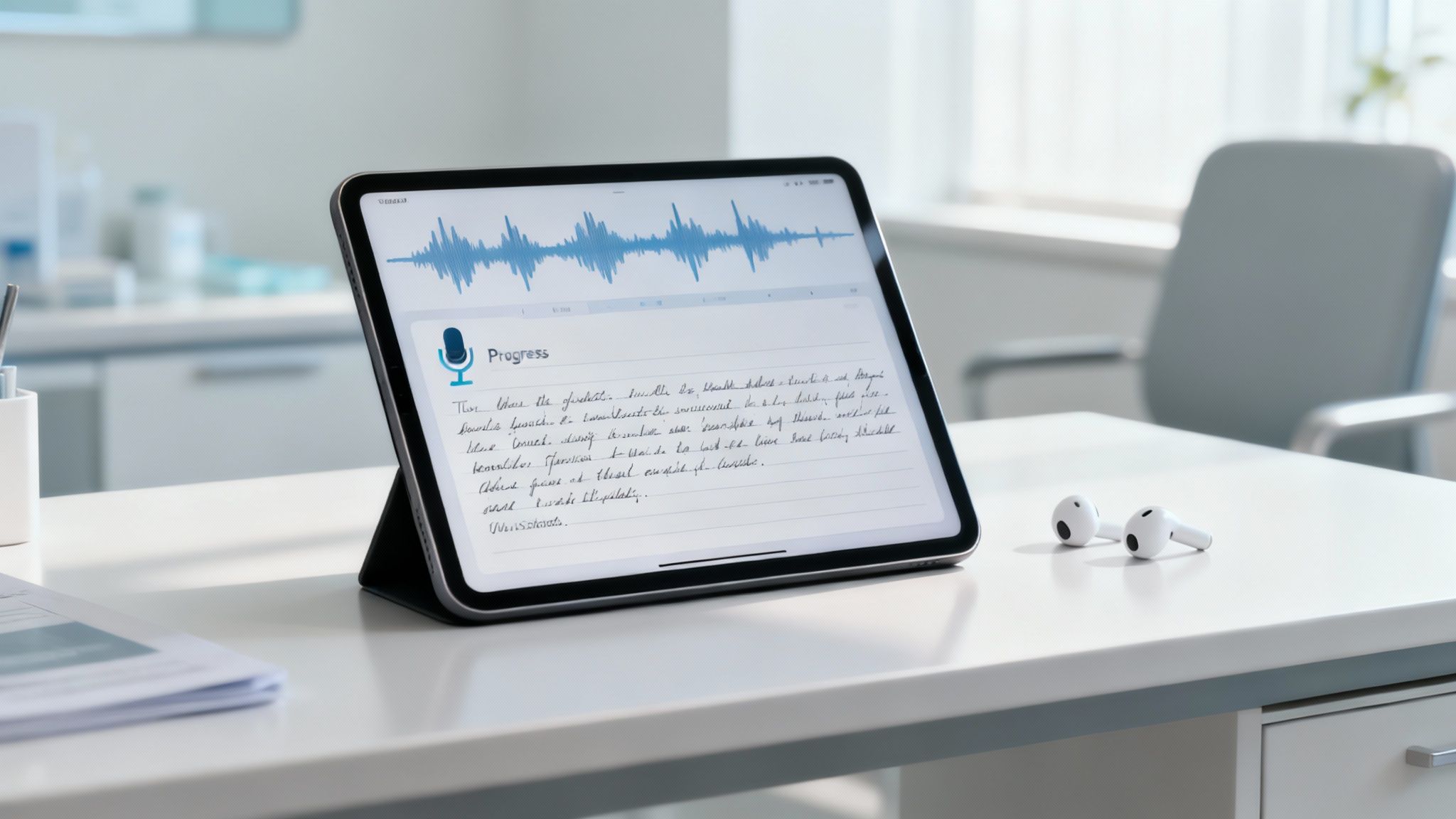
Let's be honest, paper charts are a thing of the past. Today's clinical world runs on digital tools that promise to make our lives easier, but they also bring their own set of challenges. It's not enough to just know how to type; the real skill is making the technology serve your clinical needs, not the other way around.
Electronic Health Records (EHRs) are now standard practice. Back in 2021, we saw nearly 78% of office-based physicians and 96% of non-federal hospitals using them. This shift has been great for accessibility and organization, but it also gave rise to a frustrating problem: "note bloat." Our notes started getting longer and more repetitive, often hiding the most important clinical details in a sea of generic, auto-populated text.
How to Use EMR Templates and Smart Phrases Without Sounding Like a Robot
Most EMR systems come packed with features like templates and "smart phrases" (or dot phrases) designed to save you time. These can be lifesavers when used correctly, but they’re also a trap for the unwary that can lead to lazy and inaccurate documentation.
Templates give you a solid framework for your note, making sure you hit all the necessary sections for compliance and billing. Smart phrases let you drop in pre-written blocks of text with a quick command—typing ".normalexam," for example, might auto-populate an entire paragraph describing a standard physical exam.
The problem comes when we rely on them too heavily. If you just click through a template and paste in smart phrases without customizing, you end up with a note that’s generic and almost useless. It becomes a bloated record filled with copied-and-pasted information that doesn’t tell the patient's unique story for that day. This not only diminishes the clinical value but can also raise red flags for auditors who look for signs of cloned notes.
My rule of thumb: treat templates as a starting point, not the final product. They're a guide, not a script. Always go back and fill in the specific details that make this encounter different from the last. Personalize, personalize, personalize.
Keeping Your Digital Notes Sharp
To avoid the pitfalls of digital documentation, here are a few practices I’ve found essential for maintaining high-quality notes in an EMR environment:
- Make Templates Your Own: Ditch the default settings. Spend a little time creating personalized templates that match your specific workflow and the common needs of your patient population. It's a one-time investment that pays off in the long run.
- Proofread Your Smart Phrases: Always—and I mean always—read through any text you insert with a smart phrase. Edit it to reflect what actually happened in the session. Delete anything that doesn't apply. Was the patient's mood really "euthymic" today, or is that just what the smart phrase says?
- Break the "Copy Forward" Habit: It’s so tempting to just copy the last note and change the date. Don’t do it. This is how errors get carried forward and how notes become meaningless chronicles of outdated information. Start fresh for each encounter.
- Tell the Story: Even inside a structured EMR, your note needs a narrative. What’s different today? What progress was made? What setbacks occurred? That’s the real heart of your note.
The Next Wave: Voice-to-Text and AI Scribes
Newer tools are pushing efficiency even further. Voice-to-text dictation has gotten incredibly accurate and is often built right into the EMR. Speaking your note instead of typing it can slash your documentation time, especially for clinicians who are faster talkers than typists.
But the real game-changer is the rise of AI-powered scribes. These tools use what’s called "ambient listening" to draft a progress note for you by listening to the patient session. The AI can identify key patient quotes for the Subjective section, summarize your interventions, and even suggest a Plan based on your conversation.
For instance, an AI scribe could listen to a therapy session, pull out key themes the patient discussed like "anxiety about work presentation" and "conflict with spouse," and neatly structure them into a SOAP note draft before you’ve even logged out. If you're curious about how this works behind the scenes, you can explore the mechanics of AI clinical documentation.
Staying in Control: Balancing Tech with Your Expertise
While these innovations are exciting, they don't replace your clinical judgment. They are powerful assistants, but you are still the clinician in charge.
- You Are the Final Editor: The AI is smart, but it's not perfect. It can misinterpret nuances or miss context. You are still legally and ethically responsible for every word in that note. Always review and edit anything generated by AI to ensure accuracy.
- Protect Patient Privacy: Make sure any tool you use is HIPAA-compliant and has robust security measures. Be transparent with your patients about how you're using technology to document their care. Trust is everything.
- Keep Your Clinical Voice: Don't let the tech scrub your personality and insight from the note. The final product should still sound like you and reflect your professional assessment and unique perspective on the case.
By weaving these tools into your practice thoughtfully, you can reclaim hours lost to administrative work. The goal is to find that sweet spot where technology supports your clinical skill, letting you get back to what matters most: your patients.
Building a Note-Writing Workflow That Actually Works
Knowing how to write a solid progress note is half the battle. The other half? Doing it efficiently without letting quality slip or succumbing to burnout. The real win is spending less time on paperwork and more time with patients. A good, sustainable workflow is what stands between you and documentation-related dread.
The first big question to tackle is timing. Are you a "write-as-you-go" person, or do you prefer to batch everything at the end of the day? Clinicians swear by both methods, and what works for you will likely depend on your personality, your clinical setting, and the rhythm of your practice.
In-the-Moment Notes vs. Batching
Writing notes contemporaneously—that is, during or immediately after a session—is fantastic for accuracy. All the little details, specific phrases, and subtle observations are still fresh in your mind. You're less likely to forget that key quote from a patient or a subtle clinical observation that could be important later. The trade-off, of course, is that it can sometimes feel like you're more engaged with your screen than your patient, which can disrupt the session's flow and therapeutic rapport.
On the other hand, batching your notes into a dedicated time block at the end of the morning or day lets you be completely present and engaged during appointments. The major risk here is memory decay. Details that were sharp at 9 a.m. can get fuzzy by 4 p.m., which can lead to vague or, worse, inaccurate notes. Many of us land on a hybrid approach: jotting down a few key phrases, data points, or direct quotes during the visit and then writing the full note in the brief window right after the patient leaves.
Setting Yourself Up for Success
A truly efficient workflow begins before you even sit down to type. A little bit of prep work can make a world of difference and transform documentation from a chore into a seamless part of your clinical process.
- Quick Scan: Before the patient walks in, take two minutes to review their last progress note and treatment plan. It’s a simple habit that instantly refreshes your memory of their treatment goals and recent progress, helping you focus the session and structure your follow-up questions.
- Know Your "Why": Go into every encounter with a clear objective. Are you assessing a new symptom? Following up on a medication change? Reviewing a specific coping skill? This focus helps guide your questions and, by extension, the structure of your note. You'll know exactly what information you need to gather.
The fastest note to write is the one you were already prepared for. When you know the encounter's purpose from the get-go, you can gather the information you need in a logical order, making it so much easier to document later.
Time-Blocking and Making Templates Your Own
Once you've figured out your timing, it’s all about building solid habits. Time-blocking is a lifesaver for clinicians. Literally schedule documentation time into your calendar and guard it fiercely, just like a patient appointment. This simple trick prevents notes from piling up and becoming an overwhelming monster at the end of the week.
Personalized templates are another huge efficiency booster. Don't just stick with the generic EMR defaults. Take some time to create your own versions tailored to your specialty and the types of cases you see most often. You can even build out smart phrases for common interventions or patient education points, but always—always—personalize them with specific details from the actual session. This drive for a smarter workflow is why many are now looking at tools like advanced medical scribe software to handle the initial draft, leaving clinicians to simply review, edit, and finalize.
At the end of the day, remember that not every note needs to be a literary masterpiece. A concise, focused note that clearly documents the encounter, supports medical necessity, and lays out the plan is exactly what's needed. Find a system that works for you, protects your time, and lets you get back to what really matters.
Got Questions About Progress Notes? We’ve Got Answers.
Even after years of practice, you’ll still run into tricky situations when writing progress notes. Getting comfortable with these everyday challenges is just part of the job. Let’s walk through some of the most common questions I hear from clinicians, so you can handle them with confidence.
Think of this as your quick-reference guide for those moments when you're staring at a blank screen and thinking, "What am I supposed to do here?"
How Long Should a Progress Note Be?
There’s no magic word count. A great progress note is long enough to be thorough but short enough to be concise. The length should be dictated by the complexity of the visit, not an arbitrary target.
A complex initial intake with a high-risk patient is naturally going to demand a much longer, more detailed note than a simple medication management follow-up. Instead of aiming for a certain length, ask yourself: does this note clearly explain the patient's status, justify why this session was medically necessary, and lay out a clear plan for moving forward? If you’ve done that without adding a bunch of fluff, you’ve nailed it.
What's the Most Important Part of a Progress Note?
Every section has its place, but if you had to pick a winner in terms of clinical and financial importance, it’s the Assessment and Plan. This is where your clinical judgment really takes center stage and where you justify the encounter.
- The Assessment is your synthesis. It's where you connect the dots between what the patient told you (Subjective) and what you observed (Objective) to form your professional conclusion about their progress and current state.
- The Plan is the roadmap. It flows directly from your assessment and details the concrete next steps for the patient’s care, including what you will do and what the patient has agreed to do.
These two sections work together to prove the value and necessity of the encounter, which is absolutely essential for both continuity of care and getting paid.
Can I Use Abbreviations?
Yes, but tread carefully. Using abbreviations is fine only if you’re sticking to the approved list from your facility or organization. Making up your own shorthand or using anything ambiguous is just asking for trouble and can lead to serious medical errors down the line. An abbreviation that is clear to you might be misinterpreted by another provider on the care team.
My rule of thumb is simple: When in doubt, write it out. The few extra seconds it takes to spell out a term is a tiny price to pay for clarity and patient safety.
How Should I Document Patient Non-Compliance?
Documenting non-compliance or non-adherence is all about being objective and non-judgmental. Your job is to be a factual reporter, not a judge. You need to state the facts clearly, without a hint of personal opinion or frustration.
For instance, instead of writing, "Patient refused to take their meds," try something more factual and neutral, like: "Patient reports they have not taken their medication as prescribed for the past three days, citing concerns about side effects." Or, "Patient did not complete the thought record homework assigned last session, stating they 'forgot'."
It’s also critical to document the education you provided on the risks of non-adherence and the patient's response to this information. This creates a clear, defensible record showing you fulfilled your clinical duty and the patient made an informed choice.
Ready to cut your documentation time and focus more on your patients? Simbie AI uses advanced voice technology to automate your progress notes, scheduling, and other administrative tasks, letting you get back to what matters most. See how Simbie works.