

Let's be real—after a 12-hour shift, the last thing you want to do is tackle a mountain of charting. It's tempting to see documentation as just another box to check before you can finally go home. But your notes are one of the most powerful clinical tools you have.
They’re not just paperwork; they are the backbone of patient safety, the main line of communication between colleagues, and your number one legal safeguard. Shifting your view from a tedious chore to a core professional skill is the first step toward mastering nursing documentation.
Think of it this way: your note is the only thing that speaks for you when you're not there. It tells the story of your patient's progress, justifies your clinical decisions, and ensures the next nurse can pick up right where you left off without missing a beat.
More Than a Task, It's the Key to Quality Care
Your documentation has a direct, measurable impact on patient outcomes. A clear, detailed note can tip off the oncoming shift to a subtle but critical change in a patient’s condition. On the flip side, a vague or incomplete entry can lead to missed symptoms and, in the worst cases, medical errors.
Your notes are the central thread connecting the entire care team—doctors, therapists, specialists, and fellow nurses. They are essential for collaborative, patient-centered care and serve a few crucial roles:
- Continuity of Care: They create a seamless handoff of vital information between shifts and different departments.
- Legal Record: You’ve heard it a thousand times because it’s true: "If it wasn't documented, it wasn't done." Your notes are your legal proof of care.
- Communication Hub: This is the single source of truth for the patient's status, relied upon by every provider involved in their care.
- Quality Improvement: Anonymized data from nursing notes is often analyzed to track outcomes, refine protocols, and elevate the standard of care across the facility.
Good documentation isn't just about protecting the patient or the hospital; it's also a direct reflection of your own clinical practice.
A clear, accurate, and thorough note showcases your competence and critical thinking. It builds trust with your colleagues and demonstrates your commitment to your patients.
Getting this right is a challenge everywhere. The quality of nursing documentation varies wildly between healthcare systems around the world. For instance, studies on compliance with documentation standards show rates as high as 77.1% in Ghana, but they drop to 46.1% in Yemen and range from 37.4% to 48.6% across different regions of Ethiopia. This shows just how vital it is to have solid, consistent habits, no matter where you practice.
Regardless of the charting format you use (SOAP, PIE, Narrative, etc.), every effective note shares a few core components. Think of these as the building blocks for a complete clinical picture.
The Anatomy of an Effective Nursing Note
Here's a quick-reference table breaking down the essential elements that should be in every comprehensive nursing note.
| Component | Description | Example |
|---|---|---|
| Objective Data | What you see, hear, measure, or feel. This is the hard, factual data like vital signs, lab results, and physical assessment findings. | "Abdomen is soft, non-distended. Bowel sounds are active in all 4 quadrants. No tenderness on palpation." |
| Subjective Data | What the patient (or their family) tells you. This includes direct quotes about their symptoms, feelings, or concerns. | "Patient states, 'My head is pounding and the light really bothers my eyes.'" |
| Assessment | Your professional conclusion based on the objective and subjective data. This is where you analyze the information and identify the problem. | "Patient appears to be experiencing an acute migraine headache." |
| Interventions | The actions you took to address the problem. This includes medications administered, treatments performed, and patient education provided. | "Administered sumatriptan 50mg PO as ordered. Dimmed room lights and provided a cool cloth for forehead." |
| Response | How the patient responded to your interventions. This closes the loop and documents the outcome of your care. | "30 minutes post-intervention, patient reports pain decreased from '8/10' to '4/10'. States, 'The headache is much better now.'" |
Mastering these five components will ensure your notes are always clear, complete, and legally sound. It creates a full story that anyone on the care team can follow.
Choosing Your Charting Format: SOAP, PIE, and DAR
Once you’ve gathered all your patient information, you need to decide how to structure it. You could write a long narrative note, but let’s be honest, who has time for that? Structured formats are your best friend on a busy shift. They act like a mental checklist, making your documentation faster, clearer, and more consistent.
Think of it this way: you wouldn't tell a patient's story out of order. These formats—primarily SOAP, PIE, and DAR—give your notes a logical flow that anyone reading them can follow instantly. Let's break down which one to use and when.
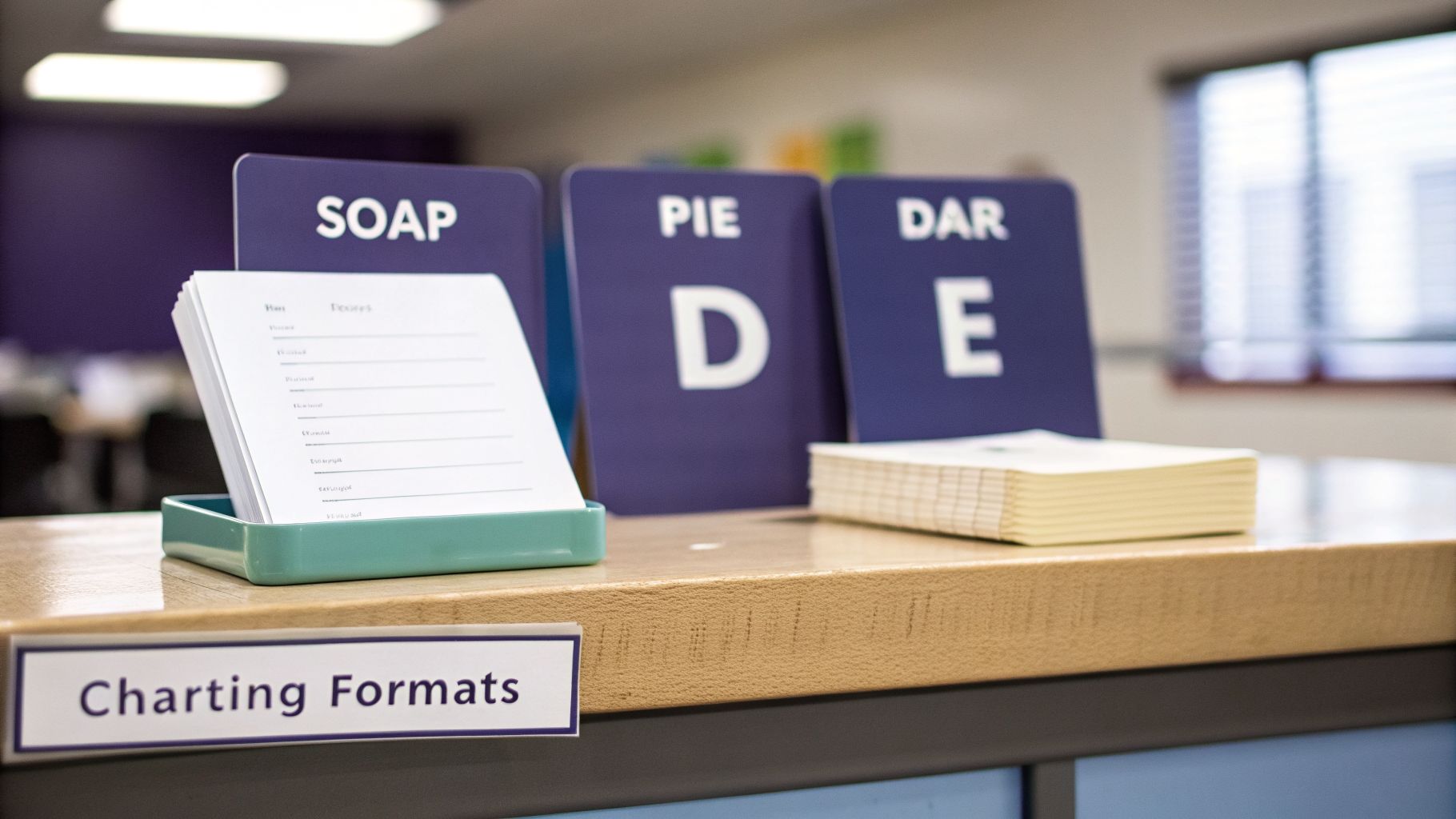
SOAP: The Go-To for Problem-Solving
You’ll see SOAP notes everywhere, and for good reason. It’s a classic, problem-oriented format that’s perfect for documenting a new issue or a sudden change in your patient’s condition. It walks you through the critical thinking process.
SOAP is an acronym for:
- S – Subjective: What the patient (or their family) tells you. Their symptoms, feelings, or concerns.
- O – Objective: The hard data. What you see, hear, measure, or feel. This includes vital signs, lab results, and your own physical assessment findings.
- A – Assessment: This is your clinical interpretation. What do you think is going on based on the S and O?
- P – Plan: What’s next? This includes your interventions, orders you've requested, and plans for monitoring.
This method is ideal for admission notes, a focused assessment on a new complaint, or documenting your response when a patient's condition changes unexpectedly.
Real-World Scenario: A SOAP Note for Sudden Abdominal Pain
- S: Patient states, "I've had this sharp, stabbing pain in my belly for about an hour. It’s getting worse." Reports feeling nauseous. Rates pain 7/10.
- O: Abdomen rigid and tender to palpation in the right lower quadrant. Bowel sounds absent. Vitals: T 100.8°F, HR 112, BP 138/88, RR 22. Patient is guarding their abdomen.
- A: Patient exhibiting signs and symptoms consistent with acute appendicitis.
- P: Kept patient NPO. Notified Dr. Smith of findings. Will prep patient for a potential CT scan and surgical consult. Continue to monitor vital signs and pain level q30 min.
PIE: Tracking Nursing-Specific Problems
The PIE format is all about the nursing process. It’s a fantastic way to document progress on care plans and show the effectiveness of your interventions for established nursing diagnoses.
Here’s what PIE stands for:
- P – Problem: The established nursing diagnosis.
- I – Intervention: What you did to address that problem.
- E – Evaluation: How the patient responded to what you did.
What makes PIE different from SOAP is that the assessment data isn't repeated in every single note. That information lives in the flowsheets or the initial assessment. This keeps your progress notes lean, focused, and centered on the actions you took and the outcomes you achieved. For more ideas on how to organize your notes efficiently, check out our comprehensive nursing report template for practical layouts and tips.
Real-World Scenario: A PIE Note for Skin Integrity
- P: Impaired skin integrity R/T immobility, evidenced by a 2 cm red, non-blanchable area on the coccyx.
- I: Repositioned patient from supine to left side. Applied barrier cream to coccyx. Educated patient on the importance of frequent position changes. Placed pressure-reducing cushion in wheelchair.
- E: Patient reports being comfortable in new position. Skin on coccyx remains intact, no further breakdown noted at end of shift.
DAR: The Flexible, All-Purpose Format
DAR is my personal favorite for its flexibility. It's part of a system called "Focus Charting," and you can use it for just about anything—a specific symptom, a change in condition, a patient education session, or even a family visit.
The structure is simple:
- D – Data: This is your evidence. It combines both subjective (what the patient says) and objective (what you observe) information.
- A – Action: What you did. These are your nursing interventions.
- R – Response: The outcome. How did the patient react to your action?
The "Focus" of your note can be whatever is most relevant at that moment. It could be a nursing diagnosis like "Anxiety," a symptom like "Shortness of Breath," or a significant event like a "Patient Fall." This versatility is why so many EHRs use a DAR-style format.
Real-World Scenario: A DAR Note for a Patient Fall
Focus: Patient Fall
- D: Found patient on floor next to bed. Patient states, "I got dizzy when I stood up and lost my balance." No visible injuries noted. Denies hitting head or loss of consciousness. Full ROM in all extremities without pain.
- A: Assisted patient back to bed with CNA. Completed full neuro assessment and vital signs per facility fall protocol. Notified charge nurse and physician. Placed bed in lowest position and activated bed alarm.
- R: Patient remains alert and oriented x4. Vitals stable. Denies any pain or discomfort. Daughter notified of event and updated on patient's current status.
Writing Clear and Objective Notes That Stand Up to Scrutiny
Think of every nursing note you write as a permanent record that could one day be read in a courtroom. Your charting is your best defense, but only if it’s built on a foundation of objective facts. It needs to paint a crystal-clear picture of your patient’s status and the care you delivered, leaving no room for anyone to second-guess your actions.
This means getting out of the habit of using personal judgments and sticking strictly to what you can see, measure, and hear. A well-written note gives any other clinician the exact information they need to understand the situation, while a poorly written one just creates confusion and risk.

Show, Don’t Just Tell
Vague words are the enemy of good documentation. Phrases like "seems," "appears," "good," or "normal" are subjective—they mean different things to different people and can instantly weaken your note. Your job is to provide the evidence, not the conclusion.
Instead of just stating that a patient did well, describe what you observed that led you to that thought. This simple shift turns a flimsy opinion into a rock-solid, factual observation.
Before (Vague): "Patient had a good day and tolerated his diet well."
After (Objective): "Patient ambulated 100 feet in the hallway three times without assistance. Ate 75% of his lunch. Denied any nausea or abdominal pain."
See the difference? The first example is an opinion. The second is a collection of facts that lets the next nurse, the doctor, or a case manager draw their own conclusions. If you want to get better at painting these factual pictures, digging into how to properly structure narrative notes for nursing is a great place to start.
Separating What They Say From What You See
It's easy to get subjective and objective data mixed up, but keeping them separate is essential for accurate charting.
- Subjective Data: This is the patient’s side of the story. The gold standard is to use direct quotes. It removes your interpretation and captures their experience in their own words, which is incredibly powerful.
- Objective Data: This is everything you can measure or observe with your own senses. Think vital signs, lab results, what you see during a physical exam, or behaviors you witness firsthand.
Let’s take a common scenario: a patient who seems anxious.
| Vague Note | Objective & Factual Note |
|---|---|
| "Patient seems anxious and agitated this morning." | "S: Patient states, 'I feel like my heart is racing and I can't catch my breath.' O: Observed pacing at the bedside. Hands are visibly trembling. Heart rate 110 bpm, RR 24. Skin is cool and diaphoretic." |
The second note doesn't just say "anxious." It gives concrete, measurable data that supports that assessment. This is the core of defensible, professional documentation.
The Pitfalls of Unapproved Abbreviations
We’re all in a rush, and it’s tempting to use shortcuts. But using unapproved abbreviations is one of the most dangerous habits you can form in charting. An abbreviation you use for one thing might mean something entirely different to a pharmacist or a physician, creating a direct line to a potential medication error.
Every facility has an approved list of abbreviations—find it and stick to it religiously. The Joint Commission also publishes a "Do Not Use" list for a reason; these are abbreviations known to cause serious mistakes.
Commonly Misinterpreted Abbreviations to Avoid:
- U (for unit): This can easily be mistaken for a 0, a 4, or cc. Always write "unit."
- IU (for international unit): This is often misread as IV or the number 10. Write out "international unit."
- Q.D. / Q.O.D. (daily / every other day): A stray mark can make the "O" look like an "I," leading to a daily dose instead of every other day. Write "daily" or "every other day."
When you're even the slightest bit unsure, write it out. Those few extra seconds could prevent a patient safety disaster. To truly master this, making reflective practice in healthcare a regular habit is key. It’s about looking back at your own work to spot these habits and consciously improve them over time.
Understanding the Legal Risks of Poor Documentation
Let's be blunt: every single note you write is a legal document. If a lawsuit ever lands on your facility's doorstep, your charting will be exhibit A. It can either be the one thing that saves you or the one thing that sinks you.
Think about it from an attorney’s perspective. When they're building a case, they will comb through your notes with a fine-tooth comb, looking for any gap, contradiction, or vague entry. Something that seems like a small omission to you could be interpreted as negligence in a courtroom, even if the care you delivered was perfect.
The Real-World Impact on Patient Safety
This isn't just about covering your bases legally. The link between weak documentation and poor patient outcomes is terrifyingly direct. We've all seen how a breakdown in communication can lead to errors, and your notes are the primary form of communication on any unit.
It’s a harsh reality backed by some sobering numbers. The World Health Organization has highlighted research showing that documentation errors in the USA contribute to at least one death and 1.3 million injuries every single year. That statistic should stop every one of us in our tracks. Meticulous charting isn't just administrative busywork—it's a core patient safety function.
HIPAA Compliance Is Not Optional
Beyond malpractice, we have a fundamental duty to protect patient privacy under the Health Insurance Portability and Accountability Act (HIPAA). A breach isn't just about snooping in a celebrity's chart; it can happen through simple carelessness in your day-to-day documentation.
These violations are easier to commit than you might think:
- Oversharing: Charting personal details about a patient’s family drama or financial woes that have no clinical relevance.
- Leaving a Trail: Forgetting your handwritten report sheet at the nurses' station or tossing it in a regular trash can.
- Digital Slip-ups: Texting a colleague about a patient using your personal phone or logging into the EMR on a public, unsecured Wi-Fi network.
A single HIPAA violation can trigger massive fines for your hospital and lead to severe disciplinary action from the board of nursing, including having your license suspended or even revoked. It’s a gamble that's never, ever worth taking.
How a Small Charting Error Can Become a Tragedy
Let me walk you through an anonymized, but very real, scenario that shows how quickly a documentation oversight can spiral.
A patient comes into the ED with chest pain. He has a known, severe allergy to a common NSAID. The allergy is documented during the initial intake, but it isn't flagged prominently or carried over into the ongoing progress notes in the EMR.
Later, a different physician, quickly scanning the chart for an unrelated pain complaint, orders that exact NSAID. The nurse, trusting the new order and only glancing at the active medication list, gives the drug. The patient has a violent anaphylactic reaction and ends up in respiratory arrest.
In the legal battle that followed, the documentation was the star witness. The fact that the allergy wasn't consistently visible in every relevant part of the chart was pinpointed as the critical failure. This painful story teaches a vital lesson: a single missed detail in your charting can have devastating consequences. Improving clinical documentation is an ongoing skill that directly prevents these kinds of errors from ever happening.
How to Avoid Common Charting Mistakes
It’s the end of a 12-hour shift. You’re running on fumes, your feet are aching, and you still have a mountain of charting to get through. In moments like these, the temptation to cut a few corners is real, and even the most seasoned nurses can fall into bad habits.
But those seemingly small shortcuts—like charting a med before you give it or using a vague term like "good"—can create huge problems down the road. Let's walk through the most common charting pitfalls I've seen and, more importantly, how to steer clear of them, even when you're feeling the pressure.
The Dangers of Pre-Charting and Vague Language
Of all the bad habits, pre-charting is one of the most dangerous. This is when you document something before it's actually happened. You plan on giving a pain med at 10:00 AM, so you chart it at 9:45 AM to get ahead. But what if the patient suddenly refuses it? Or you get pulled into a code blue next door? Your documentation is now false, and in the eyes of the law, that’s considered fraudulent.
The golden rule is simple: chart in real-time or right after you've provided the care. Never before.
Just as problematic is relying on vague, subjective language. Words like "slept well," "ate a good amount," or "seems less anxious" don't mean much clinically because everyone's definition is different. My "good amount" of a meal might be half the plate, while another nurse might consider that a poor intake.
Instead of "slept well," try documenting what you actually observed or what the patient told you: "Patient reports sleeping for approximately 6 hours, waking once to use the restroom. States, 'I feel rested this morning.'" Now you have objective, factual data.
Making Corrections and Late Entries the Right Way
Look, mistakes are going to happen. The key is how you fix them. Never, ever use white-out, scribble over a mistake on a paper chart, or delete an entry in the EMR. Doing so looks like you're trying to hide something and instantly compromises the integrity of that legal record.
Here’s the correct way to handle it:
- On Paper: Draw a single, clean line through the incorrect entry so it's still readable. Write "mistaken entry" or "error" nearby, then add your initials, the date, and the time.
- In an EMR: Follow your hospital's specific protocol for making an addendum. This creates a new entry that's electronically tied to the original, preserving the record while adding the correct information.
A late entry is just as important to get right. If you realize hours later that you forgot to chart something, simply create a new note. Clearly label it as a "late entry," note the date and time the care actually happened, and then add the current date and time of your charting.
Why Do Charting Errors Happen in the First Place?
It’s easy to point fingers and blame errors on laziness, but the truth is usually a lot more complicated. Often, the work environment itself is the biggest barrier to good documentation. Study after study has shown that systemic issues are the real culprits. For example, research across different healthcare settings consistently finds that high workloads and not enough time are the top obstacles nurses face. Other major factors include a lack of ongoing training and inconsistent documentation rules within the same facility. You can read a detailed review of these challenges to see just how common these problems are.
When we understand these pressures, we can stop blaming ourselves and start looking for real solutions. If you’re struggling to keep up with your charting, you’re not alone—it’s a sign that the workflow itself might need a second look.
To help you spot these issues in your own practice, I've put together a quick-reference table.
Common Documentation Mistakes and How to Fix Them
This table breaks down some of the most frequent errors I see and gives you a clear, best-practice alternative for each.
| Common Mistake | Why It's a Problem | Best Practice Solution |
|---|---|---|
| Charting personal opinions (e.g., "Patient was difficult") | It's subjective, unprofessional, and legally risky. | Document specific, objective behaviors. "Patient refused medications and stated, 'I don't trust you.'" |
| Leaving blank spaces in paper charts | Someone else could add information to your note later, altering the record. | Draw a clean line through any empty space to the end of the line before signing your name. |
| Copy-pasting previous notes without review | This is a huge risk. It carries forward outdated or inaccurate information, which can lead to clinical errors. | Always review and update every single section of a templated note to reflect the patient's current status. |
| Failing to document communication | If you don't chart that you notified a physician of a critical lab value, there's no proof it happened. | Document every important call: "Dr. Evans notified of K+ 2.9 at 14:15. New orders for K-Dur 40mEq PO received and acknowledged." |
Keeping these simple fixes in mind can make a huge difference in the quality and legal standing of your documentation, protecting your patients, your license, and your facility.
Using Technology to Make Documentation Easier
Let’s be honest: the endless charting is one of the biggest frustrations in nursing. What if you could actually cut that time in half? It's not just a fantasy. Beyond the basic functions of your Electronic Medical Record (EMR), some genuinely helpful tech is changing how we handle our notes.
These tools are designed to attack the biggest enemy of good documentation—not having enough time. By taking over some of the repetitive, manual work, they free you up to focus on your patients, which is why we got into this profession in the first place.
Mastering Your EMR with Templates
Most EMRs come with features that a lot of us never get around to using. The single most effective one I've seen is the template. Instead of typing out a full note from memory for a common admission, you can pull up a pre-built template for pneumonia, post-op hip recovery, or diabetes management.
These give you a solid starting point, making sure you hit all the key assessment points. But a word of caution from experience is needed here.
Never blindly copy-paste. A template is a guide, not the final word. Always, always review and tailor the information to fit what's actually going on with your patient right now.
The Rise of Voice-Dictation and AI Scribes
For years, we've watched physicians use voice dictation to fly through their notes. Now, that same technology is finally getting good enough for nurses. You can simply speak your observations instead of typing them out, which is a lifesaver when you need to capture a detailed narrative but can't afford to be stuck at a workstation.
The next step is already here with AI-powered assistants. Tools like Simbie AI are built to work right inside your EMR, and they do more than just turn speech to text. These platforms can actually listen to a conversation—like during an admission or at the bedside—and help structure a complete nursing note from it automatically.
Imagine you're talking with a new patient about their symptoms and history. The AI can identify and sort that information into the right sections of a SOAP or DAR note as you speak.
- It pulls out the patient's subjective complaints ("my chest feels tight").
- It logs the objective data you mention (respirations at 22, O2 sat 94%).
- It can even suggest potential nursing interventions based on what it heard.
This massively reduces the time spent on manual data entry, which is where mistakes and omissions often happen. It translates your real-time conversation into an accurate chart, giving you back valuable time without sacrificing quality.
Practical Tips for Integrating Technology
Adopting new tech can feel like one more thing to learn, but you don't have to go all-in at once. Starting small can make a huge impact.
- Explore EMR Shortcuts: Block off 15 minutes to learn your EMR’s "dot phrase" or macro feature. These let you type a short code (like ".woundcare") to auto-populate a longer, standard phrase you use all the time.
- Try Your Phone's Dictation: Get a feel for voice-to-text by using your phone's built-in microphone. Practice dictating a few non-confidential notes or reminders to yourself to see if the workflow clicks for you.
- Advocate for Better Tools: If your unit is struggling with outdated tech, speak up. Talk to your manager about how tools like AI scribes could reduce charting time, lower burnout rates, and ultimately improve patient safety.
Embracing these aids helps shift your energy from tedious clicking and typing back to patient care. It's a critical part of learning how to write a nursing note that is not only accurate but also efficient.
Your Nursing Documentation Questions, Answered
Even the most thorough guide can’t cover every question that pops up on the floor. After years in clinical practice, I've heard them all. Here are quick, straight-to-the-point answers to the most common questions nurses ask about charting.
What's the Golden Rule of Nursing Documentation?
You’ve probably heard it a thousand times, and for good reason: "If it wasn't documented, it wasn't done." It's the absolute foundation of everything we write.
Beyond that, your guiding principle should be to stay completely objective. Your notes need to paint a crystal-clear picture of what you saw, what the patient told you, the care you provided, and how the patient responded. This isn't the place for personal opinions or vague descriptions. Just the facts.
How Can I Chart Faster Without Cutting Corners on Quality?
Getting faster at charting isn't about rushing; it's about building smart habits and using the tools at your disposal. First, pick a charting format you like—whether it’s SOAP, PIE, or DAR—and get so good at it that it becomes second nature. Having that mental template makes the whole process smoother.
Next, get into the habit of charting right after you provide care. Don't save it all for the end of your shift. You’ll forget crucial details, and the risk of making an error goes way up. Also, really learn your EMR. It's full of shortcuts and templates that are there to help you. And don't be afraid to look into newer tools like voice-dictation or AI scribes that can automate a lot of the busywork.
The goal is to chart smarter, not harder. A few minutes spent documenting an intervention right away saves you an hour of trying to piece things together before you clock out. It’s more accurate, and it gives you more time for your patients.
What Do I Do If I Make a Mistake in a Note?
We all make mistakes, but how you fix them is what counts. The key is transparency. Never, ever try to delete, white-out, or scribble over an error.
- On Paper Charts: Simply draw a single, clean line through the incorrect text so it's still readable. Write "mistaken entry" or "error" nearby, add your initials, and then write the correct information.
- In an Electronic Medical Record (EMR): You'll need to follow your facility's specific protocol for creating an addendum. This process adds the correct information while preserving the original entry, which is a must for legal integrity.
Is It Okay to Use Abbreviations in My Notes?
Yes, but with a huge caveat: only use facility-approved abbreviations. This is non-negotiable. Using random, unapproved shortcuts is a notorious source of serious medical errors. Your hospital or clinic will have a specific list of what's allowed.
Always check your organization's policy and make sure to avoid anything on The Joint Commission's "Do Not Use" list. My personal rule? When in doubt, write it out. It’s the safest and most professional thing to do.
Ready to cut your documentation time and get back to what matters most? Simbie AI works with your EMR to automatically create accurate notes from your spoken conversations. Find out how our clinically-trained voice agents can completely change your workflow and give you time back in your day.