
Meta description: Improve post-op follow up with a practical workflow that reduces gaps, standardizes outreach, and supports better recovery across your practice.
A patient gets discharged with a packet of instructions, a follow-up date they only half-heard, and a phone number they probably won't call unless something feels wrong. Back at the practice, your MA is trying to squeeze outbound calls between rooming patients, refill requests, and inbox cleanup. That's where post-op follow up usually breaks down.
For independent and community-based practices, how to improve post-op follow up isn't a customer service project. It's an operating model. Done well, it lowers clinical risk, reduces preventable friction, and keeps your team from spending the day chasing voicemail dead ends. Done poorly, it creates avoidable complications, readmissions, scheduling chaos, and staff burnout.
Why Post-Op Follow Up Fails and What It Costs You
Most follow-up failures aren't caused by bad intentions. They come from fragmented ownership.
The surgeon assumes the discharge instructions were clear. The front desk assumes the clinical team is handling outreach. The MA assumes the patient will call back if there's a problem. The patient assumes they're doing fine because nobody told them otherwise. In a busy dermatology, GI, or internal medicine practice, that kind of ambiguity is common, especially when post-procedure follow-up sits between clinical care and front-office operations.
A useful way to look at it is this. Post-op breakdowns happen when communication is treated as a one-time event instead of a managed sequence. The handoff from procedure room to discharge, then from discharge to home, then from home back to the practice, has to be designed.
Where the process usually breaks
- Discharge instructions are too dense: Patients leave with written materials, but they don't always understand what matters today, what can wait, and what needs a call.
- Outreach is inconsistent: One staff member calls early, another calls late, and no one documents the same way.
- Scheduling isn't closed loop: A patient is told to follow up, but the return visit is never firmly booked, confirmed, and re-confirmed.
- Clinical screening is too vague: “How are you feeling?” doesn't tell you enough to catch medication nonadherence, wound concerns, mobility decline, or a brewing complication.
- The wrong staff are doing the wrong work: Skilled staff spend time on repetitive call attempts instead of high-value intervention.
Practical rule: If your follow-up process depends on memory, goodwill, or whoever has five spare minutes, it isn't a process yet.
The clinical and business costs show up fast. Some patients deteriorate unobserved at home. Others miss scheduled checks, then present later with more complex issues. Meanwhile your team absorbs the hidden tax: repeat calls, inbox clutter, patient complaints about poor communication, and avoidable schedule gaps when follow-up visits fall through. Online reviews often reflect access and communication failures long before they mention clinical quality.
This is also where burnout sneaks in. Physicians get pulled into problems that should've been screened earlier. Nurses and MAs become human patch cables. Office managers end up solving workflow defects with overtime and heroics. That isn't sustainable.
Building a Reliable Post-Op Workflow from Scratch
A good post-op system starts before the patient leaves the building. If you build it only around the call that happens after discharge, you're already late.
Map the journey before you assign tasks
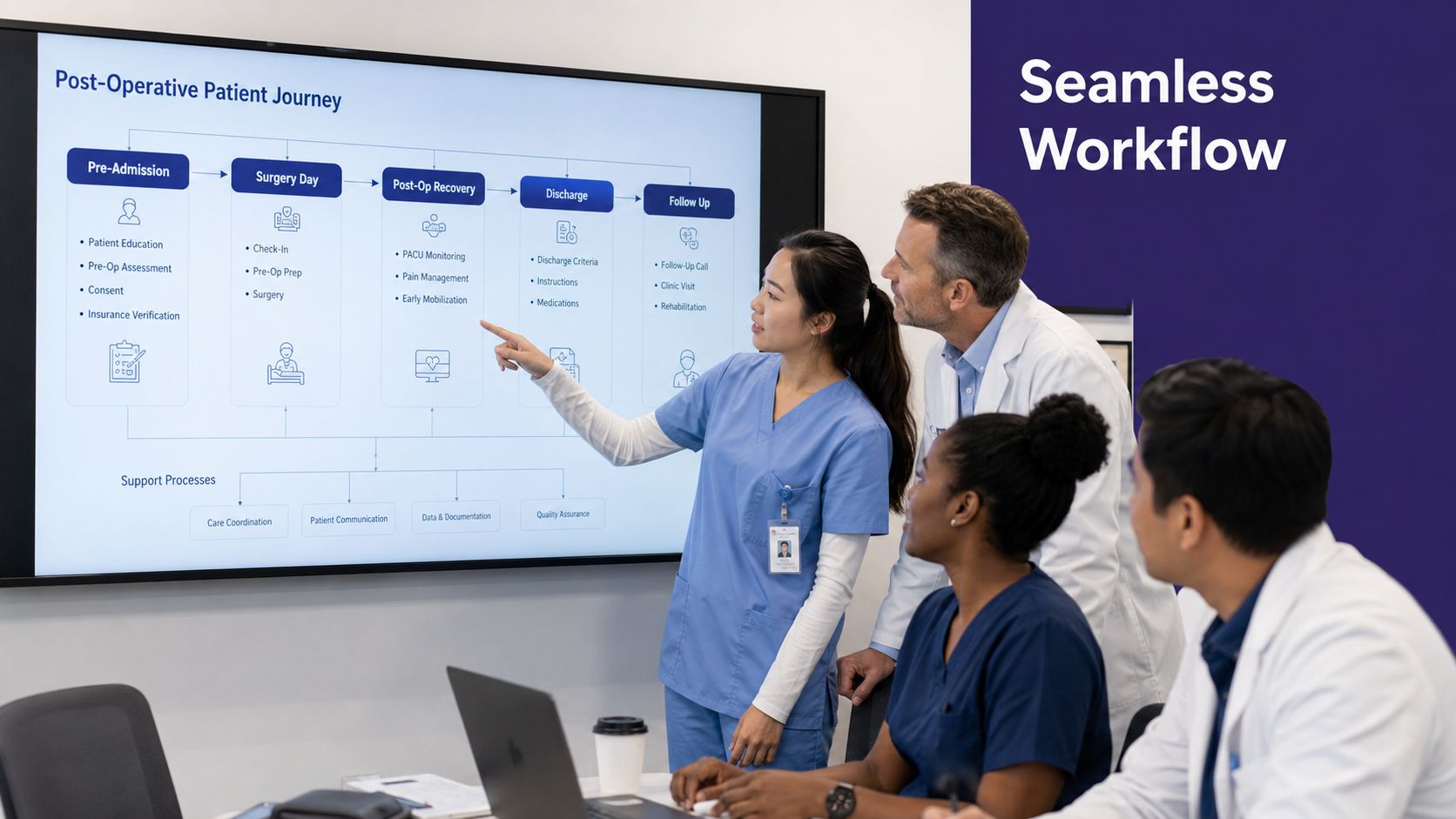
Start with the actual patient path, not your org chart. Write out every touchpoint from discharge orders to final clearance. Include who speaks to the patient, what the patient receives, where it gets documented, and what happens if the patient doesn't respond.
At minimum, the workflow should define:
- The discharge moment when instructions are reviewed and the patient knows what to expect next.
- The first outbound contact after the procedure.
- The follow-up appointment sequence with scheduling logic and reminder logic.
- Escalation criteria for symptoms, medication issues, wound concerns, or functional decline.
- Closure rules so the chart shows whether the patient completed the pathway or dropped out.
Many practices find it beneficial to look at broader digital health workflow solutions as process design examples, not because every tool will fit your clinic, but because they force the right question: where does the workflow start, where does it stall, and who owns the next move?
Build closed-loop communication
Closed loop means no instruction, call, or appointment is considered complete until the next step is confirmed and documented. A voicemail left is not a completed follow-up. A portal message sent is not a completed follow-up. A discharge packet handed over is definitely not a completed follow-up.
Use a simple operating standard:
| Workflow point | Required action | Completion standard |
|---|---|---|
| Discharge | Review instructions in plain language | Patient repeats back key next steps |
| Return visit | Schedule before discharge when possible | Date, time, and location confirmed |
| Outreach | Send reminder and conduct structured check-in | Response documented or retry sequence triggered |
| Escalation | Route concerning responses to clinician | Hand-off documented with owner and time |
| Closure | Confirm pathway completed | Final status visible in chart |
Practices that want to standardize this without rebuilding everything manually often start by formalizing the workflow inside existing systems and referencing examples from healthcare workflow automation.
Add social support before the patient goes home
One of the biggest misses in post-op planning is assuming adherence is purely an administrative issue. It isn't. Recent clinical guidance for older adults emphasizes that understanding a patient's social support system before surgery is essential to align resources and prevent post-discharge non-compliance according to Medscape's 2024 guidance on improving post-op care for older adults.
That matters even in smaller independent practices. If a patient can't drive, lives alone, gets confused by medication changes, or lacks a family member who can reinforce instructions, your follow-up plan should change. The schedule should be firmer, the check-ins more deliberate, and the education simpler.
Social support is not extra context. It's part of the follow-up plan.
Standardize the handoff, not just the call
A workable handoff script should answer four things before discharge:
- What should the patient do today
- What symptoms are expected
- What symptoms require contact
- When the practice will reach out next
That turns post-op follow up from a vague promise into a managed pathway. Once that's built, automation has something solid to execute.
Scripting Clinical Communication That Prevents Complications
The content of the check-in matters more than the fact that a call happened. Too many practices still run follow-up outreach like a courtesy callback. That misses the clinical point.

A useful script does three jobs at once. It checks for early warning signs, confirms adherence, and tests whether the patient understood the discharge plan. If your team only asks “Any problems?” patients will often say no, even when they've skipped medication doses, misunderstood wound care, or missed the reason for their return visit.
Ask narrow questions that produce actionable answers
Structured questions work better than broad ones. They should be short, concrete, and easy for non-clinicians to ask consistently.
For example:
- Pain control: “Are you taking the medication as instructed, and is the pain getting better, staying the same, or getting worse?”
- Wound or site concerns: “Have you noticed new redness, drainage, swelling, or bleeding?”
- Medication adherence: “Did you start every medication you were told to take after the procedure?”
- Function and mobility: “Are you able to walk, move, or do normal daily tasks at the level your clinician expected?”
- Appointment clarity: “Do you know when and where your next follow-up is?”
This style creates cleaner escalation decisions. It also improves documentation because the response can be charted in a repeatable format.
Use teach-back instead of repeating instructions louder
A patient saying “yes” does not mean the patient understood. Teach-back is still one of the most effective habits in follow-up communication. Ask the patient to restate the plan in their own words.
A simple version sounds like this:
“Tell me how you're taking your medications and what would make you call the office.”
That one sentence will reveal a surprising number of misunderstandings. It also gives your team a chance to correct errors before they turn into avoidable complications.
Define escalation rules before staff pick up the phone
Your staff should never have to improvise the threshold for escalation. Write it down. Keep it visible. Train to it.
A practical escalation framework looks like this:
- Routine responses stay in the standard workflow and get documented.
- Moderate concerns route to a nurse queue for same-day review.
- High-risk responses trigger immediate clinician notification according to your practice protocol.
Follow-up phone calls by themselves are not enough. Comprehensive discharge planning, individualized patient education, and timely follow-up with the operating surgeon or familiar providers can substantially reduce postoperative readmissions, whereas follow-up phone calls alone are not consistently sufficient according to a peer-reviewed review on interventions to reduce postoperative readmissions.
That finding matches what most experienced operators already know. Outreach works when it reinforces care, not when it substitutes for care.
Keep language plain, not polished
If your script sounds like documentation language, patients will tune out. Use short sentences. Name the symptom. Name the action. Name the deadline. Avoid stacked instructions.
For SMB practices, especially where call volume is high and staffing is tight, the best scripts are boring in the best possible way. They're predictable, teachable, and easy to audit. That's what prevents drift.
Integrating Automation and EMRs Intelligently
Once the workflow and the script are stable, automation becomes useful. Before that, it just accelerates inconsistency.
The first layer is simple. Most practices can configure reminder logic and task routing inside systems they already know, such as eClinicalWorks, Athenahealth, EMA ModMed, Epic, DrChrono, or gGastro. Appointment reminders, message templates, recall tasks, and chart prompts are basic but valuable. They reduce reliance on memory and help your team work from queues instead of scraps of paper.
Use automation for repetition, not judgment
The strongest use case for automation in post-op follow up is the repetitive work that humans are least likely to perform reliably at scale. That includes reminders, rescheduling touches, unanswered call retries, educational reinforcement, and structured intake questions that feed a standard note.
That matters because a significant proportion of patients aware of their missed appointments indicated that specific modifications, such as appointment reminders, could improve follow-up rates, suggesting that targeted interventions like automated reminders can boost postoperative care continuity in this study of missed follow-up after upper extremity surgery.
Automation can also reduce appointment friction when calendars stay aligned across front-desk tools and provider schedules. If your operation still struggles with mismatched slots or duplicate updates, even a practical reference on real-time calendar synchronization can help your team think more clearly about schedule consistency across systems.
Let the EMR become the operating surface
A reminder system outside the chart creates one more place for work to hide. The better approach is to keep follow-up status visible where your team already works. That means documenting outreach attempts, patient responses, escalation flags, and completed milestones directly in the patient record.
Practices exploring more advanced outreach often look at tools that connect with the chart rather than sitting beside it. For example, EMR-integrated automation can support outbound follow-up, documentation, and task routing across common platforms.
Here's the practical distinction:
| Tool type | What it handles well | Where it falls short |
|---|---|---|
| Basic reminder tools | Appointment nudges, simple confirmations | No clinical conversation |
| Portal messaging | Written reinforcement, non-urgent reminders | Low response from some patient groups |
| Staff outbound calls | Clinical nuance, relationship continuity | Hard to scale consistently |
| AI medical staff | High-volume outreach, structured screening, chart-ready documentation | Needs clear scripts and escalation rules |
A product such as Simbie AI fits as one operational option. It is positioned as AI medical staff, not just a phone tool, and can support both front-office tasks like scheduling and refill coordination and clinical workflow support like post-op calls, patient education reinforcement, adherence check-ins, and chart documentation. For independent practices, the appeal is usually operational: up to 60% reduction in front-office staff costs, 100% of inbound calls captured, 24/7 availability with zero hold times, plus HIPAA-compliant, SOC 2 Type 2 certified controls and integration with systems such as eClinicalWorks, gGastro, EMA ModMed, Athenahealth, Epic, and DrChrono.
The important point is not the brand. It's the design principle. Technology should execute the workflow you already defined, document the result, and hand off exceptions cleanly to humans.
Rethinking Staffing Models for a Hybrid Human-AI Approach
The old model is familiar. MAs, nurses, or front-desk staff make outbound follow-up calls between everything else. It feels cheaper because the work is spread around. In practice, it's usually more expensive because no one is truly responsible, call attempts are inconsistent, and licensed staff end up doing low-yield administrative work.

A hybrid model is more disciplined. Routine outreach gets standardized and scaled. Humans focus on interpretation, judgment, and intervention.
What the traditional model gets wrong
The traditional setup usually creates three operational problems:
- Task switching: Staff jump from rooming to phones to inboxes, which lowers accuracy and follow-through.
- Skill mismatch: Clinically trained people spend time on repetitive call attempts and reminder loops.
- Invisible backlog: Managers can't easily see who still needs outreach, who responded, and who is escalating.
That's why post-op work often feels “done” when it was only attempted.
What the hybrid model changes
In a hybrid model, the first layer of contact can be handled at scale. Routine calls, reminder sequences, education reinforcement, and structured screening questions happen consistently. Flagged patients then move to a nurse, APP, or physician based on clear thresholds.
Operational advice: Put humans where clinical ambiguity starts, not where repetitive outreach begins.
This matters because mobility and recovery can now be monitored more actively. Each additional 1,000 daily steps taken after surgery was associated with an 18% reduction in the odds of complications and a 16% reduction in hospital readmission likelihood, making step count a strong predictor of recovery that a hybrid team can monitor, as summarized in Medical News Today's report on postoperative step counts.
Even if your practice isn't collecting wearable data today, the staffing lesson still holds. High-frequency, low-complexity monitoring belongs in a scalable system. Interpretation and intervention belong with trained clinicians.
A side-by-side view
| Staffing model | Routine outreach | Clinical escalation | Documentation consistency | Burnout risk |
|---|---|---|---|---|
| Everyone does a little | Unpredictable | Delayed | Variable | High |
| Dedicated manual team | Better than ad hoc | Better | Moderate | Moderate |
| Hybrid human-AI | Consistent and continuous | Focused on flagged patients | High | Lower |
For independent practices, this is about protecting scarce talent. “Protecting Doctors' Time for Doctoring” only becomes real when physicians and nurses stop carrying avoidable call work. A voice AI agent for healthcare can support that model by handling the routine layer while staff keep full oversight and step in when nuance is required.
The payoff isn't just efficiency. Morale improves when people work at the top of their license and can finish the day's work.
Measuring What Matters for Post-Op Success
If you only track no-shows, you'll miss the complete picture. Post-op performance needs a small set of measures that reflect access, adherence, and clinical follow-through.
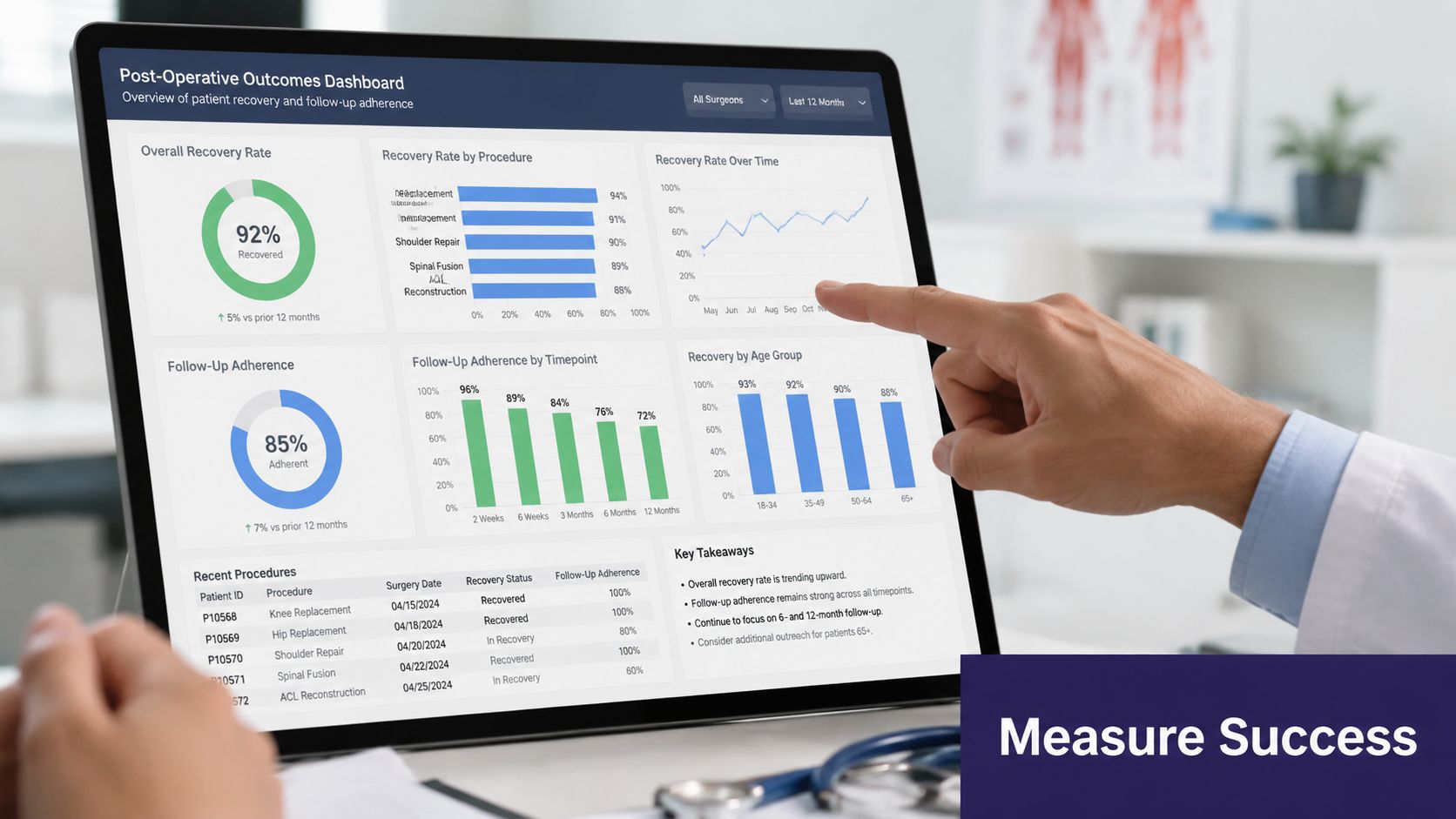
A stronger dashboard starts with follow-up compliance rate. In refractive surgery practices, the follow-up compliance rate is a critical surgical KPI that measures the exact percentage of patients who adhere to recommended post-operative follow-up appointments, serving as a direct metric for tracking and improving post-operative care performance according to LiveseySolar's overview of refractive surgery KPIs. The specialty is different, but the management principle applies broadly.
Use a balanced KPI set
The best practices don't overload themselves with metrics. They track a handful that can drive action.
Consider these categories:
- Access and completion
- Follow-up compliance rate: Did patients complete the recommended sequence, not just the first visit?
- Time to first contact: How quickly did the practice reach the patient after discharge?
- Clinical process
- Escalation rate: Are concerning findings being identified and routed appropriately?
- Education confirmation: Did the patient demonstrate understanding of instructions through teach-back or equivalent documentation?
- Operational reliability
- Documentation completion: Did each outreach attempt land in the chart in a usable format?
- Reschedule recovery: When a patient cancels, does the team successfully bring them back into the pathway?
Don't separate clinical quality from workflow quality
A common mistake is to let the clinical team own outcomes and the front office own scheduling. Post-op follow up sits in the middle, so your reporting should too. If patients miss return visits because your phone lines are overloaded, that's not a “front desk issue.” It's a clinical continuity issue.
Practices that want more mature reporting often need better data plumbing, not just better intentions. Resources on scalable data analysis for healthcare can be useful when you're trying to pull scheduling, communication, and outcome signals into one view.
Build a dashboard physicians will actually trust
Keep it simple enough to review in a monthly operations meeting. Show trends, exceptions, and action items. Pull data from the systems your team already uses. If your automation and outreach tools don't write back into the chart, your reporting will always be partial.
For smaller practices, a practical starting point is a compact metrics framework tied to scheduling, communication, and chart completion. That's the kind of structure discussed in medical practice metrics for healthcare operators.
The point of measurement is not to admire the dashboard. It's to spot where the pathway is leaking and fix it before patients feel the consequences.
When a practice treats follow-up as a managed system, the metrics get cleaner, the team gets calmer, and the physician stops hearing about preventable gaps only after they've become real problems.
If you're evaluating AI for your practice, you can see how Simbie AI supports post-op outreach, scheduling, documentation, and clinical follow-up workflows at book a demo.