

If you want to get serious about lowering costs, you have to start with a brutally honest look at your books. It's a straightforward, data-first approach: meticulously audit every single expense, from front-desk salaries to clinical supplies. This isn't just about budgeting; it's about creating a financial map that shows you exactly where money is being wasted and where you can make the biggest impact, fast. Getting a firm grip on your financial health is the essential first step to building a more resilient and profitable practice.
Pinpointing Your Biggest Cost Drivers

Before you can slash a single line item, you have to know precisely where your money is going. A quick glance at a high-level budget won't cut it. Real cost control begins with a deep-dive audit to uncover the hidden inefficiencies bleeding your practice dry across administrative, clinical, and financial operations. Without this granular understanding, any attempt to decrease healthcare costs is merely guesswork.
This initial diagnostic phase is non-negotiable. It’s where you build a data-driven baseline that informs every decision you make from here on out. Without this clarity, any cost-cutting effort is just a shot in the dark, likely to miss the biggest sources of financial drain and potentially harm patient care or staff morale.
Conducting a Comprehensive Cost Audit
First things first, pull your detailed expense reports for the last 12-18 months. And I mean detailed. Don't just look at broad categories like "payroll" or "supplies"—you need to break them down into their smallest components to see the real story. This is the only way to get a true picture of your spending habits and identify specific opportunities for savings.
For example, "administrative costs" is a massive bucket. Let's dissect it:
- Billing and Coding: What are you actually paying your third-party service? More importantly, what’s your denial rate? A high number here means you're paying people to do work that has to be done over and over again, a classic example of operational waste.
- Front-Desk Operations: Think about the time your staff spends on manual scheduling, phone tag, and patient intake. Time is money, and clunky front-office workflows are a huge, often invisible, cost driver that directly impacts both efficiency and patient satisfaction.
- IT and Software: Are you still paying for software licenses or premium features that no one on your team even uses? Those small monthly subscriptions add up quickly and can represent significant "ghost" expenses over a year.
The same logic applies to your clinical operations. It’s not just about physician salaries. You have to analyze everything from medical supply usage to procedure-specific costs. Expensive pharmaceuticals, underused diagnostic machines, and choppy patient flow all hammer your bottom line and represent areas ripe for optimization.
A classic mistake I see is practices fixating on big-ticket items while completely ignoring the slow, steady bleed from smaller, recurring expenses. Saving a few hundred dollars a month on smarter supply ordering or less administrative rework can easily translate into tens of thousands in annual savings.
Sorting Expenses for Actionable Insights
With a granular list of expenses in hand, it's time to categorize them. This simple framework is incredibly powerful for prioritizing your efforts and showing you what you can actually control. I recommend sorting every expense into one of three buckets: fixed, variable, or avoidable. This classification is key to developing a targeted cost reduction strategy.
- Fixed Costs: These are your predictable, consistent expenses—things like rent, insurance premiums, and base salaries. They're tough to change overnight but are crucial for baseline budgeting and long-term financial planning.
- Variable Costs: These costs move with your patient volume. Think medical supplies, lab fees, and hourly staff wages. This is often fertile ground for finding savings through better management, improved efficiency, and strategic vendor negotiations.
- Avoidable Costs: This is where the gold is. These are the expenses born from inefficiency, waste, or just plain outdated processes. We're talking about paying for expedited shipping because of poor inventory management, overtime pay caused by a chaotic schedule, or revenue lost to simple coding errors. Identifying and eliminating these is the fastest way to impact your bottom line.
To help you get started, here's a framework we use with practices to begin categorizing their primary cost centers and identifying where to look first.
Initial Cost Assessment Framework
This table provides a structured way to start breaking down your major cost areas, define what to measure, and pinpoint where to start digging.
| Cost Category | Key Metrics to Track | Example High-Cost Driver | Initial Action Step |
|---|---|---|---|
| Administrative Overhead | Staff time per task, call volume, no-show rate | Manual phone-based scheduling and reminders | Analyze front-desk call logs and appointment confirmation workflows. |
| Clinical Operations | Supply waste %, cost-per-procedure, room turnover time | High-cost, single-use supplies or brand-name drugs | Review supply ordering patterns and research clinical equivalents. |
| Revenue Cycle Management | Claim denial rate, days in A/R, cost to collect | High percentage of denied claims due to coding errors | Perform a root-cause analysis on your top 5 denial reasons. |
| Staffing & Payroll | Overtime hours, staff turnover rate, patient-to-staff ratio | Unpredictable patient flow leading to staff overtime | Map patient check-in to check-out times to identify bottlenecks. |
This kind of structured analysis moves you from a reactive "we need to cut costs" mindset to a proactive, strategic plan. It empowers you to make informed decisions based on data, not just intuition.
Establishing Your Key Performance Indicators
With your costs audited and categorized, the final piece of the puzzle is setting up your Key Performance Indicators (KPIs). Data is your best friend here—it provides the objective proof you need to know if your cost-saving initiatives are actually working. Without KPIs, you're flying blind.
Pick a handful of metrics that give you a clear, immediate signal of your practice's operational and financial health. This becomes your dashboard.
- Cost-Per-Patient Visit: Your total operational cost divided by the number of patient visits. This is the ultimate efficiency metric, providing a high-level view of your cost structure.
- Supply Waste Percentage: The dollar value of expired or unused supplies as a percentage of your total supply budget. This directly measures supply chain efficiency.
- Claim Denial Rate: A direct measure of your revenue cycle's health. The industry average hovers around 5-10%; if you're above that, you've got a significant problem that needs immediate attention.
- Staff Overtime Hours: This KPI is a fantastic canary in the coal mine, often revealing deeper issues with scheduling, workflow bottlenecks, or inadequate staffing levels.
Armed with this detailed financial map, categorized expenses, and clear KPIs, you’re no longer just hoping to decrease costs—you have a strategic plan to make it happen. This is the foundation for every other effective cost-reduction strategy you'll implement.
Optimizing Staffing and Clinical Workflows
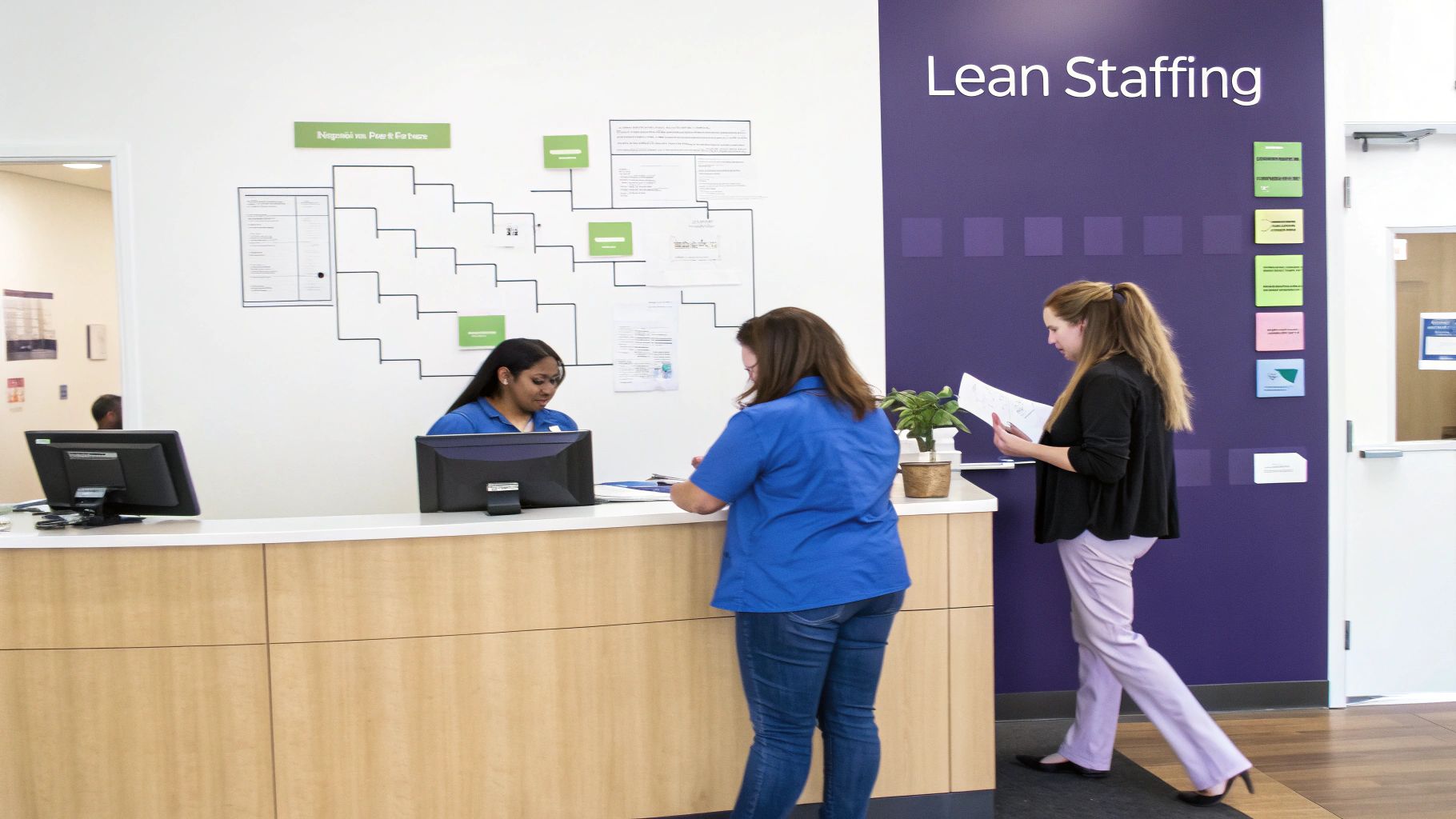
Let's be honest: your team is your greatest asset, but they're also your biggest expense. With labor costs eating up over 50% of a typical practice's budget, even small tweaks to staffing efficiency can make a huge difference to your bottom line. An intelligent approach to staffing is a critical component of any plan for how to decrease healthcare costs.
This isn’t about just cutting hours or staff. It’s about building a smarter, more agile operation. The real goal is to match your staffing to actual patient demand and make sure every single person on your team is focused on what they do best, working at the top of their license.
Map the Patient Journey to Find the Bottlenecks
You can't fix a workflow problem you can't see. The best way I've found to get a clear picture is to literally map the entire patient journey, from the first phone call to the final payment. This simple exercise almost always uncovers surprising logjams that frustrate patients and secretly inflate your costs.
Get a whiteboard and follow a single patient through your system. Document every touchpoint and how long each step takes.
- First Contact: How long is a new patient on hold before they can book an appointment? Are they forced to navigate a confusing phone tree?
- Check-In: What's the average wait time in your lobby? How much repetitive paperwork are they filling out that could be digitized?
- The Encounter: How long does the patient sit alone in the exam room waiting for the doctor or nurse? What inefficiencies are happening during clinical handoffs?
- Check-Out: Are co-pays collected smoothly? How quickly is the claim actually submitted? Are patients leaving with clear follow-up instructions?
I saw this play out at a small primary care clinic. After mapping their process, they were shocked to find their Medical Assistants (MAs) spent nearly 25% of their day on the phone scheduling follow-ups. That’s a task that administrative staff could easily handle. Meanwhile, patients were backing up in the waiting room because the MAs couldn't room them fast enough, creating a domino effect of delays all afternoon.
Match Your Staffing to Real Patient Demand
A rigid, one-size-fits-all staffing schedule is a relic of the past. Your patient flow has predictable peaks and valleys, and your staffing model needs to reflect that. Moving to a more flexible, demand-based approach is one of the quickest ways to cut down on unnecessary overtime and prevent staff burnout.
A great starting point is to pull your appointment data from the last six months. Look for the patterns.
Are Monday mornings a madhouse of phone calls? Is Thursday afternoon always dead? This data is gold for optimizing schedules.
For example, a pediatric practice I worked with noticed a huge spike in sick-visit calls every morning between 8 AM and 10 AM. By simply scheduling one extra admin just for those two hours to handle phones, they slashed patient hold times and freed up their nurses to focus on clinical triage. Many practices are also turning to dedicated healthcare staff scheduling software that can analyze this data for you and recommend optimal staffing patterns, taking the guesswork out of the equation.
Let Your Team Work at the Top of Their License
One of the biggest hidden money drains in any practice is having highly skilled clinicians doing work that could be delegated. When a registered nurse is bogged down with paperwork or a physician is handling routine prescription refill requests, you're not just overpaying for that task—you're wasting their most valuable clinical time. This is a fundamental principle of operational efficiency.
The "top of license" rule is simple: Every task should be handled by the least expensive person who is qualified to do it. This isn't about cutting corners on care; it's about smart delegation and resource allocation.
To put this into practice, do a quick task audit for each role. Make a list of all the daily duties for your nurses, MAs, and physicians. Then, for every single item on that list, ask the critical question: "Could someone else on this team handle this safely and effectively?"
This process often reveals immediate opportunities to reassign duties. You might find that MAs can handle more rooming responsibilities, or that front-desk staff can manage prior authorization follow-ups. You might even find it makes sense to explore cost-effective strategies for hiring virtual assistants to take over non-clinical tasks like appointment reminders, data entry, or insurance verifications. This frees up your on-site team for what matters most: direct patient care.
Leveraging Technology for Smarter Operations

It’s easy to look at technology as just another line item in the budget. But in reality, it's one of the most powerful levers you have for cutting costs and making your practice run smarter, not harder. Strategic technology adoption is a cornerstone of modern healthcare cost reduction.
The goal isn’t to just digitize your old, clunky processes. It’s about strategically eliminating the soul-crushing, repetitive tasks that burn out your staff and drive up your overhead. When you automate the right things, your team can finally shift from administrative busywork to the high-value, patient-focused care they were hired to do.
Automating the Front Desk and Patient Communication
Think about your front desk. It's the nerve center of your practice, but it's probably buried under an avalanche of manual work. How many hours a day are lost to phone calls for scheduling, prescription refills, and answering the same basic questions over and over? This constant fire-fighting pulls your team away from the patients standing right in front of them and inflates your administrative burden.
This is exactly where an AI-powered voice agent or a smart digital scheduling tool can be a game-changer. These systems work around the clock, handling routine requests without needing a person on the other end.
- Appointment Management: An AI can book, confirm, and reschedule appointments by phone or text. This alone slashes no-show rates and frees up your phone lines for more complex patient needs.
- Prescription Refills: Instead of a nurse or MA playing phone tag, an automated system can securely log refill requests and queue them up for clinical review. It’s faster for the patient and way more efficient for your team.
- Routine Inquiries: Let the bots handle the simple stuff. Answering questions about office hours, directions, or accepted insurance plans filters out the calls that don’t actually require a human touch, saving valuable staff time.
By offloading these high-volume, low-complexity tasks, you aren’t just cutting administrative costs—you’re transforming the patient experience. Imagine a world with no hold times, where your front desk staff has the breathing room to give a warm, personal welcome to every person who walks through the door.
Streamlining the Revenue Cycle with Automation
The revenue cycle is another place where manual work creates expensive friction. From submitting a claim to chasing down a denial, every human touchpoint is a chance for error and delay, which directly impacts your cash flow. One simple typo can trigger a denial, forcing your billing team to spend hours on rework they shouldn't have to do. This inefficiency is a major barrier to decreasing healthcare costs.
Automation tools are built to bring precision and speed to this entire process.
- Automated Claims Scrubbing: Good software can "scrub" a claim before it's even submitted, catching common errors and flagging potential issues. This dramatically increases your first-pass acceptance rate and accelerates reimbursement.
- Denial Management Workflows: When a denial does happen, an automated system can instantly categorize the reason and route it to the right person with all the necessary info, cutting the appeal time down significantly.
- Prior Authorization Automation: This is the administrative headache that plagues nearly every practice. Modern tools can now initiate and track prior authorizations electronically, lifting a massive burden from your team and preventing care delays.
This is about more than just getting paid faster. It’s about plugging the leaks in your billing process and reducing the labor costs that come with it. As you look into this, it’s worth seeing how others are automating their healthcare processes to sharpen their financial performance.
Calculating the ROI on New Technology
New tech always comes with a price tag, and you have to be able to justify it. A clear return on investment (ROI) calculation is your best friend for getting leadership buy-in and making sure a tool actually delivers what it promises. Don't overcomplicate it; a simple, practical approach is all you need to get started.
Example ROI Calculation for an AI Scheduler:
Let's say your front desk staff earns $20/hour and spends a conservative 3 hours per day just scheduling appointments over the phone. That’s $60 per day in pure labor cost for one task.
- Calculate Current Annual Cost: $60/day x 5 days/week x 50 weeks/year = $15,000 per year. That's what you're currently spending on manual scheduling.
- Estimate New Tech Cost: A good AI scheduling tool might have an annual subscription of $5,000.
- Calculate Net Savings: $15,000 (labor saved) – $5,000 (tech cost) = $10,000 in net annual savings.
This quick math shows a clear financial win. And that doesn't even touch the "soft" returns, like less staff burnout and freeing up that team member to focus on more valuable work, like helping a patient understand their insurance benefits.
When you pair this kind of automation with smart staffing models, the savings multiply. Exploring different telehealth staffing solutions, for example, can further leverage technology to reduce overhead and expand patient access at the same time.
Taking a Hard Look at Your Vendor Contracts and Supply Chain
Some of the biggest savings you can find are hiding in plain sight—stuffed in filing cabinets and sitting on supply closet shelves. Your vendor agreements and the way you manage supplies are huge opportunities to cut costs. Getting a handle on these expenses is one of the most direct ways to boost your bottom line, and you can do it without ever touching the quality of patient care.
It all starts with one simple, but powerful, action: pull every single vendor contract you have. I'm talking about everything—your labs, medical suppliers, software providers, even the company that handles your office cleaning or linen service. So many practices are on autopilot with contracts that renew automatically. If you haven't looked at them in years, you're almost certainly leaving money on the table.
Dig In and Don't Be Afraid to Renegotiate
Once you have those contracts in hand, it’s time to put on your detective hat. For each one, you need to find your leverage.
- When does it renew? Put a reminder in your calendar for 90 days before the renewal date. This gives you plenty of time to negotiate without being backed into a corner.
- What are the exit clauses? Knowing how you can walk away is your ace in the hole. Sometimes, just showing you're willing to leave is your most powerful negotiating tool.
- Are you hitting your volume targets? A lot of contracts have tiered pricing. If your practice has grown since you signed, you might already qualify for a better rate and not even know it.
Armed with this info, get your account rep on the phone. Be direct. A simple, "We're reviewing all our operational expenses and need to find a way to lower our costs here," can work wonders. You’d be surprised how many vendors will bend to keep your business.
Here's a pro tip: The biggest mistake I see practices make is assuming prices are set in stone. They almost never are. A single phone call where you mention a competitor's price can magically unlock a 10-15% discount. Vendors would much rather give you a better deal than lose you completely.
Combine Your Orders for Real Clout
Are you buying gloves from one place, gauze from another, and printer paper from a third? That fragmented approach kills your purchasing power. When you consolidate your orders with just a few core vendors, you become a much more valuable customer, and that gives you leverage for better pricing.
This is also the perfect time to look into a Group Purchasing Organization (GPO). GPOs negotiate massive contracts for thousands of practices just like yours. They use that collective buying power to get prices you could never dream of on your own. The administrative fees are usually a drop in the bucket compared to what you'll save on everything from medical supplies to office equipment.
Stop Letting Your Supply Closet Bleed Money
If it's not managed well, your supply closet is a financial black hole. Every expired syringe, every lost box of gloves, is cash straight into the trash. A disciplined approach to inventory can free up thousands of dollars.
The goal is to shift from a "just in case" mindset to a "just in time" model. Instead of over-ordering to feel safe, look at your past data to figure out what you actually use. A simple tracking system—even a well-organized spreadsheet—can help you see how quickly you go through items and when you truly need to reorder. This stops both wasteful overstocking and expensive last-minute rush orders.
Get Smart About Biosimilars
For most practices, drug costs are a massive line item that only seems to go up. One of the best ways to get this under control is to start using biosimilars. These are FDA-approved medications that are clinically the same as their more expensive brand-name biologic counterparts.
The impact can be huge. In one case, a strategic push for biosimilars caused the adoption rate for a Humira alternative to jump from just 3% to 28%, creating massive savings for health plans. You can dig into the numbers in PwC's research on cost-containment strategies. Working biosimilars into your clinical pathways, where it makes sense, can cut your drug spending almost overnight.
Driving Down Costs with Preventive Care

Sometimes the most effective way to lower healthcare costs isn't found in a spreadsheet or a vendor contract—it's by keeping your patients healthy in the first place. Shifting your focus from reactive treatment to proactive prevention is a powerful, yet often overlooked, financial strategy.
It’s all about getting ahead of expensive health crises before they ever begin. This approach directly cuts down on the high-cost events that strain your practice and your patients, like ER visits, hospitalizations, and complex surgeries. When you build a business case for wellness, you're not just improving community health; you're building a more financially sound future for your organization.
Building Proactive Care Programs That Pay Off
Getting a preventive care program off the ground is more straightforward than many practice leaders think. It all starts with identifying which patient groups are most at risk for chronic conditions like diabetes, hypertension, or heart disease. From there, you can design targeted, cost-effective programs that make a real difference.
- Chronic Care Management (CCM): For your Medicare patients, CCM programs are a fantastic, well-reimbursed way to offer continuous support between office visits. This steady engagement helps manage conditions day-to-day, preventing acute flare-ups that result in costly hospital stays.
- Annual Wellness Visits (AWVs): These visits are goldmines for creating personalized prevention plans. They’re the perfect opportunity to catch health issues early and establish a health baseline for each patient, all while generating a reliable revenue stream for the practice.
- Targeted Health Screenings: Make it easy for patients to get screened for common conditions based on their age and risk factors. You’ll identify problems when they are far easier—and cheaper—to treat.
These programs do more than just manage disease; they foster strong, lasting relationships with your patients. Understanding what care coordination in healthcare means is the glue that holds these preventive efforts together, ensuring nothing falls through the cracks.
The real magic of preventive care is that it turns the traditional healthcare model on its head. Instead of waiting for a patient to get sick enough to need your most expensive services, you're actively working to keep them out of the high-cost parts of the system. It’s a win for their health and a win for your bottom line.
Empowering Patients with Modern Engagement Tools
Technology today makes it easier than ever to get patients involved in managing their own health. These tools extend your practice’s reach far beyond the clinic walls, providing the kind of continuous support that leads to real, lasting behavior change. They also deliver a steady stream of data to inform care plans and prevent complications.
Modern patient engagement tools include:
- Telehealth Platforms: Regular virtual check-ins make it simple to monitor patients with chronic conditions, adjust medications, and answer quick questions without the time and expense of a full in-person visit.
- Remote Patient Monitoring (RPM): Devices that track vitals like blood pressure or glucose levels from a patient’s home give you real-time insight. This allows your team to intervene before a small problem becomes a major medical event.
- Automated Educational Outreach: You can send automated, personalized health tips and reminders via text or email. This keeps patients engaged and thinking about their health goals long after they've left your office.
Diving into preventive care isn't just good medicine; it's smart business. Analysis from Deloitte on the future of healthcare spending confirms that these initiatives create meaningful long-term savings by improving population health and reducing the need for acute care. By empowering patients to become active participants in their own wellness, you create a positive cycle of better outcomes and lower costs.
Answering Your Top Questions on Healthcare Cost Reduction
Cutting costs in a healthcare setting can feel like a maze, but you're not alone. Most practice leaders I talk to are asking the same questions and running into the same roadblocks. Let's tackle some of the most common ones head-on.
Think of this as a practical FAQ from someone who's been in the trenches. We'll skip the jargon and get straight to what actually moves the needle.
What Are the First Steps a Small Practice Should Take?
For smaller practices, the biggest wins almost always come from small, targeted changes. You don't need to rip everything up and start over to see a real difference. The key is to find the high-frequency tasks that are eating up your time and money.
Start by pulling up your top three non-payroll expenses. It's usually supplies, rent, and billing services. Instead of just hitting "reorder" on supplies, actually look at your usage. Joining a group purchasing organization (GPO) is a no-brainer and can easily slash your supply costs by 10-15%.
Next, get honest about your billing. Is your claim denial rate creeping above the 5% industry benchmark? If it is, you're literally just leaving money on the table. A better RCM partner or software often pays for itself simply by getting more of your claims paid on the first pass. Finally, a simple automated appointment reminder system can drastically cut down on costly no-shows. These aren't huge, complex projects, but their financial impact is immediate.
How Can We Bring in New Tech Without a Huge Budget?
This is a big one. The old idea that new technology requires a massive upfront capital investment just isn't true anymore. Most health tech is now sold as a subscription service (SaaS), turning a huge one-time expense into a predictable, manageable monthly fee. This opens the door for practices of any size to access powerful tools.
My advice? Start small with one specific pain point. Maybe it’s a digital patient intake form or an automated scheduler. Run a pilot for a month or two and track the results—how many hours did it save? How many data entry errors did it prevent?
Use that data to prove the ROI. For instance, if a new scheduling tool frees up your front desk for five hours a week, that’s 260 hours a year. At $20/hour, you’ve just saved $5,200 in labor costs, which will likely more than cover the subscription fee.
Don’t be afraid to ask vendors about phased rollouts or introductory pricing. A good partner will work with you. This way, you can modernize your practice at a pace that both your budget and your team can handle.
Is Investing in Preventive Care Really Worth It for a Fee-for-Service Practice?
Absolutely. It's one of the biggest myths in healthcare finance that preventive care only pays off in a value-based model. Fee-for-service practices that ignore it are missing out on significant, reliable revenue.
Many preventive services, like Medicare's Annual Wellness Visits (AWVs), are well-reimbursed. Setting up a Chronic Care Management (CCM) program is another fantastic way to get paid for the care coordination work your team is probably already doing for free.
But it's not just about direct billing. Proactive care creates incredibly loyal patients, which means less churn and more word-of-mouth referrals. Healthier patients also lead to a more predictable schedule filled with routine, billable services, rather than a chaotic stream of last-minute emergencies.
Where Do Most Practices Overlook Potential Savings?
Hands down, the most overlooked area is the "soft costs" hidden inside clunky, inefficient workflows. These are the expenses that don't appear as a line item on your P&L but are quietly draining your resources every single day.
Take a hard look at how your clinical staff spends their time. How many hours are they burning on administrative work that could be automated or delegated? Every minute a nurse spends chasing down a prior authorization or an MA spends manually keying in data from a paper form is a hidden cost.
Map out a few of these internal processes. You’ll probably be shocked to find your team is bogged down by things like prescription refill requests or phone tag with other providers. These aren't top-of-license clinical tasks. The goal isn't to cut corners or people; it's to free up your talented team to focus on what they do best: patient care.
Ready to slash administrative overhead by up to 60%? Simbie AI automates patient intake, scheduling, refills, and more, freeing your staff to focus on what matters most. See how our clinically-trained voice AI can transform your practice's efficiency and financial performance at https://www.simbie.ai.