
The most common advice on healthcare provider burnout still misses the point. Telling clinicians to build more resilience, attend another wellness session, or download a meditation app doesn't fix a workday that is badly designed.
I've seen this firsthand in practice operations. Burnout doesn't ease because leaders tell people to cope better. It eases when we remove pointless friction, reduce after-hours work, give teams more control, and stop burying clinical judgment under clerical load. That's the difference between a wellness program and an operating model.
The complex reality of healthcare provider burnout today
The easy story is that burnout is getting better, so the crisis is fading. The harder truth is that the acute spike has eased, but the structure that produced it is still in place.
The American Medical Association reports that physician burnout fell to 45.2% in 2023 from 62.8% in 2021, returning to roughly 2017 levels, which means the emergency phase cooled off but the underlying system did not materially change (AMA physician burnout trends). I don't read that as a victory lap. I read it as a warning that many organizations are now living with a level of distress they've started to treat as normal.
Improvement is real, but it's incomplete
That distinction matters because leaders often react to modest improvement by backing away from operational fixes. They assume the worst has passed, so they put burnout back in the HR bucket.
That's a mistake. Healthcare provider burnout is still an operations problem, a staffing problem, and a workflow problem. It sits right beside access, retention, patient experience, and revenue cycle pressure.
Burnout rarely disappears on its own. Most of the time, it gets redistributed across the team.
In my experience, the burden shifts rather than vanishes. One practice reduces physician inbox volume, but front-desk staff drown in calls. A hospital improves shift coverage, but leaves documentation untouched. A clinic adds mental health resources, but doesn't change who handles refills, prior auths, or scheduling.
Why leaders need a wider frame
If you treat burnout as an individual weakness, you'll buy coping tools. If you treat it as a systems failure, you'll redesign work.
That's also why burnout belongs in the same conversation as staffing resilience and capacity planning. Leaders looking at healthcare workforce shortage solutions should include burnout prevention in that work, because a workforce strategy that keeps people exhausted isn't a workforce strategy at all.
Putting numbers to the crisis in 2026
The data is clear enough to move this out of the realm of anecdote. Burnout is still widespread, and it cuts across specialties, settings, and roles.

According to the AMA's 2025 physician well-being reporting summarized by Fierce Healthcare, 41.9% of physicians reported at least one symptom of burnout in 2025. That was down from 43.2% in 2024 and 48.2% in 2023, but “down” is not the same as “solved.” The same report says 42.9% of physicians still felt a great deal of job stress in 2025.
The specialty pattern tells the real story
What gets my attention is the spread across specialties. The same 2025 data shows burnout at 49.8% in emergency medicine, 49.5% in urological surgery, 49.3% in hematology and oncology, 45.7% in obstetrics and gynecology, and 45.2% in radiology. Even infectious diseases, listed among lower-burnout specialties, still reported 23.3% burnout in that dataset.
That tells leaders something practical. This isn't a problem sitting in one department with a weak manager. It's system-wide strain showing up in different ways.
| Specialty or measure | Burnout rate |
|---|---|
| Physicians with at least one burnout symptom in 2025 | 41.9% |
| Emergency medicine | 49.8% |
| Urological surgery | 49.5% |
| Hematology and oncology | 49.3% |
| Obstetrics and gynecology | 45.7% |
| Radiology | 45.2% |
| Infectious diseases | 23.3% |
The longer trend matters too
A peer-reviewed JAMA Network Open study of U.S. healthcare workers tracked burnout from 2018 to 2023 and found rates of 30.4% in 2018, 31.3% in 2019, 30.9% in 2020, 35.4% in 2021, 39.8% in 2022, and 35.4% in 2023. That means burnout rose by 9.4 percentage points from 2020 to 2022, then stayed above pre-pandemic levels in 2023.
The same study found primary care physicians had the highest burnout among service areas, ranging from 46.2% in 2018 to 57.6% in 2022. That fits what many of us see operationally. Primary care absorbs coordination work, inbox work, chronic disease management, referral follow-up, and patient messaging on top of direct visits.
This is more than a hard-job problem
The AMA has also reported that physicians were 82.3% more likely to experience burnout than U.S. workers in other occupations after adjustment for age, gender, relationship status, and work hours (AMA national physician burnout survey). That matters because it pushes back on a lazy explanation. This isn't only about people working long hours. Healthcare has its own organizational stressors, and leaders need to address those directly.
The real drivers behind provider burnout
Burnout doesn't come from one bad week. It usually comes from repeated work patterns that drain attention, time, and professional control.
One of the clearest drivers is documentation and EHR work that spills beyond the shift. A 2024 systematic review and meta-analysis in JMIR Medical Informatics found a pooled burnout prevalence of 40.4% among healthcare professionals and reported that time spent on EHR tasks outside scheduled work was associated with 2.43 times higher odds of burnout. It also noted that longer daily EHR duration correlated with higher burnout prevalence.

Administrative work is not neutral
Leaders sometimes talk about admin tasks as if they're just part of modern care. They aren't neutral. They crowd out recovery time, they break concentration, and they turn highly trained clinicians into clerical backstops.
I've seen the same pattern across practices:
- Inbox sprawl: Results, refill requests, patient messages, and approval requests arrive all day, so clinicians leave with unfinished cognitive work.
- Fragmented phone workflows: Front-desk teams field the same scheduling, refill, and paperwork questions over and over, then route exceptions manually.
- After-hours charting: Notes don't get done in clinic hours, so people finish them late, which pushes stress into home life.
- Authorization drag: Prior auths and payer follow-up consume staff attention, and denials create rework that hits both clinicians and billing teams.
That last point matters more than many burnout discussions admit. If your organization is struggling with payer friction, work on denial patterns too. A practical example is resolving behavioral health claim denials, because denial cleanup often creates repeat chart review, resubmission work, and clinician queries that nobody counts when talking about burnout.
Practical rule: If a task repeatedly interrupts care and doesn't require clinical judgment, treat it as redesign work.
Loss of control is often the breaking point
Two clinicians can carry similar patient loads and feel very different. The one with some control over scheduling, support, and task routing can usually sustain the work longer. The one who has no say in pace, panel flow, or inbox burden burns out faster.
That's why generic advice fails. Yoga doesn't fix a refill queue. Breathing exercises don't repair a broken triage model.
Underserved settings carry a different burden
In safety-net and underserved environments, the mechanism of burnout can look different. A study on burnout in these settings points to limited resources, barriers to building trust with patients, administrative requirements, and compassion fatigue as major drivers. That matches what many leaders in community care already know. Staff aren't only tired. They're trying to deliver good care inside scarcity, social complexity, and moral strain.
That's why workflow relief matters so much. In those settings, motivational messaging can even backfire if it sounds like leaders are asking people to absorb more pain with a better attitude.
How to see and measure burnout in your organization
You can't manage what you only discuss in broad terms. Burnout needs local measurement, not just national awareness.
I don't start with a long committee process. I start by looking for friction signals in the day-to-day work. Who is staying late? Which inboxes pile up? Where do people get interrupted most often? Which roles are doing work that should have been redesigned six months ago?
Start with what you can observe
You don't need a formal instrument on day one to notice that something is off.
Watch for patterns like these:
- Rising cynicism: Staff become more detached, more irritable, or more likely to describe patients and tasks in transactional terms.
- Avoidance behavior: Teams delay messages, leave calls unanswered longer, or push decisions downstream because they don't have the bandwidth.
- Breakdown in teamwork: Handoffs get rougher, cross-coverage creates tension, and people guard time instead of helping each other.
- Quiet attrition signs: Increased call-outs, requests for reduced hours, or strong performers withdrawing from improvement work.
Those signals matter even more in clinics serving vulnerable populations. In underserved settings, the visible issue may look like fatigue, but the deeper problem may be the emotional load of trust-building, resource scarcity, and compassion fatigue. That's one reason I like to pair staff observation with a few operational measures, not just sentiment alone.
A useful companion to this work is tracking medical practice metrics that affect operations, because burnout often shows up first in throughput delays, call handling strain, or backlog growth before people say it out loud.
Use a short pulse survey before you use a bigger tool
The Maslach Burnout Inventory is widely used and worth considering if you want a structured assessment. But many organizations wait too long because they think measurement has to be perfect.
A short anonymous pulse survey can tell you a lot. I'd keep it plain and repeat it on a regular cadence. Ask questions such as:
| Question to ask | What it helps you see |
|---|---|
| How much control do you feel you have over your workload? | Autonomy and pace |
| How often do you finish required work during scheduled hours? | After-hours burden |
| Which task wastes the most time in your week? | Process targets |
| Do you feel your work is valued by this organization? | Recognition and trust |
Ask fewer questions, ask them regularly, and show people what changed because they answered.
Don't measure burnout in isolation
A survey score without workflow context can send you in the wrong direction. If one department reports high distress, look at staffing, scheduling logic, inbox routing, phone burden, and documentation expectations before you prescribe another wellness resource.
Burnout data becomes useful when it points to a fix.
A multi-level strategy for meaningful change
Organizations that make progress usually stop looking for a single cure. Burnout responds best to a layered response, because the causes sit at more than one level.

Start with the individual, but don't stop there
Individual support still matters. I'm not against counseling access, peer support, protected recovery time, or stress-management tools. Those can help people cope while larger fixes are underway.
What doesn't work is pretending individual support is the intervention. If your clinicians are doing hours of clerical work after clinic, resilience training becomes a bandage on a process problem.
For leaders building manager training or people policies, broader strategies for managing workplace well-being can be useful. The mistake is treating general well-being guidance as enough for a healthcare environment with heavy documentation, payer friction, and nonstop interruptions.
Fix the team layer where daily pain actually lives
Most burnout is experienced at the unit, clinic, or pod level. That's where the workday either holds together or falls apart.
A practical team-level plan often includes:
- Protected focus blocks: Give clinicians windows where inbox work, calls, and nonurgent interruptions are filtered.
- Daily load balancing: Brief huddles can surface which schedules are overloaded, which clinicians need support, and where tasks can be reassigned.
- Clear task ownership: Refill queues, patient forms, and prior auth prep should not drift to whoever is least able to say no.
- Escalation rules: Teams need to know what requires a clinician now, what can wait, and what can be handled by protocol.
I've seen simple ownership rules do more for morale than expensive well-being campaigns. People can handle hard work better than chaotic work.
Make the organizational decisions only leaders can make
Many burnout plans collapse because executives approve awareness efforts but avoid decisions that change throughput assumptions, staffing models, or documentation policy.
Leaders need to act on issues only they can solve:
| Organizational lever | What it changes |
|---|---|
| Staffing model review | Reduces chronic overload and unsafe coverage patterns |
| Schedule control | Gives clinicians more say over pace and session design |
| Documentation policy | Cuts unnecessary note bloat and duplicate work |
| Administrative redesign | Moves repetitive tasks away from clinicians where possible |
| Manager accountability | Ties burnout reduction to real operating decisions |
If a clinician needs an MD or DO license to complete the task, keep it with the clinician. If not, ask why it still sits there.
That principle has saved us from a lot of magical thinking. Burnout work gets real when leaders start pulling tasks apart, role by role, and decide what requires clinical training.
Using technology to give clinicians their time back
Technology can worsen burnout when it adds another screen, another login, or another inbox. It helps only when it removes work that people hate doing and shouldn't be doing in the first place.
That means the target is not “digital transformation.” The target is repetitive administrative load. Phone calls about scheduling. Prescription refill intake. Prior auth follow-up. Patient intake questions. Documentation steps that can be structured and routed instead of retyped.
What useful automation looks like in a clinic
In practice, I'd evaluate tools based on one question. Do they remove work from the clinical day, or do they just shift work around?
The strongest use cases usually have four traits:
- High volume: The task happens constantly.
- Low complexity at intake: Many requests follow the same pattern before they need a person.
- Frequent interruption cost: Every request breaks attention.
- Clear routing logic: The organization can define who handles what.
That's why voice and workflow tools can be a serious burnout intervention. A system like AI clinical documentation support can reduce manual data capture and route information into the record more cleanly, while voice agents can handle common front-door interactions such as intake, scheduling, refill collection, and routine patient communication.
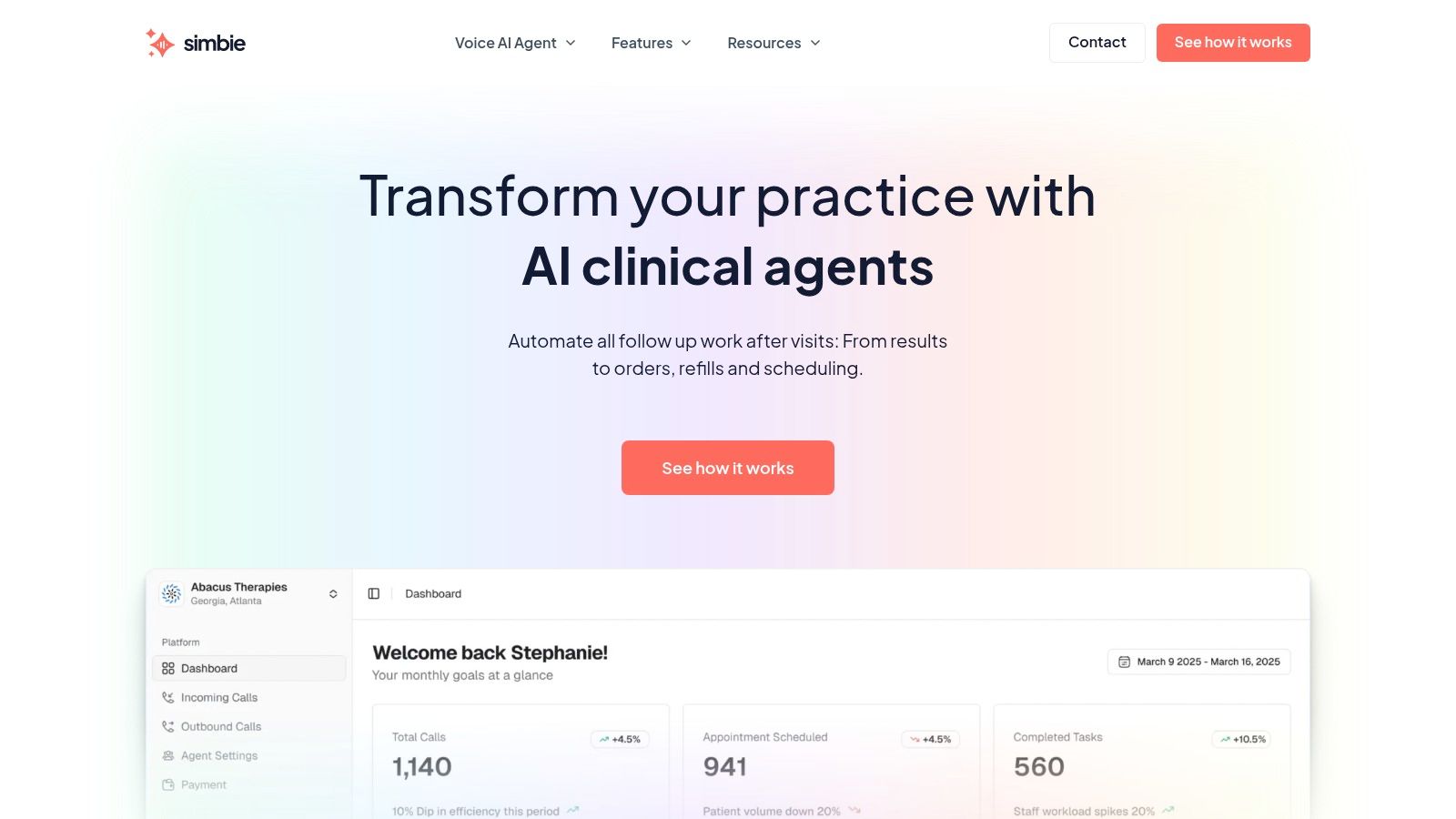
I'd put Simbie AI in that category. It is one option for practices that want clinically trained voice agents to handle routine administrative tasks, document patient information into the EMR, and manage high-volume patient calls without asking front-desk staff or clinicians to absorb all of that load manually.
What to watch before rollout
I've also seen automation fail when leaders buy software before fixing process logic. If your refill workflow is messy, a tool will scale the mess.
Before implementation, check these points:
- Exception paths: Where does the case go when the request isn't standard?
- Clinical oversight: Who reviews the edge cases and how quickly?
- Integration reality: Does the tool fit the EMR and staffing model you already have?
- Trust with staff: Do teams understand that the purpose is to remove clerical strain, not squeeze more visits out of them?
Technology helps most when staff feel relief in the first week. If they only feel surveillance or added complexity, adoption will stall.
Your first steps and how to track progress
Don't try to fix healthcare provider burnout with a giant enterprise plan in month one. Start where the burden is obvious, measurable, and hated.
I'd begin with three moves.
Pick a baseline and keep it simple
Run a short anonymous pulse survey and pair it with operational data from the same period. Ask about control over workload, after-hours work, and the one task people most want removed.
Then review local signals. Late charting. Refill backlog. Call abandonment. Schedule bottlenecks. The point is to connect staff experience to a workflow you can change.
Choose one bottleneck and test one fix
Don't launch seven interventions at once. Pick one pressure point, such as phone management, inbox triage, refill intake, or prior auth prep.
Assign one owner, define one pilot group, and give the pilot a fixed review date. If the test works, expand it. If it doesn't, stop pretending and redesign it.
Track progress with measures that change behavior
Use a small scorecard. Keep it visible to leaders and managers.
I'd track:
- Burnout pulse responses: Are staff reporting less after-hours strain and more control?
- Admin time burden: Are repetitive tasks consuming less clinician and staff time?
- Turnover and retention signals: Are fewer people reducing hours or looking to leave?
- Workflow backlog: Are queues, calls, and unresolved requests becoming manageable?
The biggest mistake is waiting for perfect proof before acting. If your team is telling you the work is unsustainable, believe them, pick one broken workflow, and fix that first.
If your practice is buried in calls, intake work, refill requests, or documentation overhead, Simbie AI is worth a look. It uses voice-based AI for healthcare workflows such as patient intake, scheduling, prescription refills, prior authorizations, and chart-ready documentation, which can help reduce the clerical load that drives burnout in the first place.