
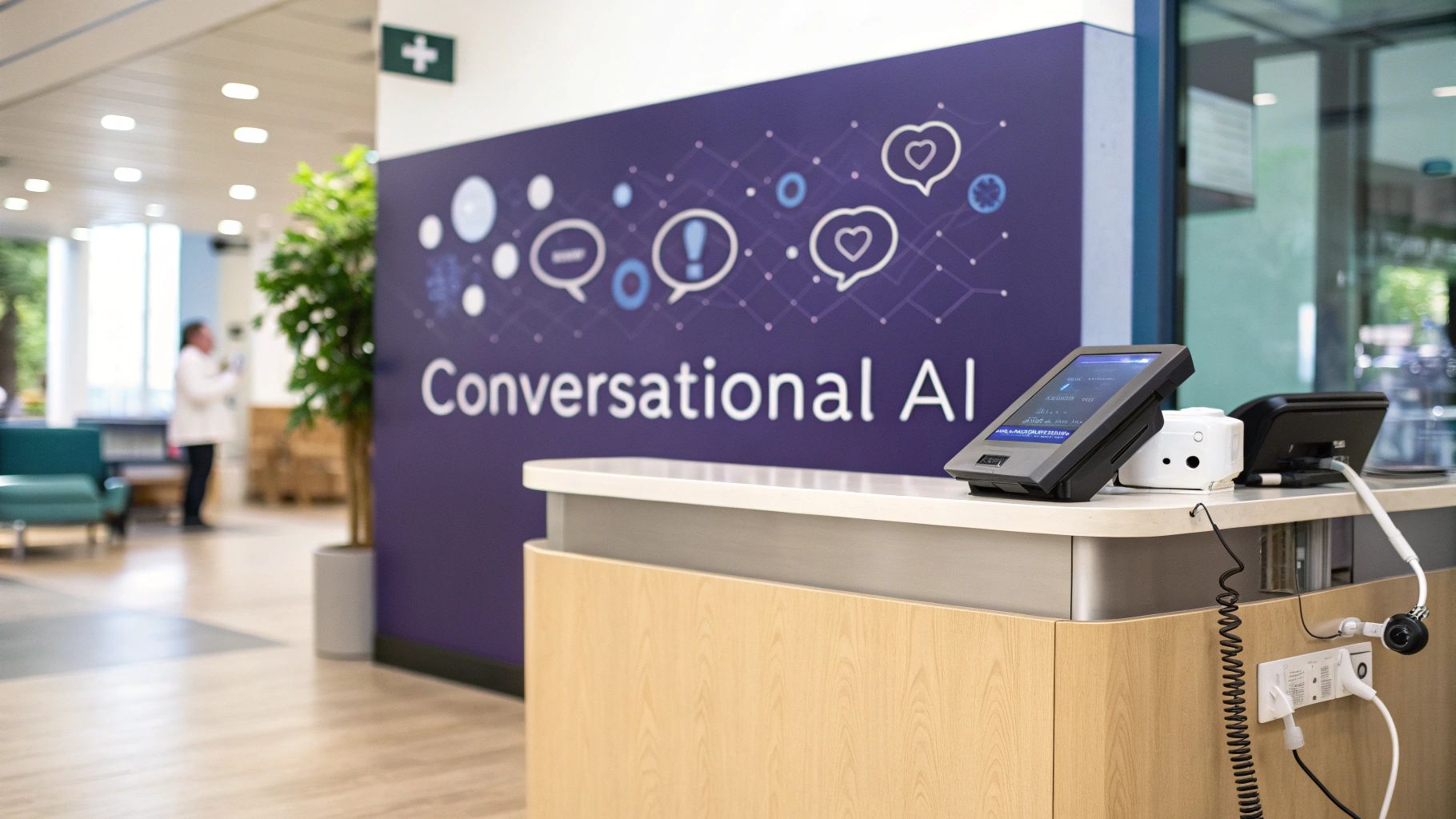
In the ever-evolving landscape of modern medicine, what exactly is conversational AI in healthcare? It's crucial to think of it less like a science-fiction robot and more like a highly intelligent, clinically aware digital assistant designed specifically for your medical practice. At its core, this is a sophisticated technology that can understand, interpret, and respond to everyday human language, whether it's spoken over the phone or typed into a chat window. This capability is powered by advanced algorithms in Natural Language Processing (NLP) and machine learning, allowing the AI to grasp context, intent, and even sentiment.
The primary role of this AI is to systematically handle the routine, time-consuming administrative tasks that are essential but often divert staff from more critical responsibilities. We're talking about the repetitive but vital functions like scheduling and rescheduling appointments, managing prescription refill requests, handling new patient intake, and answering a high volume of common questions about clinic hours, insurance, or directions. By automating these workflows, conversational AI clears the deck for your highly trained medical and administrative staff, empowering them to focus on what they do best: providing exceptional, hands-on patient care and tackling complex clinical issues that require human expertise. This isn't just a simple, scripted chatbot; it's a dynamic, clinically-aware system ready to manage patient communications with precision and empathy, 24/7.
Your New Digital Front Desk
Imagine hiring the most efficient, empathetic, and consistently reliable front desk coordinator imaginable—one who works around the clock, never needs a break, and handles every interaction with perfect accuracy. That, in essence, is what conversational AI brings to your practice. It acts as a tireless digital front desk, ensuring that no patient call ever goes unanswered to voicemail and no online query is left lingering in an inbox. This constant availability transforms the accessibility of your practice.
But its function goes far beyond simply answering the phone. It's about intelligently managing and directing the entire flow of communication that can easily bog down a busy medical office. This technology provides a streamlined, single point of contact for patients, regardless of their preferred communication channel—be it a phone call, a text message, or a chat on your website.
Unlike the frustrating, rigid automated phone menus that force callers to "press 1 for appointments," conversational AI truly comprehends natural language. A patient can simply say, "Hi, I need to move my appointment with Dr. Smith to sometime next Tuesday afternoon," and the AI understands the complex intent behind the request. It can then access the doctor's schedule in real-time, identify available slots, and offer them to the patient instantly for confirmation. This level of immediate, helpful, and intuitive response completely redefines the patient experience from the very first interaction. No more long hold times, no more frustrating games of phone tag, and no more communication barriers. It simply makes accessing care simpler and more dignified.
How It Understands And Acts
At its core, this advanced technology utilizes sophisticated programming—specifically, Natural Language Understanding (NLU)—to decipher what a patient intends to do, not just the literal words they use. This is the critical capability that allows it to handle requests that are far more complex than a simple yes-or-no question. It can discern the difference between a new patient seeking an initial consultation and an existing patient who needs a follow-up for a chronic condition, routing them through different workflows accordingly.
Here’s a quick breakdown of how this sophisticated process comes together in seconds:
- Listens and Understands: The AI first captures and analyzes what the patient says or types, using NLU to pinpoint their exact need and intent, whether it's scheduling, a refill request, or a question about billing.
- Accesses Information: It then securely connects with your clinic's core systems, such as your Electronic Medical Record (EMR) or Practice Management (PM) software, to retrieve the necessary information, like provider schedules, patient files, or medication history.
- Takes Action: With the right information in hand, it completes the requested task—booking the visit directly into the EMR, sending a structured refill request to the provider's queue, or providing verified directions to the clinic.
- Documents Everything: Finally, and most importantly for clinical and legal integrity, it meticulously documents the entire conversation and the actions taken directly in the patient's chart, creating a clear, complete, and auditable record of the interaction.
The real magic of conversational AI is its ability to handle these high-volume, repetitive communication tasks with perfect accuracy and consistency, every single time. This systematic automation frees up your highly-trained staff to focus on the nuanced, empathetic parts of their jobs that truly require a human touch.
See the immediate impact of conversational AI on common administrative workflows in a medical practice.
Comparing Daily Tasks With and Without Conversational AI
| Administrative Task | Traditional Manual Process | Automated AI Process |
|---|---|---|
| New Patient Intake | Staff manually enters data from paper forms or portals; prone to human error and takes 15-20 minutes per patient. | Patient answers questions conversationally via phone or text; AI auto-populates EMR fields in real-time with perfect accuracy. |
| Appointment Scheduling | Staff member spends 5-7 minutes on the phone, manually cross-referencing schedules and patient availability. | Patient self-schedules in under 2 minutes via voice or text, 24/7, without any staff involvement. |
| Prescription Refills | Patient leaves a voicemail; staff listens, pulls the chart, sends a request to the provider, and then notifies the pharmacy. The process is slow and multi-touch. | AI verifies the patient, identifies the correct medication, and sends a structured request directly to the provider for approval instantly. |
| Answering FAQs | Front desk staff spends hours per week answering the same questions about hours, location, accepted insurance, and appointment policies. | AI provides instant, accurate answers to 90% of common questions, freeing up the phone lines for urgent clinical matters. |
It's clear how much valuable time gets unlocked when you automate these essential but repetitive processes.
More Than Just A Chatbot
It's a common misconception to lump conversational AI in healthcare in with the generic customer service chatbots you encounter on retail websites. The two are worlds apart. A true healthcare AI is a specialized tool, trained on vast datasets of clinical language, medical terminology, and healthcare-specific workflows. It understands the nuances of medical conversations, the critical importance of HIPAA privacy rules, and the specific operational needs of a medical practice.
These systems are architected from the ground up with security, privacy, and compliance as core pillars, ensuring all sensitive protected health information (PHI) is handled with the utmost care. This deep clinical focus allows them to handle complex, sensitive tasks that a standard chatbot could never touch, such as verifying patient identity or collecting medical history. You can learn more about these specialized healthcare AI agents and see how they are built specifically for the rigorous demands of a medical environment.
By lifting the heavy administrative weight off your team, you empower them to dedicate their valuable time, energy, and skills to what really counts—delivering outstanding, compassionate care to your patients.
How AI Automation Reduces Costs and Boosts Efficiency
Whenever a new technology emerges in healthcare, the first and most critical question is always about the return on investment (ROI). With conversational AI in healthcare, the business case is not just theoretical—it's crystal clear, demonstrating tangible cost savings and significant gains in operational efficiency. It’s fundamentally about empowering your existing team to achieve more without adding to their workload.
Imagine your staff spending significantly less time on the phone scheduling appointments, answering the same repetitive questions, or manually managing intake forms. Their productivity would naturally soar. This isn't a narrative about replacing people; it's about reallocating their expertise to high-value, patient-focused work that genuinely requires a human touch, such as financial counseling, care coordination, or patient education.
Think of it as adding a tireless, hyper-efficient digital assistant to your team—one that handles all the repetitive, administrative work with perfect accuracy and consistency. This strategic automation frees up your clinical and administrative staff to operate at the top of their licenses and skill sets, leading to a more efficient, less stressed, and more productive practice overall.
Slashing Administrative Overhead
One of the most immediate and impactful benefits you'll notice with AI automation is a substantial drop in administrative costs. Manual tasks are not just tedious; they're expensive. Every minute a team member spends on the phone trying to coordinate an appointment is a minute they aren’t assisting a patient face-to-face, managing a complex billing issue, or supporting a clinician.
Conversational AI steps in to handle these high-volume, low-complexity jobs 24/7 without fail. By automating a large portion of inbound calls and online messages related to scheduling, refills, and FAQs, it frees up a tremendous amount of staff time. This recovered time has a direct and positive impact on your operational budget, allowing you to do more with your existing resources.
By automating routine communication and administrative workflows, healthcare practices can reclaim thousands of staff hours annually. This newfound time is a valuable asset that allows staff to focus on complex problem-solving and delivering compassionate, in-person patient care.
The financial data supporting this shift is compelling. Clinics that adopt conversational AI are on a clear path to cut staffing-related overhead by up to 70% through the automation of routine tasks. Real-world case studies show mid-sized practices increasing their weekly patient volume by 40%, cutting after-hours EHR work by an astonishing 75%, and improving follow-up compliance by 20%. Zooming out to the bigger picture, the U.S. healthcare system as a whole could potentially save $150 billion each year by 2026 through broader adoption of AI-driven automation.
Increasing Patient Capacity and Access
A more efficient front office naturally translates to an increased capacity to see more patients without overwhelming or burning out your staff. When scheduling is automated and available around the clock, you effectively eliminate the bottlenecks that prevent patients from easily booking appointments. This improved access leads directly to a fuller schedule, reduced no-show rates, and, ultimately, increased revenue for the practice.
This efficiency boost enables clinics to scale their operations and grow their patient base without the corresponding need to expand their physical office space or hire additional administrative staff. It represents a smart, scalable strategy for growth that is achieved by optimizing and maximizing the effectiveness of your current operations. You can explore how this works in practice by looking at powerful healthcare automation software.
Reducing Staff Burnout and Turnover
Administrative overload is consistently cited as one of the biggest drivers of burnout in the healthcare sector. The relentless combination of tedious, repetitive work, high call volumes, and packed schedules wears down even the most dedicated and resilient employees. High staff turnover is not only disruptive to team morale and patient continuity but is also incredibly expensive, costing practices dearly in recruitment, hiring, and training.
Conversational AI tackles this pervasive problem head-on by taking the most frustrating and monotonous tasks off your team's plate.
- Eliminates Phone Tag: The AI expertly manages scheduling, rescheduling, and simple questions, putting a definitive end to the frustrating and time-consuming back-and-forth of missed calls and voicemails.
- Reduces Documentation Overload: It automatically logs all interactions directly into the EHR, saving staff from countless hours of manual data entry and ensuring records are always accurate and up-to-date.
- Manages After-Hours Work: With the AI fielding requests 24/7, your team no longer walks into a daunting mountain of voicemails and messages every morning, allowing them to start their day focused and proactive.
By fostering a more manageable, efficient, and satisfying work environment, AI helps you retain your valuable and experienced staff. A stable, tenured team isn't just more efficient—it provides better, more consistent, and higher-quality patient care. In that sense, an investment in this technology is truly an investment in your people and the long-term health of your practice.
Putting Conversational AI to Work in Your Daily Practice
The real, transformative magic of conversational AI in healthcare happens when you witness it tackling the everyday, mundane tasks that consistently consume your staff's valuable time. It's one thing to discuss the technology in the abstract, but it’s another entirely to see it solve tangible, real-world problems in your clinic from day one. This implementation isn’t about a massive, disruptive overhaul of your entire operation. Instead, it’s about strategically targeting specific, high-volume, low-complexity workflows and letting intelligent automation do the heavy lifting.
Let's walk through a few practical 'before and after' scenarios. These concrete examples make it crystal clear how AI can turn frustrating, error-prone manual chores into smooth, efficient, and automated processes in any busy medical practice.
Automating New Patient Intake
The classic patient intake process is notoriously clunky and inefficient. It's heavily weighed down by physical paperwork, redundant questions, and manual data entry, creating a first impression for new patients that’s often slow, impersonal, and frustrating for everyone involved.
-
Before AI: A new patient arrives for their first appointment and is handed the dreaded clipboard with a thick stack of forms. They spend the next 15-20 minutes trying to recall their detailed medical history, medication dosages, and insurance details. Afterward, a front desk staffer must decipher their handwriting and manually type every single piece of information into the EMR, a process that opens the door for typos, transcription errors, and incomplete records.
-
After AI: Days before the appointment, the patient receives a friendly, automated text or call from an AI assistant. They simply answer a series of questions in a natural, guided conversation. The AI intelligently and instantly populates their electronic chart with structured, accurate data. The entire intake process is completed before they even set foot in your clinic, saving valuable time for both the patient and the staff and ensuring perfect data integrity from the start.
This simple yet profound change doesn't just accelerate the process; it allows your staff to welcome new patients with a warm, personal conversation instead of immediately burdening them with a stack of forms.
Streamlining Appointment Scheduling
The telephone often represents the single biggest bottleneck in a medical practice. A constant stream of calls for scheduling, rescheduling, and cancellations leads to long hold times for patients and endless, disruptive interruptions for your front-office team. This is precisely where AI can make an immediate and massive positive impact.
-
Before AI: A patient calls to book a visit and is immediately placed on hold. Once they finally get through, the receptionist spends the next 5-7 minutes juggling the EMR schedule, provider preferences, and the patient’s availability. It's a frustrating, inefficient back-and-forth dance, and scheduling outside of standard business hours is simply not an option.
-
After AI: Patients can call, text, or use a webchat whenever it is convenient for them—24/7/365. They just state when they’d like to come in, and the AI presents them with available, confirmed slots in seconds. The appointment is booked and confirmed automatically, often in less than two minutes, with zero human effort required from your team.
By automating appointment management, practices can also dramatically cut down on costly no-shows with intelligent, personalized reminders. The AI can even dynamically offer to fill last-minute cancellations, ensuring the schedule remains full and maximizing practice revenue.
This is the kind of on-demand, consumer-friendly convenience that modern patients have come to expect in every other area of their lives. It also frees up your phone lines for more pressing clinical issues and urgent patient needs. You can see how this works in the real world by checking out the features of a modern AI medical receptionist built to handle these exact tasks with precision.
Handling Prescription Refill Requests
Managing prescription refill requests is a repetitive but critically important job. The traditional process usually involves a multi-step, asynchronous game of telephone tag between the patient, your staff, the provider, and the pharmacy, with multiple potential points of failure.
-
Before AI: A patient leaves a voicemail requesting a refill. A staff member must find time to listen to the message, pull up the patient’s chart to verify details, confirm the medication and dosage, and then forward the request as a message to the provider for their approval. The whole process is slow, inefficient, and can leave patients waiting anxiously for medicine they need.
-
After AI: The AI assistant securely identifies the patient via voice or text and understands their specific refill request. It then queues the request directly in the EMR in a structured format for a simple, one-click provider approval. The entire front-end of the process is handled in an instant, ensuring that requests are processed quickly, accurately, and without errors.
By letting conversational AI take over these time-sucking daily chores, you empower your team to focus on what they do best: handling complex patient needs, providing clinical support, and delivering the essential human touch where it matters most.
A Better Patient Journey, From Start to Finish
Exceptional patient care isn't confined to what happens within the four walls of the exam room. It begins the very moment someone identifies a health need and seeks help, and it extends long after they’ve returned home. Conversational AI in healthcare is fundamentally about supporting every single step of that journey, making each touchpoint more responsive, empathetic, and seamlessly connected.
Think of this technology as the new digital front door to your practice—one that is always open, always welcoming, and always ready to help. It effectively eliminates the classic frustrations that have long plagued the patient experience: endless phone trees, long hold times, and voicemails that seem to go into a black hole. With AI, patients get the help they need right away, on their own terms and on their own schedule.
Always-On Access and Support
One of the most significant and immediate wins with conversational AI is simple yet profound: 24/7 availability. Health concerns and questions don't adhere to a 9-to-5 schedule. The ability for a patient to get a reliable answer, book a necessary appointment, or request a refill at 10 PM on a Tuesday brings an incredible sense of security and peace of mind.
This constant, on-demand access makes healthcare feel more approachable and less intimidating. Patients no longer have to disrupt their work schedules or family commitments just to make a quick administrative call. An AI assistant handles these routine requests instantly and efficiently, ensuring every individual feels heard and supported without having to wait.
This is a game-changer for patient engagement and satisfaction. In fact, patient engagement has become the largest application for this technology, making up over 29.51% of the market in 2024. Healthcare providers using these advanced tools are seeing tangible results: patient engagement metrics jumping by 30%, hospital readmissions dropping by 25%, and in-office wait times being slashed by 15%. It's a powerful way to create personalized connections at scale, leading to happier, more empowered patients and better adherence to care plans.
Personalizing Communication for Everyone
Beyond merely being available, conversational AI excels at sending personalized, timely, and relevant messages that would be logistically impossible for a human team to manage at scale. It acts as an intelligent safety net, ensuring no patient gets lost in the shuffle before, during, or after their appointment.
For instance, an AI tool can automatically send pre-operative instructions tailored to a specific surgical procedure. A few days after the procedure, it can proactively check in to see how the patient's recovery is progressing. It can also handle the full spectrum of automated reminders for follow-up appointments, prescription refills, or crucial annual screenings, all communicated in a conversational and empathetic tone.
Conversational AI transforms patient communication from a series of disconnected, reactive moments into a continuous, supportive, and ongoing conversation. It makes people feel genuinely cared for and guided throughout their entire health journey, not just during a brief 15-minute visit.
This proactive and personalized outreach builds genuine trust, fosters patient loyalty, and keeps people actively involved and accountable in their own health. To understand how this fits into a broader patient acquisition and retention strategy, it's worth exploring different healthcare digital marketing strategies.
Monitoring and Flagging Clinical Concerns
For patients managing chronic conditions like diabetes, hypertension, or heart failure, the healthcare journey is a continuous one. Conversational AI can serve as a daily partner in their care, providing consistent, low-friction monitoring that leads to better long-term health outcomes.
Take a patient with diabetes, for example. An AI assistant could be programmed to:
- Send daily pings via text message to check and log blood sugar levels.
- Offer helpful, personalized tips on diet and exercise that align with their specific care plan.
- Ask about specific symptoms, such as fatigue, blurred vision, or dizziness.
If the patient reports a blood sugar reading that is dangerously high or a symptom that is a clinical red flag, the AI is intelligent enough to act immediately. It can automatically escalate the issue to a real nurse or doctor, ensuring that a small problem gets addressed proactively before it can escalate into a serious medical event. It serves as a smart, vigilant bridge between the patient at home and their dedicated care team, representing a core component of proactive, modern, and value-based healthcare.
Your Roadmap for Bringing Conversational AI Onboard
Bringing any new technology into a healthcare practice can feel like a daunting undertaking. However, getting conversational AI in healthcare up and running is less about technical wizardry and more about smart, deliberate, and strategic planning. A clear, step-by-step approach is the key to a smooth and successful rollout that delivers immediate benefits to your team and your patients from the very start.
This isn't about flipping a switch and hoping for the best. It's a phased, collaborative approach that thoughtfully addresses the most critical questions—like HIPAA compliance, EMR integration, and staff adoption—with a solid, proven game plan.
Finding the Right AI Partner
Your first, and arguably most important, move is to select the right technology partner. Not all AI platforms are created equal, especially when it comes to the unique demands of the healthcare industry. You will want to find a solution that was designed from the ground up with clinicians and practice managers in mind. Such a partner will inherently understand the day-to-day realities of your practice, from your specific clinical workflows to the subtle nuances of patient conversations.
Look for a partner who can confidently check these essential boxes:
- Understands Healthcare Lingo: The AI needs to be pre-trained on medical terminology and must know the difference between a check-up and a follow-up, or a referral and a prior authorization. It has to grasp the clinical context of what’s being discussed.
- Takes Security and HIPAA Seriously: This is a non-negotiable deal-breaker. Ask for detailed specifics on their security architecture, including end-to-end encryption, data storage policies, and Business Associate Agreements (BAAs). They must demonstrate a rock-solid, unwavering commitment to protecting patient health information (PHI).
- Plays Well with Your EMR: The AI solution should feel like a natural, seamless extension of your existing technology stack. It absolutely must be able to read and write information directly and securely into your EMR. This bidirectional integration is the single feature that saves your staff from the soul-crushing task of manual data entry.
A great AI implementation is built on the foundation of a great partnership. You want a provider who acts more like a trusted guide than a simple vendor—someone who will be there to assist with integration, provide comprehensive training, and help you fine-tune the system as your practice evolves.
Making Sure the Tech and Data Flow Smoothly
With a trusted partner selected, the next phase is to plug the AI into your practice's digital nervous system. The primary goal here is to establish a seamless and secure flow of information between the conversational AI and your Electronic Medical Record (EMR) system. This robust connection is what transforms the AI from just another isolated screen to check into a genuinely helpful and integrated tool.
This technical process is all about connecting the dots in your workflow. When the AI books an appointment or completes a new patient intake form, that structured data should instantly and automatically appear in the correct fields within the patient’s chart. This level of automated documentation not only eliminates typos and human errors but also gives your staff back precious hours they used to spend on tedious data entry.
Getting Your Team Excited and Managing the Change
New technology is only as good as the people who use it every day. Getting your clinical and administrative staff on board and enthusiastic is absolutely essential for a successful implementation. The best way to begin is by introducing the AI as a helpful new digital teammate—one that’s specifically designed to take the most tedious and repetitive work off their plates, not to replace them.
Here are a few proven strategies to build that internal support:
- Start with the "Why": Clearly demonstrate to your team exactly how the AI will reduce their most frustrating daily tasks, whether it’s answering endless phone calls, playing calendar Tetris to find an open appointment slot, or chasing down missing patient paperwork.
- Offer Real, Hands-On Training: Set up interactive training sessions where everyone can actually use the system in a test environment and ask questions. Walk them through how the AI integrates into their specific daily tasks and workflows.
- Keep a Human in Charge: Make it unequivocally clear that a human always has the final say on anything clinical. The AI is there to handle the administrative grunt work, but your team’s clinical expertise, judgment, and oversight are what matter most. This approach builds trust and ensures your high standard of care is maintained.
Following this simple, logical roadmap will help your practice implement conversational AI the right way—setting you up for lower operational costs, happier and more engaged patients, and a clinical team that can finally focus on what they do best.
What's Next for AI in Medical Practice Operations?
Looking ahead, conversational AI in healthcare is not just a shiny new tool—it's on a clear trajectory to become an integral part of the very foundation of how modern medical practices operate. We're not just talking about making old administrative tasks a little faster. This technological shift is about fundamentally rethinking and re-engineering the entire clinical workflow so that clinicians can spend the vast majority of their time on what they were actually trained to do: diagnosing, treating, and caring for patients. Getting on board now isn't just a simple upgrade; it’s a crucial strategic step toward building a practice that’s resilient, efficient, and ready for the future of medicine.
The momentum behind this trend is enormous. The global market for conversational AI in healthcare reached USD 13.68 billion in 2024 and is projected to skyrocket to an astonishing USD 106.67 billion by 2033. That kind of exponential growth doesn't happen by accident. It’s fueled by a real, pressing, and universal need for smarter, more efficient solutions in clinics and hospitals everywhere. You can dig deeper into this compelling data on the rapid expansion of conversational AI on Nextiva.com.
Tighter Integrations with Telehealth and Documentation
The next significant leap for conversational AI involves moving beyond the front desk and deeper into direct clinical support roles. Picture this common scenario: a telehealth appointment where an AI assistant is quietly and intelligently working in the background. It not only connects the call securely but also actively listens, transcribes the entire conversation in real-time, and automatically populates the patient’s chart with structured, coded clinical notes.
Think about the profound implications of that capability. The drudgery of after-hours charting and administrative "pajama time" could all but disappear. A physician or nurse practitioner could finish a virtual visit and find the complete documentation 90% done, just waiting for a quick review, edit, and signature. That single change would free up an incredible amount of time and mental energy, which can be redirected right back into focusing on the patient in front of them.
Smarter Clinical Triage and Support
As these AI systems become more sophisticated and are trained on more extensive clinical data, they'll be able to handle more complex clinical tasks, such as initial patient triage. A patient could call in with a set of symptoms and be guided by an AI through a series of clinically-approved, dynamic questions based on established protocols. Depending on their answers, the AI could then intelligently suggest the right next step—scheduling a telehealth call, booking an in-person visit, or recommending a trip to urgent care—and have all the preliminary notes and relevant history compiled and ready for the clinician.
This evolutionary shift transforms conversational AI from a simple administrative helper into a key, integrated part of the clinical team. It becomes the intelligent, reliable first point of contact that safely and efficiently gets patients to the right level of care, faster and more effectively than ever before.
The ultimate end goal here is a medical practice where AI seamlessly handles nearly all of the repetitive administrative and documentation work. This comprehensive automation frees up everyone on the team, from medical assistants to surgeons, to focus their unique human skills on complex problem-solving, hands-on care, and building genuine, trusting relationships with patients. Investing in this technology today is the first critical step toward that smarter, more efficient, and more human-focused future for medicine.
Answering Your Questions About Conversational AI in Healthcare
It's natural and wise to have questions when considering the adoption of a new technology for your practice. When it comes to conversational AI in healthcare, most of the concerns we hear from practice administrators, physicians, and clinical staff circle back to a few key areas: data security, patient acceptance, and the practicalities of implementation.
Let's tackle those important questions head-on.
Is Patient Data Secure and HIPAA Compliant with AI?
Yes, absolutely. Any conversational AI platform that is purpose-built for the healthcare industry has security and compliance woven into its very fabric. Think of it this way: these are not generic, off-the-shelf chatbots that have been repurposed for healthcare. They are highly specialized tools designed from the ground up to operate within the strict regulatory environment of medicine.
These platforms rely on robust security measures like end-to-end encryption for all communications and are hosted on secure, HITRUST-certified servers that meet the most demanding compliance standards. Every interaction and data point is structured to protect sensitive patient health information (PHI), ensuring your practice remains fully compliant with all HIPAA and HITECH regulations.
The secret is in the specialized design. A healthcare-specific AI is engineered from day one to keep all sensitive data within your secure clinical ecosystem, meeting privacy and security demands that general-purpose AI tools simply cannot handle.
Will My Patients Actually Be Okay Talking to an AI?
This is probably the most common and understandable question we get, and it’s a fair one. But what we’ve seen consistently in practice is that patients overwhelmingly appreciate the convenience, speed, and accessibility it offers. They love getting an immediate answer to their question or booking an appointment in seconds without ever having to wait on hold.
Modern AI systems are designed to be surprisingly natural, empathetic, and conversational. For straightforward, transactional tasks like scheduling a visit, requesting a prescription refill, or asking about office hours, patients often prefer the 24/7 availability and instant, reliable response of an AI. This preference, in turn, frees up your human staff to focus their time, energy, and empathy on the more complex, nuanced, and sensitive conversations where a human touch makes all the difference.
How Difficult Is It to Integrate AI with Our EMR?
It's much easier and more straightforward than you might think. The best conversational AI providers have already done the heavy lifting of building secure, pre-built connections, or APIs (Application Programming Interfaces), that are designed to link up with all major EMR systems like Epic, Cerner, eClinicalWorks, and Athenahealth.
Your chosen AI partner should handle the majority of the technical work, making the integration process smooth and light on your team's resources. Once connected, the AI and your EMR talk to each other seamlessly and in real-time. New patient information, appointment changes, and other details captured by the AI flow directly and automatically into the patient's chart—which means no more manual data entry, fewer errors, and clinical records that are always accurate and up-to-date.
Ready to see how a clinically-trained AI can transform your practice? Discover Simbie AI and learn how our intelligent voice agents can automate your front desk, reduce staff burnout, and create a better patient experience. Start streamlining your operations today.