
So, what exactly is conversational AI in healthcare? Put simply, it’s advanced technology that powers tools like intelligent voice assistants and sophisticated chatbots to automate administrative tasks, communicate effectively with patients, and provide invaluable support to your clinical staff.
Think of it as a highly capable digital assistant that operates 24/7, communicates in multiple languages, and can expertly manage everything from complex appointment scheduling to answering routine patient questions—all through natural, human-like conversation. This technology is specifically designed to address some of the most pressing challenges in modern healthcare, including administrative overload, operational inefficiencies, and the pervasive issue of staff burnout. By offloading repetitive work, it allows human teams to focus on higher-value activities that require their unique skills and empathy.
The New Voice of Modern Medicine

Imagine your medical practice operating without the constant administrative bottlenecks that slow everything down. Every single patient call is answered instantly—no more frustrating hold music or voicemails. Your highly trained clinical team is liberated from mundane paperwork, free to focus entirely on what they do best: delivering exceptional patient care. This isn't a futuristic concept; it's the tangible reality that conversational AI in healthcare is actively creating for practices and health systems right now. It represents a fundamental shift in how healthcare services are delivered, making operations more efficient and patient-centric.
A Smarter Front Desk
At its core, conversational AI is not just about sophisticated algorithms and code. It is a practical, results-oriented tool engineered to understand the nuances of human language and respond in a genuinely helpful and context-aware manner. Picture a supremely efficient front desk coordinator who works around the clock, never gets tired, and can seamlessly manage the relentless flow of patient calls, inquiries, and requests that often overwhelm your staff. This digital workforce becomes an extension of your team, ensuring no patient query goes unanswered.
This technology directly targets one of healthcare’s most persistent and damaging problems: staff burnout. A significant portion of this stress stems from administrative overload and the constant pressure to keep up with patient communication demands. By automating up to 30% of inbound patient requests with a clinically-trained AI, practices can dramatically lighten the administrative burden on their teams. This allows staff to dedicate their time and energy to more complex, fulfilling tasks that require human judgment and empathy, ultimately improving job satisfaction and reducing turnover.
Bridging the Communication Gap
For patients, conversational AI creates a direct, frictionless, and immediate channel to connect with your practice. Whether they need to book a new appointment, reschedule an existing one, inquire about their insurance coverage, or request a prescription refill, the entire process becomes incredibly smooth and efficient. This enhanced accessibility has a profound impact on both the operational efficiency of your practice and the overall patient perception of their care experience.
- Eliminating Missed Calls: An advanced AI agent can handle a virtually unlimited number of calls simultaneously, ensuring every patient receives the assistance they need right away, without delay. This means no more lost revenue from missed appointment opportunities.
- Reducing Administrative Workload: The numerous repetitive, time-consuming tasks that clog daily workflows are automated, freeing up your valuable team members for the complex problem-solving and patient-facing work that truly requires a human touch.
- Improving Patient Access: Patients gain instant access to answers and support whenever they need it—day or night, weekends or holidays. This level of responsiveness significantly boosts their satisfaction and fosters a stronger, more positive relationship with your practice.
This technology empowers healthcare practices to delegate routine administrative tasks—the very ones that consume vast amounts of time but can be executed flawlessly by an intelligent, automated system. The primary goal isn’t to replace skilled healthcare professionals, but to augment and support them, allowing them to work at the top of their license.
In the remainder of this comprehensive guide, we will delve deeper into exactly how this transformative technology is reshaping clinic operations, enhancing financial performance, and ultimately leading to better patient outcomes. We'll explore everything from the underlying technical components to a practical roadmap for integrating it into your own practice.
If you want to jump ahead, you can learn more about the role of voice AI in healthcare and its specific applications.
How Conversational AI Actually Works
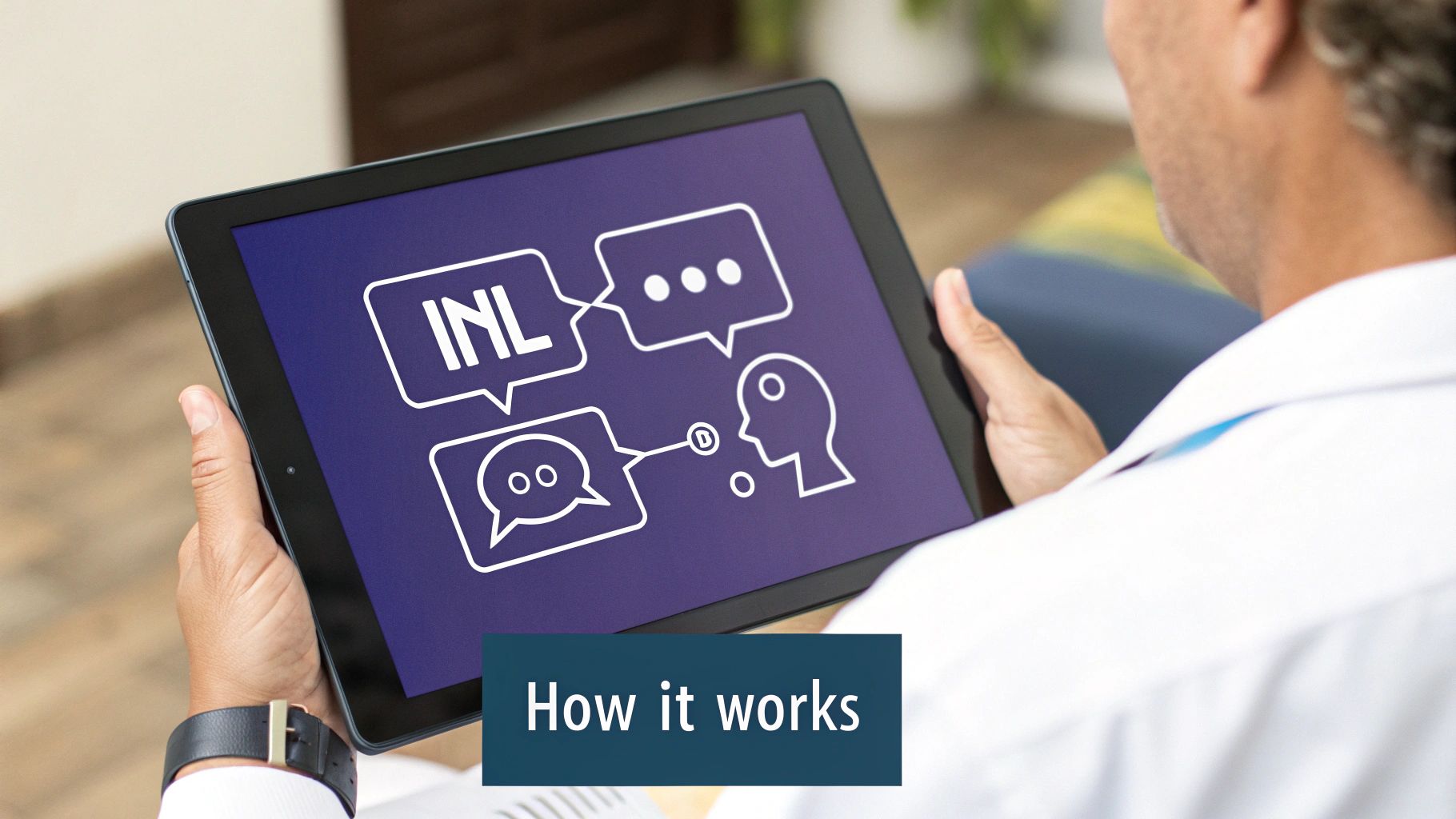
To truly appreciate why conversational AI in healthcare is a game-changing innovation, it’s helpful to understand the sophisticated technology powering it. It’s not magic—it's a complex system of interconnected components working in harmony, much like a highly trained and experienced medical assistant.
It all comes down to two foundational technologies: Natural Language Processing (NLP) and Machine Learning (ML). These are the powerful engines that enable a digital tool to comprehend, interpret, and generate human language, making seamless conversation possible. They are the key to moving beyond simple, rigid chatbots to truly intelligent virtual agents.
The Ears and Brain of the System
Think of Natural Language Processing (NLP) as the AI’s ears and cognitive brain. It's the technology that allows the system to listen to human language—whether spoken or typed—and accurately decipher its meaning, intent, and context.
When a patient says, "I need to reschedule my Tuesday appointment with Dr. Smith for next week," NLP is what deconstructs that sentence to extract the key pieces of information: the intent (reschedule), the current time (Tuesday), the provider (Dr. Smith), and the new desired timeframe (next week). This is a world away from primitive, old-school chatbots that merely hunt for keywords. Modern NLP understands context, sentiment, and nuance, which is what makes the conversation feel natural and productive rather than clunky and frustrating.
Then you have Machine Learning (ML), which functions as the system’s long-term memory and accumulated experience. ML algorithms enable the AI to learn and improve from every single interaction it has. With each call and chat, it becomes slightly smarter, more accurate, and more efficient at handling a wider range of requests.
This continuous learning capability is what allows the technology to evolve and adapt. A brand-new system might initially handle simple scheduling tasks, but an AI powered by ML can learn to navigate far more complex scenarios, such as understanding a patient's description of symptoms, triaging requests based on urgency, or answering intricate questions about their post-operative care plan.
Connecting to Your Clinic's Core
Of course, the underlying technology is only half of the equation. For it to be truly effective, it must seamlessly integrate into your clinic's existing daily workflow. This is where robust EMR integration is absolutely crucial. The AI needs a secure, real-time, bidirectional connection to your Electronic Medical Record (EMR) system.
This deep integration unlocks the true potential of intelligent automation:
- Pulling Patient Data: When a patient initiates contact, the AI can instantly query the EMR to look up their record, confirm their identity, and access relevant medical history.
- Documenting Interactions: All important details from the conversation—such as appointment changes, symptom descriptions, or refill requests—are automatically logged directly into the patient’s chart. This eliminates the need for manual data entry and reduces the risk of human error.
- Executing Actions: The AI can autonomously execute tasks in real time, such as booking appointments in the schedule, sending prescription refill requests to the pharmacy, and updating patient demographic information, all without human intervention.
This secure, intelligent bridge between the conversational AI and the EMR is what makes genuine, end-to-end administrative automation possible. It ensures that your EMR remains the single, undisputed source of truth for all patient information, maintaining data integrity and consistency across your organization.
The demand for these powerful tools is experiencing explosive growth. The global conversational AI in healthcare market was valued at USD 17.2 billion in 2025 and is projected to skyrocket to USD 169.5 billion by 2035. This massive growth trajectory underscores just how eager healthcare providers are to offload burdensome administrative work and redirect their focus toward patient care. You can read the full research on this market expansion to see the detailed analysis driving this industry shift.
As these systems become more intelligent and deeply integrated, they evolve from being simple tools into true digital partners within the clinic. You can learn more about how AI agents in healthcare are fundamentally changing how modern medical practices operate.
Changing How Your Administrative and Clinical Teams Work

The real magic of conversational AI in healthcare becomes apparent when you witness its practical application, making a genuine, measurable difference in the daily routines of both your front office and your clinical staff. It's not about replacing talented people. It's about empowering them with an incredibly capable digital assistant designed to handle the repetitive, high-volume tasks, allowing them to concentrate on what they do best: solving complex problems and delivering compassionate patient care.
Think of it this way: your administrative team gains a new, hyper-efficient coworker who operates 24/7 without ever needing a break. This AI-powered helper takes on the mountain of time-consuming administrative tasks that often create bottlenecks, lead to staff burnout, and detract from the patient experience.
Instead of your team being constantly tied up on the phone scheduling appointments, chasing down insurance details, or processing another routine prescription refill request, a clinically-trained AI agent handles it all. This strategic automation frees them up to manage the situations that truly require a human touch, like talking a patient through a complex billing issue, providing reassurance to an anxious family member in the waiting room, or coordinating care with other providers.
A New Era for Administrative Efficiency
The ripple effect of automating these routine tasks is enormous. By removing the administrative burden from their plates, healthcare practices can significantly slash overhead costs and experience a major boost in operational efficiency. Fewer manual errors, zero missed patient calls, and streamlined workflows make the entire front-office operation more reliable, predictable, and cost-effective.
Here are a few key areas where you'll observe an immediate and significant impact:
- 24/7 Appointment Scheduling: Patients can book, reschedule, or cancel appointments whenever it's most convenient for them—even in the middle of the night or on a weekend. This eliminates the frustration of waiting for office hours and ensures your schedule stays full.
- Instant Insurance Verification: The AI can confirm a patient's insurance coverage and eligibility in mere seconds by connecting directly to payer databases. This proactive step dramatically reduces claim denials and billing headaches down the line.
- Automated Prescription Refills: Standard refill requests are handled automatically by the AI, which can either send them directly to the pharmacy for fulfillment or flag them for a physician’s approval, depending on your practice's protocols.
This isn't just about saving a few minutes here and there. It's about fundamentally redesigning workflows to build an administrative team that is more strategic, more focused, and less stressed. The data strongly supports this shift. A study by Microsoft and IDC revealed that nearly 80% of healthcare organizations are already leveraging AI, generating an impressive $3 in ROI for every $1 spent. It's therefore no surprise that 54% of providers now view conversational AI as a top strategic priority for managing their workload and improving financial performance. You can discover more insights on AI's financial impact in healthcare to see the full picture.
Giving Clinicians More Time for Actual Care
The benefits of conversational AI extend far beyond the front desk. For physicians, nurses, and other clinical staff, it acts like a dedicated clinical assistant, handling all the preliminary administrative and data-gathering work so they can walk into every patient encounter fully prepared and focused.
Imagine this scenario: a new patient is scheduled for an appointment. Before the doctor even enters the exam room, an AI agent has already engaged the patient to gather their complete medical history, document their current symptoms, and reconcile their medication list. All of this crucial information is then intelligently summarized and neatly organized within the EMR.
By the time the clinician sits down with the patient, the essential groundwork is already complete. This allows them to dedicate their valuable and limited time to what truly matters—diagnosis, treatment planning, and building a meaningful, trusting relationship with the patient, rather than spending half the visit typing into a computer.
This level of intelligent support directly addresses one of the biggest drivers of physician burnout: the overwhelming burden of administrative and clerical work. When an AI handles the data entry and documentation load, clinicians are freed to practice at the top of their license and do the work they were actually trained for.
To fully appreciate the impact, let's compare the traditional way of doing things to a modern workflow enhanced by conversational AI.
Administrative Workflow Transformation With Conversational AI
The table below provides a clear before-and-after comparison, illustrating just how profoundly a conversational AI platform can optimize and improve everyday administrative tasks.
| Administrative Task | Traditional Manual Process (Before AI) | Automated AI Process (With Conversational AI) |
|---|---|---|
| New Patient Scheduling | Staff spends 5-10 minutes on the phone gathering details, checking schedules, and manually entering data into the EMR. | Patient interacts with an AI agent via phone or chat 24/7; the AI confirms details and books the appointment directly in the EMR in under two minutes. |
| Appointment Reminders | Staff manually calls dozens of patients daily, leaving voicemails and documenting outcomes—a process that consumes hours. | AI automatically sends personalized voice or text reminders and confirms appointments, updating the EMR in real time with the patient’s response. |
| Insurance Inquiries | A patient calls and is placed on hold while staff navigates multiple systems to check eligibility and benefits. | AI instantly verifies insurance information by connecting to backend systems, providing the patient with an immediate answer. |
As you can see, the difference is night and day. Tasks that once consumed significant staff time and effort are now handled instantly, accurately, and around the clock, allowing your human team to operate at a much higher, more strategic level.
Putting Conversational AI to Work in Your Practice
It's one thing to discuss technology in theory, but it's far more impactful to see it in action. Let's step into the shoes of patients and clinic staff to observe how conversational AI solves real, everyday problems. These aren't futuristic fantasies; they are practical, proven applications being implemented in healthcare settings right now.
Taming the Beast of Patient Scheduling
Picture Sarah, a busy working mother trying to book a check-up for her son. Her schedule is chaotic. She needs a late afternoon appointment, but only on a Tuesday or Thursday, and it must be with Dr. Evans. To complicate matters, she just switched insurance plans and needs to confirm if the clinic accepts it.
The Old Way: Sarah calls the clinic during her lunch break, gets placed on hold for ten minutes, and then attempts to explain her complex scheduling needs. The receptionist, juggling other calls, puts her on hold again to cross-reference the doctor's calendar with a long list of accepted insurance providers. After a frustrating 15-minute back-and-forth, she finally secures an appointment. It's an inefficient and stressful experience for everyone involved.
The New Way: Sarah calls the clinic after dinner when she has a quiet moment. An AI voice assistant answers immediately. In a single, natural statement, she outlines her entire request. The AI understands it all—the specific doctor, the day and time constraints, and the insurance question. It instantly cross-references all variables and finds a perfect slot. It confirms her new insurance is in-network and sends a confirmation text directly to her phone. The entire interaction takes less than two minutes.
This is precisely where tools like AI-powered Healthcare Appointment Apps demonstrate their value. They are purpose-built to handle these complex, multi-step requests that used to consume hours of staff time each day, turning a major operational bottleneck into a seamless patient experience.
Automating the Drudgery of Prior Authorizations
Now, let's consider the administrative team and the universally dreaded prior authorization process. A patient requires a new medication, but their insurance company refuses to cover it without a mountain of paperwork, clinical documentation, and time-consuming phone calls first.
The Old Way: A dedicated staff member dials the insurance company, navigates a confusing interactive voice response (IVR) system, and then waits on hold…and waits. Once they finally reach a human representative, they must manually submit clinical notes and justification forms. This process can drag on for days or even weeks, delaying critical patient treatment and creating a massive administrative burden. A single authorization can easily consume 30 minutes or more of an employee's time.
The New Way: The moment a prescription requiring prior authorization is entered into the EMR, a clinically-trained AI agent is automatically triggered. It initiates the prior authorization process, intelligently pulls the necessary clinical notes from the patient’s chart, and manages all the electronic back-and-forth with the insurer's systems. The human staff is only alerted if an exception occurs or a peer-to-peer review with a physician is required.
This single change can literally save a practice hundreds of administrative hours per month. It slashes operational costs and, more importantly, ensures patients get the medications they need without unnecessary and potentially harmful delays. The AI handles the high-volume, repetitive grunt work, freeing up skilled staff to manage the exceptions.
Making Pre-Visit Intake Smarter
Gathering a patient's medical history is critical for an accurate diagnosis, but it often consumes precious time from the actual consultation, especially in telehealth appointments where every minute counts.
The Old Way: The patient hastily scribbles on a clipboard in the waiting room, or a medical assistant rapidly fires off a long list of questions before the doctor enters. Important details are often missed, and the doctor ends up spending the first five to ten minutes of the visit just re-asking questions and performing data entry.
The New Way: A day or two before a scheduled telehealth visit, the patient receives an automated call from an AI voice agent. It engages them in a natural, empathetic conversation, asking about their current symptoms, medication adherence, and relevant medical history. Because the AI is clinically intelligent, it knows to ask smart, dynamic follow-up questions based on the patient's answers, much like an experienced triage nurse would.
The entire conversation is then transcribed, neatly summarized into a clinical note format, and placed directly into the patient's EMR chart. When the doctor logs on for the virtual visit, they have a complete, well-organized, and clinically relevant history waiting for them. This allows them to spend the entire appointment focused on the patient—diagnosing, treating, and building rapport—instead of on data entry.
As these examples illustrate, conversational AI is not just a buzzword. It's a practical, powerful tool that takes on the repetitive, time-consuming tasks, creating a healthcare system that operates more smoothly and efficiently for everyone involved.
Making the Patient Experience a Top Priority

This is where conversational AI truly excels. It transitions from being merely an administrative efficiency tool and becomes a core component of providing genuine, patient-focused care. When implemented thoughtfully, AI can make patients feel seen, heard, and actively supported throughout their entire healthcare journey, fostering loyalty and trust.
Providing 24/7 Access to Information
Imagine a patient who wakes up at 2 a.m., anxious about a potential side effect from a new medication. Instead of waiting hours in a state of worry for the clinic to open, they can interact with an AI assistant and receive a reliable, clear, and clinically-vetted answer right then and there. This immediate access to information is more than just a convenience—it empowers patients, giving them a sense of control and profound peace of mind.
Offering this kind of round-the-clock support dramatically reduces patient anxiety and builds a deep, lasting sense of trust in your practice. It’s like providing every patient with a reliable, personal health resource that is always available, making them feel more confident and engaged in managing their own health.
Personalized Reminders and Proactive Care
Beyond simply answering inbound questions, conversational AI is exceptionally effective at proactive patient outreach. It can send personalized reminders for upcoming appointments or gently nudge patients to take their medications on time—simple, automated actions that have a massive, proven impact on treatment adherence and health outcomes.
But the capabilities extend to much more sophisticated applications. For an individual managing a chronic condition like diabetes or hypertension, an AI agent can become a consistent daily health partner.
- It can proactively ask about their latest blood sugar reading or blood pressure measurement.
- It can offer gentle, encouraging reminders about diet, exercise goals, or upcoming lab work.
- It can be programmed to spot a concerning pattern (e.g., several days of high readings) and automatically flag it for a nurse or care manager to follow up with a human touch.
This proactive approach keeps patients actively engaged and on track with their care plans between office visits, leading to significantly better long-term health outcomes and preventing many avoidable complications and hospitalizations down the road.
The fundamental shift here is from a reactive model of care to a proactive one. Instead of waiting for a patient to experience a problem and call you, you're constantly and automatically engaging with them, ensuring they feel supported and connected every single day.
The healthcare market is clearly and rapidly moving in this direction. Patient engagement and ongoing support are poised to become the largest applications for conversational AI in healthcare, predicted to constitute 29.5% of the market share in 2025. These tools are becoming indispensable for extending care beyond the four walls of the clinic. After all, patients might see their doctor a few times a year, but they live with and manage their health 24/7. You can read the full research about these market trends to see just how much strategic focus is shifting toward patient-first technology solutions.
From Patient Satisfaction to Practice Growth
When patients feel heard, supported, and in control of their healthcare journey, it completely transforms their perception of their provider. This vastly improved experience translates into very real, measurable benefits that directly impact the practice's bottom line.
Higher patient engagement almost invariably leads to better patient satisfaction scores, which are crucial for a clinic’s reputation and reimbursement rates. Patients who feel valued and cared for are far more likely to remain loyal to your practice, which means less patient churn and higher lifetime value.
And frankly, a strong reputation for providing exceptional, accessible, and modern care is one of the most powerful marketing tools you can have. Happy, satisfied patients tell their friends, family, and colleagues, becoming vocal advocates for your practice and driving steady, sustainable organic growth. In that sense, investing in a better patient experience through technology is a direct investment in the long-term health and success of your practice.
How to Implement Conversational AI in Your Practice
Bringing conversational AI into your practice is a much more approachable and manageable process than you might think. The key is to view it not as a massive, disruptive tech overhaul, but as a series of strategic, targeted steps aimed at solving your biggest operational headaches first.
Think of it like adding a new, highly efficient digital member to your team. You would never bring a new person on board without a clear job description, proper training, and the right tools for them to succeed. The same principles apply here. The goal is a smooth, seamless rollout that empowers your staff, not burdens them.
Start With Your Biggest Pain Point
Instead of attempting to automate every process all at once, which can be overwhelming, start by pinpointing the single biggest bottleneck that is slowing your practice down. Is your team constantly pulled away from in-office patients because the phones are ringing off the hook? Are you losing significant revenue and frustrating patients because of a high volume of missed calls? Or is the sheer complexity and volume of appointment scheduling creating a persistent backlog and administrative strain?
By tackling one major, high-impact problem first, you can achieve a quick win that demonstrates the value of the technology to your entire team right away. This phased, methodical approach keeps the implementation process manageable, builds confidence, and generates enthusiasm for subsequent phases of automation.
Most practices find the greatest initial success by starting with one of these core areas:
- Automating inbound call handling to eliminate hold times and ensure every patient is helped immediately.
- Streamlining appointment scheduling to free up your front desk staff for higher-value, patient-facing interactions.
- Handling prescription refill requests to reduce the administrative load on your valuable clinical team.
Choose a Secure and Integrated Partner
After you’ve identified your starting point, selecting the right technology partner is the most critical decision you will make. Not all AI platforms are created equal, especially in the highly regulated healthcare industry. Your non-negotiable criteria should be security, compliance, and seamless integration with the systems you already rely on every day.
Let’s be unequivocally clear: any solution you consider must be fully HIPAA-compliant. Your chosen partner should be ready and willing to sign a Business Associate Agreement (BAA), which is a legally binding contract that holds them accountable for safeguarding your patients' protected health information (PHI) to the same high standards you do.
Beyond fundamental compliance, ensure the platform can integrate directly and deeply with your Electronic Medical Record (EMR) system. This connection is not just a feature; it's a necessity for true automation. It allows the AI to both read and write information directly to patient charts, which eliminates the need for manual data entry, prevents errors, and ensures your EMR remains the single, authoritative source of truth.
Train Your Team and Plan for Handoffs
A successful implementation depends entirely on your team's buy-in, understanding, and confidence in the new system. Provide them with comprehensive training so they understand precisely what the AI does, how it works, and how it is designed to make their jobs easier, not harder. Emphasize that it is not a replacement for them, but a powerful tool that takes over the repetitive, mundane tasks, freeing them up to focus on the more rewarding, human side of patient care.
A well-designed conversational AI system also knows its own limitations. There will always be situations that require human empathy, clinical judgment, or complex problem-solving. Your AI should be intelligent enough to detect when a caller is becoming frustrated, is asking a complex clinical question, or has an issue that falls outside its programmed capabilities. In these moments, it must be able to seamlessly and gracefully hand the call off to a live staff member—complete with the full context of the conversation so far, so the patient doesn't have to repeat themselves.
For a more detailed breakdown, our guide on how to implement AI voice agents offers a comprehensive, step-by-step implementation plan. This kind of careful planning and execution ensures you maintain clinical accuracy, build trust with both your staff and your patients, and maximize your return on investment.
Frequently Asked Questions
When you're dealing with sensitive patient data and considering a new technology, it's natural and wise to have questions. Getting a firm handle on security, patient adoption, and how the tech integrates with your current setup is crucial for making an informed decision about conversational AI in healthcare. Let's directly address some of the most common concerns.
Is Conversational AI Secure and HIPAA Compliant?
Yes, absolutely. Any reputable conversational AI platform designed for the healthcare space is built from the ground up with security and compliance as its highest priorities. These platforms utilize robust, end-to-end encryption for all data, both in transit and at rest, and operate within strictly HIPAA-compliant cloud environments. This is a non-negotiable requirement for protecting patient health information (PHI).
The most important litmus test when evaluating a vendor is their willingness to sign a Business Associate Agreement (BAA). This is the legally mandated contract that makes them a steward of your data and holds them responsible for protecting it just as carefully as your own organization does. A well-architected system ensures every single patient interaction is secure, private, and fully compliant.
Will My Patients Actually Talk to an AI?
This is a very common and valid concern, but real-world data shows that patients are more open to interacting with AI than you might think, especially for specific tasks. For straightforward, transactional needs like booking an appointment, checking office hours, or requesting a prescription refill, many people actually prefer the speed, efficiency, and convenience of an AI. There's no waiting on hold, they can get what they need 24/7, and the process is quick and predictable.
Modern conversational AI is engineered to sound surprisingly human, natural, and empathetic, which makes the experience feel comfortable rather than robotic. Interestingly, some studies have shown that patients are sometimes more comfortable discussing sensitive health topics with an AI because they feel there's no risk of being judged. The key is to implement a system that makes it incredibly easy and seamless for a patient to switch to a live person whenever they want or when their question becomes too complex for the AI to handle.
How Does This AI Plug Into Our EMR System?
A smooth, deep, and bidirectional connection with your Electronic Medical Record (EMR) system isn't just a nice feature to have; it's an absolute necessity for realizing the full benefits of automation. The leading conversational AI solutions are specifically built to integrate directly with all major EMRs—including platforms like Epic, Cerner, and athenahealth—using secure, modern APIs.
This direct data pipeline is what allows the AI to perform its tasks automatically and autonomously. It can pull up patient records to verify identity, log detailed notes from a call, update appointment statuses in the schedule, and even queue up prescription refill requests directly in the patient's chart without any human intervention.
This level of deep integration completely eliminates tedious manual data entry, which significantly cuts down on the risk of human error and improves data accuracy. It also ensures that your EMR remains the single, authoritative source of truth for all patient information, with everything updated in real time.
Ready to see how a clinically-trained AI can reshape your practice? Simbie AI automates your front-desk tasks, from patient intake to scheduling, so your staff can focus on what they do best—caring for patients. Find out how our HIPAA-compliant voice agents can slash overhead by up to 60% and make missed calls a thing of the past. Learn more at Simbie.ai.