
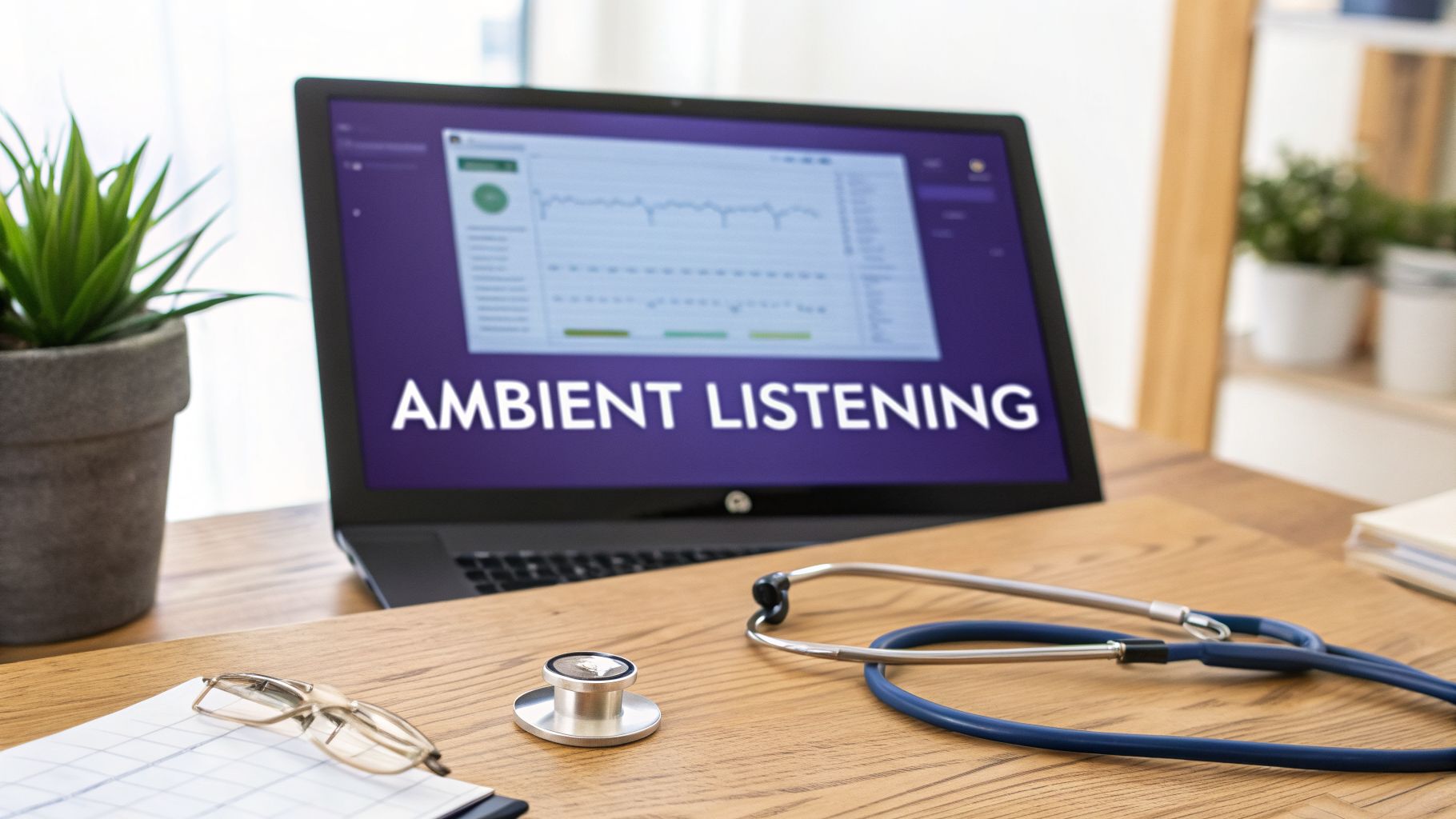
Picture an invisible, flawless medical scribe in the room for every patient visit. That's the promise of ambient listening in healthcare—a technology that intelligently captures the natural conversation between a doctor and patient. It then seamlessly converts that dialogue into structured clinical notes, directly in the electronic medical record (EMR). This guide explores how this transformative technology is reshaping clinical workflows, enhancing patient care, and solving one of medicine's most persistent challenges: the overwhelming burden of documentation.
What Is Ambient Listening in Healthcare

Think of ambient listening technology as a smart assistant working quietly in the background during a patient encounter. It liberates clinicians from the keyboard, allowing them to focus entirely on the person in front of them. The main problem this solves is the crushing burden of manual documentation, a task that consumes a significant portion of a physician's day and is a leading cause of professional burnout. This administrative load is notorious for eating up a huge chunk of a physician's day and contributes heavily to what's known as "pajama time"—those extra hours spent at home catching up on notes long after the clinic has closed. This isn't just an inconvenience; it's a primary driver of physician burnout and steals time away from actual patient care.
The Shift from Manual to Automated Notes
For far too long, doctors have had to split their focus between the patient and the computer screen, frantically typing to capture every detail. This often creates a disjointed experience for the patient and can easily lead to incomplete or inaccurate records. Ambient listening completely flips this script. It represents a paradigm shift from cumbersome, manual data entry to an automated, intelligent process that enhances the human connection at the heart of medicine.
Instead of pausing the conversation to type, the clinician can engage naturally. The system takes on the heavy lifting of listening, transcribing, and organizing the information into a medically coherent note. This is far more than a simple dictation tool; it's a sophisticated system built to understand clinical context. You can learn more about the evolution of voice technology and its applications in our detailed overview.
Ambient AI can unburden hours of administrative work for a physician. When you think about its ability to help more consistently capture a more accurate, complete picture of the patient in the medical record, it’s just better for patients.
How It Redefines Patient Interaction
At its core, this technology enables a fundamental return to patient-centered care. By removing the physical and mental barrier of the computer screen, doctors can make better eye contact, listen more attentively, and build a stronger, more trusting relationship with their patients. This renewed focus on the human element is one of the most celebrated benefits of ambient listening.
This change directly boosts the quality of care and patient satisfaction. The most immediate benefits are clear:
- Restored Focus: Clinicians can give their full attention to the patient's story, concerns, and non-verbal cues. This undivided attention can lead to better diagnostic accuracy and a more empathetic care experience.
- Improved Accuracy: The AI captures the entire conversation, minimizing the risk of missing key details that can happen with hurried manual note-taking. It documents the patient’s narrative in their own words, providing a richer, more nuanced record.
- Greater Efficiency: Documentation gets done almost instantly, which means no more backlog of administrative work at the end of a long day. This allows clinicians to leave work on time, significantly improving their work-life balance.
Ultimately, ambient listening isn't a futuristic concept; it's a practical tool making a real difference in practices today. It allows medical professionals to get back to the heart of their profession: caring for people. It is a direct response to the call for more humane, less administratively burdened healthcare delivery.
How a Conversation Becomes a Clinical Note

Turning a casual clinic conversation into a structured, secure EMR entry isn't magic—it's a sophisticated process that unfolds in seconds. It all starts the moment a doctor and patient begin their dialogue. High-fidelity microphones capture the conversation clearly, filtering out the background noise of a busy practice. This step is critical, as the quality of the audio input directly impacts the accuracy of the final note.
This raw audio is immediately fed into an Automatic Speech Recognition (ASR) system. You can think of ASR as the first-pass transcriber, creating a simple, word-for-word script of everything that was said. But a raw transcript isn’t a clinical note. The real work is just beginning. This transcript is the raw material that the AI will now refine and structure.
This is where a powerful combination of Natural Language Processing (NLP) and artificial intelligence takes over, revealing the true potential of ambient listening in healthcare. The AI acts like a highly specialized translator that doesn't just hear words but grasps their clinical context and importance. It can differentiate between medical terminology and conversational filler, a crucial capability for creating useful clinical documentation.
From Raw Dialogue to Structured Data
Think of the AI as an expert medical scribe that’s listening in. As it processes the transcript, it performs several complex jobs simultaneously:
- Speaker Diarization: First, it figures out who is speaking—the doctor, the patient, or a family member—and correctly assigns each statement. This ensures the history of present illness is captured from the patient's perspective.
- Contextual Understanding: It then identifies the clinically important parts of the conversation, pinpointing symptoms, medical history, diagnoses, and treatment plans. It understands that "my stomach hurts" is a symptom and "take two of these a day" is a medication instruction.
- Data Extraction: Finally, it pulls out specific, structured details like medication names, dosages, allergies, and follow-up timelines, while neatly ignoring the conversational filler and small talk. It populates these details into the correct fields of the EMR, such as the Assessment and Plan sections.
This is worlds away from a standard transcription tool. The AI models built for healthcare are trained on millions of real-world clinical conversations, so they understand the complex terminology and shorthand that would trip up any general-purpose software. To learn more about this, see our guide on AI for clinical documentation.
The AI essentially acts as an intelligent filter, separating the signal (critical clinical data) from the noise (casual chatter). This ensures the final note is concise, relevant, and accurate.
The Final Step: Clinician Review
Once the AI has extracted and structured all the key information, it assembles a draft clinical note. This draft is then presented to the physician for a quick review, often directly within the EMR system. The format is typically a standard SOAP (Subjective, Objective, Assessment, Plan) note or another format customized to the practice's needs.
The clinician can then easily edit, add to, or approve the note with just a few clicks. This "human-in-the-loop" model is crucial. It guarantees that the final record is 100% accurate and officially signed off by the clinician who was actually in the room. It’s the perfect blend of AI’s speed and a professional’s irreplaceable clinical judgment, ensuring both efficiency and accountability. This final sign-off is what makes the note a legal part of the medical record.
How Ambient Listening Changes Clinical and Administrative Workflows

Bringing ambient listening into a healthcare practice isn't just a small tweak—it creates a positive ripple effect that touches nearly every part of the operation. For clinicians, the biggest and most immediate win is getting back the hours they used to lose to manual note-taking. This is a direct assault on one of the biggest drivers of physician burnout. On average, physicians can save up to two hours per day on documentation.
The technology is a game-changer for what many in the industry call “pajama time”—those extra hours doctors spend at home, long after their last appointment, just trying to catch up on charts. Instead of typing away late at night, they can finalize their notes right after seeing their last patient, often in less than a minute. This allows them to be fully present in their personal lives.
But this isn't just about a better work-life balance. That recovered time is put right back into patient care, allowing doctors to be more present, focused, and empathetic during visits. Some practices report being able to add one or two additional patient slots per day without extending clinic hours, increasing access to care.
A Higher Standard of Patient Care
When a doctor isn’t tethered to a keyboard, everything changes. They can make eye contact. They can listen more carefully to what a patient is saying (and not saying) and pick up on important non-verbal cues. This fosters a much deeper, more meaningful conversation, which strengthens the doctor-patient relationship and can even lead to more accurate diagnoses. The quality of care just naturally improves when a provider's complete attention is on the person in front of them, not the computer screen.
This isn't just theory; early adopters are seeing real results. A pilot program at Stanford, for example, found ambient listening significantly cut down on after-hours documentation. And at a massive scale, Kaiser Permanente's rollout across more than 50 specialties is turning conversations into clinical notes on the spot. You can dig into more details about these ambient listening implementations on Honeywell.com.
Making Administrative Operations Smoother
The benefits don't stop at the exam room door. They flow directly into the administrative side of the practice, making things run much more smoothly for everyone. When clinical notes are accurate and complete from the moment they're created, it kicks off a chain reaction of efficiency.
By automating the most time-consuming part of the clinical encounter, ambient listening technology allows the entire operational workflow to run more smoothly, with fewer errors and less administrative friction.
This automation directly leads to some major operational wins:
- Fewer Documentation Errors: AI-generated notes tend to be more thorough and consistent than those typed by a busy human. This means fewer questions from coders and fewer billing mistakes down the road. The improved detail can also better support medical necessity for claims.
- Faster Billing Cycles: With complete notes available almost instantly, the medical coding and billing teams can get to work sooner. This tightens up the whole revenue cycle, reducing the time between service delivery and reimbursement.
- Reduced Administrative Overhead: Automating this task can lessen the need for human scribes or costly transcription services, with some practices seeing administrative costs drop by as much as 60%.
The benefits of ambient listening truly span the entire practice. Here’s a quick summary of how different roles are impacted.
Ambient Listening Benefits At-a-Glance
| Role | Primary Benefit | Operational Impact |
|---|---|---|
| Physicians/Clinicians | Reduced documentation time and burnout | More face-to-face time with patients, less "pajama time" |
| Medical Coders | Clearer, more complete clinical notes | Fewer back-and-forth queries to clinicians, faster coding |
| Billers | Quicker access to finalized documentation | Accelerated claim submissions and improved revenue cycle |
| Practice Managers | Lower transcription/scribe costs | Increased operational efficiency and clinician satisfaction |
| Patients | Undivided attention from their doctor | Better communication and a stronger patient-provider relationship |
Ultimately, ambient listening in healthcare helps everyone involved. Clinicians reclaim their time, administrators deal with fewer headaches, and patients get the focused, high-quality care they’ve always wanted. It’s a perfect example of how the right technology can make medicine feel more human again by removing administrative barriers.
Navigating Security and HIPAA Compliance

When you're dealing with Protected Health Information (PHI), trust is everything. This couldn't be more true for ambient listening in healthcare, where the deeply personal nature of patient conversations means security can't be an afterthought. The best platforms are built with security at their very core, not just as a feature tacked on to meet a requirement. Reputable vendors must sign a Business Associate Agreement (BAA), legally obligating them to protect PHI according to HIPAA standards.
This dedication to security starts the second the conversation is recorded. Every bit of audio and every word of text needs to be locked down with end-to-end encryption. That means it’s protected while it's traveling from the exam room to the cloud (in transit) and while it's being stored (at rest).
Building a Secure Digital Fort
Think of the security setup as a digital fortress with multiple layers of defense. Encryption is the outer wall, but there’s a lot more going on inside to keep patient data safe and private. It's this combination of safeguards that ensures compliance and helps earn the confidence of both doctors and patients.
These protections create a highly controlled environment where data is managed with extreme care. Because patient conversations are so sensitive, it's vital for healthcare organizations to focus on mastering HIPAA compliance IT requirements before bringing in any new ambient listening tool.
Key security measures usually include:
- Secure Cloud Infrastructure: Data is housed in HIPAA-compliant cloud environments, such as AWS, Google Cloud, or Microsoft Azure, which come with their own advanced threat detection systems and even physical security measures.
- Strict Access Controls: Not everyone gets a key to every room. Role-based access ensures that only people who need to see specific patient information can, preventing prying eyes. All access is logged and auditable.
- Regular Security Audits: The system is constantly monitored, and third-party experts are brought in for penetration testing and to look for weak spots, so potential issues can be fixed before they become real problems.
The Central Role of Patient Consent
All the technology in the world doesn't replace clear, honest communication. Getting a patient's informed consent isn't just a box to check—it’s a fundamental part of the process. This means explaining what the technology is, how it will use their data, and what steps are being taken to protect their privacy. This should be a transparent and explicit part of the patient intake process.
A successful implementation hinges on transparency. When patients understand that the technology allows their doctor to be more focused on them, they are generally very receptive.
The best way to handle consent is to make it a simple, routine part of the visit. This could involve having a small sign or handout in the exam room and having the doctor give a quick explanation before hitting record. For example, a clinician might say, "To make sure I give you my full attention, I use a secure recording tool to help with my notes. Is that okay with you?" It’s all about building trust and making sure patients feel respected and in control of their information.
A Practical Guide to Putting Ambient Listening into Practice
So, you're thinking about bringing ambient listening into your practice. It’s a great idea, but moving from concept to reality takes a solid game plan. For any practice manager or healthcare leader, the key is to approach this thoughtfully, starting with a clear-eyed look at what your practice actually needs.
The first, and arguably most important, step is picking the right vendor. You’re not just buying software; you’re choosing a partner. Look for someone who gets the nuances of your specialty’s documentation and has HIPAA-compliant security locked down tight. Most importantly, they need to prove their system can play nicely with your current Electronic Medical Record (EMR). A clunky integration is a deal-breaker—it will cause more headaches than it solves. Request a live demonstration to see how the tool functions within your specific EMR environment.
Building a Foundation for Success
Once you have a partner on board, it's time to focus on your team. Training isn't just a "click here, type that" exercise. You have to sell the why. Explain how this tool is going to give them back their time, help fight burnout, and let them get back to focusing on their patients instead of their keyboards. Highlight the benefits to both their professional and personal lives.
The good news is, you're likely pushing on an open door. People are ready for this. A recent survey from Net Health found that in the rehab therapy world, 93% of non-clinicians and 86% of clinicians already feel positive about this kind of technology. That's a huge wave of support for AI scribes.
From Pilot Program to Full Adoption
Before you flip the switch for everyone, start small. A pilot program with a handful of enthusiastic early adopters is the perfect way to kick the tires in a real-world setting. This trial run does a few crucial things for you:
- Measure the ROI: You can track real numbers, like how much time clinicians save on notes per patient, and see if patient satisfaction scores go up. Collect baseline data before the pilot to demonstrate a clear before-and-after impact.
- Get Honest Feedback: Your pilot users will tell you what works and what doesn't. This is your chance to smooth out any workflow kinks before the full rollout. Use this feedback to create best practice guides for the wider team.
- Build Your Champions: When the pilot group starts raving about how much better their days are, they become your best advocates for getting the rest of the team on board. Their testimonials are far more powerful than any top-down directive.
This is all about change management. Frame ambient listening not as another top-down mandate, but as the solution to a problem everyone hates: the crushing weight of documentation.
By taking it one step at a time—from picking the right vendor and ensuring deep EMR integration to getting your team excited and running a smart pilot program—you can make this transition a smooth one. It turns a daunting project into a clear, manageable path toward a practice that’s more efficient and, ultimately, better for your patients.
Common Questions About Ambient Listening
Whenever a new technology enters the clinic, it’s bound to raise a few eyebrows. A healthy dose of skepticism is expected. When practice leaders start looking into ambient listening in healthcare, they usually bring up the same handful of concerns about accuracy, how patients will react, and what it means for their staff. Let's tackle these questions head-on.
The first question is almost always about the quality of the notes. Can an AI really produce accurate documentation? The best platforms out there can hit an accuracy rate of over 95% right out of the box. These aren't your everyday voice assistants; they are sophisticated AI models trained on a massive amount of clinical conversations and medical jargon, which is why they perform so well.
Even better, these systems are built to get smarter. The AI learns a clinician's unique way of speaking, their common phrases, and even the types of edits they make. This refinement loop means the notes just keep getting more precise over time. The "human in the loop" review process not only ensures final accuracy but also provides feedback to the AI model.
How Do Patients Feel About This Technology?
Of course, the patient's point of view is a huge piece of the puzzle. Will they be weirded out knowing a device is "listening"? The feedback has been surprisingly positive. When you explain that the technology helps the doctor focus entirely on them instead of staring at a computer screen, most patients get it immediately. They appreciate the undivided attention.
Transparency is everything. The most successful rollouts involve a simple, clear process for letting patients know what’s happening and getting their consent before the appointment starts. This simple step builds trust and shows you respect their privacy, turning the technology into a welcome part of the visit, not an intrusion.
When patients understand that ambient listening allows their doctor to be more present and engaged, they often see it as a direct benefit to their own care experience.
Does It Replace Medical Staff?
Another common worry is job security. Will this make our scribes or medical assistants obsolete? Not at all. In reality, ambient listening doesn't replace people; it elevates their roles. By automating the monotonous task of transcription, it frees up your team for more meaningful, patient-focused work. It allows staff to work at the top of their license.
Instead of just typing, your staff can now handle things like:
- Care Coordination: Guiding patients through their treatment plans and scheduling follow-ups.
- Patient Education: Taking the time to explain conditions and make sure care instructions are crystal clear.
- Clinical Workflow Management: Pitching in on other hands-on tasks that support the physician and keep the clinic running smoothly, such as preparing exam rooms or managing prior authorizations.
It’s a shift from administrative busywork to direct patient support. And what about the learning curve for doctors? Modern ambient listening tools are designed to be incredibly simple. The system just works quietly in the background, so training is minimal. The main task is learning the quick review-and-sign-off step in the EMR, which most clinicians pick up in a session or two.
Ready to see how AI can reduce administrative burdens and free your staff to focus on patient care? Learn how Simbie AI can automate your practice's administrative tasks, from patient intake to scheduling, saving you up to 60% on overhead. Visit us at https://www.simbie.ai to get started.