
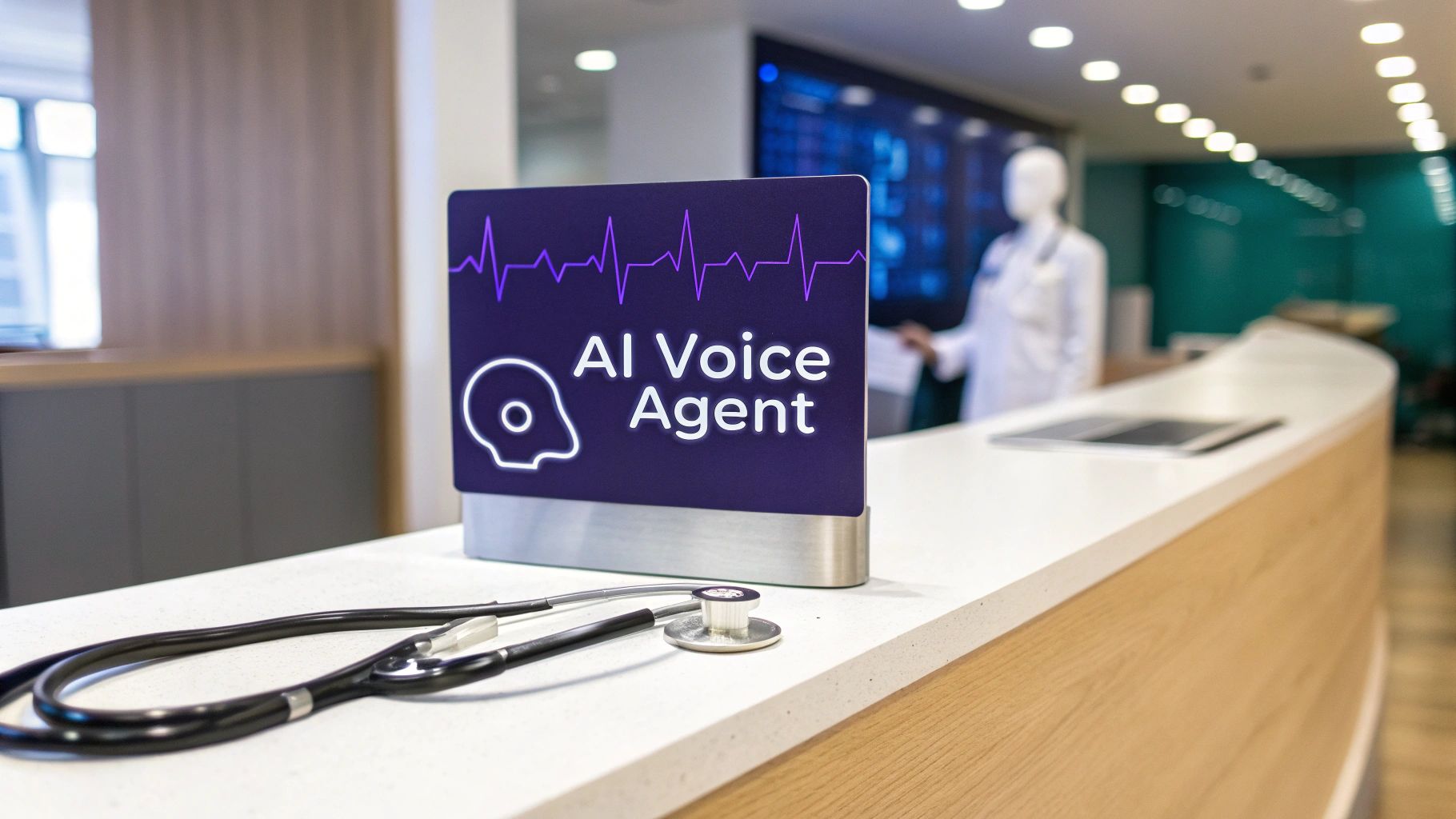
An AI voice agent for healthcare is a specialized piece of software that uses artificial intelligence to manage phone calls from patients and handle administrative communication. Think of it as a superhuman medical assistant that's on the clock 24/7, automatically taking care of tasks like booking appointments, processing prescription refills, and completing patient intake. And it does all this without needing a human to step in.
What an AI Voice Agent Really Does

Picture your most dependable team member—the one who never gets sick, can juggle countless calls at once, and documents every single conversation flawlessly. That’s essentially what an AI voice agent brings to a healthcare practice. It’s far more than a simple phone tree or a basic chatbot; it’s a sophisticated communication hub that understands the clinical context.
Unlike generic voice assistants you might have on your phone, these agents are specifically trained on medical language and real patient conversations. They get the subtleties of a patient's request, whether they're asking for a new appointment, a refill, or have a question about prior authorizations. This is not just automation; it is intelligent automation designed for the unique demands of healthcare. The system uses advanced Natural Language Processing (NLP) to interpret the caller's intent, ensuring that "I need a follow-up for my diabetes check" is understood and routed correctly, not just as a generic appointment request.
Your Superhuman Medical Assistant
A helpful way to think about this technology is to see it as a superhuman medical assistant. This assistant is built to handle the repetitive, high-volume work that so often burns out your staff and leaves patients frustrated. It acts as a digital front door, ensuring every patient interaction is efficient, accurate, and consistent.
Here’s what it focuses on:
- Answering Every Call: It picks up the phone instantly, every time. This means no more hold music and no more missed calls from patients needing care, which directly impacts patient retention and acquisition.
- Automating Routine Tasks: It takes care of the day-to-day administrative work—scheduling, sending reminders, and gathering information—with incredible speed and accuracy. This frees up human staff from mundane, repetitive tasks.
- Connecting to Your EMR: It logs call details, patient updates, and appointment requests directly into your Electronic Medical Records (EMR) system, keeping everything in sync and reducing the risk of manual data entry errors.
Let's look at how this new approach stacks up against the old way of doing things. The comparison highlights a fundamental shift in how practices can manage their resources and patient communications.
AI Voice Agent vs. Traditional Call Center
| Feature | Traditional Call Center | AI Voice Agent |
|---|---|---|
| Availability | Limited to business hours (e.g., 9-5, M-F) | 24/7/365, including holidays |
| Call Capacity | 1 agent = 1 call at a time | Unlimited simultaneous calls |
| Patient Hold Time | Often several minutes, especially during peak hours | Zero hold time, ever |
| Cost | High; salaries, benefits, training, overhead | Low; predictable monthly subscription |
| EMR Documentation | Manual data entry, prone to human error | Automated and instant, highly accurate |
| Staff Focus | Answering repetitive calls, scheduling | Complex patient needs, in-person care |
The difference is night and day. The AI handles the volume, while your team provides the high-touch care that truly matters.
This kind of automation is becoming essential for modern medical practices. Recent research on the healthcare voice AI market found that hospitals and health systems are the biggest adopters, making up 41.87% of the market, driven by the need to manage overwhelming call volumes and administrative loads. The pressure to improve efficiency while enhancing patient access is a key driver behind this trend.
By taking over these foundational workflows, an AI voice agent for healthcare gives your skilled staff the freedom to focus on what they do best: delivering compassionate, high-quality care to the patients right in front of them.
Ultimately, the goal is to replace the daily chaos of phone tag and manual data entry with a smooth, efficient process that puts patients first. This doesn't just boost your practice's productivity; it dramatically improves the patient experience from their very first interaction. You can learn more about how voice technology in healthcare is transforming practices in our detailed guide.
How AI Voice Agents Change Your Daily Grind
An AI voice agent for healthcare doesn't just add a new tool; it changes the entire rhythm of a medical practice. It can turn the daily chaos into something much more manageable and efficient.
Think about the typical morning rush at a busy clinic. The old way involved a front desk buried under ringing phones, patients stuck on hold, and a line forming at the check-in counter. With an AI voice agent, that picture is completely different.
The phones are quiet. The AI is handling dozens of calls at once, so no patient ever hits a busy signal or gets stuck listening to hold music. This frees up your front office staff to actually focus on the people standing in front of them, giving them a real welcome and sorting out complex issues without being constantly interrupted. This shift from reactive call handling to proactive patient engagement is a cornerstone of modern healthcare delivery.
Taking Administrative Tasks Off Your Plate
For your admin team, the difference is night and day. The tedious, repetitive tasks that used to eat up their entire morning are now handled automatically. This shift lets your people focus on higher-value work that actually requires a human touch, such as financial counseling, complex scheduling scenarios, and providing empathetic support to distressed patients.
Here are a few key administrative jobs the AI takes over:
- Hands-Off Appointment Management: The agent can schedule new appointments, send out confirmations, and handle cancellations or rescheduling requests 24/7. It does this by talking directly to your EMR’s calendar, respecting complex scheduling rules like provider availability and appointment types.
- A Better Patient Intake Process: Forget the clipboards. The agent can call patients before they arrive to gather their demographic info, insurance details, and medical history, then drop it all right into the EMR. This not only saves time during check-in but also improves data accuracy.
- Automated Reminders That Work: The system sends out friendly, conversational reminders about appointments and necessary follow-ups. This simple step can slash your no-show rates and make a real difference to the clinic's bottom line by optimizing provider schedules.
This kind of reliable, round-the-clock communication is a huge win for keeping patients engaged. It’s no surprise that this area of AI is expected to see the fastest growth as providers work to meet patient demand for personalized, instant support.
Giving Your Clinical Team a Hand
The benefits go well beyond the front desk, directly helping out your nurses and physicians. By taking routine communication off their hands, an AI voice agent lets clinical staff work at the top of their license. They get to spend more time on patient care and less time fighting with paperwork. To see more examples, check out our guide on automating healthcare workflows.
Here’s how an AI assistant helps on the clinical side:
- Prescription Refill Requests: A patient can call anytime to request a refill. The AI will gather the necessary details, confirm who they are, and put the request in the EMR queue for a doctor to approve with a single click. This structured process eliminates back-and-forth calls and ensures all necessary information is collected upfront.
- Kicking Off Prior Authorizations: The agent can start the prior authorization process by gathering the basic information from the patient. This alone saves the clinical team from spending ages on the phone with insurance companies, a common source of administrative burnout.
- Lab Result Communication: Instead of staff making dozens of calls for normal lab results, the AI can be configured to securely deliver this information to patients, freeing up nurses to handle more critical clinical tasks and patient education.
Of course, voice agents aren't the only AI tool making waves. Chatbots are also changing how clinics handle daily work, as detailed in this great resource from ProMed Certifications on AI in Healthcare: How Chatbots Can Help Your Team. While chatbots are excellent for text-based interactions, voice agents excel at providing an accessible, hands-free option for all patient demographics.
Ultimately, this technology turns frustrating, time-sucking processes into smooth, well-documented interactions, creating a much better work environment for everyone.
What This Actually Means for Your Medical Practice
Let's get past the tech jargon and talk about what an AI voice agent for healthcare really does for your practice on a day-to-day basis. The results aren't just marginal improvements; they're major wins that fall into three main buckets: huge gains in efficiency, real cost savings, and a patient experience that actually feels modern and supportive.
At its core, an AI voice agent offers 24/7 availability and can handle a virtually unlimited number of calls at once. Think about that for a second. No more busy signals. No more "high call volume" messages. Every single patient who calls gets an immediate response, which means you never miss an opportunity to provide care or fill your schedule. This is crucial for both patient satisfaction and practice revenue.
Unlocking Serious Efficiency
Imagine your front office team, but without the constant interruption of ringing phones. By handing off all the routine calls—the appointment bookings, the prescription refill requests, the basic questions—the AI frees up your staff to do what they do best. They can finally give their full attention to the patient standing at the desk, sort out a complicated billing issue, or handle other tasks that require a human touch. This simple change can break the cycle of frantic multitasking that so often leads to mistakes and staff burnout. A more focused staff is a more effective staff.
This move toward automation is happening across healthcare. The biggest growth is in clinical workflow assistance, where providers are automating things like documentation and updating patient records. When AI takes over these repetitive tasks, clinicians get more face-to-face time with patients. It's a big reason this technology is catching on so quickly. You can dig into more of the numbers on the AI voice agent market over at towardshealthcare.com.
Finding Real Cost Savings
The financial argument is just as compelling. Automating these administrative phone calls can cut your overhead costs by up to 60%. This isn't just about saving money on salaries for call-handling roles. It’s also about solving the expensive problem of staff turnover.
High-stress administrative jobs often have a revolving door, and every time someone leaves, you're stuck with recruiting and training costs. By making the work environment calmer and more manageable, an AI voice agent helps you keep good people, leading to a more stable and experienced team.
And don't forget about patient leakage. When a potential new patient can't get through, they just call the next clinic on their list. By making sure every call gets answered, the AI helps you capture revenue that would have otherwise walked out the door. Furthermore, reducing appointment no-shows through automated, intelligent reminders directly impacts your bottom line, ensuring provider time is fully utilized.
Crafting a Better Patient Experience
Perhaps the biggest impact is on how patients feel about your practice. In an on-demand world, being put on hold for 15 minutes is a massive source of frustration. An AI voice agent makes that entire problem disappear. It meets modern patient expectations for immediate, convenient service.
Here’s what that looks like from the patient's side:
- No More Waiting: They get an immediate response every single time they call, whether it's midnight or the middle of a busy Monday.
- Self-Service That Works: They can book an appointment, ask for a refill, or get an answer to a simple question right then and there, without waiting for a person to become available.
- Total Convenience: Patients can interact with your practice whenever it suits them, not just during your office hours. This accessibility is invaluable for patients with unconventional work schedules or urgent, non-emergency needs.
This kind of responsive, hassle-free service is a direct driver of patient satisfaction. When patients have a good experience, they stick around, they recommend you to their friends and family, and they're more likely to stay on top of their care. Improved satisfaction scores can also impact reimbursement rates and public ratings, making it a critical business metric.
Navigating HIPAA Compliance and Data Security
Anytime you bring new technology into a healthcare setting, one question looms larger than all others: is it secure? When it comes to an AI voice agent for healthcare, that answer has to be a firm, unequivocal yes. Patient trust is the foundation of everything we do, and protecting their data is simply non-negotiable.

This goes way beyond just checking a box on a compliance form. It's about making sure every piece of Protected Health Information (PHI) is handled with the utmost care, from the second a patient speaks on the phone to the moment that data is filed away in the EMR. A security breach not only carries hefty financial penalties but can also irreparably damage a practice's reputation.
The Pillars of Secure AI Communication
Any AI voice agent vendor worth their salt builds their platform on a rock-solid foundation of security measures designed from the ground up for healthcare. These aren't just features you can turn on or off; they are baked into the core of the system to maintain HIPAA compliance.
Here are the security protocols you should expect as standard:
- End-to-End Encryption: This scrambles all voice and text data the moment it leaves the patient's phone and keeps it that way until it lands safely in your EMR. To any outsider, it's just unreadable noise. This applies to data both in transit and at rest.
- Secure Data Storage: Patient information isn't just stored anywhere. It's kept in fortified, compliant environments—like HITRUST-certified cloud servers—that meet and often exceed industry standards for data protection.
- Access Controls: Strict user permissions are crucial. They ensure only authorized staff can see sensitive patient data, creating a clear and simple line of accountability. This principle of "least privilege" is a cornerstone of effective data security.
These layers work in concert to build a secure environment where patient privacy is always the top priority. If you want to dive deeper into the nuts and bolts, you can explore our overview of HIPAA-compliant AI tools.
Business Associate Agreements and Continuous Monitoring
But great technology alone isn't enough. The relationship you have with your AI vendor has to be compliant, too. This is where a Business Associate Agreement (BAA) comes in. It's a legally binding contract that clearly lays out the vendor's responsibilities for protecting PHI. Operating without one is a massive risk and a direct violation of HIPAA.
A BAA ensures your technology partner is just as committed to HIPAA compliance as you are. It's a critical document that shares the responsibility of safeguarding patient data, making it a mandatory checkpoint when evaluating vendors.
Beyond the initial contract, keeping data safe is a day-in, day-out job. A strong Data Loss Prevention (DLP) strategy is essential for protecting the sensitive patient data processed by AI. The system must also maintain detailed audit trails that log every single action taken, including who accessed what data and when. This constant monitoring helps catch and stop unauthorized access, giving you a transparent record of all interactions and ensuring the system remains secure and trustworthy for the long haul. Regular security audits and penetration testing by the vendor are also signs of a mature security posture.
Your Guide to a Successful Implementation

Bringing an AI voice agent for healthcare into your practice can feel like a massive undertaking, but a good game plan makes all the difference. Success isn't just about flipping a switch on new technology. It's about smart planning, smooth integration, and getting your whole team excited about the change.
The first big step is making sure the AI can talk to your existing Electronic Medical Record (EMR) system. This connection is non-negotiable. It's how the AI agent books appointments directly into your schedule and logs patient interactions without anyone having to lift a finger. If that link is broken, you're not saving time—you're just creating more work.
Laying the Groundwork for Integration
Think of EMR integration like building a solid bridge. For the AI to do its job, information has to flow securely and instantly between the two systems. This means you need a vendor who knows the ins and outs of major EMR platforms and can guarantee a stable, compliant connection right from the start. Look for vendors with a proven track record of successful integrations with platforms like Epic, Cerner, eClinicalWorks, or Athenahealth.
A huge part of this initial setup is customizing the AI's personality and scripts. Every practice has its own way of doing things, and the AI should sound like a natural extension of your team. This involves tailoring how it greets patients, the questions it asks, and how it handles common requests like scheduling or prescription refills. A good vendor will work with you to map out your existing workflows and translate them into efficient, automated processes.
Managing Change and Training Your Team
Even the most brilliant technology will fall flat if your team isn't on board. It’s absolutely critical to bring your staff into the conversation early. They need to see the AI voice agent for what it is: a tool to make their lives easier, not a threat to their jobs. Frame the technology as a way to eliminate tedious work and empower them to focus on more rewarding, patient-facing activities.
Here are a few practical steps to make the transition smooth:
- Set Clear Expectations: Be upfront about what the AI will do. Explain how it will take over repetitive phone calls so your team can focus on patients who are right there in the office.
- Provide Hands-On Training: Walk your staff through the system. Show them where the AI’s notes appear in the EMR and how they can quickly review its activity. Confidence is key.
- Create a Feedback Loop: Give your team an easy way to share what’s working and what isn’t. They're on the front lines and will have the best ideas for improving the AI’s scripts and flow.
- Identify Champions: Designate one or two tech-savvy team members as super-users or champions. They can help answer questions and build enthusiasm among their peers.
This human-centric approach is everything. We're already seeing a major shift in how clinicians view these tools. A recent study found that 86% of clinicians are comfortable with AI either fully handling (26%) or assisting with (60%) administrative tasks. The readiness is there. You can dig into more of these findings in the full market report on Grandview Research.
How to Choose the Right Vendor
Picking the right partner is probably the single most important decision you'll make in this entire process. The vendor you choose will be the difference between a frustrating headache and a genuine success story. You're not just buying software; you're looking for a partner with deep healthcare experience.
When you're evaluating different companies, it's easy to get lost in the sales pitches. This checklist can help you cut through the noise and focus on what really matters.
Vendor Evaluation Checklist for AI Voice Agents
| Evaluation Criteria | Key Questions to Ask | Importance (High/Medium/Low) |
|---|---|---|
| Healthcare Specialization | Is the AI trained specifically on medical terms and real patient conversations, or is it a generic chatbot? | High |
| EMR Integration Proof | Can they show you a live demo of a deep, bidirectional integration with your specific EMR system? | High |
| HIPAA Compliance & Security | Will they sign a Business Associate Agreement (BAA)? How do they encrypt and protect patient data? | High |
| Customization & Onboarding | How much control do we have over the scripts? Who will help us set everything up? | Medium |
| Ongoing Support | What happens after launch day? Do we get a dedicated account manager or just a general support email? | High |
| Transparent Pricing | Is the pricing model clear? Are there hidden fees for setup, extra call volume, or EMR integration? | Medium |
Taking the time to vet vendors properly ensures you find a partner who understands your challenges and has the technical chops to deliver. A successful rollout isn't just about technology—it’s about turning a great idea into a real asset that helps your practice run better and improves the patient experience.
The Future of AI Voice in Patient Care
The journey for AI voice agents in healthcare is really just getting started. Right now, we often see them as helpful administrative assistants, but their role is set to expand dramatically, becoming a central hub for proactive and coordinated patient care.
We're heading toward a future where these agents provide sophisticated clinical decision support, helping clinicians connect the dots in patient data. Think about an AI that doesn't just sit and wait for a phone call. Instead, it proactively reaches out to a patient because their EMR data shows they’re due for a follow-up or might need a medication adjustment. This changes the game entirely, turning the AI from a reactive tool into a genuine partner in care.
What's Coming Next?
The next wave of innovation is all about deeper, smarter integrations. We're not just talking about booking appointments anymore. The focus will shift towards population health management and personalized patient engagement.
- Telehealth Synergy: Imagine an AI voice agent that not only schedules a telehealth visit but also follows up afterward to confirm the patient understood their care plan and has what they need. It could even administer automated post-visit surveys to collect outcomes data.
- Specialist Coordination: These agents will act as a communication bridge, smoothing out the referral process and making sure information flows seamlessly between primary care doctors and specialists. This can significantly reduce care gaps and delays.
- Proactive Health Management: The AI will keep an eye on patient data, looking for early warning signs. It can then trigger an outreach for preventive care long before a minor issue becomes a serious health problem, for example, by calling diabetic patients to remind them to schedule their annual foot exam.
- Clinical Trial Recruitment: AI agents could analyze patient records (with consent) to identify eligible candidates for clinical trials and initiate outreach, accelerating the pace of medical research.
The market is absolutely set to explode. One forecast predicts the AI voice agent in healthcare market will rocket from USD 650.65 million to an incredible USD 11,695.26 million by 2035. You can dig into more of the projections for voice-based AI solutions on towardshealthcare.com.
When it comes down to it, adopting this technology isn't just about chasing the latest trend. It’s a strategic decision that allows forward-thinking practices to run more efficiently, get a handle on costs, and ultimately deliver a much higher standard of care to their patients. It's about building a healthcare system that is more accessible, responsive, and patient-centered.
Frequently Asked Questions
Exploring any new technology for your practice naturally brings up a lot of questions. Let's walk through some of the most common ones we hear from providers when they're looking into an AI voice agent for healthcare.
How Does The AI Integrate With Our EMR System?
This is probably the most critical question, and the answer is simpler than you might think. A well-designed AI voice agent doesn't just sit on top of your current systems; it connects directly into them.
This connection is usually made through something called an API (Application Programming Interface), which is a secure and standard way for different software to talk to each other. When the AI schedules an appointment or updates patient details over the phone, that information flows straight into your EMR in real time. No more manual data entry, no more double-booking, and far fewer human errors. A robust integration should be bidirectional, meaning the AI can both read data from the EMR (like provider schedules) and write data back to it (like new appointment details).
Can The AI Handle Complex Medical Terms and Accents?
Yes, and this is what separates a true healthcare AI from a general-purpose assistant like Siri or Alexa. A medical-grade AI isn't just a generic voice bot; it has been specifically trained on a massive library of real-world clinical conversations, medical records, and industry terminology.
Thanks to this specialized training, its Natural Language Processing (NLP) is incredibly advanced. It can reliably understand complicated medical terms, pick up on the nuances of different accents and dialects, and grasp the context of a healthcare conversation. For instance, it can differentiate between a patient asking for "hydrocodone" versus "hydrocortisone." The goal is to get it right the first time, every time. Leading vendors continuously refine their models to improve accuracy and comprehension across diverse patient populations.
Return on investment (ROI) is not just about cost savings. It also includes major gains in operational efficiency and a significantly better patient experience, allowing clinical staff to dedicate more time to direct patient care.
This level of accuracy means fewer misunderstandings and a smoother, more reliable experience for your patients, which builds trust in the technology and your practice.
What Is The Typical Return On Investment?
The ROI shows up in a few different, but equally important, ways. First, there are the direct financial savings. You can reduce the hours your staff spends on the phone and capture revenue from calls that might have gone to voicemail after hours. Calculating the cost of a full-time employee (salary, benefits, etc.) versus the subscription cost of an AI agent often reveals immediate savings.
But the return goes beyond just the numbers. Operationally, you'll see things like higher appointment show-up rates and a less frantic front desk, which does wonders for staff morale and reduces turnover.
Clinically, the biggest return is giving your team back their time. By letting the AI handle the repetitive phone traffic, you free up your skilled staff to focus on what they do best: providing excellent care to the patients right in front of them. This shift toward top-of-license work improves job satisfaction and patient outcomes, which are invaluable long-term benefits.
Ready to see how an AI voice agent can transform your practice? Simbie AI offers a clinically-trained, HIPAA-compliant solution that automates routine tasks, cuts administrative costs, and enhances patient care. Learn more and schedule your demo today.