
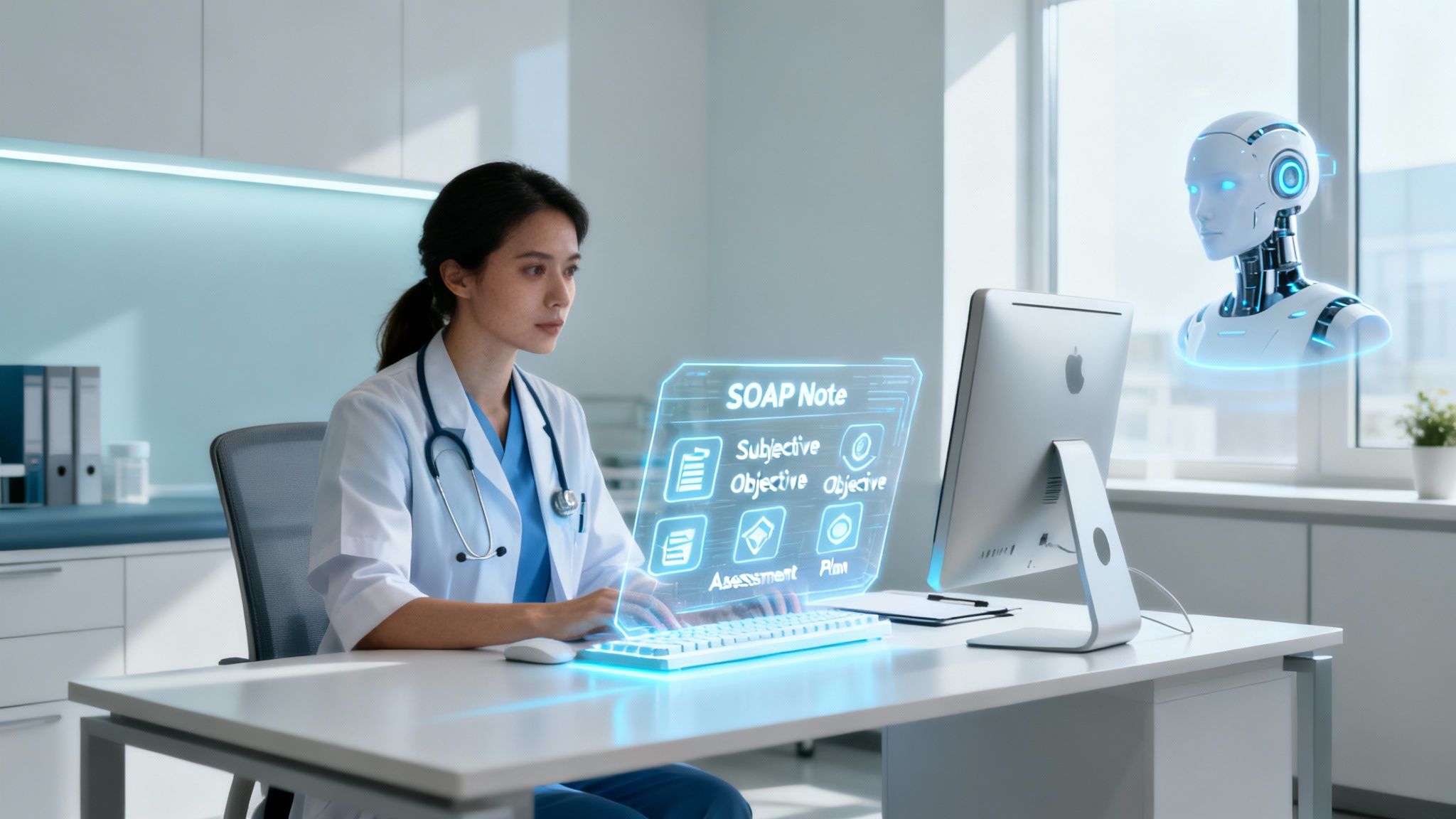
An AI SOAP note is a clinical document generated by an artificial intelligence tool. It operates by listening to the conversation between a clinician and a patient, then automatically structuring that dialogue into the standard Subjective, Objective, Assessment, and Plan (SOAP) format.
Think of it as a highly-trained digital scribe that never gets tired. It meticulously captures all the crucial details from the patient visit and delivers a comprehensive first draft of the medical record. This simple yet powerful automation saves a massive amount of administrative time, allowing healthcare professionals to focus on patient care rather than paperwork.
Understanding the AI SOAP Note
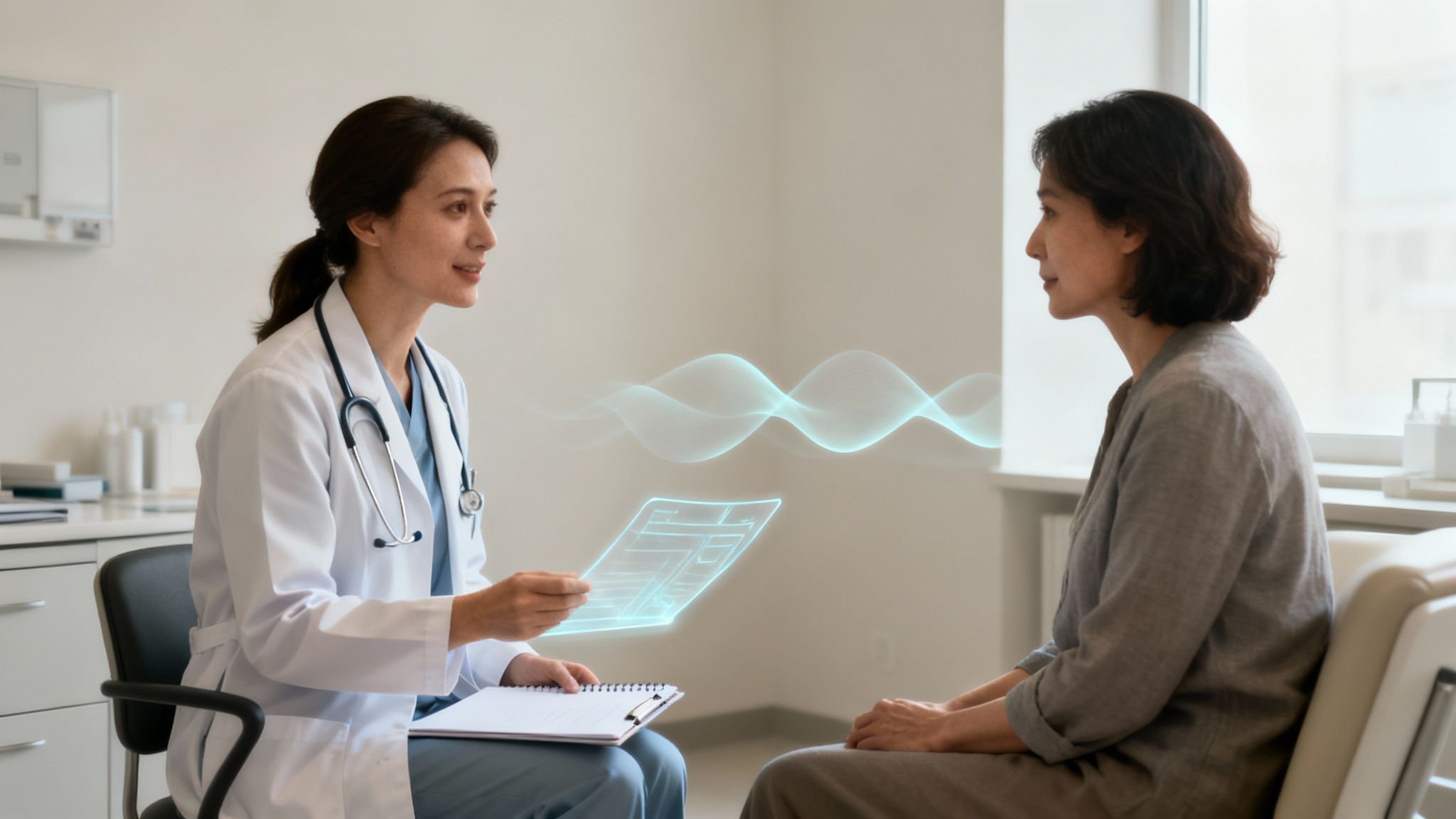
Imagine having a master scribe present in the room for every single patient encounter. This scribe never interrupts, never needs clarification, and never misses a detail—they just listen. They understand the nuances of medical conversations and, moments after the visit concludes, produce a perfectly structured note. That's precisely the function of an AI SOAP note generator.
This technology isn't just about convenience; it's a direct and powerful response to one of the biggest pain points in modern medicine: administrative overload. Clinicians spend countless hours typing up notes, a task that is a leading cause of professional burnout and pulls focus away from the core mission of patient care. It's a drain on time, energy, and morale.
An AI SOAP note generator completely flips that script. Instead of being tethered to a keyboard, you can give your patient your full attention, make genuine eye contact, and build a stronger therapeutic connection. The AI works quietly and unobtrusively in the background, a process often referred to as "ambient listening." This allows the clinical encounter to feel natural and unmediated, preserving the human element of care.
The Technology Behind the Note
So, how does this technology actually work? It's far more sophisticated than basic dictation software. The system relies on a powerful blend of advanced technologies to accurately convert a natural, free-flowing conversation into a well-formed and clinically relevant document.
Here are the key technological components at play:
- Natural Language Processing (NLP): This is the core engine that allows the AI to interpret human speech. NLP models are trained to understand complex medical terminology, patient slang, colloquialisms, and the back-and-forth flow of a real conversation. It can differentiate between speakers and parse sentences to extract meaningful clinical data.
- Machine Learning (ML): The AI models undergo extensive training on millions of anonymized clinical encounters. This process teaches them to recognize patterns, identify key information, and accurately sort that information into the correct S, O, A, and P sections of the note. The more data it processes, the smarter and more accurate it becomes.
- Ambient Listening: The conversation is captured using specialized software or discreet microphones designed to be non-intrusive. The goal is to ensure the interaction between clinician and patient feels completely natural, without the distraction of a device that needs to be actively managed.
The goal of an AI SOAP note isn't to replace the clinician. It’s to enhance their abilities by taking over the tedious, repetitive, and time-consuming documentation work. This frees up your mental bandwidth for what truly matters: critical thinking, complex problem-solving, and making the best possible decisions for your patient's health.
More Than Just a Gadget
It’s tempting to write off new technology as just another shiny object, but the AI SOAP note is fundamentally different. It marks a paradigm shift in how clinical work gets done. By automating one of the most draining and universally disliked tasks of the day, it gets right to the heart of what causes clinician burnout.
That time you get back can translate into more thorough patient visits, a healthier work-life balance, and a renewed opportunity to rediscover the human side of medicine. It allows clinicians to operate at the top of their license, focusing on diagnosis and treatment rather than data entry.
This technology directly tackles the documentation burden that has plagued healthcare for years, a problem exacerbated by the widespread adoption of electronic health records. To really see how this translates to a real-world setting, you can dive deeper into the principles of AI clinical documentation and how it boosts a practice's overall efficiency. The mission is simple: bring the joy back to medicine by letting the technology handle the paperwork.
Transforming Your Daily Clinical Workflow

Moving from the idea of an AI SOAP note to using one in your daily practice is where you witness the magic happen. This isn't just a minor tweak to your routine; it’s a fundamental redesign of the clinical workday, shifting the focus from administrative drudgery back to direct patient care. For most clinicians, the day doesn't end after seeing the last patient. It ends hours later, after climbing a mountain of documentation and chart closures.
Think about a typical day in a busy primary care clinic. Before AI, every 15-minute patient visit is chased by another 10-15 minutes of frantic typing, clicking through cumbersome EMR templates, and trying to recall specific details from the conversation. By late afternoon, you're running behind schedule, your brain is fried from context-switching, and the quality of your notes starts to dip under the sheer pressure of the workload. This scenario inevitably leads to the dreaded "pajama time"—spending hours at home, often late at night, just to catch up on charting.
Now, imagine that same day, but with an AI scribe integrated into your workflow. You can focus completely on your patient, making sustained eye contact, listening actively, and actually building a meaningful connection. The AI is quietly capturing the entire conversation in the background. As soon as the patient leaves the exam room, a structured, detailed SOAP note is waiting for you in your EMR, ready for review in less than a minute. You just need to scan it for accuracy, make a few quick edits or additions based on your clinical judgment, and sign off. Done. The chart is closed in real-time.
The Tangible Gains in Efficiency and Focus
This workflow transformation delivers real, measurable benefits that go way beyond just saving time. It's about reclaiming your mental energy, reducing stress, and genuinely improving your quality of life at work. The drop in documentation time is often staggering, with many doctors reporting they save two to three hours per day. This reclaimed time can be repurposed for seeing more patients, spending more time with complex cases, or simply leaving work on time.
Let's look at a few real-world examples of this impact:
- The Family Physician: Instead of being stuck at the office until 7 PM finishing charts, she can now review and sign notes between appointments. She leaves on time, every single day, which helps fend off burnout, reduces stress, and gives her a personal life back. This sustainability is crucial for long-term career satisfaction.
- The Specialist: A cardiologist is seeing a patient with a complicated, multi-system history. Because he isn't tied to the keyboard, he can engage in a much deeper, more nuanced conversation and pick up on subtle cues—a slight hesitation, a non-verbal gesture—he might have missed otherwise. The AI-generated note is more detailed and accurate as a result, which is a huge help for care coordination with other providers.
- The Mental Health Therapist: A therapist can stay completely present and engaged during an intense session, confident that the key subjective points, emotional undertones, and the collaboratively developed therapeutic plan are being captured accurately. This strengthens the patient-therapist relationship and ensures no critical details get lost in the shuffle between sessions.
The real game-changer here is the massive reduction in cognitive load. Instead of constantly trying to listen to your patient while mentally drafting a chart note and navigating an EMR, you can give them your full, undivided attention. This leads to better diagnoses, more effective treatment plans, and stronger patient relationships.
Beyond Documentation: Data-Driven Insights
But the benefits don't stop at a faster, more efficient workflow. These intelligent systems are brilliant at turning unstructured, conversational data into structured, usable data. This unlocks some powerful secondary advantages that can improve the quality of care across an entire practice or health system. AI SOAP note tools don't just make you more efficient; they enable better data analysis and can even offer predictive clinical insights.
By taking over note creation, these systems free you up to focus on what matters most: your patients. The AI is also constantly learning from every interaction, ensuring the notes it produces stay relevant, comprehensive, and aligned with best practices. This can help you practice more evidence-based medicine, as the system can be configured to flag potential health risks, suggest preventive care measures based on patient history, or ensure compliance with quality metrics.
Ultimately, this high-quality, structured data can feed into broader Clinical Decision Support Systems (CDSS), making the entire clinical ecosystem smarter and more responsive. Bringing an AI scribe into your practice isn't just about writing notes faster. It’s about creating a more sustainable, focused, and effective clinical environment where technology finally starts working for you, not the other way around.
How AI Gets Clinical Notes So Accurate

Trust is the cornerstone of medicine. So, it's completely fair and rational to be skeptical about a clinical note written by a machine. How could an algorithm possibly grasp the complex, nuanced, and deeply human reality of a patient visit?
The secret lies in its specialized, intensive training. An AI SOAP note tool isn't your everyday chatbot like ChatGPT. It's a purpose-built, fine-tuned system trained on a massive, carefully curated dataset of millions of anonymized clinical conversations. Think of it as a medical resident who has silently observed countless appointments across every imaginable specialty—from pediatrics and primary care to cardiology and oncology—learning the entire time.
This intensive, domain-specific training is what allows the AI to pick up on intricate medical terminology, understand the subtle back-and-forth dialogue between a doctor and patient, and organize it all into a high-quality, coherent clinical note. It learns to differentiate between a patient describing their subjective experience of chest pain and a physician explaining the objective findings of an EKG, putting each piece of information exactly where it belongs in the SOAP format.
Training the Digital Scribe
The remarkable accuracy of a modern AI scribe comes down to its very specific "education." It’s a meticulous, multi-stage process designed to handle the messy, unpredictable, and often non-linear nature of real-world clinical conversations.
This deep training gives the AI several key abilities:
- Mastery of Medical Language: The system learns to not just transcribe words but also correctly contextualize complex medical terms, whether it's a specific medication like lisinopril, a complex diagnosis like cholecystectomy, or a detailed anatomical reference. It understands abbreviations and professional jargon.
- Understanding Conversational Nuance: It is trained to filter out the small talk and focus on what's clinically relevant. It can handle interruptions, speakers talking over each other, and instances where a patient uses slang or non-technical language to describe their symptoms.
- Recognizing Clinical Patterns: The AI is trained to spot the typical flow and structure of a patient visit. This helps it accurately place subjective complaints, objective findings from physical exams or lab results, the clinician's assessment, and the resulting treatment plan.
The results of this training are truly remarkable. Thanks to recent leaps in ambient clinical listening technology and natural language processing, leading AI SOAP note tools can now achieve up to 95-98% accuracy in routine appointments. That’s a powerful benchmark for ensuring your documentation is both comprehensive and reliable. You can discover more about how these top-performing tools are tested by real clinicians and the massive time savings they bring to the table.
To put the benefits in perspective, let’s compare the old way of manual documentation with the new AI-assisted approach.
Manual vs AI SOAP Note Generation: A Comparison
This table breaks down how AI-assisted documentation stacks up against the traditional, manual approach, highlighting just how much of a difference automation can make in the quality and efficiency of daily practice.
| Aspect | Manual Documentation | AI-Powered Documentation |
|---|---|---|
| Time Investment | High; requires significant post-visit time for typing, structuring, and recalling details. | Minimal; a complete draft is ready in seconds, requiring only a quick review and sign-off. |
| Clinician Focus | Divided between patient interaction, mental note-taking, and navigating the EMR. | Fully on the patient, leading to better engagement, active listening, and stronger rapport. |
| Accuracy & Detail | Dependent on clinician's memory; prone to human error, omissions, and transcription fatigue. | Captures the full conversation verbatim, often with 95-98% accuracy and greater detail. |
| Consistency | Varies by clinician, time of day, workload, and individual charting habits. | Highly consistent format, structure, and level of detail across all notes and providers. |
| Burnout Factor | A major contributor to administrative burden, "pajama time," and clinician burnout. | Significantly reduces administrative stress and helps restore a healthy work-life balance. |
As the table clearly shows, the shift isn't just about speed—it's about fundamentally changing the documentation workload for the better, improving both the quality of the notes and the quality of life for the clinician.
The Clinician Is Always in Control
Even with this incredible accuracy, it's critical to remember one non-negotiable principle: the AI is an assistant, not the authority. The clinician is, and always will be, in charge of the patient's record. This is built directly into the workflow through a concept known as a "human-in-the-loop" system.
Here’s how it works in practice:
- Capture and Draft: The AI listens in on the conversation and generates a complete SOAP note draft almost instantly after the visit ends.
- Review and Edit: The clinician gives the note a once-over, making any quick tweaks, adding clinical insights, or clarifying nuances based on their own professional judgment.
- Approve and Sign: Once they are satisfied that the note is accurate and complete, the clinician signs off on it, and the note becomes an official, permanent part of the patient's medical record.
This simple, efficient process ensures that every single note is validated by a qualified medical professional before it's finalized. The clinician's expertise serves as the final, essential layer of quality control and medical-legal responsibility.
The point of an AI SOAP note is to augment clinical reasoning, not replace it. It automates the tedious, mechanical work of transcription and organization, which frees up the clinician to focus on what truly matters: analysis, diagnosis, patient education, and comprehensive care planning.
This powerful partnership combines the raw speed, recall, and efficiency of artificial intelligence with the irreplaceable judgment, empathy, and legal responsibility of a human provider. By keeping the clinician firmly in the driver's seat, AI scribe systems ensure the final note is not only generated quickly but is also clinically sound, accurate, and legally defensible.
Navigating HIPAA Compliance and Security
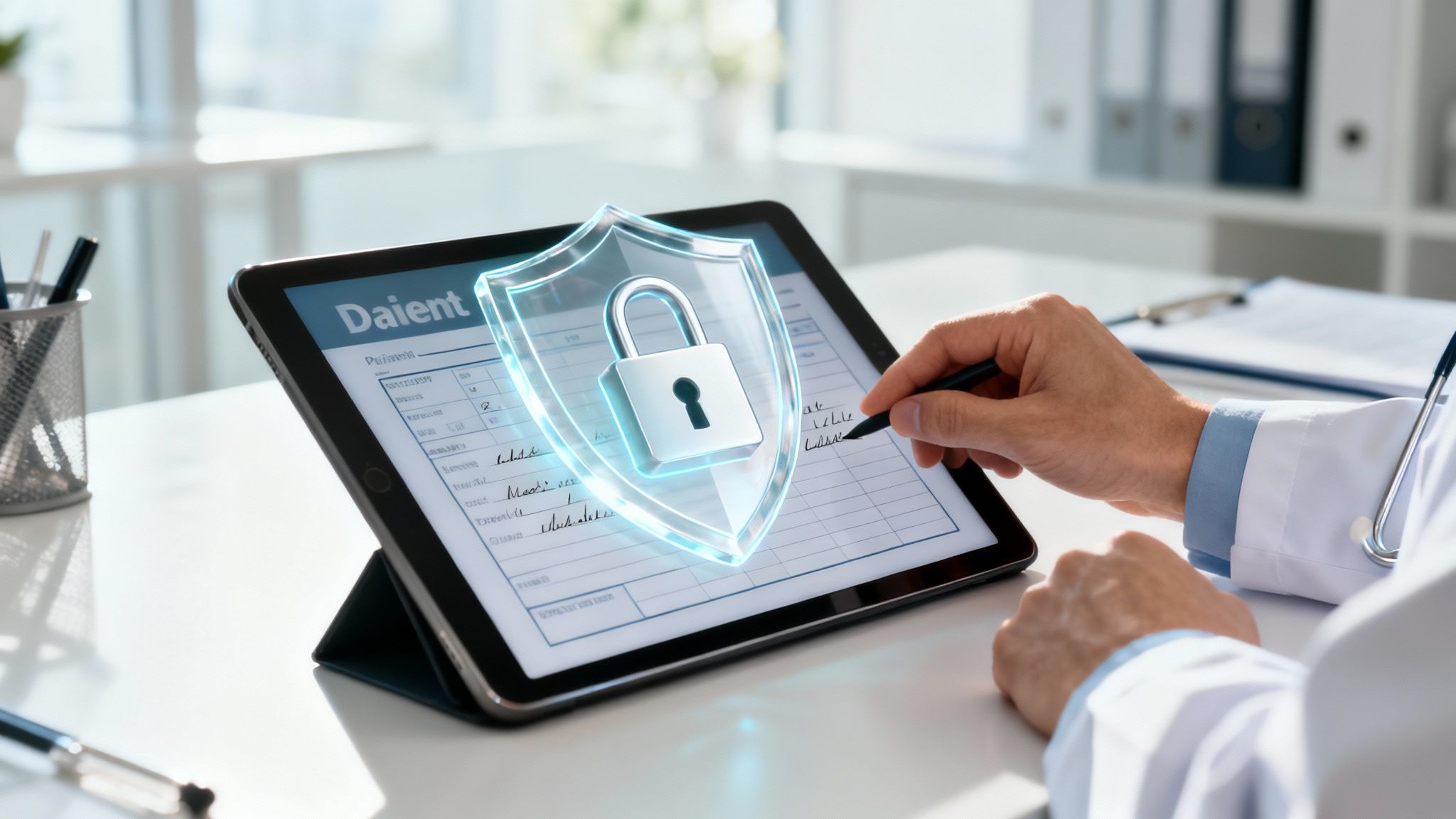
Whenever new technology enters the healthcare space, one question always comes to the forefront, and for good reason: is it secure? When you're handling Protected Health Information (PHI), patient privacy isn’t just a best practice; it's a strict legal and ethical requirement. An AI SOAP note platform is right in the middle of this sensitive ecosystem, capturing the most intimate details of every patient encounter. That makes its security architecture and compliance protocols absolutely non-negotiable.
The good news is that reputable AI scribe companies don't just bolt security on as an afterthought. They build their entire systems on a foundation of trust, privacy, and compliance, designed from the ground up to meet—and often exceed—the tough standards set by the Health Insurance Portability and Accountability Act (HIPAA). Think of it less like a regular piece of software and more like a purpose-built digital vault for clinical data, with multiple layers of protection.
This means you can bring this technology into your practice with confidence, knowing that multiple layers of advanced security are working tirelessly to protect your patients' information, your clinic's reputation, and your legal standing.
Core Pillars of a HIPAA-Compliant AI Scribe
So, what does a truly secure and HIPAA-compliant AI platform look like? It’s not just one single feature but a comprehensive combination of technical, physical, and administrative safeguards working in concert to create a secure bubble for PHI. When you're evaluating different AI SOAP note providers, these are the non-negotiable security features you should be asking about.
Here’s what to look for:
- End-to-End Encryption: From the moment the conversation is captured by the microphone to the second it’s stored in the cloud and transmitted to your EMR, all data needs to be encrypted both in transit and at rest. This essentially scrambles the information, making it completely unreadable to anyone without the proper authorization key.
- Secure Cloud Infrastructure: The platform should run on a secure, HIPAA-compliant cloud environment like Amazon Web Services (AWS), Google Cloud Platform (GCP), or Microsoft Azure. These providers have incredibly robust physical and digital security protocols already in place, including guarded data centers and redundant systems.
- Strict Access Controls: Only authorized users should ever be able to access patient data. A solid system will have strict identity verification, multi-factor authentication, and role-based access controls, ensuring that clinicians can only view the information they need to perform their jobs.
For any organization using AI, setting up a strong system for compliance and risk management is key to protecting sensitive data. You can dig deeper into how these principles work on a larger scale by exploring resources on building a Modern Compliance Risk Management Framework.
The Business Associate Agreement (BAA)
Here’s one of the most important pieces of the compliance puzzle: the Business Associate Agreement (BAA). This is a legally binding contract between you (the covered entity, i.e., the healthcare provider) and the AI company (the business associate) that handles your PHI. The BAA clearly defines each party's responsibilities for protecting patient data and makes sure the vendor is held to the same high security and privacy standards as your own practice under HIPAA law.
Never use an AI scribe or any third-party service that handles PHI without a signed BAA in place. A vendor’s willingness to promptly sign a BAA is a clear sign that they take their HIPAA obligations seriously and have the necessary controls in place.
This document is your legal assurance that the AI company has implemented the required safeguards and will notify you in the event of any potential data breach, as required by law. It’s all about creating a chain of trust and ensuring accountability.
Your Role in Maintaining Security
While the AI vendor provides the secure technology and infrastructure, your role as the clinician is still at the heart of the process. The AI-generated draft is just that—a draft. It only becomes an official, legally sound part of the medical record after you review, edit, and formally sign off on it.
This "human-in-the-loop" step is essential for both clinical accuracy and legal integrity. It maintains the sanctity of the patient's chart, and your final approval authenticates the note. Once you add your digital signature, the AI SOAP note carries the exact same legal weight as one you typed out word-for-word yourself.
If you're looking for more details, our guide on the essentials of a HIPAA-compliant AI scribe takes a deeper dive into the technical and legal side of things. By understanding these key security components, you can confidently bring an AI scribe into your workflow knowing that patient privacy remains the top priority.
Weaving an AI Scribe Into Your Practice
Bringing a new tool into a busy clinical setting can feel like a heavy lift, but you might be surprised at how smoothly and seamlessly modern AI scribes can fit into existing workflows. This isn't about ripping out your old systems and starting from scratch. It's about adding a smart, intuitive assistant that learns and adapts to the way you already work.
Let's be clear: this adoption is already happening at a rapid pace. A recent survey of nearly 900 ambulatory care practices found that about 50% had already brought some form of AI on board to help with administrative tasks. And it's not just the big hospital systems. AI is making its way into smaller, community-based clinics because 84% of clinicians see its clear potential to handle the repetitive, time-consuming tasks that are the primary drivers of burnout.
Getting Started: The Simple Ways In
You don't need a massive, multi-month IT project to see if an AI scribe is right for your practice. Many of these tools are designed to work right out of the box as standalone applications, giving you an immediate sense of the benefits without any technical headaches or complex integrations.
The easiest on-ramp is a simple copy-and-paste workflow. The AI scribe runs as its own secure app on your computer or smartphone. After you finish a patient visit, you just copy the finished SOAP note and paste it directly into the appropriate field in your EMR. It’s a zero-integration approach that’s perfect for a trial run or for smaller practices that want to keep things simple.
For a slightly smoother workflow, some AI scribes offer browser extensions or desktop apps that can "float" over your EMR. This small step up can shave off a few extra clicks for each note, which really adds up over the course of a busy clinic day.
The Next Level: Full EMR and Workflow Integration
When you're ready to make the AI scribe a core, indispensable part of your clinical workflow, direct EMR integration is the ultimate goal. This is where the magic really happens, as the tool stops feeling like a separate program and becomes a natural, seamless extension of your patient chart.
True integration means the AI scribe talks directly to your EMR. The generated note automatically populates in the patient's chart, ready for you to review and sign—no copying, no pasting, no jumping between different windows or applications.
This deep connection is usually made through something called an API (Application Programming Interface), which acts as a secure, private bridge between the AI tool and your EMR system. Top-tier AI scribe providers have already built these API bridges for major EMRs like Epic, Cerner, and athenahealth. If you're considering this path, you'll need to understand how it fits with your specific setup. Our deep dive on EMR system integration walks through exactly how this works and what questions to ask your vendor.
Your Action Plan: An Implementation Checklist
A great rollout is all about good planning, clear communication, and starting small. Taking it one step at a time helps your team feel comfortable, confident, and supported as they adopt the new tool. Here’s a simple checklist to guide you to a successful implementation.
-
Assemble a Pilot Team: Start small. Grab a few tech-savvy or just plain enthusiastic clinicians to try it out first. Their feedback, success stories, and real-world tips will be your best asset when you're ready to bring everyone else on board.
-
Run a Quick Training Session: These tools are built to be intuitive, so training shouldn't be a long, drawn-out process. Just focus on the essentials: how to start a recording, how to review the generated note, how to make quick edits, and how to sign off. The most important message to convey? The clinician is always in control of the final note.
-
Set Up the Hardware: All you really need is a good microphone. This could be a small, discreet ambient mic placed in the exam room or even the high-quality microphone built into a modern smartphone. Do a couple of quick audio tests in a typical exam room to make sure conversations are being captured clearly.
-
Map Out Your Workflow: Think about how you’ll use the scribe in different clinical situations. A flexible tool can adapt to just about any type of clinical encounter, maximizing its value.
- In-Person Visits: An ambient mic or a smartphone app on the counter works perfectly and is very unobtrusive.
- Telehealth Calls: The AI can join the video call just like another participant, listening in and generating the note in the background.
- Phone Consultations: Many platforms can also record and process audio from phone calls, which is great for documenting quick follow-ups, triage calls, or patient check-ins.
By following a clear, phased plan, you can introduce an AI SOAP note tool without disrupting your practice's rhythm. Before you know it, it will go from being a "new technology" to just another indispensable part of your daily clinical toolkit.
Answering Your Questions About AI SOAP Notes
Adopting any new technology brings up fair and important questions. It's only natural to be a little skeptical when something promises to fundamentally change a core part of your daily work. When it comes to AI SOAP note tools, most clinicians and practice managers have the same key concerns: How well does it actually work in a messy, real-world setting? What's the cost, and is it worth it? And most importantly, will my team even use it?
Let's tackle these common questions head-on. The goal here is to provide straightforward, practical answers so you can make a clear-eyed and informed decision for your practice.
Can AI Really Understand a Complex Medical Conversation?
Yes, but it’s crucial to understand how. The AI used for medical documentation isn't a general-purpose chatbot or a simple voice-to-text program. These are highly specialized, fine-tuned systems that have been trained on millions of hours of anonymized, real-world clinical conversations across dozens of specialties. This deep, domain-specific training allows them to recognize complex medical terms, understand the natural back-and-forth of a patient visit, and correctly identify what information belongs in each section of the note.
The AI is fantastic at extracting the factual pieces of the conversation and structuring them correctly into the SOAP format. It accurately captures what the patient said (Subjective), what you found during the exam or in lab results (Objective), your diagnosis or differential diagnosis (Assessment), and the next steps for treatment (Plan).
But remember, it's a tool meant to assist you, not replace your clinical expertise. Your clinical judgment is still the most important part of the equation. You are the one who validates the note, adds the necessary nuance, corrects any misinterpretations, and ultimately signs off. The AI does the heavy lifting—the tedious transcription and organization—freeing you up to focus entirely on your medical expertise and patient care.
What's the Typical Cost and Return on Investment?
Most AI SOAP note services operate on a monthly subscription model, typically priced per provider. The exact cost can vary depending on the vendor, the level of integration with your EMR, and the specific features you need. While it is an investment, the return on that investment (ROI) is usually fast, substantial, and easy to measure.
The biggest and most immediate ROI comes from getting your time back. Saving clinicians hours of documentation work every single day leads to some powerful and tangible financial benefits:
- More Time for Patients: With less time spent on paperwork, clinicians can often see more patients in a day without feeling stretched thin or working late into the night. This directly increases practice revenue.
- Lower Transcription Costs: For practices still using them, automated AI notes can significantly reduce or even completely eliminate costly manual transcription services.
- Better Billing Accuracy: Well-documented, detailed, and timely notes provide the necessary support for more accurate and higher-level medical coding, which often leads to improved reimbursement rates and fewer claim denials.
But beyond the hard numbers, the real win is the relief from the crushing weight of administrative burnout. That's what boosts morale, improves provider satisfaction, helps with staff retention, and allows everyone in the practice to get back to focusing on what matters most: delivering excellent patient care.
How Do We Get Our Clinical Team Comfortable with This?
The key to successful adoption is all about how you frame it and introduce it to the team. This isn't another complicated piece of software they have to learn; it's a personal assistant designed to take the most annoying and time-consuming part of their job off their plate. The goal is to make their lives easier, not add another task or layer of complexity.
A great way to start is with a small pilot group. Find a few clinicians who are either tech-savvy or just excited to try something new and let them lead the way. Their success stories, real-world feedback, and genuine enthusiasm will be the best endorsement you can possibly get when you're ready to roll it out to the entire team.
Most platforms offer simple, direct training that centers on the "review and edit" workflow. By making it abundantly clear that the clinician always has the final say and is in complete control of the final note, you build trust and alleviate fears of being replaced. It shows that the tool is there to support their expertise, not overrule it. Once people see firsthand how much time they get back in their day, even the biggest skeptics usually come around pretty quickly.
Will This Technology Get in the Way of Patient Interaction?
This is a huge and understandable fear, but what we see in practice is the complete and total opposite. One of the most common pieces of positive feedback from clinicians using ambient AI scribes is that their connection with their patients has actually gotten stronger and more authentic. For too long, the computer screen has acted as a physical and metaphorical wall between the doctor and the patient.
When you're not tied to a keyboard, frantically typing and clicking through an EMR, you can finally maintain eye contact, listen without distraction, and have a natural, human conversation. Patients can tell when you're fully present with them. They feel heard, respected, and better understood, and that builds immense trust.
Instead of getting in the way, the technology just fades into the background. It removes the computer as the "third wheel" in the exam room, allowing the human side of medicine to shine. An AI SOAP note tool helps bring back the personal connection that's so critical for good healthcare, leading to happier, more engaged patients and better clinical outcomes all around.
Ready to eliminate administrative burdens and bring the focus back to patient care? Simbie AI offers clinically-trained voice agents that automate your practice's most time-consuming tasks. From patient intake and scheduling to generating perfect clinical notes, our platform is designed to save you time and money. Discover how Simbie can transform your workflow.