
When you hear "AI receptionist," you might picture a clunky, automated phone tree that frustrates patients. That’s not what we’re talking about. A true AI receptionist for virtual healthcare is a clinically smart voice agent built to be the first point of contact for a modern medical practice.
After implementing these systems in dozens of clinics, I've seen firsthand that a good AI handles patient calls 24/7 with zero hold time—scheduling appointments, taking down patient information, and handling prescription requests, all on its own.
What is an AI receptionist for virtual healthcare?
Let’s be clear: this isn't your average phone system that just routes calls from one department to another. A genuine AI receptionist, like what we’ve built at Simbie AI, acts more like a highly efficient partner for your front desk.
I think of it as the air traffic controller for a clinic's phone lines. It can manage hundreds of calls at once, understand what each patient needs, and make sure every request is handled correctly without dropping the ball. Best of all, it understands natural, conversational language, so patients can just talk like they would to a person.
More than just a chatbot
This isn't a text-based chatbot on your website, either. A voice AI receptionist meets patients where they are most comfortable: on the phone. This is a big deal, as it handles the entire front-end workflow over a simple call.
This technology is a solution for virtual care providers struggling to keep up. It’s why the market for these tools is growing so fast. The virtual receptionist market, largely pushed by healthcare needs, hit $3.85 billion in 2026 and is expected to climb to $9 billion by 2033. This growth shows just how badly clinics need a better way to manage administrative work and give patients the access they deserve.
To give you a clearer picture, let's compare how a traditional front desk operates versus one supported by an AI receptionist.
Traditional receptionist vs. AI receptionist
| Feature | Traditional Receptionist | AI Receptionist (like Simbie AI) |
|---|---|---|
| Availability | 8-10 hours/day, 5 days/week | 24/7, including holidays |
| Call Capacity | 1 call at a time | Unlimited simultaneous calls |
| Hold Times | Common during peak hours | Zero hold time, ever |
| Task Focus | Multitasking between calls, paperwork, and in-person patients | Dedicated to handling call-based administrative tasks instantly |
| Documentation | Manual data entry into EMR, prone to human error | Automatic, real-time documentation directly into the patient chart |
| Cost | Full-time salary, benefits, and overhead | Predictable monthly subscription fee |
As you can see, the difference isn't just about efficiency—it's about creating a more reliable and scalable front-desk operation.
The Simbie AI difference
A specialized system like Simbie AI is built for healthcare from the ground up, not a generic business tool that’s been tweaked for medical use. It’s a clinically aware agent that gets the nuances of a medical practice, from strict HIPAA compliance to deep EMR integration.
The real point of an AI receptionist isn't to replace your staff. It’s to take the mountain of repetitive, time-consuming tasks off their plate so they can focus on what matters most: giving patients incredible, hands-on care.
By automating this administrative load, practices can finally stop worrying about missed calls and long wait times. You can learn more about how a healthcare virtual assistant gives your staff the breathing room they need. The end goal is a smoother, less stressful experience for everyone—and that’s what a dedicated AI receptionist delivers.
How AI redefines your clinic operations
When we talk about bringing an AI receptionist into a virtual healthcare setting, we're not just talking about a fancy answering machine. We’re talking about a fundamental shift in how your clinic handles the daily grind of administrative work—the kind of work that burns out your staff and creates frustrating delays for patients.
Think of it this way: instead of having your team bogged down by every single call, an AI can step in to field the routine, predictable tasks. This frees up your skilled staff to focus on the patients who need a human touch the most. Let’s break down what this looks like in practice.
Conversational patient intake
This goes far beyond a robotic script asking for a name and number. A well-designed AI receptionist, especially one trained for clinical settings, can have a surprisingly natural conversation to get a new patient's complete history.
For instance, when a new patient calls, the AI can immediately ask why they're calling, listen to their symptoms, and collect their insurance and pharmacy details. If the patient says, "My insurance is Aetna," the AI knows to follow up for a member ID and can even ping the system to verify coverage on the spot. We built Simbie AI to handle these conversations with a sense of understanding, so patients feel heard from the very first interaction.
Intelligent appointment scheduling
Scheduling is a constant headache. It's a game of Tetris trying to fit patient needs into provider schedules, and it eats up a massive amount of time. An AI receptionist smooths out this entire workflow by plugging directly into your clinic’s calendar and EMR.
It instantly cross-references provider availability with the type of appointment requested. A new patient evaluation might be blocked for 30 minutes, while a quick follow-up only needs 15. The AI gets these rules and only offers patients the time slots that actually work.
Picture this: A new mom calls at 2 a.m., worried about her baby’s fever. The AI can book a telehealth visit for 8 a.m., text her a confirmation link, and drop the appointment right into the pediatrician's schedule—all while your staff is sound asleep. This is how you deliver true 24/7 access.
Prescription refill and prior authorization handling
The phone ringing off the hook for refill requests is a classic productivity killer. An AI receptionist can take over this entire process, from the initial call to the final provider sign-off.
When a patient calls for a refill, they just need to provide their name and date of birth. From there, the AI securely pulls up their file in the EMR, confirms the prescription details, and routes the request to the right provider for approval. It also logs every step, giving you a clean and simple audit trail. This is a huge time-saver that also cuts down on the risk of human error.
Automated chart documentation
This might be the single most impactful part of the whole system. An AI doesn't just handle a call; it translates that conversation into structured, usable clinical documentation. No more listening back to voicemails or trying to decipher scribbled notes.
A smart AI receptionist automatically transcribes the call, summarizes the key points, and neatly organizes the information right into the patient’s chart.
Here’s what that pre-visit note typically includes:
- Patient details: Name, DOB, and contact info.
- Chief complaint: The patient's reason for the call, in their own words.
- History of present illness: A summary of their symptoms, timeline, and relevant details.
- Action taken: A clear record of what happened—appointment scheduled, refill requested, or call escalated to a staff member.
With Simbie AI, by the time a provider opens a new patient’s chart, that initial intake note is already there, perfectly formatted. They can get up to speed in seconds, not minutes, allowing them to walk into every visit prepared and focused entirely on the patient.
When you're running a practice, every decision comes down to the numbers. And while the idea of an AI receptionist for virtual healthcare sounds great for your operations, let's talk about what it really means for your bottom line. The biggest, most immediate change we see with clinics is a dramatic drop in administrative overhead.
Think about all the time spent on repetitive front-desk tasks. When you automate that, the savings pile up faster than you might expect. In our experience with practices using Simbie AI, it's not uncommon to see front-desk operational costs slashed by up to 60%. This isn't just a one-off success story; it's a consistent pattern.
Whether you're a small private practice or part of a larger healthcare system, the math works out. Across the industry, clinics are reporting 35-60% reductions in front-desk spending. With over 60% of US clinics now using these tools as of 2026, it's pretty clear the financial wins are real—average administrative costs have been shown to fall by 30% after adoption. You can dig into more statistics about the rising adoption of AI receptionists to see the broader trend.
Ending the tyranny of hold times
It’s not just about cutting costs; it's also about capturing lost revenue. We all know what happens when a patient is put on hold for too long. A staggering 74% of patients will just hang up, according to one study. Every one of those abandoned calls is a lost appointment and a missed opportunity.
An AI receptionist changes this by eliminating hold times entirely. Every single call gets answered instantly, day or night. That means you're capturing every patient who reaches out, whether they call during a hectic lunch rush or at 3 a.m. This 24/7 coverage doesn't just boost patient satisfaction—it directly leads to more booked appointments and better patient retention.
We worked with a mid-sized pediatric clinic that was completely swamped during the back-to-school rush. After getting their AI receptionist up and running, their abandoned call rate fell to zero in the first month. Better yet, they saw a 22% jump in after-hours appointment bookings, capturing revenue that had been slipping through their fingers.
A smarter way to manage staffing
Let's be honest: burnout is a huge and expensive problem in healthcare. Your front-desk staff are constantly juggling ringing phones, patients at the counter, and a mountain of administrative work. That kind of pressure causes high turnover, and replacing a trained staff member can cost thousands.
An AI receptionist for virtual healthcare works alongside your team, freeing them from the constant barrage of simple, repetitive calls. This lets your skilled staff focus on the work that truly requires a human touch:
- Complex patient issues: They can dedicate real time to patients with tricky insurance questions or those who need a more sensitive, empathetic conversation.
- In-person care: Your team can give their undivided attention to the patients who are physically in the office, creating a much better on-site experience.
- High-value tasks: They can finally get to those important, revenue-generating activities like chasing down unpaid claims or coordinating specialist referrals.
It’s not about replacing people; it’s about making their jobs better. By taking away the administrative grind—which nearly 53% of practice managers name as a major cause of stress—you create a more stable, focused, and effective team.
Case study: a mid-sized virtual clinic
Let’s put this into perspective with a real-world example. We had a mid-sized telehealth practice with five providers. They were getting around 300 calls a day, and their three full-time receptionists were completely overwhelmed. Patients were starting to complain about long waits on the phone.
Here’s a quick look at their numbers before and after they brought Simbie AI on board:
| Metric | Before AI Receptionist | After AI Receptionist (3 Months) |
|---|---|---|
| Average Daily Call Volume | 300 | 300 |
| Calls Answered Instantly | ~65% | 100% |
| Average Hold Time | 4.5 minutes | 0 minutes |
| Appointment Booking Rate | 78% of answered calls | 92% of all calls |
| Staff Time on Phone (per day) | 18 hours | 5 hours (complex calls only) |
The financial impact was clear and fast. By capturing calls they used to miss and making the booking process more efficient, the clinic boosted its monthly revenue by 15%. Just as importantly, they cut their administrative overtime costs by 90%. That’s a powerful and immediate return on investment.
Getting the tech and compliance right for your AI receptionist
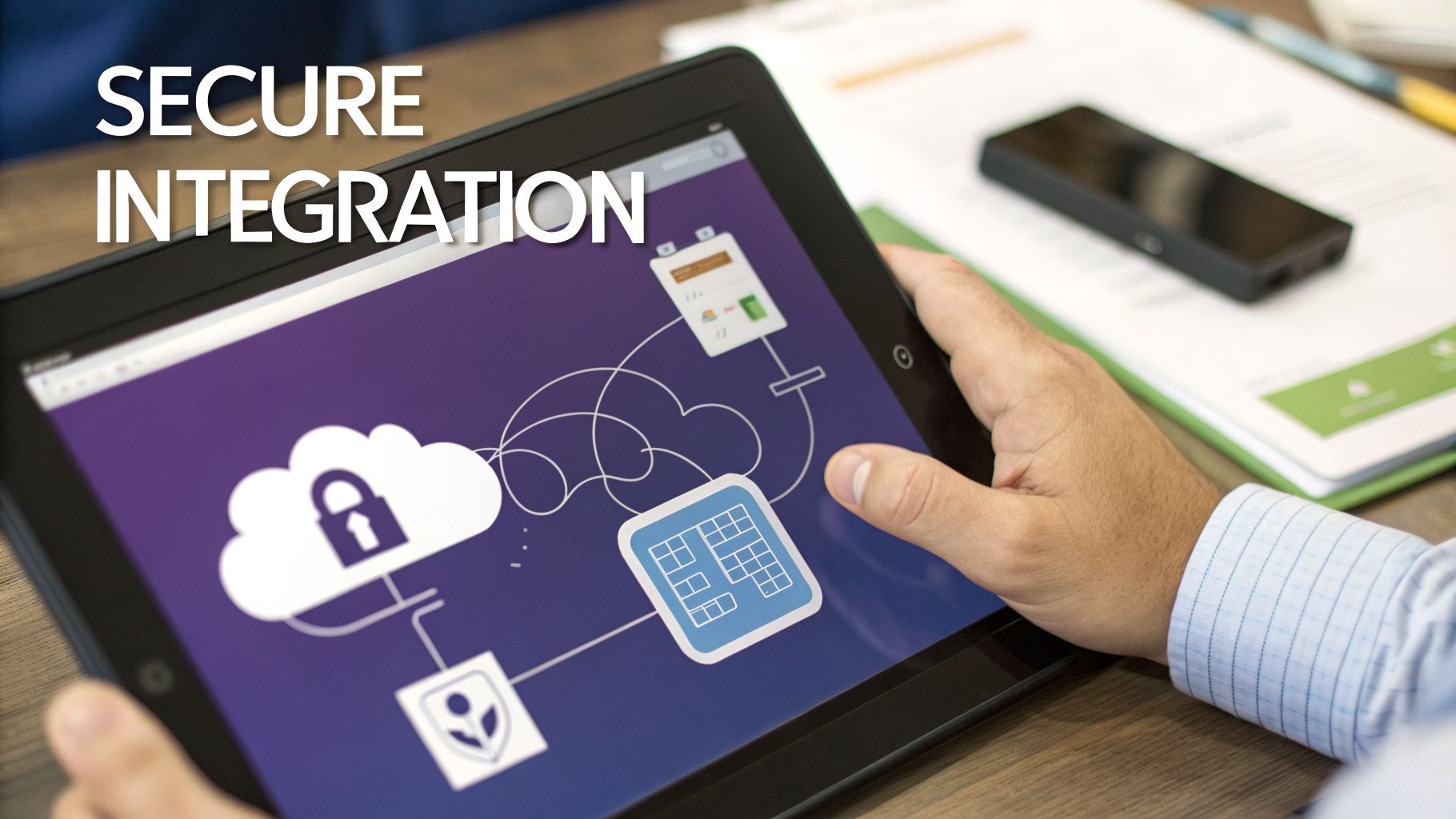
When you’re thinking about bringing an AI receptionist for virtual healthcare into your practice, it’s about so much more than just finding a cool piece of software. In healthcare, any new technology has to be built on a rock-solid foundation of trust, security, and seamless operation.
Let's be blunt: if the AI can’t talk to your existing systems or protect patient data, it’s not just a waste of money—it's a serious liability. That’s why the entire conversation has to start with the technical nuts and bolts of integration and compliance.
EMR and EHR integration is non-negotiable
Get this one thing straight: an AI receptionist that doesn't fully integrate with your Electronic Medical Record (EMR) or Electronic Health Record (EHR) system is basically a glorified answering machine. Sure, it can take a message, but it can’t actually do anything with the information it gathers.
For an AI to truly take work off your plate, it needs deep, two-way communication with systems like Epic, Cerner, or Athenahealth. This connection is what separates a simple chatbot from a genuine workflow automation tool.
This was our top priority when we built Simbie AI. True integration is what allows the AI to perform high-value tasks on its own:
- Pulling patient data: The AI can instantly look up a caller, verify their identity against their record, check their appointment history, and see their current medication list.
- Automating chart notes: A phone call about symptoms can be automatically turned into a structured clinical note and dropped right into the patient’s chart, ready for a provider's review.
- Real-time scheduling: The AI sees the real, up-to-the-minute availability of your providers and books appointments directly into the EMR schedule without double-booking or causing conflicts.
Without that integration, your staff is just manually moving data from one screen to another. That’s not saving time—it’s just creating more work and opening the door for human error.
HIPAA security and patient data protection
In our world, nothing trumps patient privacy. An AI receptionist, by its very nature, handles a constant stream of protected health information (PHI). This means it absolutely must be HIPAA compliant from the ground up. This isn’t a feature you can bolt on later; it has to be baked into the core architecture.
A critical part of the technical essentials for healthcare AI, especially when handling sensitive patient data, involves conducting a thorough AI code security audit. This verifies that the system's code and infrastructure are secure against potential threats.
For an AI to be truly secure, you need several non-negotiable layers of defense:
- Data encryption: All data—whether it’s in transit during a call or sitting in a database—must be encrypted and unreadable to anyone without authorization.
- Strict access controls: The system must have granular controls to ensure only the right people can access PHI, with a clear audit trail logging every single action.
- Secure communication: Any channel used to transmit voice or data must be completely locked down.
Simbie AI, for example, is built to live inside a secure, HIPAA-compliant environment. We treat patient data with the exact same level of care and security as a hospital’s own internal network. If you want to dig into the specifics, our guide on HIPAA-compliant AI tools breaks down all the requirements.
Smart monitoring and seamless human handoffs
A good AI knows its own limits. Let’s be clear: an AI receptionist for virtual healthcare is an administrative powerhouse, not a clinical diagnostician. It should never, ever try to be one. That’s why a clean, instant handoff process isn't just a nice-to-have; it's a fundamental safety requirement.
The AI must be trained to recognize when a caller’s needs are too urgent, complex, or sensitive for it to manage. When it hears trigger words like "chest pain" or detects a high level of distress in someone's voice, it needs to do two things instantly:
- Flag the call for immediate human review.
- Transfer the call to the right person—a triage nurse, a specific department, or an on-call provider—without dropping the patient.
And here’s the key part: the AI has to pass along the context. When your staff member picks up the phone, they should already know who the patient is and the gist of their call. This simple step prevents patients from having to repeat their story, transforming a moment of high anxiety into a smooth, supportive experience. It’s this safety net that allows clinical teams to truly trust the technology and embrace the help it offers.
Your implementation checklist for a smooth go-live
Thinking about bringing an AI receptionist for virtual healthcare into your practice probably sounds like a huge undertaking. But it really doesn’t have to be a months-long headache. Based on our experience onboarding clinics at Simbie AI, we’ve gotten the entire process—from the first conversation to being fully operational—down to just a few weeks. The secret is a clear, step-by-step plan.
We’ve found that breaking it down into manageable phases makes the whole thing feel less intimidating and keeps your team in the loop. This isn't about flipping a switch and hoping for the best. It’s about a thoughtful rollout that makes sure your staff, systems, and patients are all ready for the change. Here’s the simple checklist we use to guide practices through a successful launch.
Phase 1: Choosing your partner and seeing a real demo
This first step is absolutely essential. This is where you cut through the marketing fluff and find a solution that will actually work for your clinic. Come to the demo with your toughest questions ready.
- Is it built for healthcare? You need to know if the AI truly understands medical terms and clinic workflows, or if it's just a generic business tool that’s been slightly modified.
- Will it connect with your EMR? Don’t just take their word for it. Ask for a live demonstration showing exactly how the AI connects with the EMR system you use every day.
- What happens when a person is needed? See the handoff process for yourself. Ask them to show you precisely what happens when the AI needs to escalate a complex call to a member of your staff.
A vendor who knows their stuff will have direct, confident answers and will be eager to show you the system in action, not just talk about it.
Phase 2: Configuration and EMR integration
Once you’ve found the right partner, the real work of customizing the system begins. This phase is all about teaching the AI the unique rhythm of your practice. We’ll map out your call flows together—what should happen when a new patient calls to book an appointment, versus an existing one who just needs a prescription refill?
This is also where we handle the technical hookup, connecting the AI to your EMR. A seamless integration is non-negotiable; it's what allows the AI to schedule appointments and document call notes directly into patient charts automatically. If you're interested in the nuts and bolts, we explain how our EMR system integration works in more detail here. The end goal is an AI that feels like a natural part of your team's existing workflow.
Timeline Check: This phase usually takes 1-2 weeks. It's the most collaborative part of the process, with plenty of back-and-forth between your team and the vendor to get every detail just right.
Phase 3: Staff training and go-live
Don't worry, your team won’t need to become AI programmers. Training should be quick, practical, and focused on the new, simpler workflow. The main things your staff will learn are how to handle calls the AI escalates to them and where to find the AI’s automated notes in the EMR.
We always suggest a "soft launch"—maybe running the AI in the background for a day or two to iron out any final wrinkles. This builds everyone’s confidence before you go fully live. A great launch day is all about solid preparation, not about being perfect from the very first call.
Phase 4: Monitoring and fine-tuning
Once you're live, the focus shifts from setup to optimization. In the first few weeks, we keep a very close eye on the call data and how the AI is performing. Are patients asking common questions we didn’t plan for? Can we make a specific call flow even smoother?
This continuous feedback loop is what makes the system truly yours. The results can show up surprisingly fast. We've seen clinics in major markets cut their missed calls by 50% in the first three months alone, mostly by finally being able to capture all those after-hours and overflow inquiries. This often leads directly to a 15-25% increase in booked appointments and helps reduce staff overtime by 20-40%. You can learn more about the impact on US clinics and see the numbers for yourself in recent industry reports.
Common questions we hear about AI receptionists
It's one thing to see the numbers and read about the benefits, but it's another thing entirely to trust a new piece of technology with your patients and your practice. When we talk with practice managers and physicians about an AI receptionist for virtual healthcare, the same few questions always come up.
These are completely valid concerns. You need to be sure that any new system upholds your standards for patient care. Let's walk through these common questions with some straight, honest answers based on what we've seen work in clinics just like yours.
Will patients actually be okay talking to an AI?
This is probably the biggest worry we hear, but in practice, it’s rarely an issue. Think about it: for simple, routine tasks like scheduling a follow-up, confirming an appointment, or asking for a refill, most people just want a quick, easy answer. They'd much rather get it done in 60 seconds than sit on hold.
The key is making sure the AI doesn't sound like a clunky robot. A well-designed system like Simbie AI uses a natural, conversational voice. More importantly, it’s smart enough to know its own limits. The goal isn't to replace your staff's empathy, but to handle the simple stuff so your team is free for the conversations that truly need a human touch.
What happens if a patient asks a complex medical question?
This is a critical point, and the answer is simple: a well-built AI receptionist is not a clinical tool. It should never, ever give medical advice, attempt to diagnose a patient, or triage symptoms.
Its programming is built around one non-negotiable rule: if a patient says anything that sounds like an urgent symptom or asks a clinical question, the AI’s job is to immediately get a human involved. It smoothly transfers the call to the right person—a nurse, the on-call provider—and passes along the context so the patient doesn’t have to start over. Safety always comes first.
Is this technology only for big hospitals?
Not at all. While large health systems certainly see a huge benefit in managing their massive call volumes, we've found that AI receptionists can be a game-changer for small and mid-sized practices.
For smaller clinics, the biggest headache is often missed calls. When your front desk staff is with a patient, on another line, or gone for the day, those calls go to voicemail—and that’s lost revenue. Modern AI receptionists are typically priced with a simple monthly subscription, so there's no need for a massive upfront investment. In fact, we’ve seen clinics cut their missed calls by 30-50%, and some platforms answer 100% of calls—a huge leap from a low of just 30%. This often leads to a 15-25% increase in appointment bookings by capturing those after-hours calls. Recent reports on how AI receptionists are transforming healthcare front desks dig deeper into these numbers.
How much training will my staff need?
Barely any. A good system is designed to work quietly in the background, taking work off your team's plate, not adding another complicated tool they have to learn.
The only real "training" is getting your staff used to the new, simpler workflow for handling calls that the AI flags for them. They'll also see how the AI automatically documents calls and notes right in the EMR. The vendor should handle all the onboarding, and since the entire point is to reduce your team's administrative burden, the transition is usually a welcome relief.
Ready to see how an AI receptionist could free up your team and improve the patient experience at your practice? At Simbie AI, we build clinically-aware voice agents that handle the administrative grind so you can focus on care.