
Medical coding departments are navigating a perfect storm of challenges. Staffing shortages, persistent coder burnout, and the ever-increasing complexity of clinical documentation are putting immense pressure on revenue cycle management. These issues lead to coding backlogs, delayed reimbursements, and a higher risk of claim denials, directly impacting a practice's financial health and operational stability. The administrative burden on skilled professionals is immense, diverting their focus from high-value tasks that require critical thinking.
Fortunately, AI-powered automation offers a practical, powerful solution to these persistent problems. Using advanced natural language processing (NLP) and machine learning, these platforms can analyze clinical notes, physician dictations, and electronic health records to suggest accurate medical codes in a fraction of the time it takes a human coder. This technology is not a distant concept; it is transforming healthcare finance right now by improving coding accuracy, accelerating claim submissions, and freeing up skilled coders to focus on the most complex cases, audits, and denials management. This shift is essential for building a more resilient and efficient revenue cycle.
This guide is designed to help you navigate the crowded market of AI medical coding companies. We will provide a comprehensive, head-to-head comparison of the top 12 vendors, moving beyond marketing claims to offer a clear-eyed view of what each platform truly offers. For each company, you will find a detailed analysis of its core features, ideal use cases, integration capabilities, and real-world performance data. Our goal is to equip healthcare leaders, from small clinic managers to large hospital administrators, with the detailed information needed to select the best AI coding partner for their specific operational needs and financial goals. This in-depth review will serve as your roadmap to adopting the right technology to future-proof your healthcare organization.
1. Solventum (360 Encompass)
Formerly 3M Health Information Systems, Solventum’s 360 Encompass platform is an enterprise-grade solution widely adopted by large U.S. health systems. It stands out by unifying computer-assisted coding (CAC), clinical documentation integrity (CDI), auditing, and analytics into a single, cohesive workflow. This end-to-end approach helps large organizations reduce the number of vendors they need to manage for revenue cycle operations, creating a streamlined and integrated ecosystem. The platform’s maturity and long-standing market presence provide a sense of stability and reliability for enterprise clients.
The platform excels at deep, native integrations with major EHR systems like Epic and Cerner, making it a natural fit for hospitals already embedded in those ecosystems. Its AI-powered Natural Language Processing (NLP) reviews clinical documentation to suggest accurate codes for both inpatient and professional services, significantly accelerating coder productivity. This direct integration minimizes workflow disruption and maximizes the value derived from existing health IT investments. The robust analytics suite also offers leadership deep insights into coder performance, denial trends, and financial impact, enabling data-driven decision-making.
Core Offering Analysis
- Best For: Large hospitals and multi-facility health systems seeking a comprehensive, integrated platform for coding, CDI, and auditing.
- Key Features: AI-assisted code suggestions, integrated CDI and auditing modules, hierarchical condition category (HCC) management, and robust analytics dashboards.
- Pricing: Enterprise-level contracts only; no publicly available pricing. Access requires a direct sales consultation.
- Pros: Market-leading maturity, deep interoperability with major EHRs, and an all-in-one platform design that streamlines complex workflows and vendor management.
- Cons: Implementation can be complex and resource-intensive, making it less suitable for smaller practices. The enterprise pricing model lacks transparency for those outside large-scale procurement processes.
2. Optum (Enterprise CAC & Professional CAC)
Part of the UnitedHealth Group, Optum offers a powerful suite of AI medical coding solutions designed for both large-scale enterprises and professional practices. Its core strength lies in its Clinical Language Intelligence, an advanced NLP engine that analyzes unstructured clinical notes to suggest accurate codes. This technology is embedded in both its Enterprise CAC (for hospitals) and Professional CAC (for physician groups) products, aiming to boost coder productivity, improve revenue integrity, and reduce claim denials. The backing of a major healthcare entity like UnitedHealth Group provides access to vast data sets for training its AI models.
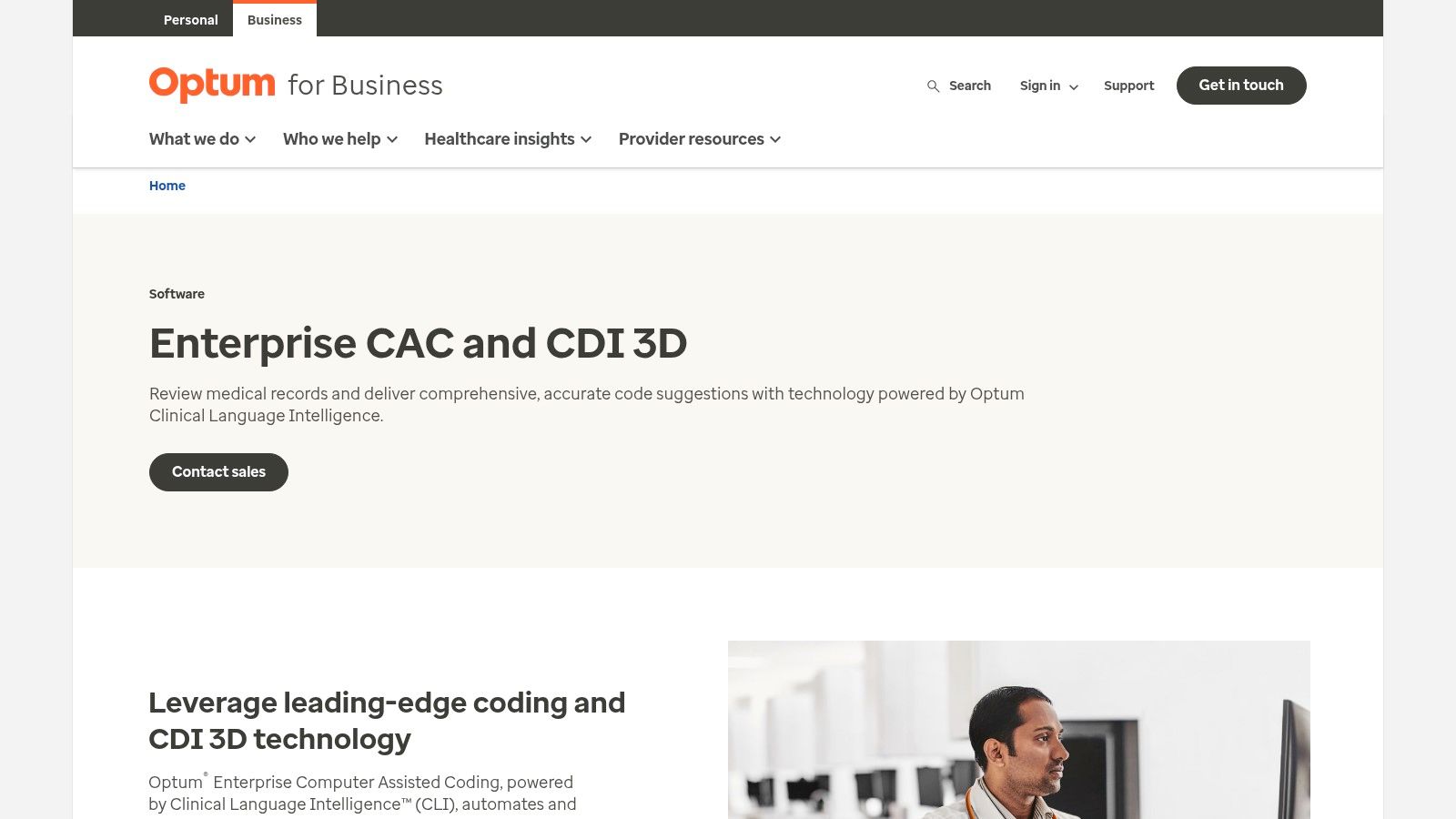
Optum distinguishes itself by integrating its coding tools into a broader revenue cycle management (RCM) ecosystem. This allows healthcare organizations to not only automate coding but also to connect that process directly to denial management, quality reporting, and clinical documentation integrity (CDI) workflows. This holistic approach makes it a compelling choice for providers focused on optimizing financial outcomes across the entire patient journey. The platform’s ability to flag potential coding errors or documentation gaps in real-time helps prevent downstream issues before they happen. For more on this, AI in medical billing is becoming an essential component for modern practices.
Core Offering Analysis
- Best For: Large health systems, hospitals, and multi-specialty physician groups seeking a coding solution tied to a comprehensive RCM framework.
- Key Features: NLP-driven code suggestions, concurrent record review for real-time CDI, automated edits and charge capture, and robust denial prevention analytics.
- Pricing: Custom enterprise pricing. A direct sales consultation is required to get a quote, as there is no public pricing information.
- Pros: Access to a vast RCM ecosystem and related services, a strong focus on improving financial and quality metrics, and dedicated solutions for both inpatient and professional settings.
- Cons: Can present large-vendor complexity, with potentially longer implementation timelines compared to smaller, niche solutions. The lack of transparent pricing makes it difficult for smaller organizations to evaluate.
3. Dolbey (Fusion CAC)
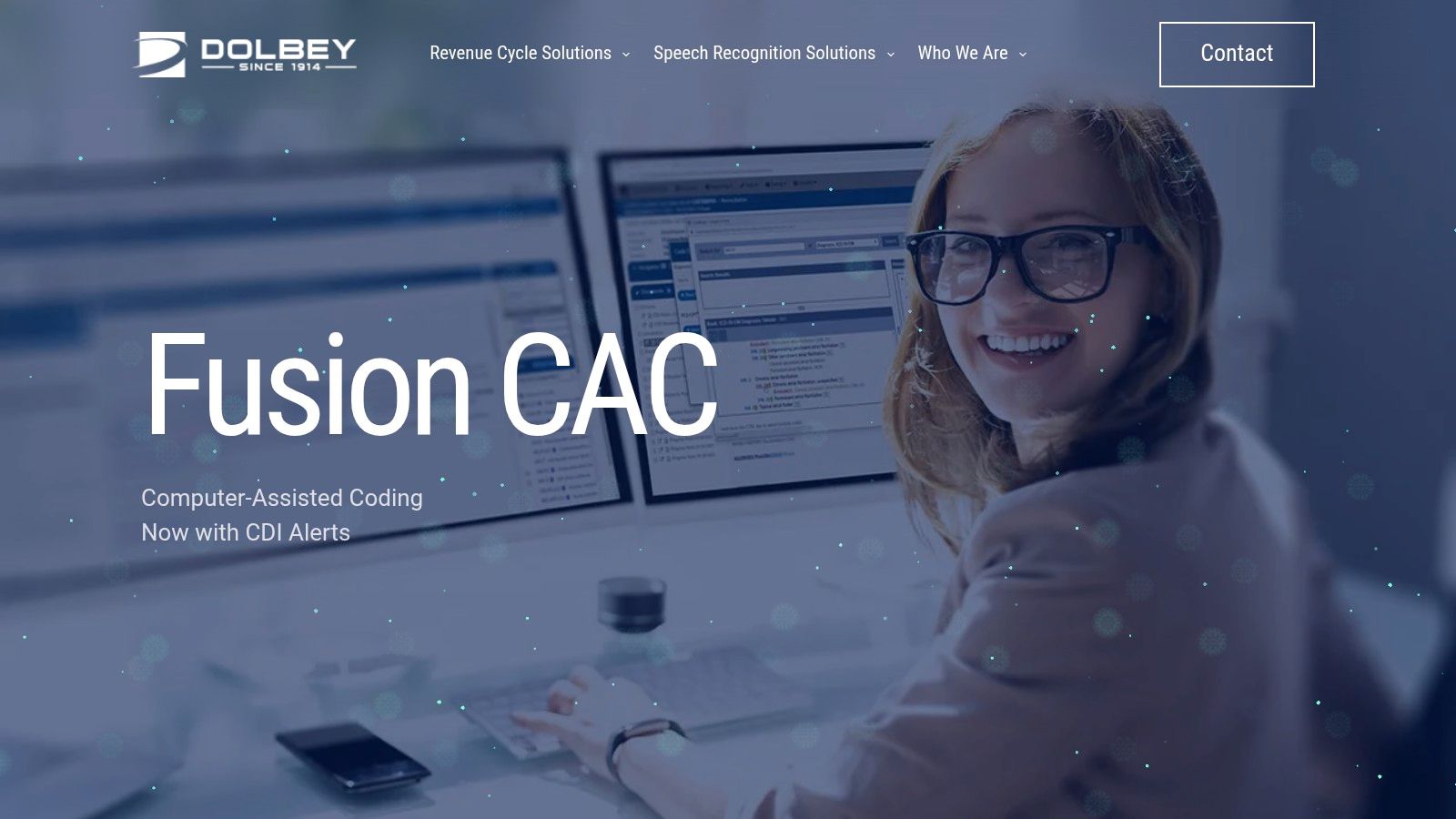
Dolbey's Fusion CAC is a multi-year Best in KLAS award-winning platform, highlighting its strong user satisfaction and effectiveness in the market. It focuses on enhancing coder productivity through a blend of AI-assisted code suggestions, workflow automation, and integrated modules for auditing and Clinical Documentation Integrity (CDI). This solution is designed to streamline the coding process and reduce days not final billed (DNFB) for healthcare organizations. The consistent high praise from users underscores the platform's usability and the company's commitment to customer support.
A key differentiator for Dolbey is its practical automation, particularly the "AutoClose" feature for autonomous outpatient coding. This allows the system to finalize codes for simpler, high-volume encounters without direct human intervention, freeing up coders to focus on more complex cases. This targeted approach to automation makes it one of the more pragmatic ai medical coding companies for achieving immediate efficiency gains. Instead of promising a complete overhaul, Dolbey delivers tangible ROI by automating the most repetitive tasks, allowing for a phased and manageable adoption of AI technology.
Core Offering Analysis
- Best For: Hospitals and healthcare systems looking for a user-friendly CAC with proven ROI and practical automation features.
- Key Features: AI-suggested ICD-10/CPT/PCS codes, AutoClose for autonomous outpatient coding, integrated audit module, query management, and automated chart prioritization. It complements efforts to improve AI clinical documentation by identifying gaps and quality indicators.
- Pricing: Custom enterprise pricing. A direct consultation is required for a quote.
- Pros: Consistently high user satisfaction (Best in KLAS), practical automation features like AutoClose that directly reduce DNFB, and strong integration capabilities with various EHRs.
- Cons: The scope of its autonomous coding is most effective for less complex encounters. Like other enterprise systems, its pricing is not publicly available, making initial comparisons difficult.
Website: https://www.dolbey.com/solutions/coding/fusion-cac/?utm_source=openai
4. Fathom (Autonomous Medical Coding)
Fathom positions itself as a leader in fully autonomous medical coding, moving beyond computer-assisted models to a platform that can independently analyze clinical documentation and assign codes with minimal human intervention. Its core value proposition is speed and scale, promising to drastically reduce turnaround times and operational costs for both facility and professional fee coding across a range of medical specialties. Fathom's deep-learning AI aims to replicate and exceed human accuracy at a massive scale, tackling the largest coding backlogs.
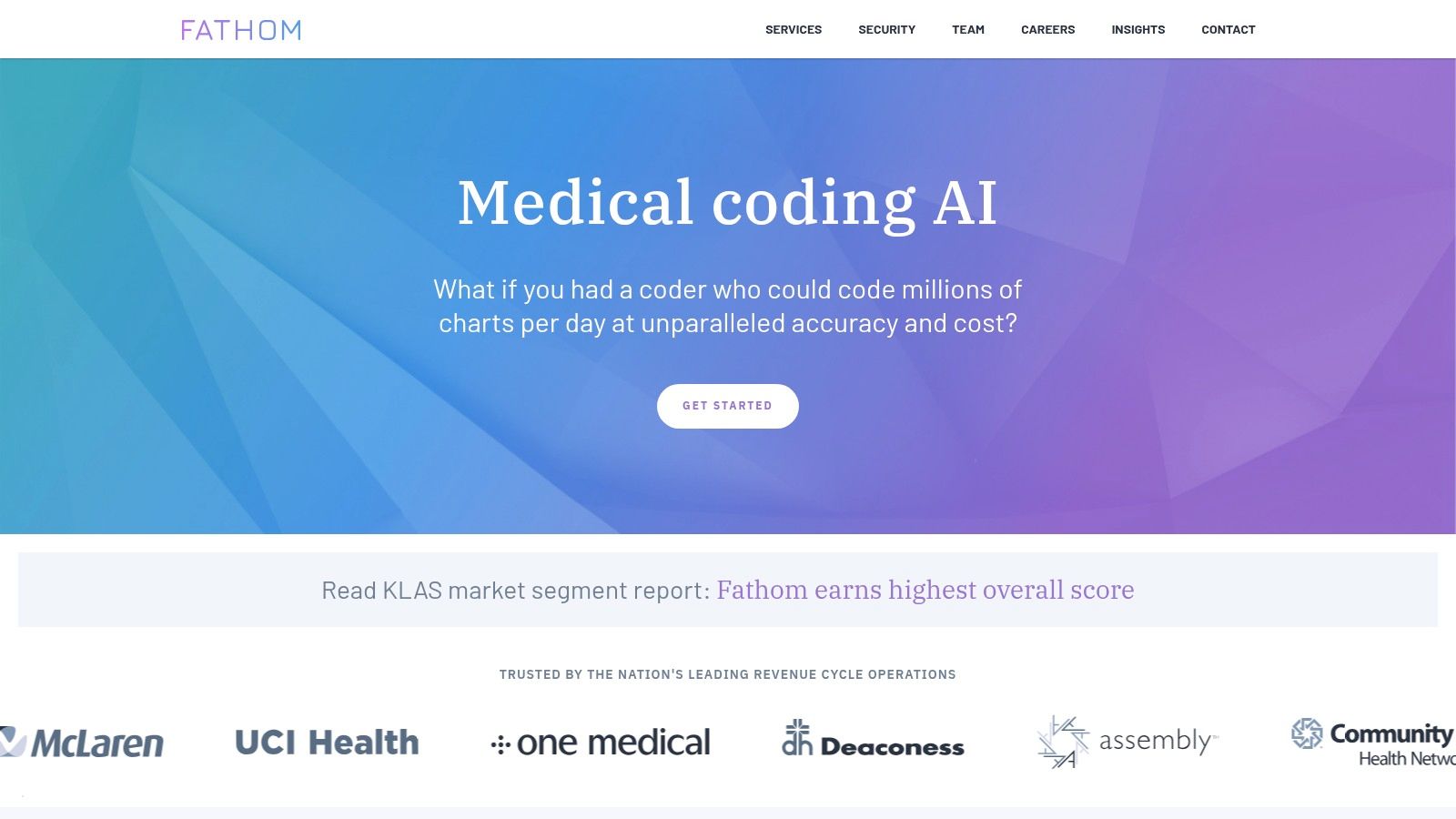
The platform stands out due to its high reported automation rates and its accessibility through modern distribution channels like the Epic Toolbox and Google Cloud Marketplace. This makes integration more streamlined for health systems already using those ecosystems. Fathom's approach is best suited for organizations looking to automate high-volume, repetitive coding tasks, thereby freeing up human coders to focus on more complex cases and revenue integrity audits. As one of a new generation of AI medical coding companies, its impact on the field is notable for pushing the boundaries of what full automation can achieve.
Core Offering Analysis
- Best For: Large health systems, revenue cycle management (RCM) companies, and high-volume specialty groups seeking maximum automation and rapid scalability.
- Key Features: Fully autonomous code assignment, real-time auditing of coded charts, enterprise-grade Service Level Agreements (SLAs) for accuracy, and availability on Epic Toolbox and Google Cloud Marketplace.
- Pricing: Enterprise pricing available by quote only. A direct consultation is required to get a customized pricing model.
- Pros: Achieves extremely rapid coding turnaround, scales effectively to handle massive volumes, and offers flexible deployment options through major cloud and EHR marketplaces.
- Cons: Performance is highest with well-structured clinical documentation, and its enterprise focus means pricing is not transparent or suitable for smaller practices. The "black box" nature of some deep-learning models can be a concern for teams wanting full transparency.
Website: https://www.fathomhealth.com/?utm_source=openai
5. CodaMetrix (CMX Contextual Coding Automation)
Born from a collaboration with Mass General Brigham, CodaMetrix brings an academic health system pedigree to the world of AI medical coding companies. Its CMX platform is designed for contextual, multi-specialty autonomous coding that goes beyond simple code suggestions. The platform’s unique strength lies in its ability to understand the full longitudinal patient story and apply payer-specific rules, ensuring codes are accurate and compliant from the first pass. This clinical-first approach resonates with complex medical environments.
CodaMetrix emphasizes a partnership approach, providing measurable ROI and publishing customer case studies that demonstrate tangible financial and operational improvements. By embedding continuous auditing directly into the workflow, it helps health systems prevent claim denials and under-coding rather than just reacting to them. This proactive stance on revenue integrity makes it a compelling choice for organizations focused on data-backed performance and sustainable revenue cycle health. The platform's ability to learn from coder feedback and continuously improve its algorithms is a key feature for long-term partnership.
Core Offering Analysis
- Best For: Large, complex health systems and academic medical centers that require sophisticated, multi-specialty coding automation with a proven ROI.
- Key Features: AI-driven autonomous coding, longitudinal patient context analysis, embedded payer-specific logic, continuous auditing, and robust performance analytics.
- Pricing: Enterprise-level contracts only. Pricing is customized based on scope and requires direct consultation with their sales team.
- Pros: Developed and validated within a major academic health system, strong focus on measurable financial outcomes, and advanced contextual understanding that reduces coder intervention.
- Cons: The enterprise sales model and lack of public pricing make it inaccessible for smaller practices. Implementation is a significant project that requires deep EHR integration and IT alignment.
Website: https://www.codametrix.com/?utm_source=openai
6. CorroHealth (PULSE Coding Automation)
CorroHealth combines AI technology with deep revenue cycle management (RCM) services, positioning its PULSE Coding Automation platform as a hybrid solution. This approach allows healthcare organizations to not only adopt advanced automation but also leverage CorroHealth’s expert services for tasks like clinical validation and denials management, creating a comprehensive support system. The platform is designed for high automation rates across both facility and professional coding, giving clients flexibility in how they deploy the technology.
Its AI and Large Language Models (LLMs) are engineered to deliver transparent logic, allowing coders to understand the reasoning behind each suggested code. This "glass box" approach builds trust and aids in training, distinguishing it from more opaque AI systems. By integrating broadly with various EHR systems, PULSE aims to fit into existing workflows rather than forcing a complete operational overhaul, making it a flexible option for many ai medical coding companies to consider. This blend of cutting-edge tech with human-centric services provides a safety net for organizations transitioning to automation.
Core Offering Analysis
- Best For: Hospitals and health systems looking for a blend of AI technology and outsourced RCM services.
- Key Features: High-accuracy automated coding (up to 97%), coverage for facility, professional, HCC, and injections/infusions, transparent AI logic, and broad EHR integration.
- Pricing: Pricing is customized for enterprise clients and provided only through a direct sales quote.
- Pros: The unique combination of a technology platform with optional RCM services offers a safety net. The company reports significant productivity lifts for its clients and maintains an active product development roadmap.
- Cons: Detailed product information can be fragmented across the website and its subdomains. The enterprise-only pricing model lacks transparency for organizations exploring initial budget estimates.
Website: https://www.corrohealth.com
7. Apixio (AI Risk Adjustment Coding)
Apixio specializes in leveraging AI for risk adjustment, a critical niche within medical coding primarily serving payers and at-risk provider groups. Its platform uses sophisticated Natural Language Processing (NLP) to scan vast quantities of unstructured clinical data, such as physician notes and patient histories, to surface suspected diagnoses and validate evidence for Hierarchical Condition Category (HCC) capture. This focus makes it an indispensable tool for organizations participating in value-based care models like Medicare Advantage and ACA programs.
The platform is designed to dramatically improve the efficiency and accuracy of risk adjustment coding projects. By automatically identifying potential codes and presenting the supporting documentation directly to coders, Apixio streamlines what is traditionally a manual, labor-intensive process. This not only accelerates coder throughput but also enhances the integrity of data submitted for risk scoring, which is a key differentiator among ai medical coding companies focused on this segment. Its analytics tools help organizations prioritize chart reviews and identify areas of greatest financial and clinical risk, optimizing resource allocation.
Core Offering Analysis
- Best For: Health plans, Medicare Advantage (MA) organizations, and large provider groups managing risk-based contracts.
- Key Features: AI-powered chart review for HCC identification, tools for both retrospective and prospective risk capture, integrated audit and analytics, and scalable project management for large-scale chart abstraction.
- Pricing: Custom enterprise pricing. Access requires a direct consultation with their sales team.
- Pros: Deep specialization in payer and provider risk adjustment workflows, historically recognized by KLAS for its powerful analytics, and proven ability to scale for massive data volumes.
- Cons: Narrowly focused on risk adjustment, making it less suitable as a comprehensive Computer-Assisted Coding (CAC) solution for daily facility or pro-fee coding. Pricing is not transparent.
Website: https://www.apixio.com/
8. Edifecs (Risk Adjustment Coding Suite)
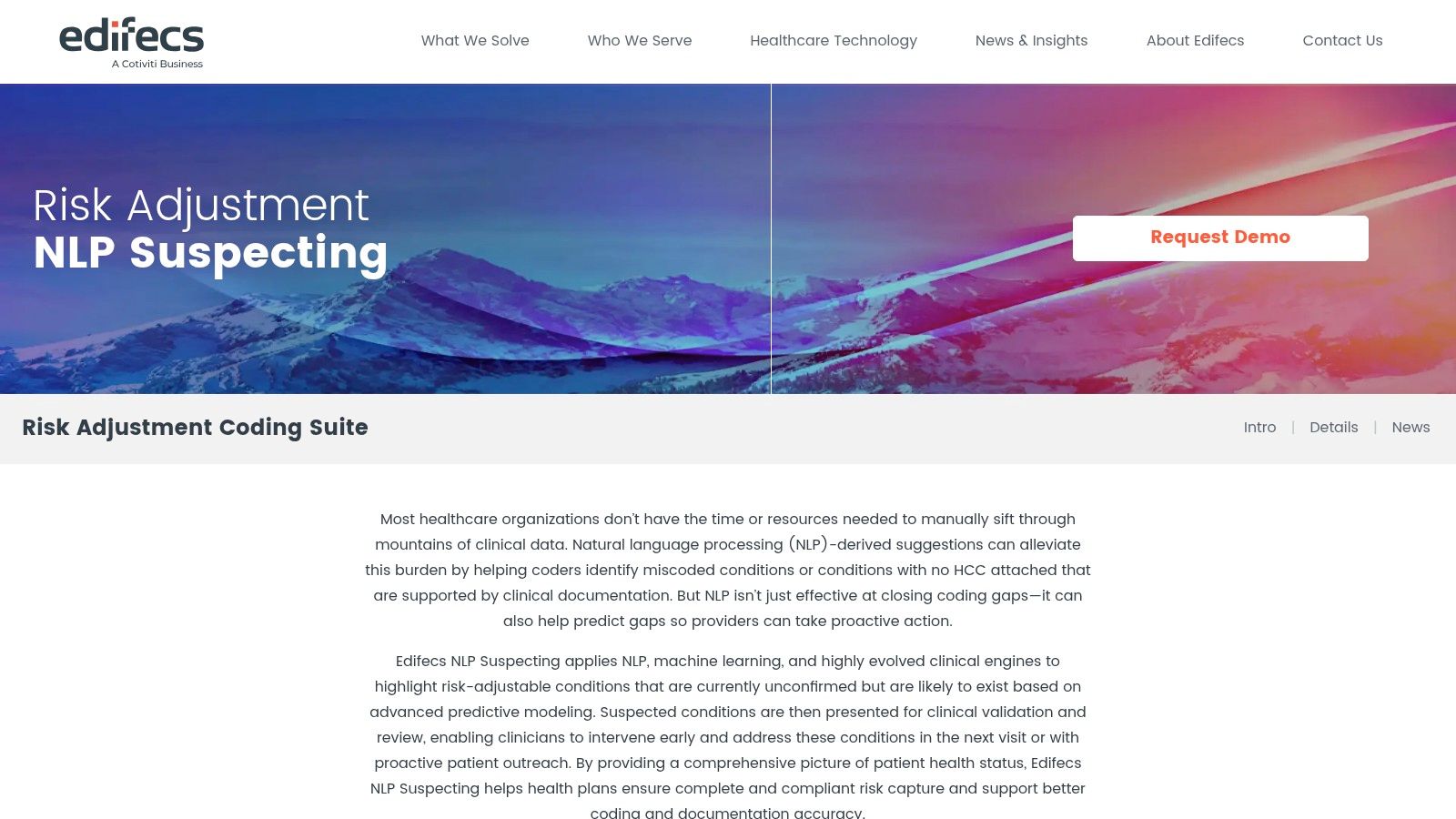
Edifecs offers a specialized AI medical coding solution focused squarely on risk adjustment, making it a critical tool for payers and at-risk provider organizations. Leveraging the powerful NLP technology acquired from Health Fidelity, its Risk Adjustment Coding Suite excels at identifying potential hierarchical condition categories (HCCs) from vast amounts of clinical data. The platform is designed to support prospective, concurrent, and retrospective coding workflows to ensure accurate risk capture and financial reconciliation in value-based arrangements.
This suite stands out by combining both claims and clinical data to create a comprehensive view of member health, enabling more precise code identification. Its NLP Suspecting module proactively scans unstructured notes to predict likely, yet undocumented, conditions for clinical review, while its Retrospective Review module helps find and correct missed coding opportunities from past encounters. This 360-degree approach helps organizations maximize accurate reimbursement while also improving care gap identification and quality metrics.
Core Offering Analysis
- Best For: Health plans, Medicare Advantage organizations, and provider groups operating under value-based care or risk-sharing agreements.
- Key Features: NLP Suspecting for proactive condition identification, Retrospective Review for historical gap closure, combined claims and clinical data ingestion, and modular SaaS deployment.
- Pricing: Pricing is based on enterprise-level contracts and requires a direct sales consultation for a custom proposal.
- Pros: Strong and proven NLP engine with a lineage from Health Fidelity, highly specialized for risk adjustment accuracy, and a modular approach allows for flexible implementation.
- Cons: Narrowly focused on risk adjustment, so it is not a comprehensive solution for general facility or professional fee coding. The enterprise pricing model lacks transparency.
Website: https://www.edifecs.com/products/coding-suite-nlp-suspecting/?utm_source=openai
9. AGS Health (AI Platform from EZDI acquisition)
AGS Health offers a flexible blend of AI-powered software and traditional coding services, making it a unique player among ai medical coding companies. Following its acquisition of EZDI, AGS integrated a powerful AI and NLP engine into its offerings. This platform is designed to automate coding workflows, reduce Discharged Not Final Billed (DNFB) days, and enhance coder productivity through intelligent worklists and code suggestions. The acquisition brought mature, proven technology into a service-oriented framework.
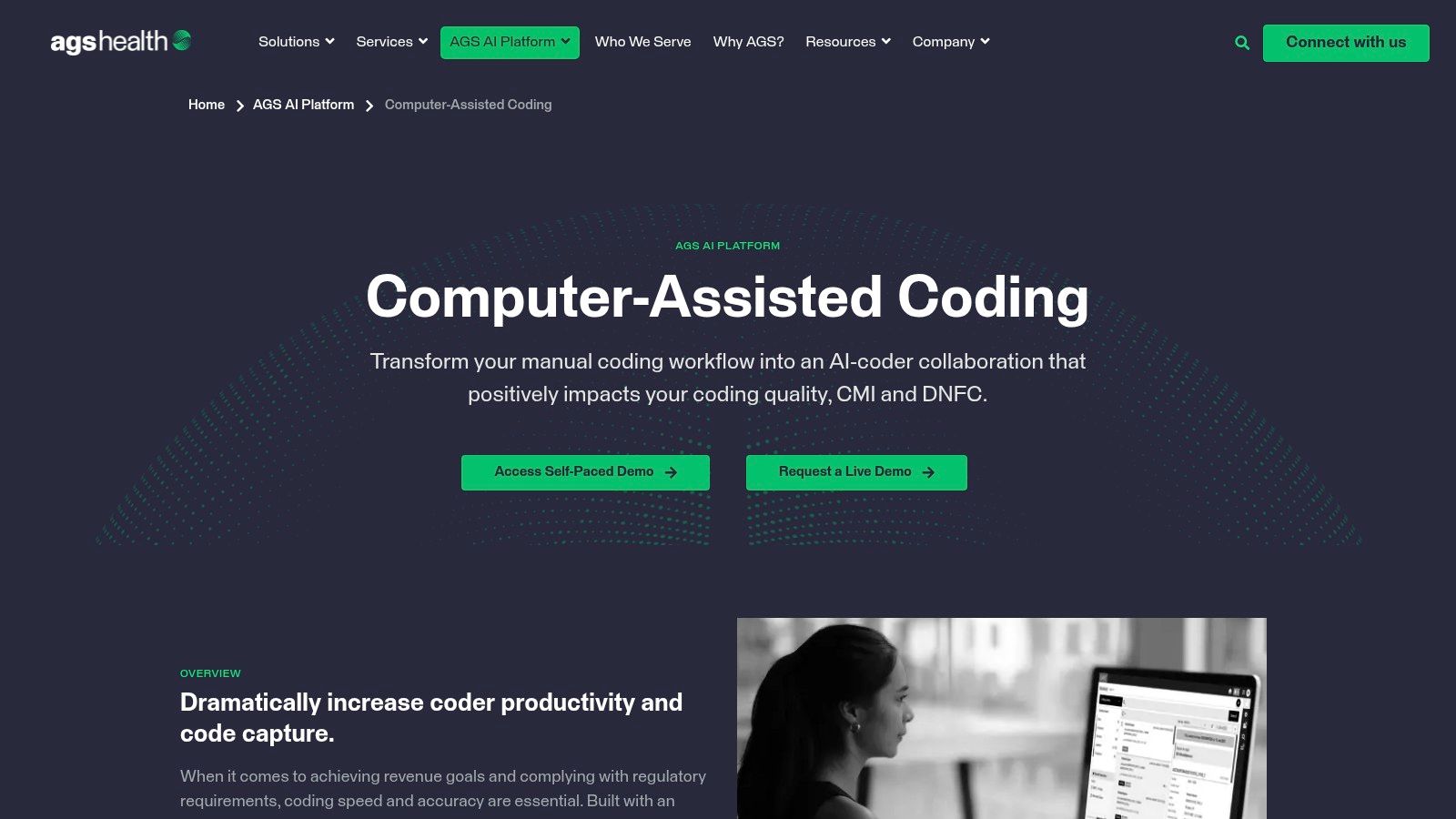
The company stands out by providing a hybrid model where organizations can leverage the AI platform for in-house teams or supplement their staff with AGS’s outsourced coding experts. This "human-in-the-loop" approach to autonomous coding ensures quality control while still capturing the efficiency gains of automation. It’s a practical solution for facilities facing staffing shortages or those wanting to scale their coding operations without a massive upfront investment in new personnel. This flexibility is a significant advantage for mid-sized organizations that need a tailored solution.
Core Offering Analysis
- Best For: Hospitals and health systems looking for a flexible solution that combines AI software with optional outsourced coding services.
- Key Features: NLP-based suggestions for ICD-10 and CPT codes, autonomous coding with human review, integrated auditing tools, and robust productivity dashboards.
- Pricing: Custom pricing based on facility size, volume, and service mix. A direct consultation is required for a quote.
- Pros: The hybrid model offers a great safety net for staffing gaps. Strong focus on operational metrics like DNFB reduction provides clear ROI.
- Cons: Feature depth can vary across different modules, potentially requiring a phased implementation. The pricing structure is not transparent and requires direct engagement.
Website: https://www.agshealth.com/ai-platform/computer-assisted-coding/?utm_source=openai
10. Infinx (mCoder & Medical Coding Services)
Infinx offers a unique hybrid approach that combines its proprietary AI engine, mCoder, with managed coding services. Instead of selling software directly, Infinx provides tech-enabled services where its deep-learning model handles a high volume of claims automatically, while complex cases or exceptions are routed to its global team of certified human coders. This model is built to help healthcare organizations scale their coding capacity quickly without hiring more staff or investing in new technology infrastructure.
The primary goal of the Infinx solution is to increase the direct-to-bill rate, ensuring more claims are coded correctly and submitted cleanly on the first pass. This service-centric model appeals to organizations that need an immediate lift in coding output and accuracy but prefer not to manage new software internally. By blending AI efficiency with human oversight, Infinx positions itself as a practical solution for practices and hospitals focused on operational outcomes rather than just technology adoption. It is an outsourcing model supercharged with AI, providing a turnkey solution for capacity issues.
Core Offering Analysis
- Best For: Practices and hospitals needing to rapidly scale coding capacity and improve clean claim rates without managing a new software platform.
- Key Features: Proprietary 'mCoder' deep-learning model, tech-enabled service with onshore/offshore certified coders, and a strong focus on direct-to-bill rate improvement.
- Pricing: Based on a per-chart or per-claim service model. Pricing requires direct consultation and is customized based on volume and complexity.
- Pros: Combines AI efficiency with human expertise for high accuracy on complex cases and provides immediate access to additional coding capacity.
- Cons: It is a service-first model, which means less direct user control over the software. The AI capabilities are embedded within the service, not sold as a standalone platform.
Website: https://www.infinx.com/medical-coding-support-services/
11. Cotiviti (Medical Record Coding for Risk Programs)
Cotiviti specializes in NLP-augmented medical record coding services designed primarily for health plans and at-risk provider organizations. Rather than offering a standalone CAC software for facilities, Cotiviti provides a service that leverages AI to enhance the accuracy and efficiency of its own coding teams, which is particularly valuable for risk adjustment programs like Hierarchical Condition Categories (HCC). This approach focuses on delivering high-quality, auditable coding outcomes at scale, which is crucial for compliance-heavy payer operations.
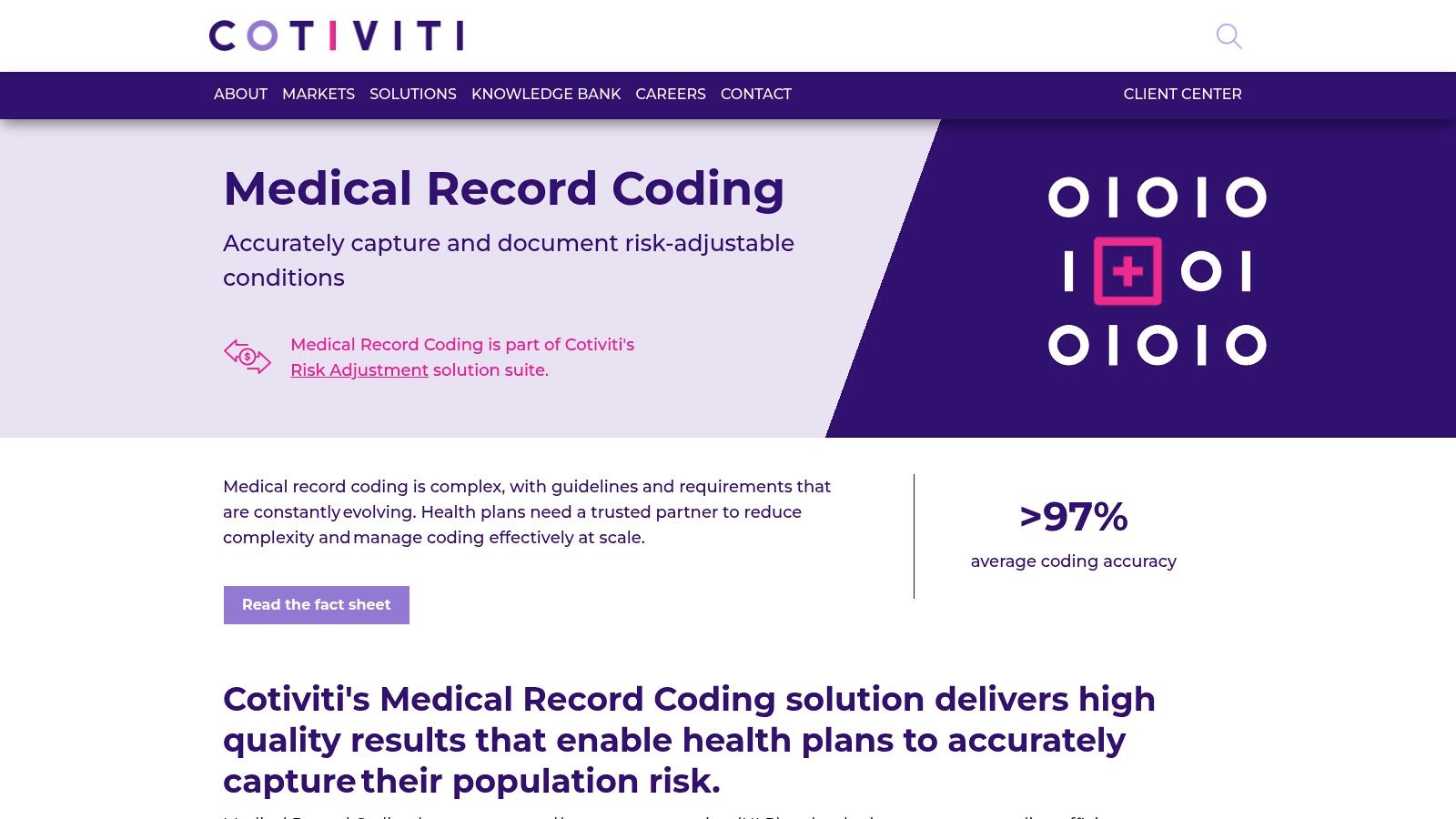
The platform's strength lies in its ability to process massive volumes of clinical charts for payers, ensuring all supported diagnoses are captured correctly for accurate risk scoring. By integrating AI to assist human coders and offering optional second-level reviews, Cotiviti positions itself as a high-accuracy partner for organizations where coding quality directly impacts revenue and compliance. This makes it a key player among AI medical coding companies focused on the payer market, where precision and auditability are paramount. Their model is less about selling technology and more about selling guaranteed, high-quality outcomes.
Core Offering Analysis
- Best For: Health plans, Accountable Care Organizations (ACOs), and large at-risk provider groups managing risk adjustment programs.
- Key Features: NLP to augment coder efficiency and quality, reported >97% average coding accuracy, and second-level review options to reduce downstream errors.
- Pricing: Service pricing is provided via program engagement or a direct Request for Proposal (RFP); no standard pricing is publicly available.
- Pros: Scales to very large chart volumes required by payers and ACOs. The strong emphasis on accuracy makes it suitable for audit-heavy environments.
- Cons: Primarily a payer-focused service, making it less suitable for hospitals seeking traditional facility-side computer-assisted coding (CAC) software.
Website: https://www.cotiviti.com/solutions/risk-adjustment/medical-record-coding?utm_source=openai
12. Nuance (Clintegrity Coding)
As a long-standing leader in health information management and now part of Microsoft, Nuance offers the Clintegrity Coding platform. This solution is deeply entrenched in the healthcare ecosystem, providing sophisticated coding and compliance tools for both facility and physician settings. It leverages advanced AI and Natural Language Processing (NLP) to automate code suggestions, streamline workflows, and ensure regulatory compliance. The acquisition by Microsoft signals a future of deeper integration with enterprise cloud and productivity tools.
Clintegrity’s key differentiator is its integration with the broader Nuance and Microsoft healthcare stack, including the widely used Dragon Medical ambient clinical intelligence solutions. This creates a connected environment where clinical documentation flows seamlessly from the point of care into the coding process. As one of the most prominent ai medical coding companies, Nuance focuses on reducing administrative burden across the entire clinical journey. It supports remote coding teams with robust, enterprise-grade reporting capabilities, making it a reliable choice for large, distributed workforces.
Core Offering Analysis
- Best For: Large health systems and hospitals already invested in the Nuance or Microsoft ecosystem.
- Key Features: AI-driven code suggestions, integrated compliance and denial management modules, advanced rules and edits for facility and pro-fee coding, and enterprise reporting for remote workforce management.
- Pricing: Enterprise-level contracts only. Pricing is customized and requires a direct sales consultation with Nuance.
- Pros: Deep HIM industry expertise and a strong reputation. Native integration with Dragon products creates a powerful documentation-to-coding pipeline. Proven outcomes are documented in various health system case studies.
- Cons: The procurement process is complex and lacks pricing transparency, making it unsuitable for smaller practices. Some product documentation may still reference legacy branding, which can be confusing for new evaluators.
Website: https://www.nuance.com/healthcare/provider-solutions/coding-compliance/facility-coding.html
Top 12 AI Medical Coding Companies — Feature & Capabilities Comparison
| Vendor | Core focus & key features | Quality / UX (★) | Value & Pricing (💰) | Target audience (👥) | Unique selling points (✨ / 🏆) |
|---|---|---|---|---|---|
| Solventum (360 Encompass) | End-to-end CAC + CDI + analytics; deep EHR integrations | ★★★★☆ | 💰 Enterprise contracts; scale value | 👥 Large health systems, enterprise coding teams | ✨ Modular CAC/CDI/Audit stack; 🏆 Market maturity & broad interoperability |
| Optum (Enterprise & Professional CAC) | NLP-driven coding + CDI prioritization; RCM integration | ★★★★☆ | 💰 Quote-based (enterprise) | 👥 Hospitals, health systems, RCM orgs | ✨ Tight RCM ecosystem; 🏆 Emphasis on denials & revenue integrity |
| Dolbey (Fusion CAC) | AI/ML code suggestions; AutoClose autonomous outpatient coding | ★★★★★ | 💰 Enterprise pricing (quote) | 👥 Hospitals, ambulatory coding teams | ✨ AutoClose for outpatient autonomy; 🏆 Multi‑year Best in KLAS satisfaction |
| Fathom (Autonomous Medical Coding) | High automation autonomous coding; rapid turnaround | ★★★★★ | 💰 Quote-based; SLA options | 👥 Large volumes, enterprise facilities | ✨ 90%+ reported automation; 🏆 Fast scale & marketplace distribution |
| CodaMetrix (CMX) | Contextual multi-specialty autonomous coding; payer rules | ★★★★★ | 💰 Enterprise sales; ROI-focused | 👥 Academic & major health systems | ✨ Longitudinal context & payer-specific rules; 🏆 Academic pedigree |
| CorroHealth (PULSE) | LLM-driven automated coding + transparent auditing | ★★★★★ | 💰 Quote-based; tech+services combos | 👥 Health systems, revenue teams | ✨ Transparent logic & clinical validation; 🏆 High reported accuracy |
| Apixio (Risk Adjustment Coding) | AI/NLP for HCC/risk capture & audits | ★★★★☆ | 💰 Sales engagement / project pricing | 👥 Payers, MA plans, at‑risk providers | ✨ Retrospective/prospective risk tooling; 🏆 Risk-specialist reputation |
| Edifecs (Risk Adjustment Suite) | NLP suspecting + retrospective review; claims+clinical ingestion | ★★★★☆ | 💰 Enterprise modular pricing | 👥 Payers & at‑risk provider programs | ✨ Health Fidelity lineage & combined claims+clinical views |
| AGS Health (EZDI) | NLP CAC + human-in-loop autonomous coding + outsourced services | ★★★★☆ | 💰 Quote-based; software+services flexible | 👥 Hospitals needing staffing relief | ✨ Hybrid software+outsourcing model; 🏆 Operational metrics focus |
| Infinx (mCoder & Services) | Deep‑learning mCoder + onshore/offshore coder services | ★★★ | 💰 Service-driven pricing (engagement) | 👥 Hospitals/practices needing capacity | ✨ Blend of AI + human coders for exceptions; 🏆 Rapid scaling via services |
| Cotiviti (Risk Program Coding) | NLP-augmented coding with 2nd-level review; high accuracy | ★★★★☆ | 💰 Program/RFP pricing | 👥 Payers, ACOs, large risk programs | ✨ >97% reported accuracy; 🏆 Audit-focused scalability |
| Nuance (Clintegrity) | Facility & physician coding, compliance, integration with Dragon | ★★★★☆ | 💰 Enterprise procurement; quote | 👥 Large health systems, compliance teams | ✨ Strong HIM footprint & Microsoft integration; 🏆 Established enterprise outcomes |
How to Choose the Right AI Coding Partner for Your Organization
Navigating the landscape of AI medical coding companies can feel overwhelming. From established giants like Solventum and Optum to innovators like Fathom and CodaMetrix, the options are diverse, each with unique strengths. This guide has provided a detailed look at the top vendors, but the final decision rests on finding a solution that aligns perfectly with your organization's specific operational needs, clinical specialties, and long-term strategic goals. Making the right choice requires a methodical approach that goes beyond a features checklist.
The transition to AI-driven coding is not just a technology upgrade; it is a fundamental shift in how your revenue cycle functions. The right partner can unlock unprecedented efficiency, boost accuracy to over 95%, and free up your skilled coders to focus on complex cases that require human expertise. The wrong choice, however, can lead to integration nightmares, workflow disruptions, and a frustratingly low return on investment. Making a thoughtful, informed decision is paramount to achieving the desired financial and operational benefits.
To help you move from evaluation to action, use this buyer's checklist to guide your conversations with potential vendors.
Define Your Primary Goal
Before you even look at a demo, you must understand what problem you are trying to solve. Are you aiming to reduce claim denials, accelerate reimbursement cycles, improve coder productivity, or all of the above? A clear objective will be your most important filter. A hospital struggling with DNFB will prioritize different features than a payer focused on HCC capture.
- Key Questions to Ask: What is our biggest pain point in the current coding workflow? Are we focused on improving professional fee coding, facility coding, or risk adjustment? What specific KPIs do we need to improve (e.g., reduce DNFB by 2 days, increase coder productivity by 30%)?
Assess EHR Integration Needs
Seamless integration with your Electronic Health Record (EHR) system is non-negotiable. A clunky or poorly integrated solution will create more work than it saves. The AI platform must be able to pull clinical documentation and push back coded data with minimal friction. Look for vendors with proven, live integrations with your specific EHR version.
- Key Questions to Ask: Does your platform have pre-built, bidirectional integrations with our specific EHR (e.g., Epic, Cerner, Athenahealth)? What is the typical timeline and process for establishing the integration? Can we speak with a reference client who uses the same EHR?
Evaluate the Vendor's AI Model
The "AI" in AI coding is not all the same. Some systems are fully autonomous, processing and finalizing codes without human touch, while others are computer-assisted, acting as a powerful co-pilot for your coding team. Understanding the model is critical to setting realistic expectations for workflow changes and the level of human oversight required.
- Key Questions to Ask: Is your model fully autonomous or a computer-assisted coding (CAC) tool? How do you continuously validate the accuracy and performance of your AI algorithms? Can you explain how your model handles ambiguous or conflicting documentation?
Request a Pilot or Proof of Concept
Never commit to a long-term contract based on a sales presentation alone. A pilot program using your own de-identified patient data is the only way to truly assess a vendor's performance, accuracy claims, and fit within your existing workflows. This is the ultimate test of whether the platform can deliver on its promises in your unique environment.
- Key Questions to Ask: Can we conduct a pilot program with our own data? What specific metrics will we use to define and measure the success of the pilot? What resources are required from our team to support the pilot?
Understand the Implementation and Support Model
The technology is only one part of the equation. The quality of the vendor's implementation process, training, and ongoing support will determine your long-term success. A strong partner will guide you through change management and be responsive when issues arise. Look for a vendor that acts as a partner, not just a supplier.
- Key Questions to Ask: What does your standard implementation and training process look like for our team? What are your support hours and guaranteed response times for critical issues? What is your process for handling software updates and regulatory changes (e.g., new ICD codes)?
Ultimately, the best choice among the many capable ai medical coding companies is the one that becomes a true extension of your team. While these solutions masterfully handle the back-end revenue cycle, it is also worth considering how automation can streamline the entire patient journey. For instance, platforms like Simbie AI automate front-end administrative tasks such as patient intake and scheduling, ensuring the clinical documentation that feeds your coding engine is clean and complete from the very start.
By taking a structured approach to your research and asking the right questions, you can confidently select an AI partner that not only meets your immediate needs but also scales with you into the future, building a more resilient and efficient healthcare organization.
While AI medical coding optimizes your back-office, the quality of coding starts with clean data from the front office. Simbie AI automates patient-facing workflows like intake, scheduling, and payments, ensuring the documentation that flows into your new AI coding system is accurate from the beginning. See how you can create a truly end-to-end automated workflow by visiting Simbie AI.