

An AI medical assistant is a new kind of digital team member built for your primary care practice. It’s made to handle the high-volume, repetitive tasks—like answering calls, booking appointments, or processing refills—that often keep your staff tied up and away from patients.
Why primary care is turning to AI assistants

Running a primary care practice often feels like a constant battle against a mountain of administrative work. I’ve seen it time and again—talented clinicians and front-office staff get bogged down by never-ending phone calls, tedious EMR data entry, and endless paperwork.
This isn't just a small bother. It’s a major cause of staff burnout and can lead to a frustrating experience for patients trying to get care. This is exactly why the AI medical assistant for primary care has gone from a futuristic idea to a necessary tool for practices that want to succeed.
The overwhelming administrative burden
Practices are actively seeking relief, and the numbers prove it. A 2024 AMA survey found that 66% of physicians are now using AI in their practice. That’s a 78% increase from the 38% who reported using it just back in 2023. This explosive growth shows a clear trend: clinics are turning to AI to automate tasks like documentation and chart reviews simply to keep up.
This technology directly tackles the operational headaches that keep practice managers up at night. It provides a real-world path to a more efficient, sustainable clinic by getting to the root of the administrative friction. For more on improving how patients connect with your practice, check out our guide on building a healthcare digital front door.
A clear before-and-after scenario
To see just how much of a difference this makes, it helps to compare the old way of doing things with the new. This isn't about replacing your staff; it's about freeing them up to focus their skills where they count the most—on patient care.
Here’s a quick look at how daily operations change.
Practice operations before and after an AI assistant
| Administrative Task | The Manual Way | With an AI Assistant |
|---|---|---|
| Appointment Scheduling | Staff answer calls, navigate the EMR, find a slot, and confirm—a multi-step process for every single booking. | AI answers instantly, offers available times from the EMR, and books the appointment in seconds, 24/7. |
| Prescription Refills | A patient calls and waits on hold. Staff then manually create a task in the EMR for the physician to review later. | AI captures the request, verifies patient and medication details in the EMR, and queues it for one-click physician approval. |
| Answering FAQs | Staff spend several minutes per call answering the same questions about hours, directions, or insurance plans. | AI provides instant, accurate answers to hundreds of common questions at once, eliminating wait times completely. |
| Patient Intake | Staff spend valuable time on the phone collecting a patient’s medical history and insurance info before an appointment. | AI calls the patient ahead of their visit, gathers all necessary information, and enters it directly into their EMR chart. |
By offloading these high-volume, low-complexity tasks, an AI medical assistant for primary care gives your team the breathing room they need. They can finally focus on more complex patient needs, improve the in-office experience, and feel less overwhelmed at the end of the day.
What an AI medical assistant actually does
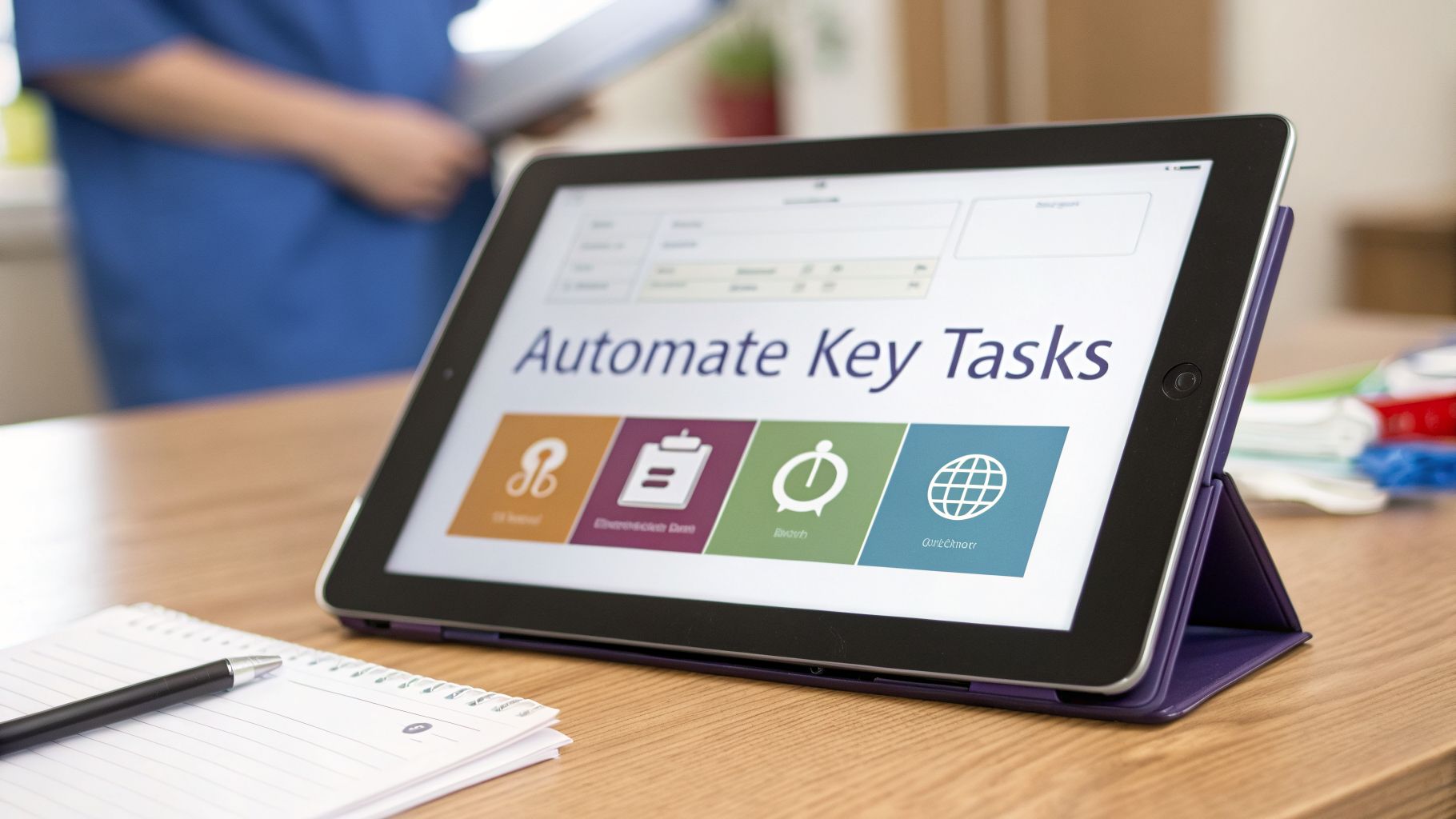
It’s easy to get lost in the buzz around AI. But to really understand its value, you need to see what it does on a Tuesday afternoon in a busy primary care clinic. An AI medical assistant for primary care isn't some generic chatbot—it's a purpose-built tool that digs into your EMR and handles real, everyday workflows.
I think of it as a new kind of team member, one with several different specialties. You have a scheduling expert, a pro who handles prior authorizations, and another who helps with clinical charting. Let's break down exactly what this looks like in practice.
Automating patient communications
Take a look at your front desk. A huge chunk of their day is spent on the phone, juggling calls while trying to help the patients standing right in front of them. An AI assistant can lift a massive portion of this phone traffic, letting your staff focus on what matters most.
This isn't just about answering calls; it's about resolving them.
- Appointment Scheduling: The AI answers every call on the first ring—no more hold music. It checks the EMR for open slots, books appointments in real-time, and sends out confirmations and reminders to cut down on no-shows.
- Answering Routine Questions: Patients call 24/7 with the same questions: "What are your hours?" or "Do you take my insurance?" The AI can handle all of these instantly, saving your team from answering the same things over and over.
Instead of a staff member spending five minutes searching for a follow-up appointment, the AI gets it done in less than a minute. This is a big deal for clinic efficiency and gives patients the quick, easy experience they expect.
Handling core administrative tasks
The administrative paperwork in healthcare is relentless. It’s filled with repetitive tasks that are necessary but drain countless hours from your day. An AI medical assistant for primary care can automate these workflows, making your whole practice run more smoothly.
I see this all the time with prescription refills. A staff member might spend 15 minutes on the phone verifying information, creating a task in the EMR, and then routing it to a doctor. The AI does all of that in seconds, putting the request directly in the physician's queue for a simple one-click approval.
This same logic applies to other administrative nightmares. Take prior authorizations—a major source of frustration for every practice. The AI can pull the necessary records from the EMR, submit the request to the payer, and track its status. It only loops in a human when a more complex judgment is needed. The assistant can even help with billing by checking codes to make sure the documentation lines up with the services provided.
Aiding clinical documentation
Many physicians spend hours every night on "pajama time," catching up on charts from the day. This is a fast track to burnout. An AI assistant can give doctors back their evenings by tackling the documentation burden.
One of the most powerful applications is chart summarization. Before walking into the exam room, the AI can scan a patient’s entire history—sometimes hundreds of pages long—and create a clean, one-page summary. This brief might include recent lab results, notes from specialists, and current medications, giving the doctor a quick, scannable overview. It’s not about replacing a doctor's clinical review; it's about making it faster and far more efficient.
Improving patient engagement and follow-up
The assistant's job isn't over when the patient walks out the door. Good outcomes depend on consistent follow-up, which is tough to manage manually. The AI can send automated, personalized messages based on a patient's recent visit.
For example, it can check in on a patient's symptoms a week after their appointment or send a reminder to schedule a lab test that was ordered during the visit. This keeps patients connected to their care plan and helps you close important clinical loops, all without adding a single task to your team's to-do list.
How AI reduces burnout and improves care

Physician and staff burnout is one of the biggest threats facing primary care. It’s not just about the long hours. It's the soul-crushing weight of administrative tasks that pulls doctors and their teams away from what they signed up to do—care for patients. I’ve seen firsthand how an AI medical assistant for primary care can completely turn this around.
Take the mountain of repetitive work off a clinician's plate, and something incredible happens. They get their spark back. They can finally focus on thoughtful conversations and tricky diagnostic puzzles instead of endless clicking and typing. This isn't just a feeling; the numbers prove it.
A year-long study by Phyx Primary Care involving 120 physicians found that using an AI assistant led to a 40% reduction in clinical review time for complex visits and a 32% decrease in physician burnout. Also, 94% of the physicians found the tool easy to adopt, which is huge. You can dig into the in-depth AI assistant study to see all the details.
Less administrative drag directly translates to better well-being. That’s the foundation of a sustainable practice.
Reclaiming time and fighting "pajama time"
One of the worst parts of the job is "pajama time"—those extra hours doctors spend at home, long after the clinic has closed, just to catch up on EMR documentation. An AI assistant tackles this head-on.
Instead of a doctor frantically digging through a patient’s history during a visit, the AI can have a neat, concise summary ready beforehand. This small change means less screen time and more face time during the appointment itself. The charting is more accurate and gets done faster, which chips away at that after-hours workload.
This reclaimed time has a ripple effect:
- More focused patient visits: When doctors aren't mentally running through the documentation they still have to do, they can be fully present with their patients.
- A better work-life balance: Cutting down on pajama time is a direct investment in your team's mental health, helping you fight the exhaustion that leads to high turnover.
How a happier team leads to better care
It’s a simple but powerful truth: a less-stressed, more engaged clinical team provides a higher standard of care. When your staff isn't buried under ringing phones and overflowing inboxes, they have the bandwidth to give patients the attention they deserve.
An AI assistant doesn't replace the human touch; it enables it. By automating the most draining parts of the job, you give your people the breathing room to do their best work. This isn't just about efficiency—it's about re-investing in the human side of medicine.
This positive shift creates real benefits for patients. For instance, when an AI handles routine appointment reminders, your staff has more time for complex issues, like helping someone navigate a tricky insurance problem. It also cuts down on the human errors that inevitably happen when a team is stretched thin. For a closer look at how AI helps with specific documentation, you can learn more about the role of a medical scribe AI and see its impact.
Calculating the ROI of your AI assistant
When you're thinking about bringing an AI medical assistant into your primary care practice, the conversation inevitably lands on one big question: "What’s the return on this investment?" As a practice owner or administrator, you need to see a clear business case, and rightly so. From my experience, the value isn't just about what you save; it's also about what you gain.
The ROI really splits into two buckets: hard savings and soft savings. Hard savings are the direct cost cuts you can easily track on a spreadsheet. Soft savings are a bit less tangible but are just as important for the long-term health and reputation of your practice. To see the full picture, you have to look at both.
Hard savings your practice can track
Hard savings are the numbers you can take straight to the bank. These are the immediate financial wins that come from automating those repetitive, high-volume tasks that clog up your team's day.
Reduced administrative overhead: This is where you'll see the biggest impact. When an AI starts handling routine scheduling, refill requests, and patient intake calls, your staff is suddenly free. We’ve seen practices cut their administrative overhead by up to 60% simply by reallocating team members to more meaningful work instead of hiring more people just to answer phones.
Lower call center costs: If you’re paying for an external call center or have staff dedicated only to phones, an AI can slash those expenses. The system can manage hundreds of calls at once, which means you no longer need a large team to brace for those peak call times.
Improved billing accuracy: An AI can also be a huge help in making sure your documentation backs up the services you bill for. By accurately capturing details from every patient interaction, it helps cut down on coding mistakes and claim denials, leading to a much healthier revenue cycle.
The value of soft savings
Soft savings can be a little harder to pin a dollar amount on, but their effect on your practice's success is massive. These are the benefits that boost your team's morale and strengthen your relationships with patients.
The most overlooked soft saving is the value of capturing every single patient call. Missed calls are missed opportunities—for appointments, for patient questions, and for building loyalty. An AI that answers 100% of calls ensures you never lose a patient to a busy signal again.
Other key soft savings include:
Lower staff turnover: Burnout is expensive. When you lose a great staff member, it costs thousands in recruitment and training to replace them. By taking the administrative weight off their shoulders, you create a better, more sustainable work environment that makes people want to stay.
Higher patient satisfaction: Nobody likes waiting on hold. An AI that gives patients instant answers for simple requests makes them feel heard and valued. Happy patients are far more likely to stick with your practice and recommend it to others.
Better clinical focus: When your team isn’t drowning in paperwork and phone tag, they can give their full attention to the patients right in front of them. This leads to better, more focused care.
Getting a handle on the financial impact is a key step. You can find excellent guides on how to calculate return on investment for specific initiatives like this. Using a simple framework will help you track the metrics that truly matter and build a clear, data-driven case for bringing an AI assistant into your practice.
Key metrics for measuring AI impact
To truly understand the value, you need to track the right things. The table below outlines some key performance indicators (KPIs) to monitor before and after you implement an AI assistant.
| Metric Category | Specific KPI to Track | What This Metric Reveals |
|---|---|---|
| Operational Efficiency | Average call handle time | How quickly routine tasks are being completed. |
| Operational Efficiency | Staff time spent on admin tasks | The direct impact on your team's daily workload. |
| Financial Performance | Cost per patient interaction | The direct "hard savings" from automating calls and tasks. |
| Financial Performance | No-show rate | Whether automated reminders are improving appointment adherence. |
| Patient Experience | Average call hold time | The most direct measure of improved patient access. |
| Patient Experience | Patient satisfaction scores (CSAT) | How patients feel about the new, faster level of service. |
| Staff Satisfaction | Employee turnover rate | The long-term effect on staff burnout and retention. |
Tracking these metrics gives you concrete data to show exactly how the AI is performing. It moves the conversation from "I think it's working" to "I know it's working, and here's why." This data is your best tool for demonstrating value to stakeholders and fine-tuning your strategy over time.
Navigating technical and regulatory hurdles
Bringing an AI medical assistant for primary care into your practice isn't like installing a new printer. I've seen firsthand that the clinics that truly succeed are the ones that treat this as a serious operational integration, not just a quick tech fix. Getting it right means facing the technical and regulatory challenges from day one.
Before you even think about choosing a partner, you need to know the right questions to ask. Let’s walk through the three big ones: deep EMR integration, ironclad HIPAA compliance, and the absolute need to keep a human in the loop.
Deep EMR integration
A tool that just sits on top of your EMR without being able to interact with it is more of a gimmick than a solution. The AI needs to be able to both read and write information directly into the patient's chart. Think of it this way: if you hired a new MA who could only look at files but never update them, how helpful would they really be?
This two-way, or bidirectional, integration is what separates a genuinely helpful assistant from a tool that just creates more work. For instance, when the AI handles an appointment request over the phone, it should book that slot directly in the EMR's schedule—not just send a task for your front desk staff to handle later.
HIPAA compliance and patient data security
This is the one area where you cannot compromise. When an AI is touching Protected Health Information (PHI), there is zero room for error. The security standards you hold your team to must be the same ones you demand from your AI vendor. Patient trust is your most valuable asset, and a single data breach can shatter it overnight.
Before you even consider a vendor, you must get a signed Business Associate Agreement (BAA). This is a non-negotiable legal contract that makes the vendor responsible for protecting any patient data they touch. Without a BAA, you are putting your entire practice at enormous risk.
Beyond the BAA, here are the specific questions you need to ask potential vendors:
- Where is the data stored and how is it encrypted? Data must be encrypted both in transit (while it's moving) and at rest (when it's stored).
- What are your access controls? You need to know exactly who can see the data and how their activity is logged.
- How do you handle potential security threats? What are their specific protocols for monitoring and responding to an incident?
Making sure patient data is locked down is paramount. Exploring available HIPAA compliant cloud solutions is a smart way to meet these strict requirements. You can also dig deeper into what to look for in our guide on HIPAA-compliant AI tools.
Ensuring clinical accuracy with physician oversight
No matter how advanced the technology gets, nothing replaces a clinician's judgment. An AI medical assistant for primary care is there to support your providers, not replace them. That’s why the best systems are always built with a "human-in-the-loop" model, which simply means a human expert is always there for review and final approval.
For example, an AI might draft a perfect summary of a patient phone call, but a provider must still review and sign off on it before it becomes a permanent part of the medical record.
One major analysis found that an AI virtual assistant achieved 76% accuracy in internal medicine diagnostics, which was much higher than the physicians' 58%. This doesn't mean the AI takes over; it means it's a powerful and reliable partner. But that final human oversight is what guarantees safety and builds trust with both patients and staff.
Your step-by-step plan for AI implementation

Bringing in new technology is always more about the people than the software itself. I’ve seen great tech gather dust because the team wasn't prepared for the change. A successful launch of an AI medical assistant for primary care hinges on a thoughtful, human-first plan that turns skepticism into support.
Think of this as your roadmap for making sure the new tool is genuinely embraced, not just begrudgingly tolerated. Without a plan, you're inviting confusion and poor adoption. With one, you're setting everyone up for a win.
Form a pilot team and set clear goals
Before you even think about a practice-wide rollout, you need to start small. The first move is to assemble a hand-picked pilot team. This group should represent a cross-section of your clinic: a physician, a front-desk coordinator, a nurse, and the practice manager.
These folks are your champions and your troubleshooters. Their mission is to put the AI through its paces in a controlled, real-world setting.
Next, you have to define what "success" actually means. "Improving efficiency" is too vague. Get granular with specific, measurable goals. For instance, you could aim to:
- Cut patient call hold times by 50% within the first two months.
- Automate 80% of all prescription refill requests coming into the clinic.
- Lower the no-show rate by 15% thanks to smarter, automated reminders.
Having concrete targets like these gives your team a clear destination and makes it easy to see if the AI is delivering on its promise.
Communicate the "why" to get your staff on board
This might be the single most important step. Your team’s biggest fear is often unspoken: "Is this AI here to replace me?" You have to tackle that concern directly and honestly.
Gather everyone for a meeting and explain the real reason for the change. Frame the AI assistant as a new teammate—one that’s designed to handle the most tedious and repetitive tasks. This frees up your staff to focus on what matters most: patient care, complex problem-solving, and making the in-clinic experience better for everyone.
My experience shows this is critical: When a team sees the AI as a tool to make their jobs less stressful—not to eliminate them—they become its biggest advocates. The conversation should always be about reducing burnout and making their daily work more meaningful.
Start with a phased rollout and listen intently
Don't try to do everything at once. Pick one or two workflows that are high-volume but relatively simple. Appointment scheduling and prescription refills are perfect starting points because they’re frequent, predictable, and offer quick wins.
As your pilot team begins using the system, you need to become a feedback machine. What’s working? Where are the friction points? Hold quick weekly check-ins to talk through their experiences and catch small issues before they snowball.
Finally, make sure your team feels completely supported. Offer great training, but more importantly, designate an internal "champion." This should be someone on the team who is tech-savvy and enthusiastic, acting as the go-to person for questions. Having a peer to turn to for help is far less intimidating than calling a support line and makes the whole transition feel more manageable.
Frequently asked questions
When I talk with practice managers and physicians about bringing an AI assistant into their clinic, the same questions tend to pop up. It's a big change, and it's smart to be thorough. Here are some straightforward answers to the most common concerns I hear.
Will an AI assistant replace my current staff?
This is easily the biggest worry, but the simple answer is no. The goal isn't to replace your people; it’s to give them a major boost.
Think of the AI as the newest member of your team, one who happily takes on all the repetitive, high-volume work. We're talking about handling routine scheduling calls, processing simple refill requests, and answering basic questions that clog up your phone lines. This frees your trained staff to focus on the work that requires a human touch—like navigating a complex billing issue with a patient or providing top-notch, in-person care.
In clinics I've worked with, we consistently see reduced staff burnout. Why? Because their jobs become more rewarding and less of a grind. The AI handles the monotonous tasks, letting your team use their skills where they truly make a difference.
How hard is it to integrate an AI assistant with our EMR?
The difficulty of connecting to your EMR really comes down to the AI vendor you choose. While some older, locked-down EMRs can be tricky, most modern AI platforms are specifically designed to integrate deeply with major systems like Epic, Cerner, and athenahealth. A good partner will have a dedicated team to handle this for you.
The most important question you can ask a vendor is: "Can your AI write information back into the patient chart?" A seamless, two-way connection is non-negotiable.
Without that, you're just creating another data silo and more work for your staff. The whole point is to have the AI handle a task from start to finish.
How do we ensure the AI is clinically safe and accurate?
Patient safety is everything. Any reputable AI medical assistant is built with multiple layers of protection. For starters, the AI is trained on massive, clinically validated datasets to make sure its actions and recommendations are sound.
But more importantly, the best systems use what's called a "human-in-the-loop" model. This means the AI might draft a note from a patient call, but it always waits for a final review and sign-off from a clinician before anything is committed to the official record. When you're evaluating a tool, ask to see its audit trails and find out its exact process for escalating complex cases to a human. This gives you all the efficiency gains without ever sacrificing clinical oversight.
What is the typical cost and how fast is the ROI?
Pricing can vary based on the size of your practice and which tasks you want to automate, but most vendors offer a predictable monthly or annual subscription.
As for the return on investment, it’s often much faster than people expect. We’ve seen practices cut their administrative overhead by up to 60%. A simple way to estimate your own ROI is to calculate the hours your staff currently spends on automatable tasks and multiply that by their wages. In many cases, the money saved from preventing just a handful of no-shows or cutting down on staff overtime can cover the entire cost of the AI in just a few months.
Ready to see how an AI assistant can automate tasks and free up your team? Simbie AI provides a clinically-trained voice AI that handles scheduling, refills, prior authorizations, and more. It’s designed to help you reduce burnout and get back to focusing on patient care. Learn more at https://www.simbie.ai.