
Let's be honest, the term "AI clinical documentation" might sound a bit like science fiction. But in reality, it's a straightforward concept: using artificial intelligence to listen to a conversation between a doctor and a patient, and then automatically turning that conversation into a structured, accurate clinical note.
Think of it as the ultimate medical scribe—one that works silently in the background, freeing you up from the keyboard so you can focus entirely on the person in front of you. It integrates directly with your existing Electronic Medical Record (EMR) system, dramatically cutting down on manual data entry. The entire point is to give you back your time. AI clinical documentation is not a future-state technology; it's a present-day solution to one of healthcare's most persistent problems: the administrative burden that leads to physician burnout and detracts from patient care. By leveraging ambient listening and advanced natural language processing, these systems are fundamentally reshaping the clinical workflow for the better.
Putting an End to Administrative Overload
For too many doctors, the day doesn't end when the last patient goes home. It stretches on for hours, filled with the click-clack of a keyboard as they battle through a mountain of charting. This isn't just a hassle; it’s a leading cause of burnout and it’s slowly eroding the foundation of patient care. This administrative work, often referred to as the "pajama-time" phenomenon, has become a systemic issue in modern healthcare.

The struggle is all too real. We’ve all heard of (or experienced) "pajama time"—that dreaded period of catching up on notes from home, long after the clinic has closed. This imbalance doesn’t just steal time; it takes away from family, from rest, and from the mental clarity needed to be at your best. It represents a significant drain on the personal and professional lives of clinicians, contributing to a cycle of fatigue and decreased job satisfaction that can ultimately impact the quality of patient care delivered.
The Hidden Costs of Manual Charting
The administrative burden has created a huge gap between why people get into medicine and what they actually do all day. Studies show that for every hour a physician spends with patients, they can spend nearly two hours on paperwork. It's a shocking statistic that perfectly explains the exhaustion plaguing the industry. This disproportionate time allocation means that highly trained medical professionals are spending the majority of their working hours on clerical tasks rather than direct patient interaction and complex medical decision-making. You can dig deeper into how automating healthcare processes is helping to fix this imbalance.
The fallout from this time-sink is significant and affects everyone:
- Delayed Notes: When documentation happens hours after a visit, details get fuzzy, and the risk of errors climbs. This "recall bias" can lead to less accurate and less complete medical records.
- Incomplete Records: A rushed doctor might leave out a crucial piece of information, impacting everything from future treatment plans to billing. These omissions can compromise continuity of care and create compliance risks.
- Divided Attention: It’s hard to be fully present with a patient when a part of your brain is already structuring the SOAP note you'll have to write later. This "cognitive split" undermines the physician-patient relationship.
Here's a simple way to think about it: every minute spent typing is a minute not spent listening, diagnosing, or building trust. The system often forces clinicians to serve the EMR first and the patient second.
To see just how different the two approaches are, let's compare them side-by-side.
Manual Documentation vs. AI-Powered Workflows
This table breaks down the practical differences between the old way of doing things and the new, AI-assisted approach. The contrast is pretty stark, illustrating a fundamental shift in the clinical experience.
| Metric | Traditional Manual Documentation | AI-Powered Clinical Documentation |
|---|---|---|
| Time Spent | Hours of post-visit charting ("pajama time") | Minutes of review and sign-off |
| Physician Focus | Divided between patient and EMR screen | 100% on the patient conversation |
| Note Accuracy | Prone to human error, recall bias, and omissions | Captures the full conversation, reducing errors |
| Burnout Level | High; a primary contributor to exhaustion | Significantly lower; frees up personal time |
| Patient Experience | Can feel impersonal and rushed | More natural, focused, and conversational |
| Data Richness | Limited to what is manually entered | Captures verbatim details, improving data for analytics and research |
The difference isn't just about saving a few minutes here and there; it’s about fundamentally changing the day-to-day experience for both the physician and the patient for the better. It's about restoring the joy of practice.
A Practical Solution for Today’s Practice
The good news is that AI-driven documentation is no longer some far-off dream. It's here, it's accessible, and it works. By taking on the heavy lifting of note creation, these tools directly tackle the documentation bottleneck that slows everything down.
Conversations can finally flow naturally, without the awkward pause of typing. The AI listens, understands the context, and drafts the note in the background, ready for a quick review. This isn't a luxury anymore—it's becoming a necessity for any practice that wants to slash burnout, improve accuracy, and put patient care back at the center of everything.
How AI Changes the Patient Encounter
At its heart, AI clinical documentation is about turning a natural conversation into a perfectly structured medical record. It’s not magic, but a smart, multi-step process that works in the background so clinicians can finally put away the keyboard and focus completely on their patients. This technology fundamentally alters the dynamic of the exam room, removing the computer screen as a barrier between provider and patient.
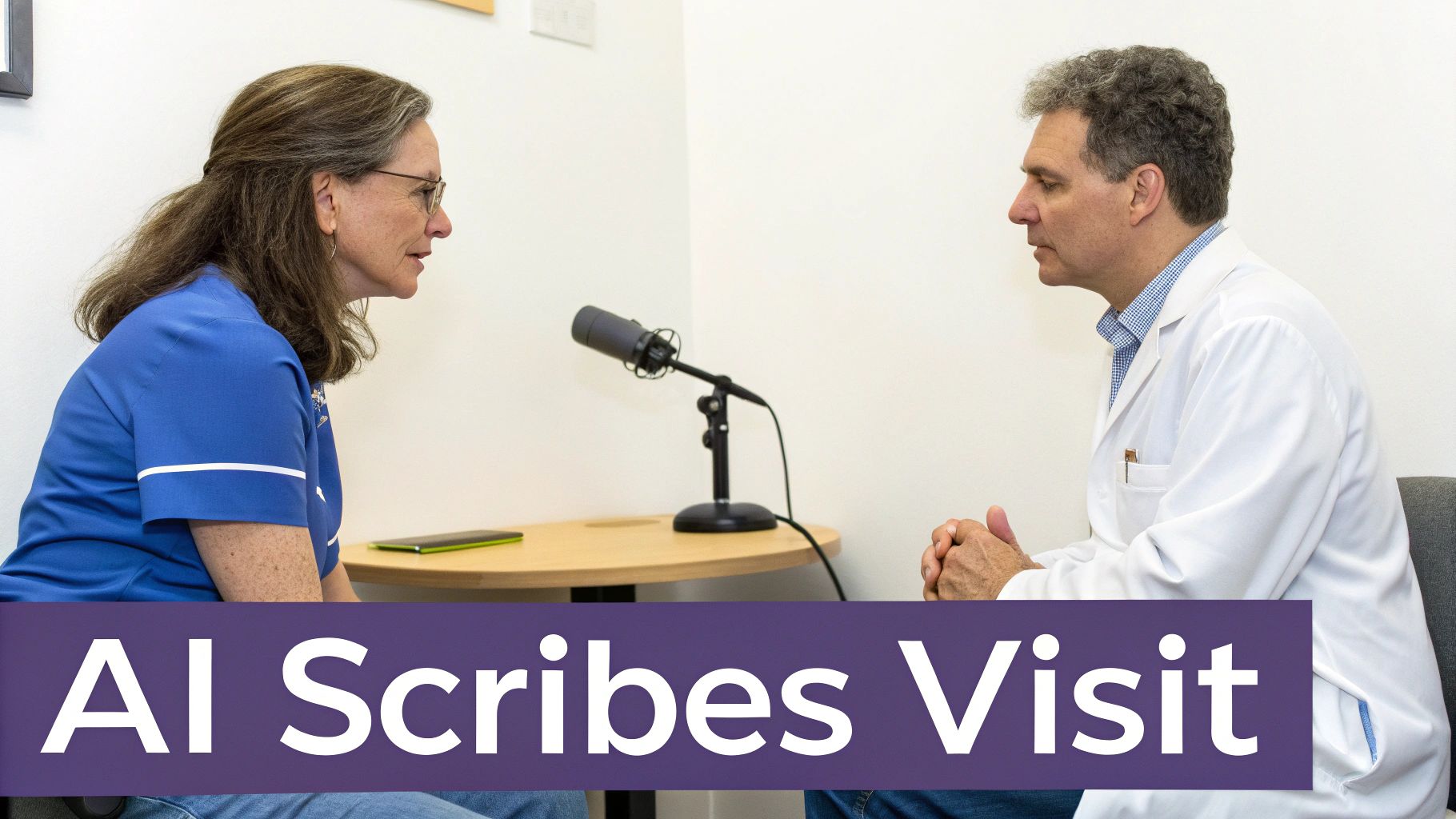
Think of it like having a highly skilled medical scribe in the room who also happens to be a world-class organizer. This AI scribe doesn't just hear words; it understands medical context, pulls out the important details, and arranges them in a way the EMR can read instantly. It’s all about restoring that human connection during the patient visit, allowing for more empathetic and effective communication.
To really get it, let's walk through the journey from a spoken word to a finished clinical note. It all happens in three key stages, each one powered by a different layer of AI.
Stage 1: Capturing the Conversation with Ambient Listening
It all starts with ambient listening. A small, secure device in the exam room—often a smartphone app or a dedicated microphone—simply captures the entire dialogue between the clinician and patient. There’s no need to speak like a robot or dictate specific commands. The system is designed to understand how people actually talk—interruptions, side stories, and all. This is a critical distinction from older dictation software that required specific phrasing and a structured monologue. Ambient technology is designed for the free-flowing nature of a real clinical encounter.
This first step is just about gathering the raw data of the encounter. It makes sure every little detail, from a quick mention of a new symptom to a slight hesitation about medication, is recorded just as it happened. This audio becomes the foundation for everything that follows, a high-fidelity record of the visit.
Stage 2: Making Sense of It All with Natural Language Processing
Once the conversation is recorded, Natural Language Processing (NLP) takes over. This is where the AI scribe really shows its intelligence. NLP algorithms are trained on mountains of medical data, including millions of de-identified clinical notes and medical literature, so they can do way more than just transcribe words.
The NLP engine carefully sifts through the dialogue to:
- Identify Clinical Entities: It spots and tags all the important stuff—medical terms, diagnoses (ICD-10 codes), medications, dosages, and symptoms. This process is known as Named Entity Recognition (NER).
- Understand Context and Intent: The AI knows the difference between a patient describing an old injury and a brand-new complaint. It also recognizes when a doctor is giving instructions versus asking a question, distinguishing between patient history, review of systems, and the final assessment.
- Attribute Information Correctly: It figures out who said what, assigning statements to either the patient or the provider. This is absolutely crucial for building an accurate patient history and assessment.
This is so much more than a standard transcription service. It's the difference between getting a raw script of a play versus a director’s annotated copy that explains who the characters are, what they’re feeling, and what they do next. It adds a layer of intelligent interpretation.
The output from this stage isn't a wall of text. It's a set of structured, clinically meaningful data points, all ready to be organized. If you're curious about the nuts and bolts, learning more about how healthcare conversational AI interprets and acts on patient dialogue offers a deeper dive into this technology.
Stage 3: Structuring and Integrating the Clinical Note
In the last stage, the system takes all that structured data from the NLP engine and assembles it into a clean, coherent clinical note. This is where the world-class organizer comes in. The AI automatically fills out the different sections of a standard format, like a SOAP (Subjective, Objective, Assessment, Plan) note, or any other template preferred by the clinician or practice.
For instance, everything the patient said about their symptoms goes straight into the "Subjective" section. The physician’s exam findings are slotted under "Objective." The system even drafts the "Assessment" and "Plan" based on the clinician’s diagnosis and recommended next steps, including orders for labs, prescriptions, and referrals.
This drafted note is then sent directly into the practice’s Electronic Medical Record (EMR) system. The clinician just needs to open the patient's chart, give the AI-generated note a quick review, make any small edits, and sign off. What used to be 15-20 minutes of tedious typing is now a quick 1-2 minute review, freeing up hours every single day.
The Real-World Benefits for Your Practice
It's one thing to understand how the technology works, but what really matters is seeing the tangible results in your own practice. Bringing AI clinical documentation into your workflow isn’t just about getting new software; it's about fundamentally changing your daily operations for the better—for your staff, your patients, and your bottom line.
These benefits aren't abstract theories. They are immediate, measurable, and impactful. Let’s break down the four key areas where practices see the biggest difference.
Reclaim Hours of Valuable Time
The most immediate and powerful change you'll notice is the drastic cut in documentation time. Instead of spending hours after clinic typing up notes, physicians can simply review and sign off on drafts that are already waiting for them in the EMR. This isn't just a minor efficiency tweak; it's a total workflow transformation.
We're seeing AI scribes consistently slash documentation time by 20-75%, with many providers getting back a full 1-2 hours every single day. Think about what that means. It means ending the workday on time, fitting in another patient without rushing, or just having a moment to breathe between appointments. This reclaimed time directly translates into increased capacity and reduced stress. You can learn more about how AI tools are replacing the traditional medical scribe and giving clinicians their schedules back.
Boost Accuracy and Compliance
Let's be honest—manual data entry is a breeding ground for mistakes. When a doctor is rushing to finish notes late at night, it’s all too easy to forget a small detail, mistype a dosage, or mix up information. These little errors can have big consequences for patient safety and billing.
AI documentation tools catch what humans might miss. By recording the entire patient conversation, the system ensures the final note is a true reflection of the encounter.
This leads to some critical improvements:
- Fewer Omissions: The AI captures the little details a busy clinician might overlook, creating a much more complete and robust patient record. This includes capturing social determinants of health and other nuances that are often lost.
- Greater Specificity: Notes are filled with precise, verbatim information, which helps justify higher-level billing codes and builds a stronger case in an audit. This directly impacts revenue cycle management.
- Consistent Formatting: Every note follows the same logical structure, making it far easier for anyone on the care team to quickly find the information they need, improving care coordination.
The takeaway is simple: A more accurate note is a more defensible note. AI helps create a high-fidelity record of every encounter, strengthening both your clinical and financial integrity.
Directly Combat Clinician Burnout
Physician burnout is a full-blown crisis, and everyone knows the crushing weight of administrative work is a huge part of the problem. When brilliant, highly-trained professionals are forced to spend a third of their day on clerical tasks, it’s demoralizing. It leads to frustration, exhaustion, and the feeling that they aren't actually doing the job they signed up for—caring for people. This phenomenon, termed "moral injury," is a key driver of workforce attrition in healthcare.
By automating the most draining part of the day, AI gives clinicians their true focus back. They can engage with patients, look them in the eye, and build trust without being tethered to a keyboard.
This directly attacks the roots of burnout by:
- Restoring Work-Life Balance: Eliminating "pajama time" (finishing charts at home) means physicians can actually leave work at work.
- Increasing Professional Satisfaction: When you spend more time with patients than with paperwork, you remember why you went into medicine in the first place.
- Reducing Mental Fatigue: The cognitive load of trying to recall and document a dozen different conversations is immense. Lifting that burden frees up mental energy for what matters: complex medical decisions.
Drive a Powerful Return on Investment
While the clinical improvements are often the main draw, the financial case is just as strong. AI clinical documentation delivers a clear and compelling return on investment (ROI) through both cost savings and revenue growth. It's an investment that starts paying for itself almost immediately.
The financial wins come from a few different places. First, you can dramatically reduce or even eliminate the steep costs of human scribes or third-party transcription services, which can cost tens of thousands of dollars per provider annually. Second, the incredibly detailed documentation captured by the AI often supports more accurate, appropriate medical coding, which can directly increase reimbursements. Finally, by tackling staff burnout, you reduce the high costs that come with employee turnover, from recruitment to training new team members. A happier, more efficient workforce is a more stable and profitable one.
Choosing the Right AI Documentation Partner
Picking an AI clinical documentation solution is a big deal. It’s a decision that will fundamentally change how your practice operates for years to come. With so many vendors popping up, it’s easy to get lost in the marketing noise. You have to look past the flashy slogans and really dig into the technology.
The truth is, not all AI platforms are created equal. The right partner should feel like a natural extension of your clinical team, not just another piece of software you have to wrestle with every day. Think of it like hiring a new, highly efficient scribe. You need to verify their skills, make sure they fit into your existing workflow, and absolutely trust them with sensitive patient information.
EMR Integration Must Be Seamless
Let’s be blunt: if the AI tool doesn’t play nicely with your existing Electronic Medical Record (EMR) system, it’s a non-starter. A clunky, manual integration completely defeats the purpose of bringing in AI for efficiency. The entire point is to have AI-generated notes flow effortlessly and accurately into the right patient chart—no extra clicks, no tedious copy-pasting.
When you’re talking to vendors, get specific about their integration process:
- How does it connect? Does the platform have a direct, native API connection to your EMR, or does it rely on a third-party workaround? Direct connections are almost always faster and more reliable.
- Who handles the setup? A good partner will have a dedicated implementation team to get you up and running, ensuring everything works perfectly from day one. You shouldn't be left on your own to figure it out.
- Does data flow both ways? The integration needs to be bidirectional. When a patient’s information is updated in one system, it should sync automatically in the other. This ensures data consistency across platforms.
Specialty-Specific Accuracy and Customization
A cardiologist’s note looks nothing like a pediatrician’s. The terminology, abbreviations, and documentation styles are worlds apart. A generic, one-size-fits-all AI model trained on general medical data will inevitably struggle with the unique language of your specialty.
The best AI documentation systems aren't generalists. They are fine-tuned for specific medical fields. This specialization is what delivers truly high accuracy and dramatically reduces the time you spend making edits.
Look for a vendor that can prove its model works well in your specific field. Ask them for case studies or, even better, a live demo using scenarios you actually encounter every day. Customization is also key. You need the ability to build your own templates and adapt the system to your personal documentation style, not the other way around. The system should learn your preferences over time. When evaluating your options, checking out solutions like the supportGPT platform can give you a good sense of what a customizable, supportive partner looks like.
Uncompromising Security and HIPAA Compliance
In healthcare, data security isn’t just a feature—it’s the foundation of trust. Any AI partner you bring on will be handling a massive amount of Protected Health Information (PHI), so their security has to be bulletproof. This isn't something you can afford to overlook.
Your due diligence should confirm a few non-negotiables:
- End-to-End Encryption: All data must be encrypted, both when it's being transmitted (in transit) and when it's stored (at rest).
- Secure Infrastructure: The vendor should be using a secure, audited cloud environment (like AWS, Google Cloud, or Azure) that is specifically configured for HIPAA compliance.
- Business Associate Agreement (BAA): They must sign a BAA. This is a legal contract that makes them responsible for protecting your patient data. It's not optional.
Don't just take a salesperson's word for it. Ask for their security certifications and audit reports (e.g., SOC 2 Type II). A transparent company will have this information ready to share, giving you peace of mind that your patients' data is in safe hands.
Before making a final decision, it’s helpful to lay out all the critical factors in a structured way. This ensures you’re making an apples-to-apples comparison between different vendors.
Key Criteria for Selecting an AI Documentation Platform
| Evaluation Criteria | What to Look For | Why It Matters |
|---|---|---|
| EMR Integration | Direct API connections, bidirectional data sync, and dedicated implementation support. | A seamless integration prevents workflow disruptions and data entry errors, making the tool an asset instead of a burden. |
| Clinical Accuracy | High accuracy rates (>95%) specific to your medical specialty, with proof from case studies or demos. | The less time you spend editing, the more time you save. High accuracy builds trust and drives user adoption. |
| Customization | Ability to create custom templates, shortcuts, and workflows that match your personal style. | The tool should adapt to you, not the other way around. Personalization makes the system feel intuitive and natural to use. |
| Security & HIPAA | End-to-end encryption, secure cloud hosting, and a signed Business Associate Agreement (BAA). | Protecting patient data is a legal and ethical obligation. A breach can destroy patient trust and lead to severe penalties. |
| User Experience (UX) | An intuitive, clean interface that is easy for clinicians and staff to learn and use daily. | If the software is confusing or frustrating, your team won't use it, and you won't see the promised benefits. |
| Vendor Support | Responsive, knowledgeable customer support available through multiple channels (phone, email, chat). | When issues arise, you need a reliable partner who can provide quick and effective solutions to keep your practice running smoothly. |
| Scalability | A solution that can grow with your practice, from a solo provider to a multi-site health system. | Your technology investment should support your future growth, not hinder it with limitations. |
Ultimately, choosing an AI documentation partner is about finding the right fit for your practice's specific needs—technically, clinically, and culturally. Taking the time to evaluate these criteria carefully will pay off immensely in the long run.
A Practical Implementation Roadmap
Bringing new technology into a practice can feel overwhelming, but rolling out an AI clinical documentation system is less about technical wizardry and more about smart planning. If you break it down into a few common-sense steps, what seems like a huge project becomes completely manageable. A good roadmap will get you there smoothly, with minimal disruption to your daily operations.
The interesting thing is, the journey doesn't start with the tech. It starts with a hard look in the mirror at how your practice runs right now. Once you know where your biggest documentation headaches are, you can point the AI solution right at the problem for the biggest and fastest impact.
Phase 1: Assess and Define
Before you can fix anything, you need to get a clear picture of the problem. The first move is to map out your current documentation process, warts and all. Where are the slowdowns? How many hours are your doctors really spending on notes after the kids are in bed? You need this baseline data. This can involve time-motion studies, clinician surveys, and analyzing EMR audit logs to quantify the existing documentation burden.
Once you’ve pinpointed the pain points, you can set real goals. "Improve efficiency" is too vague to be useful. You need specific, measurable, achievable, relevant, and time-bound (SMART) goals that mean something to your team.
Think in terms of concrete success metrics:
- Cut average documentation time per visit by 50% in the first three months.
- Slash clinician "pajama time" (work after 6 PM) by 75%.
- Get note completion rates up to 98% within 24 hours of an appointment.
- Boost clinician satisfaction scores for EMR usability by 25% in six months.
These aren't just numbers—they're your guideposts. They'll steer your implementation and, down the road, make it easy to prove the investment was worth it.
Phase 2: Run a Pilot and Check Your Tech
Don't try to go live across the entire practice at once. That's a recipe for chaos. Instead, start small with a controlled pilot program. Pick a few willing clinicians—maybe two or three providers from different specialties who are excited about new tech—to be your champions. This lets you iron out all the wrinkles in a low-stakes environment.
Think of the pilot program as your real-world test drive. It gives you priceless feedback on everything from the AI's accuracy to how the software feels to use, so you can make tweaks before everyone else jumps in.
During this test phase, collect both hard data (like time saved) and qualitative feedback (what did they love? what was clunky?). This intel is gold for refining your training and showing the rest of the staff that this thing actually works.
At the same time, have your IT folks give your infrastructure a check-up. They need to make sure your Wi-Fi can handle the audio streams without choking and that the clinic’s computers meet the software's minimum specs. A little prep work here prevents a lot of frustrating glitches later.
Phase 3: Train Your Team and Go Live
With a successful pilot in the books, you're ready to plan the full launch. Honestly, this phase is all about the people. Your training needs to do more than just show them which buttons to push; it has to build their confidence and trust in their new AI assistant.
Keep the training practical and hands-on. Focus on the stuff that matters in a real exam room: where to place the device for the best audio, how to quickly review and sign off on AI-generated notes, and how to create custom templates. Have your pilot champions co-lead some of the sessions. Hearing a colleague say, "This saved me an hour yesterday," is more powerful than any sales pitch.
Once your team feels ready, it's time to set a go-live date. A phased rollout—maybe one department at a time—is often much smoother than flipping the switch for everyone at once. And make sure your vendor has support staff on-site or a phone call away during the first few weeks. Quick answers to real-time problems are crucial for keeping the momentum going and making sure everyone gets off to a great start.
Navigating Data Security and HIPAA Compliance
In healthcare, nothing is more important than trust. When you start using AI clinical documentation, you're not just adding a new tool—you're handing it the most sensitive details of your patients' lives. So, let’s talk straight about what really matters: data security and HIPAA compliance.

The thought of an AI processing a patient's story can naturally make anyone a bit uneasy. But the good news is that reputable AI companies get it. They build their platforms from the ground up with healthcare's strict privacy rules baked right in, knowing that protecting patient data isn’t just a nice-to-have feature; it's their core legal and ethical duty.
End-to-End Encryption: The Foundation of Security
Your first line of defense is always end-to-end encryption. Think of it like sending a message in a sealed, tamper-proof lockbox that only the right person can open. From the second the conversation is recorded in the exam room until it’s stored safely in the cloud, the data is completely scrambled and unreadable to prying eyes.
This is a non-negotiable standard. It guarantees that even if someone managed to intercept the data, the Protected Health Information (PHI) would remain totally private. A good AI partner will always use top-tier encryption for data, whether it's moving (in transit) or being stored (at rest). And as you adopt new technologies like AI, it's smart to review all your communication channels; for instance, a comprehensive guide to HIPAA compliant texting apps can help ensure you're secure across the board.
What HIPAA Compliance Actually Means for an AI Vendor
Being HIPAA compliant is the absolute minimum requirement. For an AI vendor, this goes way beyond just using encryption. It's about a deep-seated, security-first culture that's proven with clear technical and administrative safeguards.
Here's what a truly compliant partner looks like:
- They insist on a Business Associate Agreement (BAA). This is a legal contract that makes the vendor just as responsible for protecting your PHI as you are. If a vendor drags their feet on signing a BAA, that's a massive red flag.
- They get regular security audits. Reputable companies bring in independent experts to constantly poke and prod their systems, looking for any weaknesses. This proves their security is more than just a marketing claim.
- They use a secure infrastructure. Their platform should run on audited, secure cloud environments built to handle sensitive data, with strict controls over who can access what.
Choosing a vendor is like choosing a specialist for a complex procedure. You wouldn't pick one without verifying their credentials, and the same rigor must be applied to your technology partners.
The Human in the Loop: Keeping Clinicians in Control
One of the biggest myths about AI in medicine is that it's here to replace clinical judgment. That couldn't be further from the truth. The AI is an incredibly skilled assistant, not the one making the final call.
The principle of clinical oversight is hardwired into any responsible AI documentation workflow. The AI can draft the note, but the clinician is always in the driver's seat. You are the "human in the loop," responsible for reviewing, editing, and ultimately signing off on every single chart entry.
This step is your ultimate safety net. It ensures the final record is not only complete but 100% clinically accurate. It keeps the standard of care and accountability right where it belongs—with you—while still giving you back hours in your day. By tackling security head-on and keeping the clinician in control, you can bring AI into your practice with total confidence.
Got Questions? We've Got Answers
Whenever a practice is thinking about bringing in new technology, the same practical questions always pop up. Getting straight answers is the only way to feel good about the decision. Let’s tackle some of the most common ones we hear about AI clinical documentation.
How Much Training Will My Staff Actually Need?
The good news is that today's AI documentation tools are built to be incredibly intuitive. Most vendors have a straightforward onboarding process that gets your team up and running after just a few short training sessions.
The training isn't about learning complex software; it's about practical habits. You'll learn the best way to record conversations to get clean audio and, most importantly, how to quickly review and tweak the AI-generated notes right inside your EMR. The whole point is to make the switch feel seamless, not disruptive.
Is This Stuff Secure and HIPAA-Compliant?
Yes, but with a big asterisk: it all comes down to choosing the right vendor. You need a partner who built their platform from the ground up for healthcare. The top platforms use multiple layers of security, like end-to-end data encryption and secure cloud hosting, to keep patient information locked down.
Pro Tip: Always ask for a vendor's security certifications and read their privacy policy. A partner you can trust will have a Business Associate Agreement (BAA) ready for you to sign, which legally binds them to protect your patient data just as carefully as you do.
What's the Real Return on Investment?
The ROI shows up in a few key places. On the financial side, you'll see immediate savings if you're currently paying for human transcription services. You can also see revenue climb thanks to more accurate and detailed billing codes that the AI pulls from the full patient conversation.
But the biggest return is often in reclaimed time. What could your physicians do with an extra hour or two every day? They could see more patients, or they could simply go home on time. That alone drastically cuts down on the staggering costs tied to clinician burnout and staff turnover. Most practices find they get a positive ROI within the first year.
Does the AI Take Over the Clinician's Job?
Absolutely not. It shouldn't, and a good system never will. Think of the AI clinical documentation tool as the most efficient medical scribe you've ever had, not as a replacement for your clinical judgment. The clinician is—and must always be—the final authority.
This "human-in-the-loop" approach is non-negotiable. You are responsible for reviewing, editing, and signing off on every single note. This final check guarantees clinical accuracy and accountability, maintaining the highest standard of patient care while still freeing you from hours of paperwork.
Ready to eliminate administrative overload and give your team back their time? Simbie AI offers clinically-trained voice agents that automate documentation, scheduling, and more, integrating directly with your EMR to reduce burnout and improve patient care. Discover how our HIPAA-compliant solution can transform your practice at https://www.simbie.ai.