
The biggest AI problem in healthcare isn't a lack of models. It's the pileup that starts before the first exam room opens.
By 8:15 a.m., many practices are already behind. Phones are ringing. A patient is standing at the desk asking why their referral hasn't gone through. Someone else needs a refill. A clinician wants a chart fixed before the next visit. Staff are flipping between the EHR, voicemail, fax inbox, and payer portal, trying not to drop anything important.
That daily scramble is where the conversation about ai advantages in healthcare should start. The flashier stories usually focus on diagnosis, imaging, or futuristic assistants. Those uses matter, but most practices don't feel the pain of healthcare AI in an abstract way. They feel it in missed calls, scheduling backlogs, prior auth delays, charting errors, and staff burnout.
From our work in healthcare automation, I think this is the part too many articles miss. Administrative load is not just an operations issue. It changes clinical quality. When staff are overloaded, handoffs get sloppier, documentation gets thinner, and patients wait longer for the next step in care. AI matters because it can remove some of that drag from the system.
The familiar chaos before the clinic opens
The front desk chaos is familiar because it's structural, not personal. It's not that teams are disorganized. They're doing too much manual work in too many systems at once.
A scheduler answers one call while two others go to voicemail. A medical assistant is trying to room a patient and call back a pharmacy. Someone prints intake forms because the digital packet never got completed. By noon, the backlog has turned into a service problem, and by late afternoon it becomes a clinical problem too.
I've seen practices blame themselves for this. Usually that's the wrong diagnosis. The issue is that the workflow was built for a lower volume, fewer channels, and less documentation pressure than practices face now.
Why this friction matters
Administrative burden drains time, but it also changes how people work under pressure. Staff rush. They rely on memory. They postpone follow-up tasks that feel “non-urgent” until they become urgent.
That's why AI is getting real budget attention across healthcare. The U.S. AI healthcare market was projected to grow from $11.8 billion in 2023 to $102.2 billion by 2030, at a 36.1% growth rate, which points to broad institutional investment in solving operational problems, not just funding experiments, as noted in Harvard Medical School's overview of AI benefits in healthcare.
The first win usually isn't “better AI.” It's fewer dropped tasks at the front of the workflow.
For a practice manager, the practical question isn't whether AI sounds impressive. It's whether it can reduce hold times, capture intake correctly, and keep the day from falling apart before lunch. That's also why patient access work matters so much. If your team is fighting inbound demand all day, fixing patient wait time bottlenecks in healthcare workflows is often the cleanest place to start.
How AI improves clinical accuracy and speeds up diagnosis
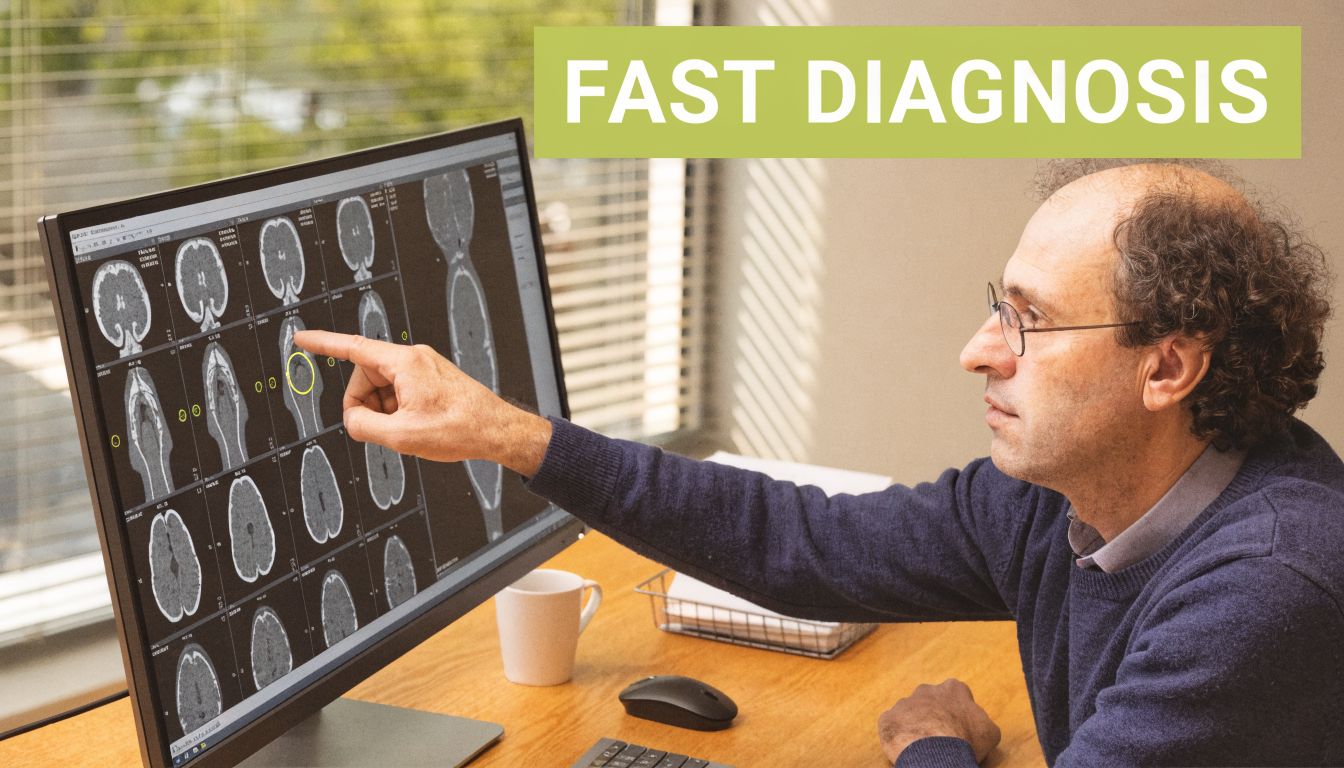
Clinical AI earned credibility first in areas where the data is dense and the workflow is repeatable. Imaging is the obvious example. Radiology, pathology, screening, and risk detection all generate the kind of structured information models can review at a scale no person can match.
Where AI has real clinical value
An AI system for diagnosis may reduce treatment costs by up to 50% and improve health outcomes by 40% by speeding detection and triage, and in breast cancer screening, deep learning models can train on over a million images, which gives them a scale advantage no human radiologist can reach, according to IBM's analysis of AI in healthcare.
That matters because many diagnostic failures are not dramatic mistakes. They're delays. A subtle finding gets buried in volume. A risky patient isn't flagged early enough. A clinician knows something is off but doesn't yet have enough signal to escalate.
Harvard Medical School also notes that AI can review large datasets quickly to identify patients at high risk of sepsis, which helps teams respond before deterioration becomes obvious. That is one of the clearest examples of AI helping medicine at the point where time matters most.
What works and what doesn't
What works is narrow, high-volume support:
- Image review support: AI can surface suspicious findings for clinician review in mammography, CT, X-ray, and ultrasound workflows.
- Risk flagging: Pattern detection helps identify patients who may need faster escalation, especially in sepsis-related monitoring.
- Triage support: Models can sort large queues so specialists spend more time on the cases most likely to need urgent attention.
- Second-pass review: AI is often useful as a backstop, not a replacement, for human interpretation.
What doesn't work is expecting a model to solve ambiguous clinical judgment on its own. If the presentation is messy, the chart is incomplete, or the care decision depends on context outside the data stream, human review still does the hard part.
Good clinical AI shortens the path to a decision. It doesn't remove the need for one.
That's why I'm skeptical of broad claims that AI will “replace diagnosis.” In practice, the strongest systems narrow uncertainty, speed prioritization, and lower the chance that something important gets missed in a busy queue. For practices evaluating tools in this area, it helps to look at clinical AI systems built around real care workflows rather than generic model demos.
The hidden advantage automating your administrative workflows
The most immediate AI advantage in healthcare is often not diagnostic. It's administrative.
That sounds less exciting, but it's where many organizations feel the payoff first. Appointment scheduling, patient intake, refill requests, call handling, documentation support, and prior auth preparation all sit in the high-volume zone where repetition is constant and small mistakes spread fast.
Why admin automation affects care quality
A 2024 narrative review describes AI as helping healthcare workers with administrative tasks, data analysis, and image interpretation, while lowering workload and helping reduce the likelihood of mistakes through decision support and real-time recommendations in guideline-based settings, as detailed in the peer-reviewed review on AI's role in healthcare practice.
That point is bigger than “saving time.” When staff aren't buried in repetitive work, they have more attention for the work only people can do well: calming a worried patient, catching a confusing medication history, spotting an inconsistency in a chart, or noticing that a follow-up never happened.
I think of this as a clinical quality multiplier. Not because AI makes every decision smarter, but because it lowers the background noise that causes human teams to miss things.
The adoption pattern tells the story
The physician perspective is already there. In an AMA survey, 69% of physicians said AI could improve work efficiency, and 56% believed it could improve care coordination and patient safety. The same body of literature also reports that 90% of healthcare organizations use AI for imaging and radiology, while 53% said AI use for clinical documentation was highly successful, according to the 2024 narrative review in the Journal of Medical Internet Research.
Those numbers line up with what we see in practice. Teams usually adopt AI where the work is repetitive, rules-based, and costly to handle manually.
Here's where admin AI tends to help first:
- Scheduling and rescheduling: Patients get answers faster, and staff don't spend all day playing phone tag.
- Intake and call capture: The system gathers the same core information every time, which reduces omissions and messy handoffs.
- Documentation support: Structured intake and note drafting reduce after-hours chart cleanup.
- Routine request handling: Refill queues, referral questions, and follow-up reminders stop clogging the front desk.
A lot of small practices understand this instinctively, even if they don't call it workflow engineering. If you want a plain-language view from outside healthcare, this guide to AI automation for small business is useful because it explains the basic operational logic without vendor jargon.
Small practices and large systems should calculate ROI differently
Small practices should start with labor pressure and missed demand. If calls are missed, forms are incomplete, and refill work spills into overtime, the ROI question is simple: which repetitive task wastes the most skilled staff time every day?
Large systems need a broader lens. They should look at queue variability, handoff failure, documentation consistency, and the cost of delay across departments. The right AI project might not save one salary. It might prevent thousands of tiny failures that create avoidable downstream work.
This is also where vendor selection matters. Some tools do one thing well and stop there. Others connect to the EHR, write back structured data, and support handoffs to staff when the workflow turns complex. Healthcare workflow automation tools built for medical practices are useful when they fit into the existing operating model instead of forcing teams to rebuild everything around the software.
Creating a better and more accessible patient journey
Patients don't experience your workflow map. They experience hold music, missed callbacks, confusing forms, and whether anyone gets back to them.
That's why one of the clearest ai advantages in healthcare is the patient-facing side of administrative AI. If a patient can schedule, confirm, ask a routine question, or complete intake without waiting for office hours, access improves right away.

What patients notice first
Most patients don't care whether a task was handled by AI or a staff member. They care that it was handled clearly and correctly.
A better journey usually starts with a few practical changes:
- Always-on access so patients can book or request help outside business hours.
- Clear routing so billing, scheduling, refill, and clinical questions don't land in the same pile.
- Consistent follow-up with reminders and next-step communication that is delivered.
- Reliable handoff to a person when the issue is sensitive, complex, or emotionally loaded.
That last point matters. Good healthcare AI doesn't trap people in a loop. It gets the easy parts done and hands off the hard parts fast.
Trust is part of access
There's also a deeper issue. In many underserved communities, healthcare distrust didn't begin with AI. It already existed.
Research on AI, health equity, and marginalized communities notes that trust has been historically hard to build even without AI, and it also shows that involving communities in design, including indigenous groups in telehealth development, makes technology more culturally appropriate, as discussed in this review on AI and trust in marginalized communities.
That finding has a practical implication for patient communication systems. If an AI voice or digital intake tool is transparent, respectful, easy to understand, and clear about when a human will step in, it can support trust rather than damage it. If it is opaque, rigid, or confusing, it does the opposite.
Access gets better when patients know what will happen next, who will respond, and how to reach a person if needed.
For practices serving diverse populations, multilingual support, plain language, and explicit human fallback are not nice extras. They are part of safe adoption.
From plan to practice how to implement AI successfully
Most failed AI rollouts don't fail because the model is weak. They fail because the workflow, ownership, and handoff rules were fuzzy from day one.
Start with one painful workflow
The smartest first move is narrow. Pick the task everyone complains about and map it in detail.
Good candidates include:
- Inbound scheduling volume: High frequency, repetitive logic, and obvious service impact.
- Patient intake collection: Useful if staff spend too much time chasing missing information.
- Refill request triage: Often a strong fit because the handoff rules can be defined clearly.
- Documentation support: Best when note quality is inconsistent and after-hours charting is common.
A peer-reviewed review notes that AI can help with administrative tasks, data analysis, and decision support while lowering workload and the likelihood of mistakes, and that implementation works best in areas with clear guidelines, including use cases such as sepsis or heart failure risk prediction. That same logic applies to operations. Start where the decision tree is visible.
Build around integration and human ownership
I'd use a simple implementation checklist:
| Area | What to verify |
|---|---|
| EHR fit | Can the tool read the data it needs and write back structured outputs cleanly? |
| HIPAA and security | Are access controls, audit trails, and data handling rules documented clearly? |
| Escalation logic | Does the system know when to stop and route to staff? |
| Staff workflow | Who owns exceptions, edits, and daily monitoring after go-live? |
Often, teams make a preventable mistake. They buy a tool because the demo looked smooth, but they don't define who handles edge cases. Then the AI becomes one more inbox to watch.
Train staff on failure paths, not just happy paths
A strong rollout prepares for the moments where automation should pause.
Staff need to know:
- what the AI can complete on its own
- what requires review
- how handoffs appear in the EHR or work queue
- who takes over when the patient is upset, confused, or medically complex
At Simbie AI, we've learned that adoption goes better when staff can see the system as a colleague with a limited job description, not a black box. For voice workflows especially, people trust the system more when they can inspect the transcript, review the captured data, and intervene easily.
Common AI challenges and how we solve them
Healthcare teams are right to be skeptical. AI can fail in ways that matter, and the risk is not only technical.
Bias, bad fit, and brittle outputs
If a model is trained on narrow or skewed data, it can perform unevenly across populations. That's not a theoretical concern. It's one reason broad claims about “human-level performance” usually don't hold up across real patient populations.
The fix is not blind trust in a vendor promise. It's ongoing review, careful scope, and choosing workflows where the system is making bounded decisions rather than open-ended judgment calls.
Security and privacy concerns
Patient communication systems touch sensitive data, so the security bar has to be high. Healthcare organizations need clear rules for storage, access, logging, and retention.
I don't think “HIPAA-compliant” is enough as a marketing phrase on its own. Teams should ask how data moves, where it lands, who can see it, and what happens during an exception or outage.
Job loss fears and clinician skepticism
Staff often worry that AI means replacement. In practice, good implementations shift work rather than erase it. The repetitive, draining tasks move first. Human staff still handle the nuanced conversations, exception management, and relationship-based parts of care.
That said, a bad rollout can feel threatening if leaders position AI only as labor reduction. The better framing is capacity and quality. What do you want your team doing less of, and what do you want them doing more of?
If you can't explain where the human takes over, you're not ready to deploy the workflow.
The practical guardrails that matter
The safest systems usually share a few traits:
- Narrow scope first: Start with one workflow, not ten.
- Clear human handoff: Define escalation triggers before launch.
- Visible monitoring: Supervisors should be able to review outputs and correct mistakes.
- Patient transparency: People should know when they're interacting with an AI system and how to reach staff.
Those aren't abstract principles. They're operating rules. If you skip them, even a technically strong model can fail in a real clinic.
Your first step toward AI integration
Don't start with a platform demo. Start with a one-hour workflow audit.
Pick one day from the last two weeks and trace where your team lost time. Look for missed calls, repeat data entry, refill delays, intake errors, prior auth backlog, or messages that bounced between departments. Then ask one simple question: which of these tasks is repetitive, high-volume, and painful enough that everyone would notice if it improved?
Write down one workflow, one owner, and one success condition. Keep it that small.
That's how most worthwhile healthcare AI projects begin. Not with a grand strategy deck. With one stubborn operational problem that keeps hurting patients and tiring out staff.
If your practice wants to start with voice-based automation for intake, scheduling, refills, or other front-desk workflows, Simbie AI is one option to evaluate. The useful next step is simple: map one workflow, bring your staff into the review, and test whether the tool fits your real day instead of a polished demo.