
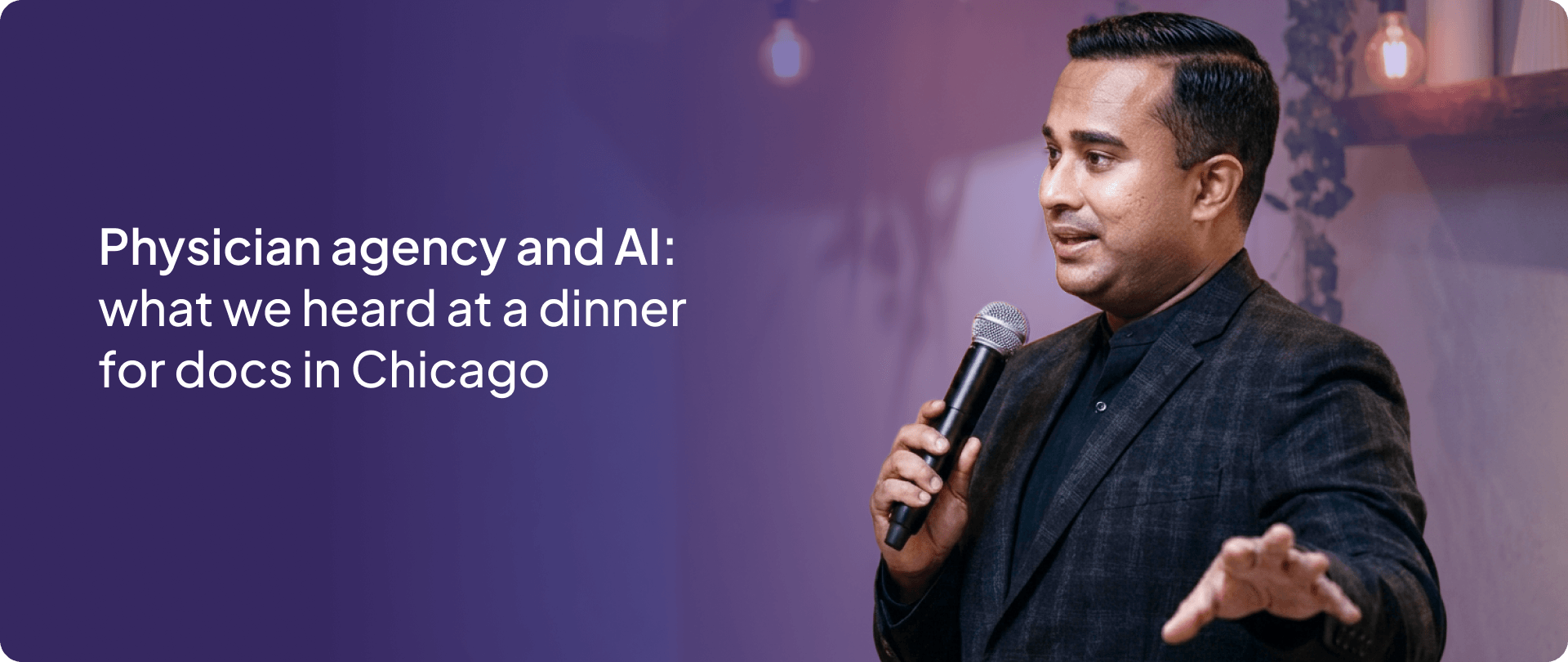
Last week we hosted a dinner for physicians in Chicago. Customers, mentors, friends. The topic on the table was “Physician Agency & AI,” and the conversation ran late into the night.
We have been to a lot of healthcare AI panels. This was not one of those. There was no roadmap slide, no demo theater. What there was instead was a room of practicing physicians talking candidly about how little say they have over the systems they work inside, and what it would take to change that.
That conversation is the reason Simbie exists, so it is worth writing down what we heard.
Why we started Simbie
Neha Khosla, MD, MSc and Rachel O’Driscoll built Simbie AI to elevate the voices of physicians and their patients, voices that have been slowly squeezed out of healthcare delivery and organizational decision-making for decades. It is also why the product is built by clinicians rather than for them.
That framing matters, because it sets a different bar than “make clinicians more efficient.” Efficiency is something done to a physician. Agency is something a physician holds. The difference shows up in who decides what gets automated, who owns the workflow, and who benefits when time is freed up.
It is hard to convey from the outside what physicians endure to get where they are, and how much they care. The cost is real, largely invisible, and mostly borne in silence, because doctors put patients first even when the structures around them keep asking for more and giving back less.
Fighting that is what powers the company forward.
The three questions that stayed with us
Neha came away from the evening with three questions raised by the physician leaders in the room. None of them are technology questions. All of them determine whether technology helps.
When did doctors start being treated like units, plugged in and out of large systems?
Somewhere along the way, clinical staffing became a capacity problem to be solved rather than a profession to be supported. Physicians in the room described being moved between sites, schedules, and service lines with the logic of load balancing, and very little of the logic of continuity, relationship, or craft.
How are you supposed to deliver excellent care with anxiety and little control over your schedule?
This one drew the most agreement. The quality of care a physician can give is bounded by the conditions they give it in. A schedule set by someone else, filled by someone else, and reshuffled without notice is not a neutral administrative detail. It is a direct input to clinical quality, and to whether a physician is still in practice five years from now.
How should medical education evolve so young doctors can shape policy, technology, and organizational decisions rather than only receive them?
Physicians are trained extensively in medicine and almost not at all in the systems that govern medicine. The result is a profession with enormous expertise and structurally little influence over budgets, staffing models, EHR selection, or the technology deployed around it. Several people in the room pointed out that this is a curriculum problem as much as a political one.
What agency looks like in practice
The abstraction becomes concrete quickly when a practice actually holds the controls.
Geogy Vennikandam, MD, CEO of GI Partners of Illinois, spoke at the dinner and wrote about it afterward. GI Partners is an independent, physician-led gastroenterology organization operating across multiple locations and satellite sites, and their standard for adopting technology is deliberately unglamorous: it should not be implemented because it is innovative, but because it solves a real problem for patients, physicians, and teams.
By his account, Simbie has changed how patients reach GI Partners. Their patients now have round-the-clock access to scheduling, Monday through Sunday, and across their sites the practice has handled thousands of calls and scheduled thousands of patients with, in his words, zero missed calls – every inbound call answered, at any hour.
The point he draws from it is the one worth carrying:
“Patients shouldn’t have to repeatedly call a physician’s office, sit on hold, or wait until the next business day simply to access care. Healthcare should meet patients where they are-and when they need us.”
For a growing independent practice, that is not a marginal improvement in phone metrics. Access is the front door. When it closes at 5pm, care gets deferred, patients go elsewhere, and the practice absorbs the loss twice, once in revenue and once in continuity.
How physicians should judge an AI vendor
Geogy set out a standard in his post that we would like to see adopted more widely:
“AI in healthcare shouldn’t just be impressive. It should be measurable. It should be impactful. And most importantly, it should make healthcare better for the patient.”
Most healthcare AI is currently sold on that first adjective. Demos are impressive. Pilots are impressive. What a practice can actually point to twelve months later, in numbers its own operations team believes, is a much shorter list.
We think this is the right filter for physicians evaluating any AI vendor, including us. Ask what it will change that you can count. Ask who on your staff has to change how they work for it to pay off. Ask what happens on the days it fails.
Agency, not replacement
The most common framing of AI in medicine is a contest: will it replace physicians, will it strip the human element out of care.
That framing keeps physicians in the passive seat, arguing about something being done to them. The more useful question is who holds the controls.
Watching doctors realize what Simbie’s voice AI agents can take off their plate – the routine and repetitive work that consumes a day without requiring a decade of training, from pre-visit intake to refill requests – is one of the most rewarding parts of this job. Not because the work disappears, but because the time comes back, and it goes where it should: to critical thinking, to shared decision-making, to the parts of care that only a physician can do.
That is the version of this technology worth building. Powerful tools in the hands of physicians and the organizations they lead, removing administrative friction, widening patient access, and returning time to clinical judgment.
What’s next
We are running more of these dinners. If you are a physician leader who wants to be in the room, we would like to hear from you. And if you want to see what this looks like against your own practice’s workflows, you can book a demo.
Neha closed the evening with the line we keep coming back to:
“Until there are docs in every Board room and every hall of Congress.”
Thanks to Geogy Vennikandam, MD and GI Partners of Illinois, and to every physician leader who joined us in Chicago.