
Picture your best front desk coordinator. Now, imagine they could work around the clock, never feel overwhelmed, and manage every single patient booking flawlessly. That’s the easiest way to think about AI scheduling in healthcare. It’s a smart system built to automate a clinic’s calendar, essentially acting as your tireless digital receptionist.
Your Clinic's New Front Desk Superpower
Unlike basic online booking pages that just display a list of open slots, AI scheduling is far more dynamic. It intelligently manages the entire appointment process—from the moment a patient reaches out to the final confirmation—all without a staff member having to lift a finger. This is a direct answer to some of the most persistent headaches in medical practice management.
We all know what the front desk shuffle looks like. Phones ring off the hook, patients get put on hold, and staff have to manually comb through different provider schedules to find an opening. It’s a recipe for administrative burnout and, frankly, a frustrating experience for patients. Some health systems even report that staff spend as much as 80% of call time just gathering information manually.
To give you a clearer picture, let's compare the old way with the new.
Manual Scheduling vs. AI-Powered Scheduling
| Feature | Traditional Manual Scheduling | AI-Powered Scheduling |
|---|---|---|
| Availability | Limited to office hours (e.g., 9 AM – 5 PM, Mon-Fri). | 24/7/365 access for patients via phone or web. |
| Patient Experience | Long hold times, phone tag, potential for human error. | Instant responses, no waiting, self-service booking anytime. |
| Staff Workload | High-volume, repetitive calls lead to burnout and less time for in-person patients. | Automates routine tasks, freeing staff for high-value interactions. |
| Appointment Management | Manual confirmation calls, difficult rescheduling process. | Automated reminders, one-click rescheduling, and smart backfilling of canceled slots. |
| Efficiency | Slow, labor-intensive, and prone to bottlenecks. | Handles dozens of requests simultaneously, increasing capacity and speed. |
This table shows a stark contrast. The move from manual to automated isn't just an upgrade; it's a fundamental change in how a practice operates.
The Shift From Manual to Automated
AI scheduling completely flips the script on that outdated workflow. It gives patients the power to book, change, or cancel their appointments whenever it's convenient for them, often just by talking to a sophisticated voice AI on the phone or using a simple online interface. That 24/7 availability is something a human-only front desk could never realistically provide.
The positive effects are felt almost immediately:
- No More Holding: The system can handle dozens of calls at once, so patients get their needs met without ever hearing, "Please hold."
- Happier Staff: By taking over the tedious booking tasks, AI lets your team step away from the phones and give their full attention to the patients right in front of them.
- Fewer Empty Chairs: Smart, automated reminders and simple rescheduling options drastically reduce no-shows—a major drain on revenue. Practices using these systems have seen call abandonment rates drop by 30% or more.
AI scheduling isn't about replacing your staff; it’s about giving them a superpower. It handles the monotonous work so your team can focus on what they do best: delivering exceptional, hands-on patient care.
This kind of technology is quickly becoming a cornerstone of modern, efficient medical practices. As you look at improving your clinic, it’s helpful to understand the range of practical AI solutions for healthcare that are making a real difference in both operations and patient outcomes.
In the end, it’s all about creating a better, smoother experience for everyone involved. For example, a complete AI front desk can not only book the appointment but also verify insurance and handle intake forms before a patient even walks through the door. This gets the administrative work out of the way early and sets a positive, professional tone for the entire patient visit.
How AI Automates and Optimizes Your Clinic Calendar

It’s easy to think of an AI scheduler as just a 24/7 digital receptionist, but that’s only scratching the surface. To really get it, you have to look under the hood. This isn't a simple chatbot following a script. It’s a sophisticated system that understands, predicts, and acts in real-time—like a master strategist for your clinic's most valuable asset: its time.
So, how does it all work? What we're really talking about are two core technologies working together: Natural Language Processing (NLP) and Machine Learning (ML).
Think of NLP as the system's ears and its ability to comprehend language. When a patient calls and says, “I need to book a follow-up with Dr. Smith for my knee sometime next Tuesday afternoon,” NLP is what deciphers the request, identifies the provider, and understands the patient’s desired timing.
Machine learning is the predictive brain of the operation. It constantly learns from your clinic’s data—past appointments, no-show patterns, cancellation reasons, and even the time of day—to make smarter decisions. This is what turns a basic booking tool into an engine that actively optimizes your entire schedule.
A Typical AI-Powered Booking, Step by Step
Let's see what this looks like in a real-world scenario. A patient, Sarah, calls your clinic to get an appointment.
Understanding the Request: An AI voice agent answers instantly—no hold music. Sarah says, "Hi, I need to see a doctor about a persistent cough." The system’s NLP immediately flags the key information: her intent ("see a doctor") and the reason ("persistent cough").
Checking the Calendar Intelligently: Because it's integrated with your EMR, the AI knows which providers handle respiratory issues and can see their real-time availability. It isn't just looking for any open spot; it’s looking for the right spot with the right provider.
Offering Smart Options: Instead of overwhelming Sarah with a long list of times, the AI offers a few of the best-fitting options. It might say, "Dr. Evans has an opening tomorrow at 10:30 AM or Thursday at 2:00 PM. Which works for you?"
Confirming and Finalizing: Sarah picks the Thursday slot. The AI confirms the details, books the appointment directly into the EMR, and instantly sends Sarah a confirmation text or email. All of this happens in about a minute, and no staff member was involved.
This simple interaction completely eliminates the phone tag and manual entry that bog down your front desk.
I like to think of the AI as a master Tetris player for your schedule. It doesn't just find empty spaces; it intelligently places each appointment to maximize efficiency, group similar visit types, and keep the day flowing smoothly for providers and patients.
This kind of automation isn't just a "nice-to-have" anymore. By 2026, many experts predict that AI-powered tools will handle the bulk of appointment booking, patient intake, and slot optimization. The market for these solutions is booming, projected to surpass $300 billion globally this year. More importantly, health systems are already seeing 3x to 4x efficiency gains for clinicians on back-office tasks, which makes a huge dent in administrative costs. You can read more on these projections in this 2026 AI trends report from industry experts.
Beyond Booking to True Optimization
But a truly intelligent system does more than just fill empty slots. It actively works to make your entire calendar more efficient and valuable. For a deeper dive into the mechanisms that make this happen, a great resource is the concept of an Agent Scheduler.
Here are a few ways it builds a smarter schedule:
- Backfilling Canceled Slots: A cancellation happens. Instead of that slot sitting empty, the AI instantly finds a patient on the waitlist who needs that exact appointment type and offers it to them automatically.
- Predicting No-Shows: The system analyzes a patient's history and other patterns to flag appointments that are at high risk for a no-show. It can then trigger an extra, personalized reminder to help ensure they make it.
- Clustering Appointments: It can intelligently group similar visit types together, like scheduling all new patient consultations in the morning. This lets clinicians get into a rhythm, minimizing context-switching and downtime.
By combining language comprehension with powerful predictive insights, these systems transform your schedule from a static grid into a dynamic, self-managing asset that directly boosts revenue and improves patient access.
The Measurable Benefits of Smart Appointment Management
The tech behind AI schedulers is impressive, but let's be honest—what really matters are the results you can see and measure. Bringing in an AI-driven system isn’t just about looking modern. It’s a serious business decision that pays for itself, affecting your bottom line, your staff's sanity, and your patients' loyalty.
The first and most dramatic change you'll notice is in your no-show rate. Those empty appointment slots are a constant drain on revenue, and the old-school method of manual confirmation calls just doesn't cut it anymore. AI scheduling tackles this problem head-on.
Using smart, automated reminders via text or voice, these systems make it dead simple for patients to confirm or reschedule. Some can even predict which patients are most likely to miss their appointment and give them an extra nudge. The result? Fewer empty chairs and less wasted time for your providers.
Slashing No-Shows and Recapturing Revenue
A high no-show rate isn't just an annoyance; it's a massive financial leak. In some healthcare systems, missed appointments can cost as much as $45,000 in lost revenue every single day. AI scheduling is a powerful way to plug that hole.
- Drastic Reductions: By automating confirmations and rescheduling, practices often see their no-show rates drop by as much as 30%.
- Proactive Backfilling: When a patient does cancel, the AI can instantly offer that opening to someone on the waitlist. This keeps your schedule full and ensures your providers' time is always put to good use.
- Improved Access: When it's easier for patients to book and manage their care, they are more likely to follow through. That means better health outcomes for them and healthier revenue for your practice.
These improvements aren't just theoretical. They directly convert lost opportunities back into billable services and a much stronger bottom line.
Driving Down Administrative Costs
The cost of running your front desk is about much more than just salaries. You have to account for the constant cycle of recruiting, hiring, and training staff in a role that’s known for high burnout. A huge part of your team's day is spent on the phone, handling repetitive booking and reminder calls.
AI scheduling takes these manual tasks off their plate, leading to big savings in your day-to-day operations. It's not about replacing your staff, but about making them more effective. A smaller, more focused team can handle complex patient issues and provide a better in-person experience because they aren't chained to the phones.
One of the most compelling results we see is the drop in administrative overhead. For example, Simbie AI has helped medical practices cut costs by up to 60% by automating routine scheduling and intake. This directly helps combat the high staff turnover that plagues so many clinics.
This shift allows you to move budget dollars away from administrative churn and toward roles that directly improve patient care and boost your staff's job satisfaction.
Boosting Patient Satisfaction and Access
In today's competitive market, the patient's experience can make or break your practice. Nobody likes being on hold forever or discovering they can only book an appointment between 9 and 5. In fact, studies show that a staggering 89% of patients have switched doctors simply because of a poor experience with things like scheduling.
AI schedulers completely remove these frustrations.
Key Patient-Centric Improvements:
- 24/7 Availability: Patients can book appointments whenever it works for them—late at night, on the weekend, or during a quick lunch break. They're no longer tied to your office hours.
- No More Holding: The system can handle dozens of calls or web requests at once, completely eliminating phone queues and making sure every patient gets an immediate response.
- Empowered Patients: Giving patients self-service tools gives them a feeling of control over their healthcare, which goes a long way toward building trust and loyalty.
By offering a smooth, modern, and accessible way to schedule, you don't just get better patient satisfaction scores—you also see more patients. A perfectly optimized calendar means you can increase patient throughput without burning out your providers, paving a clear path for practice growth.
Navigating the Real-World Hurdles of AI Scheduling
Let's be realistic. While the upside of AI scheduling is huge, you can't just flip a switch and expect everything to run perfectly. Bringing this kind of technology into a healthcare setting comes with its own set of challenges—from patient privacy to getting your own team on board. Successfully rolling this out means thinking through these issues from the very beginning.
First and foremost, we have to talk about security. Patient data is incredibly sensitive, and protecting it is non-negotiable. Any legitimate AI platform for healthcare is built with HIPAA compliance baked in from day one, using strong encryption to protect information whether it's being stored or sent.
A critical piece of this puzzle is the Business Associate Agreement (BAA). Any vendor you work with must sign one. This is a legally binding contract that holds them to the exact same privacy and security standards you follow. Think of it as your practice's legal assurance that your partner is just as committed to protecting patient health information (PHI) as you are.
Making Sure Accuracy and Safe Handoffs Are Guaranteed
Okay, so what happens when a patient has a complicated or urgent problem that a machine just can't parse? This is a fair and common question. The answer lies in having a rock-solid process for seamless human handoffs.
The point of AI isn't to replace your staff's clinical judgment—it’s to free them from repetitive tasks so they can use that judgment where it matters most. A well-designed AI knows what it doesn't know. It’s programmed to listen for trigger words like "chest pain" or "severe bleeding," or even just signs of confusion or distress in a patient's voice, and immediately route that call to a person.
Here’s a simple way to picture it:
- Routine Work: The AI takes care of about 90% of the daily grind—booking new appointments, handling cancellations, and answering basic questions.
- Complex Needs: The other 10%—the calls that require empathy, a clinical ear, or complex problem-solving—are seamlessly transferred to your staff, along with all the context the AI has already gathered.
This way, the AI acts as an intelligent front door, not a wall. It ensures that urgent needs get a human touch right away, while your team isn't drowning in a sea of simple, time-consuming calls.
The rapid rise of AI in healthcare has definitely had some growing pains. We've seen some organizations get ahead of themselves, using unvetted "shadow AI" tools to chase efficiency. This has rightly led to a push for stronger governance and integrated, compliant platforms. Looking ahead, experts see this evolving to give us real-time visibility into prior authorizations and even use historical data to accurately predict no-shows. For large health systems and telehealth providers, this means adopting scalable, HIPAA-compliant platforms that can automate intake 24/7, leading to the kinds of 60% administrative cost drops some have already experienced. You can get a deeper look at these AI governance trends in this analysis on Healthcare Dive.
Getting Your Team On Board
Finally, no technology will succeed if the people who have to use it every day don't buy in. Staff resistance is one of the biggest reasons new systems fail. If your team views this AI as a threat to their jobs or just another complicated tool to learn, you're going to have a tough time.
The key is to position the AI as a helpful new teammate, not a replacement. It’s a tool specifically designed to make their jobs less stressful and more focused on what they do best: care for patients.
A Few Tips for a Smooth Transition:
- Explain the "Why": Show your team exactly how this tool will cut down on endless phone calls and administrative busywork, giving them more time for meaningful patient interactions.
- Involve Them from the Start: Ask your front desk and clinical staff what their biggest scheduling headaches are. Then, show them precisely how the AI is going to solve those specific problems.
- Train, Train, Train: Make sure everyone is comfortable with the new system and knows exactly how the handoff process works. Confidence is key.
When your staff truly understands that the AI is there to help reduce their burnout and let them focus on patients, they'll go from being hesitant to being its biggest supporters. Tackling these compliance, accuracy, and human challenges is what turns a simple tech rollout into a strategic move that makes your entire practice stronger.
How AI Schedulers Fit Into Your Practice (Without Tearing It Apart)
Let's be honest: the thought of bringing in any new software can make a practice manager nervous. The last thing anyone wants is a tool that blows up the workflows you’ve spent years perfecting. A well-designed AI scheduler doesn't do that. It shouldn't force you to start over.
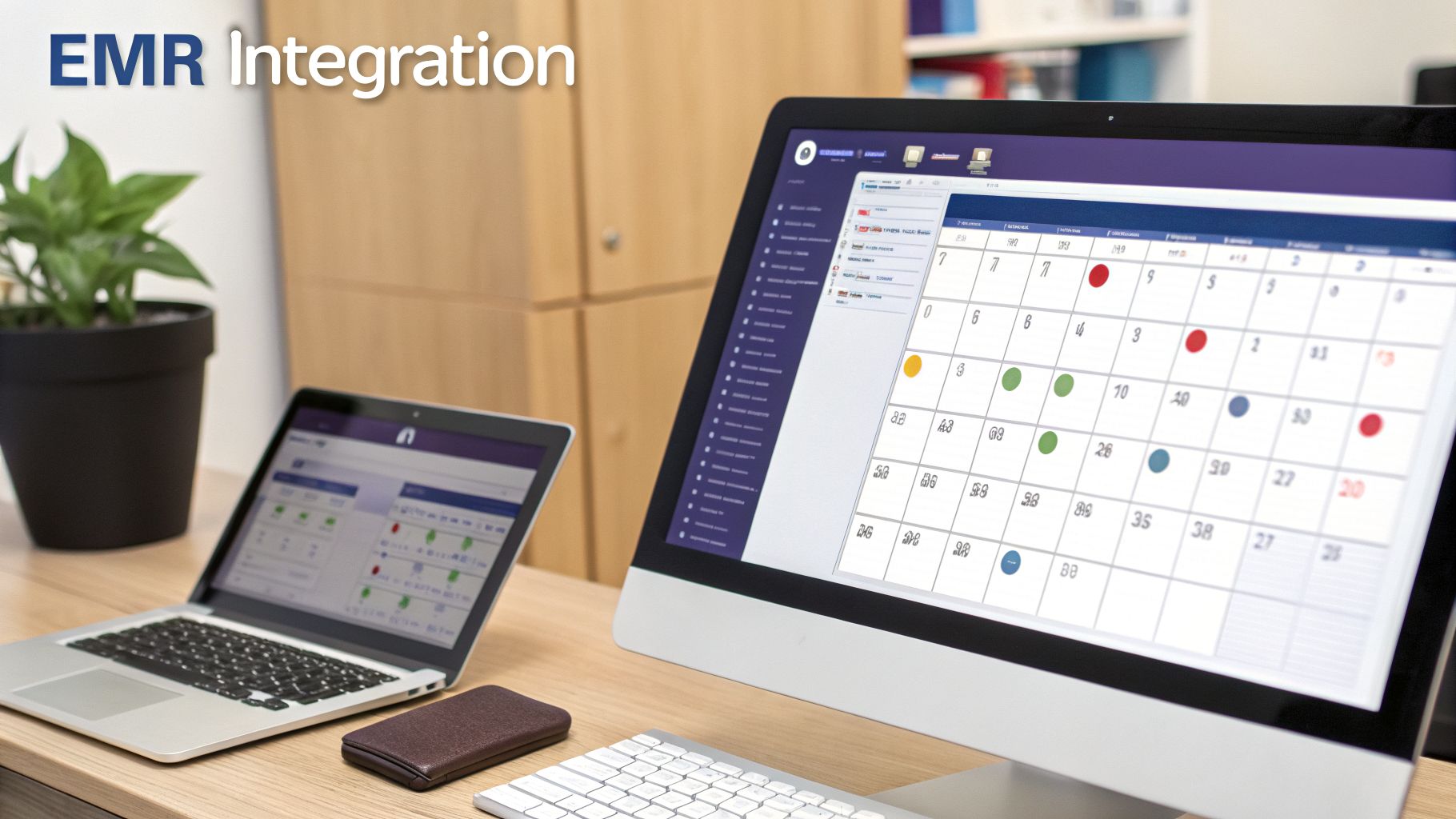
Instead, think of it as a smart layer that sits on top of the systems you already rely on, like your Electronic Medical Record (EMR) and Practice Management (PM) software. This connection is what makes the whole thing work.
Your EMR is the heart of your practice—it’s the official record for patient charts, provider schedules, and clinical notes. If an AI scheduler can’t talk to it, you’re just creating another data silo. That means your staff is stuck toggling between screens and manually copying information, which completely defeats the point of automation and opens the door to mistakes.
Why Two-Way Communication with Your EMR is a Must-Have
The secret sauce here is bidirectional data flow. It’s a fancy term for a simple concept: a two-way conversation between the AI and your EMR that happens automatically and in real time. This is what lets the scheduling process run on its own without a human babysitting it.
Here’s what that looks like day-to-day:
- The AI "reads" the schedule: A patient calls looking for a check-up. The AI instantly looks at your EMR to see Dr. Smith's real-time availability. It knows which appointment slots are open and what kind of visits they’re for.
- The AI "writes" the appointment: The patient picks a time. The AI immediately books that slot directly into the EMR calendar. It’s done. No one on your staff has to re-enter anything.
This constant back-and-forth prevents double-bookings and makes sure the schedule your team sees is always the most current version. It takes the tedious, repetitive task of updating calendars completely off their plate.
The goal isn't to replace your core systems. It's to make the AI a smart extension of what you already have. Deep integration gives the AI the context it needs to make good decisions, like checking a patient's history to see if they're due for a follow-up.
This level of connectivity is non-negotiable. An AI tool that can’t integrate deeply with your EMR will just end up creating more busywork for your team. If you're curious about the technical side, our guide on EMR integration strategies gets into the nuts and bolts.
The Real-World Benefits of a Connected System
When your AI scheduler and EMR are in sync, you'll see improvements that go way beyond just booking appointments. Your entire front desk operation becomes smarter and more efficient.
Here are the key advantages of a fully integrated setup:
- Fewer Human Errors: When the AI handles the data entry, you sidestep the typos and mistakes that lead to booking the wrong time or provider. Everything is accurate from the start.
- Smarter Scheduling: The AI can see a patient’s history and make helpful suggestions. For example, it might notice a patient is overdue for a wellness check and offer to book it for them.
- Faster Patient Check-In: By pulling insurance data directly from the EMR, the AI can help verify eligibility before the patient even walks in the door. This makes the whole intake process much smoother.
- One Source of Truth: Your EMR remains the official record. Every appointment, cancellation, and reschedule is logged there automatically, giving you a clear, auditable trail for every patient.
How to Implement AI Scheduling in Your Practice
Bringing an AI scheduler into your practice isn't like installing a new piece of software; it's a strategic move that will change how your front office operates. Thinking about it in a few clear, manageable phases makes the whole process feel less overwhelming and really sets your practice up for a win.
Here’s a practical game plan for getting it right, from the initial planning to seeing a real return on your investment.
Phase 1: Assess Your Practice's Needs
Before you even start looking at different AI tools, you need to get a firm grip on what’s happening in your practice right now. This isn't about guesswork. It's about collecting hard numbers so you can see exactly where the problems are and, later, prove that the new system is working.
Here’s what you need to measure:
- Call Volume: How many calls is your front desk actually fielding every day? What portion of those are just for booking, canceling, or rescheduling appointments?
- Staff Workload: How much of your team's day is spent on the phone? Compare that to the time they spend on higher-value work, like helping patients who are physically in the clinic.
- No-Show Rate: You have to know your current no-show percentage. This is a direct hit to your revenue, and it’s one of the first things AI scheduling can help fix.
- Hold Times and Abandoned Calls: Start tracking how long patients wait on hold and, just as important, how many just give up. A high abandonment rate—some practices see 7% or more—is a flashing red light that your patients are getting frustrated.
This data gives you a solid "before" picture to compare with your "after" results.
Phase 2: Choose the Right AI Partner
Once you know your pain points, you can start looking for an AI partner. This is a critical step, because not all scheduling platforms are built the same. You're looking for a solution that slots neatly into your existing workflow, not one that makes you overhaul everything you do.
When you talk to vendors, get straight to the point with these kinds of questions:
- How does your system connect with our specific EMR?
- What's involved in customizing the call scripts and workflows for our practice?
- Can you walk me through your security and HIPAA compliance protocols?
- What kind of training and long-term support do you offer our staff?
A real partner won’t just sell you software. They’ll dig in to understand your practice's specific challenges and show you exactly how they’ve helped similar clinics get tangible results, like cutting down on administrative busywork.
For example, if you want to do more than just book appointments, look into a comprehensive medical appointment scheduling software that can also manage patient intake forms and send out automated reminders.
Phase 3: Manage the Onboarding Process
This is where the rubber meets the road. A good partner will have a clear onboarding plan, but your team's involvement is what will make or break the transition. This phase usually covers migrating data, setting up your custom workflows, and, most importantly, training your staff.
Staff training is absolutely essential. Your team has to feel comfortable with the new system. Show them how the AI will take the repetitive, simple calls off their plate, freeing them up to focus on the patients who need their attention the most.
Phase 4: Measure Your Success
Once your AI scheduler is live, it’s time to go back to the numbers you gathered in Phase 1. Now you can track your key performance indicators (KPIs) and see the actual value it's delivering.
Keep an eye on these key metrics for improvement:
- A sharp drop in patient hold times and the number of abandoned calls.
- A clear, measurable decrease in your no-show rate.
- A reduction in administrative overhead and staff hours spent on scheduling.
- Positive comments from patients who appreciate the new, faster way to book.
Watching these numbers change over time gives you undeniable proof of your ROI and helps you spot new opportunities to make your practice even more efficient.
Frequently Asked Questions About AI Scheduling
Bringing any new technology into a healthcare practice is a big decision, and it’s only natural to have questions. Practice managers, in particular, always want to know how a tool will work in the real world before they even consider it. Let's walk through some of the most common questions we hear about using AI for scheduling.
Is AI Scheduling Secure and HIPAA Compliant?
Absolutely, but this hinges on choosing the right vendor. Any AI scheduling platform worth its salt is built with HIPAA compliance as a core principle, not an afterthought. This means every piece of patient information—from a name and phone number to the reason for their visit—is secured with robust encryption, both when it's being stored and when it's being transmitted.
Think of it this way: your vendor is an extension of your practice. That's why a Business Associate Agreement (BAA) is non-negotiable. Any reputable AI provider will sign a BAA, which is a legal contract binding them to protect your patients' health information just as carefully as you do. If a vendor won't sign one, that's a major red flag.
Can an AI Handle Complex Scheduling Requests?
Yes, but it's also smart enough to know its own limitations. A well-trained AI scheduler can handle the vast majority of routine calls—booking an annual physical, rescheduling a follow-up, or canceling an appointment—without a hitch. But what happens when a call is more complicated or urgent?
That's where a clear handoff protocol comes in. The system is designed to escalate to a human staff member immediately in certain situations.
- Trigger Words: The AI is trained to recognize keywords that signal an emergency, like "chest pain" or "trouble breathing."
- Signs of Distress: It can also pick up on cues like frustration or confusion in a person's tone of voice.
- Seamless Handoff: The moment it detects an issue, the AI instantly transfers the call to a live person. It even provides your staff with the context of the conversation, so the patient doesn't have to start over from the beginning.
The whole point is to let the AI manage the predictable work, freeing up your team to focus their expertise on patients who truly need a human touch.
What Is the Typical ROI for AI Scheduling?
The return on investment usually shows up in three main places: direct cost savings, recaptured revenue, and a huge boost in staff efficiency. The exact numbers will depend on your practice's size and call volume, but the financial impact is almost always significant.
One of the biggest drivers we see is the reduction in overhead. For example, some practices have cut their phone-related administrative costs by as much as 60%. This isn't just about saving money; it's a powerful way to combat staff burnout and reduce turnover.
Here’s where those returns come from:
- Fewer No-Shows: Automated, interactive reminders make it easy for patients to confirm or reschedule, which can slash no-show rates by up to 30%. That’s pure revenue back in your pocket.
- Lower Front Desk Costs: When an AI is handling hundreds of calls a day, you can operate a much leaner and more focused front desk.
- More Appointments Booked: A 24/7 scheduler captures appointments you'd otherwise miss overnight or during busy periods, helping you fill the calendar and maximize your providers' time.
Will Patients Be Comfortable Talking to an AI?
This is a common concern, but we’ve found that patient acceptance is surprisingly high, especially when the experience is a good one. Modern conversational AI doesn't sound like a clunky robot from a sci-fi movie; it's designed to be natural, friendly, and incredibly efficient. Most patients just want their problem solved quickly. When they realize they can book an appointment in less than a minute without ever being put on hold, they're thrilled.
In fact, considering that 89% of patients report they would switch doctors over a poor phone experience, offering an instant and effective solution is a fantastic way to improve patient satisfaction and keep them loyal to your practice.
Ready to see how a clinically-trained voice AI can transform your practice's efficiency and patient experience? Simbie AI automates scheduling, intake, and more, allowing your staff to focus on what matters most—delivering exceptional care. Discover the benefits at Simbie.ai.