
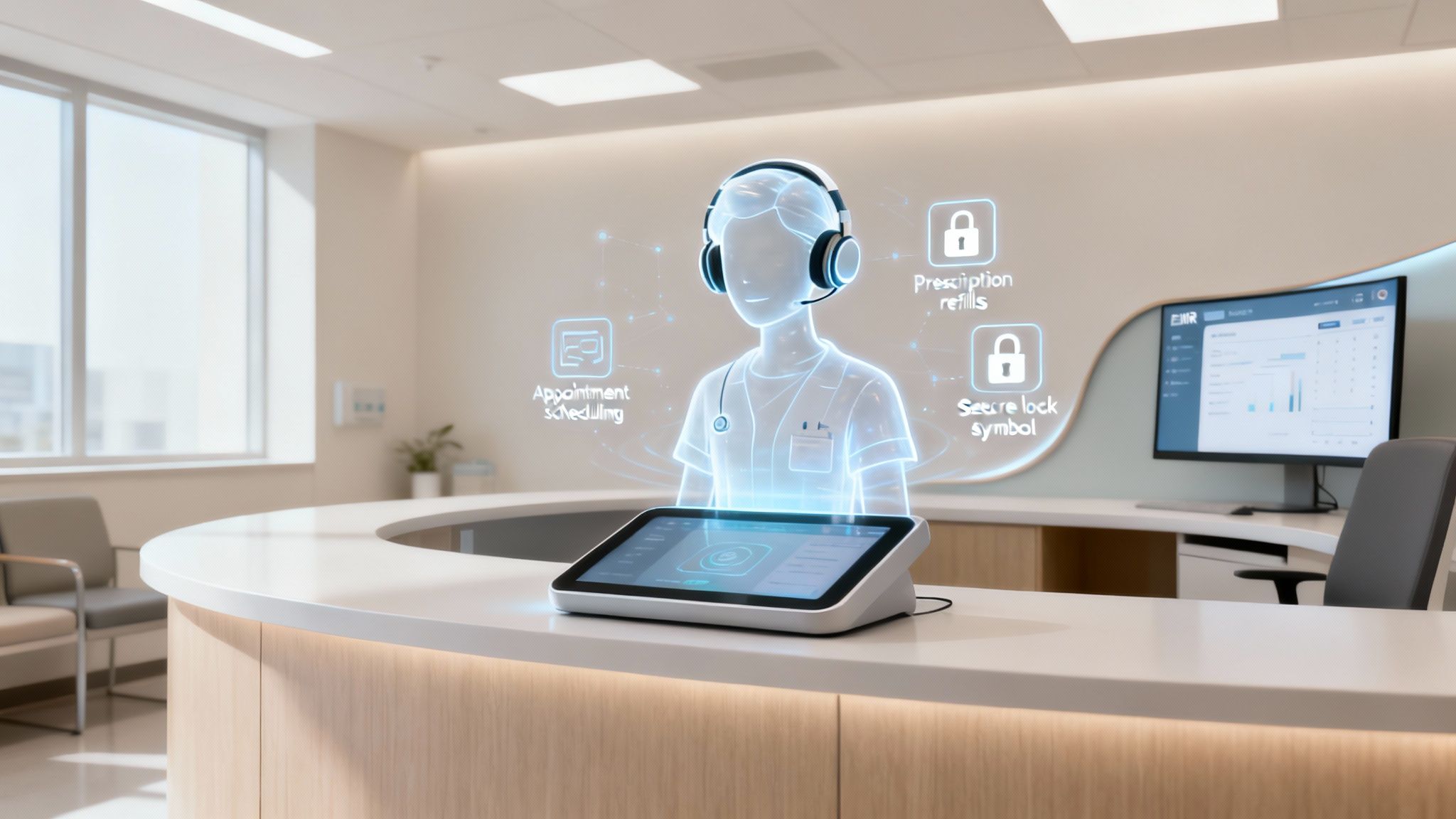
Think about your front desk. Phones ringing off the hook, staff juggling check-ins, and patients waiting on hold. It’s a familiar scene in almost every medical practice. Now, what if you had a team member who could answer every single call instantly, 24/7, without ever getting flustered?
That’s essentially what a virtual medical receptionist is. It's not just another answering service that takes a message; it’s a smart, AI-powered system built specifically for healthcare. It handles the routine, predictable tasks that clog up your phone lines, from scheduling appointments to answering basic questions.
What Is a Virtual Medical Receptionist?
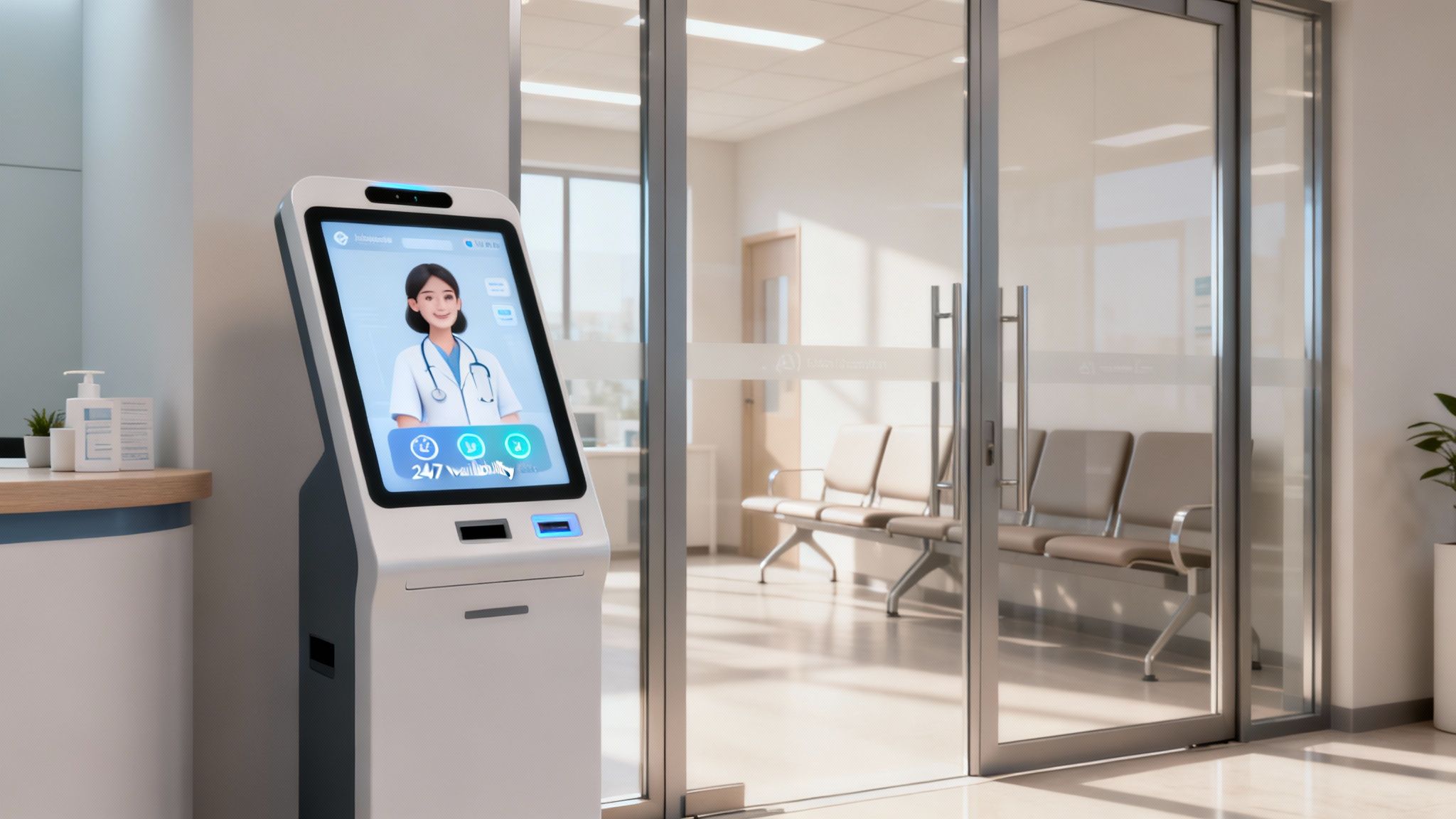
Picture a digital front door for your practice—one that never closes, never puts a patient on hold, and can handle hundreds of conversations at once. That's the best way to understand a virtual medical receptionist. It’s a specialized AI that understands patient needs over the phone and acts on them immediately.
Unlike a traditional answering service that just jots down messages for a callback, a virtual receptionist actually solves the patient's problem right then and there. It can book, reschedule, or cancel appointments directly in your EMR, handle prescription refill requests, and answer common questions about office hours or directions.
This isn't about replacing your team. It's about giving them backup. The goal is to take the high volume of repetitive calls off their plate so they can focus on the patients standing right in front of them and handle more complex issues that require a human touch.
The Technology Behind the Voice
So, how does it work? At its core, a virtual medical receptionist runs on advanced voice AI and Natural Language Processing (NLP). This is the tech that allows it to understand how real people talk—including different accents, informal phrasing, and unique requests.
When a patient calls, the AI springs into action:
- It figures out what the patient wants. Is it a new appointment? A refill request? Just a quick question about insurance? The AI is trained to recognize a wide range of patient intents, even when they don't use specific keywords.
- It connects to your systems. The AI securely talks to your practice management software to check a doctor’s calendar or pull up relevant patient info. This seamless integration is what allows for real-time task completion, not just message-taking.
- It gets the job done. It confirms the appointment, sends the refill request to the clinical team, or provides the information—all in a single, quick conversation. This immediate resolution dramatically improves the patient experience and reduces administrative follow-up.
This kind of automation is quickly becoming essential. The market for virtual receptionists hit $3.85 billion globally and is expected to reach $9 billion by 2033, growing at a rate of 9.8% each year. That's not just a trend; it's a clear signal that practices are actively looking for smarter, more efficient ways to manage their front-desk operations. This growth reflects the increasing pressure on healthcare providers to enhance efficiency while managing rising operational costs.
More Than Just a Chatbot
It's easy to confuse this with a simple chatbot, but they're worlds apart. A basic chatbot follows a rigid script and often hits a dead end, frustrating the caller with responses like "I'm sorry, I don't understand." A true AI-powered receptionist, on the other hand, can hold a dynamic, two-way conversation that feels natural and adaptive. It can ask clarifying questions, understand context, and handle multi-step requests.
A virtual medical receptionist acts as a force multiplier for your front desk. It doesn't just answer the phone—it resolves patient needs on the first call, creating a seamless experience while reducing administrative burdens on your staff.
This ability to resolve issues on the spot is what makes all the difference. By taking care of the bulk of routine calls, it ensures your human staff are free for the high-empathy, complex conversations where they're needed most. To see how this technology fits into the bigger picture, you can explore the wider role of a virtual assistant in healthcare. It's all about empowering your practice to run more smoothly, keep patients happy, and build a more resilient front desk capable of handling fluctuating call volumes without stress.
Human vs. Answering Service vs. Virtual Medical Receptionist
To put things in perspective, let’s break down how these three options stack up against each other. Each serves a purpose, but their capabilities and costs vary significantly. Understanding these differences is key to choosing the right solution for your practice's specific needs.
| Feature | Human Receptionist | Traditional Answering Service | AI Virtual Medical Receptionist |
|---|---|---|---|
| Availability | Business Hours | Typically 24/7 | Always-on, 24/7/365 |
| Primary Function | Comprehensive patient management | Message taking, call forwarding | Real-time task resolution |
| Appointment Scheduling | Yes, but limited by availability | No, takes a message | Yes, directly in EMR |
| Cost | $35k-$50k+ per year (salary & benefits) | $200-$2,000+ per month | $500-$3,000+ per month |
| Scalability | Low (1 call at a time) | Moderate | High (unlimited concurrent calls) |
| Patient Experience | High-touch, personal | Impersonal, delayed resolution | Instant, consistent, efficient |
| HIPAA Compliance | Requires ongoing training | Varies, BAA required | Built-in, BAA provided |
As you can see, the AI virtual receptionist fills a crucial gap—offering the 24/7 availability of an answering service but with the task-completion power of an in-house team member, all at a scalable cost. This hybrid model provides both efficiency and accessibility, which is a powerful combination in modern healthcare.
How a Virtual Receptionist Actually Changes Your Front Desk

Don’t think of a virtual medical receptionist as just another piece of software. It’s better to see it as a new, highly efficient member of your front-desk team—one that takes on all the repetitive, high-volume jobs that tie up your staff. The difference? It handles every task with perfect consistency and speed, 24/7.
Here’s a real-world example. A patient, let's call her Sarah, calls your practice after hours with a question. Instead of hitting a voicemail and waiting for a callback, she's greeted by the virtual receptionist. It understands she wants to book a follow-up, instantly checks the doctor's live schedule, finds a time that works for her, and books it right into your EMR. It then sends a confirmation text message to Sarah, completing the entire interaction in under two minutes.
That one simple interaction gets to the heart of what this technology does: it resolves patient needs on the first try. No phone tag, no waiting, no added work for your team the next morning.
Intelligent Appointment and Schedule Management
The most immediate change you'll notice is how it takes control of your schedule. And we're talking about much more than just simple booking. A sophisticated virtual receptionist becomes a true steward of your practice's calendar.
- Complex Scheduling Logic: You can teach it your clinic's specific rules. For instance, it can learn to always book new patient consultations for 30-minute slots and routine check-ups for 15 minutes. It can also understand provider-specific preferences, such as blocking out the last hour of the day for administrative work or only scheduling certain procedures on specific days of the week. This simple logic prevents a ton of common scheduling errors.
- EMR Integration: The whole system talks directly to your Electronic Medical Records (EMR), so the schedule is always live and accurate. This completely gets rid of the double-booking nightmares that happen when you use a separate, disconnected answering service. It ensures that both the AI and your human staff are working from a single source of truth.
- Cancellations and Rescheduling: Patients can call anytime to cancel or move an appointment. The AI handles the request, immediately opens that slot on the calendar for someone else, and offers the patient new times—all without anyone on your team lifting a finger. It can even be configured to automatically offer the newly opened slot to patients on a waitlist.
This level of automation turns your calendar into a self-managing tool that fills itself, adapts on the fly, and keeps empty slots to a minimum, which has a direct and positive impact on your practice's revenue.
Automating Routine Administrative Workflows
Beyond scheduling, a virtual receptionist is a workhorse for all those other small but essential administrative tasks that collectively consume hours of your staff's day.
Think of it as a digital filter for your front desk. It catches and resolves the most common, simple requests, which frees up your human staff to focus on patients who have more complex needs. This isn't just a nice-to-have; it's quickly becoming a must-have in modern healthcare.
The market for healthcare chatbots—the category a virtual receptionist falls into—has already blown past the $1 billion mark. With a projected growth of 26.2% a year, it's on track to top $10 billion in the next decade. This shows just how fast practices are turning to these AI tools to become more efficient.
Here’s a look at the other workflows it can take off your plate:
- Prescription Refill Requests: A patient calls and says they need a refill. The AI identifies them, confirms the medication and pharmacy details, checks their last prescription, and queues the request in the EMR for a doctor to approve. Done.
- Prior Authorization Intake: It can kick off the prior authorization process by gathering the basic info from the patient—insurance details, reason for the request, referring provider information—and logging it for your billing team.
- Patient Registration and Intake: For new patients, the AI can handle the initial registration over the phone, collecting demographic information, insurance details, and primary health concerns, saving significant time during their first visit.
- Answering Common Questions: It can instantly answer all those FAQs like, "What are your office hours?", "Are you accepting new patients?", or "Where's the best place to park?". This alone deflects a huge number of inbound calls.
By taking over these high-frequency, low-complexity tasks, a virtual receptionist lets your skilled staff focus on what they do best: managing in-person patient needs, sorting out tricky insurance questions, and providing the human empathy that technology can't.
To really get the full picture, it helps to look at the broader future trends in business automation and see how they are reshaping entire industries. This isn't just a gadget for answering phones; it's a fundamental shift in how you can run your front desk for peak efficiency and patient happiness. By embracing it, you give your practice the power to do more with less, creating a better experience for everyone involved.
The Real-World Impact on Your Patients and Staff
Bringing a virtual medical receptionist on board is more than just a tech upgrade—it's a fundamental shift in how your practice operates. The benefits ripple out, touching two critical areas: how efficiently your practice runs and the quality of the experience you provide to your patients.
By automating those first few steps of patient communication, you free up incredible amounts of time and energy. At the same time, patients get the quick, reliable service they want, which goes a long way in building trust. Let's dig into what this actually looks like day-to-day.
A Shot in the Arm for Your Operational Efficiency
The constant drumbeat of administrative tasks can easily overwhelm even the best front-desk team. A virtual medical receptionist acts as a force multiplier, taking on the repetitive work that leads to bottlenecks and staff burnout.
The impact is felt almost immediately. Your practice can suddenly manage a much higher volume of calls and requests without needing to hire more people. Your front desk transforms from a constant juggle to a smooth, efficient hub.
Here are the key operational wins you'll see:
- Slash Your Administrative Burden: Just think about how much time your staff spends answering the same basic questions all day. The virtual receptionist handles all those FAQs—office hours, directions, insurance questions—instantly. This frees up your team to focus on more complex work, like tricky billing issues or giving in-person patients their full attention.
- Drastically Reduce No-Shows: Every missed appointment is a hit to your bottom line. By sending out friendly, conversational reminders by phone or text, the AI makes sure patients remember to show up. Better yet, it can offer to reschedule them right then and there, helping you keep your schedule packed. Many practices see a 30-50% reduction in their no-show rate after implementation.
- Capture Every Single Call: A busy signal or a trip to voicemail is a missed opportunity. A virtual medical receptionist can handle hundreds of calls simultaneously, meaning every patient gets an answer right away, 24/7/365. You'll never lose a potential new patient to a competitor just because your phone lines were swamped. This directly translates to increased patient acquisition and revenue.
There's a reason this market is exploding. The global healthcare virtual assistants market was recently valued at around USD 1.41 billion. It’s expected to climb to an incredible USD 19.2 billion within the next ten years, all because practices are recognizing the urgent need for smarter patient communication. You can explore more data on this rapid market expansion to see what's driving this change.
A Better, More Human Patient Experience
A patient's experience doesn't start when they see the doctor. It starts with that very first phone call. A clunky, frustrating front-desk experience can sour their opinion of your practice before they even walk through the door.
A virtual receptionist turns that first touchpoint into a smooth, positive one. It gives patients the instant answers and self-service tools they’re used to getting from every other modern service.
By providing immediate answers and 24/7 access, a virtual medical receptionist meets patients where they are. This convenience doesn't just improve satisfaction; it builds the kind of loyalty that keeps patients engaged with your practice for the long term.
Here’s how patients feel the difference:
- 24/7 Accessibility: Health issues don’t follow a 9-to-5 schedule. A worried parent can book an appointment for their sick child at 10 PM without having to wait until morning. That kind of round-the-clock access provides incredible peace of mind and demonstrates a commitment to patient convenience.
- Instant, Reliable Answers: Patients get the information they need on the first try, without being put on hold or passed from person to person. The answers are always right and always consistent, which builds their confidence in your practice. This reliability removes a major point of friction in the patient journey.
- A More Focused Staff for Better In-Person Care: When your team isn't chained to the phone answering repetitive questions, they can give their full attention to the patients standing right in front of them. This means shorter check-in lines, more helpful conversations, and a calmer, less stressful clinic for everyone. The result is a happier team and a noticeable drop in staff burnout.
Integrating with Your EMR and Ensuring Compliance
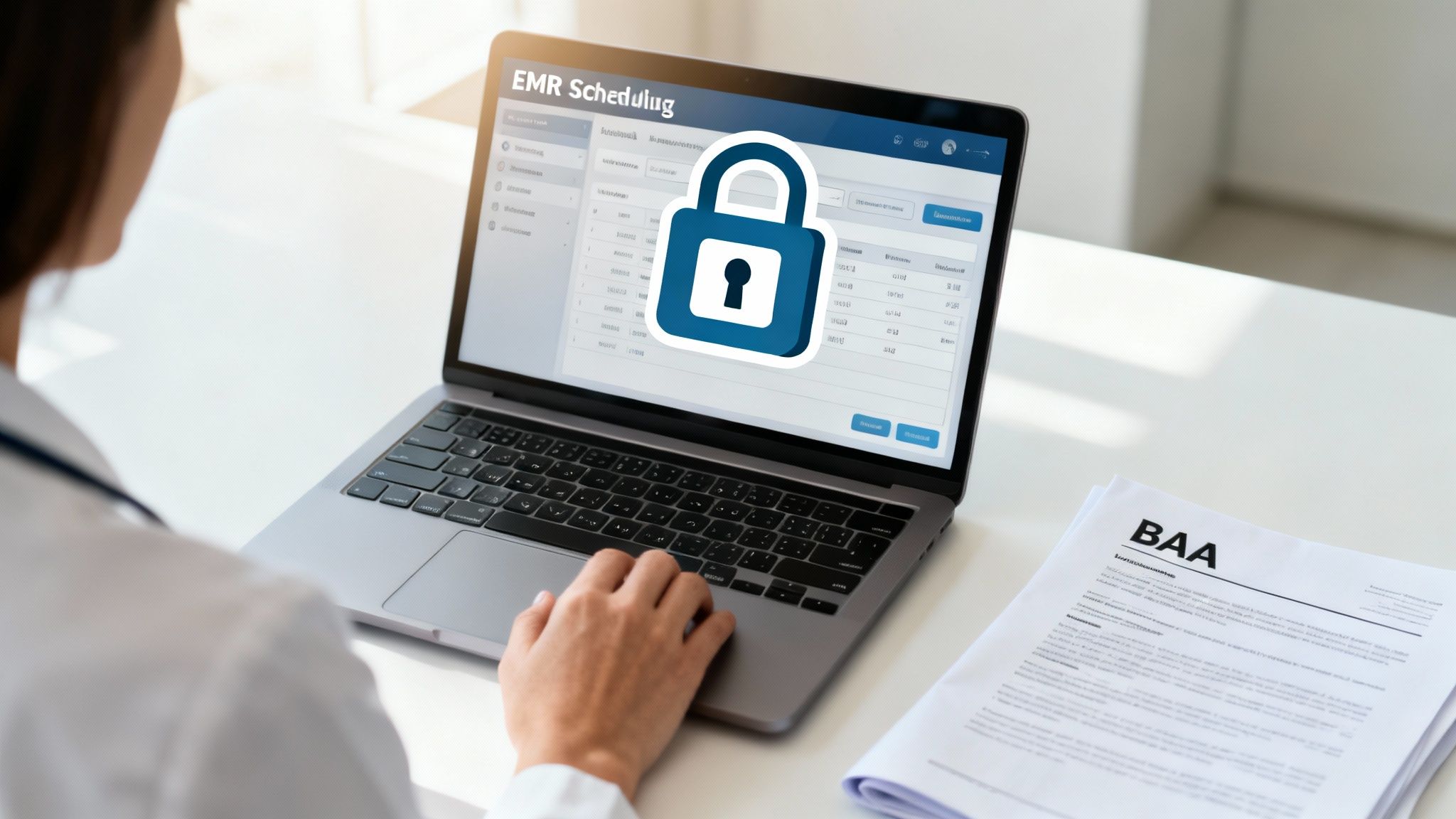
When you're thinking about bringing any new tool into a medical practice, two questions always jump to the front of the line. First, will it actually work with our current systems? And second, is it secure? These aren't just minor details—they're the absolute deal-breakers when considering a virtual medical receptionist.
This technology can't operate in a vacuum. It has to become a trusted, integrated part of your daily workflow. Let’s break down how it connects with your EMR and, just as crucially, how it keeps patient data locked down and safe.
Building a Secure Bridge to Your EMR
Think of the connection between a virtual receptionist and your EMR as a secure digital bridge. It’s not just about pushing data from one place to another; it's about making sure that transfer happens safely and instantly. When a patient uses the AI to book an appointment, that information should travel across the bridge and write itself directly into your practice’s schedule.
That seamless flow is what makes the whole thing work. It’s how you eliminate double-bookings and kill the need for manual data entry. Any virtual receptionist worth its salt has to integrate with a wide range of EMR platforms, from the big household names to more specialized systems. Without that direct link, you've just got a fancy answering service that ends up creating more work for your team. You can find out more about the nuts and bolts of what a proper EMR system integration looks like. The integration should be bi-directional, meaning the AI can both read the EMR for availability and write back new appointments, cancellations, or patient notes.
Non-Negotiable Security and HIPAA Compliance
In healthcare, data security isn’t just a good idea—it’s the law. A virtual medical receptionist is handling Protected Health Information (PHI) from the moment it answers the phone, which means it absolutely must be compliant with the Health Insurance Portability and Accountability Act (HIPAA).
This is where you really need to vet a provider. Simply saying "we're HIPAA compliant" on a website isn't good enough. Any legitimate partner must provide a Business Associate Agreement (BAA). This is a legally binding contract that spells out exactly how they’ll protect your patient data, what security measures are in place, and who is on the hook if a breach ever occurs.
A Business Associate Agreement is your practice's legal assurance that a third-party vendor is just as committed to protecting patient privacy as you are. Never partner with a vendor that cannot or will not sign a BAA.
The BAA is your first line of defense, but it’s the security features behind it that truly matter. It's more important than ever to know how to enhance network security in healthcare when adding any new digital tools to your practice. This includes understanding the vendor's disaster recovery plans and data backup policies.
Core Security Features to Demand
When you're evaluating a virtual receptionist, look for a layered approach to security. You want to see that data is protected from the second a patient calls until their information is safely tucked away in your EMR.
Here are the non-negotiables every provider must offer:
- End-to-End Encryption: All data, whether it's moving over phone lines or sitting on a server, has to be encrypted. This essentially scrambles the information, making it completely unreadable to anyone without the right key. This applies to both data in transit (during the call) and data at rest (stored on servers).
- Secure Data Handling Protocols: The vendor should have strict, documented rules for how its own team handles data. Access should be on a need-to-know basis, limited only to staff who require it for essential maintenance or support. Role-based access control is a critical component of this.
- Regular Security Audits: The best partners are constantly trying to break their own systems to find weaknesses. Ask to see the results from independent, third-party security audits that prove their defenses are up to snuff. Certifications like SOC 2 are a strong indicator of a commitment to security.
At the end of the day, a trustworthy virtual medical receptionist is built with privacy at its very foundation, not as an afterthought. By insisting on deep EMR integration and demanding robust, BAA-backed security, you can bring this technology into your practice with confidence, knowing both your workflow and your patients are protected.
Your Guide to a Smooth Implementation

Bringing new technology into a medical practice can feel daunting. But rolling out a virtual medical receptionist doesn't have to be a headache. With a clear plan, it's a completely manageable process.
The secret is to treat it less like a tech project and more like a people project. It's all about managing change and communicating clearly. With the right approach, you can introduce this powerful tool so smoothly that your team and patients are on board from day one. Let's break it down into a few simple phases.
Phase 1: Laying the Groundwork
Before you even think about looking at vendors, the most critical work happens inside your own practice. You have to start by defining what success looks like for you. Are you trying to slash patient hold times? Maybe you need to stop missing after-hours appointment requests or get the endless prescription refill calls off your staff's plate.
Pinpointing these specific goals will be your North Star for every decision you make later on. It’s also the right time to pull together a small implementation team. A practice manager, a lead receptionist, and someone from the clinical side make a great trio. This group will act as champions for the project, making sure every department’s needs are heard.
With your goals set, take the time to map out how your front desk currently operates. How are calls answered? How do you schedule appointments? How are messages passed along? This "workflow map" is essential for configuring your virtual medical receptionist to fit your practice like a glove. Identify the highest-volume, most repetitive call types—these are the perfect candidates to automate first.
Phase 2: Choosing and Training Your AI Partner
Now it’s time to find the right technology partner. They aren't all created equal, so you’ll want to do your homework. Having a solid plan makes this much easier. For a really detailed walkthrough, this step-by-step guide to implement AI voice agents is a fantastic resource.
Be sure to look for a vendor that lives and breathes healthcare. They absolutely must provide a signed Business Associate Agreement (BAA) to ensure HIPAA compliance—that’s non-negotiable. When you’re watching demos, use your workflow map to ask very specific questions. You want to see exactly how the AI will handle the real-world calls your practice gets every day. Ask about their support model and what kind of ongoing optimization they provide.
The most successful rollouts happen when the virtual receptionist is introduced as a powerful new assistant for your staff, not a replacement. This simple shift in framing is the key to getting your whole team excited.
Once you’ve picked a provider, the real fun begins: configuration. This is where you customize the AI’s voice, script, and logic. You'll work closely with your vendor to "teach" it your scheduling rules and call routing preferences, turning it into a true digital extension of your team. This process should be collaborative, ensuring the final product reflects your practice's unique character.
Phase 3: Getting Your People Ready
With the tech side sorted, the focus swings back to the human element. Getting your staff on board isn't just a nice-to-have; it's the most important step for a seamless transition.
Here’s a simple checklist for preparing your team:
- Explain the "Why": Host a team meeting to walk them through the benefits. Don't just talk about the practice—talk about them. Emphasize how this tool will cut down on their repetitive tasks and free them up to focus on the patients standing right in front of them.
- Get Their Hands Dirty: Training is key. Let your front-desk staff make test calls, listen to recordings, and learn how to check the AI's activity log. Make sure they know how to jump into a call if they ever need to. Confidence is built through practice.
- Create Clear Rules of Engagement: Put together a simple one-page guide that clearly outlines when a call gets handed off from the AI to a person. When there’s no guesswork, people feel secure. This should include protocols for urgent calls, complex insurance queries, and any other situation that requires a human touch.
Finally, let your patients know what’s coming. A friendly notice on your website, a small sign at the check-in desk, and an updated on-hold message can introduce the new system in a positive light. When you highlight the benefits—like 24/7 service and no more hold music—they'll be just as excited as you are.
Got Questions About Virtual Medical Receptionists?
Thinking about bringing a virtual medical receptionist into your practice is a big step. It’s a change to how your clinic runs, so it's completely normal to have some practical questions pop up. It's smart to get these sorted out before you move forward.
We’ve pulled together the most common questions we hear from practice managers and clinicians just like you. The goal here is to clear up any lingering doubts and help you feel confident about your decision.
Will a Virtual Medical Receptionist Replace My Human Staff?
This is usually the first question on everyone's mind, and the answer is a straightforward "no." A virtual medical receptionist isn’t here to replace your team; it’s here to supercharge it. Think of it as a force multiplier for the people you already have.
Your front desk is constantly swamped with high-volume, repetitive tasks—endless appointment bookings, basic questions about office hours, and a mountain of prescription refill requests. A recent study found that nearly 53% of practice managers are dealing with serious stress from this kind of administrative burnout. The AI is built to take on exactly this kind of work.
This frees up your talented staff to handle the situations that truly need a human touch. They can finally focus on calming a distressed patient in the waiting room, untangling a complicated insurance problem, or walking someone through a complex bill. The AI handles the predictable, so your team can handle the personal.
How Does a Virtual Receptionist Handle Urgent Patient Calls?
This is non-negotiable, and any good system is designed with this in mind. Smart escalation is a core feature. These AIs are not built to make clinical decisions; they're programmed to recognize the signs of an emergency and react instantly.
Using Natural Language Processing (NLP), the AI listens for specific keywords, phrases, or even a sense of panic in a caller's voice. If a patient says anything like "chest pain," "trouble breathing," "severe bleeding," or other trigger words you define, the system immediately follows its emergency protocol.
Think of the AI receptionist as a smart filter. It knows its own limits and is designed to pass any call it can't—or shouldn't—handle to the right person, making sure patient safety always comes first.
The call is instantly and seamlessly handed off to a human on your team, an on-call doctor, or whatever emergency line you’ve designated. This creates a reliable safety net, ensuring a critical situation is never left in the hands of automation. This is not just a feature; it is a fundamental safety requirement.
What Is the Typical Cost and How Is ROI Calculated?
Of course, the bottom line matters. Most virtual medical receptionists work on a subscription basis, with the price often tied to your call volume or the number of providers in your practice.
While you'll have a monthly fee, the return on your investment (ROI) shows up in several clear, measurable ways. A solid ROI analysis looks at both direct cost savings and new revenue opportunities.
Key Metrics for Calculating ROI:
- Reduced Labor Costs: Think about the savings from not having to hire more full-time staff to keep up with calls. Or what you're currently spending on a traditional after-hours answering service.
- Increased Revenue from Captured Appointments: This one is huge. A staggering 74% of patients will simply hang up if they're put on hold. A virtual receptionist answers every call, turning what would have been lost opportunities into scheduled appointments.
- Lower No-Show Rates: Automated, conversational reminders and easy rescheduling options are proven to cut down on costly no-shows. That keeps your schedule full and your practice running smoothly.
- Improved Staff Productivity and Retention: When your team isn't drowning in administrative tasks, they're more efficient and happier. That has a direct impact on staff satisfaction and reduces the high cost of turnover.
When you add it all up, the new efficiencies and captured revenue almost always far outweigh the subscription cost, making it a smart financial move for most clinics.
Can Older Patients Who Are Not Tech-Savvy Use This System?
That’s a great question, because healthcare has to work for everyone. The best platforms are designed from the ground up to be accessible. The interaction is all voice-based, which is the most natural way for anyone, at any age, to communicate.
There are no apps to download, no confusing phone menus to navigate, and no special commands to remember. A patient just calls and speaks their request, the same way they would to a person. The system's advanced voice recognition is tuned to understand different accents, speaking speeds, and dialects, so the conversation feels natural, not robotic.
Most importantly, there's always an easy "out." At any point in the call, a patient can say they want to speak with a person, and the AI will transfer them right away. This ensures no one ever feels stuck or frustrated by the technology. The goal is to offer a new layer of convenience, not to put up a barrier, making it a great tool for all your patients.
Ready to see how an AI-powered voice agent can reduce administrative overhead by up to 60% and eliminate missed calls for your practice? Discover the future of patient communication with Simbie AI. Learn more about how Simbie AI can transform your front desk operations.