
A language gap in a hospital rarely looks dramatic at first. It looks like a nurse repeating a triage question, a family member stepping in to “help,” a registrar skipping language preference because the line is backing up, and a clinician deciding they'll come back later when they have more time.
That's how risk enters the workflow. Not as one big failure, but as a chain of small workarounds that feel reasonable in the moment and expensive later.
I've seen hospitals treat translators for hospitals as a vendor purchase. That's usually the wrong frame. The job is building a language access system that clinicians will use under pressure, that registration can trigger reliably, that compliance can defend, and that leaders can measure without hand-waving.
The hidden costs of a simple language barrier
The problem usually starts in a place every hospital knows well. A patient arrives in pain, the front desk gets the name right but not the preferred language, triage asks a few urgent questions, and the conversation turns into fragments. Staff lean on gestures. Someone finds a relative. A clinician gets partial history and moves ahead because the department is busy.
Nobody sets out to cut corners. The workflow pushes them there.
What gets missed in these moments isn't just “translation.” It's symptom detail, timing, consent, discharge understanding, medication history, follow-up instructions, and the patient's ability to ask a question that changes the whole encounter. That's why I don't treat language access as a side issue. It sits inside patient safety, throughput, readmissions, complaints, and staff stress.
The near miss is usually operational, not linguistic
In most hospitals, the weak point isn't that nobody bought an interpreting service. The weak point is that access sits outside the normal path of care. Staff have to remember a separate number, find a working device, decide which modality fits the moment, then document what happened afterward. Under load, that breaks.
Professional interpretation has to be easier than improvisation, or staff will improvise.
This gets harder once you move past broad language labels. Hospitals don't just face a general interpreter shortage. They also face dialect-specific scarcity. One analysis reported only 177 certified Cantonese interpreters and 388 certified Mandarin interpreters in the United States, leaving speakers of other Chinese dialects such as Henan, Fujian, and Yunnan particularly underserved, which is tied to misdiagnoses, medication errors, and delays in care, as noted by Think Global Health's analysis of U.S. medical interpreter shortages.
If your intake process records “Chinese” and stops there, you've already created avoidable risk.
Why staff burnout gets pulled into this too
Language barriers don't stay confined to the patient room. They spill into delays, repeat calls, longer discharge teaching, missed signatures, frustrated clinicians, and unit leaders wondering why a task that should take minutes keeps expanding.
The hardest part is that teams often normalize it. They get used to extra steps and stop seeing them as defects.
A lot of what makes effective communication in healthcare operations work is boring on purpose. Capture the right language and dialect early. Make interpreter access immediate. Train staff on when family help is not enough. Build escalation paths for rare languages. None of that feels flashy, but it's what prevents the quiet failures that make a hospital feel disorganized to both staff and patients.
Choosing your interpreter modality a portfolio approach
No single modality works everywhere. Hospitals that chase one answer usually end up frustrating clinicians in half their use cases. The better approach is a portfolio. Match the tool to the setting, the acuity, the privacy needs, and the likely duration of the encounter.
A blended model often works best in practice. A case study from Geisinger found that combining on-site staff with on-demand access at every care point supported 24/7 coverage across more than 240 languages, while Washington State's Health Care Authority reduced patient wait times for interpreters by 35% through a matching initiative, according to LanguageLine's rural healthcare case study.
That tells me the core decision isn't “phone or video?” It's how you route demand.
Interpreter modality comparison
| Modality | Best For | Cost Structure | Key Limitation |
|---|---|---|---|
| In-person interpreter | Family meetings, end-of-life discussions, complex consent, behavioral health, long consults | Staffing cost or scheduled vendor cost | Hard to scale for nights, weekends, rare languages, and last-minute demand |
| Over-the-phone interpreting | Fast questions, pharmacy follow-up, registration, triage, brief inpatient interactions | Usually usage-based | No visual cues, which can make some encounters harder |
| Video remote interpreting | ED, bedside consults, discharge teaching, encounters where visual context matters | Device plus usage or contracted service | Device placement, connectivity, and cart management can become a daily headache |
| AI-assisted language tools | Low-risk admin tasks, intake support, wayfinding, call routing, draft translation support with oversight | Software subscription or platform cost | Not a substitute for qualified medical interpretation in high-risk clinical conversations |
Where each modality tends to work best
I prefer in-person interpreters for conversations that carry emotional weight or legal sensitivity. Goals-of-care, serious diagnoses, complex informed consent, and long multidisciplinary meetings benefit from someone physically present. The downside is obvious. You can't staff every unit and every shift for every language.
Phone interpretation is still the workhorse for many hospitals because it's fast and broad. It works well for short interactions and coverage gaps. But if clinicians need to read body language, point to a wound, or walk through device use, audio-only starts to feel thin.
Video remote interpretation is often the best middle ground. It keeps the speed of on-demand access while giving enough visual context to improve many bedside encounters. The catch is operational. If the cart battery is dead, the tablet is missing, or staff need five steps to connect, adoption drops fast.
AI tools are entering the conversation, and they do have a place. I'd use them for narrow administrative tasks, not as a blanket replacement for professional medical interpretation. If you're evaluating that category, this piece on multilingual AI in healthcare operations is a useful starting point because it separates low-risk automation from high-risk clinical communication.
Build the model around friction, not theory
Hospitals often over-design by service line and under-design by moment of care. A better model is simpler:
- Use scheduled in-person coverage for recurring high-complexity demand.
- Use video as the default on-demand option in clinical areas where visual context matters.
- Keep phone access everywhere as the fallback that never fails.
- Reserve AI-assisted tools for administrative workflows with clear guardrails.
- Plan for rare language escalation so staff know what to do when the standard path doesn't fit.
If your model looks elegant on paper but slows down an ED nurse, it won't survive first contact with real operations.
Navigating the legal and compliance maze
Language access law isn't abstract. It lands in registration scripts, consent workflows, discharge documentation, vendor contracts, and privacy reviews.

The legal foundation goes back to the 1964 Civil Rights Act, which established the requirement for patients to have “meaningful access” to the translation and interpretation services needed to make informed medical decisions. Yet a 2016 national survey of 4,586 hospitals found only 56% offered linguistic or translation services, according to the California Health Care Foundation's review of medical interpreters and hospital language access.
That gap matters because compliance problems rarely start with an auditor. They start with inconsistent daily practice.
What a defensible program looks like
Hospitals get into trouble when they rely on custom, unit-level habits. One floor always calls one number. Another asks the family to interpret. Registration captures language sometimes. Nobody agrees on where to document interpreter use.
A defensible program usually includes these pieces:
- Language preference capture at registration: Record preferred spoken language and relevant dialect before the patient reaches a clinical bottleneck.
- Clear patient-rights process: Staff should know how to offer professional interpretation and how to document patient acceptance or refusal.
- Rules on family and ad hoc interpreters: Family presence may be helpful socially, but it should not become the default substitute for qualified interpretation in clinical decisions.
- Documented privacy review: Any platform touching protected health information needs review before rollout, especially if audio, video, or transcripts are stored.
- Role-based staff training: Registration, nursing, physicians, social work, and virtual care teams don't need the same script, but they do need the same policy.
Don't separate language access from privacy
A lot of teams treat interpreter procurement and privacy review as two separate tracks. That creates rework. If a vendor offers video, mobile apps, call recording options, or integrations, compliance and security should evaluate it before operations rolls it out.
For teams building that review process, guidance on mitigating data privacy risks in Alberta is a useful reference point because it shows how structured privacy assessment can catch issues early, before they turn into deployment delays or policy exceptions.
If you're assessing AI-enabled communication tools alongside interpreter workflows, the same rule applies. Start with HIPAA-compliant AI tools for healthcare and ask hard questions about data handling, access controls, retention, and human oversight.
Compliance works best when it is built into the request path, not added after the fact by policy memo.
How to select the right language service partner
This market is too large for vague vendor claims to be acceptable. Nimdzi estimates the language services industry reached $72.7 billion in 2024 and projects $95.3 billion by 2028, while its healthcare interpreting rankings list providers such as LanguageLine Solutions at $963 million and AMN Language Services at $260 million in estimated revenue, as shown in Nimdzi's healthcare interpreting provider rankings.
That scale is useful context. It means you're not buying from a cottage industry. It also means slick procurement language can hide weak operational fit.
Questions that separate real partners from sales decks
I don't start with price. I start with failure modes.
Ask the vendor what happens when your top language is easy but your fourth-most-common dialect is not. Ask what support looks like on nights and weekends. Ask who owns implementation, and whether that team has worked inside hospitals or only sold into them.
Here's the scorecard I'd use:
- Interpreter quality and qualification: How do they qualify interpreters for medical work, especially for high-risk specialties and dialect variation?
- Operational response: What does connection look like for your actual use cases, not just a generic demo flow?
- Technical support: Who answers when a video endpoint fails during evening shift? Sales won't fix that.
- Reporting depth: Can they show usage by unit, language, modality, and failure point, or only invoice totals?
- Implementation muscle: Do they have people who can map workflows, train staff, and troubleshoot launch issues with your IT and clinical teams?
Watch for the common buying mistakes
Hospitals often buy breadth and forget adoption. A vendor may cover many languages, but if clinicians can't access the service in one or two steps, the broad catalog won't matter.
Another mistake is choosing on top-line rate alone. A cheaper service that causes staff delays, manual workarounds, and low trust can cost more than a better partner with stronger integration and support.
I also look closely at reporting. If the vendor can't show where requests fail, where wait times spike, or which units underuse the service, continuous improvement becomes guesswork. That's where many contracts disappoint. They sell access, not operational visibility.
Red flags I take seriously
“We support any workflow” often means “we haven't thought deeply about yours.”
I get wary when a vendor can't explain how they handle ED demand spikes, discharge peaks, rare language escalation, or staff onboarding after go-live. I also worry when the implementation team appears late in the sales process. In hospital work, implementation is the product.
The most important step integrating services into your workflow
The best interpreter program in the region can still fail inside your hospital if staff have to fight the workflow to use it.
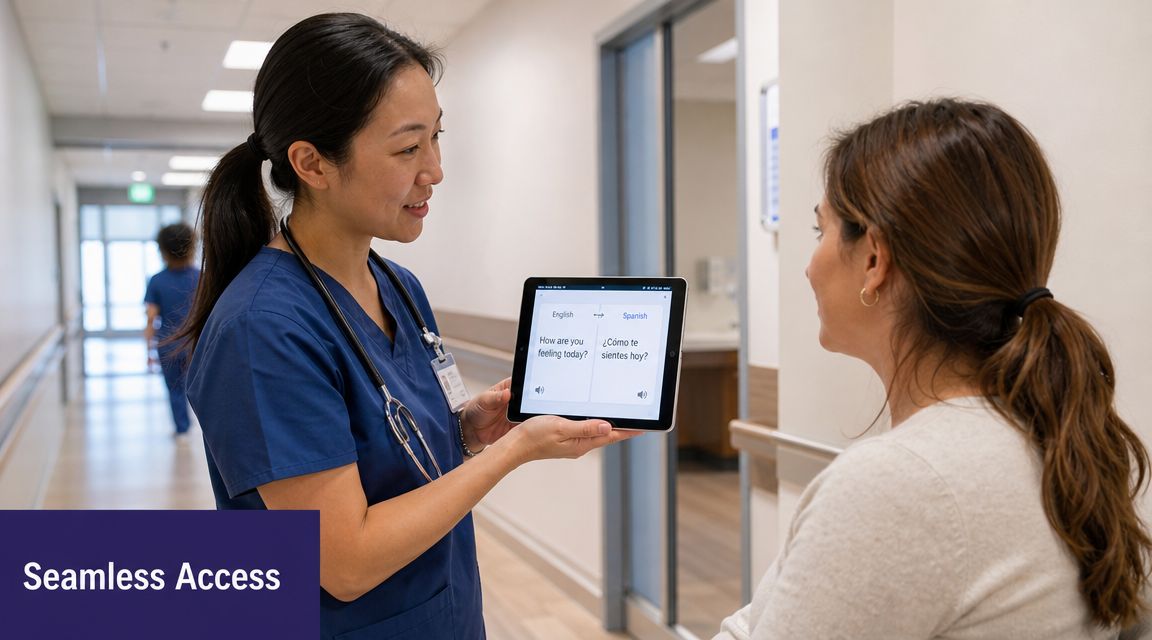
This is the pattern I've seen again and again. Leadership approves a service. Devices arrive. Training happens once. Then real life starts. The interpreter number is pinned to a workstation in one unit but not another. Registration captures language inconsistently. Providers forget where to click. Nurses use the service for some patients and skip it for others because the path feels too slow.
That's why workflow integration matters more than vendor branding.
A major implementation study found that 95% of targeted interventions increased at least one professional-interpreting measure, and the interventions commonly combined clinician education, access redesign, EHR modifications, and policy standardization. In one system-wide implementation, embedding on-demand interpretation into the EHR produced a 250% increase in utilization, with 14,336 providers using the service for more than 121,077 unique LEP patients, and average connection wait times for the top languages stayed below 30 seconds, according to JAMA Network Open's study on language assistance implementation.
What integration should look like on the ground
Good integration starts before the clinician opens the chart.
Registration should capture preferred language and dialect in a standard field, not free text. That field should be visible throughout the encounter. If the patient's language needs are hidden in a note, staff will miss them.
Then make the request path obvious:
- Put interpreter access inside the EHR or the main clinical workspace. Staff should not need to search email, laminated cards, or old policy files.
- Standardize the trigger points. Registration, triage, consent, discharge, care transitions, and telehealth visits need clear rules.
- Use the simplest possible device setup. Shared tablets and carts can work, but only if charging, storage, and ownership are clear.
- Build documentation into the encounter. If interpreter use is invisible in the record, quality review becomes weak fast.
Training has to match the shift, not the policy
Hospitals often train language access like annual compliance. That's not enough. Staff need short, practical guidance tied to their actual work.
For registration, that means asking the language question the same way every time. For nurses, it means knowing which modality to use in a fast bedside interaction. For physicians, it means understanding when “good enough English” is not a safe assumption. For managers, it means checking usage patterns and coaching low-adoption teams.
I've had the best results with short demos at the unit level, reinforced by charge nurses and super users, plus visible escalation paths when the first method fails.
Operational rule: If staff need memory to use your interpreter service, adoption will drift. If the workflow prompts them at the right moment, use becomes routine.
Measuring success quality, ROI, and troubleshooting
If all you measure is total interpreter minutes, you can fool yourself into thinking the program works.

Volume matters, but it doesn't tell you whether patients got access when it counted, whether staff bypassed the service because the process was clumsy, or whether outcomes improved for patients with limited English proficiency.
The strongest measurement frame I know uses three linked endpoints: interpreter-request completion rate, median time-to-connection, and LEP-stratified quality metrics such as readmissions and patient satisfaction. That pairing matters because isolated utilization counts can hide access failures and workflow friction. It also reflects what the implementation literature points to: correct workflow placement matters as much as service availability.
Tie language access to real hospital outcomes
A systematic review found that 30-day readmission was 24.3% when patients had no interpreter at admission and discharge versus 14.9% when a professional interpreter was present at both points. The same review reported average length of stay fell from 5.06 to 2.57 days in one included study, and patients without interpreter support were about half as likely to receive defect-free care, according to the systematic review on professional medical interpretation and hospital outcomes.
That gives operations leaders a better ROI conversation. You're not just defending an expense category. You're examining a clinical process that affects discharge quality, avoidable returns, and inpatient flow.
I'd track at least these measures:
- Access measures: Request completion rate, connection time, and failed or abandoned sessions
- Use measures: Utilization by department, language, modality, and shift
- Equity measures: LEP patient experience signals and complaints tied to communication
- Outcome measures: LEP-stratified readmissions, length of stay, and discharge-related issues
- Operational friction: Device downtime, login issues, and staff-reported barriers
How to troubleshoot what the numbers are telling you
Low use in one unit doesn't always mean low need. It often means workflow resistance. Start by observing the request path. Are staff missing devices, skipping documentation, or using family members because the official route feels slow?
If connection times look acceptable overall but complaints persist, break the data down by language and unit. Rare languages and overnight shifts often reveal the hidden defects.
If staff say interpreter quality is uneven, don't treat that as a vague morale issue. Review the affected encounter types. Some services work fine for brief triage but not for nuanced discharge counseling or behavioral health.
The strongest improvement loops are practical and fast:
- Audit a few real encounters each month to see where access broke down
- Review outlier units with managers rather than sending system-wide reminders
- Fix technical friction first because staff lose trust quickly
- Escalate dialect issues early instead of forcing a near match that satisfies procurement but not patient care
The hospitals that get this right don't just buy translators for hospitals. They build a repeatable operating model, then watch it closely enough to correct drift before it becomes standard practice.
Simbie AI helps healthcare teams reduce communication bottlenecks around intake, scheduling, refills, and other routine workflows, while fitting into existing clinical systems. If you're tightening front-end operations and want fewer missed calls, cleaner documentation, and more reliable patient communication, take a look at Simbie AI.