
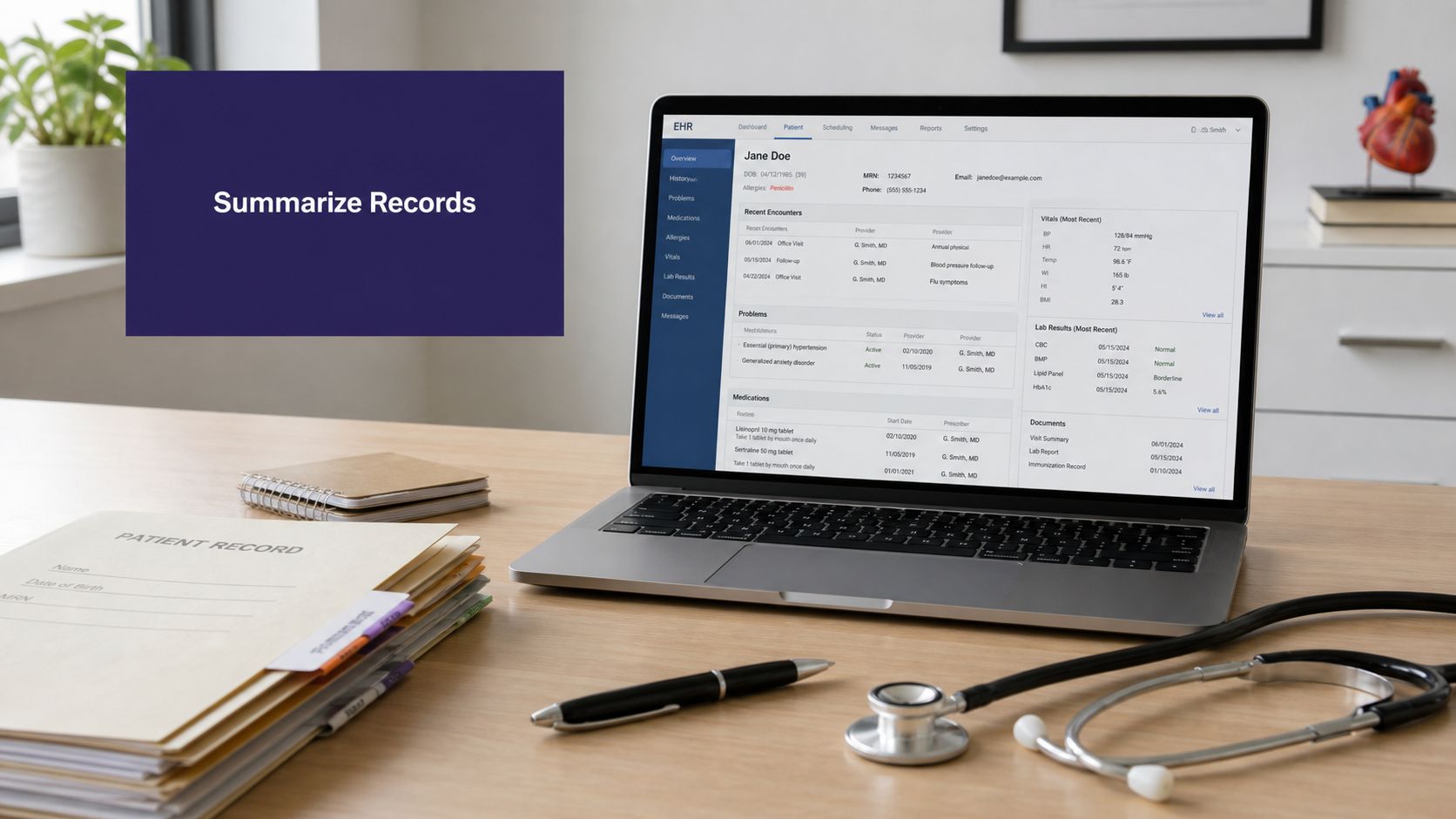
When you have a new patient on tomorrow's schedule and a faxed, scanned, badly ordered chart lands in your inbox at 4:45 p.m., the problem isn't just paperwork. It's whether your physician walks into that visit with a usable clinical picture or with fragments. For independent practices trying to summarize medical records quickly and safely, the old process is slow, inconsistent, and too dependent on whoever had time to review the file.
A better workflow treats summarization as part of care delivery, not as a back-office cleanup task. That matters in dermatology, gastroenterology, and internal medicine, where outside records, refill histories, procedure notes, and follow-up questions all shape what happens in the room. Done well, a summary saves time, reduces avoidable rework, and gives clinicians a clearer starting point before the visit even begins.
Meta description: Summarize medical records faster with a dynamic workflow that improves clinical prep, reduces admin burden, and supports safer patient care.
Why Medical Record Summaries Are More Than Paperwork
A familiar scene in any busy practice. A new patient is booked, the records arrive late, and the file is a stack of progress notes, scanned lab reports, duplicate medication lists, outside consult letters, and unlabeled imaging. Someone on your team has to turn that mess into something usable before the first visit.

When that summary is thin, outdated, or copied forward without judgment, the physician does the work again in real time. They dig through PDFs, ask the patient to repeat history that should already be clear, and spend visit time reconciling contradictions instead of treating the patient. That is wasted clinician effort, but it's also a continuity-of-care problem.
Static summaries break down in active care
Most published guidance still treats medical record summaries as a static narrative prepared for legal review or insurance review. That approach misses what outpatient practices need day to day. As U.S. Legal Support notes in its discussion of summarization limits, important data is often “buried within extensive, noisy, and repetitive entries,” and standard guides do not address dynamic, actionable summaries that support active patient care.
That distinction matters. A static summary says what happened. A dynamic summary helps your team act on what matters now.
Practical rule: If a summary doesn't help with medication reconciliation, pre-visit planning, or identifying unresolved issues, it's not finished.
What a useful summary changes in the room
A good summary gives the clinician a fast read on the patient's story without forcing them to trust a black box. It surfaces the current problem list, recent specialist input, medication changes, allergies, pending tests, and any mismatch between what different notes say. It also makes room for uncertainty. If an outside note conflicts with the PCP history, the summary should flag that clearly instead of smoothing it over.
For practice owners, summarization stops being clerical work. It becomes part of patient safety, schedule flow, and physician capacity.
A clean summary can shorten the mental ramp-up before the visit. Beyond that, it reduces duplicate questioning, helps staff prep smarter, and protects doctors' time for doctoring.
The Anatomy of a High-Quality Summary
Not every summary should look the same. The right format depends on what the clinician needs to decide next.
For a complex GI transfer, a chronological summary often works best because it shows the sequence of symptoms, scopes, pathology, medication trials, and specialist handoffs. For longitudinal internal medicine or dermatology patients with several active issues, a problem-oriented summary is usually more useful because it groups information by condition rather than by date.
Start with structure, not prose
The strongest summaries are built in layers. A high-fidelity workflow often uses a section-to-meta pipeline, where each part of the chart is condensed first and then rolled into an overall summary. As explained in Abstractive Health's guide to medical record summarization, computer-based metrics such as ROUGE can support initial validation, but clinician review is still necessary to assess readability, factual accuracy, and patient safety.
That mirrors what works operationally in real practices. If you ask staff or software to collapse an entire chart in one pass, details get lost. If you summarize by section first, errors are easier to catch.
The checklist that makes a summary clinically usable
A summary should be short enough to scan and complete enough to trust. At minimum, it needs:
- Patient identifiers: Correct demographics, referring provider, and relevant dates of service.
- Reason for care: Why the patient is being seen now, not just what diagnoses appear in the chart.
- Active problem list: Current conditions separated from historical or resolved issues.
- Medication reconciliation: Current meds, recent changes, refill issues, and obvious duplicates.
- Allergies: Verified allergy list with any severe reactions if documented.
- Recent results: Key labs, pathology, imaging, and outside consult conclusions relevant to the current visit.
- Procedural history: Prior surgeries, scopes, biopsies, or interventions that change current management.
- Family and social context: Smoking, alcohol, family history, and other context only when it affects care.
- Open loops: Pending referrals, unanswered abnormal results, missing records, and contradictory notes.
A standard output format helps. Teams that need examples of consistent layouts can review different medical report formats used for structured clinical documentation.
A summary should answer two things fast: what is true right now, and what still needs clarification.
What to leave out
The easiest way to ruin a summary is to confuse completeness with usefulness. Repeating every normal lab, copying unchanged review-of-systems text, or pasting entire note sections creates clutter. The point is not to produce a shorter chart. The point is to produce a more actionable one.
That's why a one-page summary can outperform a ten-page “complete” digest. If your clinicians can't spot active issues at a glance, the format is working against them.
The Manual Workflow and Its Hidden Costs
Most practices still handle summarization the hard way. A staff member downloads records, opens multiple portals, flips through scanned PDFs, highlights medication names, and tries to build a timeline from notes that were never written for that purpose. Then someone else double-checks part of it, usually under time pressure.
That process looks inexpensive because it's done in-house. It rarely is.
The work is repetitive, but the risk is not
Manual summarization consumes skilled attention that your front desk, MA team, and clinical staff already don't have enough of. In smaller practices, the work often lands on non-clinical team members because they're the only ones available. That's where quality drifts.
As Compex Legal points out in its review of summarization challenges, many guides give vague advice like “seek expert advice” without defining the human-in-the-loop workflow needed for non-clinical staff to validate AI output or recognize when a clinically meaningful unit has been missed. In independent practices, that gap raises the risk of transcription and transfer errors.
Hidden costs that show up elsewhere
The damage from a weak manual workflow usually appears downstream:
| Workflow failure | What the practice feels |
|---|---|
| Incomplete intake summary | Longer physician prep and repeated history-taking |
| Missed medication change | Refill confusion, extra callbacks, and chart corrections |
| Contradictory outside notes not flagged | More chart review during the visit |
| Overloaded front desk handling summaries | Slower scheduling, phones backing up, and staff frustration |
Those costs don't sit in one line item. They spread across the day.
If your best staff are spending hours rewriting outside records, they're not available for the work only humans should be doing.
Why “good enough” stops scaling
Often, community practices hit a wall at this point. The physician thinks the records are “mostly there.” The office manager sees overtime, dropped balls, and a chart-prep process nobody has standardized. The front desk is covering phones, prior auth follow-ups, and intake at the same time. Summarization becomes one more task squeezed into the cracks.
That might work for a few charts a week. It doesn't hold up when you have high new-patient volume, multiple providers, frequent outside referrals, or specialties like GI and internal medicine where longitudinal history indeed changes decisions.
The practical fix is not to push staff harder. It's to redesign the workflow so the first draft is generated faster, the validation steps are clear, and the final output is easy for clinicians to trust.
Integrating AI and EHRs into Your Workflow
The transition doesn't have to start with a giant systems project. Most practices can improve summarization just by tightening how they use their current platforms. In eClinicalWorks, Athenahealth, Epic, DrChrono, gGastro, and EMA ModMed, there are usually underused ways to standardize pre-visit tasks, pull recent results into a consistent view, and separate active from historical items. That alone reduces some chart chaos.
But the bigger jump comes when AI handles the first pass on unstructured records.
Where AI actually helps
The strongest use case is not “write a perfect summary and trust it.” It's to scan outside records, extract decision-relevant details, and generate a draft your team can validate quickly.
There is real evidence behind the efficiency claim. A review of AI medical record summary statistics cites rigorous U.S. evidence showing an average reduction of 18 seconds per visit in chart-review time, from 3 minutes 22 seconds to 3 minutes 4 seconds. The same source reports that a separate Mayo Clinic study found an approximately 40% reduction in review time for scanned outside medical records in breast cancer workflows when OCR was combined with LLM processing. For a clinic handling 1,000 daily visits, that 18-second reduction adds up to roughly 5 hours of saved clinician time per day.
Those gains won't show up evenly in every encounter. They matter most where charts are dense, disorganized, and full of outside documentation.
Dynamic summaries are better than one-time summaries
Many tools stop too early, summarizing the chart once, then leaving your team to manage everything that happens after. Real outpatient care doesn't work like that. The record keeps changing with refill requests, test result questions, pre-op calls, chronic disease outreach, and specialist updates.
That's why practices are moving toward a model that combines record summarization with live workflow capture. Resources like these insights on AI for medical professionals are useful because they frame AI as operational support for the care team, not as a novelty layered on top of bad processes.
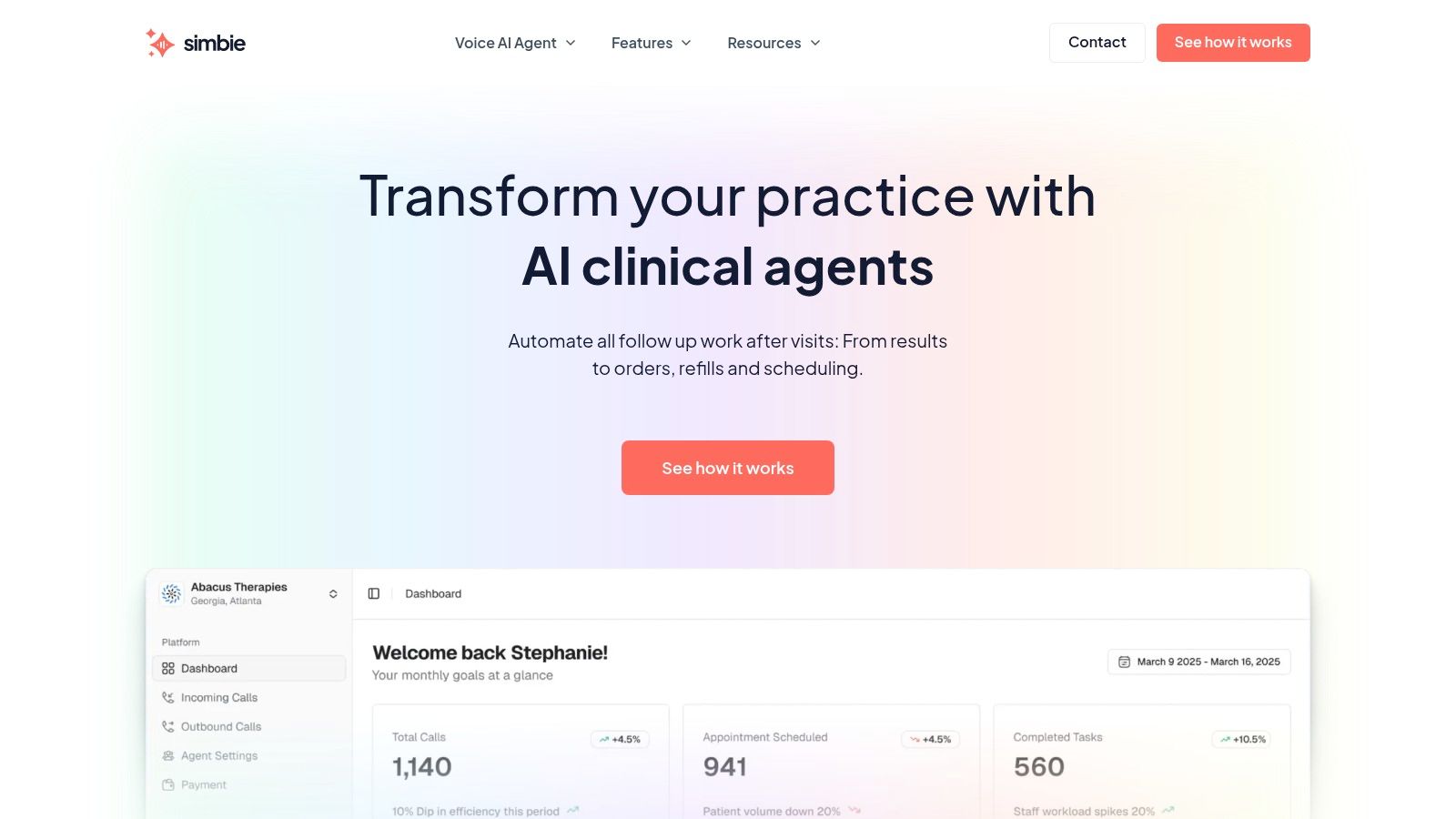
One approach is to use AI Medical Staff that covers both front-office and clinical support tasks. Simbie AI is one example. It can manage scheduling, intake, refills, prescription renewals, test result follow-up, patient education, adherence check-ins, and phone-based chart documentation while integrating with systems such as eClinicalWorks, gGastro, EMA ModMed, Athenahealth, Epic, and DrChrono. For practices evaluating what AI can do inside the chart and around it, this overview of electronic health records and artificial intelligence in practice workflows is a useful reference.
What this changes for small practices
The operational upside isn't just faster summaries. It's a cleaner information loop.
- Calls get captured: Simbie reports 100% of inbound calls captured, with 24/7 availability and zero hold times.
- Front-office pressure drops: The model is built to support up to 60% reduction in front-office staff costs.
- Clinical updates don't wait for someone to type them later: Phone interactions can feed structured documentation directly into the chart.
That matters when your office is trying to keep new-patient intake, refill requests, and pre-visit work from colliding at the same time.
Ensuring Accuracy and HIPAA Compliance with AI
A fast summary is only useful if your team can trust the process behind it. In healthcare, accuracy and privacy are not separate conversations. They're part of the same operational standard.
The right posture with AI is simple. Use it to accelerate the first draft. Require human review before anything becomes part of the patient record or drives patient-facing communication.

Human review is not optional
The current evidence supports that position. In Stanford HAI's report on AI-generated medical summaries, evaluators rated AI outputs as at least as good as human-written summaries 45% of the time and superior 36% of the time. At the same time, the research reinforces the key trade-off. AI performs well on speed and consistency, while human clinicians remain stronger on contextual nuance, which is why human-in-the-loop verification remains the standard.
“Trust the draft, not the final.”
That should be your operating rule. A clinician, nurse, or trained reviewer still needs to confirm medications, allergies, current problems, and any item that could affect immediate treatment.
A practical QA workflow for small practices
A workable process does not need to be complicated:
- Generate the draft summary from outside records, recent chart history, and intake data.
- Route it to the right reviewer. Medication-heavy cases may need nursing review. Referral-heavy specialty cases may need provider review.
- Check high-risk elements first: allergies, medication changes, recent abnormal results, pending tests, and contradictions across notes.
- Write unresolved items clearly: if the chart is unclear, mark it for confirmation at intake or during the visit.
- Finalize only after sign-off from the designated human reviewer.
This is especially important when non-clinical staff are involved in intake. They can support the workflow, but they shouldn't be the last line of clinical judgment.
Security standards should be explicit
Any platform handling PHI should meet the basics you'd already expect from a healthcare technology partner. That includes HIPAA-compliant controls, role-based access, auditability, and secure data handling practices. For vendor diligence, many practices also look for SOC 2 Type 2 certification because it speaks to how controls are maintained over time, not just described on paper.
Practices that need outside infrastructure help often benefit from working with teams that understand healthcare environments specifically. If your internal IT support is thin, this guide to expert healthcare IT support gives a practical sense of what to look for when security, uptime, and compliance all matter.
For AI-specific review, it also helps to use a vendor that explains its safeguards plainly. This overview of HIPAA-compliant AI in healthcare workflows is a good example of the questions practice leaders should be asking before they hand over patient data.
Simbie's operational posture is built for that environment. It is HIPAA-compliant, SOC 2 Type 2 certified, available 24/7, and built by clinicians from Stanford, Yale, Columbia, and Princeton. That last point matters less as a brand credential than as a workflow signal. Systems designed by people who understand intake, refill logic, pre-visit tasks, and charting realities tend to fit outpatient operations better.
Building Your Practice's Future Information Workflow
The old assumption is that summarization is a backlog task. Something to clear. Something to assign when there's time. That mindset is exactly what keeps practices stuck.
Clinical studies discussed in PubMed Central's review of patient history summarization found that AI-generated summaries allowed clinicians to answer key questions with 80% accuracy compared with 75% using full records, while reducing response time by 50%. The same review also notes a real limitation in current systems. Most commercial EHRs still organize and reduce data, but they do not synthesize it into actionable guidance.
That gap is where your workflow decisions matter. The better model is a living summary that updates as calls come in, medications change, records arrive, and visits are prepared. It combines machine speed with human review, and it treats information flow as a clinical asset.
Protecting Doctors' Time for Doctoring.
If you're evaluating AI for your practice, book a demo with Simbie AI and see how a dynamic, human-reviewed workflow can support both front-office operations and clinical follow-through.