
You're probably reading this after a long treatment day with a stack of unfinished notes hanging over you. Many OTs experience this. The problem is that a rushed note doesn't just make your evening worse. It can weaken your clinical story, create billing problems, and leave the next provider guessing what happened in the session.
I've trained a lot of new grads on documentation, and I keep seeing the same issue. They know the SOAP headings, but they haven't been taught how to write a soap note for OT that is fast, clear, and defensible. That gap matters because the actual standard isn't “Did you fill in S, O, A, and P?” It's “Did you show why skilled OT was needed, what changed, and what happens next?”
Why your SOAP notes matter more than you think
At 5:45 p.m., you finish your last patient, open the chart, and realize your note has to do more than remember the session. It has to justify the visit, support the bill, explain your clinical decisions, and protect you if the chart is reviewed months from now.
That is why weak SOAP notes create problems far beyond paperwork.
SOAP came out of the problem-oriented medical record developed by Dr. Lawrence Weed, and it spread because it gave clinicians a consistent way to document an encounter so another provider could follow the case over time. In OT, that consistency matters because your note may be read by the next treating therapist, a physician, a case manager, a payer, or an auditor. Each reader is looking for something slightly different. Your job is to make the chart work for all of them without turning every note into a novel.
New grads often miss this trade-off. They either write too little and leave out the skilled reasoning, or they write everything and bury the important parts. Neither approach holds up well. A defensible note is selective. It captures the details that prove function, change, risk, and skilled intervention.
The Canadian Association of Occupational Therapists documentation handout makes the practical point that documentation supports communication, accountability, and evidence of professional reasoning. That is the part many SOAP note tutorials skim past. Filling in Subjective, Objective, Assessment, and Plan is not enough if the note never shows why OT was medically necessary that day.
Use this standard when you chart: an unfamiliar reviewer should be able to answer two questions in under a minute. What changed, and why did this patient need skilled OT?
A useful SOAP note template for OT documentation can speed up the process, but speed only helps if the note still does four jobs well:
- Support continuity of care: Another clinician can quickly see the patient report, your findings, and the next treatment priority.
- Show clinical reasoning: The chart explains why you chose the intervention, not just what you did.
- Defend reimbursement: The note connects impairment to function and shows why skilled treatment was required.
- Reduce rework: Clear documentation now saves time on addenda, utilization review questions, and end-of-month billing cleanup.
I tell new therapists this all the time. Your SOAP note is part of treatment because it is the record that proves treatment happened for a skilled, medically necessary reason. If that story is weak, the rest of your work is harder to defend.
Breaking down the SOAP note structure
A new grad finishes a busy treatment block and writes, “Patient tolerated session well. Continue plan.” It feels done until utilization review asks what skilled OT was provided, what changed, and why the next visit is justified. That is where weak SOAP notes fail. The format is simple, but each section has a separate job, and blurred sections create longer notes that are harder to defend.
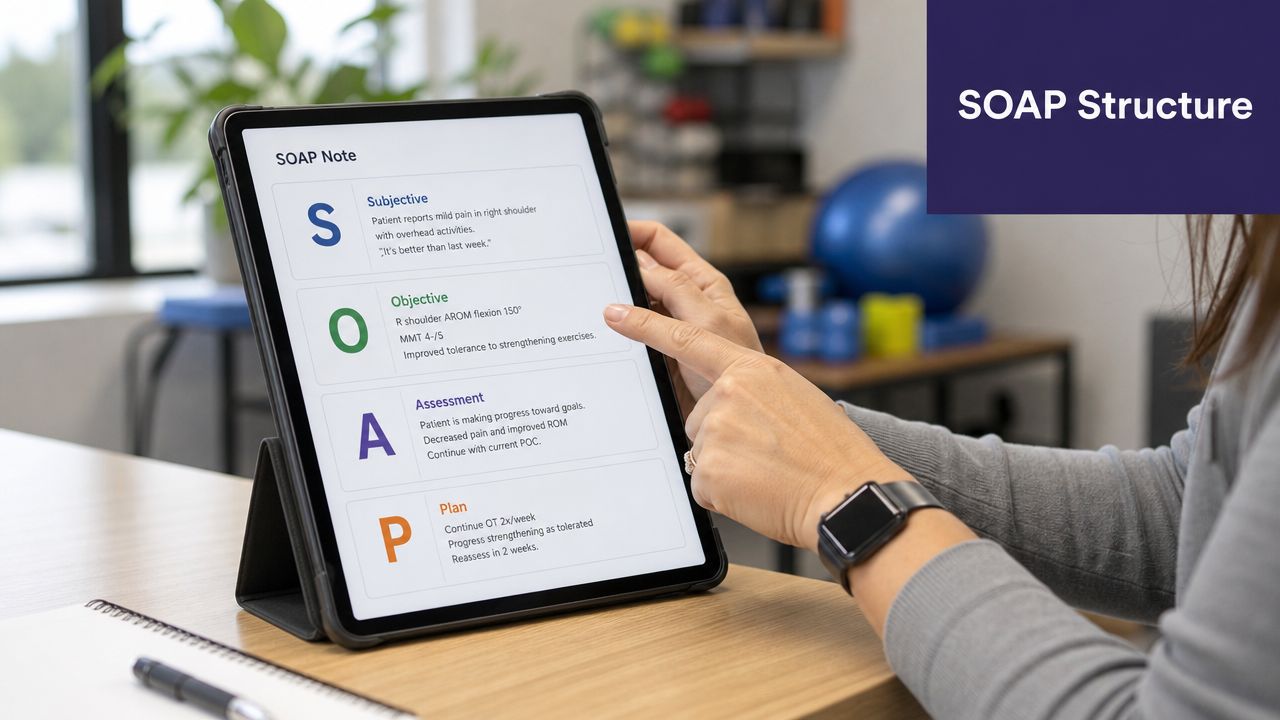
SOAP works when it turns a treatment session into a clinical record another therapist, payer, or auditor can follow quickly. In OT, that means the Objective section carries observable and measurable performance data, while the Assessment explains your reasoning about function, progress, barriers, and continued need for skilled care. A SOAP note template for occupational therapy can speed up the workflow, but it does not supply clinical judgment. You still have to document why your treatment choices made sense that day.
Subjective
The Subjective section captures the patient's or caregiver's report. Use it for symptoms, function, concerns, home carryover, and perceived change since the last visit.
What belongs here is what the patient says or what a reliable caregiver reports. Keep it relevant to occupational performance.
- Do capture functional statements: “Reports dropping utensils at dinner” is stronger than “having some trouble.”
- Do include caregiver input when needed: In pediatrics, dementia care, or low insight cases, caregiver report may explain what is happening outside the clinic.
- Don't insert your opinion: “Patient is lazy” or “appears unmotivated” is not subjective data.
- Don't fill space with details that do not affect care: If it does not relate to pain, function, safety, participation, or response to treatment, leave it out.
Objective
The Objective section is the record of what you observed, measured, instructed, and graded during the session.
This section usually takes the most space because it has to show skilled intervention, patient response, and enough detail to support billing. Good Objective writing answers practical questions fast. What task was addressed? What level of assist or cueing was needed? What changed with your intervention? If you are treating post-op hand function, for example, details around edema control, tendon gliding, dexterity, and task-specific performance matter far more than “worked on hand use,” especially in cases that may overlap with hand physical therapy.
- Do document measurable performance: assist level, number and type of cues, repetitions, duration, ROM, strength, task tolerance, errors, or success across trials.
- Do tie the activity to function: “Completed lower body dressing training with reacher, min assist for threading affected LE” is stronger than “used adaptive equipment.”
- Do show your skilled role: mention grading, modification, education, positioning, facilitation, or feedback when those actions changed performance.
- Don't write unsupported judgments: “Did well” means nothing unless you show how performance improved.
- Don't stay vague: “Fine motor activity completed” leaves out the task, the deficit, and the result.
Assessment
The Assessment section is where your reasoning shows up. This is the part many weaker notes miss.
I tell new therapists to treat Assessment as the answer to three questions. What changed today? Why does that change matter for function? Why does the patient still need skilled OT? If your Assessment only repeats the Objective data, you have not done the job.
- Do interpret the findings: explain whether performance improved, plateaued, or declined, and what likely contributed.
- Do connect impairment to occupation: reduced pinch strength matters because it limits fastener management, meal prep, med management, or work tasks.
- Do name barriers affecting progress: pain, fatigue, apraxia, impulsivity, poor carryover, sensory regulation problems, or limited caregiver follow-through belong here when they affect outcomes.
- Don't use filler: “Tolerated treatment well” adds little unless you explain the clinical significance.
- Don't avoid medical necessity: if skilled cueing, adaptation, progression, or safety judgment was required, say so plainly.
A strong Assessment gives an auditor enough reasoning to understand why the visit was necessary without guessing.
Plan
The Plan section states what happens next based on what happened today. It should read like a logical continuation of the session, not a stock phrase pulled from a dropdown.
- Do make the next step specific: frequency, target tasks, progression, caregiver training, home program updates, coordination needs, or discharge planning.
- Do connect the plan to today's findings: if the patient needed repeated cues for sequencing during dressing, the next plan should address sequencing, not switch to a generic strengthening line.
- Do note adjustments when progress is limited: modify task demands, change cueing strategy, update splint wear schedule, or shift treatment emphasis when needed.
- Don't rely on “continue plan of care” alone: reviewers want to know what you are continuing and why.
- Don't promise progress your note does not support: if change is slow, document the barrier and your response to it.
When Subjective, Objective, Assessment, and Plan each do their own job, the note gets shorter, clearer, and much easier to defend.
From theory to practice with examples and phrasing
Most therapists don't need another definition of SOAP. They need wording they can use at the point of care, without sounding robotic or vague.
The fastest way to improve your notes is to build a phrase bank that still leaves room for patient-specific details. Standardized templates help with consistency, and OT documentation guidance specifically recommends capturing quantifiable data such as assistance level, number of cues, and trial-based success rates like “completed task successfully in 8/10 trials,” as explained in this OT SOAP note template guide.
Sample phrasing for OT SOAP notes
| Section | Sample phrasing |
|---|---|
| Subjective | “Patient reports increased difficulty opening containers during meal prep since last visit.” |
| Subjective | “Caregiver states child becomes frustrated with handwriting tasks at home and avoids seated table work.” |
| Subjective | “Patient states, ‘I can pull my shirt on now, but I still need help with socks.’” |
| Objective | “Completed upper body dressing with min assist for hemi-technique and 3 verbal cues for sequencing.” |
| Objective | “Performed grasp-release activity using medium-resistance putty. Required 2 tactile cues to maintain pinch pattern.” |
| Objective | “Completed task successfully in 8/10 trials with verbal cueing for attention to left side.” |
| Objective | “Tolerated standing grooming task for set duration with close supervision and intermittent rest breaks.” |
| Assessment | “Improved task accuracy compared with prior session, but continued cueing needs show reduced carryover and ongoing need for skilled intervention.” |
| Assessment | “Fine motor weakness and poor motor planning continue to limit school participation in cutting and pencil tasks.” |
| Assessment | “Patient is progressing in dressing independence, though fatigue and decreased dynamic balance still affect safety.” |
| Plan | “Continue ADL retraining with emphasis on lower body dressing and safe transfer setup.” |
| Plan | “Progress fine motor tasks to smaller manipulatives as tolerated and update home program for hand strengthening.” |
| Plan | “Provide caregiver education on cueing strategies to support carryover between sessions.” |
I also tell newer therapists to borrow wording from related rehab documentation when the functional issue overlaps. For upper extremity recovery and dexterity-related cases, seeing how clinicians describe hand function and rehab goals in settings like hand physical therapy can sharpen your own language around function, tolerance, and task-specific progression.
Example 1 pediatric fine motor SOAP note
S
Mother reports child resisted homework writing tasks this week and needed frequent breaks. Teacher reported difficulty with cutting accuracy and letter formation during classroom work.
O
Engaged in seated fine motor session targeting grasp, bilateral coordination, and pre-writing control. Child used short crayon in tripod grasp during vertical surface tracing with verbal cues for finger placement. Completed simple line and curve tracing with variable control and required repeated redirection to task. Cut along bold lines on paper strips with assist for paper stabilization and cueing to slow pace. Participated in pinch-strength task using resistive clips and small object retrieval. Demonstrated improved tolerance for table-top work compared with prior session, with fewer movement breaks needed during structured tasks.
A
Child continues to show fine motor control and grasp pattern deficits that affect classroom participation in handwriting and cutting. Better seated tolerance supported more task completion today, but ongoing cueing needs show limited independent carryover. Skilled OT remains needed to build hand strength, motor planning, and task persistence for school-based fine motor demands.
P
Continue fine motor intervention focused on grasp development, cutting accuracy, and pre-writing control. Progress seated tasks gradually while using short, structured activities to support attention. Educate caregiver on brief home activities for pinch strength and proper crayon grasp.
Example 2 adult post-stroke ADL SOAP note
S
Patient reports he is dressing upper body with less help from spouse but still struggles with lower body dressing and bathroom setup. States left arm feels “stiff” during morning routine.
O
Completed neuromuscular re-education and ADL retraining focused on hemi-dressing techniques, seated balance, and left upper extremity use during self-care. Patient completed upper body dressing with setup and verbal cues for affected-side placement. Required min assist for lower body dressing due to limited reach, balance deficits, and delayed sequencing. Participated in grooming at sink with close supervision and cueing for weight shift and left-side awareness. Left shoulder active range and functional reach were addressed through task-based movement during grooming item retrieval. Patient needed verbal and tactile cues to incorporate left upper extremity as stabilizer during dressing setup. Demonstrated improved initiation of affected-side use by session end.
A
Patient is making functional gains in upper body dressing, but lower body dressing and standing self-care remain limited by decreased balance, reduced left upper extremity integration, and sequencing deficits. Today's performance supports continued skilled OT for task-specific ADL retraining, safety, and carryover of hemi-techniques into home routines. Morning stiffness appears to affect early-session efficiency and should be considered when planning home practice.
P
Continue ADL retraining with emphasis on lower body dressing, sink-side grooming, and left upper extremity incorporation during bilateral tasks. Progress cueing demands as carryover improves. Review bathroom setup and adaptive strategies next session to reduce caregiver burden and improve safety.
What works better than generic charting
I'd rather read a note that says, “Required mod verbal cues for sequencing during toileting transfer and min assist for clothing management” than one that says, “Worked on toileting.” The first one tells me what happened and what skill level was needed. The second one forces me to guess.
“Tolerated session well” is not a treatment outcome. It's a filler sentence unless you explain what the patient tolerated, under what conditions, and what that means for the plan.
If you're trying to write faster, don't remove the measurable parts. Remove the empty parts.
Writing for reimbursement and demonstrating skilled care
A reviewer opens the chart because your visit is being questioned. They were not in the room. They do not know the patient. They decide based on whether your note shows a skilled service tied to function, safety, and ongoing need.
That is the standard. A SOAP note is not just a memory aid for the next therapist. It is part of the payment record, the legal record, and the clinical argument for why OT was required on that date. If the note only lists activities, it leaves too much room for denial.
The strongest notes make three things easy to find. What the patient could and could not do. What skilled OT changed during the session. Why the patient still needs therapist-level care instead of a generic exercise sheet or routine assistance.
Skilled language versus vague language
Here's the distinction I teach new grads early, because it affects both audits and time spent defending care later:
| Weak phrasing | Better phrasing |
|---|---|
| “Worked on dressing” | “Completed lower body dressing retraining using reacher. Required min assist and verbal cues for sequencing and safety.” |
| “Patient improving” | “Demonstrated reduced assist needed for upper body dressing and improved initiation of affected-side use during setup.” |
| “Continue OT” | “Continue skilled OT to address dressing safety, cueing dependence, and limited carryover that affect home independence.” |
| “Did exercises for hand” | “Performed task-based pinch and grasp activity to improve utensil management and container opening.” |
The stronger version does more than sound better. It identifies the functional target, the therapist's skilled input, and the barrier that still limits independence. That is what supports reimbursement.
Where medical necessity usually shows up
Medical necessity usually rises or falls in the Assessment and Plan. The Objective section gives the raw material, but the Assessment is where you connect performance to function and explain your clinical reasoning. The Plan is where you show that next steps require therapist judgment, not just repetition.
Write the Assessment so an auditor can answer four questions without hunting through the chart:
- What changed today
- Why that change matters for daily function or safety
- What skilled OT adjusted, taught, graded, or monitored
- Why discharge, caregiver-only support, or a home program is not enough yet
I tell staff to listen for one dangerous sentence while they chart: “Patient completed task with cues.” What kind of cues? For what deficit? How much support? Why were those cues clinically necessary? If you do not answer those questions, the service reads like routine supervision.
A practical self-check is this line: could a reviewer tell why this required an OT and not just extra time? If the answer is no, tighten the note. Name the adaptation. Name the safety risk. Name the progression decision. Name the response to intervention.
If your team is trying to clean up denials or reduce addendums, a focused review of your clinical documentation improvement process can show where notes lose specificity. In my experience, the biggest gains come from sharper Assessment statements and Plans that explain why skilled care must continue.
Your note should make the treatment decision defensible. Clear clinical reasoning is what gets paid, survives audits, and saves you from rewriting the same visit two weeks later.
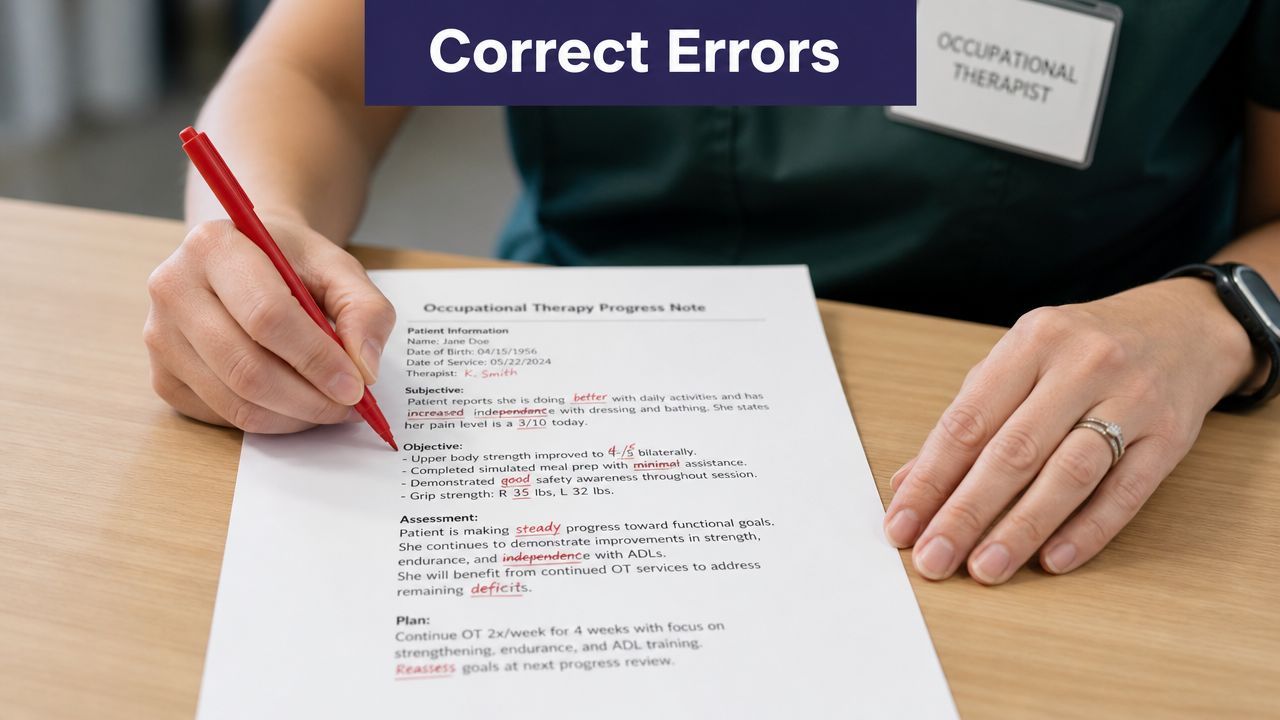
Common documentation mistakes and how to fix them
The biggest documentation problems usually come from shortcuts. Therapists are under pressure to chart fast, especially across telehealth, new EMRs, and packed schedules, and that pressure can strip out the clinical nuance that makes a note accurate and useful, which is a real concern discussed in this OT workflow article on documentation pressure.
Mistake 1 mixing up Objective and Assessment
I still see notes where the Objective says things like “patient had poor motivation” or “good progress today.” That's not objective data.
Fix: Put observable facts in Objective. Put your interpretation in Assessment.
Write what you saw first. Then explain what it means.
Mistake 2 repeating the Objective in the Assessment
If your Assessment is just a shorter copy of your Objective section, you missed the whole point of the A.
Fix: Force yourself to answer one sentence starter: “These findings show…”
That pushes you into interpretation instead of repetition.
Mistake 3 writing a plan that says nothing
“Continue POC” is one of the most common weak endings in rehab notes. Sometimes it's true, but by itself it doesn't tell anyone what you're continuing or why.
Fix: Add the next treatment focus, progression idea, or barrier you plan to address.
Even one extra sentence can make the plan useful.
Mistake 4 copying forward old text
Copy-forward saves time until it creates a contradiction, makes progress look fake, or carries old deficits long after they changed. Auditors notice repetitive notes fast, and so do supervisors.
Fix: If you use prior text, rewrite the parts that should change every visit. At minimum, refresh function, cueing level, response, and plan.
Fast charting is fine. Lazy charting isn't. There's a difference.
Mistake 5 documenting tasks without function
“Did theraputty, pegboard, and clothespins” is activity logging. It doesn't tell me why the session mattered.
Fix: Link every major intervention to a functional goal.
Not every sentence needs a goal statement, but the note as a whole should show the bridge from task to occupation.
Your next step toward better and faster documentation
Most therapists don't have a note-writing problem. They have a workflow problem. They're trying to produce detailed, defensible documentation inside systems that reward speed and interruption.
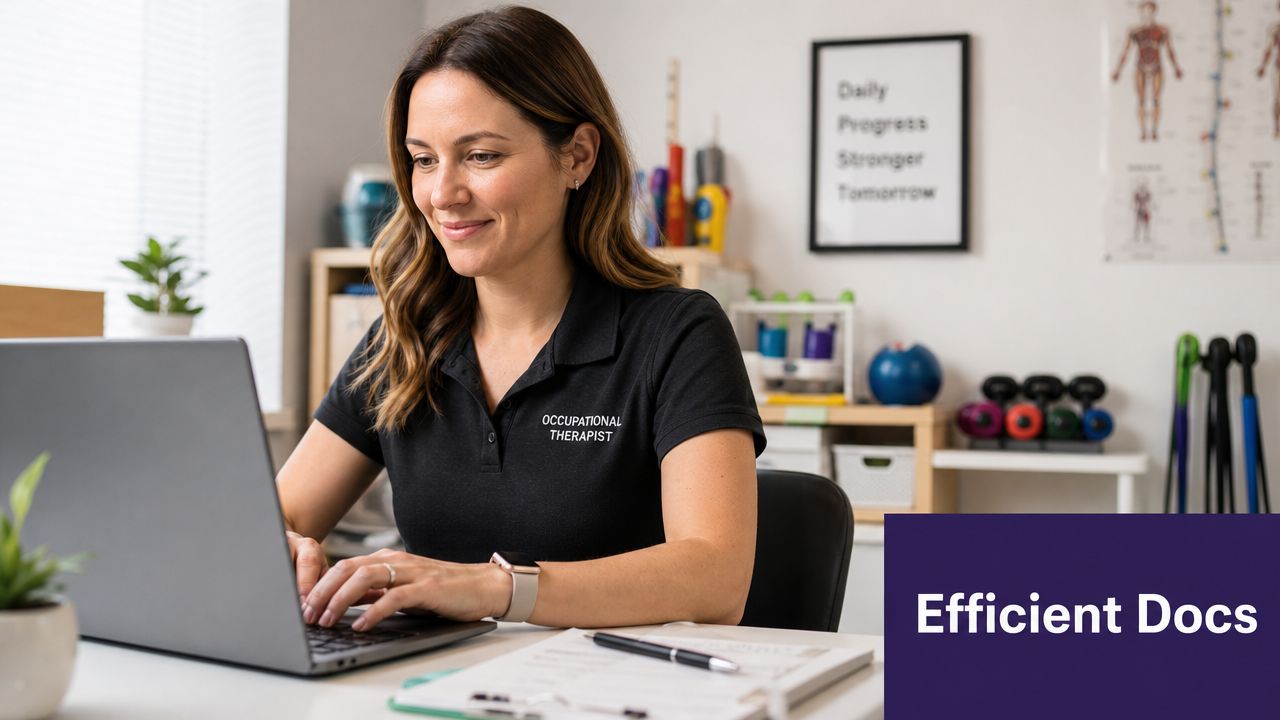
The answer isn't to make your notes thinner until they're useless. It's to build a process that captures your reasoning while the session is still fresh.
What actually saves time
The tools that help most are usually boring. Good templates. Smart text expansion. Point-of-service charting. Consistent phrasing for common cueing patterns, assistance levels, and functional barriers.
That's why standardized templates are worth using. They reduce omissions and give you a repeatable frame. But the template should hold your thinking, not replace it.
I also think therapists need to be realistic about technology. AI-assisted documentation is becoming part of real clinical workflow, especially in settings that need faster charting across in-person and virtual care. The challenge isn't just format anymore. It's how to document accurately, quickly, and consistently without flattening OT-specific reasoning. If you're exploring that route, a tool like AI medical scribe software can draft structured notes from clinical conversations, but it still needs therapist review and editing.
A simple one-week documentation audit
If you want a better soap note for OT, don't try to overhaul everything at once. Audit your own process for one week.
Use this checklist after each session:
- Check your Objective section: Did you include measurable data, cueing level, assist level, or clear task performance?
- Read your Assessment out loud: Does it explain why the findings matter for function and skilled care?
- Look at your Plan: Would another therapist know what to do next session?
- Scan for filler: Cut “tolerated well,” “worked on,” and other vague phrases unless you've added specifics.
What I'd tell any new grad
Start with accuracy. Then build speed.
This task is often approached backward, and it shows in notes. A clean, defensible note doesn't have to be long. It has to be specific, current, and tied to function. Once you learn that habit, speed follows.
Your next practical step is simple. Download a template you can live with, use it for a week, and review your own notes with a harsh eye. Find the one section where your thinking disappears. For most therapists, it's the Assessment. Fix that first.
If your team is spending too much time turning solid treatment into weak documentation, take a look at Simbie AI. It's a voice-based AI platform for healthcare workflows that can structure documentation from clinical conversations and reduce manual admin work, which can help practices build a faster note process without dropping therapist review.