
In the fast-paced world of nursing, clear and concise documentation is not just a task. It's a critical component of patient safety, legal protection, and effective care coordination. For nurses, the SOAP note format (Subjective, Objective, Assessment, Plan) provides a structured language for communicating patient status and care progression. However, moving from classroom theory to bedside practice can be a significant challenge, especially under pressure.
This guide is designed to bridge that gap. We will provide an in-depth look at high-quality soap charting examples nursing professionals can rely on every day. Instead of just showing you a finished note, we will break down seven common clinical scenarios with detailed analysis and strategic insights.
You'll get more than just templates; you will learn precisely what to write and why it matters, turning your documentation from a routine chore into a powerful clinical instrument. To achieve true clinical excellence in your charting, understanding the principles of Clinical Documentation Improvement (CDI) is essential, as it directly impacts patient care quality and overall record accuracy.
This collection offers actionable takeaways for documenting:
- Acute patient intake
- Chronic disease follow-ups
- Post-operative care
- Mental health assessments
- Medication refills
- Patient education
- Complex multi-system patient assessments
We will also explore how modern tools, including EMR integrations and voice-AI assistants, are changing this process, helping nurses improve note quality while saving valuable time. Let's dive into the examples.
1. Acute Patient Intake with Chief Complaint Documentation
Documenting an acute patient intake is a foundational nursing skill. This initial SOAP note sets the stage for the patient's entire course of care, capturing the chief complaint, relevant history, and initial objective findings. A well-structured intake note ensures continuity of care and provides a clear baseline for tracking the patient's progress.

This process is vital for creating effective soap charting examples nursing students and professionals can learn from. The note must be detailed enough to guide the provider's diagnosis but concise enough for quick review. It's a balance between capturing the full story and highlighting the most critical clinical data points.
Example Scenario: Acute Upper Respiratory Infection
Let's break down a SOAP note for a patient presenting with symptoms of an upper respiratory infection (URI). This common scenario is perfect for illustrating how to structure an initial assessment.
S (Subjective):
Patient is a 34-year-old female presenting with a 3-day history of sore throat, nasal congestion, and a non-productive cough. She rates her throat pain as a "6/10" and describes it as "scratchy." Reports associated headache and generalized malaise. Denies fever, shortness of breath, or chest pain. States she has been taking over-the-counter Tylenol with partial relief. No known sick contacts. Allergies: Penicillin (rash).
O (Objective):
- Vitals: T 99.1°F, HR 88, RR 18, BP 124/78, SpO2 99% on room air.
- General: Alert and oriented x4, in no acute distress.
- HEENT: Pharynx is erythematous with no exudate. Nasal mucosa is swollen and boggy with clear rhinorrhea. Tympanic membranes are clear bilaterally.
- Lungs: Clear to auscultation bilaterally, no wheezes or rales.
A (Assessment):
- Acute viral upper respiratory infection: Based on the patient's reported symptoms of sore throat, congestion, and cough, along with objective findings of pharyngeal erythema and clear lung sounds. The absence of fever and pulmonary symptoms makes a bacterial infection less likely.
- Headache: Likely secondary to sinus congestion associated with the URI.
P (Plan):
- Encourage increased fluid intake and rest.
- Recommend saline nasal spray for congestion.
- Continue acetaminophen as needed for throat pain and headache, not to exceed 3g/day.
- Educate patient on signs of worsening infection requiring follow-up, including fever >101°F, productive cough, or shortness of breath.
- Patient verbalizes understanding of the plan.
Analysis and Actionable Takeaways
This example demonstrates a clear and logical progression from the patient's story to the clinical plan.
- Be Specific in Subjective: Quantify symptoms when possible (e.g., "6/10 pain," "3-day history"). This creates a measurable baseline to track improvement or decline.
- Connect Objective to Subjective: The physical exam findings (erythematous pharynx, clear lungs) directly support or rule out aspects of the patient's subjective report. This connection is key to a strong assessment.
- Prioritize the Assessment: The primary diagnosis (URI) is listed first. Secondary issues (headache) are listed next, showing a clear thought process.
- Make the Plan Action-Oriented: The plan includes specific treatments (fluids, saline spray), medication instructions, and clear patient education with "red flag" symptoms for return. This ensures the patient knows exactly what to do and when to seek further care.
2. Chronic Disease Management Follow-Up SOAP Note
Documenting a follow-up visit for a patient with chronic conditions is essential for tracking long-term health, ensuring treatment efficacy, and preventing complications. This type of SOAP note captures the patient's ongoing status, medication adherence, and any adjustments to the care plan. It serves as a running record of disease management, which is critical for continuity and quality of care.
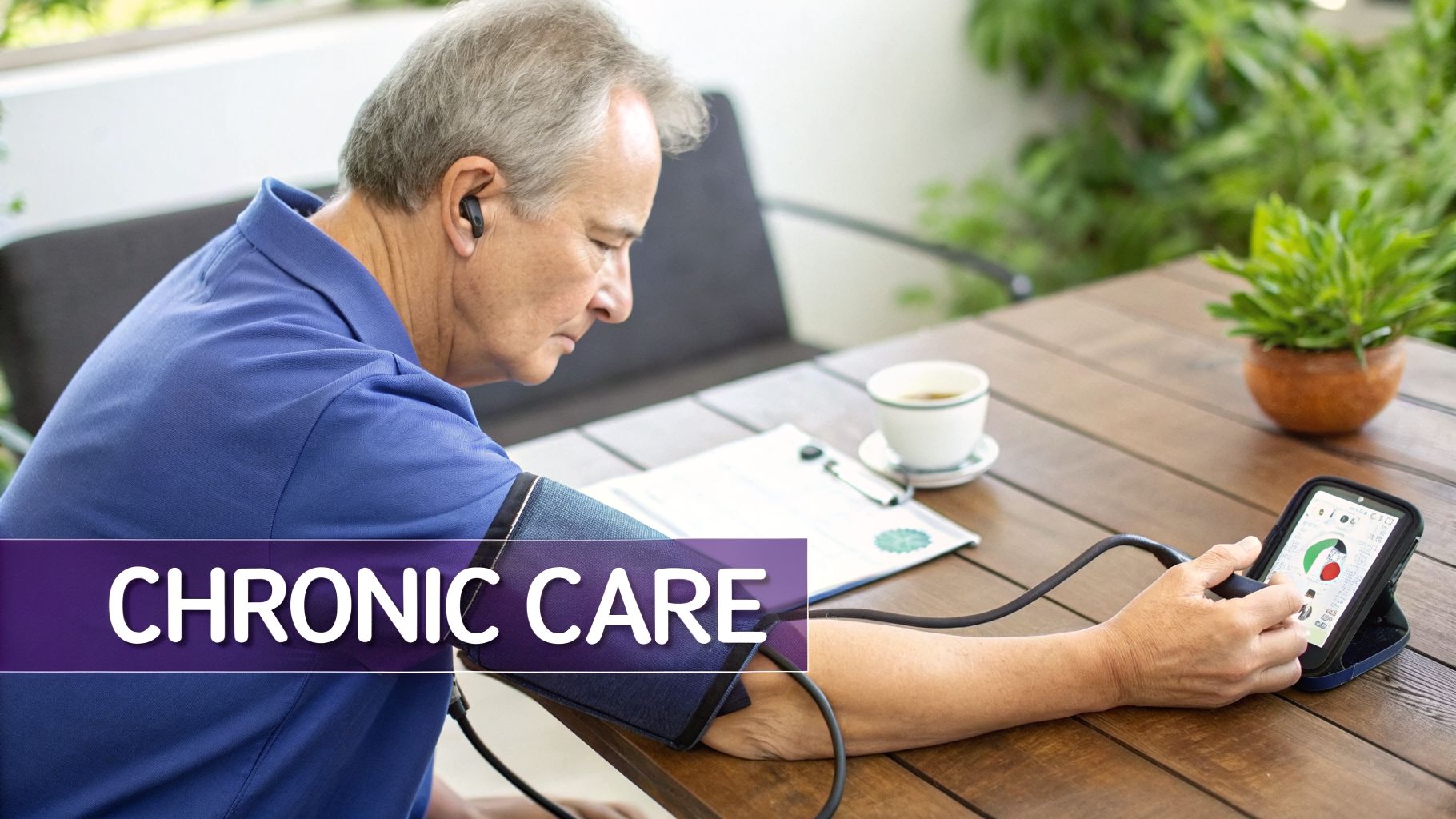
Effective follow-up notes are a cornerstone of providing excellent soap charting examples nursing students can study. Unlike an acute intake note, this documentation focuses on trends over time, patient self-management, and subtle changes that might indicate a need to modify the treatment strategy. For more in-depth guidance on crafting these documents, you can learn how to write a nursing note with detailed best practices.
Example Scenario: Routine Type 2 Diabetes Follow-Up
Here is a SOAP note for an established patient attending a routine quarterly check-in for type 2 diabetes and hypertension. This demonstrates how to document progress, adherence, and plan adjustments.
S (Subjective):
Patient is a 62-year-old male here for a scheduled 3-month follow-up for Type 2 Diabetes Mellitus and Hypertension. Reports good adherence to Metformin and Lisinopril, stating he misses "maybe one dose a week." He checks his blood glucose (BG) at home 1-2 times daily, with fasting readings in the 130s-150s and post-prandial readings in the 180s-200s. Denies symptoms of polyuria, polydipsia, or blurred vision. Reports occasional tingling in his feet but no new numbness or pain. States he is trying to walk 20 minutes, 3 times per week. No medication side effects reported.
O (Objective):
- Vitals: BP 138/84 (in-office), HR 76, RR 16, Weight 215 lbs (down 3 lbs from last visit).
- Labs: Point-of-care A1C is 7.8% (previous was 8.1%).
- Physical Exam:
- Cardiovascular: Regular rate and rhythm, no murmurs.
- Pulmonary: Lungs clear to auscultation bilaterally.
- Feet: Monofilament test intact bilaterally. No ulcers or skin breakdown. 2+ dorsalis pedis pulses.
A (Assessment):
- Type 2 Diabetes Mellitus: Sub-optimally controlled, as evidenced by home BG readings and A1C of 7.8%. However, there is noted improvement from the previous A1C of 8.1% and recent weight loss, suggesting positive patient engagement.
- Hypertension: Adequately controlled on current medication, with BP below the target of 140/90.
- Diabetic Neuropathy: Stable, with no progression of symptoms reported.
P (Plan):
- Continue Metformin and Lisinopril at current dosages.
- Reinforce importance of consistent medication adherence.
- Educate patient on carbohydrate counting to improve post-prandial BG control. Provided with a handout.
- Encourage patient to continue and gradually increase physical activity as tolerated.
- Schedule follow-up appointment in 3 months. Will repeat A1C at that visit.
- Patient verbalized understanding of the plan and goals for BG control.
Analysis and Actionable Takeaways
This follow-up note effectively summarizes progress and outlines the next steps in management.
- Highlight Trends: The note compares current data (A1C 7.8%, weight 215 lbs) to previous data (A1C 8.1%). This is fundamental in chronic care to show whether the plan is working.
- Acknowledge Patient Effort: Mentioning the patient's reported walking and the documented weight loss reinforces positive behaviors and strengthens the nurse-patient relationship.
- Balance Control and Improvement: The assessment accurately states the diabetes is "sub-optimally controlled" but also acknowledges the "noted improvement." This provides a balanced clinical picture.
- Keep the Plan Specific and Forward-Looking: The plan isn't just "continue meds." It includes specific patient education (carb counting), encouragement (increase activity), and a clear timeline for the next follow-up.
3. Post-Operative Follow-Up and Wound Assessment SOAP Note
Charting a post-operative follow-up is critical for ensuring patient safety and promoting optimal recovery. This SOAP note documents the patient's progress after a surgical procedure, with a strong focus on wound healing, pain control, and screening for potential complications like infection or dehiscence. It's an essential record for tracking recovery milestones and justifying clinical decisions.
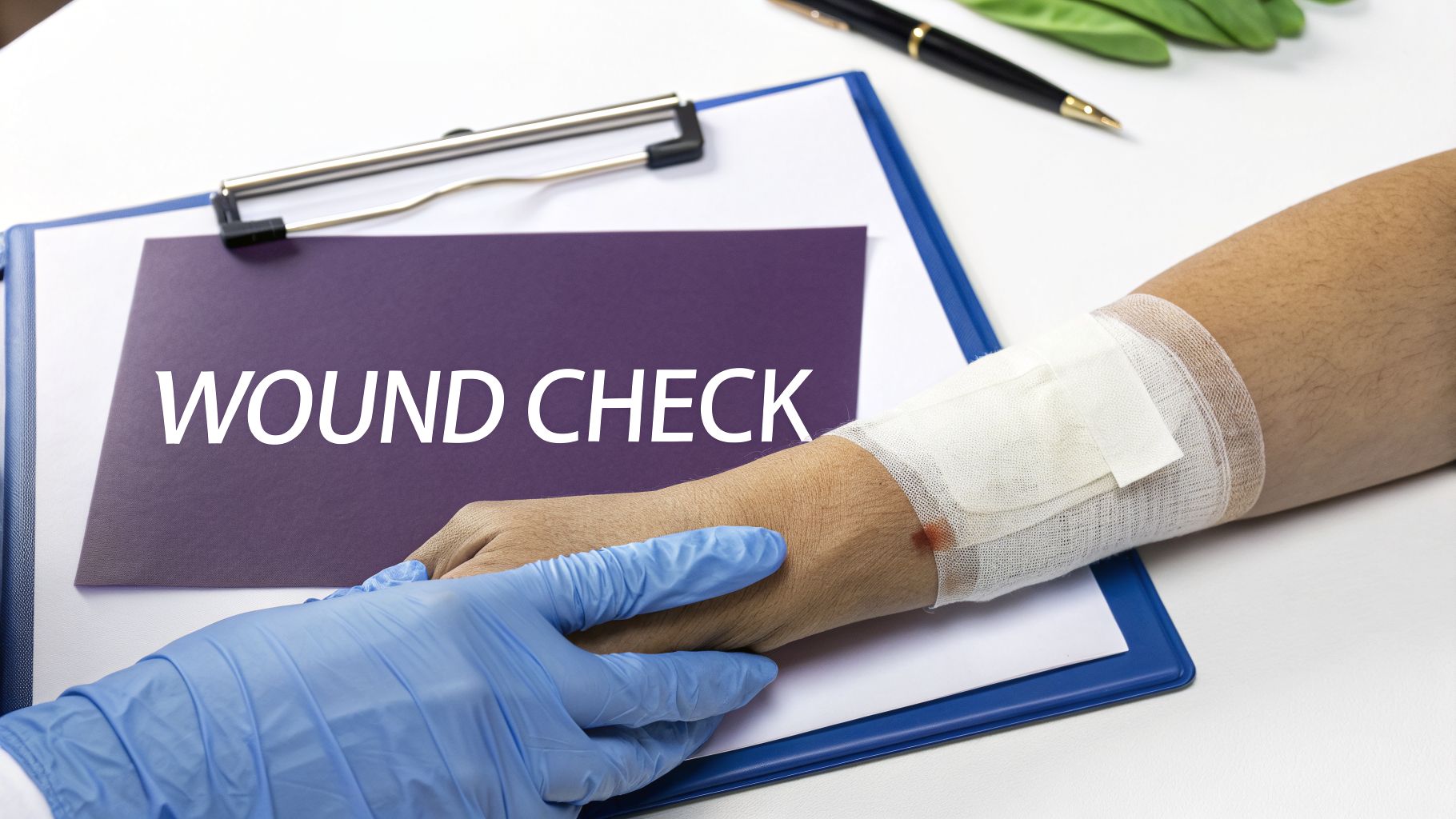
This type of documentation is one of the most important soap charting examples nursing professionals will encounter, especially in surgical, orthopedic, or ambulatory care settings. A detailed post-op note provides a clear, sequential story of the patient's recovery, which is invaluable for the entire care team and for legal documentation.
Example Scenario: Post-Laparoscopic Cholecystectomy Follow-Up
Let's examine a SOAP note for a patient one week after a laparoscopic gallbladder removal. This common procedure highlights how to document wound status, pain management, and functional recovery.
S (Subjective):
Patient is a 45-year-old male presenting for a 1-week post-operative follow-up after a laparoscopic cholecystectomy. Reports pain has improved significantly, now a "2/10" at incision sites, primarily with movement. States he is taking ibuprofen 600mg as needed and last took his prescribed oxycodone 2 days ago. Describes incision sites as "clean with no redness or drainage." Reports tolerating a low-fat diet well, with normal bowel movements. Denies fever, chills, nausea, vomiting, or increased abdominal pain. Ambulating at home without difficulty.
O (Objective):
- Vitals: T 98.7°F, HR 76, RR 16, BP 130/82, SpO2 98% on room air.
- General: Alert, well-appearing, and in no acute distress.
- Abdomen: Soft, non-tender, non-distended. Bowel sounds are present in all four quadrants.
- Wound: Four small laparoscopic incision sites are clean, dry, and intact with Steri-Strips in place. No erythema, edema, purulent drainage, or warmth noted. Edges are well-approximated.
A (Assessment):
- Post-operative status s/p laparoscopic cholecystectomy: Patient is recovering as expected. Incisions are healing well without signs of infection. Pain is well-controlled with minimal non-opioid analgesia.
- Adequate pain management: Transitioning successfully from opioid to non-opioid pain relief.
P (Plan):
- Continue to monitor incision sites for signs of infection (redness, swelling, drainage, warmth, fever).
- Allow Steri-Strips to fall off naturally. No soaking in a tub or pool until they are off and incisions are fully healed.
- Continue ibuprofen as needed for pain.
- Advance diet as tolerated.
- Patient may lift no more than 10 lbs for another week. Follow up in 3 weeks or sooner if concerns arise.
- Patient verbalized understanding of all instructions.
Analysis and Actionable Takeaways
This post-operative note effectively captures the patient's recovery trajectory and confirms that key milestones are being met.
- Focus on Post-Op Specifics: The subjective section directly addresses pain, medication use, diet tolerance, and bowel function, all critical components of post-abdominal surgery recovery.
- Use Descriptive Wound Language: The objective assessment uses precise terms like "well-approximated," "no erythema," and "non-tender." This creates a clear picture of the wound's status for anyone reviewing the chart.
- Confirm Expected Progress: The assessment explicitly states that the patient is "recovering as expected." This is a key judgment that tells the story of the patient's progress at a glance.
- Provide Clear, Forward-Looking Instructions: The plan gives specific, actionable guidance on wound care, activity restrictions (lifting limits), and a clear timeline for the next follow-up. This empowers the patient and reduces the risk of complications.
4. Mental Health and Behavioral Health SOAP Documentation
Documenting a mental health encounter requires a nuanced approach that captures both subjective emotional states and objective behavioral observations. A SOAP note in this context is essential for tracking progress, ensuring patient safety, and coordinating care between therapists, psychiatrists, and primary care providers. This is especially important as more practices integrate behavioral health services.
Crafting these notes is a critical skill for creating useful soap charting examples nursing students can study. The note must document sensitive information accurately while maintaining a professional, objective tone. It serves as a legal record and a clinical tool for managing conditions like depression, anxiety, and substance use disorders.
Example Scenario: Follow-up for Major Depressive Disorder
Let's review a SOAP note for a patient's routine follow-up appointment for major depressive disorder (MDD) and generalized anxiety disorder (GAD). This scenario highlights how to document ongoing management of chronic mental health conditions.
S (Subjective):
Patient is a 45-year-old male with a history of MDD and GAD, here for a scheduled follow-up. Reports his mood has been "mostly down" for the past two weeks, rating it a "4/10." States he has "low energy" and difficulty concentrating at work. Reports sleeping 8-9 hours per night but does not feel rested. Admits to increased feelings of worry about finances. Denies anhedonia, stating he still enjoys his weekly hiking group. He is compliant with Sertraline 100mg daily and denies side effects. Denies suicidal or homicidal ideation. Patient completed a PHQ-9, scoring 14 (moderately severe).
O (Objective):
- Appearance: Well-groomed, dressed appropriately for the weather.
- Behavior: Maintained good eye contact. Speech is of normal rate and rhythm. Affect is congruent with mood, appears subdued.
- Cognition: Alert and oriented x4. Thought process is logical and goal-directed.
- Vitals: BP 130/84, HR 76, RR 16.
A (Assessment):
- Major Depressive Disorder, recurrent, moderate: Patient's subjective report of low mood, low energy, and a PHQ-9 score of 14 indicates a moderate depressive episode. The condition is worsening compared to the last visit (PHQ-9 was 10).
- Generalized Anxiety Disorder: Symptoms of worry are present but appear secondary to depressive symptoms and specific financial stressors.
P (Plan):
- Continue Sertraline 100mg daily. Discussed potential for dose increase at next visit if no improvement.
- Reinforce use of cognitive-behavioral therapy (CBT) techniques for managing anxious thoughts, specifically thought-stopping and reframing.
- Encourage patient to continue engaging in enjoyable activities (hiking).
- Provide patient with the National Suicide Prevention Lifeline number as standard practice.
- Schedule follow-up appointment in 4 weeks to reassess symptoms and medication efficacy.
- Patient verbalized understanding of the plan and agreed to the follow-up schedule.
Analysis and Actionable Takeaways
This behavioral health SOAP note focuses on subtle but significant changes in the patient's condition. For a deeper dive into structuring these notes, you can explore another detailed SOAP note example.
- Incorporate Standardized Tools: Referencing scores from tools like the PHQ-9 (for depression) or GAD-7 (for anxiety) provides objective, quantifiable data to support your assessment. This makes tracking progress over time much clearer.
- Document the "Negatives": Specifically noting the denial of suicidal ideation (SI) or homicidal ideation (HI) is a critical safety and liability measure in mental health charting.
- Observe Behavior Objectively: The "O" section should focus on what you see and hear. Describe the patient's appearance, affect, and speech without interpreting them. Phrases like "appears subdued" and "normal rate and rhythm" are good examples.
- Create a Safety-Oriented Plan: The plan should always address safety. Even without active SI, providing crisis resources is a best practice. The plan also sets clear expectations for the next steps, including potential medication changes and a scheduled follow-up.
5. Medication Refill and Reconciliation SOAP Note
Documenting routine medication refills and conducting medication reconciliation are high-volume tasks in nearly every nursing setting. A well-structured SOAP note for these encounters is crucial for patient safety, ensuring medication adherence, and maintaining an accurate medical record. This type of note confirms the appropriateness of a refill and serves as a vital safety check.
These routine but critical encounters are central to providing effective care. Crafting clear soap charting examples nursing students can follow helps standardize this process, reducing errors and improving communication between providers, patients, and pharmacies. The note must efficiently capture verification, adherence, and any new concerns.
Example Scenario: Routine Hypertension Medication Refill Request
Let’s break down a SOAP note for a patient requesting a refill for their blood pressure medication. This common primary care task highlights how to document medication management efficiently.
S (Subjective):
Patient is a 68-year-old male calling to request a 90-day refill of Lisinopril 10mg. States he takes the medication "every morning" and has approximately one week of supply remaining. Reports monitoring his blood pressure at home with readings "usually around 130/80." Denies any side effects such as cough, dizziness, or lightheadedness. Also denies any recent hospitalizations or new medications started by other providers.
O (Objective):
- Medication Record: Lisinopril 10mg, take one tablet by mouth daily. Last refilled 88 days ago for a 90-day supply.
- Last Office Visit (2 months ago): BP 132/76. No acute concerns noted.
- Allergies: No known drug allergies (NKDA).
- Labs: Last metabolic panel (2 months ago) showed creatinine at 0.9 mg/dL and potassium at 4.1 mEq/L, both within normal limits.
A (Assessment):
- Hypertension, stable: Patient is adherent to his medication regimen with self-reported home blood pressure readings at goal. He denies any adverse effects, and recent lab work is stable. The refill request is appropriate.
- Medication Reconciliation: Patient’s reported medication list matches the EMR. No new medications or discrepancies identified. This process is a key part of what is medication reconciliation and is essential for preventing errors.
P (Plan):
- Sent 90-day electronic prescription for Lisinopril 10mg to the patient’s preferred pharmacy.
- Advised patient to continue daily home BP monitoring.
- Instructed patient to follow up if home BP readings consistently exceed 140/90 mmHg or if he develops any new symptoms.
- Scheduled for a routine follow-up appointment in 4 months. Patient confirmed understanding.
Analysis and Actionable Takeaways
This example shows how a seemingly simple request requires a structured, safety-focused documentation process.
- Verify Adherence: Don't just refill; ask how the patient is taking the medication. Noting the last refill date (88 days ago for a 90-day supply) provides objective evidence of good adherence.
- Screen for Side Effects: The subjective section should always include specific questions about common side effects for the medication in question (e.g., cough for an ACE inhibitor like Lisinopril).
- Document Objective Cross-Checks: Reference objective data like the last office BP and relevant lab work (creatinine/potassium for Lisinopril) to justify the assessment that the patient is stable and the refill is safe.
- Close the Loop: The plan isn’t just about sending the prescription. It includes specific patient education, "red flag" parameters for follow-up, and scheduling the next appointment, ensuring continuity of care.
6. Patient Education and Preventive Care SOAP Documentation
Documenting patient education and preventive care is a cornerstone of modern nursing, shifting the focus from reactive treatment to proactive health management. A SOAP note in this context captures counseling on lifestyle changes, health screenings, and immunizations. This documentation is essential for tracking progress, ensuring consistency in health messaging, and demonstrating the value of nursing interventions in promoting long-term wellness.
These notes provide some of the most impactful soap charting examples nursing professionals can create, as they directly support population health goals and empower patients. Clear documentation of education demonstrates that care was provided and records the patient's understanding, readiness to change, and any identified barriers, which is critical for continuity of care.
Example Scenario: Smoking Cessation Counseling
Let's examine a SOAP note for a follow-up visit focused on smoking cessation. This scenario highlights how to document a behavioral health intervention and the patient's response to it.
S (Subjective):
Patient is a 52-year-old male here for a scheduled follow-up on smoking cessation. He states, "I'm ready to make a real change this time." Reports smoking 1 pack per day for 25 years. Expresses concern about the health risks, citing a recent diagnosis of hypertension. Identifies primary triggers as "stress from work" and "my morning coffee." Patient denies use of any previous cessation aids. He is motivated to quit to "be healthier for my grandkids."
O (Objective):
- Vitals: BP 142/88, HR 76, RR 16, SpO2 96% on room air.
- General: Alert and oriented, appears motivated and engaged in conversation.
- Readiness to Change: Patient assessed as being in the "Preparation" stage of change.
- Education Provided: Discussed benefits of quitting, reviewed pharmacologic options (nicotine patch, gum) and non-pharmacologic strategies (identifying and avoiding triggers, deep breathing exercises for stress). Provided with a state-sponsored quit-line phone number and brochure.
A (Assessment):
- Tobacco Use Disorder: Long-term, heavy use with expressed desire to quit. Patient demonstrates readiness and motivation for a cessation attempt.
- Hypertension: Likely exacerbated by nicotine use. Cessation is a primary intervention for BP management.
- Knowledge Deficit: Regarding effective smoking cessation strategies and available resources.
P (Plan):
- Prescribed nicotine patch, 21 mg, for daily use. Provided education on proper application and potential side effects.
- Advised patient to establish a firm quit date within the next two weeks.
- Collaboratively developed a plan to manage triggers: switch to decaf coffee in the morning and take a 5-minute walk during stressful periods at work.
- Patient will call the state quit-line for additional counseling support.
- Schedule follow-up appointment in 2 weeks to assess progress, monitor for side effects, and provide reinforcement. Patient verbalizes understanding of the plan and agrees to the follow-up.
Analysis and Actionable Takeaways
This education-focused note documents a clear, patient-centered intervention.
- Capture the "Why": The subjective section includes the patient's own words ("be healthier for my grandkids"). This motivational insight is valuable for tailoring future counseling and reinforcing his goals.
- Assess Readiness: Objectively stating the patient's stage of change ("Preparation") provides a clinical framework for the intervention. It justifies moving from simple advice to active planning.
- Tie Education to Diagnoses: The assessment clearly links the education (cessation) to the patient's medical problems (Tobacco Use Disorder, Hypertension). This shows strong clinical reasoning.
- Create a Collaborative Plan: The plan is not just a list of orders; it's a shared strategy. Including details like "switch to decaf coffee" shows that the nurse and patient worked together to create specific, actionable steps, which greatly increases the likelihood of success.
7. Complex Multi-System Patient Assessment and Care Coordination SOAP Note
Documenting care for patients with multiple chronic conditions is one of the most demanding tasks in nursing. This type of SOAP note must synthesize a large volume of information, track various treatments from different specialists, and create a cohesive care plan that balances competing priorities. A well-constructed note for a complex patient is essential for preventing medication errors, identifying care gaps, and ensuring all providers are aligned.
These detailed soap charting examples nursing professionals will find critical for managing geriatric or multi-morbid populations. The note serves as a central hub for care coordination, pulling together disparate threads from cardiology, pulmonology, and primary care into one clear narrative. This level of detail is vital for safe and effective patient management.
Example Scenario: Post-Hospitalization Follow-up for Geriatric Patient
Let's examine a SOAP note for an 82-year-old male recently discharged from the hospital after an exacerbation of Congestive Heart Failure (CHF). He also has a history of COPD, Type 2 Diabetes, and osteoarthritis.
S (Subjective):
Patient is an 82-year-old male, A&Ox3, seen for post-hospitalization follow-up for CHF exacerbation. He states, "I feel a bit better, but I get tired very easily." Reports 2-pillow orthopnea, down from 4 pillows in the hospital. Denies chest pain or palpitations. States his home BP readings are "around 130/80." Reports blood sugar logs are between 140-180 mg/dL. Complains of increased knee pain, rated "5/10," which he attributes to "water pills making my joints ache." Patient brought in hospital discharge summary and medication list.
O (Objective):
- Vitals: T 98.4°F, HR 78 (regular), RR 20, BP 134/82, SpO2 94% on room air. Weight: 185 lbs (down 5 lbs from hospital discharge weight of 190 lbs).
- Cardio: S1/S2 heard, no murmurs. 1+ bilateral pedal edema.
- Pulmonary: Lungs with fine crackles in bilateral bases. Respirations unlabored.
- Meds Rec: Hospital discharge meds (Furosemide 40mg daily) reconciled with home meds. Patient is taking all 14 medications as prescribed.
- Labs: BMP from 2 days ago reviewed: K+ 3.4 mEq/L (low).
A (Assessment):
- Congestive Heart Failure, Chronic Systolic: Improving post-exacerbation, evidenced by weight loss and reduced orthopnea. Residual fluid overload noted by pedal edema and lung crackles. Hypokalemia is likely secondary to increased Furosemide dosage.
- Type 2 Diabetes: Sub-optimally controlled based on patient-reported blood glucose logs.
- Osteoarthritis: Chronic, with acute increase in pain, possibly related to perceived medication side effects or fluid shifts.
P (Plan):
- Increase Furosemide to 40mg BID for 3 days, then return to 40mg daily.
- Start Potassium Chloride 20mEq daily to correct hypokalemia. Recheck BMP in 1 week.
- Patient to continue strict daily weight monitoring and contact office if weight gain is >3 lbs in one day.
- Consult note sent to endocrinology regarding blood glucose trends.
- Reassured patient that Furosemide does not cause joint pain; recommended acetaminophen for knee pain and to follow up with rheumatology.
- Patient verbalized understanding of medication changes and follow-up plan.
Analysis and Actionable Takeaways
This example highlights the synthesis required for complex patient care, connecting lab results, patient reports, and physical findings.
- Synthesize, Don't Just List: The assessment connects the diuretic (Furosemide) to the low potassium (hypokalemia) and the patient's weight loss. This shows a high level of clinical reasoning, not just a list of problems.
- Close the Loop on Coordination: The plan explicitly mentions sending a note to endocrinology. This documents a key care coordination action and ensures the patient's entire care team is informed.
- Address Patient Concerns Directly: The nurse directly addressed the patient's belief that the diuretic was causing joint pain. This builds trust and improves adherence by providing accurate education.
- Create a Multi-faceted Plan: The plan addresses the acute issue (fluid overload), the resulting complication (low potassium), a chronic issue (diabetes), and the patient's specific complaint (knee pain). Each part of the plan is distinct and actionable.
7-Example SOAP Charting Comparison for Nursing
| Scenario | 🔄 Implementation Complexity | ⚡ Resource Requirements | ⭐📊 Expected Outcomes | 💡 Ideal Use Cases | Key Advantages |
|---|---|---|---|---|---|
| Acute Patient Intake with Chief Complaint Documentation | Medium — needs HPI parsing, decision trees, validation | Moderate — EMR writeback, voice model training, clinician review workflow | High quality structured SOAP capture; faster charting and triage 📊 | New acute complaints, initial triage calls, first-time patient intake | Consistent intake template; reduces manual entry; rapid physician review |
| Chronic Disease Management Follow-Up SOAP Note | Low–Medium — templated flows per disease, device data ingestion | Moderate — device integrations, scheduled call infrastructure | Improved disease control and trend detection; supports quality metrics ⭐📊 | Routine follow-ups (diabetes, HTN, asthma); adherence monitoring | Scalable automation; proactive monitoring; metric reporting |
| Post-Operative Follow-Up and Wound Assessment SOAP Note | Medium — standardized protocols and escalation rules | Low–Moderate — patient education materials, scheduled calls, escalation links | Early complication detection, fewer in-person visits when appropriate 📊 | 24–72 hr and 1‑week post-op checks, pain and wound assessments | Standardized postop checks; timely escalation; documentation compliance |
| Mental Health and Behavioral Health SOAP Documentation | High — sensitive scripting, crisis protocols, empathy modeling | High — clinician oversight, strict escalation, validated screening tools | Consistent screening and follow-up; limited non‑verbal assessment; safety support ⭐📊 | Routine mental health follow-ups, PHQ‑9/GAD‑7 monitoring, med checks | Scalable screening; reduces access barriers; supports outcome tracking |
| Medication Refill and Reconciliation SOAP Note | Low — highly repetitive, rule-based flows | Moderate — pharmacy/interaction DBs, EMR medication update, 24/7 availability | Faster refill turnaround, fewer reconciliation errors, high throughput ⭐📊 | High-volume refill requests, routine med reconciliation, pharmacy coordination | Maximizes automation; reduces clinician workload; improves safety checks |
| Patient Education and Preventive Care SOAP Documentation | Low — scripted education modules with checkpoints | Low — content library, follow-up scheduling, links to materials | Standardized education delivery; improved screening and preventive uptake 📊 | Smoking cessation, screening reminders, lifestyle counseling | Scalable health promotion; consistent messaging; supports population health |
| Complex Multi-System Patient Assessment and Care Coordination SOAP Note | Very High — sophisticated logic, multi-source synthesis, conflict detection | High — full EMR access, specialist notes, frequent physician review | Better care coordination and interaction detection but requires clinician validation ⭐📊 | Complex geriatrics, post‑hospital transitions, polypharmacy cases | Comprehensive synthesis; identifies interactions; improves handoffs and safety |
From Examples to Expertise: Charting Your Path Forward
We've explored a wide range of soap charting examples nursing professionals can use as a blueprint, from the urgency of an acute intake to the detailed coordination needed for complex patient care. These examples are more than just templates; they are structured guides to thinking critically and communicating effectively within a healthcare team. Moving beyond basic note-taking requires a commitment to the principles demonstrated in each scenario.
The journey from understanding the SOAP format to mastering it is built on consistent practice. Each note you write is an opportunity to refine your ability to tell a clear, concise, and clinically relevant patient story. Remember that documentation is not a separate, administrative task. It is a direct extension of your clinical assessment and a vital component of safe, high-quality patient care.
Key Insights to Carry into Your Practice
The core of exceptional documentation lies in a few powerful habits. As you review the examples and apply them to your work, keep these strategic takeaways at the forefront:
- Objectivity is Non-Negotiable: The "Subjective" section is the only place for patient-reported feelings and unverified statements. Your "Objective" and "Assessment" sections must be grounded in measurable data, direct observations, and professional clinical judgment.
- The "Assessment" Connects the Dots: This is where you demonstrate your clinical reasoning. A strong assessment doesn't just list problems; it synthesizes the subjective and objective information to create a clear clinical picture, as seen in the chronic disease and multi-system examples.
- Your "Plan" Must Be Actionable: Every part of the plan, from ordering diagnostics to patient education and referrals, should be specific and clear. Another nurse or provider should be able to read your plan and understand exactly what needs to happen next without ambiguity.
Strategic Point: The best SOAP notes anticipate the next clinician's questions. They provide a complete narrative that supports continuity of care, minimizes errors, and builds a strong legal and professional record of the care provided.
Actionable Next Steps for Continuous Improvement
True expertise is an active pursuit. Use the foundation this article provides to build a stronger documentation practice starting today.
- Benchmark Your Next Note: Choose one of the soap charting examples nursing scenarios from this article that most closely matches your next patient encounter. Use it as a mental checklist to structure your own note.
- Practice Specificity: Challenge yourself to eliminate vague terms. Instead of "wound looks better," write "Wound edges well-approximated, erythema reduced to 1 cm border, minimal serosanguinous drainage."
- Seek Peer Feedback: Ask a trusted senior colleague to review one of your more complex SOAP notes. A fresh perspective can reveal areas for improvement in clarity or detail that you might have missed.
Mastering this skill has a direct impact on patient outcomes, team collaboration, and your professional confidence. Efficient and accurate charting reduces the risk of medical errors, ensures seamless care transitions, and protects both the patient and the provider. By dedicating effort to improving this fundamental nursing skill, you elevate not just your own practice, but the standard of care within your entire organization. It's a commitment that pays dividends in patient safety and professional satisfaction.
Ready to turn documentation from a time-consuming chore into a streamlined, intelligent process? Simbie AI integrates directly into your workflow, capturing patient conversations and automatically generating precise, structured SOAP notes. Explore how you can spend less time typing and more time caring by visiting Simbie AI today.